
50 Pound Deep Fryer
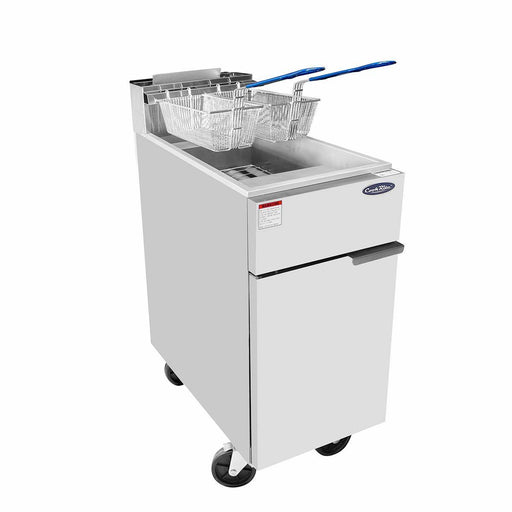
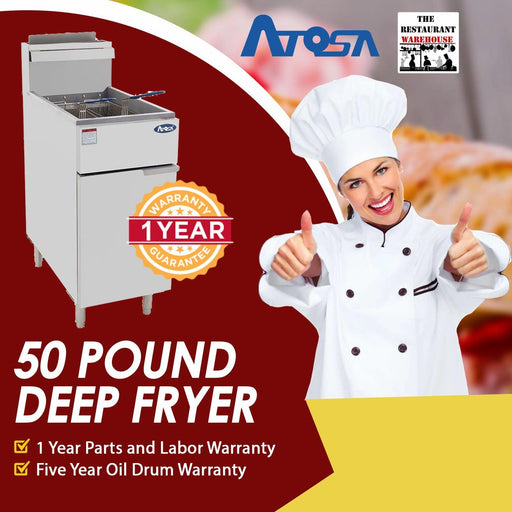
Atosa ATFS-50 Heavy Duty 50 LB Stainless Steel Deep Fryer - Natural Gas
Atosa
Original price
$1,861.00
Original price
$1,861.00
-
Original price
$1,861.00
Original price
$1,861.00
Current price
$1,341.00
$1,341.00
-
$1,341.00
Current price
$1,341.00
Atosa ATFS-50 50 lb Commercial Natural Gas Deep Fryer Serious frying capacity for restaurants, sports bars, and high-demand kitchens. The Atosa ...
View full details
Original price
$1,861.00
Original price
$1,861.00
-
Original price
$1,861.00
Original price
$1,861.00
Current price
$1,341.00
$1,341.00
-
$1,341.00
Current price
$1,341.00
Save 28%
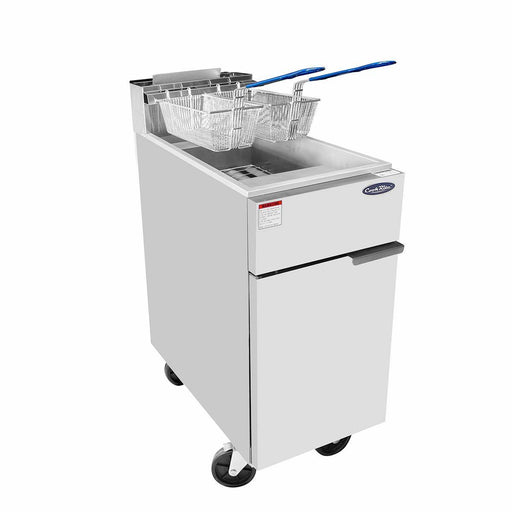
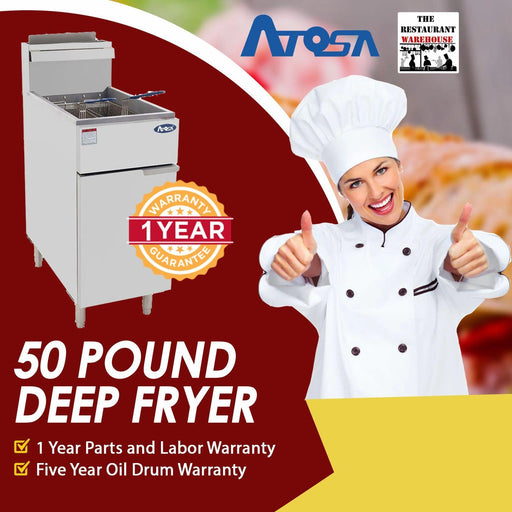
Atosa ATFS-50 Heavy Duty 50 LB Stainless Steel Deep Fryer - Propane
Atosa
Original price
$1,861.00
Original price
$1,861.00
-
Original price
$1,861.00
Original price
$1,861.00
Current price
$1,341.00
$1,341.00
-
$1,341.00
Current price
$1,341.00
Atosa ATFS-50 50 lb Commercial Propane Deep Fryer Built for serious frying power in food trucks and commercial kitchens. The Atosa ATFS-50 Propa...
View full details
Original price
$1,861.00
Original price
$1,861.00
-
Original price
$1,861.00
Original price
$1,861.00
Current price
$1,341.00
$1,341.00
-
$1,341.00
Current price
$1,341.00
Save 28%

Atosa 21101001047 Fryer Splash Guard for ATFS Series
Atosa Parts
Original price
$88.00
-
Original price
$88.00
Original price
$88.00
$88.00
-
$88.00
Current price
$88.00
Atosa 21101001047 Fryer Splash Guard for ATFS Series The Atosa 21101001047 Fryer Splash Guard is designed to enhance safety and cleanliness in com...
View full details
Original price
$88.00
-
Original price
$88.00
Original price
$88.00
$88.00
-
$88.00
Current price
$88.00

Atosa FP-1324-5 Filter Paper for FPOF-50, 13-1/2"x24" (100 Sheets/Box)
Atosa Parts
Original price
$125.00
-
Original price
$125.00
Original price
$125.00
$125.00
-
$125.00
Current price
$125.00
Atosa FP-1324-5 Fryer Filter Paper for FPOF-50 (13-1/2" x 24") – 100 Sheets per Box The Atosa FP-1324-5 Filter Paper is designed for efficient oil...
View full details
Original price
$125.00
-
Original price
$125.00
Original price
$125.00
$125.00
-
$125.00
Current price
$125.00
Atosa FP-1728-5 Filter Paper for FPOF-50, 17-1/2"x28" (100 Sheets/Box)
Atosa Parts
Original price
$150.00
-
Original price
$150.00
Original price
$150.00
$150.00
-
$150.00
Current price
$150.00
Atosa FP-1728-5 Fryer Filter Paper for FPOF-50 (17-1/2" x 28") – 100 Sheets per Box Keep your fryer oil cleaner, longer with Atosa FP-1728-5 Filte...
View full details
Original price
$150.00
-
Original price
$150.00
Original price
$150.00
$150.00
-
$150.00
Current price
$150.00

Atosa 21201001019 Fryer Cover for ATFS-40/50 with Stainless Steel Handle
Atosa Parts
Original price
$93.00
-
Original price
$93.00
Original price
$93.00
$93.00
-
$93.00
Current price
$93.00
Atosa 21201001019 Fryer Cover for ATFS-40 / ATFS-50 The Atosa 21201001019 Fryer Cover is designed to protect the oil in your ATFS-40 and ATFS-50 c...
View full details
Original price
$93.00
-
Original price
$93.00
Original price
$93.00
$93.00
-
$93.00
Current price
$93.00

Atosa ATTAB1 Fryer Boil Out Tabs (50/Pail)
Atosa Parts
Original price
$350.00
-
Original price
$350.00
Original price
$350.00
$350.00
-
$350.00
Current price
$350.00
Atosa ATTAB1 Fryer Boil Out Tabs (50 Tablets per Pail) Atosa ATTAB1 Fryer Boil Out Tabs are specially formulated cleaning tablets designed to deep...
View full details
Original price
$350.00
-
Original price
$350.00
Original price
$350.00
$350.00
-
$350.00
Current price
$350.00

Atosa 21101001046 Fryer Connector Strip for ATFS Series
Atosa
Original price
$61.00
-
Original price
$61.00
Original price
$61.00
$61.00
-
$61.00
Current price
$61.00
Atosa 21101001046 Fryer Connector Strip for ATFS Series The Atosa 21101001046 Fryer Connector Strip is designed to securely connect two Atosa ATFS...
View full details
Original price
$61.00
-
Original price
$61.00
Original price
$61.00
$61.00
-
$61.00
Current price
$61.00
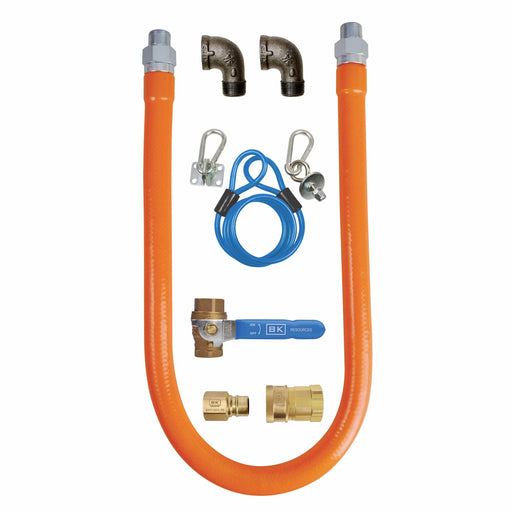
BK Resources Fryer Hose Kit for Natural Gas and Propane Deep Fryers
BK Resources
Original price
$386.00
-
Original price
$386.00
Original price
$386.00
$386.00
-
$386.00
Current price
$386.00
BK Resources Fryer Hose Kit for Natural Gas and Propane Deep Fryers (BKG-GHC-7548-SCK3, 3/4-Inch x 48-Inch, cCSAus Certified) This BK Resources ga...
View full details
Original price
$386.00
-
Original price
$386.00
Original price
$386.00
$386.00
-
$386.00
Current price
$386.00

Atosa WA300001 Hose Kit for Propane and Natural Gas Units - 48 inch
Atosa
Original price
$415.00
Original price
$415.00
-
Original price
$415.00
Original price
$415.00
Current price
$300.00
$300.00
-
$300.00
Current price
$300.00
Gas hoses are very important. They safely and efficiently deliver propane and natural gas to appliances in restaurants and food trucks. The Atosa ...
View full details
Original price
$415.00
Original price
$415.00
-
Original price
$415.00
Original price
$415.00
Current price
$300.00
$300.00
-
$300.00
Current price
$300.00
Save 28%
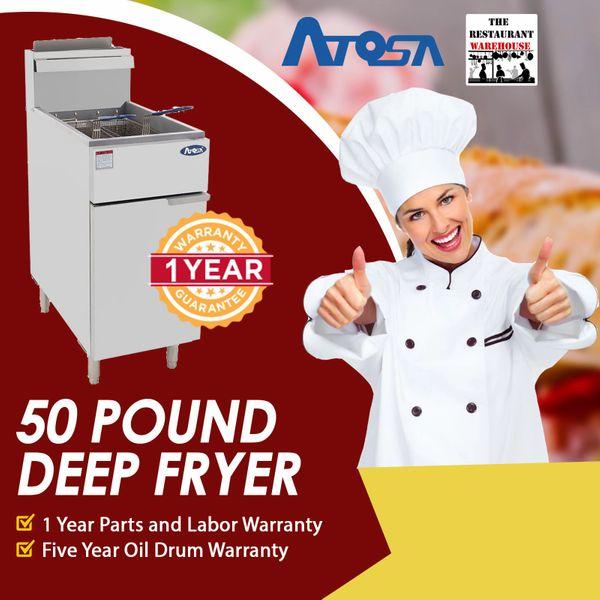
50 Pound Commercial Deep Fryers
50 pound deep fryers are the industry standard for restaurants and commercial kitchens that need consistent frying performance, fast recovery, and enough oil capacity to carry a peak-service rush. The CookRite ATFS-50 platform is a heavy-duty floor model delivering 136,000 BTU/h on natural gas or 120,000 BTU/h on LP gas across a four-burner atmospheric heating system.
Compare all sizes in our full selection of commercial deep fryers, or step to 40 lb deep fryers or 75 lb deep fryers.
Why 50 lb Is the Restaurant Standard
- Industry-standard capacity for most full-service restaurants
- Four-burner recovery holds temperature under back-to-back basket drops during peak
- Balanced oil mass for efficiency and per-basket cost
- Versatile cooking across fries, wings, seafood, and breaded proteins
Combustion and Gas Utility Requirements
The CookRite ATFS-50 uses four high-grade cast iron burners rated at 34,000 BTU/h per burner on natural gas and 30,000 BTU/h per burner on LP. Integrated millivolt controls let the unit operate without an external electrical connection, using a standing pilot and thermopile to actuate the gas valve. Optimal performance depends on maintaining correct intake-tube pressure and ensuring the supply line diameter can carry the full BTU load.
| Parameter | Natural Gas (NG) | Liquid Propane (LP) |
|---|---|---|
| Total BTU Output | 136,000 BTU/h | 120,000 BTU/h |
| Number of Burners | 4 | 4 |
| Burner Input | 34,000 BTU/h | 30,000 BTU/h |
| Intake-Tube Pressure | 4" W.C. | 10" W.C. |
| Nozzle Size | #36 | #52 |
| Thermostat Range | 200°F to 400°F | 200°F to 400°F |
| Pilot System | Standing Pilot / Millivolt | Standing Pilot / Millivolt |
Structural Engineering and Dimensions
The chassis is heavy-gauge stainless steel on the front, sides, and door for corrosion resistance in high-moisture, high-heat environments. The internal fry tank is a fully welded stainless steel vessel with a tapered bottom that facilitates the cool zone: particulate matter settles below the heating tubes, preventing carbonization and extending oil longevity. The footprint is engineered for high output per square foot and drops into modular batteries in restricted-space kitchens.
| Component | Specification |
|---|---|
| Body Dimensions (mm) | 394 mm x 746 mm x 751 mm |
| Body Dimensions (approx.) | 15.5" x 29.4" x 29.6" |
| Tank Dimensions | 397 mm x 706 mm x 438 mm |
| Internal Tank Material | Stainless Steel |
| Exterior Finish | Stainless Steel Front, Sides, Door |
| Configuration | Floor Model, Tube-Type Gas Fryer |
Standard Accessories Included
| Item | Quantity | Material / Description |
|---|---|---|
| Fry Baskets | 2 | Twin nickel-plated with plastic-coated handles |
| Basket Hanger | 1 | Removable, stainless steel |
| Crumb Screen | 1 | Wire mesh, positioned above heating tubes |
| Drain Extension | 1 | Threaded pipe for oil evacuation |
| Casters | 4 | Heavy-duty, non-marking (2 locking, 2 swivel) |
| Regulator | 1 | External gas pressure regulator (NG or LP) |
Installation and Clearance Standards
Professional installation by a certified gas technician is mandatory to ensure compliance with NFPA 96 and local code. Improper installation voids manufacturer warranties and creates significant safety risks around carbon monoxide accumulation and fire.
Ventilation
The fryer must sit under an approved exhaust hood. Flue gases exit the rear of the unit through the integrated smokestack. Obstruction of the flue causes incomplete combustion and can trip the high-limit safety switch. Maintain a minimum of 18 inches of clearance between the flue top and the grease filters of the exhaust hood.
Spatial Clearances
- Combustible construction: minimum 6 inches (152 mm) of clearance at sides and rear
- Non-combustible construction: zero clearance permitted at sides and rear; 6 inches recommended for maintenance access
- Front clearance: minimum 30 inches (762 mm) for door swing, basket removal, and safe operator movement
Maintenance and Calibration
1. Thermostat Calibration
If oil temperature deviates by more than 5°F from the dial setting, the millivolt thermostat needs calibration.
- Submerge a high-accuracy digital thermometer 3 inches deep in the center of the vat.
- Set the thermostat to 350°F and let the unit cycle three times.
- Note the temperature at the moment the burners cycle off.
- Remove the thermostat dial and locate the adjustment screw inside the shaft.
- Turn the screw clockwise to decrease temperature or counter-clockwise to increase (1/8 turn = 10°F).
2. High-Limit Switch Inspection
The high-limit safety device (Robertshaw self-resetting or manual-reset) cuts gas flow if oil exceeds 450°F. Visually inspect the capillary tube for kinks or leaks. If the fryer fails to stay lit or the pilot will not hold, test the high-limit switch for continuity with a multimeter.
3. Burner Orifice Cleaning
Grease and carbon obstruct burner orifices over time, causing yellow lazy flames and reduced BTU output. Use a soft-bristle brush to remove debris from the burner ports. Do not use wire or drill bits that can enlarge the orifice size and alter the gas-to-air mixture.
4. Weekly Boil-Out
Carbonized grease on the heating tubes degrades heat transfer efficiency. Weekly boil-out is essential.
- Drain all oil and close the drain valve.
- Fill the tank to the oil level line with water and a non-corrosive boil-out chemical.
- Set the thermostat to 200°F (do not exceed boiling point to avoid overflow).
- Simmer for 30 minutes, then scrub the tank walls and tubes with a long-handled brush.
- Drain, rinse with a water/vinegar solution to neutralize the cleaner, and dry thoroughly before refilling with oil.
Atosa 50 lb Deep Fryer Features
Atosa 50 lb fryers are built with durable stainless steel construction and high-performance burners for consistent heat and long-term reliability.
- Tube-style burners for even heat distribution
- Cold zone design to extend oil life
- Heavy-duty thermostat for temperature control
- Available in natural gas and propane
- High BTU output for faster cooking cycles
Gas Fryer Options
Choose the right fuel type for your kitchen setup:
- Natural gas deep fryers for permanent installations
- Propane deep fryers for food trucks, trailers, and mobile setups
Frequently Asked Questions About 50 lb Fryers
What is a 50 pound deep fryer used for?
A 50 lb fryer cooks fries, chicken, seafood, and other high-demand fried foods in restaurants, bars, and food trucks running peak-service volume.
Is a 50 lb fryer enough for a restaurant?
Yes. It is the most common size in commercial kitchens and works well for medium to high-volume operations.
Why is my fryer showing lazy yellow flames instead of crisp blue?
Typically an incorrect air-to-gas ratio. Check air shutters on the burner tubes for obstructions or lint. Verify manifold gas pressure matches the spec table above. Yellow flames cause excessive carbon buildup on the heating tubes and decrease efficiency.
Can I convert a natural gas CookRite ATFS-50 to liquid propane in the field?
Mechanically possible but requires a specific manufacturer conversion kit including different nozzles and a regulator adjustment. Must only be performed by a certified technician to ensure the safety valve and pilot assembly are properly re-rated for LP pressure.
What causes the pilot light to repeatedly go out?
Most common causes: faulty thermopile, loose connection at the gas valve, or a tripped high-limit switch. Inspect the thermopile for soot buildup; if it cannot generate at least 250 to 750 millivolts, the gas valve will not remain open.
How often should the flue be cleaned?
Inspect the internal smokestack and the area behind the fry tank daily and clean weekly. Grease accumulation in the flue is a primary cause of secondary ignition (flue fires).
Why does the oil temperature drop significantly when I add a second basket?
This is recovery time. The ATFS-50 uses a four-burner system totaling 136,000 BTU/h on natural gas (120,000 BTU/h on LP). If gas pressure is below specification or burner ports are dirty, recovery slows and product quality drops. Do not overload the vat.
What is the purpose of the cool zone at the bottom of the tank?
The cool zone sits below the burner tubes. Heat rises, so oil in this lower section stays cooler. Food particles that fall off during frying settle here rather than sticking to hot tubes, preventing them from burning and tainting the flavor of the oil.
What fuel types are available?
50 lb fryers are available in both natural gas and propane configurations. Each unit ships from the factory set up for one fuel and requires a manufacturer kit for field conversion.
What brand is the CookRite 50 lb fryer?
CookRite is the foodservice fryer brand from Atosa. The CookRite ATFS-50 is an Atosa-manufactured unit sold under the CookRite name. Both names refer to the same product line and share identical specs, parts, warranty, and service support.
Where are 50 lb fryers used?
Restaurants, bars, food trucks, and commercial kitchens running medium-to-high-volume fried programs.
Commercial Fryer Features
- Stainless steel construction for durability
- High-output burners for fast recovery
- Thermostatic controls for consistent cooking
- Safety valves and high-limit protection
- Fry baskets and crumb screens included
- Oil cooling zone to extend oil life
These features maintain frying consistency, food quality, and reliable output through peak service in busy commercial kitchens.