
Catering Equipment

Thunder Group SLRCF001 8 Quart Full Size Welded Chafer
Thunder Group
Original price
$125.00
Original price
$125.00
-
Original price
$125.00
Original price
$125.00
Current price
$99.00
$99.00
-
$99.00
Current price
$99.00
8 qt, 23-3/8" x 13-7/8" x 15-1/2", Full Size Welded Chafer, Stainless Steel
Original price
$125.00
Original price
$125.00
-
Original price
$125.00
Original price
$125.00
Current price
$99.00
$99.00
-
$99.00
Current price
$99.00
Save 21%

Thunder Group SLRCF0171G Roll Top/Golden Handle Chafer
Thunder Group
Original price
$339.00
Original price
$339.00
-
Original price
$339.00
Original price
$339.00
Current price
$200.00
$200.00
-
$200.00
Current price
$200.00
8 qt, 25-1/4" x 14-3/4" x 15-1/2" Roll Top Chafer, Stainless Steel with Gold Accented Handles
Original price
$339.00
Original price
$339.00
-
Original price
$339.00
Original price
$339.00
Current price
$200.00
$200.00
-
$200.00
Current price
$200.00
Save 41%

Thunder Group SLRCF0831GH 4 Quart Gold Accented Round Chafer
Thunder Group
Original price
$143.00
Original price
$143.00
-
Original price
$143.00
Original price
$143.00
Current price
$125.00
$125.00
-
$125.00
Current price
$125.00
4 qt, 16-1/2" x 13-1/2" x 12", Gold Accented Round Chafer, Stainless Steel with Gold Accented Handles & Legs
Original price
$143.00
Original price
$143.00
-
Original price
$143.00
Original price
$143.00
Current price
$125.00
$125.00
-
$125.00
Current price
$125.00
Save 13%

Thunder Group SLRCF0833GH 8 Quart Gold Accented Oblong Chafer
Thunder Group
Original price
$168.00
Original price
$168.00
-
Original price
$168.00
Original price
$168.00
Current price
$100.00
$100.00
-
$100.00
Current price
$100.00
8 qt, 25" x 13-7/8" x 12-1/4", Gold Accented Oblong Chafer, Stainless Steel
Original price
$168.00
Original price
$168.00
-
Original price
$168.00
Original price
$168.00
Current price
$100.00
$100.00
-
$100.00
Current price
$100.00
Save 40%

Thunder Group SLRCF0836GH 6 Quart Gold Accented Oval Chafer
Thunder Group
Original price
$195.00
Original price
$195.00
-
Original price
$195.00
Original price
$195.00
Current price
$150.00
$150.00
-
$150.00
Current price
$150.00
6 qt, 21-3/4" x 12-1/2" x 11-1/2", Gold Accented Oval Chafer, Stainless Steel with Gold Accented Handles & Legs
Original price
$195.00
Original price
$195.00
-
Original price
$195.00
Original price
$195.00
Current price
$150.00
$150.00
-
$150.00
Current price
$150.00
Save 23%

Thunder Group SLRCF0840 8 Quart Full Size Brass Trim
Thunder Group
Original price
$389.00
Original price
$389.00
-
Original price
$389.00
Original price
$389.00
Current price
$229.00
$229.00
-
$229.00
Current price
$229.00
8 qt, 22-5/8" x 14-7/8" x 12-3/4", Full Size Continental Chafer, Stainless Steel with Brass Handles
Original price
$389.00
Original price
$389.00
-
Original price
$389.00
Original price
$389.00
Current price
$229.00
$229.00
-
$229.00
Current price
$229.00
Save 41%

Thunder Group SLRCF0860 6 Quart Round Roll Top Stainless Steel
Thunder Group
Original price
$375.00
Original price
$375.00
-
Original price
$375.00
Original price
$375.00
Current price
$220.00
$220.00
-
$220.00
Current price
$220.00
6 qt, 17" x 16-1/2" x 17-3/8" Round Roll Top. Lid swivels open up to 90 degree angle , Stainless Steel
Original price
$375.00
Original price
$375.00
-
Original price
$375.00
Original price
$375.00
Current price
$220.00
$220.00
-
$220.00
Current price
$220.00
Save 41%

Thunder Group SLRCF8307 7 Quart Marmite Chafer, Stainless Steel
Thunder Group
Original price
$132.00
Original price
$132.00
-
Original price
$132.00
Original price
$132.00
Current price
$95.00
$95.00
-
$95.00
Current price
$95.00
7 qt, 12-1/2" x 9-1/4" x 13-1/4" Marmite Chafe, Stainless Steel
Original price
$132.00
Original price
$132.00
-
Original price
$132.00
Original price
$132.00
Current price
$95.00
$95.00
-
$95.00
Current price
$95.00
Save 28%

Thunder Group SLRCF8311 11 Quart Marmite Chafer, Stainless Steel
Thunder Group
Original price
$158.00
Original price
$158.00
-
Original price
$158.00
Original price
$158.00
Current price
$120.00
$120.00
-
$120.00
Current price
$120.00
11 qt, 14-1/2" x 11-1/8" x 13-1/4", Marmite Chafer, Stainless Steel
Original price
$158.00
Original price
$158.00
-
Original price
$158.00
Original price
$158.00
Current price
$120.00
$120.00
-
$120.00
Current price
$120.00
Save 24%

Thunder Group SLRCF8533 8 Quart Full Size Brass Handle
Thunder Group
Original price
$485.00
Original price
$485.00
-
Original price
$485.00
Original price
$485.00
Current price
$300.00
$300.00
-
$300.00
Current price
$300.00
8 qt, 26-1/2" x 14" x 16-1/2", Full Size Rectangular Deluxe Chafer, Stainless Steel with Brass Handles
Original price
$485.00
Original price
$485.00
-
Original price
$485.00
Original price
$485.00
Current price
$300.00
$300.00
-
$300.00
Current price
$300.00
Save 38%

Thunder Group SLRCF8632 5 Quart Half Size Round/Wood Handle
Thunder Group
Original price
$346.00
Original price
$346.00
-
Original price
$346.00
Original price
$346.00
Current price
$200.00
$200.00
-
$200.00
Current price
$200.00
5 qt, 17-5/8" x 13" x 16-5/8", Half Size Round Chafer, Stainless Steel 18-8 with Wooden Handles
Original price
$346.00
Original price
$346.00
-
Original price
$346.00
Original price
$346.00
Current price
$200.00
$200.00
-
$200.00
Current price
$200.00
Save 42%

Thunder Group SLRCF8633 5 Quart Half Size Round/Brass Handle
Thunder Group
Original price
$418.00
Original price
$418.00
-
Original price
$418.00
Original price
$418.00
Current price
$240.00
$240.00
-
$240.00
Current price
$240.00
5 qt, 17-5/8" x 13" x 16-5/8", Half Size Round Chafer, Stainless Steel 18-8 with Brass Handles
Original price
$418.00
Original price
$418.00
-
Original price
$418.00
Original price
$418.00
Current price
$240.00
$240.00
-
$240.00
Current price
$240.00
Save 43%

Thunder Group SLRCF002 Full Size Weld Chafer with Plastic Footed
Thunder Group
Original price
$292.00
Original price
$292.00
-
Original price
$292.00
Original price
$292.00
Current price
$199.00
$199.00
-
$199.00
Current price
$199.00
8 qt, 23-7/8" x 13-7/8" x 13-3/8", Full Size Welded Chafer, Stainless Steel with Black Plastic Footed
Original price
$292.00
Original price
$292.00
-
Original price
$292.00
Original price
$292.00
Current price
$199.00
$199.00
-
$199.00
Current price
$199.00
Save 32%

Thunder Group SLRCF0031GH 2.2 Gallon Juice Dispenser, Stainless Steel With Gold Plated Accents
Thunder Group
Original price
$535.00
Original price
$535.00
-
Original price
$535.00
Original price
$535.00
Current price
$300.00
$300.00
-
$300.00
Current price
$300.00
2.2 Gallon, 10" x 13-7/8" x 23-1/4" Juice Dispenser, Stainless Steel Lid, Center Tube, Base with Gold Accented Knobs and Stem And Polycarbonate Body
Original price
$535.00
Original price
$535.00
-
Original price
$535.00
Original price
$535.00
Current price
$300.00
$300.00
-
$300.00
Current price
$300.00
Save 44%

Thunder Group SLRCF0825 4 Quart Half Size Wood Handle
Thunder Group
Original price
$201.00
Original price
$201.00
-
Original price
$201.00
Original price
$201.00
Current price
$150.00
$150.00
-
$150.00
Current price
$150.00
4 qt, 17-3/4" x 11-3/4" x 16-1/4", Half Size Square Deluxe Chafer, Stainless Steel 18-8
Original price
$201.00
Original price
$201.00
-
Original price
$201.00
Original price
$201.00
Current price
$150.00
$150.00
-
$150.00
Current price
$150.00
Save 25%

Thunder Group SLRCF0833BT 8 Quart Stainless Steel Chafer
Thunder Group
Original price
$248.00
Original price
$248.00
-
Original price
$248.00
Original price
$248.00
Current price
$150.00
$150.00
-
$150.00
Current price
$150.00
8 qt, 24-2/5" x 14-3/8" x 12-3/5" Stackable Chafer, Stainless Steel
Original price
$248.00
Original price
$248.00
-
Original price
$248.00
Original price
$248.00
Current price
$150.00
$150.00
-
$150.00
Current price
$150.00
Save 40%

Thunder Group SLRCF0834GH 4 Quart Gold Accented Chafer
Thunder Group
Original price
$258.00
Original price
$258.00
-
Original price
$258.00
Original price
$258.00
Current price
$200.00
$200.00
-
$200.00
Current price
$200.00
4 qt, 17" x 11-5/8" x 12-5/8", Gold Accented Chafer, Stainless Steel with Gold Accented Handles & Legs
Original price
$258.00
Original price
$258.00
-
Original price
$258.00
Original price
$258.00
Current price
$200.00
$200.00
-
$200.00
Current price
$200.00
Save 22%

Thunder Group SLRCF8532 8 Quart Full Size Wood Handle
Thunder Group
Original price
$235.00
Original price
$235.00
-
Original price
$235.00
Original price
$235.00
Current price
$135.00
$135.00
-
$135.00
Current price
$135.00
8 qt, 26-1/2" x 14" x 16-1/2", Full Size Rectangular Deluxe Chafer, Stainless Steel with Faux Wood Handles
Original price
$235.00
Original price
$235.00
-
Original price
$235.00
Original price
$235.00
Current price
$135.00
$135.00
-
$135.00
Current price
$135.00
Save 43%

Thunder Group SEJ92000 23" High Freestanding Dual Heat Lamp
Thunder Group
Original price
$269.00
-
Original price
$269.00
Original price
$269.00
$350.46
$350.46
-
$350.46
Current price
$350.46
19-2/7" x 13-7/9" x 23" Freestanding Dual Heat lamp, with Adjustable arm height of 23" - 30", Aluminum Frame with 5.42 ft Long power cord, Voltage:...
View full details
Original price
$269.00
-
Original price
$269.00
Original price
$269.00
$350.46
$350.46
-
$350.46
Current price
$350.46
Catering Equipment Buying Guide
Trust the experts in catering equipment and buffet supplies for your restaurant or special event. A well-designed catering setup ensures efficient service, proper food temperatures, and an attractive presentation that leaves a lasting impression on your guests.
Essential Catering Equipment
Successful catering operations rely on dependable equipment such as stainless steel chafers, hotel pans, food pans, and beverage dispensers. Pair these with steam tables and food warmers to maintain safe serving temperatures throughout your event.
Hot and Cold Beverage Solutions
Insulated beverage containers are essential for keeping drinks at the right temperature. Whether you're serving coffee or cold beverages, these containers ensure consistent quality during long service periods.
Food Presentation and Display
Presentation plays a key role in catering. Enhance your setup with items like tiered serving stands, trays, and display cases. Equipment such as heated display cases helps keep food warm while showcasing it to guests.
Efficient Food Holding and Prep
To support your workflow, consider adding proofers for dough preparation, rice cookers for bulk sides, and soup warmers for soups and sauces. These tools help maintain consistency and efficiency in high-volume environments.
Sanitation and Service Setup
Maintain a clean and professional serving line with sneeze guards and organized food stations. Proper setup ensures food safety while improving customer experience.
Why Invest in Catering Equipment?
High-quality catering equipment helps streamline service, reduce labor, and improve presentation. Whether you're running a catering business or offering catering services within your restaurant, the right tools make it easier to deliver consistent, professional results.
Commercial Chafing Dishes for Catering and Buffet Service
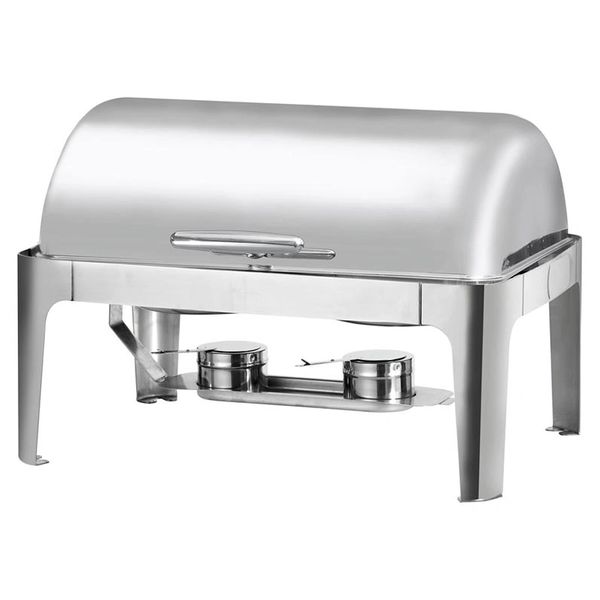
A chafing dish is a serving and hot-holding vessel, not a replacement for cooking equipment. A traditional wet-heat chafer uses a frame, water pan, food pan, cover, and an approved heat source. Heat warms the water beneath the food pan, helping distribute warmth during service. The operator still needs to monitor food temperature and quality; a lit fuel canister alone does not prove that food is being held safely.
Build your catering equipment package around the menu, service duration, venue, and refill plan. Rectangular chafers suit a buffet with several entrees and sides, while round, oval, and marmite styles offer other serving formats. Choose the equipment that fits your usual events before investing in specialty pieces for occasional bookings.
Compare Chafer Sizes and Serving Formats
| Format | Example in this collection | Planning considerations |
|---|---|---|
| Full-size rectangular | Thunder Group SLRCF001, 8-quart welded chafer | Consider for a main entree or popular side. Check the complete footprint, lid access, and refill-pan fit. |
| Half-size | Thunder Group SLRCF0825, 4-quart chafer with wood handle | A smaller serving quantity can suit a secondary dish without dedicating a large chafer to it. |
| Round | Thunder Group SLRCF0831GH, 4-quart gold-accented round chafer | Consider presentation and utensil access as well as capacity. Round pans are not interchangeable with rectangular hotel pans. |
| Oval | Thunder Group SLRCF0836GH, 6-quart gold-accented oval chafer | Check usable table space and matching replacement pans before choosing the shape. |
| Round roll-top | Thunder Group SLRCF0860, 6-quart round roll-top chafer | An attached lid avoids needing a separate landing area for a loose cover. Allow room for its opening movement. |
| Marmite | SLRCF8307, 7-quart and SLRCF8311, 11-quart marmite chafers | Useful formats to consider for soup and other ladled menu items. Plan for a suitable serving utensil and controlled refilling. |
Quart capacity is not a guaranteed guest count. Portion size, menu variety, refill frequency, and the time guests spend at the buffet all affect the quantity you need on display. Plan a working fill level that leaves room for safe serving rather than assuming every pan should be filled to its rim. Confirm the exact model specifications and included components before ordering.
Roll-Top Versus Lift-Off Covers
A lift-off cover is straightforward, but your buffet needs a clean, heat-safe place to put it during serving. Account for condensation and avoid placing a hot, wet lid where it can drip onto guests, linens, or other dishes. An attached roll-top cover stays with the chafer and can simplify self-service, provided the opening direction and clearance suit the table layout.
Look beyond decorative finishes when comparing commercial chafing dishes. Check frame stability, handle attachment, cover fit, and whether replacement food pans, water pans, and covers are available for that model. Mixed designs can work, but standardizing frequently used units can simplify packing, setup, and spare-parts management.
Fuel, Electric, and Induction Chafers
Choose the heat source to match the venue rather than assuming one design fits every event. The following comparison explains equipment formats; it does not mean every format is currently stocked in this collection. Follow the instructions for the exact chafer and heat source, and confirm venue requirements before purchasing.
- Fuel-heated chafers: Useful where electrical outlets are limited. Confirm that the venue permits open flames and that the fuel type and holder match the chafer. Buy fuel according to its labeled burn time and the service plan, not an assumed universal duration.
- Electric chafers: Avoid an open fuel flame but still require safe handling of hot surfaces and water. Check voltage, plug type, power draw, outlet access, and available circuit capacity. Keep cords out of guest traffic and follow the equipment instructions for installation.
- Induction-compatible chafers: Require a matched induction heat source and compatible vessel. Stainless steel appearance alone does not establish compatibility. Confirm the manufacturer's approval for the complete setup rather than using a generic chafer on an induction unit.
For outdoor catering, wind and ambient conditions can change holding performance. Use equipment approved for the setting and a venue-approved layout; do not improvise enclosures around burning fuel. Assign a staff member to monitor the service line, heat sources, water levels where applicable, and food temperatures throughout the event.
Catering Pots, Hotel Pans, and Chafer Inserts
Catering pots and hotel pans serve different jobs. A stockpot or saucepan is cooking equipment selected for the menu and cooking surface. A hotel pan, also called a steam-table pan, is a rectangular insert used in compatible preparation, holding, and serving equipment. A chafer may use a hotel-pan format or a model-specific round, oval, or other shaped insert.
Do not choose replacement pans by capacity alone. Compare the outside rim dimensions, depth, corner shape, support arrangement, and lid fit with the chafer's requirements. Fractional pans may need appropriate support bars, and a deeper insert may not leave the necessary space in a water pan. Standard size names are a starting point, not proof that every pan and chafer combination fits.
Match the cookware material to the job and confirm its approved heat sources. For buffet service, prioritize compatible, easy-to-clean inserts and lids. For cooking, evaluate pot depth, handles, weight when full, and the manufacturer's instructions for the intended range or induction surface. Keep hot-holding equipment separate from the equipment used to cook or reheat the meal.
Plan extra compatible food pans so staff can replace a pan during service rather than improvise with a poor-fitting container. Include lids for protected staging and transport, suitable serving utensils, and a labeling method in the equipment checklist. For broader holding options, compare commercial food warmers and holding equipment.
Plan a Catering Buffet from Kitchen to Guest
Prepare and Transport
Map the complete route: preparation, cooking, loading, transport, unloading, holding, service, and cleanup. Confirm the venue's unloading access, available workspace, electrical service, and restrictions before loading the vehicle. A beautiful chafer is not a substitute for a suitable transport system or a safe food-handling plan.
Use transport equipment designed for the food and conditions, follow its preconditioning instructions, and secure containers against movement and spills. Keep the service equipment clean and protected during travel. Check food temperatures at the relevant handoff points rather than assuming an insulated carrier has maintained the required temperature.
Arrange the Buffet Line
Set up a clear direction of travel with plates at the beginning and enough space to serve each dish without reaching across another guest. Position beverages and desserts separately when the space allows, so guests returning for drinks do not block the main meal line. Keep a staff access route for replacing pans and checking temperatures.
Place stable equipment on appropriate tables and keep heat sources away from combustible decorations. Match utensils to the dishes and provide clear labels, including allergen information appropriate to your operation. A replenishment plan should identify who checks the line, where replacement pans wait, and how used pans return to the cleaning area.
Safe Hot Holding with Chafing Dishes
The FDA Food Code, section 3-501.16, generally calls for time/temperature control for safety foods to be held at 135°F or above when hot, or 41°F or below when cold, with specified exceptions. Follow your local health authority's adopted requirements and your operation's approved procedures. These are food-temperature limits, not water-pan or equipment-dial settings.
- Start with properly prepared food. Cook or reheat it using suitable equipment and the applicable food-safety procedure before placing it in the chafer. Do not rely on a conventional holding chafer to cook raw food or rapidly reheat cold food.
- Set up the chafer as directed. Where a water bath is required, use the specified water level and preheating procedure. Do not run the water pan dry or assume every electric or induction unit uses the same setup.
- Measure the food temperature. Use a suitable, calibrated food thermometer and follow the monitoring schedule in your food-safety plan. Check the food itself rather than judging by steam, appearance, or whether the pan feels warm.
- Maintain the service line. Monitor water levels, fuel or power, cover position, and portion quality. Replace pans using your safe service procedure rather than repeatedly mixing a new batch into an older one.
- Respond to a temperature failure. Follow the approved corrective-action procedure. Do not assume that a general four-hour allowance makes improperly held food safe; time as a public-health control requires specific procedures and conditions.
Indirect heat can help with holding, but it does not prevent every dish from drying, scorching, or losing quality. Delicate sauces, eggs, and other sensitive foods may need smaller batches, closer attention, or different holding equipment. Choose the equipment and service method around the recipe as well as the guest count.
Cleaning, Storage, and Event Readiness
Shut off the heat source and let components cool before disassembly. Follow the manufacturer's cleaning instructions for the food pan, water pan, frame, cover, and decorative handles or trim. Do not assume every component is dishwasher-safe; electrical assemblies require their own care procedures.
Clean away food residue with suitable products and nonabrasive tools, then rinse, sanitize food-contact components as required, and dry before storage. Inspect handles, feet, hinges, and fuel holders before the next event. Avoid stacking equipment in a way that bends rims or damages finishes, and pack matching parts together to reduce setup mistakes.
Budgeting for Catering Equipment
Compare the complete cost of a usable setup, not just the chafer price. Include compatible inserts and lids, serving utensils, transport equipment, fuel or electrical requirements, cleaning supplies, and replacement parts. Buy around recurring menus and confirmed bookings rather than filling storage with equipment that rarely gets used.
For a larger purchase, review restaurant equipment financing alongside paying cash or obtaining an independent rental quote for occasional events. Compare the total amount paid, fees, payment schedule, end-of-term ownership conditions, early payoff provisions, and maintenance responsibilities. Approval and terms depend on the provider and your application; confirm any tax treatment with your own adviser rather than assuming all equipment payments are deductible.
Catering Equipment Buying Checklist
- Menu and volume: List each dish, portion size, planned display quantity, and refill frequency.
- Chafer format: Confirm pan shape, usable capacity, lid operation, and the complete table footprint.
- Venue requirements: Verify open-flame permissions, electrical capacity, unloading access, and service space.
- Included components: Check whether the frame, water pan, food pan, lid, and fuel holders are included with the exact model.
- Transport and backups: Plan compatible carriers, spare pans, serving utensils, temperature checks, and replacement fuel where applicable.
- Ongoing use: Review cleaning requirements, replacement-part availability, storage space, and the complete purchase cost.
Winco Concession Equipment
Winco concession and catering equipment — conveyor toaster and popcorn poppers for events, snack bars, and buffet service: