
Charbroilers
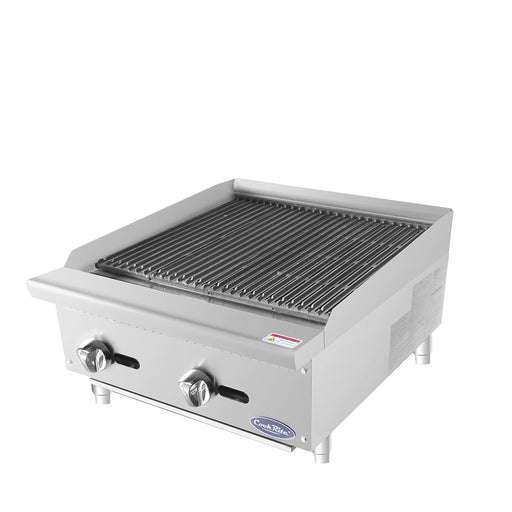
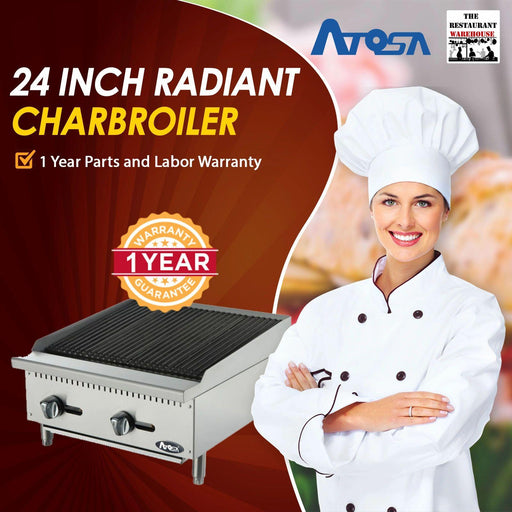
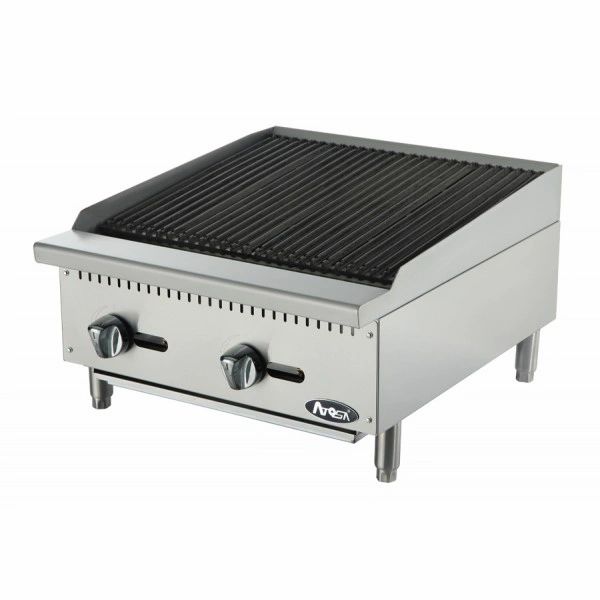
Atosa USA ATRC-24 Heavy Duty Stainless Steel 24-Inch Radiant Broiler - Natural Gas
Atosa
Original price
$1,280.00
Original price
$1,280.00
-
Original price
$1,280.00
Original price
$1,280.00
Current price
$923.00
$923.00
-
$923.00
Current price
$923.00
Atosa USA ATRC-24 24-Inch Radiant Charbroiler – Natural Gas The Atosa ATRC-24 Natural Gas Radiant Charbroiler delivers powerful grilling performan...
View full details
Original price
$1,280.00
Original price
$1,280.00
-
Original price
$1,280.00
Original price
$1,280.00
Current price
$923.00
$923.00
-
$923.00
Current price
$923.00
Save 28%
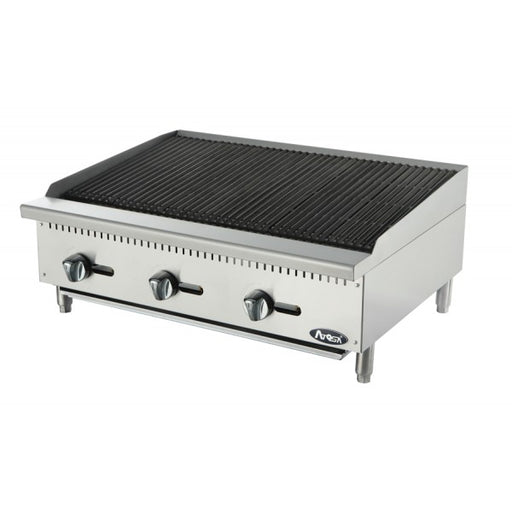
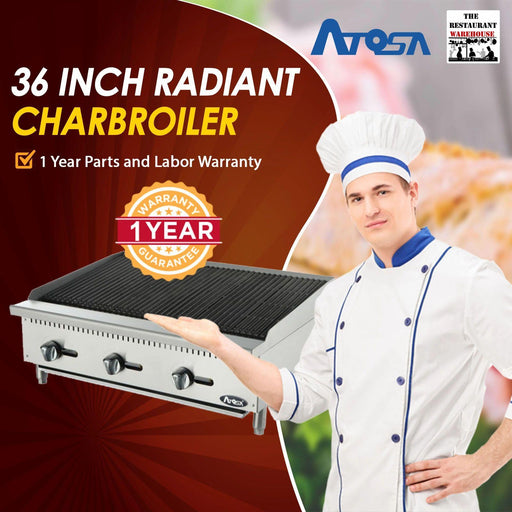
Atosa USA ATRC-36 Heavy Duty Stainless Steel 36-Inch Radiant Broiler - Natural Gas
Atosa
Original price
$1,718.00
Original price
$1,718.00
-
Original price
$1,718.00
Original price
$1,718.00
Current price
$1,238.00
$1,238.00
-
$1,238.00
Current price
$1,238.00
Atosa USA ATRC-36 Heavy Duty 36-Inch Radiant Charbroiler – Natural Gas Built for busy kitchens that need fast recovery and consistent grilling res...
View full details
Original price
$1,718.00
Original price
$1,718.00
-
Original price
$1,718.00
Original price
$1,718.00
Current price
$1,238.00
$1,238.00
-
$1,238.00
Current price
$1,238.00
Save 28%
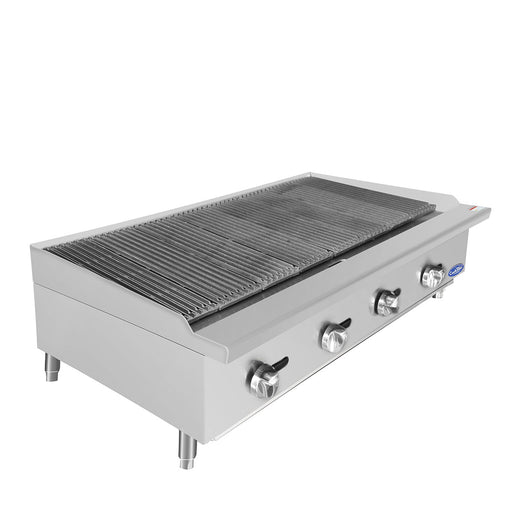
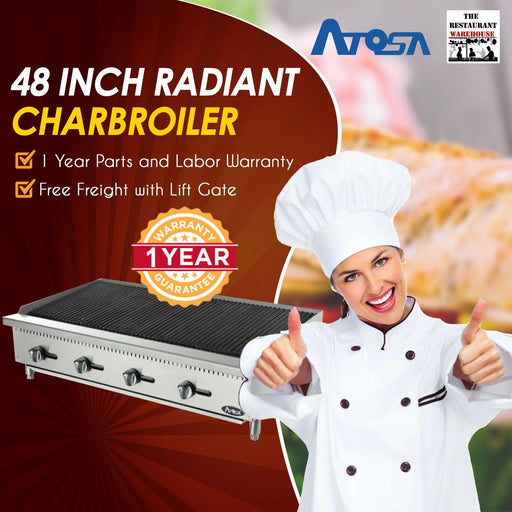
Atosa USA ATRC-48 Heavy Duty Stainless Steel 48-Inch Radiant Broiler - Natural Gas
Atosa
Original price
$2,155.00
Original price
$2,155.00
-
Original price
$2,155.00
Original price
$2,155.00
Current price
$1,533.00
$1,533.00
-
$1,533.00
Current price
$1,533.00
Atosa USA ATRC-48 Heavy Duty 48-Inch Radiant Charbroiler – Natural Gas The Atosa ATRC-48 Natural Gas Radiant Charbroiler delivers powerful co...
View full details
Original price
$2,155.00
Original price
$2,155.00
-
Original price
$2,155.00
Original price
$2,155.00
Current price
$1,533.00
$1,533.00
-
$1,533.00
Current price
$1,533.00
Save 29%
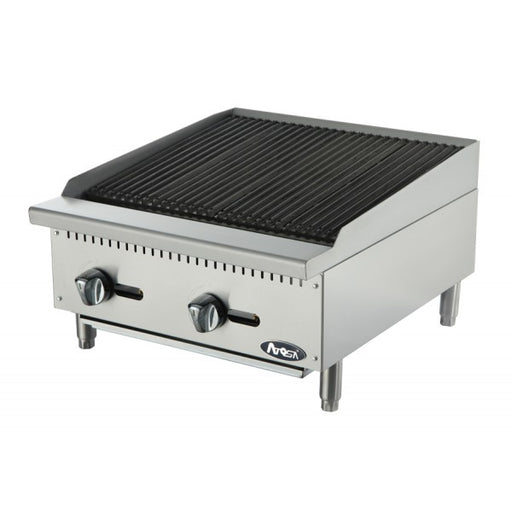
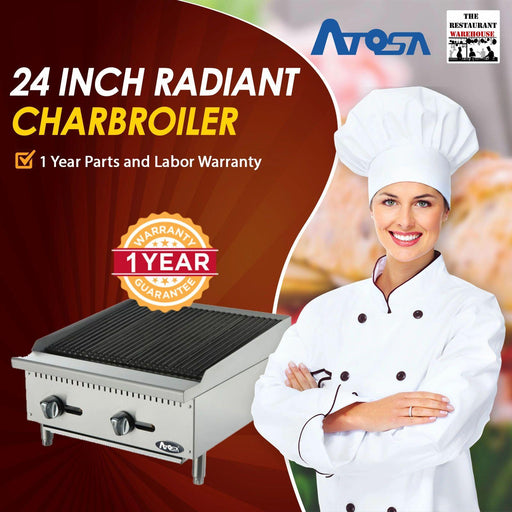
Atosa USA ATRC-24 Heavy Duty Stainless Steel 24-Inch Radiant Broiler - Propane
Atosa
Original price
$1,280.00
Original price
$1,280.00
-
Original price
$1,280.00
Original price
$1,280.00
Current price
$923.00
$923.00
-
$923.00
Current price
$923.00
Atosa USA ATRC-24 Heavy Duty 24-Inch Radiant Charbroiler – Propane The Atosa ATRC-24 Radiant Charbroiler is a rugged, commercial-grade counte...
View full details
Original price
$1,280.00
Original price
$1,280.00
-
Original price
$1,280.00
Original price
$1,280.00
Current price
$923.00
$923.00
-
$923.00
Current price
$923.00
Save 28%
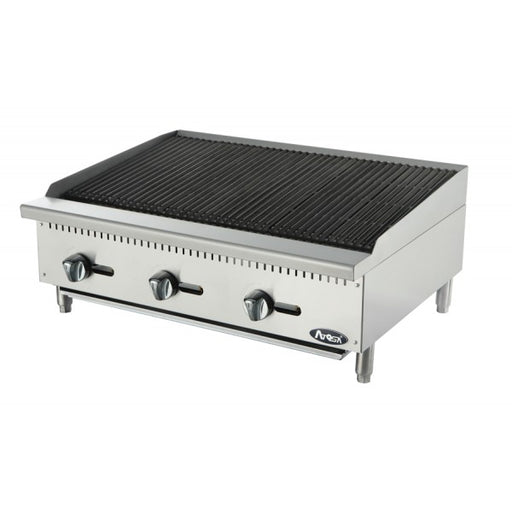
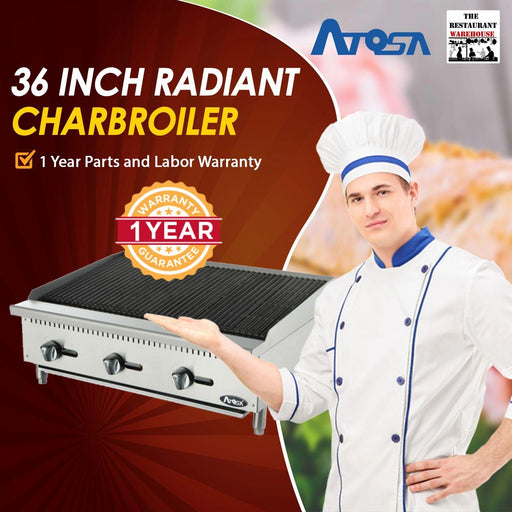
Atosa USA ATRC-36 Heavy Duty Stainless Steel 36-Inch Radiant Broiler - Propane
Atosa
Original price
$1,718.00
Original price
$1,718.00
-
Original price
$1,718.00
Original price
$1,718.00
Current price
$1,238.00
$1,238.00
-
$1,238.00
Current price
$1,238.00
Atosa USA ATRC-36 Heavy Duty 36-Inch Radiant Charbroiler – Propane The Atosa ATRC-36 Radiant Charbroiler is built for commercial kitchens that dem...
View full details
Original price
$1,718.00
Original price
$1,718.00
-
Original price
$1,718.00
Original price
$1,718.00
Current price
$1,238.00
$1,238.00
-
$1,238.00
Current price
$1,238.00
Save 28%
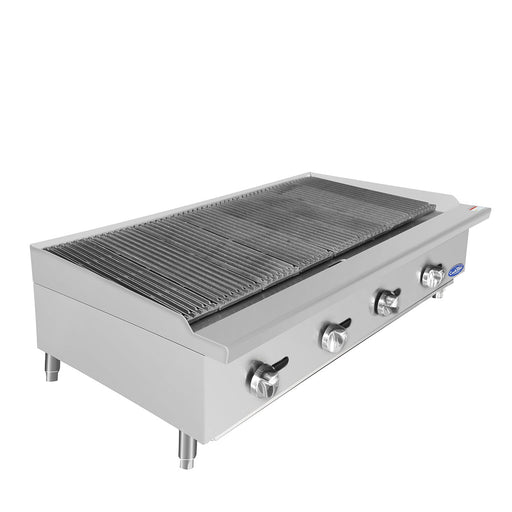
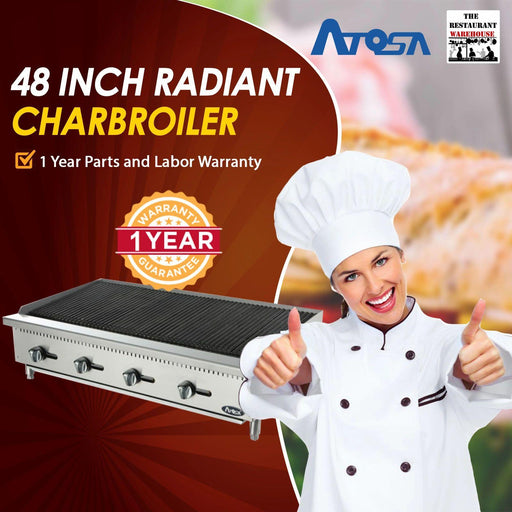
Atosa USA ATRC-48 Heavy Duty Stainless Steel 48-Inch Radiant Broiler - Propane
Atosa
Original price
$2,155.00
Original price
$2,155.00
-
Original price
$2,155.00
Original price
$2,155.00
Current price
$1,533.00
$1,533.00
-
$1,533.00
Current price
$1,533.00
Atosa USA ATRC-48 Heavy Duty 48-Inch Radiant Charbroiler – Propane The Atosa ATRC-48 Radiant Charbroiler is built for high-performance commercial ...
View full details
Original price
$2,155.00
Original price
$2,155.00
-
Original price
$2,155.00
Original price
$2,155.00
Current price
$1,533.00
$1,533.00
-
$1,533.00
Current price
$1,533.00
Save 29%
Commercial Charbroilers: The Complete Buyer's Guide
A commercial charbroiler is the cooking appliance that uses intense direct radiant heat from below to sear food on heavy metal grates, producing the signature dark sear marks, smoky flavor, and crisp crust associated with grilled steaks, burgers, chicken, and vegetables. Unlike a backyard grill, a commercial unit is built for continuous high-volume restaurant service with heavier construction, higher BTU per burner, and integrated grease management designed for daily shift use.
This page consolidates our complete commercial charbroiler buying guidance: how a charbroiler actually works, radiant vs lava rock vs char rock construction, sizing by line volume and the burner-per-inch rule, gas vs electric, fuel type comparisons, install and hood requirements, TCO, daily and weekly maintenance, and the Maillard chemistry that separates a charbroiled steak from a pan-seared one.
How a Commercial Charbroiler Works
Every charbroiler operates on the same core principle: a heat source below the cooking surface generates intense radiant energy that travels upward through a heat-distribution layer and into heavy metal grates that contact the food. The food sears on the grates while drippings fall onto the hot surface below, vaporize into smoke, and rise back up to coat the food with aromatic flavor compounds.
The Three Core Components
Strip away brand differences and every commercial charbroiler comes down to three working parts.
The heat source. Most commercial charbroilers use gas burners running on natural gas or propane, producing 15,000-40,000 BTU per burner. Electric models use sheathed heating elements. Traditional charcoal units burn hardwood lump or briquettes. The heat source determines how fast the unit recovers between loads and how much fuel infrastructure the restaurant needs.
The heat-distribution layer. Sitting between the burner and the grate, this layer takes the concentrated flame and spreads it into even radiant heat. Three common materials handle this job:
- Cast iron or steel radiants - durable, easy to clean, used in radiant charbroilers like the Atosa ATRC series
- Ceramic briquettes or lava rocks - more porous, more flavorful from vaporized drippings, but messier to maintain
- Char rock - the lava rock alternative used in models like the Atosa ATCB-24
The choice of distribution layer shapes both the flavor profile and the daily cleaning workload.
The cooking grates. Heavy cast iron is the standard because it absorbs and holds heat, producing the deep, dark sear marks that define charbroiled food. Some grates are reversible, with thick bars on one side for searing steak and finer bars on the other for delicate items like fish fillets. Stainless steel grates exist on lighter-duty units, heat up faster, and clean easier, but rarely produce the same sear character as cast iron.
The Science of Searing and Smoke
Two chemical reactions create the flavor signature of charbroiled food, and both depend on the intense heat that only a commercial charbroiler delivers consistently.
The Maillard reaction is the browning chemistry between amino acids and reducing sugars that begins at about 285°F and accelerates dramatically above 350°F. On a charbroiler running plate temperature above 500°F at the grate contact points, the Maillard reaction fires immediately on protein contact, building the deep crust, caramelized sugars, and complex flavor compounds that separate a charbroiled steak from a pan-seared one.
The second reaction is drip vaporization. Grease and juice fall from the food onto the hot heat-distribution layer, flash-vaporize into a fatty smoke, and rise back into the food. This smoke deposits aromatic compounds onto the food surface, adding the recognizable "grilled" flavor that no oven or flat-top can reproduce. Lava rock and char rock deliver more of this flavor deposition because their porous surface holds and re-vaporizes drippings across the cook. Cast iron radiants deliver less but come out cleaner.
Charbroiler vs Griddle vs Grill vs Broiler
- Charbroiler - radiant heat from below through grates; direct flame contact zones between grates; used for burgers, steaks, chicken, vegetables, seafood, anything that benefits from sear marks and smoke
- Griddle - solid flat cooking surface; heat conducts through the plate to the food; used for eggs, pancakes, bacon, hash browns, smashburgers, anything that benefits from uniform surface contact
- Salamander broiler - overhead radiant heat, food sits below; used for finishing, browning tops of casseroles, melting cheese
- Cheesemelter - lower-BTU overhead broiler tuned specifically for melting cheese and finishing
- Backyard grill - residential BTU, thinner grates, no NSF certification, not built for continuous restaurant service
Radiant vs Lava Rock vs Char Rock: The Heat-Distribution Decision
Radiant Charbroilers (Atosa ATRC Series)
Radiant charbroilers use cast iron or steel radiants between the burner and the grate. Radiants distribute heat evenly across the plate, deflect drippings away from the burners (protecting orifices from clogging), and are removable for cleaning. Cleaning time is 10-20 minutes at end of shift. This is the standard build for most independent restaurants and the workhorse across the Atosa ATRC-24, ATRC-36, and ATRC-48 line.
Lava Rock and Char Rock Charbroilers (Atosa ATCB-24)
Lava rock and char rock charbroilers use porous stone as the heat-distribution layer. The stones absorb drippings, vaporize them across the cook, and deposit more flavor on the food. Steakhouses and BBQ concepts prefer this build for the flavor signature. The trade-off is maintenance: cleaning time runs 20-35 minutes at end of shift, the rocks need periodic replacement (typically annually under heavy use), and the burners are more exposed to grease clogs if the rocks shift or crack.
Radiant vs Lava Rock Cleaning Labor
An extra 10 minutes per day at closing wage of $15-$20 per hour adds $900-$1,200 per year in labor cost for the lava rock option versus radiant. Worth it for the flavor in steakhouse and BBQ concepts. Real money in operations where the flavor difference does not show up in customer perception.
Sizing a Commercial Charbroiler by Line Volume
The most common buying mistake is sizing by intuition rather than by line volume. Operators either undersize because they want to save floor space and then bottleneck on Saturday nights, or oversize because they assume bigger is safer and then carry idle capacity they pay to run every shift. The right answer is sizing math that accounts for menu mix, peak ticket times, and recovery capability.
The Burner-Per-Inch Rule
The industry sizing rule for commercial charbroilers is one burner for every 6 to 12 inches of width. A 24-inch unit has 2 burners, a 36-inch unit has 3, a 48-inch unit has 4, and a 60-inch unit has 5-6 depending on manufacturer.
Burner count matters more than total BTU for one reason: recovery time. When a cold steak hits a hot grate, the surface temperature drops 100-150°F in the contact zone. The burner directly under that zone has to fire continuously until the grate recovers. If you load eight steaks across a four-burner 48-inch grill, every burner is recovering at the same time and the grill stays in spec. If the same eight steaks land on a two-burner 24-inch unit, both burners overload and recovery slows dramatically.
Size Class by Line Volume
| Size | Burners | BTU (typical) | Best For |
|---|---|---|---|
| 24 inch | 2 | 60,000-70,000 | Food trucks, cafés, low-volume steak menus, secondary station |
| 36 inch | 3 | 90,000-105,000 | Mid-volume independents, breakfast burger stations |
| 48 inch | 4 | 120,000-140,000 | Full-service steakhouses, high-volume grill concepts |
| 60 inch | 5-6 | 150,000-180,000 | Chain-restaurant cooklines, banquet operations |
Compare Charbroiler Options by Type and Fuel
- Radiant charbroilers - cast iron or steel radiants, workhorse for most restaurants
- Lava rock charbroilers - porous stone, more vaporized-drippings flavor, steakhouse and BBQ concept
- Natural gas charbroilers - highest BTU-per-dollar for kitchens with a permanent gas line
- Propane charbroilers - food trucks, outdoor kitchens, temporary operations
- Atosa charbroilers - the ATRC radiant series
- Combined charbroiler and griddle assortment
Featured Commercial Charbroiler Models
- Atosa ATRC-24 Natural Gas 24 inch Radiant Charbroiler - 2 burners, cast iron radiants and grates
- Atosa ATRC-24 Propane 24 inch Radiant Charbroiler
- Atosa ATRC-36 Natural Gas 36 inch Radiant Charbroiler - 3 burners
- Atosa ATRC-36 Propane 36 inch Radiant Charbroiler
- Atosa ATRC-48 Natural Gas 48 inch Radiant Charbroiler - 4 burners
- Atosa ATRC-48 Propane 48 inch Radiant Charbroiler
Gas vs Electric vs Charcoal
Gas Charbroilers
Natural gas and propane run the vast majority of commercial charbroilers. They deliver 15,000-40,000 BTU per burner, recover fast, and integrate directly into a standard commercial gas line and hood system. Natural gas is the cheapest per BTU where a permanent gas line exists; propane is the fuel of choice for food trucks, outdoor kitchens, and temporary operations.
Electric Charbroilers
Electric charbroilers use sheathed elements below the grate and typically peak at lower surface temperature than gas. They install without a gas line, run cleaner, and can operate in some hoodless jurisdictions with a ventless capture hood. Trade-off: lower peak sear temperature, slower recovery, and lower BTU-equivalent output.
Charcoal Charbroilers
Charcoal units burn hardwood lump or briquettes and produce the deepest flavor profile of any charbroiler category. Reserved for steakhouse concepts and BBQ operations where the fuel signature is a core menu differentiator. Higher labor cost (fire management, ash removal), significantly higher hood requirement (Type I with grease and particulate capture), and stricter jurisdictional rules on installation.
Food That Belongs on a Charbroiler
Anything that benefits from high heat, surface searing, and smoke character.
- Beef - steaks of every cut, burgers, kebabs, skirt and flank for fajitas, short ribs
- Pork - chops, tenderloin medallions, sausages, ribs (finishing after smoke), pork belly
- Poultry - boneless chicken breasts, thighs, wings, half chickens (with care to manage flare-ups), turkey cutlets, duck breast
- Seafood - salmon, tuna, swordfish, halibut, shrimp skewers, scallops, octopus, lobster tails; delicate fish benefits from the finer side of a reversible grate
- Vegetables - bell peppers, zucchini, eggplant, asparagus, onions, mushrooms, corn on the cob, romaine for grilled Caesar
- Fruit - pineapple slices, peach halves, watermelon steaks for plated salads
- Bread - bruschetta toasts, panini, grilled flatbreads, garlic bread
The throughline is the same across every category: anything that benefits from a sear and a touch of smoke is a candidate. Foods that need uniform surface contact rather than line-pattern searing belong on a commercial griddle.
What "Charbroiled" Means on a Menu
When a menu describes a dish as "charbroiled," it signals to the diner that the food was cooked on a charbroiler with dark sear marks, smoky aromatics, and grilled character that come from radiant heat and dripping vaporization. The term is most often paired with beef ("charbroiled burger," "charbroiled steak") but appears on chicken, fish, and vegetable preparations as well. "Char-grilled" is a synonymous menu term used interchangeably in most regions. In strict foodservice usage, "charbroiled" implies a commercial charbroiler with radiant heat and vaporized drippings, not a residential-style grill or a flat top with a grill press.
Why the Right Charbroiler Drives Menu Pricing
The decision is not just about cooking equipment. The right charbroiler is what produces the diamond grill marks and crosshatch sear pattern customers recognize as a premium grilled item before they take the first bite. The intense direct heat triggers the Maillard reaction at the contact points between grate and protein, building the crust, caramelized sugars, and complex flavor compounds that separate a charbroiled steak from one cooked on a flat top.
Restaurants with a properly sized charbroiler can confidently put signature items on the menu and justify higher price points: seared steaks and chops with bold sear marks, juicy chicken with crisp seasoned skin, charred peppers and zucchini and asparagus, and grilled fish that holds together on the grate. Restaurants without one tend to default to plain pan-seared or oven-finished proteins that do not command the same plate price.
Installation, Hood, and Gas Line Sizing
Every gas commercial charbroiler requires a Type I grease hood with fire suppression. Charbroilers produce higher grease vapor loads than most cook-line equipment because dripping vaporization is intrinsic to how they work. Hood CFM ratings for charbroilers typically run 300-500 CFM per linear foot, higher than griddles or ranges of equivalent width.
Gas Line Sizing
- 24 inch charbroiler (65,000 BTU) - 3/4 inch black iron gas line minimum from meter
- 36 inch charbroiler (99,000 BTU) - 3/4 inch minimum, 1 inch preferred if line run exceeds 25 feet
- 48 inch charbroiler (132,000 BTU) - 1 inch minimum, especially if shared with other gas equipment on the same branch
Undersized gas lines starve the burners and drop measured BTU output significantly, showing up as slow recovery and cool zones under load. Any operator whose charbroiler "runs cold" should verify gas pressure and line diameter before assuming a burner defect.
Clearance Requirements
- Rear: 6 inches to combustibles
- Sides: 6 inches to combustibles
- Above: per hood spec, typically 24 inches to hood filter face
Zero clearance to non-combustible surfaces is generally allowed but must be verified with local code and the AHJ.
Daily, Weekly, and Long-Term Maintenance
A maintained charbroiler holds peak performance for years. A neglected one loses 20-30% of effective output within months and becomes a fire risk. The maintenance routine below is non-negotiable for any restaurant running this equipment.
The Water-in-Drip-Pan Trick
One of the most useful operational habits in any commercial charbroiler kitchen is keeping roughly one inch of water in the grease drip pan during service. The water serves two purposes: first, it cools grease as it falls into the pan, preventing the grease from reaching ignition temperature and catching fire in the tray; second, it prevents grease from baking onto the pan metal, which dramatically reduces end-of-night cleaning time. Refill the water periodically through service and drain and clean the tray at end of every shift without exception.
Daily End-of-Shift Routine
After every service, while the grates are still warm but not blazing, scrape the grates with a heavy-duty grill brush or grate scraper to remove food residue and carbon buildup. Empty and clean the grease drip tray (the single highest fire-risk task on any cook line). Wipe down all exterior stainless surfaces with a food-safe degreaser. For cast iron grates, apply a light coat of high-smoke-point oil (canola or other neutral) and fire the burners on low for 15 minutes to bake the oil into a polymerized barrier that protects against rust and reduces sticking on the next shift.
Weekly Burner Maintenance
Once a week, when the unit is fully cool, remove the grates and radiants and use a stiff wire brush to clear any clogged burner ports. Carbon buildup and grease infiltration progressively block burner orifices, leading to uneven heating and yellow-tipped flames (a sign of incomplete combustion that wastes fuel and produces carbon monoxide). Inspect burner integrity for cracks or warping.
Radiant, Lava Rock, and Char Rock Care
Cast iron radiants get scraped clean weekly and replaced every 3-5 years under heavy use. Lava rock and char rock get rotated during weekly cleaning (bottom to top) to burn off accumulated grease, and replaced annually under heavy use.
Charbroiler Accessories and Related Cooking Equipment
- Salamander broilers - overhead radiant, complementary to a charbroiler
- Commercial griddles
Charbroiler Buying Resources
- Best 24 Inch Charbroilers
- Atosa 24 Charbroiler Review
- Atosa Char Broiler Guide
- Radiant Char Broilers Guide
- How to Season a Charbroiler
- Cleaning a Broiler
- Salamander Broiler Guide
- What Is a Salamander Broiler
Frequently Asked Questions About Commercial Charbroilers
What is a commercial charbroiler?
A commercial charbroiler is a cooking appliance that uses intense direct radiant heat from below to sear food on heavy metal grates. It produces the dark sear marks, smoky flavor, and crisp crust associated with grilled steaks, burgers, chicken, and vegetables in a restaurant setting.
What size commercial charbroiler do I need?
Follow the burner-per-inch rule: one burner per 6-12 inches of width. A 24 inch unit handles low-volume steak menus and food trucks; a 36 inch handles mid-volume independents; a 48 inch fits steakhouses and volume grill concepts; a 60 inch fits chain and banquet cooklines.
Radiant vs lava rock charbroiler, which is better?
Radiant units clean faster (10-20 minutes end of shift) and are the standard for most restaurants. Lava rock and char rock units produce more of the vaporized-drippings flavor and are preferred by steakhouses and BBQ concepts; they take 20-35 minutes to clean and add roughly $900-$1,200 per year in labor.
What is the difference between a charbroiler and a griddle?
A charbroiler uses radiant heat below open grates and produces sear marks and smoke from vaporized drippings. A griddle uses a solid flat plate and produces uniform surface contact without sear marks or smoke.
What is the difference between a charbroiler and a broiler?
A charbroiler heats from below with radiant heat through grates. A broiler (including a salamander) heats from above and sits over the food. Charbroilers deliver sear and smoke; broilers deliver top-browning and finishing.
How much BTU should a commercial charbroiler have?
Expect 15,000-40,000 BTU per burner. A 24 inch runs 60,000-70,000 BTU total, 36 inch runs 90,000-105,000, 48 inch runs 120,000-140,000, and 60 inch runs 150,000-180,000.
Do I need a hood over a commercial charbroiler?
Yes, always for gas and charcoal units: a Type I grease hood with fire suppression is required, and charbroilers demand higher CFM per linear foot than most other cook-line equipment because of grease vapor loading. Electric units may qualify for a ventless system in some jurisdictions.
What foods are cooked on a charbroiler?
Steaks, burgers, chicken, pork chops, sausages, seafood, shrimp, vegetables, and grilled fruits. Anything that benefits from sear marks and vaporized-drippings smoke.
How long does a commercial charbroiler last?
A maintained gas charbroiler with cast iron grates lasts 10-15 years. Grates and radiants may need replacement every 3-5 years under heavy use; lava rock and char rock get replaced annually.
What is the Maillard reaction and why does it matter?
The Maillard reaction is the browning chemistry between amino acids and reducing sugars that begins at about 285°F and accelerates above 350°F. A charbroiler operating at grate contact temperatures above 500°F triggers this reaction immediately, producing the crust and complex flavor compounds that define charbroiled food.