

Cook Up a Bargain with These Food Truck Stoves for Sale
Why Finding the Right Food Truck Stove for Sale Matters for Your Mobile Business
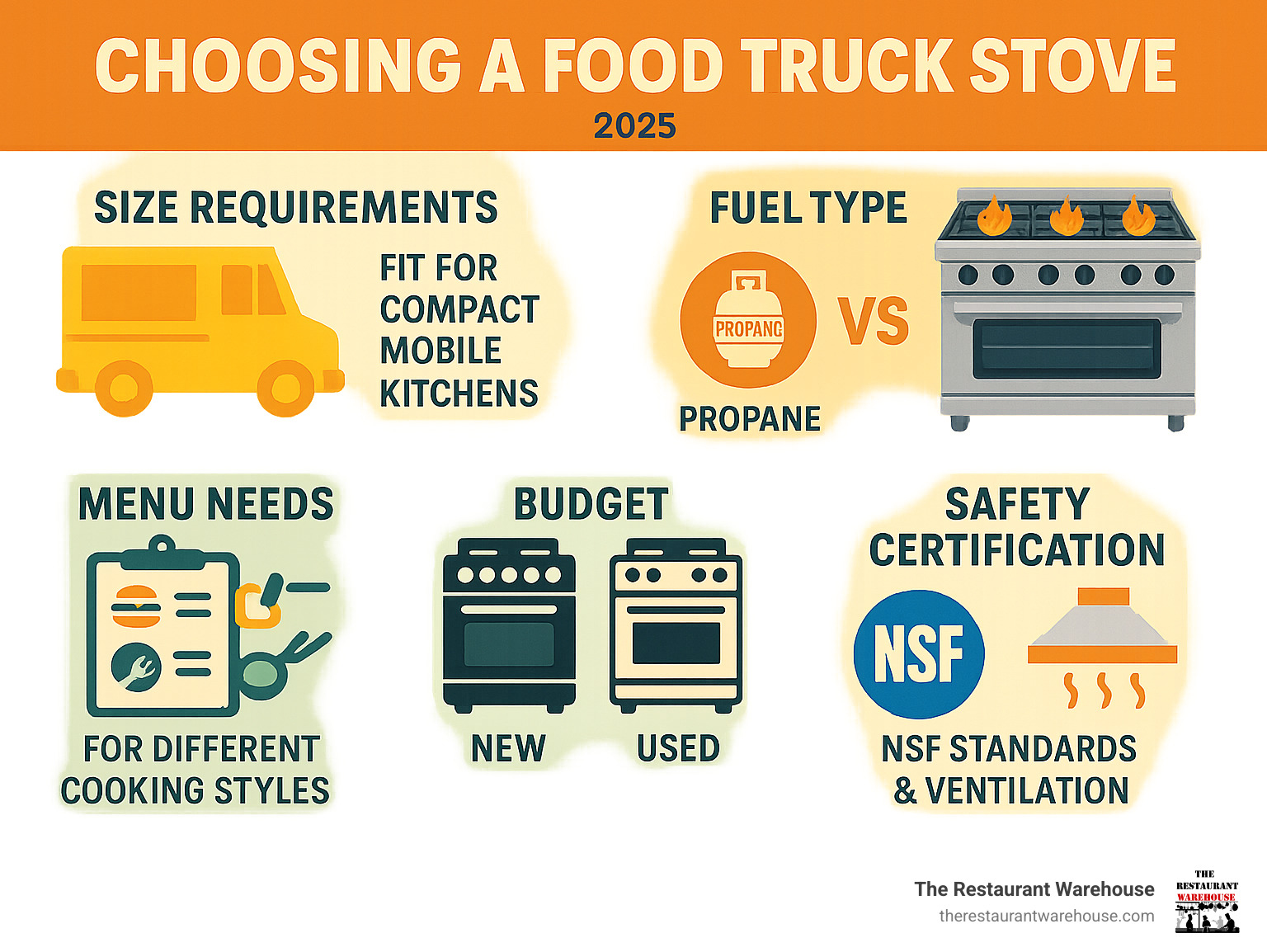
Looking for a food truck stove for sale? Here's what you need to know before you buy:
Quick Buying Guide:
- New 2-burner stove: $500
- New 4-burner range: $2,500
- Used 3-burner stove: ~$600
- Power options: Propane (most common) or electric
- Key features: BTU rating, burner count, compact footprint
- Must-haves: NSF certification, proper ventilation compatibility
The food truck industry is booming, growing at 15% annually. With the industry set to double in the next decade, more entrepreneurs are jumping into mobile food service than ever before. Your stove is the heart of your operation. The right choice leads to efficient service and profitability, while the wrong one can cause slow service, frustrated customers, and safety issues.
The biggest challenges food truck owners face when buying cooking equipment are:
- Space constraints: Every square inch counts in a mobile kitchen.
- Power limitations: Generator capacity affects equipment choices.
- Menu matching: Your cooking style determines the equipment you need.
- Budget pressure: New equipment costs add up fast.
- Safety compliance: Health departments have strict requirements.
This guide will show you what to look for, where to find the best deals, and how to match your equipment to your menu without overspending.
Terms related to food truck stove for sale:
More Than Just a Stove: Essential Food Truck Cooking Equipment
When searching for a food truck stove for sale, a successful mobile kitchen requires a collection of equipment working together in a limited space. Modern food truck equipment is designed with compact footprints and multi-functionality in mind.
Commercial ranges are the backbone of many operations. A quality 24-inch four-burner range, costing around $2,500, offers incredible versatility for sautéing, boiling, and simmering. These units combine stovetop burners with a small storage cabinet or open base below, focusing on the cooking surface rather than an oven.
Cooktops and hot plates are ideal for extra cooking power. A 12-inch two-burner unit costs about $500 and can fit almost anywhere, perfect for dedicated sauces or sides. They are available in both gas and electric models, making them highly adaptable.
Griddles are essential for concepts like breakfast or burgers. A 24-inch flat top costs around $1,500, while a 36-inch model for about $2,500 can dramatically increase output during rush periods. Their large, even cooking surface is perfect for high-volume operations.
Charbroilers deliver a smoky, char-grilled flavor. A 24-inch flame grill runs about $1,500 and is perfect for burgers, hot dogs, and grilled vegetables.
Fryers are a major crowd-pleaser. A 16-inch, 40-pound capacity double-basket fryer costs around $1,500 and can handle high volume. Gas models are preferred for maintaining consistent temperatures during heavy use.
Specialty equipment sets some trucks apart. High-BTU wok ranges (~$2,500 for an 18-inch model) are vital for Asian concepts, while stock pot stoves (~$800 for an 18-inch model) are essential for soups and stews.
For a complete breakdown, see our Food Truck Equipment List.
Add-ons and Upgrades for Functionality
Smart add-ons can transform your efficiency and expand your menu.
Salamander broilers mount above your range for intense, focused heat, perfect for melting cheese or toasting buns, speeding up your plating process.
Cheese melters are designed for rapid melting, a must-have for cheese-heavy menus featuring nachos or cheese steaks.
Warming drawers and Bain maries solve the challenge of holding prepared food at a safe, optimal temperature without overcooking, allowing you to prep components ahead of rush hour.
The right combination of these upgrades improves workflow, reduces wait times, and boosts sales. For more insights, see our Buyers Guide Best Food Truck Equipment For 2025 and our guide on Trailer Made Meals Concession Trailer Cooking Equipment Essentials.
Fueling Your Success: Gas (Propane) vs. Electric Stoves
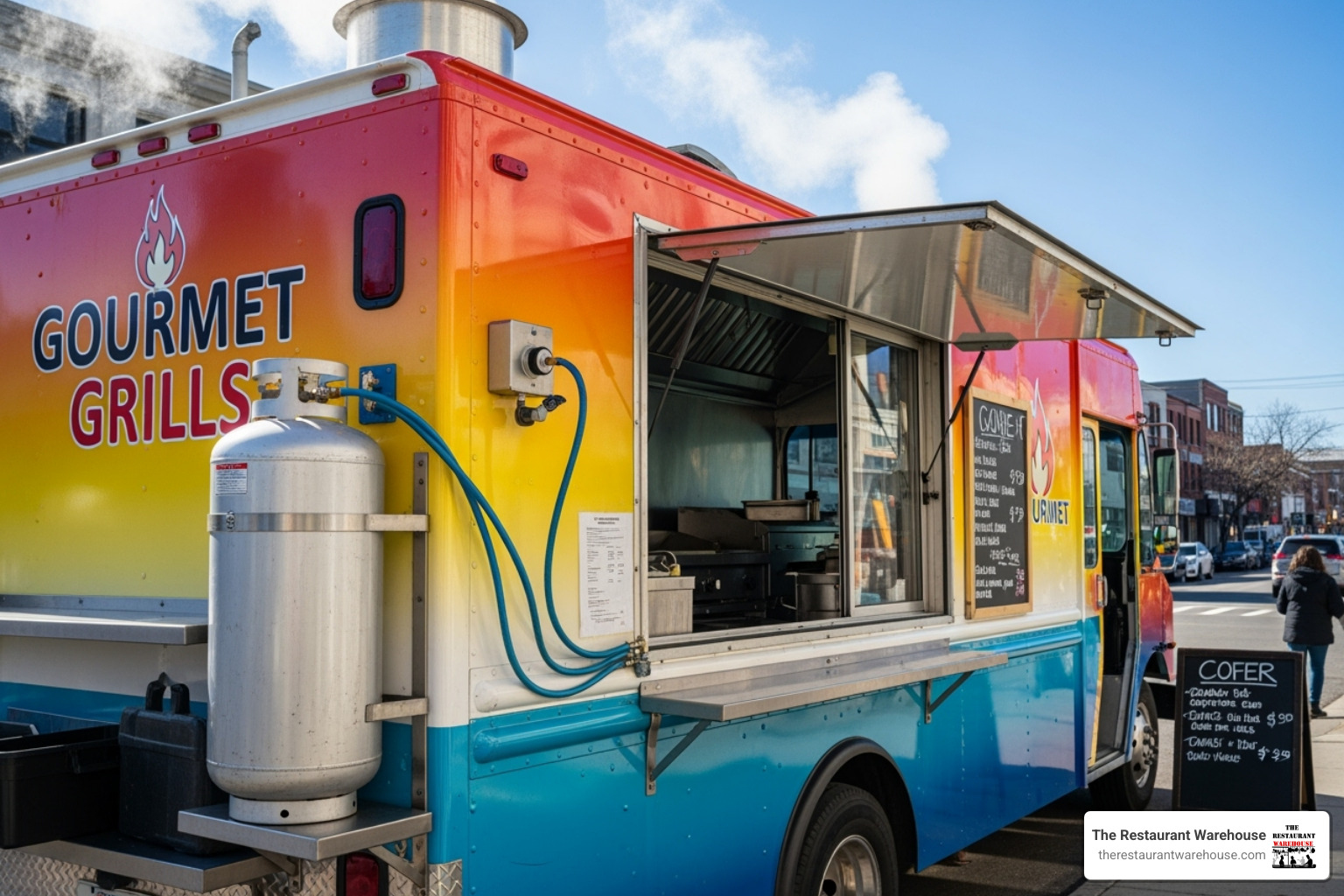
Choosing a power source for your food truck stove for sale is a strategic business decision that impacts daily operations and your bottom line. About 85% of successful trucks run on propane, and for good reason.
Propane: The Food Truck Favorite
Propane is the go-to fuel for mobile kitchens due to its key benefits. The biggest advantage is complete independence, allowing your truck to operate anywhere without needing electrical access. The heat control is superior, with instant flame adjustment crucial for a environment. From a cost perspective, propane is often more economical per BTU than electricity, leading to significant savings over time.
However, propane requires diligent tank management and adherence to complex safety regulations. Your system needs professional installation, regular inspections, and robust ventilation and fire suppression systems. Once properly installed, these systems are incredibly reliable.
Electric: The Clean Alternative
Electric equipment is gaining ground, particularly for specific applications. The appeal includes no gas lines, no tank storage, and simpler installation. It's a viable option for trucks operating at locations with reliable shore power. Induction cooktops are especially efficient, offering precise temperature control that rivals gas.
The main challenge is the substantial power requirement. A fully electric setup might need a 15KW generator, increasing noise and fuel consumption. The heat response of traditional electric coils can be slow, which is a disadvantage in a high-pressure food truck setting.
The Real-World Numbers
A gas-powered truck might only need a 5KW generator for lighting and refrigeration, while an all-electric setup could require triple that. In terms of energy costs, running a large generator for electric equipment can cost $50-80 per day in fuel, compared to $20-30 for propane for the same cooking output. While gas systems require certified installation, electric systems need complex heavy-duty wiring, making both potentially costly to set up.
For more details, explore our guides on Electric Or Gas Restaurant Equipment and our Propane Gas Stove Guide.
[TABLE] Comparing Gas/Propane vs. Electric Equipment
| Feature | Gas/Propane | Electric |
|---|---|---|
| Initial Cost | Can be slightly higher for equipment | Can be lower for basic equipment, higher for induction or high-power units |
| Operating Cost | Often lower per BTU, but depends on propane cost | Varies widely; can be high if running a large generator |
| Heat Response | Instant and precise | Slower for coil/radiant, instant for induction |
| Portability | High; self-sufficient with tanks | Requires generator or shore power |
| Installation | Requires gas lines, ventilation, safety checks | Requires robust electrical wiring, ventilation for heat/steam |
| Power Needs | Propane tanks; minimal electricity for igniters/fans | High electrical draw; requires powerful generator or shore power |
Most mobile kitchens choose propane for its independence and reliability, but electric can be a smart choice for certain niches.
Maximizing Your Mobile Kitchen: Space, Layout, and Efficiency
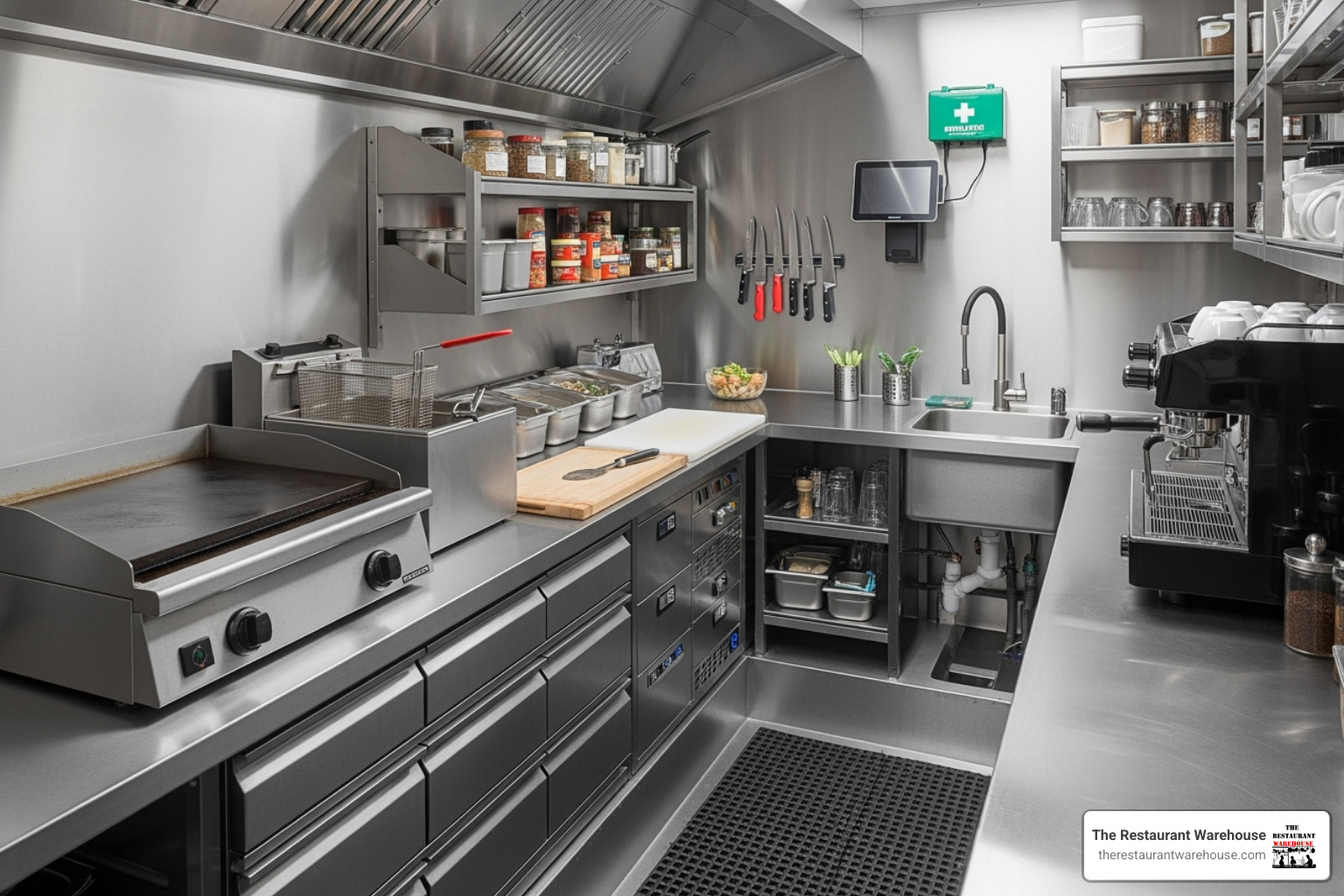
In a food truck kitchen, where space is minimal, every equipment decision impacts your entire operation. When searching for a food truck stove for sale, you're choosing a cornerstone piece that defines your kitchen's flow.
Countertop models are essential, delivering commercial power without dominating counter space. Equipment with compact footprints, like a 24-inch range, provides a powerful centerpiece while leaving room for other necessities. Multi-function units, such as a griddle with integrated burners, offer versatility without taking up extra space.
Thinking vertically by stacking equipment can double your cooking capacity. A salamander broiler mounted above your range is a perfect example. The key to success is workflow design, where your layout allows ingredients to flow logically from prep to cooking to plating. Your equipment choices shape this entire process, so it's crucial to create a kitchen that lets you work efficiently.
Ventilation: A Critical Space Consideration
Proper ventilation is a non-negotiable legal and safety requirement. Hood systems are the core of this setup, engineered to capture heat, smoke, and grease at the source. Most food truck hoods are 8 to 10 feet long, and an extension can cost around $2,500.
Exhaust fans must be correctly sized for your cooking volume. Critically, your hood must integrate an automatic fire suppression system (like an Ansul system) and be paired with K-class fire extinguishers. The space requirements for hoods and their components are significant and must be planned from the beginning, as they influence your entire kitchen layout.
When done right, your ventilation system creates a safe, comfortable, and inspection-ready kitchen. For detailed guidance, see our Commercial Kitchen Hood Guide.
Where to Find the Best Deals on a Food Truck Stove for Sale
When shopping for a food truck stove for sale, the goal is to find the right balance of quality, price, and support. Knowing where to look can save you thousands.
Specialized Suppliers
Specialized restaurant equipment suppliers understand the unique needs of your business. At The Restaurant Warehouse, we curate equipment specifically for performance in mobile kitchens. Our wholesale pricing benefits come from skipping the retail middlemen, passing savings of 30% or more directly to you. Online restaurant supply stores offer the convenience of comparing models and accessing a wide inventory from anywhere.
For more insights on finding reliable suppliers, check out our guides: Cook Up A Storm With These Commercial Cooking Equipment Suppliers and our Buy Restaurant Equipment Guide.
Finding a New Food Truck Stove for Sale

Buying new equipment offers several advantages. The warranty benefits (typically 1-3 years) provide peace of mind and protect against costly downtime. You also get the latest technology, which often means better energy efficiency and more precise controls, saving you money on fuel over time. Above all, reliability is the most compelling reason to buy new, as you start with zero wear and tear.
Price ranges for new equipment vary. A new 2-burner stove is about $500, while a new 4-burner range with an integrated storage base is around $2,500. Specialty items like a new 18-inch wok burner cost about $2,500, and griddles or grills are in the $1,500-$2,500 range depending on size. Our Commercial Gas Stoves Guide offers more detail.
Finding a Used Food Truck Stove for Sale
A quality used food truck stove for sale can be a smart financial move for startups. The primary benefit is cost savings; a used 3-burner stove might sell for around $600, a fraction of the new price. However, there are potential risks, as you inherit the equipment's history and lack a warranty.
Thorough inspection is crucial. Check that burners light evenly, controls work smoothly, and there are no signs of rust or damage. Refurbished options offer a middle ground, as they are professionally serviced and may come with a limited warranty. Success with used equipment requires careful evaluation. For help navigating this market, see our Used Commercial Kitchen Guide.
Matching the Heat to the Street: Features, Capacity, and Menu
Choosing the right food truck stove for sale means matching its capabilities to your menu's demands. A taco truck needs different power than a burger van or a coffee cart.
Burner count is your starting point. A 2-burner stove (~$500 for a new 12-inch unit) works for simple or focused menus. Most trucks find a 4-burner stove (~$2,500 for a new 24-inch range) provides the ideal flexibility for handling multiple orders.
BTU ratings determine heat output. Look for commercial burners delivering 20,000 to 35,000 BTUs. Higher BTUs mean faster heating and quicker recovery times, which is essential during a rush.
Griddle size impacts your output. A 24-inch griddle (~$1,500) is solid for smaller operations, but a 36-inch griddle (~$2,500) can double your capacity for burger or breakfast concepts.
Fryer capacity is typically around 40 lbs of oil for food truck units. A 16-inch double-basket fryer (~$1,500) can handle the needs of most mobile kitchens.
For more on specifications, see our guides on Restaurant Ranges and our Commercial Gas Range Guide.
Stove Setups for Popular Food Truck Concepts
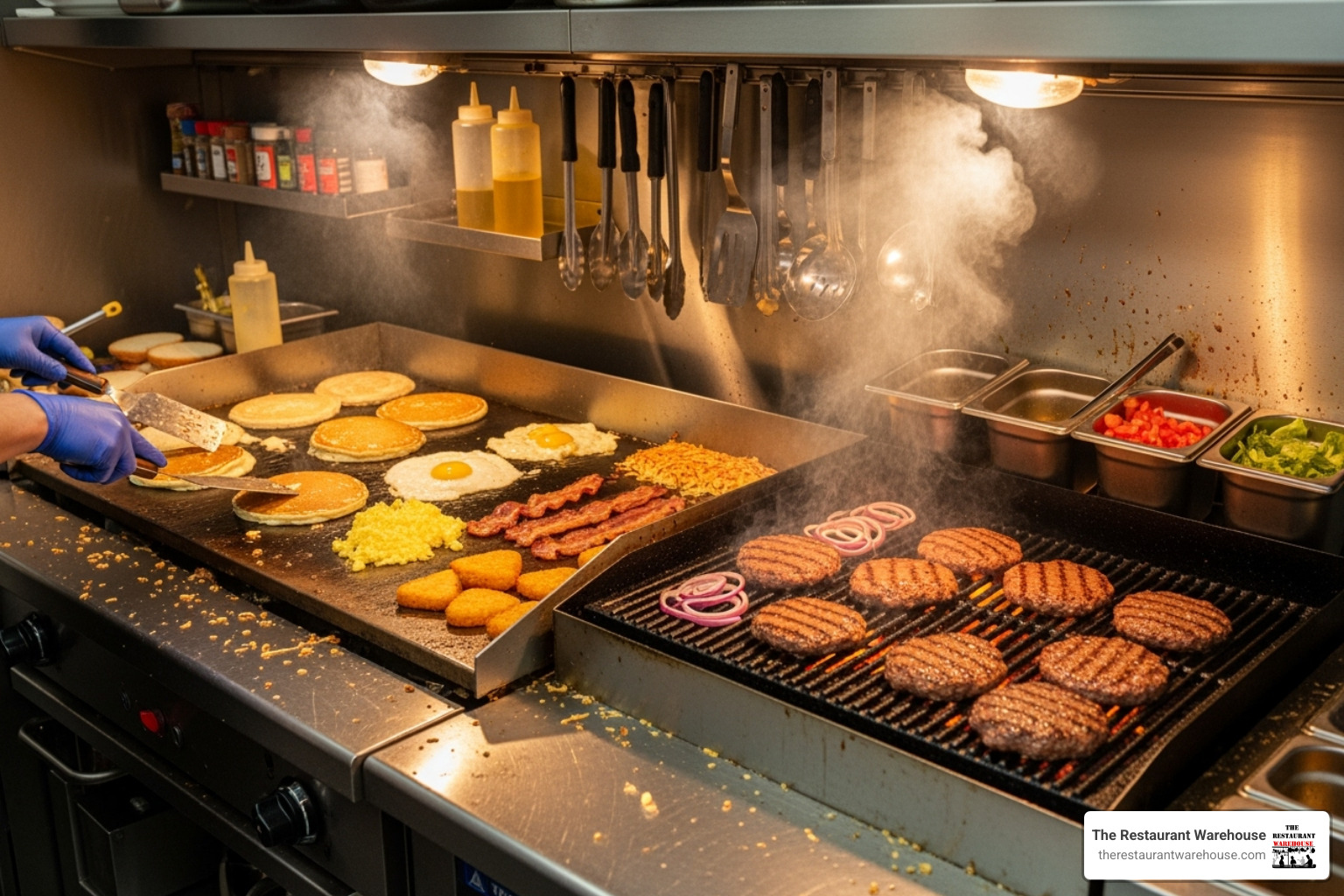
Taco trucks rely on a large 36-inch flat-top griddle for searing meats and are often paired with 2-3 high-BTU burners for sides and salsas. A small fryer is a common addition.
Burger vans need a charbroiler for smoky flavor or a large flat-top griddle for fast-cooking smash burgers. A double-basket fryer for fries is non-negotiable.
Coffee and pastry trucks have simpler needs. A small hot plate for liquids and a warming drawer for pastries are often sufficient. Some may add specialty equipment like a commercial crepe maker or waffle iron for fresh-made treats.
Staying Compliant: Safety Regulations and Inspections
When shopping for a food truck stove for sale, you are investing in machinery that must meet strict safety standards. These regulations protect your customers, staff, and business in a high-risk environment.
NSF certification is your first checkpoint. It ensures equipment meets public health standards for cleanability and safe materials. Reputable suppliers only carry NSF-certified equipment.
Local health codes dictate everything from your 3-compartment sink setup to waste disposal and kitchen workflow.
Fire safety is paramount. Your fire suppression system (e.g., an Ansul system) is a mandatory, life-saving feature integrated into your exhaust hood. It must be paired with accessible K-class fire extinguishers and an emergency pull station.
Gas line inspections are critical for propane-powered trucks. Your system must be professionally installed and regularly inspected by certified authorities to prevent dangerous leaks.
Electrical inspections ensure your wiring can handle the high power draw of commercial equipment, preventing fire hazards.
Ventilation requirements tie all safety aspects together, as a robust hood system prevents the dangerous buildup of grease, smoke, and heat.
Navigating these requirements is easier when working with experienced suppliers who understand food truck regulations. Compliance is not an obstacle; it's the foundation for operating safely and building customer trust.
For comprehensive guidance, review our Food Truck Regulations guide and check local examples, like Toronto's permit information, to understand requirements in your area.
Frequently Asked Questions about Food Truck Stoves
Here are answers to the most common questions we receive from entrepreneurs searching for a food truck stove for sale.
What is the most common type of stove for a food truck?
Propane-powered equipment is the industry standard due to its power and portability. The most common setup includes a compact commercial range (2 or 4 burners) combined with countertop units like a griddle or hot plates. This modular approach maximizes limited space while providing power independence, allowing you to operate anywhere.
How many BTUs do I need for a food truck stove?
For commercial-grade burners, you should look for a range of 20,000 to 35,000 BTUs per burner. This level of power ensures fast recovery time—meaning your cooking surface gets back to temperature quickly after adding cold food. This is crucial for maintaining speed and food quality during busy service periods.
Do I need a special license for a propane stove in my food truck?
Yes, you must comply with local safety regulations. This isn't a single "license" but a series of requirements. Your entire propane system must be installed by a certified professional and pass mandatory fire department and gas system inspections. These certifications ensure your setup is safe for you, your employees, and the public.
Conclusion
Finding the right food truck stove for sale is the most critical decision for your mobile business. Your cooking equipment is the engine of your operation, and the right choice will dictate your efficiency, capacity, and profitability.
To make the best decision, remember these key takeaways:
- Let your menu guide you: Match your equipment's capabilities (griddle, charbroiler, burners) to the food you plan to serve.
- Plan your space carefully: In a compact kitchen, countertop models, multi-function units, and smart layouts are essential for an efficient workflow.
- Choose the right fuel: For most, propane offers the best combination of power, portability, and cost-effectiveness, giving you the freedom to operate anywhere.
- Budget smartly: Balance the reliability and warranty of new equipment against the cost savings of a well-inspected used unit.
- Prioritize safety and compliance: Adhering to NSF, fire, and health codes protects your investment and builds customer trust.
The most successful food truck owners are those who invest time in matching their equipment to their vision. The choices you make today will define your business for years to come.
Ready to build your dream mobile kitchen? Check out our ultimate Restaurant Kitchen Equipment Checklist to ensure you have everything you need to turn your vision into a thriving reality.
About The Author

Sean Kearney
Sean Kearney used to work at Amazon.com and started The Restaurant Warehouse. He has more than 10 years of experience in restaurant equipment and supplies. He graduated from the University of Washington in 1993. He earned a BA in business and marketing. He also played linebacker for the Huskies football team. He helps restaurants find equipment at a fair price and offers financing options. You can connect with Sean on LinkedIn or Facebook.
Leave a comment