

From Chaos to Culinary Control: Why Every Restaurant Needs a Prep Station
Why Every Commercial Kitchen Needs Strategic Control
A commercial prep station is the command center of any successful restaurant kitchen—a dedicated, multi-functional workspace that combines refrigerated ingredient storage, durable preparation surfaces, and intuitive organization tools to streamline the entire food production process. These essential units are far more than simple tables; they serve as the critical bridge between raw ingredients and finished dishes, ensuring every component remains fresh, instantly accessible, and held at a precise, safe temperature. They are the physical embodiment of kitchen efficiency, transforming potential chaos into a symphony of controlled, profitable activity.
Quick Answer: What is a Commercial Prep Station?
- Primary Function: A centralized, ergonomic workspace designed for the complete preparation of dishes, from chopping and mixing to final assembly, while providing immediate access to chilled ingredients.
- Key Types: Specialized units include refrigerated prep tables, non-refrigerated work tables, sandwich/salad units, pizza prep tables, and high-capacity "Mega Top" tables.
- Essential Features: Precise temperature control (maintaining a strict 33-41°F range for refrigerated units), heavy-duty stainless steel construction for durability and hygiene, configurable ingredient pans (food pans), and integrated cutting boards.
- Main Benefits: Dramatically improved workflow efficiency, strict adherence to food safety and HACCP compliance, significant reduction in prep time and ticket times, superior ingredient organization, and reduced food waste.
- Common Applications: Indispensable in pizzerias, delis, sandwich shops, cafes, salad bars, ghost kitchens, and full-service restaurants that require high-volume, consistent output.
Walk into any chaotic restaurant kitchen during the dinner rush, and you'll witness the cost of inefficiency firsthand: cooks frantically running between walk-in coolers, low-boy refrigerators, and scattered prep surfaces. Cross-contamination risks increase, ticket times soar, and staff morale plummets. Now, picture that same kitchen with strategically placed prep stations. Everything needed for each specific menu item is within arm's reach. Ingredients stay at optimal temperatures, protected from the ambient heat of the kitchen. The entire workflow moves like a well-oiled machine, with each team member executing their tasks in a defined, ergonomic space.
The global market for professional foodservice solutions, valued at $25.5 billion in 2023, is projected to reach an impressive $41.7 billion by 2032. Prep stations represent a significant and growing portion of this investment. Modern restaurant owners are realizing that efficiency in food preparation isn't just about speed; it's about creating robust, repeatable systems that maintain ingredient integrity while slashing preparation time. The right commercial prep station can make or break a restaurant's daily operations, fundamentally changing a chaotic scramble into a highly efficient and profitable culinary operation.
The Heart of Kitchen Workflow: Functions and Benefits of a Prep Station
Picture this: It's the peak of your Saturday night dinner rush, and the kitchen is humming with energy. Orders are flying in, but instead of chaos and stress, your team moves with the fluid precision of a seasoned orchestra. The secret to this harmony? Strategic commercial prep stations that transform hectic scrambling into smooth, professional execution. This is where the foundational French culinary concept of mise en place—having everything in its place—truly comes to life in a modern foodservice setting. A well-designed prep station doesn't just organize ingredients; it creates a powerful, self-contained ecosystem for culinary excellence, empowering your staff to perform at their absolute best.
The magic happens when you eliminate the endless, time-wasting back-and-forth between disparate storage areas, coolers, and prep surfaces. Every step saved is a second gained. When staff can stand in one place and access everything they need—from chilled proteins and fresh vegetables to cutting boards and utensils—they can focus their full attention on creating exceptional food. This streamlined workflow turns your kitchen from a cost center into a profit-generating machine. Increased productivity follows naturally, as your team can assemble and plate more dishes in less time without ever sacrificing quality or consistency. This heightened efficiency directly and positively impacts your bottom line, allowing you to serve more customers, increase table turnover, and reduce costly labor hours.
Perhaps most importantly, this systematic approach ensures unwavering consistency in every dish that leaves the kitchen. When ingredients are meticulously organized and procedures are standardized around these dedicated prep areas, your staff can execute recipes with pinpoint precision, time after time. This is the bedrock of customer loyalty and positive reviews. The impact on reduced ticket times is immediate and measurable. Faster, more accurate preparation means hotter food, happier customers, and higher table turnover, especially during crucial peak hours. For comprehensive strategies on optimizing your entire operation, explore our guide on How to Improve Restaurant Operations.
Boosting Efficiency and Ensuring Safety
The profound beauty of a commercial prep station lies in its ability to create a centralized workspace that ruthlessly eliminates wasted motion. By establishing designated zones within each station—dedicated cutting areas, specific assembly points, and organized ingredient storage—you create a mini-ecosystem of peak efficiency. This thoughtful ergonomic design dramatically reduces the physical strain and movement your staff needs to make, keeping them focused, energized, and less prone to fatigue-related errors. The ergonomics of a well-designed prep station cannot be overstated; when your team isn't constantly bending, reaching, or walking across the kitchen, they can maintain their energy and focus on the fine details of food quality, which in turn improves staff productivity and retention.
Beyond pure efficiency, modern prep stations are non-negotiable tools for food safety compliance. Refrigerated units are engineered to maintain precise temperature control, typically holding perishable ingredients between 33°F and 41°F (0.5°C to 5°C). This critical temperature range, known as the safety zone, significantly slows bacterial growth and keeps ingredients at their peak freshness and quality. The design also inherently promotes cross-contamination prevention through the use of dedicated, separated ingredient wells and easily removable pans. This system of separation aligns perfectly with HACCP principles, a systematic preventive approach to food safety that focuses on identifying and controlling physical, chemical, and biological hazards. Smart organization within the station also helps minimize food waste by keeping ingredients fresh, visible, and easily inventoried, preventing costly spoilage. Learn more about this crucial aspect in our article on Reducing Food Waste in Restaurants.
For detailed information on implementing these critical food safety systems, our guide on What is HACCP Food Safety is a valuable resource. For official guidelines, the FDA Food Code on Time/Temperature Control provides the authoritative standards for the industry.
Decoding the Options: Types of Prep Stations
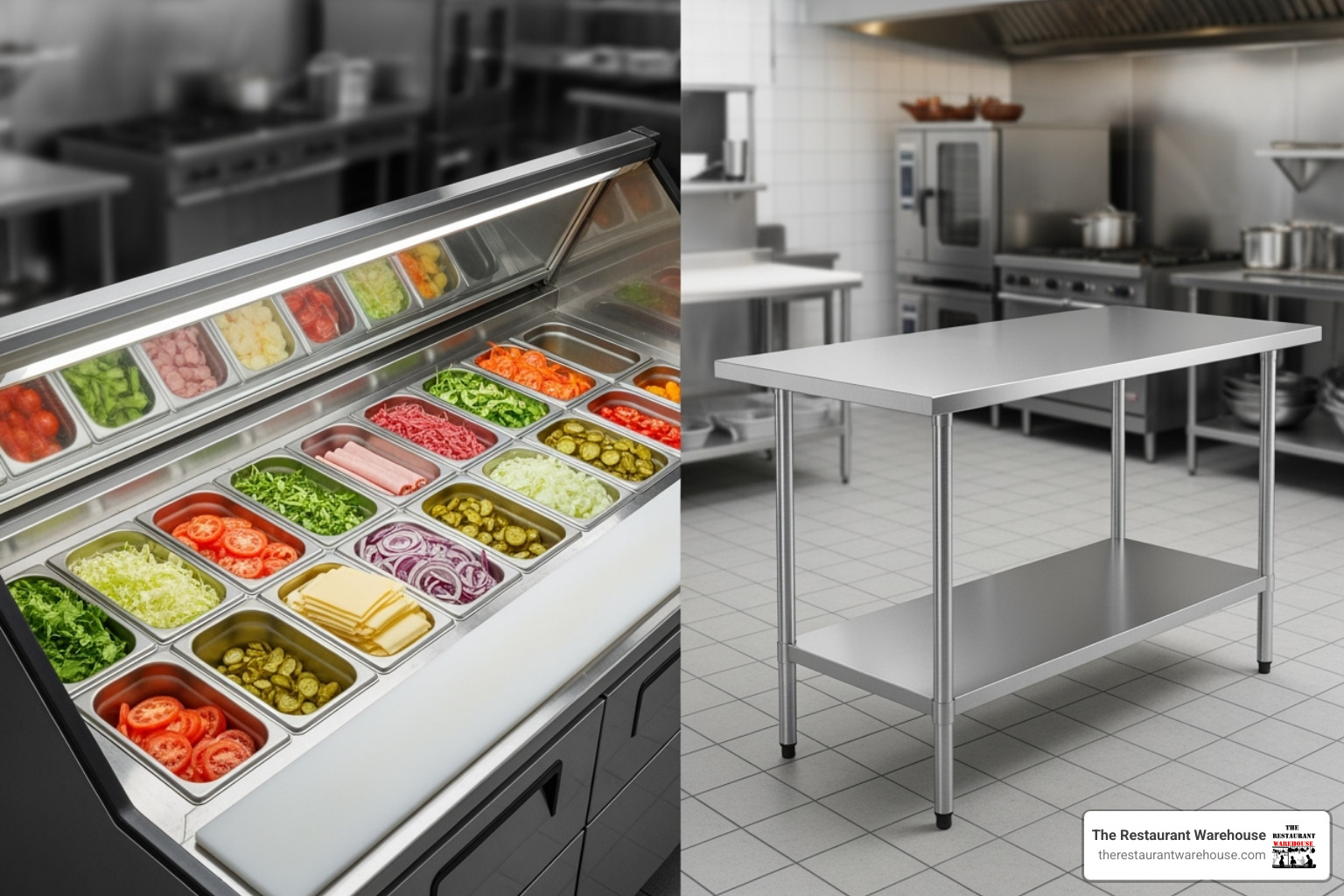
Choosing the right commercial prep station is a critical decision that involves matching the unit's design and features to your kitchen's specific menu, volume, and workflow. The most fundamental decision is between refrigerated units and non-refrigerated tables. Refrigerated stations are the cornerstone of operations handling perishable, time-temperature sensitive ingredients. They are essential for keeping sandwich meats, pizza toppings, salad greens, and cut vegetables safely chilled and fresh. Non-refrigerated tables, on the other hand, are the versatile workhorses for dry prep work, such as dough kneading, portioning dry goods, or any task where ambient temperature is not a critical factor.
Within the refrigerated family, you'll find a range of specialized options designed for specific applications, most notably sandwich/salad units and pizza prep tables. These designs feature an array of ingredient pans (or wells) that sit in an insulated, chilled rail on top of the work surface, keeping every topping perfectly organized and instantly accessible during a busy service. For kitchens with extensive menus or extremely high volume, Mega Top tables offer a solution by providing deeper rails that can accommodate more rows of pans and larger cutting surfaces. On the simpler side, basic work tables provide sturdy, reliable workspace without refrigeration, forming the backbone of prep areas in nearly every kitchen. Our guide From Deli to Dough: Unpacking the Versatility of Prep Coolers explores how different stations can transform your workflow. For sandwich-focused operations, our Sandwich Prep Table Guide offers detailed insights.
Refrigerated Prep Tables: The All-in-One Solution
Refrigerated prep tables are the ultimate key to unlocking efficiency and consistency in high-volume settings. Sandwich/salad tables are the indispensable workhorses of delis, cafes, and quick-service restaurants. They are engineered to keep a wide variety of toppings in perfectly sized pans (typically 1/6-size or 1/9-size) at eye level, completely eliminating time-wasting trips to a separate cooler. The integrated cutting board rails provide a dedicated, sanitary surface for assembly, while the spacious undercounter refrigeration cabinet keeps backup ingredients ready for immediate restocking during a rush. This all-in-one design creates a seamless, linear workflow from assembly to service.
Pizza prep tables brilliantly adapt this concept for the unique demands of pizzerias. These units feature significantly deeper cutting boards (often 19 inches or more) to accommodate large pizza doughs and larger ingredient pans (usually 1/3-size) for hefty, high-volume toppings like shredded cheese and pepperoni. A key feature is the raised pan rail, which is often refrigerated with a gentle airflow system designed to keep toppings cold without drying them out. Both styles are engineered to maintain the critical temperature zone between 33°F and 41°F, keeping ingredients fresh, safe, and compliant with health codes. The removable ingredient pans are a crucial feature, simplifying cleaning, refilling, and end-of-day storage. These all-in-one solutions shine brightest in operations where speed, consistency, and food safety are paramount. Pizza operations will find valuable insights in our Pizza Prep Stations guide.
Non-Refrigerated Prep Tables: The Versatile Workhorse
Stainless steel work tables are the unsung heroes and foundational building blocks of many successful kitchens. Their elegant simplicity is their greatest strength, providing flexible, durable, and hygienic workspace for a multitude of tasks. When choosing one, it's vital to consider the material grades. 304 stainless steel is the industry standard and preferred choice for tabletops and food-contact surfaces due to its superior corrosion resistance, thanks to a higher chromium and nickel content. This makes it resilient against acids from foods and harsh cleaning chemicals. 430 stainless steel, which is more budget-friendly but less corrosion-resistant, is often used for legs and undershelves where direct food contact is minimal. Pay attention to the table's edge type as well; a 'marine edge' features a raised lip to contain spills, while a 'bullnose edge' is rounded for safety and comfort.
Undershelves are a simple but powerful feature, transforming a basic work surface into a multi-level storage hub for mixing bowls, sheet pans, ingredient bins, and other bulky items, keeping the main worktop clear and organized. Adding casters (wheels) makes the table mobile, which is incredibly useful for daily floor cleaning or for rearranging your kitchen layout to accommodate different service needs or new workflows. These tables excel in a wide variety of applications, from bakery prep and vegetable chopping to butchering and final plating. Our Stainless Steel Tables Guide breaks down the technical specifications, while our Prep Table Stainless Steel Guide helps you choose the right materials for maximum longevity.
How to Choose the Right Commercial Prep Station
Choosing the perfect commercial prep station requires a thoughtful, strategic approach that goes far beyond just budget and physical size. It's about integrating a powerful tool that will fundamentally improve your daily workflow, boost your team's efficiency, and directly contribute to your bottom line. To make the right choice, you need to analyze your operation from three critical angles: your physical space and existing workflow, the demands of your menu, and the long-term financial value of the unit.
First, you must deeply consider your kitchen space and workflow. Don't just measure the footprint where the station will sit; account for every spatial interaction. This includes door swings (both for the unit and the room), vertical height clearance for any overshelving, and, most importantly, how staff move through the area. A proper workflow analysis can reveal hidden bottlenecks and inefficiencies. Observe your team during a peak service period: Are they constantly crossing paths, creating traffic jams? Are they struggling for elbow room or clean workspace? The ultimate goal is to place the station in a location that supports a natural, linear flow from storage to prep to the cooking line, minimizing wasted steps and maximizing output.
Second, meticulously evaluate your menu complexity and food volume. A simple sandwich shop offering a dozen core items has vastly different needs than a gourmet pizzeria with thirty-plus toppings or a high-volume salad bar. Your menu directly dictates the number, size, and configuration of ingredient pans you'll need. Your peak-hour volume determines the required undercounter storage capacity and the overall durability required of the unit. A high-volume operation might need a larger "Mega Top" unit with three rows of pans or even multiple, specialized stations to keep up with demand without sacrificing quality or speed.
Finally, train yourself to think in terms of long-term value over upfront cost. A well-chosen, high-quality prep station is an investment that pays for itself through reduced labor costs, less food waste from spoilage, and improved output. Don't let a slightly higher initial price deter you from a unit with a more efficient compressor, better insulation, or more durable construction. These features will save you money on energy bills and repair costs every single day. For kitchens with limited square footage, compact options can provide full functionality without overwhelming the space. Our guide on Choosing 27 Prep Table covers excellent options that don't compromise on essential features.
Ready to find the perfect prep station for your kitchen? Contact us today for personalized recommendations based on your specific needs and space requirements, or browse prep station solutions to see what fits your operation.
Assessing Your Space and Matching to Your Menu
Before you even browse for models, grab a measuring tape and a notepad. Your measurements must be precise and comprehensive. Include not only the length and depth of the available space but also the vertical height clearance for any potential overshelves and the required ventilation space around the refrigeration system (usually a few inches on the back and sides). Critically, measure the clearance needed for door swings to ensure they don't obstruct busy walkways. Your kitchen layout dictates the flow of food, and the best station placement supports and enhances this flow. Map out your ideal assembly line process on paper. For a sandwich shop, the flow is typically linear: refrigerated storage to prep station assembly to the customer. For a pizzeria, the workflow is more complex, with dough, sauce, cheese, and toppings potentially coming from different areas to converge at the prep table. Understanding these patterns is key to minimizing staff movement and maximizing efficiency.
Your menu is the ultimate blueprint for your prep station. Deli sandwiches and complex salads require stations with numerous small pans (like 1/6-size and 1/9-size) to accommodate a wide variety of sliced meats, cheeses, vegetables, and dressings. Pizzeria needs, by contrast, demand deeper, larger pans (typically 1/3-size) for bulk ingredients like shredded mozzarella and pepperoni, plus a much deeper cutting board for stretching and saucing dough. Cafes and bistros often need maximum versatility, benefiting from flexible pan configurations that can adapt to different tasks throughout the day, from breakfast burritos in the morning to sandwiches at lunch. The key is to match the station's design—its pan capacity, cutting board depth, and storage options—to your most frequently prepared and profitable menu items. Our Pizza Prep Table Comparison Cheat Sheet breaks down the specific features that make high-volume pizza operations more efficient.
Quality and Longevity: Essential Features and Maintenance
Investing in a commercial prep station is a long-term investment in your kitchen's core efficiency and your business's financial future. To ensure a strong return on this investment, it's crucial to prioritize durability, ease of cleaning, and refrigeration efficiency over flashy, unnecessary features. A reliable unit that is easy for staff to maintain is fundamental to both smooth daily operations and unwavering food safety. For any refrigerated model, the efficiency of its cooling system is key to managing high energy costs and ensuring consistent, safe temperatures day in and day out. The overall workspace design should be ergonomic and intuitive, and smart customization options can transform a standard unit into your kitchen's secret weapon for productivity.
Key Features and Customization
When evaluating a commercial prep station, focus on the features that directly determine its performance and longevity. Stainless steel construction is the industry standard, but the specific type matters immensely. Insist on Type 304 stainless steel for all food-contact surfaces, including the top and interior. Its higher chromium and nickel content provides superior resistance to corrosion from food acids and cleaning chemicals. Type 430 stainless steel, while less expensive, is more prone to rust and is only acceptable for non-critical components like sides and legs. The steel's gauge (thickness) is also important; a lower number signifies thicker, more durable material (e.g., 16-gauge is more robust than 18-gauge). Above all, insist on NSF certification. This independent mark ensures the unit has been rigorously tested to meet strict public health standards for material safety, design, and cleanability.
For refrigerated models, the compressor location significantly affects maintenance and airflow. Top-mounted compressors are often preferred in environments with greasy or flour-dusted air, as they are less likely to pull in floor debris, while side-mounted units can be better for tight spaces with low overhead clearance. Closely inspect the gasket quality around the doors and drawers. High-quality, magnetic gaskets that create a tight seal and are easily removable for cleaning are absolutely essential for maintaining temperature and energy efficiency.
Customizing your station can dramatically improve your specific workflow. The choice between drawers versus doors for undercounter storage is a key decision. Drawers are excellent for organizing smaller, portioned items and minimize cold air loss when opened. Doors, however, offer greater flexibility for storing bulkier items like large containers or hotel pans. Adding overshelves (single or double-tiered) creates invaluable vertical storage for tools, spice containers, and plates, keeping the primary work surface clear and uncluttered. Other powerful customizations like sink integration for handwashing or small-scale rinsing and caster options for mobility can further boost convenience and operational efficiency. Explore how to maximize your prep capacity with our guide, Prep Like a Pro: Your Guide to Mega Top Prep Tables.
Maintenance for Longevity and Performance
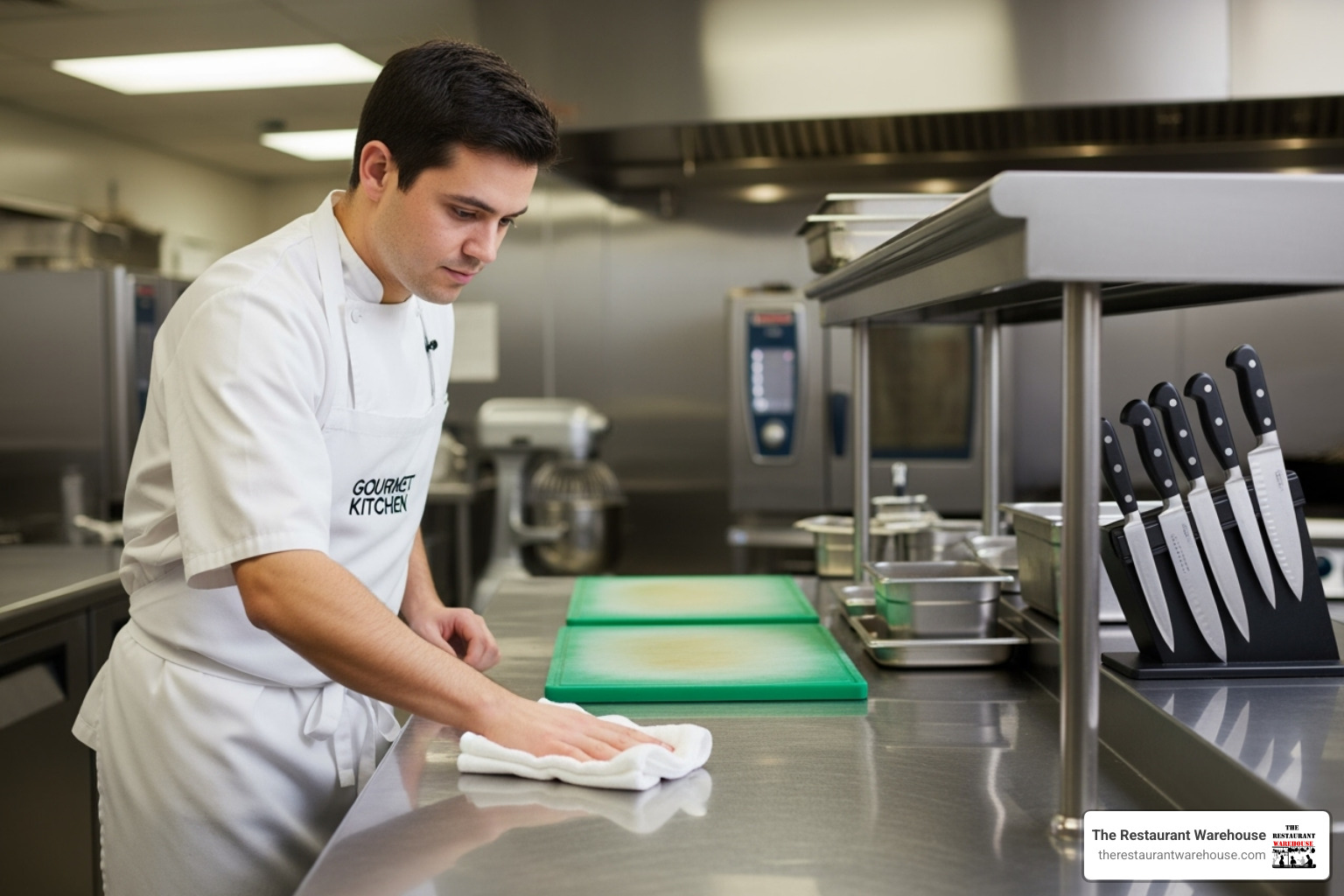
A proactive maintenance schedule will ensure your prep station outlasts and outperforms a neglected one, protecting your investment and preventing costly downtime. Your daily cleaning routine is the first and most important line of defense. This non-negotiable task list includes wiping down all stainless steel surfaces, thoroughly cleaning and sanitizing the cutting board, and washing and sanitizing all ingredient pans at the end of the day. Our guide Final Step: Cleaning & Sanitizing Prep Table provides a detailed checklist for this process.
Regular condenser coil cleaning is the single most critical maintenance task for any refrigerated unit. A clogged coil, choked with dust, grease, or flour, forces the compressor to work harder, dramatically increasing energy bills and leading to premature system failure. In a busy kitchen with significant airborne grease or flour (like a pizzeria), this may need to be done monthly; in cleaner environments, quarterly is often sufficient. A weekly gasket inspection should also be part of your routine. Check for any tears, cracks, or warping that could compromise the seal. A failing gasket is a major source of energy waste and compromises food safety. Finally, implement a system of daily temperature monitoring. Use a reliable, calibrated, independent thermometer to verify the unit's internal temperature, rather than relying solely on the external display. This ensures your unit is holding a safe temperature and helps you catch performance issues early. For more tips, our Sandwich Prep Table Maintenance guide offers actionable advice.
Frequently Asked Questions about Commercial Prep Stations
When choosing a commercial prep station, many of the same important questions arise for restaurant owners and kitchen managers. Here are detailed answers to the most common queries we receive at The Restaurant Warehouse, designed to help you make a confident and informed decision for your kitchen's unique needs.
What's the difference between a pizza prep table and a sandwich prep table?
While they look similar and are both refrigerated prep tables, these two units are highly specialized and engineered for very different workflows. Attempting to use one for the other's purpose will lead to inefficiency and frustration. The three main differences are cutting board depth, pan configuration, and the design of the refrigeration system.
- Cutting Board Depth: This is the most obvious difference. Pizza prep tables feature extra-deep cutting boards, typically 19-20 inches deep, to provide ample space for stretching large pizza doughs directly on the surface. Sandwich prep tables have much shallower boards, usually around 10-12 inches deep, which is perfect for the linear assembly of subs, sandwiches, and wraps.
- Pan Rail Configuration: The pan layout is tailored to the menu. Pizza tables are designed to use larger 1/3-size pans to hold high-volume, bulky toppings like shredded cheese, pepperoni, and sauce. Sandwich tables, in contrast, utilize a greater number of smaller 1/6-size or 1/9-size pans to offer a wide variety of sliced meats, cheeses, vegetables, and garnishes.
- Refrigeration and Airflow: The airflow within the refrigerated pan rail is specifically engineered for its purpose. Pizza tables often use a gentler, ducted airflow to keep shredded cheese and other toppings cold without drying them out or blowing them around. Sandwich tables use a more direct cooling method designed to maintain the crisp texture of delicate produce and the integrity of sliced meats.
For more details, you can review our Pizza Prep Table Guide and our Sandwich Prep Tables overview.
How often should I clean my refrigerated prep station's condenser coil?
Forgetting to clean the condenser coil is one of the most common and costly mistakes an operator can make. A clean coil is absolutely essential for the energy efficiency, cooling performance, and overall longevity of your commercial prep station's refrigeration system.
As a general rule, you should plan on performing a thorough quarterly cleaning. However, the single most important factor is your specific kitchen environment. A kitchen with high levels of airborne grease or flour, such as a high-volume pizzeria, bakery, or fried chicken spot, will require more frequent attention—potentially monthly or even bi-weekly cleaning. You must also watch for performance indicators. If you notice the unit is running constantly, struggling to hold its set temperature, or blowing warm air from the compressor area, these are urgent signs that the coil is clogged and needs immediate attention. A few minutes spent cleaning a coil can significantly reduce your monthly energy consumption and prevent an expensive emergency service call.
What is the ideal temperature for a refrigerated prep station?
Proper temperature control is the cornerstone of food safety and is non-negotiable in a professional kitchen. The ideal and legally required temperature range for a refrigerated commercial prep station is between 33°F and 41°F (0.5°C to 5°C). Most experienced operators find that setting the unit's thermostat to around 38°F provides a safe buffer and works best for most ingredients.
This range is critical because it keeps your perishable ingredients safely out of the temperature "danger zone" (defined by the FDA as 41°F to 135°F), where harmful bacteria can multiply at an exponential rate. Staying consistently below 41°F (5°C) is a standard and enforceable requirement for health code compliance in virtually every jurisdiction. While different ingredient types have slightly different optimal holding temperatures for quality (e.g., delicate lettuce vs. cured meats), the primary goal is always to keep everything safely chilled. A crucial pro tip is to use a calibrated, independent thermometer to verify the unit's internal air temperature daily. Do not rely solely on the built-in external display, which can be inaccurate. This simple practice of regular temperature monitoring helps ensure food safety and allows you to spot potential system issues before they lead to catastrophic food loss or a failed health inspection.
Conclusion
After exploring the critical functions, diverse types, and essential features of commercial prep stations, it's abundantly clear that they are far more than just pieces of stainless steel furniture. They are the strategic cornerstone of any efficient, safe, and organized modern kitchen. From dramatically boosting efficiency by centralizing workflow and eliminating wasted steps, to guaranteeing food safety through precise, consistent temperature control, the right prep station is one of the most powerful tools in a restaurant's arsenal. It brings deliberate organization to the potential chaos of a busy service, empowering your culinary team to perform at their highest level with less stress and greater consistency.
With the market for professional foodservice tools continuing to expand, savvy restaurant owners and operators recognize that investing in the right prep station is not an expense, but a smart investment in their business's success. A quality unit pays for itself many times over through improved productivity, reduced food waste, lower labor costs, and a smoother, less stressful work environment for your valuable staff.
At The Restaurant Warehouse, we understand the intense financial pressures of running a foodservice business. That's precisely why we've built our entire business model on providing high-quality, durable, and certified commercial units at true wholesale prices, allowing you to bypass the high retail markups common in the industry. Our dedicated team is committed to helping you find the perfect option that fits not only your operational needs but also your budget.
If you're ready to see what a profound difference the right prep station can make in your daily operations, our comprehensive Restaurant Prep Table Guide can help you navigate your options and make a confident choice.
Ready to transform your kitchen from chaos to culinary control? Book a Strategy Call or Contact Us for expert, no-pressure advice on choosing the perfect prep station. Our team is standing by to help you find exactly what your kitchen needs to run like the well-oiled machine it should be.
About The Author

Sean Kearney
Sean Kearney is the Founder of The Restaurant Warehouse, with 15 years of experience in the restaurant equipment industry and more than 30 years in ecommerce, beginning with Amazon.com. As an equipment distributor and supplier, Sean helps restaurant owners make confident purchasing decisions through clear pricing, practical guidance, and a more transparent online buying experience.
Connect with Sean on LinkedIn, Instagram, YouTube, or Facebook.