


Mobile Munchies: The Best Portable Restaurant Equipment for Your Food Truck
Gearing Up for Success on Wheels
Choosing the right food truck restaurant equipment is crucial for your mobile kitchen's success, whether you're starting fresh or upgrading.
Here's a quick look at essential equipment:
- Cooking Equipment: Griddles, fryers, ovens, and stovetop burners.
- Refrigeration: Commercial refrigerators, freezers, and ice makers.
- Prep & Serving: Stainless steel prep tables, cutting boards, and a point-of-sale (POS) system.
- Sanitation & Safety: Three-compartment sinks, handwashing sinks, and fire suppression systems.
The food truck industry is booming, growing at 15% annually and on pace to double in the next decade. This growth means more opportunity and competition. Efficient, reliable equipment helps you stand out and serve delicious meals on wheels.
This guide will cover the best equipment choices, considering space, budget, and efficiency to help your food truck thrive.
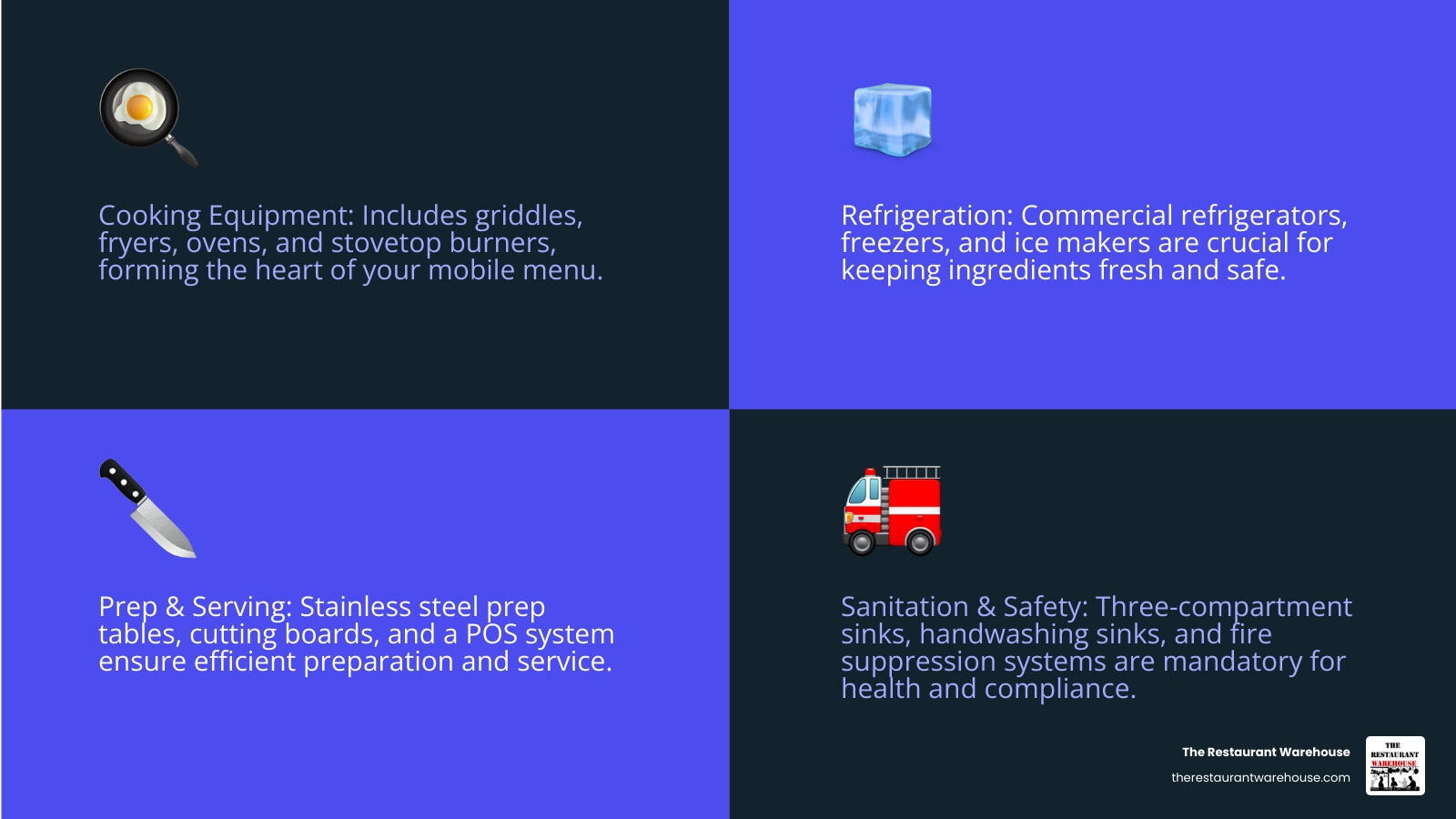
Simple guide to food truck restaurant equipment terms:
The Core Kitchen: Essential Cooking & Refrigeration Equipment
Behind every great food truck menu is an efficient, compact kitchen with the right food truck restaurant equipment. This section covers the must-have cooking and refrigeration units that form the heart of your mobile kitchen.
Cooking Appliances: The Heart of Your Mobile Menu
Your cooking equipment shapes your menu and output. In a tight food truck space, every piece must be a compact workhorse.
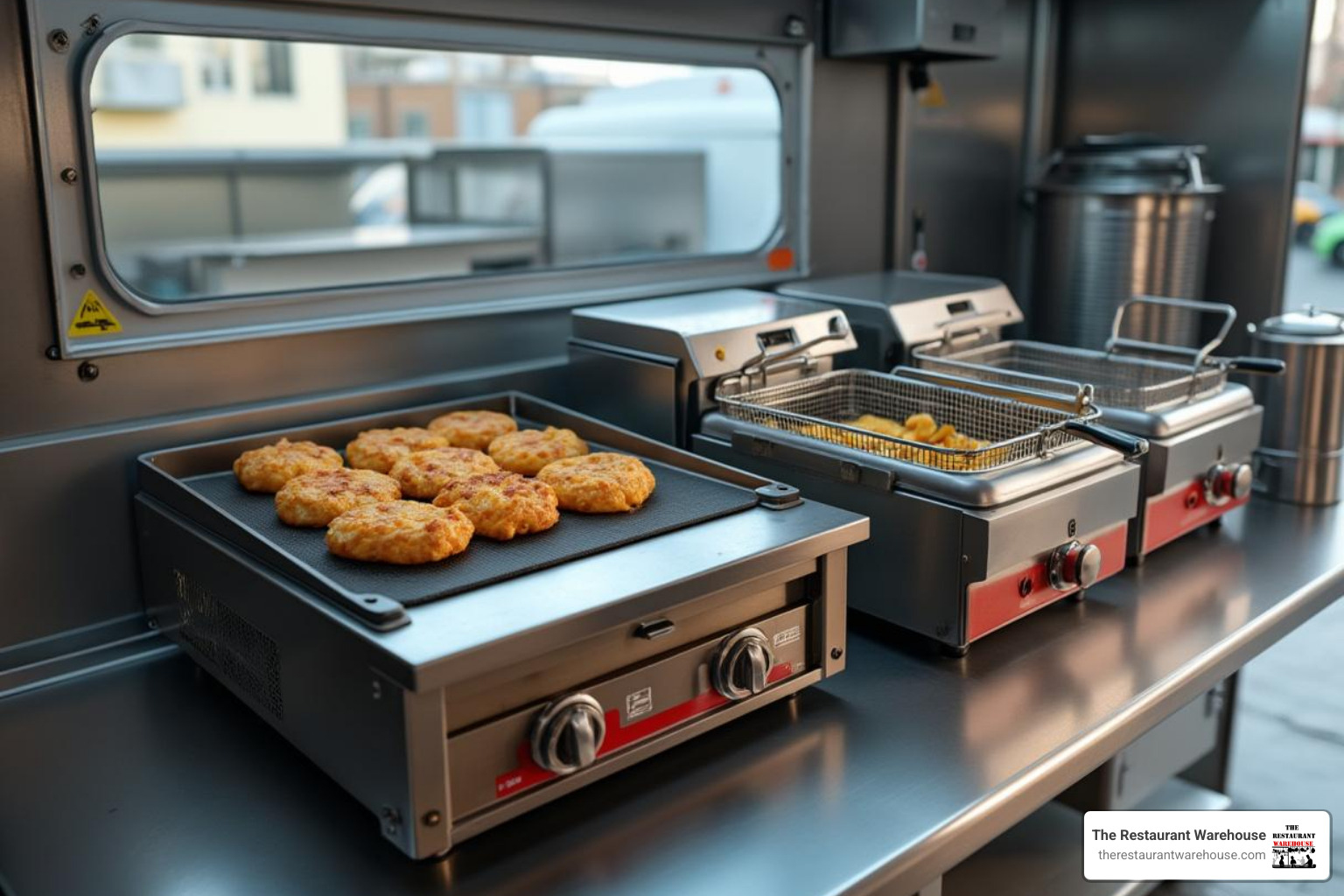
A griddle or grill is one of the most versatile pieces of equipment, perfect for cooking everything from pancakes to burgers. Its flat surface is efficient, while grills offer a charred flavor. Countertop models are ideal for saving space. Expect to pay $1,000 to $3,000. Propane is often a cost-effective and easy-to-install fuel source.
If your menu features items like french fries or chicken tenders, a deep fryer is essential. Countertop models are perfect for food trucks, offering quick, efficient cooking. A good unit costs between $500 and $2,000. A model with a basket lift can boost speed during peak hours.
Not every food truck needs an oven, but it's essential for menus with baked goods or roasted items. Compact convection ovens are popular for their speed and even cooking. An oven for your food truck can cost between $1,000 and $5,000.
For sauces, soups, and sautéed dishes, stovetop burners are vital. Countertop gas ranges with two to four burners allow for multitasking and typically range from $200 to $1,200.
A microwave ($100 - $300) is handy for quick reheating and defrosting. For smoothies or pureed soups, a commercial blender ($50 - $200) is a crucial, heavy-duty tool.
Want to learn more about all the cooking essentials? Check out our guide on Trailer Made Meals Concession Trailer Cooking Equipment Essentials.
Cold Storage: Keeping Ingredients Fresh and Safe
Proper cold storage is critical for food safety, especially in a mobile business. The right units keep ingredients fresh and compliant with health codes while optimizing space.
Refrigerators are non-negotiable for keeping perishables safe. Compact, undercounter units are common. Refrigerated prep tables are highly valuable, offering both cold storage and a workspace. Expect to pay $1,000 to $3,000.
A dedicated freezer is a must for frozen items. Compact and efficient models help manage inventory and keep food fresh. A freezer typically costs $500 to $2,000.
Depending on your menu, an ice maker can be a critical piece of food truck restaurant equipment, especially for drinks. Countertop models are ideal for food trucks and generally cost $1,000 to $3,000.
Efficient dry storage is vital for non-perishables like spices and paper goods. Shelving or cabinets are common solutions, costing $200 to $800.
Insulated food pan carriers ($100 - $500) are useful for catering or transport from a commissary. They maintain food-safe temperatures, which is key for quality and safety on the go.
For a complete list of all the equipment you might need, take a look at our Food Truck Equipment List.
Prep, Service, and Safety: The Backbone of Your Operation
Beyond the main cooking gear, prep, service, and safety equipment are vital for a smooth, legal, and profitable operation. This food truck restaurant equipment ensures everything from chopping vegetables to serving customers happens efficiently and safely.
Your Essential Food Truck Restaurant Equipment for Prep & Service
In a food truck's limited space, efficiency is everything. The right prep and service food truck restaurant equipment boosts productivity and customer satisfaction by enabling you to work smarter.
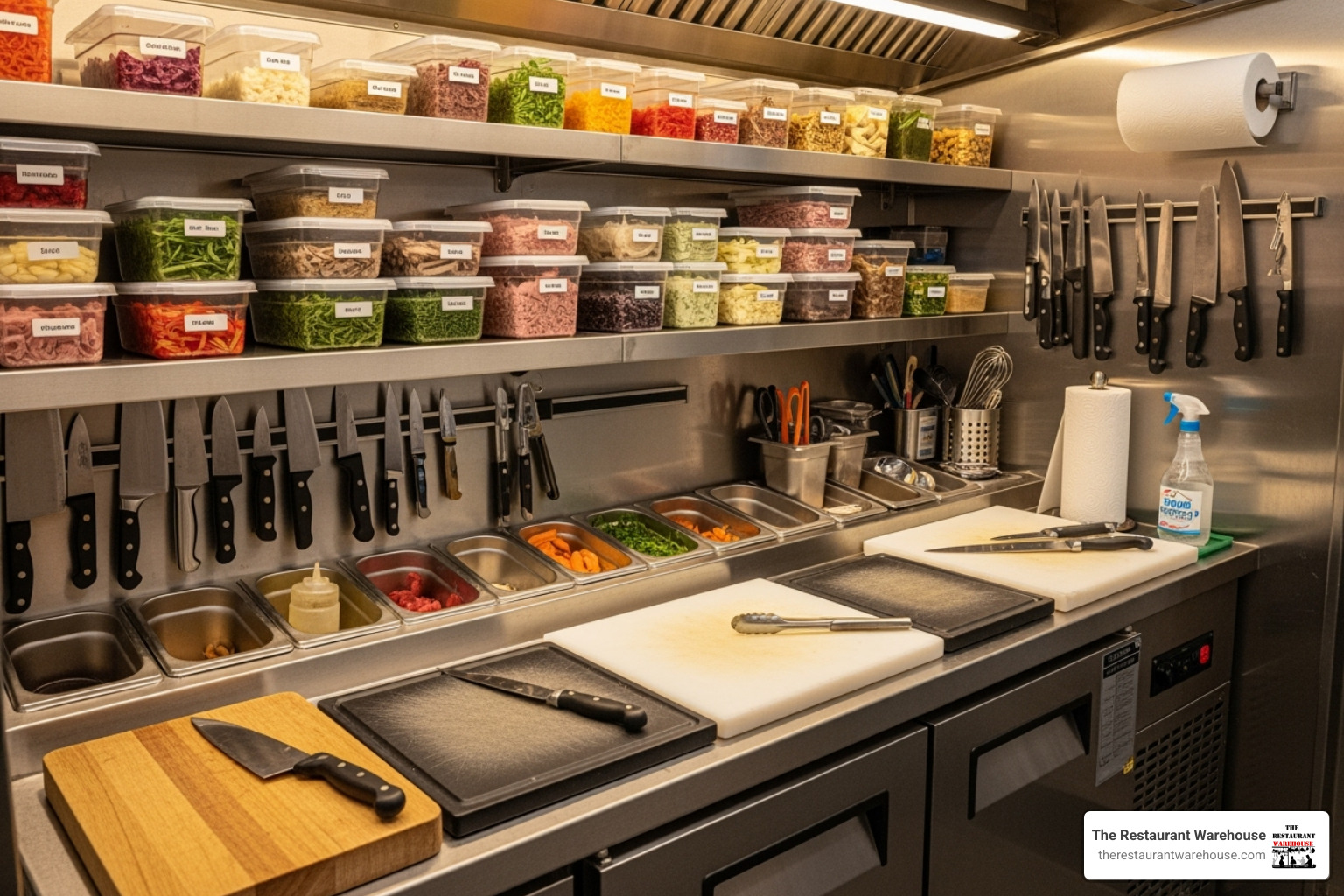
Stainless Steel Prep Tables are kitchen workhorses. They are durable, easy to clean, and meet health codes. Models with undershelves maximize vertical storage. They are perfect for all prep work and cost between $200 and $1,000. Look for adjustable or wheeled legs for flexibility.
Multiple Cutting Boards ($10 - $50 each) are needed to prevent cross-contamination; color-coded systems are a smart practice. A full set of commercial-grade Utensils ($50 - $200), like spatulas and tongs, is also essential for handling high heat and heavy use.
Food Pans & Containers ($50 - $200) are key for organizing ingredients and holding food. Stainless steel pans are especially versatile. For service, disposable Serving Supplies ($50 - $200) like plates, cutlery, and napkins are a must for speed and convenience.
A good POS (Point of Sale) System is a game-changer for taking orders, processing payments, and tracking sales. Mobile, tablet-based systems are ideal for food trucks. Using a QR code system for menus and payments can further streamline service and reduce wait times.
Mandatory Sanitation and Safety Gear
Strict health and safety rules for mobile food businesses are non-negotiable. The right sanitation and safety food truck restaurant equipment is a crucial investment that protects your customers and team, building trust and a great reputation.
A dedicated Handwashing Sink is a mandatory requirement by health departments. It must have hot and cold water, soap, and paper towels, and be separate from other sinks. Expect to spend $300 to $1,000.
A Three-Compartment Sink ($500 - $2,000) is also essential for the proper washing, rinsing, and sanitizing of dishes and cookware. Our Food Truck Sinks Guide has more details.
Safety is paramount. Fire Extinguishers are mandatory, including at least one K-class extinguisher ($50 - $150) for grease fires. A well-stocked First Aid Kit ($20 - $50) is also a must for handling minor injuries.
Trash and Recycling Bins ($50 - $200) are needed for cleanliness. A powerful Ventilation Hood is crucial for removing heat, smoke, and grease, improving air quality for staff and preventing fire hazards. This is a major safety requirement.
Understanding and following all the rules is truly key to success. You can learn more about what you need to do to stay compliant in our guide on Food Truck Regulations.
Smart Shopping: Key Factors for Buying Food Truck Restaurant Equipment
You know what tools you need, but buying food truck restaurant equipment is more than just checking off a list. It's about making strategic choices that impact your operations, profits, and sanity. Considering factors beyond price ensures your investment serves you well and helps you build a dream mobile kitchen.
Maximizing Your Mobile Kitchen: Space, Layout, and Workflow
The biggest challenge in a food truck is the confined space. Every piece of food truck restaurant equipment must be chosen carefully, and the layout must be designed for maximum efficiency to prevent bottlenecks.

Space optimization is key. Look for compact equipment designed for mobile kitchens, such as countertop models, undercounter refrigeration, and stackable units. The goal is to get maximum functionality from a minimal footprint.
Dual-purpose appliances are champions of efficiency. A refrigerated prep table provides both cold storage and a work surface. A refrigerated chef base can hold cooking gear on top. This multi-tasking approach is key to an efficient mobile kitchen.
Your equipment choices directly impact your layout and workflow efficiency. A smart layout minimizes steps and creates a smooth flow from storage to prep to cooking to service. This is crucial for speed during busy hours. Sketch your layout before buying to ensure all your food truck restaurant equipment works together harmoniously. For more ideas, see our guides on 16 Ft Food Trailers and general Food Truck Tips.
Power, Durability, and Eco-Friendly Choices
With space planned, consider your equipment's power source, durability, and environmental impact. These factors are crucial for long-term success and profitability.
Energy-efficient models reduce operational costs. Look for appliances that offer powerful performance without high energy consumption. Efficient refrigeration is especially important when running on a generator.
The Propane vs. Electric debate is key. Propane offers mobility and powerful, precise heat, ideal for high-heat cooking. Electric equipment provides consistent performance but requires a powerful generator or shore power hookup. The choice depends on your menu, power needs, and typical locations.
Durable equipment is a must. Your mobile kitchen endures vibrations, temperature changes, and heavy use. Investing in high-quality, commercial-grade food truck restaurant equipment (like stainless steel) prevents costly breakdowns and provides a better return on investment.
Ease of maintenance is a lifesaver. Equipment that is simple to clean saves time and helps you meet health codes. Look for smooth surfaces and removable parts. Regular maintenance extends equipment life and prevents costly repairs.
Regulatory compliance is mandatory. All equipment must meet local health and safety codes, including standards for ventilation, fire suppression, and utility connections. This ensures safety and responsible operation.
Consider eco-friendly options as a selling point. Look for Energy Star rated appliances, equipment made from sustainable materials, and water-saving devices. Using compostable supplies and even installing solar panels can reduce your environmental impact. For more on efficiency, explore our guide on High Efficiency Fryers.
Financing Your Kitchen: Budgeting and Investment Strategies
You've picked your food truck restaurant equipment, but now you need to finance it. How you pay for and manage these investments is crucial. This section guides you through budgeting, financing options, and tax implications to ensure your business has a healthy financial outlook.
Budgeting for Your Food Truck Restaurant Equipment
A solid budget for your food truck restaurant equipment is the foundation of your business. It helps you control costs, prioritize purchases, and avoid financial surprises.
Start by listing all necessary equipment. Research market prices and remember to include hidden costs like installation, shipping, and truck modifications. A detailed Food Truck Business Plan is essential for navigating these financial details.
Understand the difference between Capital Expenditures (CAPEX) and Operating Expenses (OPEX). CAPEX are large, long-term investments like your oven or the truck itself. OPEX are daily costs like food supplies and fuel. This distinction is vital for financial tracking and taxes. Learn more about how food truck appliances fit into your business model.
Keep meticulous records of all purchases, warranties, and invoices for your food truck restaurant equipment. This is crucial for budgeting, taxes, and identifying savings. Also, be sure to budget for maintenance and repairs. Regular care extends the life of your equipment and helps you avoid costly, unexpected breakdowns.
Funding Your Purchases: Leasing, Loans, and Tax Benefits
You know what you need and what it costs. Now, let's explore how to fund your food truck restaurant equipment without draining your cash reserves. You have several options.
Consider leasing your food truck restaurant equipment. This involves making regular payments instead of a large upfront purchase, which preserves cash flow. At the end of the lease, you can often buy, return, or upgrade the equipment. Learn more in our guide to used food truck leasing.
Equipment loans allow you to borrow money to buy your food truck restaurant equipment outright, gaining ownership from day one. You'll make regular payments over a set term. Also, explore vendor financing. Many suppliers, including The Restaurant Warehouse, offer convenient financing programs custom to the equipment you're purchasing.
Understanding tax implications can significantly boost your bottom line. Depreciation allows you to expense the cost of large assets over their useful life, lowering your taxable income annually. A more powerful tool is the Section 179 Deduction, which may allow you to deduct the full purchase price of qualifying food truck restaurant equipment in the year it's put into service, offering immediate tax savings. Always consult a tax professional to understand how these deductions apply to your business. You can find more info about food truck equipment taxes online.
Frequently Asked Questions about Food Truck Equipment
Starting a food truck is exciting, but outfitting your kitchen can bring up many questions. Setting up your food truck restaurant equipment can feel overwhelming. Here, we answer some of the most common questions from new food truck owners.
What is the most critical piece of equipment for a new food truck?
The "most critical" piece of food truck restaurant equipment depends on your menu. However, refrigeration is absolutely non-negotiable. Proper cold storage is essential for keeping ingredients fresh and meeting health codes; it's the foundation of your operation.
For cooking, versatility is key. A griddle or versatile range is often the heart of the kitchen, able to handle a wide variety of dishes. If your menu focuses on fried foods, a high-efficiency deep fryer is your star player. The most critical piece is what lets you execute your signature dishes safely and efficiently.
How do I know if I need gas (propane) or electric appliances?
The choice between gas (propane) and electric appliances impacts your truck's design, operational costs, and location options.
Gas (propane) offers mobility and powerful, precise heat, which chefs love for high-heat cooking. However, it requires space for tanks, regular refueling, and adherence to strict safety codes.
Electric appliances offer consistent heat and are simpler to install, but they require a powerful generator or a shore power hookup. A generator adds noise, fuel, and maintenance costs.
The best choice depends on your menu's power needs and where you'll operate. Many owners use a hybrid approach: propane for heavy cooking and electricity for refrigeration and lighting. Learn more in our guide to electrical gear for food trailers.
Should I buy new or used food truck equipment?
Choosing between new and used equipment depends on your budget and risk tolerance.
New equipment offers reliability, manufacturer warranties, and the latest energy-efficient technology, but at a higher upfront cost.
Used food truck restaurant equipment provides significant cost savings, but it requires careful inspection. There's often no warranty, and you must assess its condition and repair history, factoring in potential future costs. You can find tips in our guide on finding used food trucks.
A great third option is leasing equipment. This gives you access to new, high-quality food truck restaurant equipment with lower initial payments, preserving capital while ensuring reliability. It’s definitely worth exploring!
Conclusion: Assembling Your Dream Kitchen on Wheels
Launching a food truck blends culinary passion with entrepreneurial spirit. As this guide has shown, selecting the right food truck restaurant equipment is a strategic investment that shapes your operations, menu, and ultimate success.
We've covered the essentials, from core cooking and refrigeration units to the prep, service, and safety gear that form your operational backbone. We also explored smart shopping strategies—focusing on space, durability, and eco-friendly choices—and steerd the financial side, from budgeting to financing and tax benefits.
Here are the key takeaways for success:
- Plan Ahead: A solid business plan and equipment layout save time and money.
- Choose Durable & Versatile Gear: Your food truck restaurant equipment must be tough and multi-functional to handle life on the road.
- Budget Smartly: Understand costs, explore financing, and use tax advantages to make your investments work for you.
- Prioritize Safety & Compliance: Following health and safety rules protects your business, staff, and customers.
At The Restaurant Warehouse, we understand the unique challenges of running a food truck. We supply top-notch commercial restaurant equipment at affordable, wholesale prices by cutting out high commissions and expensive retail storefronts. We have all the essential food truck restaurant equipment you need to get rolling.
We encourage you to use these insights to plan carefully and choose your equipment with confidence. Your journey begins with a well-equipped kitchen. For a complete list, download our handy Restaurant Kitchen Equipment Checklist today!
About The Author

Sean Kearney
Sean Kearney used to work at Amazon.com and started The Restaurant Warehouse. He has more than 10 years of experience in restaurant equipment and supplies. He graduated from the University of Washington in 1993. He earned a BA in business and marketing. He also played linebacker for the Huskies football team. He helps restaurants find equipment at a fair price and offers financing options. You can connect with Sean on LinkedIn or Facebook.
Leave a comment