

Trailer Treasure Hunt: Top Picks for 16 Ft Food Trailers
Why a 16 Ft Food Trailer is Your Ticket to Mobile Food Success
Looking to launch your mobile culinary dream? A 16 ft food trailer hits the sweet spot for new entrepreneurs, offering a proper kitchen without the high costs or tricky navigation of larger setups.
Here are the key characteristics of a 16 ft food trailer:
- Cost: Base models start around $20,699. A fully equipped kitchen can cost up to $54,700 (CAD).
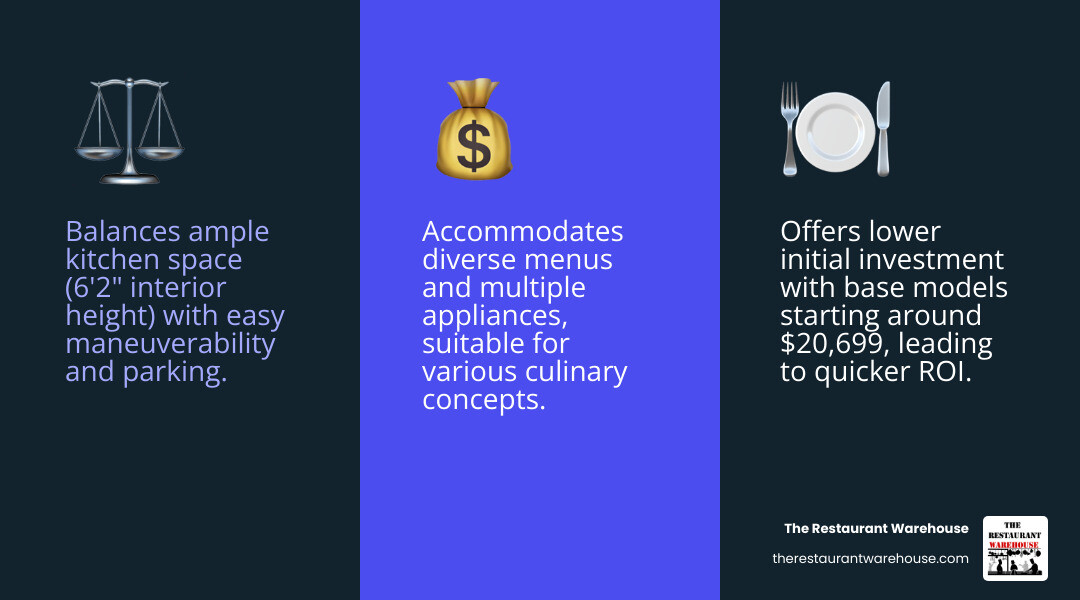
- Size: Balances ample kitchen space (often 6'2" interior height) with maneuverability (16' overall length).
- Standard Equipment: Often includes a 9ft exhaust hood, a griddle, a fryer, and a 3-compartment sink.
- Build Time: Custom builds typically have a 6 to 8-week lead time.
- Benefits: Enough room for diverse menus while being easier to tow and park than larger food trucks.
For new restaurateurs, choosing the right mobile kitchen is a big decision. The 16-foot food trailer is a smart choice, offering the perfect blend of operational space and practical mobility.
16 ft food trailer terms to know:
Balancing Space and Mobility
A 16 ft food trailer perfectly balances kitchen space and maneuverability. It provides enough room for a well-organized workflow and key appliances like a 36" griddle and a 40 Lb deep fryer, supporting diverse menus during busy rushes. Compared to larger trucks, a 16 ft trailer is easier to tow and park. Its manageable dimensions (16' length, ~8' 11" width) allow access to tight urban spots and smaller venues where larger units can't go. The typical 6' 2" interior height ensures staff comfort during long shifts.
Cost-Effectiveness for New Entrepreneurs
A 16 ft food trailer is an affordable and efficient choice for new entrepreneurs, with a much lower initial investment than a full-sized food truck. A fully equipped 16 ft trailer might cost around $54,700 CAD, while a comparable food truck could be $57,700 CAD. This savings is significant for a startup.
Operational costs are also lower. Trailers use less fuel than food trucks and typically have lower insurance costs. While you need a capable tow vehicle, the overall setup is more economical long-term, allowing you to allocate more resources to ingredients and marketing. For more insights, explore our Sample Food Truck Business Plan.
Decoding the Price Tag of a 16 Ft Food Trailer
The price of a 16 ft food trailer varies based on packages and customizations. Costs can range from around $20,699 for a basic shell to $54,700 CAD for a fully-equipped, turnkey unit.
To give you a clearer picture, here’s a general comparison:
| Feature | Basic "Starter" 16 ft Trailer Package | Fully-Equipped "Turnkey" 16 ft Trailer Package |
|---|---|---|
| Price Range | $20,699 - $27,500 (USD) | $26,869 - $54,700 (USD/CAD equivalent) |
| Included Features (Shell) | Basic shell, unequipped interior | Insulated walls, commercial flooring, service windows, basic lighting, water connections |
| Included Features (Kitchen) | Minimal to none, perhaps a basic sink | Comprehensive cooking equipment (griddle, fryer, burner, fridge), 3-comp sink, hand wash sink, water tanks, water heater, exhaust hood, electrical panel, propane setup |
| Customization | High potential for DIY setup | Pre-configured layouts, options for specific appliance upgrades, exterior branding |
| Regulatory Compliance | Buyer responsible for full build-out | Often built to common health/fire codes, but local variations apply |
The final price depends on whether it's new or used, the builder's reputation, and your customizations. Local health and safety codes can also affect the cost, as they may require specific features or materials.
What Determines the Base Price?
A trailer's base price is determined by its shell quality and construction. A used 16 ft trailer might be found for around $19,999, while new, basic shells start near $20,699.00.
The manufacturer's reputation matters. Established builders use superior materials like durable .030" or .040" aluminum skin, sturdy 3/4" Drymax or hardwood flooring, and effective R13 insulation. These cost more but offer better longevity. Structural strength is also key. Solid frame materials like 3", 4", or 6" I-beams and reliable axles (e.g., 3500 LB or 5200 LB Dexter axles) determine the trailer's GVWR and payload capacity. Investing in these features ensures your trailer can handle the demands of the road.
The Cost of a Fully-Equipped Kitchen
After the shell, the kitchen package is the next major cost. The price depends on the type and amount of equipment you choose.
A typical kitchen package includes essential cooking equipment like a 40 Lb deep fryer, a 36'' flat top griddle, and a stove double burner. Specialized menus might require a larger 48" griddle or a 6-burner range. For refrigeration, a single-door reach-in refrigerator or a 23 Cu Ft stand-up refrigerator is standard, often paired with a 7 Cu Ft chest freezer.
Strict health codes dictate sinks and plumbing. A 3-compartment sink and a separate hand wash sink are mandatory. The water system includes a fresh water tank (30-37 gallons), a larger grey water tank (45-93 gallons), and a hot water heater (6-10 gallons).
For safety, a 7ft to 9ft exhaust hood with a powerful high-speed exhaust fan (e.g., 1850 CFM) is crucial for ventilation. A fire suppression system is a non-negotiable safety feature for commercial cooking. Finally, a robust electrical system (e.g., 100 AMP breaker panel, 50 AMP/240 V service) is vital to power all your appliances.
Choosing quality commercial-grade equipment is key. For a full list of what you might need, check out our Buyers Guide Best Food Truck Equipment For 2025.
Beyond the Sticker Price: Hidden Costs to Anticipate
While the trailer and kitchen equipment form the bulk of your initial investment, several other "hidden" costs are crucial for budgeting. Overlooking these can strain your finances before you even serve your first customer. Key expenses to factor in include:
- Permits, Licenses, and Certifications: This is a significant and highly variable cost. You'll need a business license, health department permits for your specific city and county, food handler certifications for your staff, and potentially special event permits. These can collectively run from several hundred to a few thousand dollars.
- Insurance: Protecting your investment is non-negotiable. You will need a comprehensive insurance package, including commercial auto liability for the trailer on the road, general liability to cover accidents or foodborne illness claims, and property insurance for the trailer and its expensive equipment.
- Tow Vehicle: The trailer is immobile without a powerful tow vehicle. If you don't already own a suitable truck or large SUV with the appropriate towing capacity, this will be a major additional expense, whether you buy new or used.
- Commissary Fees: Most health departments require food trailers to operate out of a licensed commissary kitchen for food prep, storage, and waste disposal. These facilities charge monthly rental fees that can range from $500 to over $1,500 depending on the location and services offered.
- Point-of-Sale (POS) System: A modern POS system is essential for processing orders and payments efficiently. This involves the upfront cost of hardware (tablet, card reader, cash drawer) and ongoing monthly software subscription fees.
- Initial Inventory and Supplies: You need to stock your kitchen before you can make any money. This includes all your food ingredients, plus a large stock of paper goods, disposable containers, cutlery, and cleaning supplies. This initial stock can easily cost a few thousand dollars.
- Branding and Marketing: A plain white trailer won't attract much attention. Budget for a professional vinyl wrap, menu design, a simple website, and a small fund for initial marketing efforts like social media ads or local event sponsorships.
The Anatomy of a Winning Trailer: Features & Customization

A winning 16 ft food trailer combines thoughtful design, durable materials, and smart features for longevity, efficiency, and safety. For more on essential cooking equipment, explore our guide on Trailer Made Meals Concession Trailer Cooking Equipment Essentials.
Standard Equipment in a 16 ft Food Trailer
A 16 ft food trailer requires certain standard features for operation and health compliance:
- 3-compartment sink: Essential for washing, rinsing, and sanitizing to meet health codes.
- Hand wash sink: A separate sink dedicated to handwashing for hygiene.
- Water tanks: A fresh water tank (30-37 gallons) and a larger grey water tank (45-93 gallons).
- Water heater: A 6 or 10-gallon unit for hot water. See our Food Truck Sinks Guide for details.
- Exhaust hood: A Type 1 hood (7ft-9ft) with a high-CFM exhaust fan for ventilation.
- Stainless steel counters: Durable, NSF-approved surfaces for prep and serving.
- Electrical panel: A 100 or 125 AMP panel with 50 AMP/240 V service.
- Propane cages: Secure exterior storage for 100 LB or 40 LB propane tanks.
- LED lighting: Efficient interior lighting.
- RV door and concession windows: For entry and customer service.
Customizing Your 16 ft Food Trailer
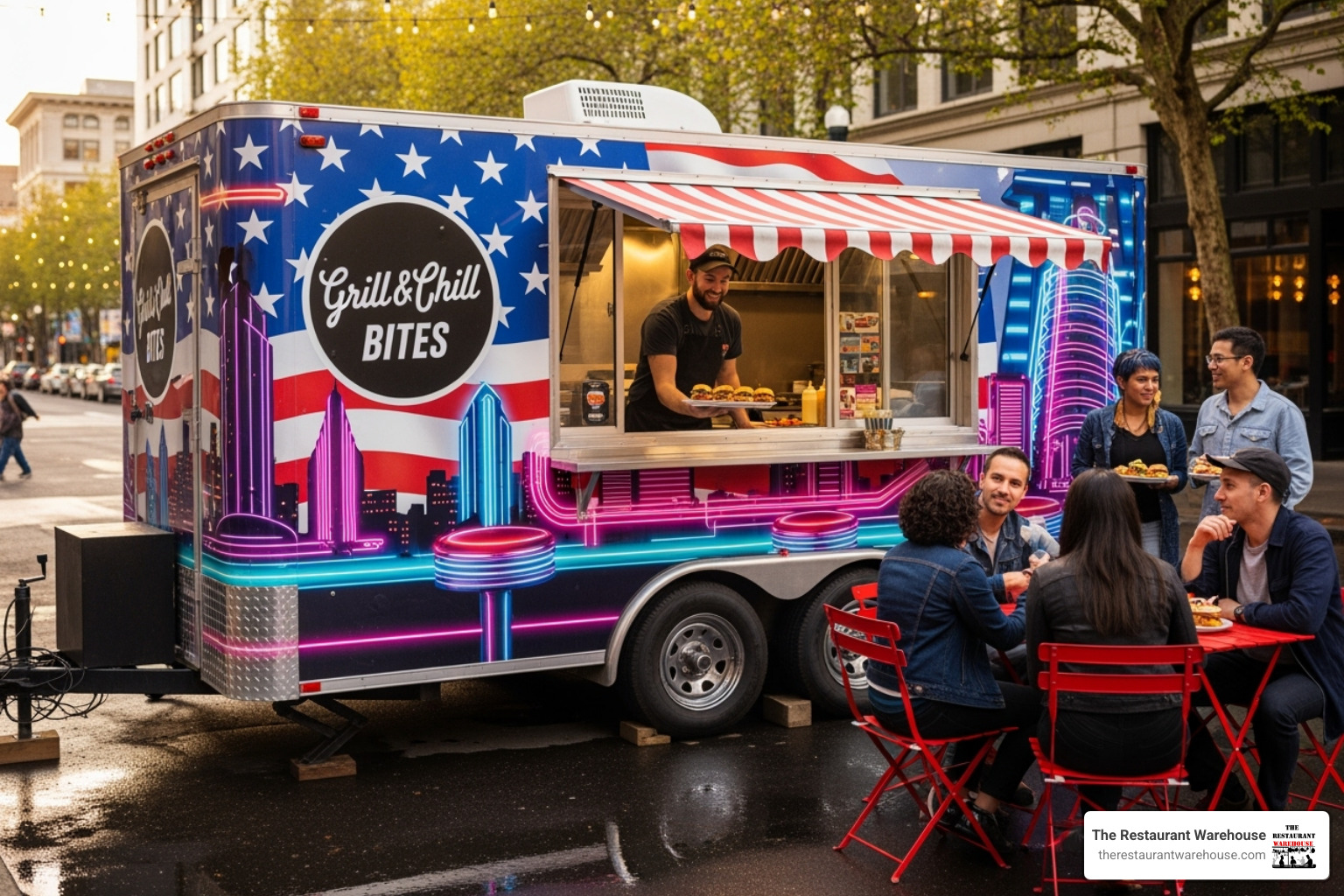
The beauty of a 16 ft food trailer is its potential for personalization. Customization helps your brand shine and optimizes your workflow.
- Interior layout design: The layout must support your specific menu, whether it's tacos, BBQ, or pizza. A well-designed space maximizes efficiency with dedicated prep, cooking, and service areas.
- Exterior design: A full vinyl wrap can turn your trailer into a mobile billboard. Consider adding awnings or exterior TVs to display menus.
- Additional appliances: Go beyond the basics with a sandwich prep table, steam table, or specialty equipment like a wok range. See our insights on Food Truck Fryers.
- Serving windows: Opt for multiple or unique window configurations to improve customer flow.
- Generator boxes: An external box with a slide-out tray provides a convenient and safe power source.
- AC units: A 13,500 or 15,000 BTU roof-mounted AC unit is essential in hot climates.
- Specialty features: The possibilities are vast, from bun racks to espresso machines. For electrical needs, see our guide on Wired For Success Top Electrical Gear For Food Trailers.
Built to Last: Materials and Safety
Durability and safety are paramount when investing in a 16 ft food trailer.
- Construction materials: Look for robust components like .040 aluminum skin, a .030 solid aluminum roof, and a 304 stainless steel interior. Floors should be heavy-duty, like 1 1/8” hardwood or 3/4" Drymax, with R13 insulation for temperature control.
- Dexter axles: Reputable axles, such as 5200 LB Dexter axles, are crucial for handling the weight.
- Electric brakes: Essential for safety, providing reliable stopping power.
- Fire suppression systems: A non-negotiable system that automatically suppresses fires.
- Propane safety: A comprehensive system with two 100 LB cylinders, a 400,000 BTU regulator, and individual shut-off valves for each appliance.
- NSF certification: Ensures equipment meets public health and safety standards.
- D.O.T. compliance: The trailer must comply with Department of Transportation regulations for roadworthiness.
- Additional safety: Features like safety chains and breakaway kits improve road safety.
Prioritizing these material and safety considerations ensures your trailer is a reliable asset. For more on regulations, visit our Food Truck Regulations page.
From Dream to Driveway: The Buying & Building Process
Turning your dream of owning a 16 ft food trailer into reality involves a clear process. We'll guide you through each phase, from concept to completion, covering the build process, regulatory compliance, and financing.
The Manufacturing Journey
The manufacturing journey for a 16 ft food trailer typically takes 6 to 8 weeks, depending on design complexity.
The process begins with the Initial Design phase, where you work with the manufacturer to map out the interior layout and equipment placement. Next is Fabrication, where craftspeople build the trailer's shell using quality raw materials for the frame, walls, and flooring.
Once the shell is ready, Equipment Installation begins, followed by Plumbing and Electrical Work. Sinks, water tanks, and electrical systems are installed to meet safety standards. Finally, the trailer undergoes rigorous Final Inspections to ensure everything is functional and compliant before it's ready for its debut.
Staying Compliant with Local Regulations
Navigating local regulations for your 16 ft food trailer is a critical step. Reputable manufacturers have experience with these requirements and can provide significant help.
You will need health department permits, which vary by state, county, and city. These cover everything from sink setups and water tank sizes to materials and ventilation. It is the buyer's responsibility to understand these local rules and inform the manufacturer of any special requirements.
Fire safety inspections are also mandatory. Organizations like the TSSA or ESA (and their US equivalents) will check that your propane and electrical systems meet fire safety codes. Also, be aware of city by-laws that dictate parking, operating hours, and noise restrictions. For an example of local permit requirements, you can check resources like those on More on local permits.
Financing Your Mobile Kitchen
A 16 ft food trailer is a significant investment, but financing options can make it achievable. Exploring these options can ease the burden of upfront costs.
Many entrepreneurs use traditional personal bank loans, which often require a good credit history and a solid business plan. Another popular choice is commercial leases. This option allows you to use the equipment for a set period with regular payments, often with competitive rates and tax benefits. Some leases offer a "lease to own" option at the end of the term.
The application process for commercial leases is often simpler than for a bank loan. Companies like Newcap and Planet Financial specialize in equipment leasing. You can explore options like Apply for leasing with Newcap or Explore financing with Planet Financial.
A down payment is usually required. Choosing the right financing option helps you maintain healthy cash flow for other critical business needs like inventory and marketing.
Frequently Asked Questions about 16 Ft Food Trailers
It's natural to have questions when building a mobile kitchen. Here are answers to common questions about 16 ft food trailers.
What is the typical weight of a 16 ft food trailer and what can tow it?
The weight of a 16 ft food trailer varies depending on its construction and the equipment inside.
The GVWR (Gross Vehicle Weight Rating) is the maximum safe weight of the trailer and its contents. For a 16 ft trailer, this can range from 3,500 LBS for a basic model to 7,000 LBS or even 10,500 LBS for a fully-loaded version. The payload capacity is how much gear and supplies you can add. For example, some models have a payload of 1,673 LBS. The hitch weight (downward pressure on the hitch) might be around 363 LBS.
To tow it, you'll need a substantial vehicle like a full-size pickup truck or a large SUV. Your tow vehicle's capacity must significantly exceed the trailer's GVWR. Always check your vehicle's specific tow rating to ensure safety.
How much water can a 16 ft food trailer hold?
Water is vital for a mobile kitchen. A 16 ft food trailer's water tank sizes are designed for smooth operations and to meet health code requirements.
Typically, a trailer has a fresh water tank for clean water, with capacities from 20 to 37 gallons (30 gallons is common). The grey water tank collects wastewater and must be larger to prevent overflows, with capacities from 30 to 93 gallons (45 gallons is common).
Local health code requirements for tank sizes can vary, so always check with your local health department. A 6-gallon or 10-gallon hot water heater is also standard for sanitation.
What kind of power source do I need?
A 16 ft food trailer requires a robust power source. Your choice will depend on your equipment and where you operate.
Most trailers are equipped for shore power, with a 50 Amp/240 V connection. You can plug into a standard commercial power outlet at events or commissaries using a 25ft or 30ft 50 Amp power cord.
When off-grid, you'll need a powerful generator. For a fully equipped trailer, consider an 11 kW quiet diesel generator or a comparable propane or gas unit.
Many cooking appliances run on propane. Trailers typically have a system with two 100 LB propane cylinders stored in an exterior cage. This system includes a regulator and shut-off valves for safety. The trailer's electrical panel, often 100 AMP or 125 AMP, distributes power to all your equipment.
What are the most common mistakes to avoid when buying a 16 ft food trailer?
Navigating the purchase of a food trailer can be complex, and a few common pitfalls can lead to costly headaches down the road. Avoiding these mistakes is key to a successful launch:
- Ignoring Local Health Codes: This is the most critical error. An entrepreneur might buy a beautiful, fully-equipped trailer from an out-of-state builder, only to find it fails their local health inspection due to specific requirements for sink sizes, water tank capacity, or surface materials. Always get a copy of your local health code regulations and ensure your builder is constructing the trailer to those exact specifications.
- Underestimating Power Needs: A common mistake is choosing a generator that is too small. Entrepreneurs often calculate the power draw of each appliance individually but forget to account for the massive surge when multiple pieces of equipment (like a fryer, refrigerator, and AC unit) start up simultaneously. This leads to constantly tripped breakers during a busy service. It's crucial to work with your builder to calculate your total power load and invest in a generator with ample overhead.
- Skimping on Build Quality: The allure of a low price can be strong, but it often comes at the cost of quality. Cheaper trailers may use thinner steel for the frame, lower-grade axles, inadequate insulation, or flimsy interior finishes. These shortcuts lead to long-term problems like frame fatigue, suspension issues, and equipment that breaks down prematurely. Invest in a trailer from a reputable builder known for using durable materials.
- Designing an Inefficient Layout: A poorly planned kitchen layout can cripple your service speed. Failing to map out a logical workflow—from taking orders to food prep, cooking, and serving—creates bottlenecks and forces staff to constantly cross paths. A good layout separates these zones and minimizes the steps needed to complete an order.
- Forgetting the Tow Vehicle: It's easy to get caught up in designing the perfect kitchen and forget about the vehicle needed to move it. A fully loaded 16 ft food trailer is heavy. Purchasing a trailer without having a truck or SUV that can safely and legally tow its Gross Vehicle Weight Rating (GVWR) is a recipe for disaster and a major, unexpected expense.
Conclusion
Investing in a 16 ft food trailer is a smart step toward launching your mobile kitchen. This guide has shown why this size is the ideal choice for new entrepreneurs in the food service industry. It offers the perfect balance of ample cooking space and maneuverability for events, and it's a cost-effective option for startups.
We've covered everything from pricing and standard features to customization and safety. We also reviewed the manufacturing process and the importance of complying with local regulations.
Here at The Restaurant Warehouse, we're dedicated to helping your entrepreneurial spirit soar. We provide commercial restaurant equipment and food service supplies at affordable, wholesale prices by cutting out high commissions and retail overhead. It’s our way of ensuring you have every chance to thrive.
Ready to take the next step on your mobile culinary journey? Make sure you're fully prepared by grabbing your complete restaurant kitchen equipment checklist. Your dream of a successful business on wheels is closer than you think.
About The Author

Sean Kearney
Sean Kearney is the Founder of The Restaurant Warehouse, with 15 years of experience in the restaurant equipment industry and more than 30 years in ecommerce, beginning with Amazon.com. As an equipment distributor and supplier, Sean helps restaurant owners make confident purchasing decisions through clear pricing, practical guidance, and a more transparent online buying experience.
Connect with Sean on LinkedIn, Instagram, YouTube, or Facebook.