

Food Truck Business Plan: Essential Guide to Success
A food truck business plan is your playbook for the real world. It’s the document that lays out everything from your killer culinary concept to the nitty-gritty financial numbers. This is what you'll hand to a lender to get that crucial startup loan, but it’s also your personal guide for making smart decisions and turning your passion for food into a business that actually thrives.
Your Blueprint for Food Truck Success
Look, a love for cooking is essential, but it won’t get you funded or keep you afloat during your first year. Success in this game hinges on a rock-solid business plan. This document forces you to get serious—to stop dreaming and start planning. It’s your internal GPS for navigating the competitive mobile food scene, influencing every decision from your menu pricing to where you’ll park on a rainy Tuesday.
Think of it less as a stuffy formality and more as your operational playbook. It's the blueprint you'll flip back to when you're wondering if you can afford to hire help, whether to hit that new farmers market, or how to tweak your menu for the winter season. Without one, you’re basically just driving around hoping for the best, and hope isn't a business strategy.
What Goes into the Plan?
A good food truck business plan tells a complete story. It walks a reader—whether it’s a banker, an investor, or you—through your vision and proves it’s a viable business. While your details will be unique, the core structure is pretty standard because it answers all the essential questions.
Let’s quickly break down the key sections you'll be building out.
Here’s a quick-reference table that outlines the essential parts of any food truck business plan and what each one is meant to accomplish. Think of these as the main chapters of your business's story.
| Section | Key Purpose |
|---|---|
| Executive Summary | A powerful, one-page snapshot of your entire business. It's written last but goes first. |
| Company Description | Your "why." This section details your mission, legal structure, and what makes your food truck special. |
| Market Analysis | Proof that you have customers. Here, you'll dive into your target audience, competitors, and local market trends. |
| Operations Plan | The "how." This covers the day-to-day nuts and bolts, from sourcing ingredients to serving customers. |
| Financial Projections | The numbers. This is where you'll map out your startup costs, forecast revenue, and project profitability. |
Each of these components works together to create a convincing argument for why your food truck will succeed. You'll use this document to secure funding, guide your launch, and measure your performance long after you hit the road.
Why the Food Truck Model Is Gaining Steam
The appeal of food trucks is undeniable. For many aspiring chefs and entrepreneurs, they offer a much more accessible entry point into the culinary world than a traditional restaurant, and the market growth reflects that.
The global food truck market is on a solid growth trajectory, projected to expand from USD 4.9 billion in 2025 to USD 7.5 billion by 2032. That’s a steady annual growth rate of 6.4%, which shows this isn't just a fad—it’s a real shift in how people dine and how entrepreneurs are building food businesses.
A huge part of the appeal is the lower initial investment. Getting a brick-and-mortar restaurant off the ground can easily demand upwards of $95,000. In contrast, most food trucks get rolling with an investment somewhere between $50,000 and $200,000. You can explore more data on food truck market growth to get a better handle on the landscape.
Defining Your Concept and Sizing Up The Market
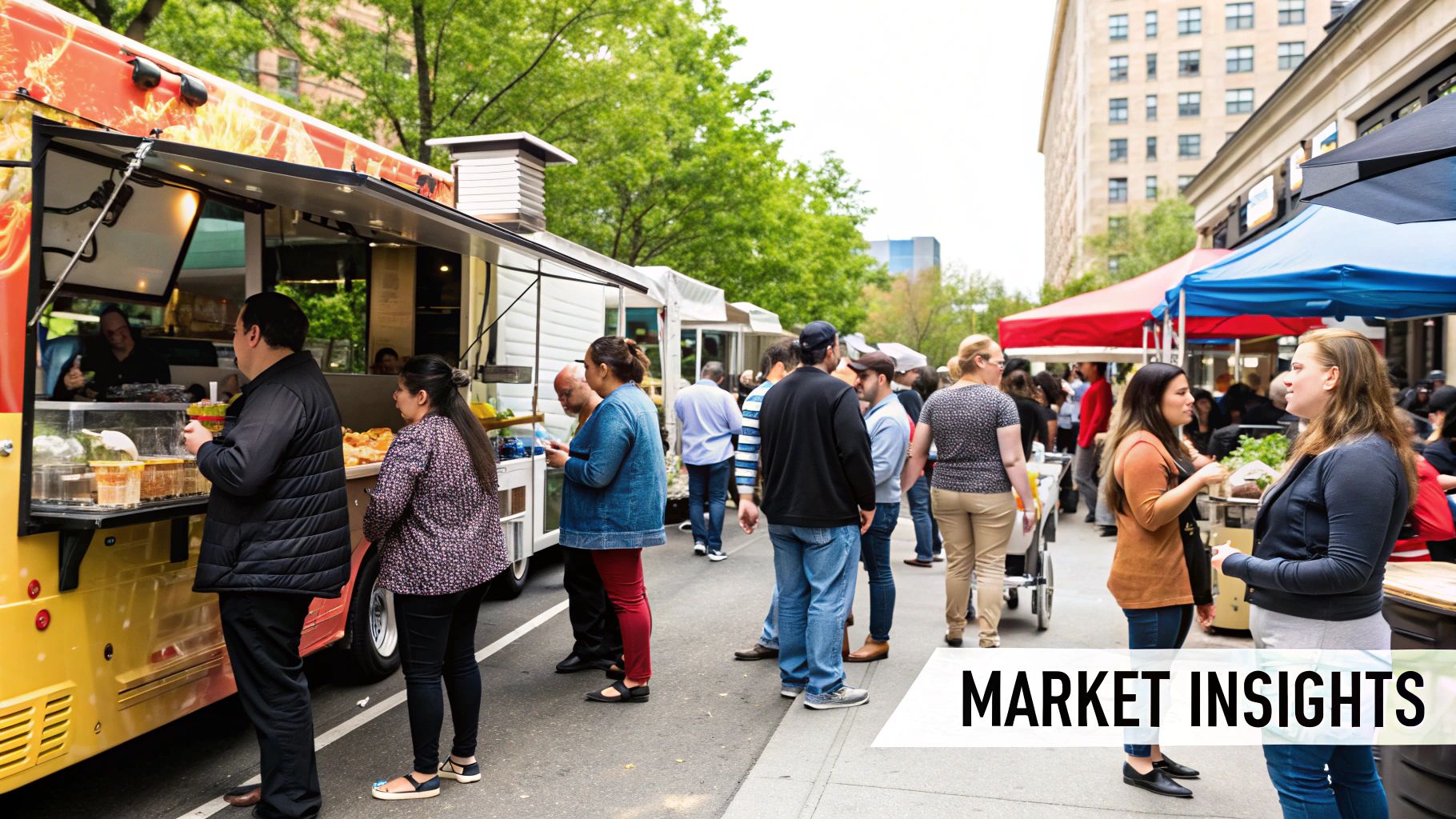
Let's start with a foundational question: what are you really selling? I'm not just asking if it's tacos or burgers. I'm asking about the unique culinary concept and story that will make someone walk past three other food options to get to your window.
This is where you bring your vision to life. Are you going to be the truck for gourmet grilled cheese, loaded with unexpected pairings like fig jam and prosciutto? Or will you be serving up authentic vegan ramen so good it'll have meat-eaters lining up? Your concept is your promise to every customer, setting the stage for the entire experience. In a crowded market, a clear, compelling concept is your first and best line of defense.
From there, we have to move from the creative side in the kitchen to the practical reality of the streets. A fantastic idea doesn't mean much without a hungry audience, which is why a solid market analysis is the absolute backbone of your business plan. This is your opportunity to prove—with actual data and real-world observation—that your truck has a profitable place in the local food scene.
Pinpointing Your Ideal Customer and Niche
So, who are you cooking for? A vague answer like "everyone" isn't going to cut it with lenders or investors. Your business plan needs to zero in on a specific target customer. Get detailed about their demographics, lifestyle, and what makes them decide where to spend their lunch money.
- Office Workers: Are you aiming for the weekday lunch rush in a business park? These customers value speed, convenience, and a price point that’s likely under $15. Your menu needs to be delicious but also easy to eat at a desk.
- Families at Events: Hitting up weekend festivals and farmers' markets? Your customers will be looking for kid-friendly choices, shareable items, and an overall experience that adds to their fun day out.
- The Late-Night Crowd: If you plan to park near bars and music venues, your menu should be all about satisfying, crave-worthy foods that are the perfect cap to a night out.
Getting a clear picture of your audience is how you spot a profitable niche. If your city is saturated with taco trucks but no one is doing high-quality, quick-service pasta, you might have just found your opening. This kind of detailed analysis shows you’ve done your homework.
Conducting a Realistic Competitive Analysis
Once you know your customer, it's time to size up the competition. And I don't just mean other food trucks. Your real competitors are any business vying for your target customer's food budget.
I recommend creating a simple competitor matrix right in your business plan. List your top 3-5 rivals—this includes other trucks and nearby brick-and-mortar spots—and break down what they're doing.
- Cuisine & Quality: What's on their menu, and honestly, how good is it?
- Pricing: How do their prices stack up against what you plan to charge?
- Location: Where do they usually set up shop? Are there any underserved neighborhoods or business areas?
- Branding & Following: How strong is their brand? Do they have a loyal following on social media?
This exercise is incredibly revealing. You might discover the most popular burger truck uses frozen patties; your advantage could be serving fresh, locally sourced beef. Or maybe you notice no one offers compelling vegetarian options. This is how you find and define your unique selling proposition (USP).
A key driver for the food truck boom is a shift in consumer behavior. Younger diners, specifically those aged 16 to 34, are actively seeking out novel dining experiences. Food trucks are perfectly positioned to meet this demand with their mobility and unique concepts. Explore the full report on food truck market trends to see how these demographics are shaping the industry.
Performing a SWOT Analysis
A SWOT analysis might sound like business school jargon, but it's a simple and powerful way to organize all your research. It gives you—and anyone reading your plan—a clear, at-a-glance snapshot of your truck's strategic position.
| Category | Description | Example |
|---|---|---|
| Strengths | Internal advantages you have direct control over. | A chef with 10 years of fine-dining experience; a proprietary sauce recipe. |
| Weaknesses | Internal disadvantages you need to address. | Limited starting capital; zero brand recognition; a small truck with limited cooking capacity. |
| Opportunities | External factors in the market you can take advantage of. | A new corporate park opening nearby; a local festival that hasn't booked its food vendors yet. |
| Threats | External factors that could potentially harm your business. | Rising food costs; new city regulations on mobile vendors; another truck with a similar concept launching. |
Being brutally honest here is crucial. Acknowledging a weakness, like realizing you’ll need high-efficiency fryers to increase your service speed and handle the lunch rush, shows you're thinking strategically about your operations. In fact, showing you understand how specific equipment choices impact your bottom line is a sign of a well-researched, professional plan. You can learn more about why high-efficiency fryers are a secret sauce for food truck success in our detailed guide. This level of detail builds confidence and proves you're ready to compete.
Structuring Your Day-To-Day Operations
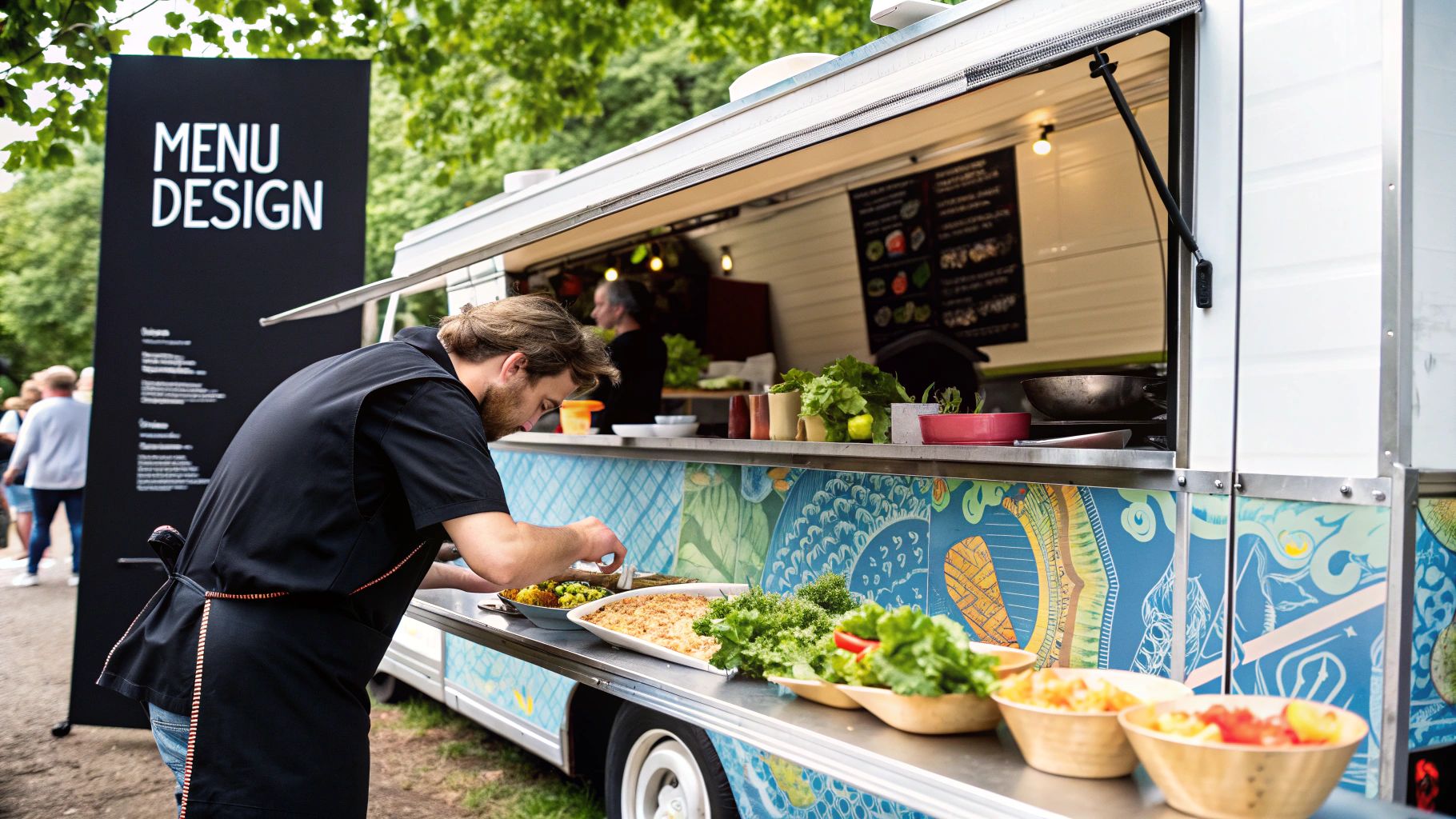 An incredible concept and a mouth-watering menu are fantastic, but they don't mean much without flawless execution. This part of your food truck business plan is where you get into the real nuts and bolts—the daily grind that keeps your business running smoothly, legally, and profitably.
This is where you prove to lenders, investors, and even yourself that you’ve thought through the practical realities of a mobile food business. A solid operational plan shows you're a serious professional who understands success isn't just about the food; it's about efficient systems and consistent delivery.
Mapping Your Daily Workflow
Your operations plan needs to paint a crystal-clear picture of a typical day on the truck. Think of it as the script for your business, detailing every single action from the moment your alarm buzzes to when you finally lock up for the night. This isn't just for the business plan; it's a vital tool for staying organized when things get chaotic.
Let's use a taco truck as an example. The day doesn't kick off at the lunch rush; it starts hours earlier.
- Morning (6 AM - 9 AM): This block is all about critical prep. It’s for picking up fresh cilantro and avocados from your supplier, then heading to the commissary kitchen to get the carnitas slow-cooking, chop onions, and whip up fresh salsas. You're also restocking the truck with drinks, paper goods, and cleaning supplies.
- Late Morning (9 AM - 11 AM): Now, the focus shifts to the truck itself. You’ll drive to your pre-scouted service location, set up the mobile kitchen, fire up the griddles, and do a final quality check on all your prepped ingredients.
- Service (11 AM - 2 PM): Showtime. The workflow here has to be a well-oiled machine, optimized for speed and quality. Maybe one person is on the griddle and assembling tacos while the other takes orders and manages the cash flow.
- Afternoon & Cleanup (2 PM onwards): After the last customer leaves, the whole process reverses. You’ll break down the service window, give the truck a thorough cleaning, properly store any leftover ingredients, and make the trip back to the commissary for deep cleaning and waste disposal.
Laying out a detailed schedule like this shows you have a realistic grasp of the time and labor involved, which adds a huge amount of credibility to your business plan.
Defining Key Roles and Responsibilities
Even if you’re a one-person army to start, you need to define the different "hats" you'll be wearing. A bank or investor wants to see that all the essential business functions are accounted for. If you plan on hiring a team, this section is even more critical.
Outline the primary roles needed to make your truck run:
- Head Chef/Kitchen Manager: This person is responsible for executing the menu, ensuring food quality, and managing inventory.
- Cashier/Customer Service Rep: This role manages the point-of-sale (POS) system, handles every customer interaction, and hypes up the daily specials.
- Operations Manager: This is the business-focused role that handles scheduling, location scouting, supplier relationships, marketing, and bookkeeping.
For a solo operator, you’re all three. For a two-person team, you might split the duties, with one person handling all the kitchen tasks while the other manages the front-of-house and business side of things.
Navigating Permits and Legal Requirements
This is a non-negotiable part of your operational plan. Trust me, ignoring regulations is the fastest way to get your business shut down before it even gets rolling. Every city, county, and state has its own unique web of rules, and proving you've done your homework is vital.
According to the U.S. Chamber of Commerce, a food truck owner can expect to spend an average of $28,276 on permits, licenses, and legal compliance in their first year alone. This is not a corner you can afford to cut.
Your business plan should include a checklist of the specific permits you need for your target area. This proves you're prepared for the bureaucratic hurdles ahead.
Common Licensing and Permit Requirements:
- Business License: The standard license required for any business to operate in your city.
- Food Handler's Permit: Often required for every single person working on the truck. This usually involves a short course and test on food safety.
- Health Department Permit: This involves a physical inspection of your truck to ensure it meets all health and safety codes.
- Mobile Food Vendor License: A specific permit that allows you to operate as a food truck.
- Commissary Agreement: Most jurisdictions require you to have a contract with a licensed commissary kitchen for food prep and storage.
- Parking Permits/Zoning Compliance: You need to research and detail the specific rules about where and when you're allowed to park and serve.
Listing these out and noting their status (e.g., "Application in Progress," "Secured") adds a powerful layer of credibility to your food truck business plan. It shows you’re not just a dreamer with a great recipe, but a serious entrepreneur ready to operate professionally and legally from day one.
Building a Marketing Plan That Attracts Crowds
Your food might be legendary, but if nobody knows your truck exists, you're just cooking for yourself. A killer marketing plan is what gets people to your window, creates a ton of buzz, and turns first-timers into regulars who track your every move. This part of your business plan is all about the real-world tactics—both online and off—that you'll actually use to build a crowd wherever you decide to park.
A great strategy starts way before you serve your first customer. It's about building a brand people actually care about. Everything from your truck's wrap and logo to your menu design and the way you talk on social media works together to tell your story. Get this right, and you'll stand out in a sea of other options.
Your Digital Bullhorn: The Social Media Strategy
For a business that’s always on the move, social media isn't just a nice-to-have; it's your main way of talking to people. It’s how you’ll shout your daily location from the rooftops, show off drool-worthy specials, and build a real community around your food. A strong digital game is non-negotiable for a modern food truck.
Your plan needs to get specific about which platforms you'll use and, more importantly, how you'll use them:
- Instagram & TikTok: These are visual goldmines for food. You need high-quality photos and short, punchy videos of your dishes. Post your daily location in your stories every single day and create a "Location" highlight on your profile so people can find it instantly.
- Facebook: This is where you build your local following. Create a Page to post your weekly schedule, run super-targeted local ads for specific neighborhoods or events, and get people involved by asking for their opinions on new menu ideas.
Consistency is everything. Your plan should lay out a simple posting schedule. For example, a "Location Drop" post every morning by 9 AM and a "Menu Special" teaser in the afternoon. This kind of reliability trains your followers to check your pages before they head out for lunch.
So many trucks make the mistake of relying only on social media. Building an email or SMS list gives you a direct, unfiltered line to your biggest fans, letting you skip right past those pesky social media algorithms.
Offer a small hook, like 10% off their next order, for anyone who signs up at your window. Use this list to send out your weekly schedule, announce a last-minute pop-up spot, or give them exclusive deals. This direct connection is priceless for driving repeat business.
Hitting the Pavement: Offline Marketing and Location Scouting
While your online presence is crucial, you can't forget about the real world. Your physical location and how your truck looks are a massive part of your marketing. A key piece of your business plan must be a strategy for being in the right place at the right time.
This means you need to be actively scouting and building relationships. Your plan should include a list of potential high-traffic spots you've already researched:
- Office Parks and Business Districts: Find the big employers in your area and figure out the peak times for the lunch rush.
- Breweries and Bars: Teaming up with a local brewery that doesn't have its own kitchen is a classic win-win. You bring the food, they bring the thirsty customers.
- Farmers' Markets and Local Festivals: These events are magnets for thousands of people actively searching for unique food. You need to research event calendars and application deadlines months ahead of time.
Don't forget, the truck itself is your mobile billboard. Market analysis shows that vans are still the top choice for operators, holding 46.2% of market revenue, partly because they're easy to maneuver and brand. Your truck's design has to be eye-catching and instantly tell people what you're all about, even from a distance. You can dig deeper into the growth and vehicle preferences in the food truck market to see how these trends are shaping the industry.
Creating Financial Projections Lenders Will Trust
Alright, let's talk about the numbers. This is the part of your business plan that gets the most heat. Lenders and investors will comb through your financial projections, looking for a story that’s both ambitious and firmly planted in reality. Vague guesses and wishful thinking just won't fly here. Your numbers need to be a fortress built on solid research and conservative assumptions.
The whole point is to show that you have a death grip on every dollar coming in and going out. This isn't just about asking for a loan; it's about proving you’re a savvy and responsible operator who can turn that investment into a profitable business.
Detailing Your One-Time Startup Costs
Before you can even think about future profits, you have to nail down every single expense needed to get your service window open on day one. These startup costs are the initial cash your business needs to simply exist. Getting this list right is absolutely crucial—underestimating it is one of the quickest ways new food trucks go under.
Your plan needs a clean, itemized breakdown. Think beyond just the truck itself and get granular with the details.
To give you a real-world picture, here’s a sample breakdown of the major one-time expenses you'll need to budget for.
Sample Food Truck Startup Cost Breakdown
| Expense Category | Estimated Cost Range (USD) |
|---|---|
| Food Truck (Used or New) | $30,000 - $100,000 |
| Kitchen Equipment & Installation | $10,000 - $50,000 |
| Vehicle Wrap & Branding | $1,000 - $10,000 |
| Permits, Licenses & Legal Fees | $500 - $5,000 |
| Initial Food & Supply Inventory | $2,000 - $5,000 |
| Point-of-Sale (POS) System | $500 - $2,000 |
| Working Capital (3-6 Months) | $5,000 - $15,000 |
That working capital line item? That’s your safety net. It’s the cash reserve that covers unexpected repairs or a few slow sales weeks right at the beginning, ensuring you don’t run out of money before you find your groove. To make sure you haven't missed anything, it's a good idea to review a complete sample food truck business plan to see more detailed line items.
Building Your Profit and Loss Projections
Once your startup costs are locked in, it's time to create your Profit and Loss (P&L) statement. This is where you forecast your revenue and expenses over time, usually for the first three years of business. For year one, I always recommend breaking it down month-by-month to show how you expect sales to change with the seasons.
Your revenue projections can't be pulled out of thin air. They have to be based on a clear formula:
(Average Customers per Hour) x (Hours of Operation per Day) x (Operating Days per Week) x (Average Order Value)
Be honest with yourself. How many people can you really serve during a crazy lunch rush? Base your average order value on your actual menu prices and what a typical customer is likely to buy. Lenders would much rather see a conservative, achievable sales forecast than one that's wildly optimistic.
The image below gives you a simple look at the daily workflow that directly fuels these sales projections.
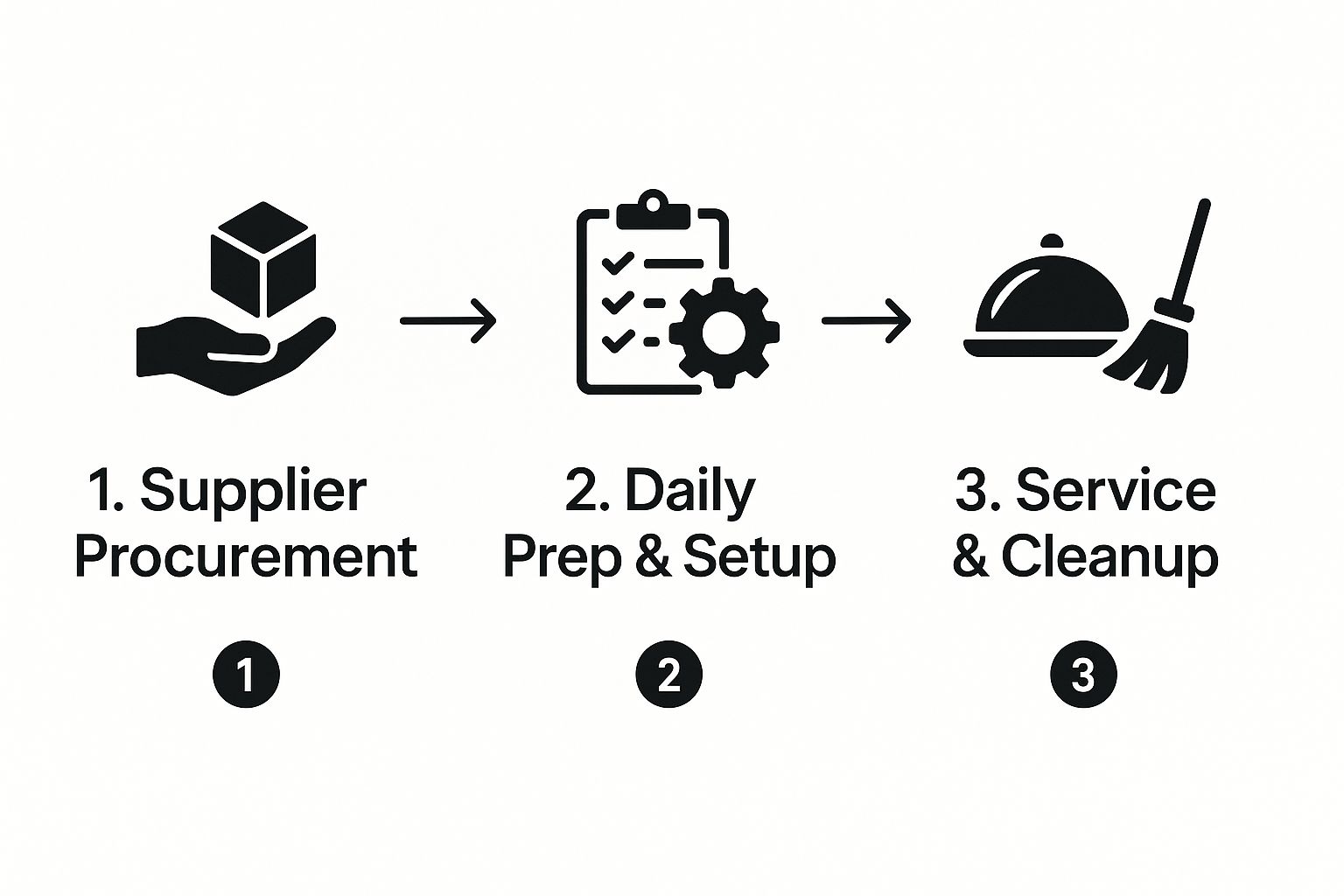
This just drives home the point that your ability to make money is tied directly to how efficient your daily operations are—from buying ingredients to the final cleanup.
Conducting a Break-Even Analysis
A break-even analysis is a powerful calculation that tells you the exact sales figure you need to hit just to cover all your costs. It's the point where you're not making money, but you're not losing it either. This is a critical metric for any lender.
To figure this out, you first have to split your costs into two buckets:
- Fixed Costs: Expenses that stay the same no matter how much you sell (e.g., truck payments, insurance, permit renewals).
- Variable Costs: Expenses tied directly to your sales volume (e.g., food ingredients, packaging, credit card fees).
The analysis pinpoints the monthly sales target you must hit to keep the lights on. Every dollar you make above that number is pure profit. This calculation shows you understand the core economics of your business and have a clear target for profitability.
Structuring a Clear Funding Request
If you're seeking a loan, this is where you make the official ask. Your funding request should be direct, specific, and totally professional. You need to state the exact amount of money you need to launch and operate the business.
But don’t just throw out a single number. Show them exactly how you plan to use the funds.
Example Funding Allocation:
- 60% ($75,000): Purchase and customization of a used food truck.
- 25% ($31,250): Kitchen equipment, POS system, and initial branding wrap.
- 15% ($18,750): Initial inventory and six months of working capital.
This level of transparency builds incredible trust. It shows you’ve thought through every dollar and have a strategic plan for putting it to work. Finally, include your proposed repayment plan, outlining the loan terms you think are realistic based on your P&L projections.
When you apply for funding, lenders will do their homework, which almost always includes a credit check. It’s vital to understand how credit bureaus work and what goes into your score, as your personal and business credit history will directly affect your ability to get a loan. A strong financial plan paired with a solid credit history makes you the kind of candidate lenders are eager to fund.
Common Questions About Food Truck Business Plans
As you start pulling all the pieces of your dream together, it's totally normal for a few big questions to pop up. Crafting a food truck business plan is a surprisingly deep process, and it’s smart to get clarity on any sticking points before you call it final. This is where we'll tackle some of the most common questions I hear from aspiring food truck owners just like you.
Getting these details right can be the difference between a plan that just sits in a folder and one that actually gets you funded and on the road. Let’s clear up the confusing parts so you can move forward with real confidence.
How Detailed Should My Financial Projections Be?
You need to get granular here—this isn't the place for guesswork. A lender or investor wants to see a thorough breakdown that proves you’ve really thought through the economics of your mobile kitchen. Think of it as the financial blueprint for your first few years in business.
A solid financial section absolutely must include a few key documents:
- A complete startup cost breakdown that lists every single one-time expense, from the truck itself down to your first set of spatulas.
- A 12-month profit and loss (P&L) statement, broken down month by month to account for things like a slow winter or a busy festival season.
- Annual P&L projections for years two and three to show how you plan to grow.
- A detailed cash flow statement and, crucially, a break-even analysis.
Your revenue forecasts can't just be wishful thinking. You need to ground them in reality. Base your numbers on real metrics, like how many customers you can realistically serve per hour, a sensible average check size, and the number of days you'll actually be operating. The more your numbers are backed by research—like knowing the exact cost of goods for every item on your menu—the more credible your entire plan becomes.
What Are the Biggest Mistakes to Avoid in My Plan?
I've seen a lot of business plans over the years, and certain classic blunders show up time and time again. Just being aware of them is the best way to make sure your plan looks professional and well-researched.
Here are the most frequent—and damaging—errors I see:
- Grossly underestimating costs and forgetting to build in a cash cushion for the first six months. Trust me, unexpected repairs will happen, and you'll have slow weeks. You need a buffer.
- A generic market analysis that doesn’t name specific local competitors or clearly define a target customer. "Everyone who likes tacos" is not a target audience.
- Neglecting local regulations, which is a massive red flag. It shows you haven't done your homework and could get your business shut down before it even starts.
- Wildly optimistic sales projections that aren't based on your truck's actual capacity or the real-world foot traffic of your proposed locations.
- A weak marketing section that just says, "we'll post on social media." You need a real strategy for building a following and actually driving sales.
A great food truck business plan anticipates these potential issues and addresses them head-on. It shows you're not just a great cook but also a smart business operator who thinks critically about challenges.
Is a Full Business Plan Necessary If I Am Not Getting a Loan?
Yes, absolutely. While a plan is a must-have for getting a loan, its most important job is to be your own internal roadmap. The act of writing it forces you to challenge your own assumptions and solve problems on paper before they cost you real money.
Think of it this way: your business plan is the strategic GPS for your food truck. It’s the document you'll go back to when making tough calls about menu changes, new service locations, or when it's time to hire your first employee. Trying to navigate the competitive food truck scene without one is like driving through a new city without a map—you might get there eventually, but the journey will be slow, expensive, and incredibly stressful.
Understanding the legal side of things is just as critical. For a deeper dive into the specific rules you'll face, our guide on food truck regulations is an essential read. It breaks down all the non-negotiable permits and licenses you'll need to operate legally and successfully.
Ready to equip your dream truck? At The Restaurant Warehouse, we offer a huge selection of commercial-grade cooking equipment, refrigeration, and supplies perfect for any mobile kitchen. Explore our affordable restaurant equipment and financing options to get started today.
About The Author

Sean Kearney
Sean Kearney is the Founder of The Restaurant Warehouse, with 15 years of experience in the restaurant equipment industry and more than 30 years in ecommerce, beginning with Amazon.com. As an equipment distributor and supplier, Sean helps restaurant owners make confident purchasing decisions through clear pricing, practical guidance, and a more transparent online buying experience.
Connect with Sean on LinkedIn, Instagram, YouTube, or Facebook.
Leave a comment