

How to Create Standard Operating Procedures That Work
Creating standard operating procedures is all about taking the critical tasks in your restaurant, documenting them in a simple step-by-step way, and training your team to follow them to the letter.
The whole point is to build a reliable playbook for every key action, from prepping ingredients to cashing out the register. This process turns that "tribal knowledge" stuck in one person's head into a scalable, trainable system that anyone can follow.
Why Effective SOPs Are Your Restaurant's Foundation
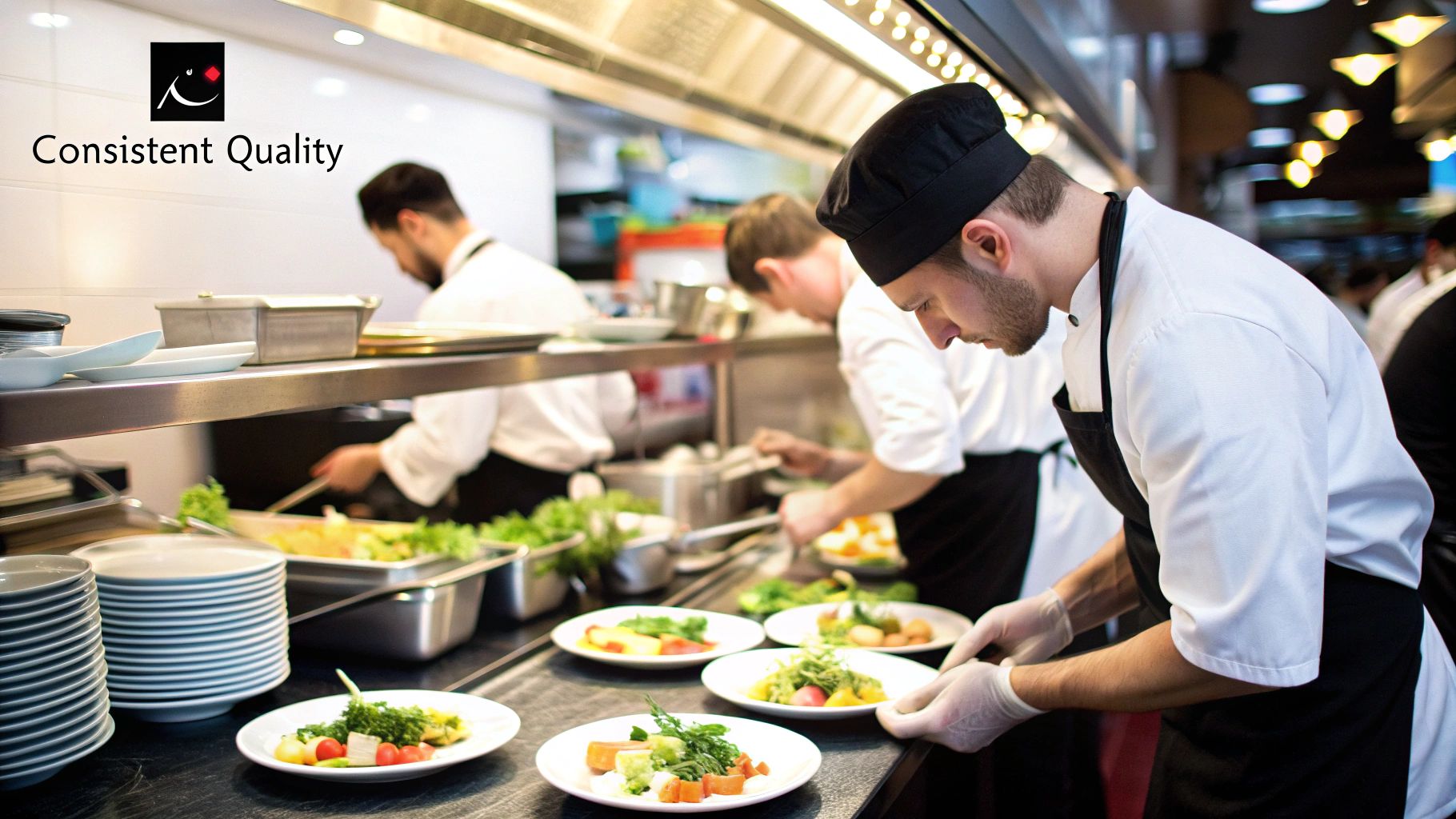
Too many restaurant owners see Standard Operating Procedures (SOPs) as just another bureaucratic chore—a dusty binder that sits on a shelf. But in reality, SOPs are the absolute bedrock of consistency, quality, and sustainable growth.
Let's get real for a second. Picture the difference between a kitchen running on memory and one guided by clear, documented processes.
One kitchen is pure chaos during the Saturday night rush. A new line cook plates the signature burger completely wrong, a server forgets the upsell script for sides, and the closing bartender misses a key cleaning step on the espresso machine. The result? Inconsistent food, missed revenue, and a frustrated team.
Now, picture another kitchen, this one powered by solid SOPs. The new hire follows a simple photo guide for plating. The server references a quick checklist for guest interactions. The closer works through their duties systematically. This isn't about killing creativity; it's about building a reliable foundation so your team can focus on great service instead of just guessing what to do next.
The Business Case for Operational Clarity
Let's be clear: effective SOPs directly pump up your bottom line and protect your brand. They aren't just about rules; they're about real results. When you learn how to create standard operating procedures the right way, you unlock some serious advantages:
- Faster Training: New hires get up to speed in a fraction of the time when they have clear, written instructions, which means your senior staff isn't constantly repeating the basics.
- Fewer Errors: Say goodbye to costly food prep mistakes and service slip-ups. When there's a single, correct way to do a task, errors plummet.
- Guaranteed Consistency: Every single customer gets the same high-quality dish and service, whether it’s a slow Tuesday lunch or a slammed Friday night.
This systematic approach is why the global market for SOP software was valued at around USD 1.2 billion in 2023 and is expected to more than double. This shows a massive shift across industries toward documenting processes for better efficiency and compliance.
Ultimately, putting time into your SOPs is a direct investment in your restaurant's future. It’s the essential framework you need to improve restaurant operations, scale your business, and deliver on your brand’s promise to every guest who walks through the door.
Setting the Stage for Successful SOPs
Jumping straight into writing without a clear game plan is a recipe for creating documents nobody will ever use. Think of this initial phase as your 'mise en place' for SOP development—it’s all the essential prep work that guarantees the final product is practical, respected, and actually effective.
Your first move? Pinpoint the critical processes in your restaurant that truly need to be standardized. Not every single task requires a multi-page document. The real goal is to focus on what matters most for consistency, safety, and a great guest experience.
This simple flow shows the core steps for getting started on the right foot.
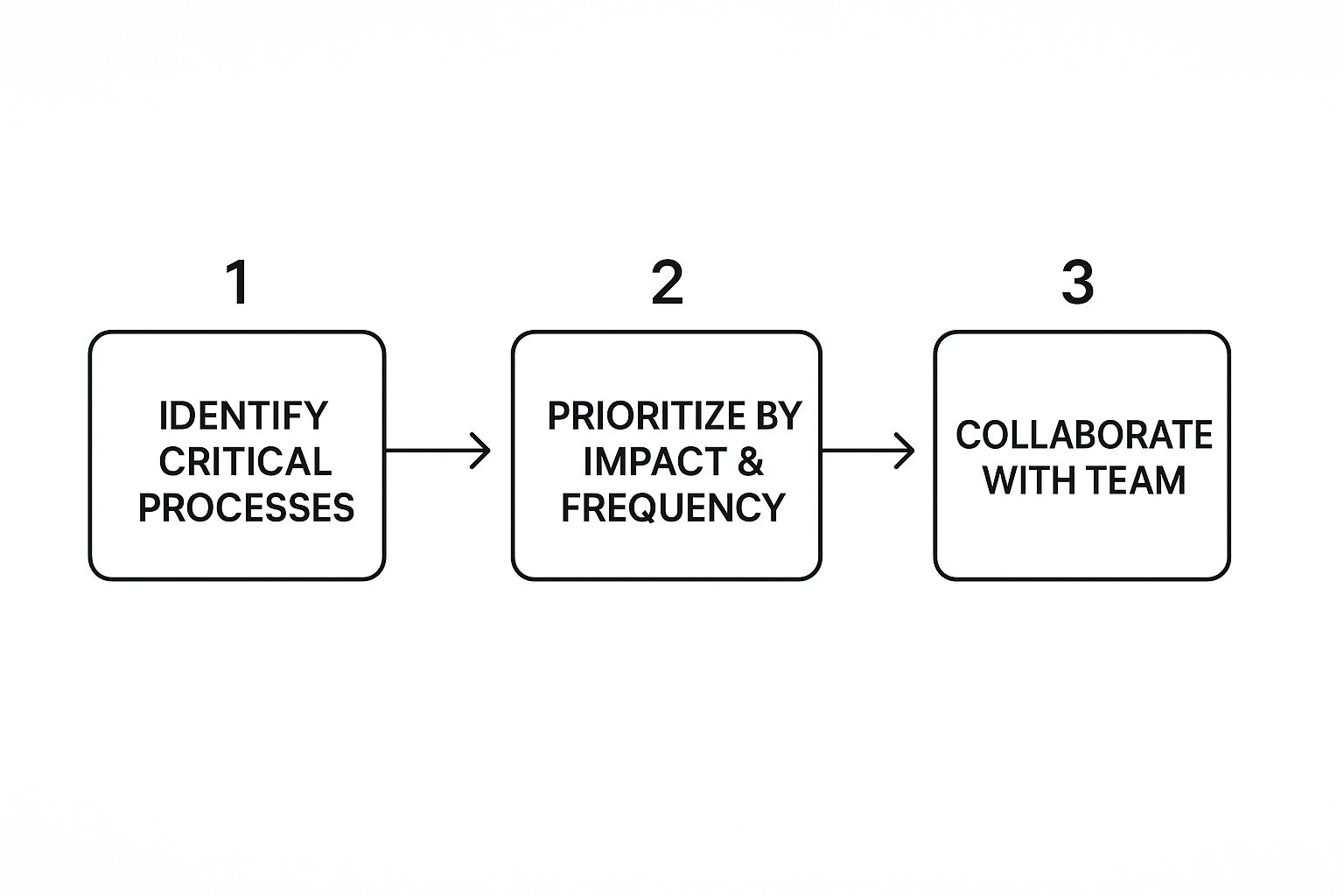
As you can see, effective SOP creation isn't about writing first. It starts with identifying the right tasks and getting your team on board before a single word is typed.
Prioritize Based on Impact
So, where do you begin? A simple way to decide is to analyze tasks based on their impact. We've all got a million things to do, so a framework helps you figure out which procedures to document first.
Start by thinking about:
- High Risk: What tasks, if done wrong, could be a safety hazard or violate health codes? (Think: handling raw chicken or cleaning the deep fryer).
- High Frequency: Which duties are performed daily, often by multiple people? (Things like opening/closing checklists or brewing the morning coffee).
- Guest Impact: Which processes directly touch the customer experience? (Like taking a reservation or handling a complaint).
A task that checks all three boxes—like the exact recipe and plating for your best-selling signature dish—is a top-priority candidate for an SOP. This approach ensures you’re putting your time and energy where it will make the biggest difference in your day-to-day operations.
The most effective SOPs are built on a solid foundation of planning and collaboration. By focusing on impact and involving your team, you create documents that serve a real purpose instead of gathering dust.
Prioritizing Your Restaurant's SOPs
Deciding which SOPs to tackle first can feel overwhelming. This table offers a straightforward way to categorize tasks and set your priorities, ensuring you focus on the procedures that will have the most immediate and significant impact on your business.
| Process Area | Example Task | Priority Level (High/Med/Low) | Reason for Priority |
|---|---|---|---|
| Food Safety & Handling | Properly cooling soups/sauces | High | Critical for preventing foodborne illness; a major health code item. |
| Guest Service | Handling a customer complaint | High | Directly impacts guest satisfaction and your restaurant's reputation. |
| Kitchen Operations | Plating the signature steak dish | High | Ensures consistency for your most popular and profitable menu item. |
| Opening/Closing | End-of-day cash handling | High | Involves financial security and accuracy; high risk for errors. |
| Bar Operations | Pouring a standard glass of wine | Medium | Important for cost control and consistency, but lower risk than food safety. |
| Maintenance | Weekly ice machine cleaning | Medium | Prevents mold and ensures health standards are met over time. |
| Front of House | Setting a table for service | Low | Important for presentation, but easily corrected and low risk. |
By using a simple matrix like this, you can quickly identify your "must-do" SOPs and create a logical roadmap for getting them all documented without feeling like you have to do everything at once.
Get the Right People Involved
Once you've identified your priority processes, the next step is collaboration. Trying to write an SOP in a vacuum from the back office is a guaranteed path to failure. Your procedures have to reflect the reality of the floor or the kitchen line to be useful.
This means you need to bring in the people who actually perform these tasks every single day. Sit down with your head chef to document a complex recipe. Work alongside your best server to outline the steps of service. Their hands-on expertise is absolutely invaluable for creating instructions that are accurate, efficient, and realistic.
Before you dive into documenting specific tasks, it's a great idea to get a firm grasp on the core principles of effective SOPs. For a deeper look, check out this excellent guide on how to create an SOP that actually works.
Ultimately, when your team helps build the playbook, they gain a powerful sense of ownership. This makes them far more likely to adopt and champion the new standards you’re putting in place.
How to Document Your Procedures Clearly

Alright, you’ve pinpointed the high-impact processes that need to be standardized. Now comes the real work: getting those operations out of your head and onto the page. The goal here isn't to write a novel. It's to create a clear, concise guide that anyone on your team—from a seasoned pro to a brand-new hire—can follow to get a perfect result every single time.
Forget the corporate jargon and dense paragraphs. Your team is busy, and your SOPs need to be scannable and instantly understandable, even in the middle of a chaotic dinner rush. Think simple, direct language and a format that puts clarity above everything else.
Choose the Right Format for the Task
Not all procedures are created equal, so a one-size-fits-all document just won’t cut it. The secret is matching the format to the complexity of the task. Your approach here should be as flexible as your kitchen itself.
Here are a few practical formats I’ve seen work wonders in different restaurant settings:
- Simple Checklists: These are perfect for linear, sequential duties. Think opening and closing procedures, daily station cleaning, or the front-of-house setup. A simple list with checkboxes ensures no step is ever forgotten. For more ideas, you might find our detailed restaurant kitchen cleaning checklist helpful.
- Step-by-Step Guides: For something a bit more involved, like brewing a specialty coffee or handling a guest reservation, a numbered or bulleted list with short, descriptive sentences is ideal. This format gives you more room for context than a basic checklist.
- Hierarchical Steps: Use this for complex tasks with distinct phases, like end-of-month inventory or a deep clean of the walk-in. You can break the main goal into major steps, each with its own set of smaller sub-steps to follow.
- Flowcharts: While less common, flowcharts are incredibly useful for processes that have decision points. A classic example is a "Handling a Guest Complaint" SOP, where the path changes based on how the guest responds.
The best format is the one that removes all guesswork. If someone brand new to your team can pick up the document and complete the task correctly without asking a single question, you’ve succeeded.
Write with Absolute Clarity
Once you've picked a format, it’s time to write the actual content. This is where so many SOPs fall flat. Vague instructions lead to inconsistent execution, which is exactly what we're trying to avoid.
Use plain, direct language. Instead of writing, "Sanitize the prep surfaces accordingly," be specific: "Wipe down all stainless steel prep surfaces with the approved sanitizing solution from the red spray bottle." Spell out the tools, ingredients, quantities, and locations.
And here's a pro tip: Incorporate visuals whenever possible. A picture truly is worth a thousand words in a bustling kitchen.
- Include a photo of the perfectly plated signature dish next to the plating instructions.
- Add a diagram showing the correct way to assemble the meat grinder.
- Use a short video demonstrating the proper knife technique for a specific cut.
Visuals make your instructions instantly clear, cut through potential language barriers, and make training significantly faster and more effective. While not specific to foodservice, the principles behind creating a robust recruitment process template show how structured, clear documentation builds consistency in any critical business operation.
Rolling Out New SOPs to Your Team

You can write the most brilliant, detailed SOP in the world, but if it just collects dust in a binder, it’s completely useless. The real success of any new procedure isn’t in the document; it’s in the follow-through from your team. This is where the human element becomes the most crucial part of the whole process.
Simply dropping a new manual on the counter and expecting everyone to magically follow it is a recipe for failure. A successful rollout needs a real strategy, one that’s built on clear communication, hands-on training, and getting genuine buy-in from the ground up.
Explain the "Why" Before the "How"
Your team is smart. They can spot pointless bureaucracy from a mile away. To get them on board with a change, you have to start by explaining the “why” behind the new procedure before you even get to the “how.”
For example, don’t just announce, "We’re now measuring all wine pours with a jigger." That feels like a top-down order. Instead, frame it with the benefit that affects everyone: "To get our inventory numbers accurate and protect our profit margins, we’re going to start using jiggers for every wine pour. This helps keep the restaurant healthy and makes sure every guest gets a consistent drink."
When your team understands that a procedure makes their job easier, improves safety, or helps the business succeed, they shift from seeing it as a rule to seeing it as a shared tool for success. That sense of shared ownership is the bedrock of a strong operational culture.
Make Training Hands-On and Engaging
Reading a document aloud during a pre-shift meeting is not training. Not even close. Effective training has to be active and hands-on, with plenty of room for questions and practice.
- Demonstrate First: Physically walk through the new process yourself. If it’s a new plating procedure for a dish, plate it right in front of them, exactly as the SOP describes. Let them see it done right.
- Allow for Practice: Give your team a chance to try it themselves in a low-pressure setting—not during the middle of a chaotic dinner service. This is how you build muscle memory and confidence.
- Encourage Questions: Create a safe space where staff can ask anything without feeling foolish. This is your best chance to clear up any confusing points before they turn into bad habits.
Proper training is especially critical when you’re bringing in new equipment. For a deeper dive, our guide on commercial kitchen equipment training provides a solid framework you can adapt for your own rollout sessions.
Ensure Constant and Easy Accessibility
Even with the best training, people forget things. It happens. That’s why your SOPs need to be incredibly easy to find right when they’re needed most. A forgotten file on an office computer is no help to a line cook during the dinner rush.
Think about the workflow of each station and put the information right where it will be most effective.
- Laminate the dish machine cleaning checklist and post it directly on the machine.
- Use a tablet in the kitchen with a digital folder of all recipes and plating guides, complete with photos.
- Keep a quick reference guide for handling guest complaints right at the host stand.
By making your SOPs a visible, integrated part of the daily environment, you turn them from a formal document into a practical, go-to tool. This constant availability reinforces the standards you’ve set and empowers your team to nail their tasks correctly and consistently, every single time.
Keeping Your SOPs Relevant and Up-to-Date
Creating your standard operating procedures is a huge accomplishment, but the job isn't done. Think of it this way: your restaurant is constantly evolving. Menus change with the seasons, you upgrade equipment, and new health regulations pop up. Your SOPs have to be living documents that grow right alongside your business, otherwise, they quickly become outdated relics.
A static SOP is actually worse than no SOP at all. It creates confusion, teaches the wrong methods, and undermines the very consistency you’re trying to build. The real goal is to create a simple, sustainable system for keeping every procedure current, accurate, and genuinely useful for your team.
Establish a Simple Review Schedule
You don’t need some complicated, color-coded auditing system to keep your documents fresh. All it takes is a straightforward and consistent review schedule to prevent your hard work from becoming obsolete.
I recommend breaking it down to make the process manageable:
- Quarterly Review: This is for your high-impact, fast-changing procedures. Think new menu item prep, seasonal cocktail recipes, or any process tied to a recent promotion. These are the things that change most often.
- Annual Review: Once a year, set aside some time to go through your foundational SOPs. This is for the big stuff—your opening and closing checklists, guest complaint protocols, and general safety procedures that don't change as frequently.
- Immediate Update: Some things just can't wait. An SOP needs to be updated immediately when you install new equipment, switch a critical vendor, or a health code regulation changes. No delays on these.
This tiered approach keeps you focused on the most critical documents without making you feel like you have to review everything all at once.
Create a Powerful Feedback Loop
Your team on the front lines is your single greatest asset for keeping SOPs relevant. They use these procedures every single day and will be the first to spot a step that’s clunky, outdated, or just plain wrong.
You have to make it easy for them to speak up. This could be a dedicated section in your communication log, a specific channel in your team messaging app like Slack, or even a simple suggestion box in the breakroom. When a line cook finds a better way to clean the flat top or a server has a faster way to polish glassware, listen.
By actively involving your team, you shift them from people who just follow instructions to active partners in operational excellence. This builds a powerful culture of continuous improvement where everyone feels a sense of ownership over how the restaurant runs.
This kind of proactive approach is becoming more common as restaurants and other businesses see the value in making their operations as smooth as possible. In North America, the demand for SOP software is growing, largely driven by strong digital infrastructure and strict regulatory needs in sectors like foodservice and healthcare. For instance, the U.S. healthcare sector’s projected 5.5% annual growth is fueling the need for effective SOP software to keep up with compliance rules. You can see more about these market trends in this detailed SOP software market analysis.
The final piece of the puzzle is simple version control. When you update a procedure, label it clearly (e.g., "Plating Guide - Steak Frites v2.1 - Updated Oct 2024"). Announce the change to the entire team and, most importantly, get rid of all the old versions to avoid any confusion. This ensures everyone is always working from the most current playbook, protecting the consistency you've worked so hard to build.
Of course. Here is the rewritten section, crafted to sound completely human-written and natural, following the style of the provided examples.
Got Questions About Creating SOPs? We’ve Got Answers.
Even with the best game plan, a few questions always pop up when you're figuring out how to create standard operating procedures. That’s perfectly normal. We hear the same handful of queries from restaurant operators all the time, so let’s tackle them head-on with some clear, direct advice.
What Is the Best Format for Writing an SOP?
Honestly? The best format is whatever gets the job done clearly and effectively for that specific task. There's no single "right" way, and a common mistake I see is trying to force every single procedure into one rigid template. That’s a fast track to confusing documents nobody wants to use.
For instance, a simple checklist is perfect for straightforward, repeatable duties like the morning kitchen opening or the nightly bar closing. These tasks have a clear beginning and end, and a checklist is a foolproof way to make sure nothing gets missed in the shuffle.
But for more complex processes, you’ll need to switch up your approach.
- Hierarchical or Step-by-Step: This is your go-to for complex recipes or procedures with distinct phases, like breaking down a whole fish. You can list the main steps and then tuck crucial details or sub-steps underneath each one, keeping it organized and easy to follow.
- Flowcharts: While they might seem a little old-school, flowcharts are invaluable for tasks with decision points. Think about handling a customer complaint—the path you take changes based on how the guest responds. A flowchart visualizes that logic perfectly so your team knows exactly what to do next.
The real goal here is to remove any and all guesswork for the employee doing the job. Always, always include photos or diagrams for anything that requires visual precision, like plating a signature dish or assembling a piece of equipment.
How Do I Get My Team to Actually Follow the SOPs?
This is the million-dollar question, isn't it? And the answer has way more to do with your kitchen culture than with the documents themselves. You can't just drop a shiny new binder on the counter and expect instant compliance. True adoption comes from building a sense of shared ownership.
Your first move should always be to involve your team in the creation process. I can't stress this enough. When your line cooks and servers help write the rules, they are far more likely to respect and follow them. They’re the ones in the trenches, and they can immediately point out steps that look good on paper but are totally impractical during a dinner rush.
Next, you have to explain the "why" behind each procedure. Don’t just tell them what to do; show them how it makes their job easier, improves food safety, or helps the whole restaurant succeed.
And finally, you have to lead by example. When managers and chefs consistently use and reference the SOPs themselves, it sends a powerful message to everyone on the team that this stuff genuinely matters.
How Often Should I Review and Update My SOPs?
Think of your SOPs as living documents, not rules carved in stone. You should plan to formally review your most critical procedures—especially anything related to food safety and guest service—at least annually.
However, an SOP needs to be updated immediately anytime a key part of the process changes. This could be when you roll out a new menu item, get a new piece of kitchen equipment, or a local health regulation gets an update.
The best way to stay on top of this is to create a simple review calendar and, more importantly, empower your staff to flag procedures that feel outdated. When everyone feels responsible for keeping the documents accurate, they remain truly useful.
Ready to equip your kitchen for success? The Restaurant Warehouse offers everything from commercial refrigeration to cooking equipment, all designed to help you run a more efficient and consistent operation. Explore our extensive catalog and find the tools you need.
About The Author

Sean Kearney
Sean Kearney is the Founder of The Restaurant Warehouse, with 15 years of experience in the restaurant equipment industry and more than 30 years in ecommerce, beginning with Amazon.com. As an equipment distributor and supplier, Sean helps restaurant owners make confident purchasing decisions through clear pricing, practical guidance, and a more transparent online buying experience.
Connect with Sean on LinkedIn, Instagram, YouTube, or Facebook.