

What Is Food Cost Percentage? Boost Restaurant Profits Now
Your food cost percentage is simply the ratio of how much you spend on ingredients versus how much revenue those ingredients generate. It's one of the most critical numbers in your restaurant, giving you a clear look at your menu's profitability. Most operators aim to keep this number between 28% and 35%.
Your Restaurant's Financial Health Score
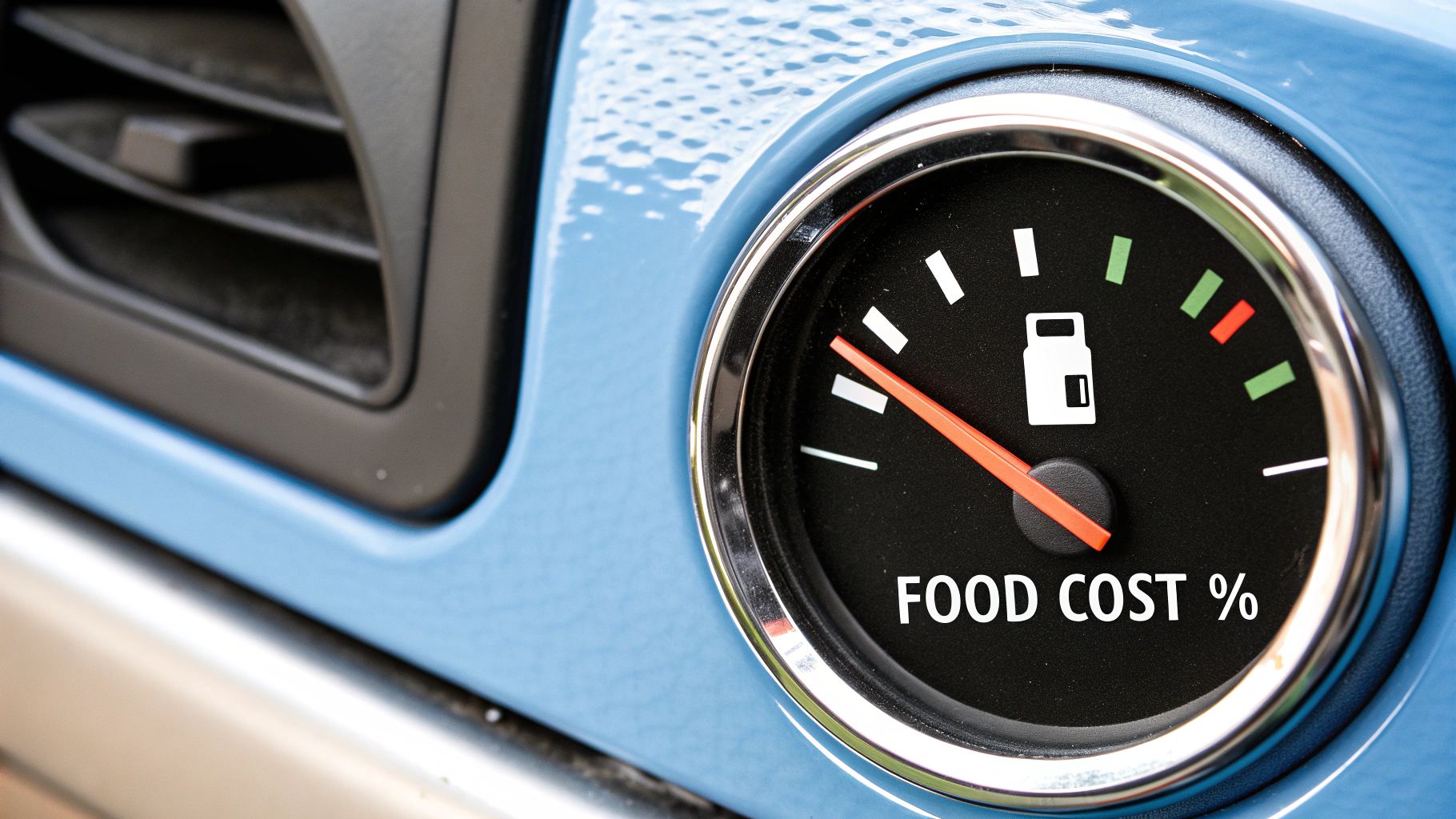
Think of food cost percentage as your restaurant’s fuel gauge. Just like a driver keeps an eye on miles per gallon to manage fuel, you track this number to manage how you spend money on ingredients. It’s not just some abstract accounting term; it’s a real-time health score for your menu.
A low percentage is a great sign—it means you're running an efficient operation and pocketing more of every dollar you earn. A high percentage, on the other hand, is a warning light telling you that ingredient costs are eating away at your revenue.
Getting a handle on this one number helps you:
- Set menu prices that actually make you money.
- Spot potential problems with waste or even theft.
- Make smarter, more informed purchasing decisions.
Understanding this metric is the first step toward building a more resilient and profitable business. To see how it fits into the bigger picture, our restaurant profit margin calculator can give you some valuable perspective.
Before we get into the full calculation, let’s quickly break down the key pieces of the formula.
Breaking Down the Food Cost Percentage Formula
This table unpacks each component of the food cost formula, explaining what it is and why it matters for your calculation.
| Component | What It Means for Your Restaurant | Simple Example |
|---|---|---|
| Beginning Inventory | This is the total dollar value of all the food ingredients you had in-house at the very start of a period (like the first day of the month). | You had $5,000 worth of ingredients on hand on June 1st. |
| Purchases | This is the total cost of all the new food supplies you bought during that same period. | You spent $2,000 on new food supplies throughout June. |
| Ending Inventory | This is the dollar value of the food ingredients you have left at the very end of the period (like the last day of the month). | You have $4,000 worth of ingredients left on June 30th. |
| Total Food Sales | This is the total revenue you brought in from selling food during that period. | You earned $10,000 in food sales during June. |
Think of these as the essential ingredients you need to get an accurate picture of your kitchen's financial performance. Now, let's put them all together.
Why This Metric Is Your Restaurant's North Star

Knowing what food cost percentage is is just the first part of the puzzle. The real power comes from using it as your operational North Star—a steady guide that helps you navigate the choppy waters of the restaurant industry.
This single number tells a powerful story about your kitchen's efficiency, your menu's profitability, and the overall health of your business. It's your early warning system.
Think about it: a sudden spike in your food cost percentage isn't just a number on a spreadsheet; it's a bright red flag. It could be a price hike from a supplier, telling you it’s time to renegotiate or find a new vendor. Or, it might point to a problem happening right inside your own kitchen.
By consistently tracking your food cost percentage, you stop reacting to problems and start building a proactive strategy. It’s the difference between plugging leaks on a sinking ship and building a stronger vessel from the start.
This metric gives you the clarity to ask the right questions and make smart, data-driven decisions that protect those razor-thin profit margins we all know so well.
Pinpointing Hidden Profit Leaks
Without tracking food cost, you're essentially flying blind. You might feel like business is good, but hidden leaks can silently drain your profits. For long-term survival in this industry, maintaining a healthy food cost percentage is non-negotiable.
Here’s how it shines a light on some of the most common issues:
- Smarter Menu Pricing: Is your signature burger actually making you money? Calculating the cost for each menu item shows you which dishes are your true stars and which ones are secretly dragging your profits down.
- Uncovering Waste: If your actual food cost is always higher than your ideal (or theoretical) cost, it often points directly to waste. This could be over-portioning, spoilage, or sloppy prep techniques bleeding your inventory dry.
- Flagging Potential Theft: A big, unexplained jump in food cost can sometimes be a sign of inventory shrinkage from employee theft. It’s a clear signal to take a closer look at your inventory controls and security.
In the end, knowing your food cost percentage gives you the control to steer your business toward profitability. You can finally trade guesswork for a clear, actionable financial strategy.
Calculating Your Food Cost Percentage Step by Step
Alright, let's get down to the brass tacks and turn all this talk into action. Figuring out your food cost percentage isn't some high-level accounting trick; it’s a hands-on process every restaurant owner needs to get comfortable with. The formula itself is actually pretty simple, but it tells you a powerful story about where your money is really going.
The basic formula looks like this: (Beginning Inventory + Purchases – Ending Inventory) / Total Food Sales.
This equation first helps you find your Cost of Goods Sold (COGS) for a specific period. Then, it stacks that number up against your sales to give you a clear, simple percentage. Let's walk through it with an example that feels real.
The Bistro Example
Let’s say you run a small bistro and you want to calculate your food cost for the month of June.
- Determine Your Beginning Inventory: On June 1st, you do a full count of everything in your walk-in, freezer, and pantry. The total value of all the food you have on hand comes out to $10,000.
- Add Up Your Purchases: Throughout the month, you get several deliveries from your suppliers. You gather up all the invoices, and the total for June is $6,000.
- Calculate Your Ending Inventory: On June 30th, you do the count all over again. This time, the value of all the ingredients you have left is $8,000.
- Find Your Total Food Sales: You pull the numbers from your Point of Sale (POS) system and see that your total food revenue for June was $25,000.
With these figures in hand, we can just plug them into the formula. This infographic gives a great visual of how the calculation flows.
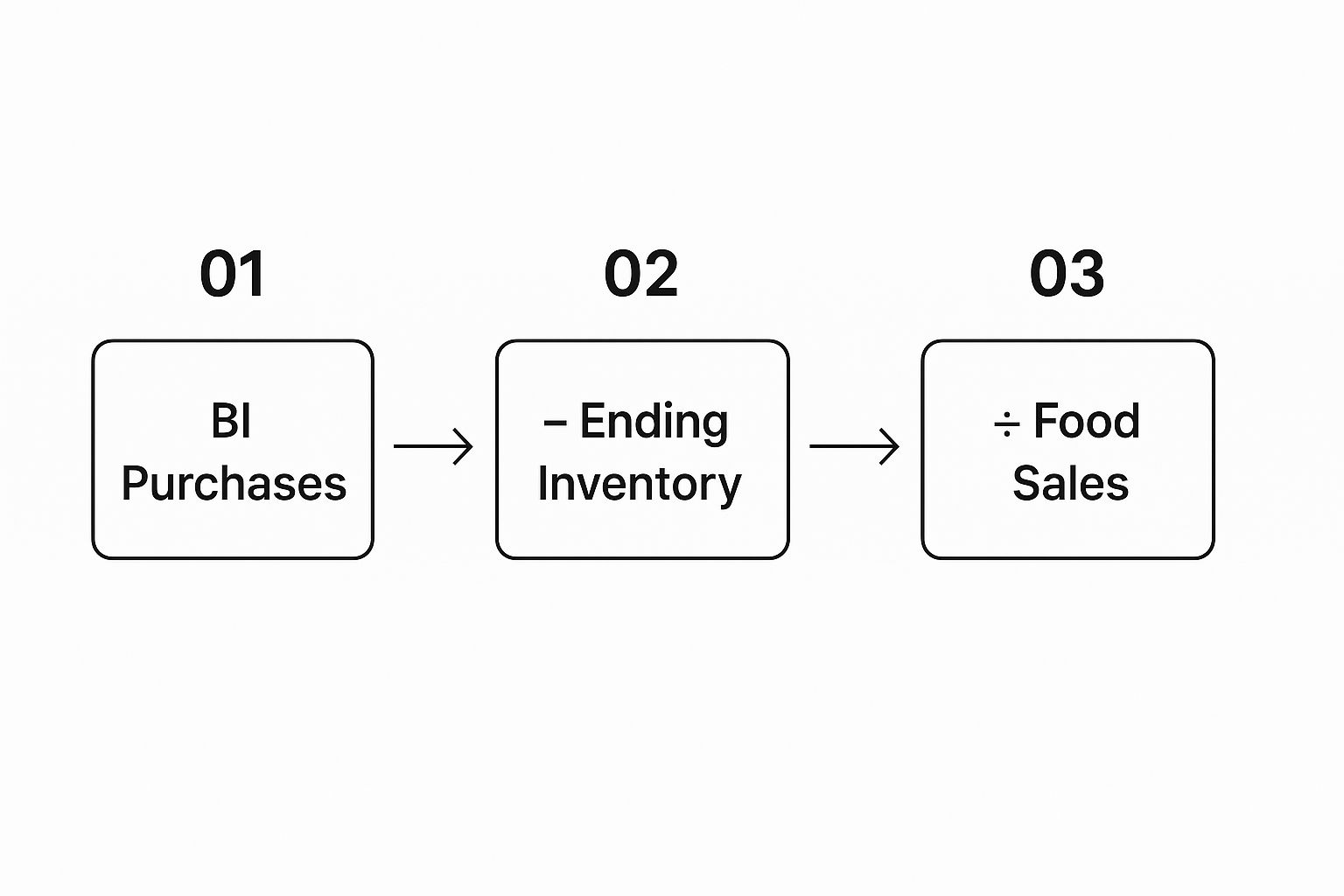
As you can see, you start with what you had, add what you bought, subtract what's left over, and then divide by your sales to get the final percentage.
Putting It All Together
Let's do the math for our little bistro:
($10,000 + $6,000 – $8,000) / $25,000
$8,000 (COGS) / $25,000 (Sales) = 0.32
To get the final percentage, just multiply that result by 100. So, the bistro's food cost percentage for June is 32%. This lands squarely in that healthy industry average of 28-35%, which is great news.
This calculation gives you your actual food cost. It’s not just theory; it accounts for everything—the perfectly portioned plates, the bit of waste from a dropped pan, and even any ingredients that went missing. Tracking this number consistently is fundamental to running a profitable restaurant, and using a modern restaurant inventory management system can automate a huge chunk of this work, saving you a ton of time and helping you avoid costly mistakes.
What's a Good Food Cost Percentage, Anyway?
Okay, so you've run the numbers and calculated your food cost percentage. The big question now is... is it any good? While there's no single magic number that works for everyone, industry benchmarks give you a vital frame of reference. Think of it as a sanity check to see where you stand and what you should be aiming for.
For most restaurants, a healthy food cost percentage is the sweet spot that covers all your ingredients while still leaving plenty of room for labor, rent, and, of course, your hard-earned profit. As of 2025, the general rule of thumb is that a healthy food cost percentage falls somewhere between 28% and 35%. So, if your restaurant pulls in $10,000 in food sales, you'd want your ingredient costs to be around $3,000 to hit that sweet 30% mark.
Why One Size Never Fits All
Now, that 28-35% range is just a guideline, not a hard-and-fast rule. The perfect number for your business really boils down to your specific concept and what you're serving. A few things can really move the needle here:
- Fine Dining: These spots often aim for a lower percentage, maybe closer to 28%. Why? Because their higher menu prices can easily absorb the cost of those premium, expensive ingredients while keeping profit margins looking healthy.
- Quick-Service Restaurants (QSR): On the flip side, fast-food joints and chains might run a bit higher, around 35%. Their menu prices are lower, so they rely on selling a ton of food and being incredibly efficient to make their money.
- Cafes and Pizzerias: These businesses usually land somewhere in the middle. Ingredients like coffee and dough are typically low-cost, which helps balance out the more expensive stuff you might put on a pizza or in a sandwich.
Look Beyond Your Kitchen Walls
Your food cost isn't just about what happens inside your restaurant. It's directly connected to what's happening out in the world. Global supply chain hiccups, weird weather patterns messing with crops, and big shifts in commodity prices can make the cost of your key ingredients swing wildly.
To really get a handle on industry benchmarks, you need to understand the economic story behind your ingredients. Knowing these forces helps you shift from being a manager who just reacts to price hikes to a strategic operator who can see them coming and plan ahead.
For example, have you ever wondered why a staple ingredient suddenly gets more expensive? Digging into its entire journey from farm to kitchen can be eye-opening. Learning why extra virgin olive oil prices are so high is a perfect real-world example of how global events can directly hit your bottom line.
Proven Strategies to Control Your Food Cost
Knowing your food cost percentage is one thing, but actually getting it under control is where the real magic happens. The good news? Lowering this critical number doesn't mean you have to start buying cheaper ingredients or shrinking your portions into oblivion. It’s all about working smarter, not harder, by putting better systems in place from the back door to the front of house.
Think of your restaurant like a high-performance engine. A few precise adjustments can give you a huge boost in efficiency without sacrificing an ounce of power. These strategies are the tools you'll use to fine-tune your operations, plug those sneaky profit leaks, and give your bottom line a healthy lift.
Master Your Menu and Portions
Your menu is so much more than a list of what you sell; it's your single most powerful sales tool. This is where strategic menu engineering comes into play. It’s the art and science of analyzing how profitable and popular each dish is, then using that data to design a menu that subtly guides customers toward your highest-margin items. A smart layout can make a world of difference.
Of course, a perfectly engineered menu means nothing without strict portion control. This part is non-negotiable. Using tools like digital scales, standardized scoops, and crystal-clear recipes ensures that every single plate leaving your kitchen is consistent. This protects your margins and gives your guests the same great experience every time they walk through your door.
A single extra ounce of protein on every dish might seem small, but over hundreds or thousands of plates a month, it adds up to a massive, unnecessary expense that directly inflates your food cost percentage.
Get Serious About Inventory and Waste
Diligent inventory management is the absolute backbone of food cost control. You need to run a tight ship. A simple "first in, first out" (FIFO) system is your best friend here, making sure older products get used before they have a chance to spoil. This alone can dramatically cut down on waste. Regular inventory checks also shine a spotlight on those slow-moving items that are just tying up cash and taking up precious shelf space.
Tracking what you throw away is just as crucial. Get a waste log and be meticulous about it. Every spoiled ingredient, kitchen mistake, or returned dish needs to be recorded. This data is gold, giving you a clear roadmap of where your money is literally going into the trash. For a deeper dive, our guide on reducing food waste in restaurants is packed with actionable tactics.
Build Smarter Supplier Relationships
Finally, don't overlook your suppliers—these relationships can be a goldmine for savings. Don't ever be afraid to negotiate on price, especially if you're a loyal, long-term customer. Ask about discounts for bulk orders on non-perishable staples you fly through. You should also look at what you can make in-house. For example, creating your own BBQ rubs or signature sauces can be far more cost-effective than buying pre-made versions.
Ready to take control? Start with these steps:
- Review Supplier Invoices: Scrutinize every single invoice for price creep. Those small, unnoticed increases from suppliers can quietly eat away at your profits over time.
- Use Seasonal Ingredients: Plan your specials and menu updates around seasonal produce. It's almost always cheaper, fresher, and higher quality.
- Train Your Staff: Get your whole team on board. Educate them on why portion sizes and minimizing waste are so important. Their buy-in is absolutely essential to making any of this work.
Answering Your Top Questions
Once you start digging into your restaurant's numbers, a few questions always seem to pop up. It's totally normal. Let's tackle some of the most common ones that owners and managers run into when they first start paying close attention to their food cost percentage.
Food Cost vs. Cost of Goods Sold?
It's really easy to mix these two up, but they're definitely not the same thing. Think of it this way:
Food cost is laser-focused. It’s only the cost of your raw food ingredients—the chicken, the flour, the produce. It's the direct cost of what's on the plate.
Cost of Goods Sold (COGS) is the bigger picture. It includes your food cost, but it also lumps in the cost of all your beverages, both alcoholic and non-alcoholic. So, food cost is just one piece of your total COGS.
Let’s say your food expenses for the month were $8,000 and your beverage costs were $2,000. Your total Cost of Goods Sold for that period is $10,000. Keeping these numbers separate is huge because it helps you see exactly where your costs are coming from.
How Often Should I Calculate This?
To get real, usable information out of this number, you have to be consistent. Every restaurant has its own rhythm, but a good rule of thumb is to calculate your food cost percentage at least once a month. This lines up perfectly with your monthly P&L statements and gives you a predictable snapshot of your financial health.
But if you want to keep a tighter rein on things (and who doesn't?):
- Weekly calculations are even better. This is how you catch problems fast. You'll spot a supplier price hike or a sudden spike in kitchen waste almost immediately, long before it has a chance to sink your profits for the month.
Can Software Help Track Food Costs?
Absolutely, and honestly, it's a game-changer. Trying to track everything manually with spreadsheets is a recipe for headaches and mistakes. Modern Point of Sale (POS) systems and inventory management software are built to handle all of this for you.
These platforms can pull in your supplier invoices, track every sale in real-time, and automatically subtract ingredients from your inventory counts with each order. They don't just calculate your food cost percentage for you; they give you a ton of invaluable data on how each menu item is performing. You'll save countless hours and get far more accurate results.
Ready to equip your kitchen for maximum profitability? The Restaurant Warehouse provides the high-quality, affordable commercial equipment you need to control costs and streamline operations. Find everything from precision scales to efficient refrigeration at https://therestaurantwarehouse.com.
About The Author

Sean Kearney
Sean Kearney is the Founder of The Restaurant Warehouse, with 15 years of experience in the restaurant equipment industry and more than 30 years in ecommerce, beginning with Amazon.com. As an equipment distributor and supplier, Sean helps restaurant owners make confident purchasing decisions through clear pricing, practical guidance, and a more transparent online buying experience.
Connect with Sean on LinkedIn, Instagram, YouTube, or Facebook.