

Beyond Basic: Specialized Shelving for Coolers, Bars, and Cellars
Why Walk-In Cooler Shelving Matters for Your Restaurant's Success
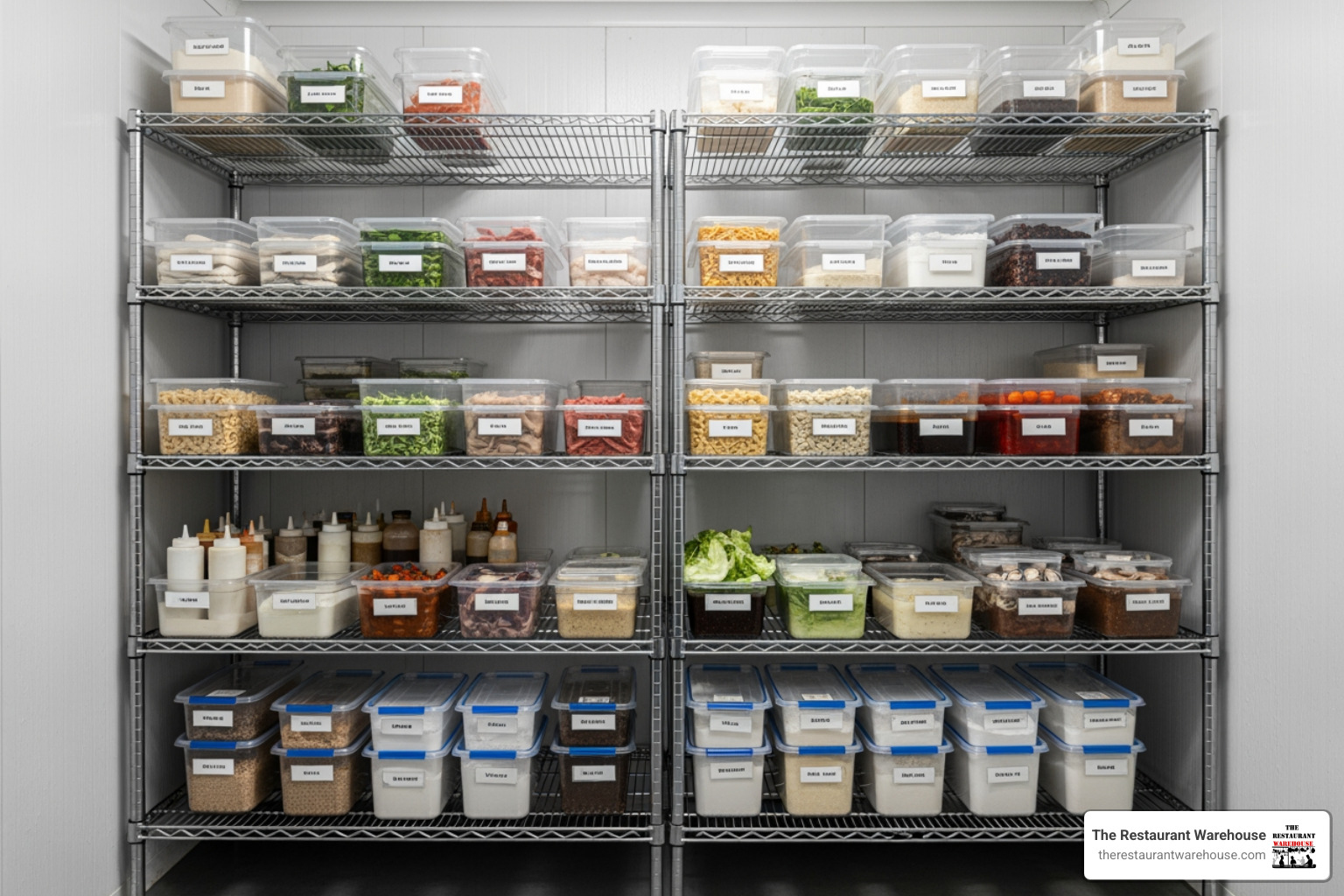
Walk-in cooler shelving is one of the most critical yet frequently overlooked investments for any restaurant. Its impact extends far beyond simple storage, directly influencing food safety, inventory control, employee efficiency, and long-term operating costs. Making an informed decision on your shelving system is not just about organization; it's about building a foundation for a safer, more profitable operation.
The right system involves selecting materials engineered to resist the relentless rust and corrosion of cold, damp environments, implementing designs that maximize every inch of your limited refrigerated space, and creating configurations that keep your team safe while streamlining the daily workflow.
Key Qualities to Look for in Walk-in Cooler Shelving:
| Quality | Why It Matters |
|---|---|
| Corrosion Resistance | The constant high humidity and cold temperatures in a walk-in will cause standard shelving to rust in months, creating food contamination risks and necessitating costly replacements. |
| Load Capacity | Commercial coolers store heavy items like cases of produce and boxes of meat. Shelving must safely support 800-1,000 pounds per shelf to prevent failures and injury. |
| Space Efficiency | Refrigerated space is expensive. Efficient shelving, such as cantilever designs, frees up valuable floor space for rolling carts and easier cleaning. |
| NSF Certification | This ensures that the shelving materials and design meet stringent public health and food safety standards, supporting health code compliance. |
| Easy Cleaning | Shelving with removable mats and open designs facilitates the deep cleaning required to support bacterial control and comply with regulations. |
The consequences of choosing the wrong shelving are costly. Standard wire shelving without protective coating will rust, potentially flaking into food products. Poorly designed systems waste valuable refrigerated real estate. Furthermore, unstable shelving can pose safety risks to your staff and inventory.
As Sean Kearney from The Restaurant Warehouse, I've dedicated my career to helping restaurant owners steer Walk-in cooler shelving selection. Through years of hands-on experience with operators of all sizes, I've seen how a strategically implemented shelving system can turn a disorganized cooler into a streamlined workspace that protects your inventory and supports your bottom line.
If you want expert input before you buy, you can contact The Restaurant Warehouse for a free walk-in shelving consultation and get recommendations custom to your space and budget.
The Foundation: Choosing the Right Materials and Finishes for Cold Storage
The environment inside a walk-in cooler or freezer is notoriously harsh on equipment. The combination of constant cold temperatures, high humidity, condensation, and frequent temperature fluctuations from door openings creates perfect conditions for corrosion and material degradation. This is why material selection is the paramount consideration; it directly impacts the durability, safety, longevity, and total cost of ownership of your walk-in cooler shelving.
Materials that perform well in dry storage will quickly succumb to rust and structural failure in refrigerated space. Rust weakens the shelf and can flake off, creating contamination concerns and leading to failed health inspections. Therefore, when selecting shelving for cold storage, the primary focus must be on proven corrosion prevention.
Beyond raw material strength, NSF certification is a non-negotiable requirement for any shelving used in commercial food service environments. This certification verifies that the shelving meets rigorous standards for public health protection. You can learn more about the role of NSF certification in food safety directly from the source.
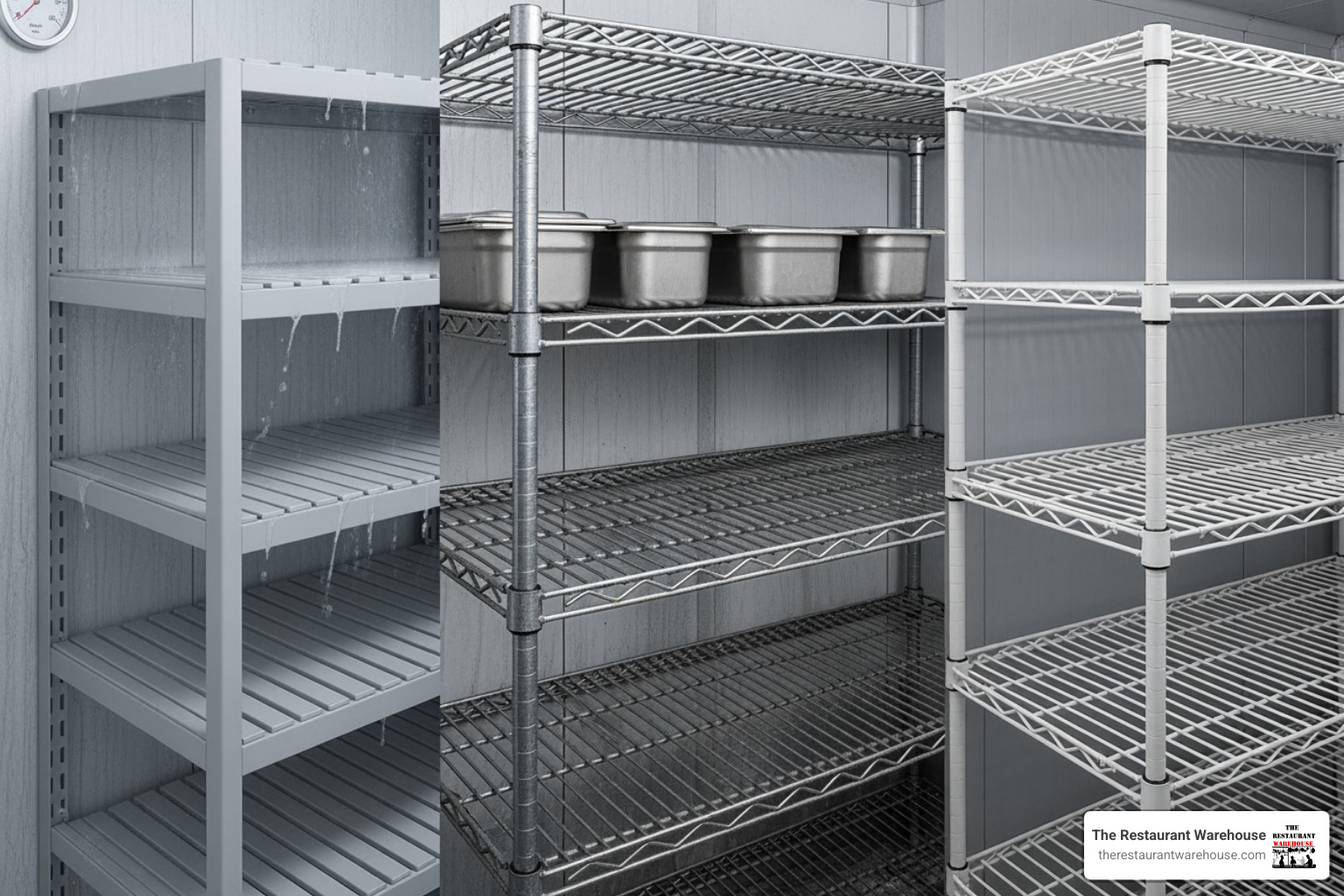
Recommended Materials for Walk-in Cooler Shelving
When it comes to materials for walk-in cooler shelving, we evaluate several options, each with distinct advantages:
Galvanized Steel: This is a popular and economical choice, offering an excellent balance of durability and cost-effectiveness. Galvanized shelving is created by applying a protective zinc coating to steel through a hot-dip process that creates a thick, resilient barrier. This zinc coating provides robust corrosion resistance, making it well-suited for cooler applications. It requires minimal maintenance and offers low long-term cost.
Polymer/Plastic: For strong defense against rust and corrosion, all-polymer or plastic shelving systems are often considered a top solution. These systems are effectively rust-proof, making them ideal for the wettest cooler and freezer environments. High-quality polymer systems often come with long-term warranties against rust and corrosion. A significant operational advantage is the inclusion of removable shelf mats that can be easily lifted off for fast and thorough sanitation. Many top-tier polymer systems have built-in antimicrobial product protection.
Epoxy-Coated Wire: Modern epoxy-coated wire shelving can be a viable and cost-effective option for coolers when specifically engineered for wet environments. These systems feature a thick, durable epoxy coating applied over a protective undercoating, providing excellent rust resistance. Quality epoxy systems may include multi-year rust warranties. For more options, explore more on wire shelving options.
Stainless Steel: Renowned for hygiene, strength, and durability, stainless steel is a premium choice for food storage. It is highly resistant to corrosion and easy to clean. While stainless steel shelving has a higher initial cost, for specialized applications its superior resistance can justify the investment.
If you are weighing material options against your budget, the team at The Restaurant Warehouse can help you compare galvanized, epoxy, polymer, and stainless choices. Request a custom quote for walk-in cooler shelving today and get pricing that fits your operation.
Design for Efficiency: How Shelving Layout Maximizes Space and Safety
The design and layout of your walk-in cooler shelving system are just as important as the materials it's made from. A well-designed system shapes workflow efficiency, inventory management accuracy, employee well-being, and your ability to adhere to food safety protocols.
A thoughtfully planned shelving layout ensures that your team can quickly locate, access, and rotate products, making it easy to follow crucial First-In, First-Out (FIFO) principles. Proper FIFO execution is essential for minimizing food spoilage and waste, which directly protects your profit margins.
Conversely, a poorly planned shelving system creates daily friction. It can lead to bottlenecks in high-traffic areas, blocked aisles that slow down service, and inefficient use of your expensive refrigerated space. It can also create significant safety concerns, such as unstable, precariously stacked items and obstructed pathways that increase the risk of trips and falls.
The Advantages of Cantilever Walk-in Cooler Shelving
When discussing efficient and safe walk-in cooler shelving, we consistently highlight the advantages of cantilever designs. This approach, proven over decades, can transform cooler organization and workflow.
The primary benefit of a cantilever design is the complete elimination of front support posts. Traditional four-post shelving systems create obstacles that impede movement and cleaning. By removing these front posts, cantilever shelving frees up the entire floor space. This creates an open-plan cooler that allows for the movement of large items and cleaning equipment. This makes daily stocking and prep tasks smoother and faster while improving safety by removing tripping hazards.
Clear floor access also allows for more thorough cleaning, helping you meet health code standards with less labor. Cantilever shelving is typically wall-mounted, anchored securely to provide stability without any reliance on floor supports. The result is a system of long, continuous shelf surfaces with no gaps and no front posts, maximizing every inch of valuable refrigerated space.
Optimizing Airflow, Accessibility, and Ergonomics
Beyond the structural design, the type of shelf surface and its adjustability play a crucial role in optimizing the cooler's environment and your team's performance. Proper air circulation is vital for maintaining consistent temperatures throughout the cooler.
- Wire or Vented Shelves for Airflow: Open-style shelves, whether made of wire or vented polymer, are excellent for promoting air circulation. Their open design allows cold air to flow freely around stored products.
- Solid Shelves for Containment: While less ideal for overall airflow, solid shelves are useful for storing small, loose items that might fall through open shelves.
Another key aspect of optimal design is shelf adjustability. The ability to easily adjust shelf heights allows you to customize your storage space to accommodate diverse inventory. This flexibility maximizes vertical space, preventing wasted empty air above shorter items. For more layout ideas, explore our comprehensive guide to commercial shelving.
A Guide to Optimizing Your Walk-in Cooler Shelving Configuration
Strategic, detailed planning is the cornerstone of an efficient, safe, and compliant walk-in cooler. Before you invest in any walk-in cooler shelving, it helps to complete a thorough assessment of your space, inventory, and operational needs. This process involves more than just taking basic measurements of your cooler; it requires a thoughtful visualization of your daily operational flow, from receiving deliveries to plating dishes.
Begin with a detailed plan. First, measure the interior length, width, and height of your walk-in. Create a simple diagram and mark the location of doors, noting their swing direction to ensure shelving doesn't impede entry or exit. Plan for clear, wide walkways—ideally 36 inches or more—that allow staff to move freely and safely, even when carrying large containers. Think critically about traffic flow: which items are accessed most frequently? High-velocity items should be placed in the most accessible locations near the door to minimize time and effort.
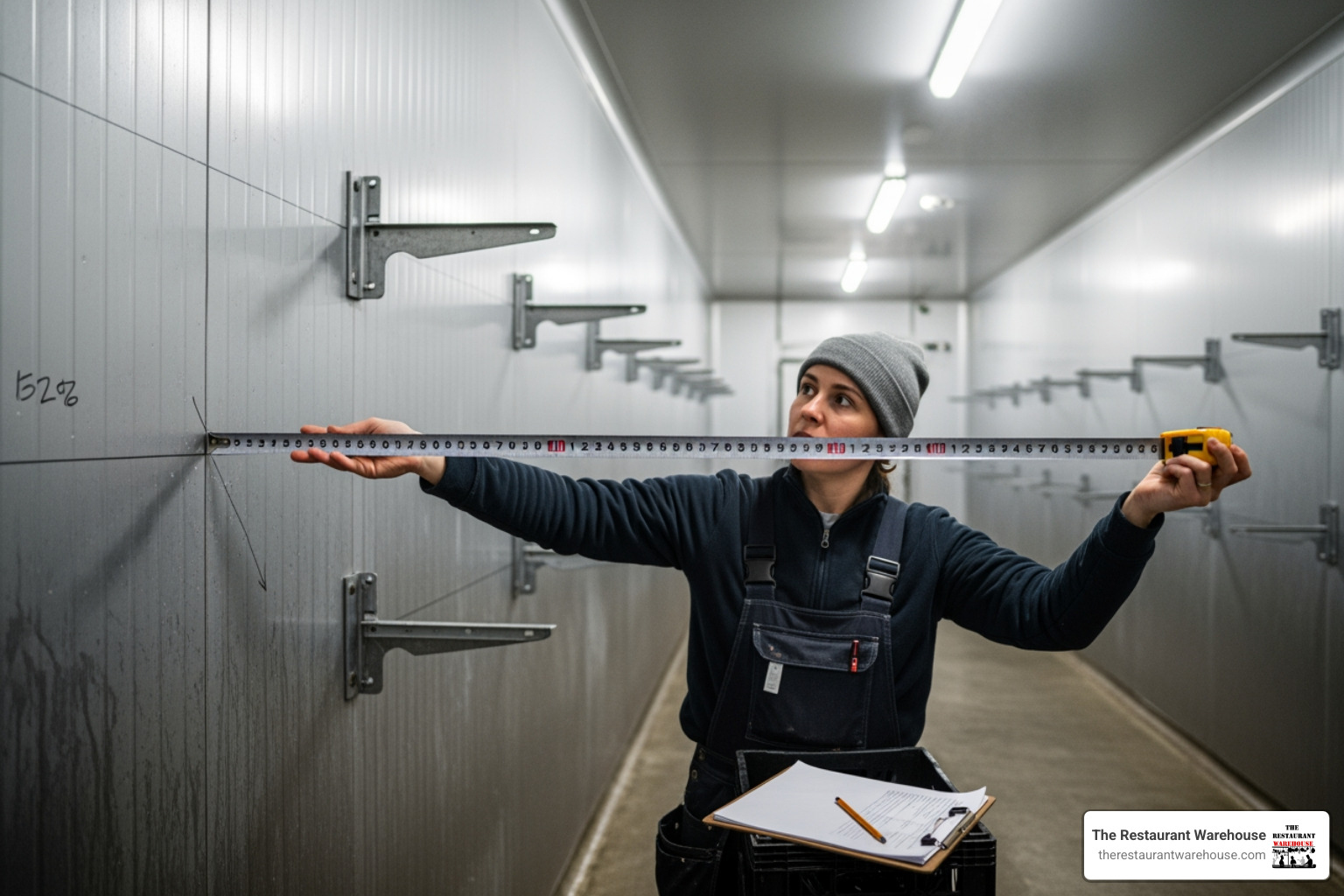
When mapping out your shelving placement, carefully document any existing infrastructure. Note the location of the evaporator unit and its fans, drain lines, lighting fixtures, and any interior wall panels or seams that might influence shelf placement or mounting. Advanced systems can be designed to work around these elements, but you need to know exactly where they are.
Do not forget to plan for the future. Your menu and inventory will change over time. A flexible, easily adjustable system will serve you far better in the long run than a rigid, fixed one.
If the planning process feels overwhelming, you do not need to do it alone. You can explore our complete commercial storage solutions to find the perfect fit for your space or reach out directly for layout help.
Understanding Shelf Dimensions and Load Capacity
Choosing the right shelf dimensions is crucial for maximizing storage density, ensuring product accessibility, and maintaining an organized inventory. Each dimension—depth, width, and height—plays a specific and important role.
Shelf Depth: This is the distance the shelf extends from the wall, with common depths ranging from a narrow 6 inches to a deep 30 inches. Deeper shelves (for example, 24-30 inches) are useful for storing large, bulky boxes, cases of beverages, or multiple rows of items, increasing storage density. However, they can make FIFO rotation more difficult if staff cannot easily see items at the back. Shallower shelves (such as 12-18 inches) are better for individual items, smaller containers, or when you need quick visual access and want to prevent older items from getting lost at the back.
Shelf Width: This is the horizontal length of the shelf, with standard widths available in increments from 24 inches up to 72 inches or more. Using longer shelf widths allows you to create continuous, uninterrupted runs of shelving. This is efficient for storing large quantities of similar items and creating streamlined inventory sections (for instance, a full wall for produce). When planning, measure the total length of your cooler walls and select shelf widths that minimize wasted space and awkward gaps.
Shelf Height and Load Distribution: This refers to the vertical spacing between shelves. Adjustable shelving systems are especially helpful, allowing you to customize the height to fit your products. You might need 24 inches of clearance for large stock pots but only 8 inches for shallow food pans. Utilizing vertical space effectively is key to maximizing your cooler's total capacity.
Always be mindful of the load capacity per shelf. High-quality shelving can often hold 800-1000 pounds, but this rating is based on a uniformly distributed load. This means the weight should be spread evenly across the shelf surface, not concentrated in one spot. Place the heaviest items, like full brine buckets or cases of meat, on the lower, more stable shelves to maintain a low center of gravity and improve safety.
To make sure your layout, shelf dimensions, and load ratings all work together, consider having a specialist review your plan. Book a shelving planning session with The Restaurant Warehouse team to get feedback before you install anything.
Frequently Asked Questions about Walk-in Cooler Shelving
Navigating the options for walk-in cooler shelving can bring up many questions. Here are answers to some of the most common inquiries we receive from restaurant owners.
What are the main differences between wire and polymer shelving for walk-in coolers?
The main differences lie in material composition, long-term corrosion resistance, ease of cleaning, and total cost of ownership.
-
Wire Shelving: Typically made of steel, wire shelving for coolers is coated with a protective layer, usually epoxy or a zinc galvanization, to resist rust.
- Pros: Encourages air circulation due to its open design, which helps maintain more consistent temperatures and can improve refrigeration efficiency. It often has a lower initial purchase price than all-polymer systems.
- Cons: The protective coating is the vulnerable point. It can be scratched or chipped by metal pans, boxes, or improper cleaning, exposing the steel underneath to moisture and leading to rust over time. Cleaning can also be more time-consuming as food particles and spills can get lodged in the wire grid.
-
Polymer Shelving: Made of advanced plastic compounds, sometimes with a steel core for added strength but fully encapsulated.
- Pros: Effectively rust-proof, making it durable and long-lasting for wet, cold conditions. Top brands often offer extended or lifetime warranties against corrosion. They are easy to clean; many systems feature removable mats that can be washed in a commercial dishwasher, saving labor. Some also include antimicrobial protection to help inhibit mold and bacteria growth.
- Cons: Generally has a higher initial investment compared to many wire shelving options. However, when you factor in the longer lifespan and reduced replacement costs, the total cost of ownership can be lower over time.
The best choice depends on your budget, the specific moisture level in your cooler, and your long-term operational goals. For strong longevity and hygiene, polymer is often the superior choice, while quality epoxy-coated wire can be a practical middle ground.
What are the primary benefits of a cantilever shelving design in a walk-in cooler?
The primary benefits of a cantilever shelving design for walk-in cooler shelving center on maximizing usable space, improving operational efficiency, and supporting safety and hygiene.
The most significant advantage is the elimination of front support posts. This open-front design transforms the functionality of the cooler:
- Unobstructed Access: Staff can move more easily, allowing for faster loading and unloading of inventory. It provides clear access for moving large inventory bins and, in larger coolers, transport equipment.
- Easier Cleaning: Without posts creating corners and obstacles on the floor, cleaning becomes simpler. Dirt and spills can be swept or washed away, which is important for maintaining hygiene standards and health inspections.
- Maximized Storage Volume: By removing floor obstructions, you gain usable storage volume and flexibility within the same footprint. Larger, bulky items can be stored on the floor underneath the bottom shelf without being boxed in by posts.
- Improved Safety: Eliminating posts can reduce tripping hazards, supporting a safer working environment for your staff.
- Wall-Mounted Stability: Cantilever systems are securely mounted to the cooler walls, providing stability and load-bearing capacity. Many systems can be installed directly onto the cooler's metal skin without additional blocking, which can simplify installation.
How can I ensure my shelving choice is durable and helps prevent corrosion?
To support durability and corrosion resistance for your walk-in cooler shelving, use this checklist during your selection process.
-
Prioritize the Right Material:
- Highest resistance: All-polymer systems. These are essentially rust-proof. Long warranties against rust are a positive sign.
- Strong protection: Epoxy-coated wire. Verify it has a thick, high-quality coating over a protective undercoat, designed specifically for wet environments.
- Value option: Galvanized steel. An economical and durable option that offers good corrosion resistance, especially in coolers that are not constantly saturated.
Check for NSF Certification: Verify that the shelving is NSF-Listed. This signals that the materials and design meet strict public health standards for cleanability and food safety.
Inspect Construction Quality: Look for heavy-duty construction. Shelves should feel rigid. Check the specified load capacity and ensure it meets your needs (800-1,000 lbs per shelf is a common benchmark for commercial use).
Look for Hygienic Design Features: Removable shelf mats on polymer or hybrid systems make cleaning easier. Smooth, non-porous surfaces are important for helping prevent bacterial buildup.
Plan for Proper Maintenance: Even the best shelving needs care. Commit to a regular cleaning schedule according to the manufacturer's guidelines to remove food debris and moisture that can accelerate wear. You can review general maintenance best practices in resources like the FDA Food Code alongside your local regulations.
If you want product recommendations that fit your budget and corrosion-resistance needs, contact us to talk through your walk-in cooler shelving options.
How much weight can walk-in cooler shelving hold?
The load capacity of walk-in cooler shelving varies by manufacturer, material, and design, but many commercial-grade systems are rated to hold between 600 and 1,000 pounds per shelf. Never assume the capacity; always confirm the manufacturer's specifications.
Importantly, this rating is almost always for a "uniformly distributed load." This means the weight should be spread evenly across the entire surface of the shelf. Placing a single heavy item in the center of a shelf rated for a certain capacity could cause it to bow or fail. For safety, always load shelves with the heaviest items (such as cases of meat, full containers of liquid, or bulk food boxes) on the bottom shelves and lighter items on upper levels to keep the overall center of gravity low.
Conclusion: Investing in the Right Shelving for Long-Term Success
Choosing the right walk-in cooler shelving is far more than a simple purchase; it's a strategic investment in the daily efficiency, long-term safety, and profitability of your restaurant. Throughout this guide, we've looked at how crucial material selection is, with options ranging from economical galvanized steel to rust-resistant polymer systems, all engineered to withstand the harsh, humid conditions of cold storage.
We have also seen how innovative designs, particularly wall-mounted cantilever systems, can transform your cooler space by maximizing usable floor area, improving accessibility for staff, and simplifying cleaning. A smart layout that considers shelf depth, width, and adjustability allows you to tailor storage to your specific inventory, supporting FIFO rotation and making it easier to find and use ingredients before they expire.
Compliance with health codes is a non-negotiable aspect of running a food service business. NSF-certified shelving, easy-to-clean surfaces, and good airflow all support safer food storage. A well-planned shelving system becomes a quiet, reliable part of your operation, backing up your food safety efforts without demanding constant attention.
Your shelving should function as a long-term asset: reducing food waste, increasing productivity by streamlining access to ingredients, and creating a safer, more comfortable workspace. Combined with consistent maintenance and thoughtful organization, the right shelves can free your team to focus on service instead of fighting clutter.
At The Restaurant Warehouse, we focus on supplying durable food service storage and shelving solutions at wholesale pricing, so you can upgrade your walk-in without overextending your budget. If you are ready to improve your cooler or planning a new build, contact us today to explore affordable and durable shelving solutions for your business and get practical recommendations that fit your menu, volume, and space.
Taking the time now to choose the right walk-in cooler shelving pays off for years in the form of better organization, less waste, smoother shifts, and greater confidence that your cold storage is supporting your operation rather than holding it back.
About The Author

Sean Kearney
Sean Kearney is the Founder of The Restaurant Warehouse, with 15 years of experience in the restaurant equipment industry and more than 30 years in ecommerce, beginning with Amazon.com. As an equipment distributor and supplier, Sean helps restaurant owners make confident purchasing decisions through clear pricing, practical guidance, and a more transparent online buying experience.
Connect with Sean on LinkedIn, Instagram, YouTube, or Facebook.
Leave a comment