

What Is ETL Certified Commercial Kitchen Equipment
Let's get right to it. When you see that ETL Listed Mark on a piece of commercial kitchen equipment, it’s basically a stamp of approval from a trusted third-party inspector. It tells you the product has met critical North American safety standards.
That little logo means the equipment has been put through its paces by an independent lab—in this case, Intertek—to make sure it’s safe from electrical, gas, and sanitation hazards.
Decoding the ETL Mark for Your Restaurant
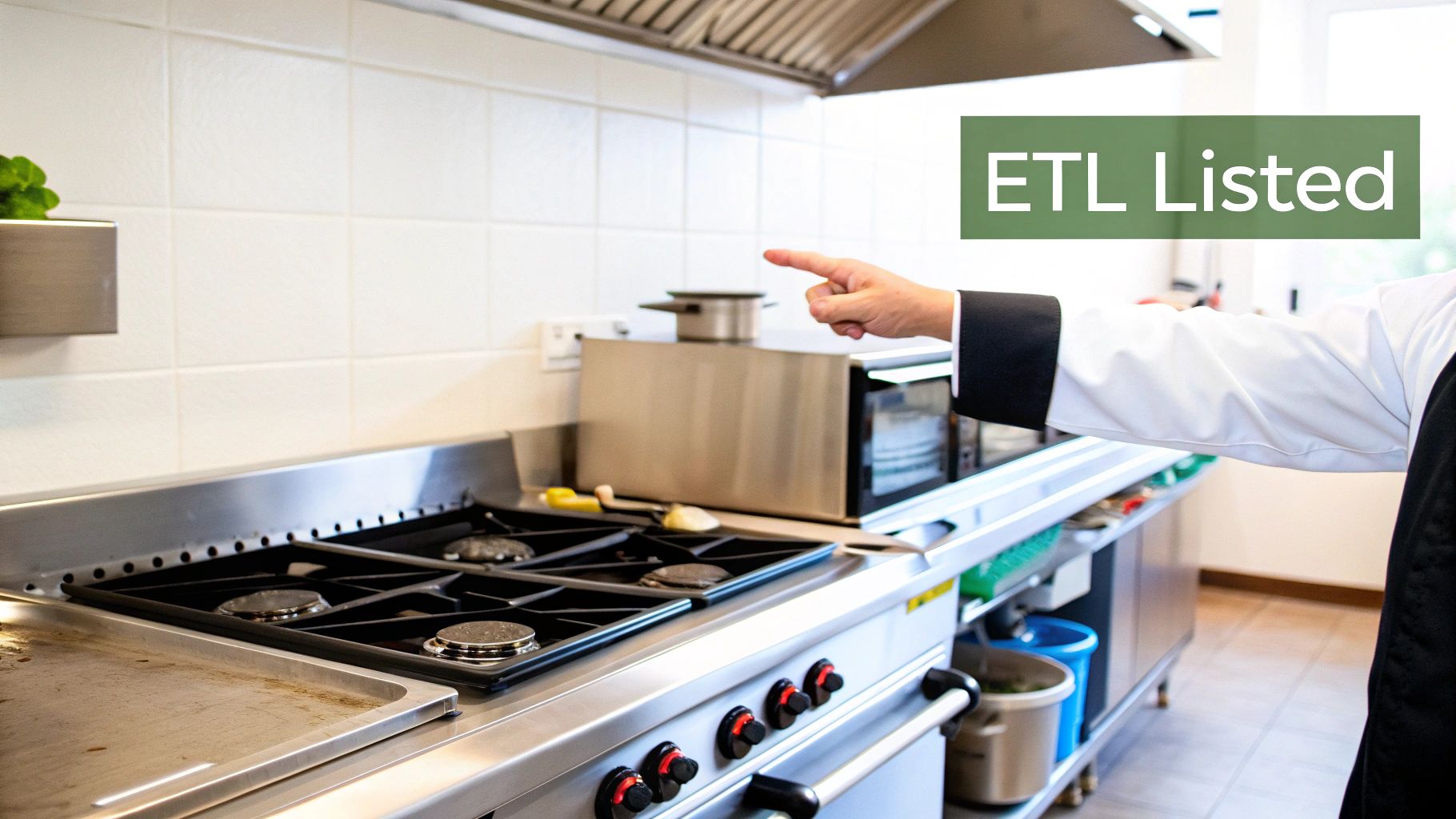
As you start outfitting your commercial kitchen, you’re going to be swimming in a sea of logos and acronyms. The ETL Listed Mark is one of the most important ones you'll see. But what is ETL certified equipment, really, and why should it be a non-negotiable for your business?
Think of it as a safety guarantee. It's a promise that your shiny new convection oven, fryer, or refrigerator won't pose an unnecessary risk to your staff, your customers, or your property.
This certification comes from Intertek, a Nationally Recognized Testing Laboratory (NRTL) that’s been given the green light by the U.S. Occupational Safety and Health Administration (OSHA). That official recognition is huge because it means local inspectors—from the fire marshal to the health department—accept the ETL mark as solid proof of compliance. For a restaurant owner, that translates to smoother inspections, easier permitting, and a whole lot more peace of mind.
Why It Matters Beyond the Sticker
Here’s the thing: the ETL mark signifies more than just passing a single, one-off test. It represents an ongoing commitment to safety.
To keep that ETL certification, manufacturers have to agree to periodic, unannounced factory inspections. These check-ups ensure their products continue to meet the required safety standards long after the initial test.
This constant vigilance ensures you're getting a consistent and reliable piece of equipment. In short, the ETL mark on your gear tells you:
- It passed mandatory safety tests: The product was rigorously evaluated against established national standards for fire, electrical shock, and other potential dangers.
- It meets local code requirements: Inspectors all over the country recognize and accept the ETL mark as proof of compliance.
- The manufacturing process is monitored: Regular factory visits ensure the product's quality and safety remain consistent over time.
For restaurant owners, the ETL mark is not just a feature; it's foundational. It protects your investment, your people, and your ability to operate without costly interruptions or compliance issues.
To give you a quick rundown, here’s what every restaurant owner should know about ETL certification.
ETL Certification at a Glance
| Aspect | What It Means for Your Kitchen |
|---|---|
| Safety Compliance | Your equipment has passed tests for electrical, fire, and sanitation hazards, making your kitchen a safer place for your staff. |
| Code Acceptance | The ETL mark is recognized by local inspectors (health, fire, building), which means fewer headaches during permitting and inspections. |
| Ongoing Verification | The manufacturer is subject to regular factory inspections, ensuring the product quality and safety standards are consistently met. |
| Insurance Premiums | Many insurance carriers look for ETL certification and may offer better rates or require it for coverage of commercial equipment. |
At the end of the day, understanding this simple logo is one of the first steps toward building a safer, more reliable kitchen. If you're currently building out your space, our commercial kitchen equipment guide offers more insights into selecting the right tools for the job.
The Surprising Story Behind the ETL Mark: From Edison's Light Bulbs to Your Kitchen
To really trust the ETL mark on your kitchen equipment, it helps to know where it came from. This isn't some new certification dreamed up overnight. Its story starts over a century ago with one of the most famous inventors in history: Thomas Edison.
Back in 1896, Edison founded the Electrical Testing Laboratories (ETL). His mission was simple but essential for the new age of electricity. He needed a reliable way to test his inventions—especially his light bulbs—to prove they were safe for the public. With that, the concept of third-party product safety testing was born in the United States.
That original mission of verifying safety has never wavered, even as the equipment being tested has become infinitely more complex than a simple light bulb.
From Edison's Lab to Intertek Today
Today, the ETL Listed Mark is owned and managed by Intertek, a massive global player in the world of testing, inspection, and certification. The name on the door may have changed, but the principle behind the work is exactly the same. Intertek is carrying Edison's legacy forward, applying the same tough, unbiased testing to thousands of products, from our smartphones to the powerful, high-demand equipment that keeps your restaurant humming.
This long history is precisely why the ETL mark carries so much authority. It’s a symbol of trust that has been built over more than 125 years of consistent, independent safety checks.
When you see the ETL mark, you're not just looking at a modern compliance sticker. You're seeing the direct descendant of a safety program started by Thomas Edison himself, now adapted for the intense demands of today's professional kitchens.
The journey from testing the first light bulbs to certifying a modern commercial convection oven is a long one, but the promise it makes is identical. It assures you that an independent lab has put the product through its paces against established safety standards.
So, when you choose ETL-certified equipment, you're plugging into a legacy of safety that began in the earliest days of electrical innovation. It's a powerful connection, linking your modern kitchen to a tradition of safety that has truly stood the test of time.
What ETL Certification Actually Tests in Your Equipment
Seeing that little ETL mark on your equipment brings instant peace of mind, but what does the certification process actually involve? This isn't just a quick once-over. To earn its mark, a piece of equipment goes through a whole series of tough trials designed to mimic real-world kitchen hazards, making sure it’s safe, reliable, and up to code from day one.
The testing process is intense, zeroing in on three core pillars of kitchen safety. Each test is designed to push the equipment to its limits, proving it can handle the intense demands of a professional kitchen without becoming a liability. These trials are what give the ETL certification its real weight.
This conceptual map shows how the ETL mark’s journey started way back with Thomas Edison and evolved into the modern-day seal of approval you see in your kitchen.
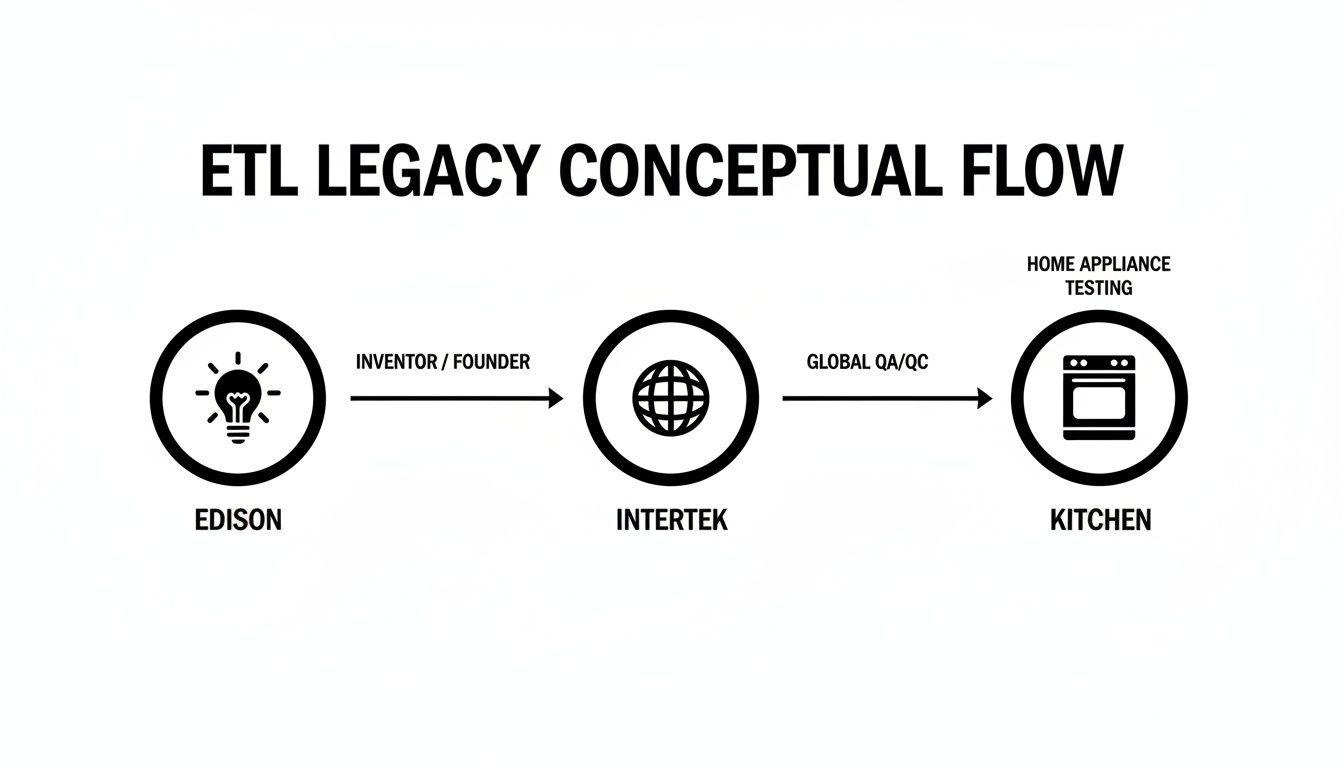
It’s a cool reminder of how a long history of safety innovation translates directly into the trustworthy equipment that powers your restaurant today.
Electrical Safety Testing
The first and most critical hurdle is electrical safety. Commercial kitchens are high-risk environments, with constant exposure to water, steam, and grease. ETL testing makes sure an appliance's wiring, insulation, and all its components are tough enough to prevent shocks, short circuits, and fires.
A convection oven, for example, undergoes tests to ensure its heating elements don’t make the outside dangerously hot, its internal wiring can take the heat, and its grounding is solid. The standards are so tough that in some industries, like sports lighting, fewer than 15% of manufacturers actually hold an ETL certification. It really speaks to how exclusive and valuable the mark is.
Gas Safety and Combustion Analysis
For gas-powered gear like ranges, fryers, and griddles, gas safety is obviously a huge deal. Technicians run extensive tests to make sure there are absolutely no gas leaks from valves or connections, which could lead to a disaster. They also analyze the combustion process itself.
This means checking that the equipment burns gas cleanly and efficiently, producing minimal carbon monoxide. Proper combustion isn't just a safety issue; it also means the appliance is running at its best, which saves you money on energy and keeps your kitchen staff safe.
An ETL test for a gas fryer confirms that its pilot light is stable, the automatic shut-off valves work flawlessly if the flame goes out, and its ventilation needs are clearly defined to maintain safe air quality in the kitchen.
Sanitation and Food Safety Standards
Finally, the equipment has to prove it's safe for food contact and, just as importantly, easy to clean. For this, ETL tests against established sanitation standards, most notably those from NSF International. This is the part of the process that’s crucial for passing your health inspections.
Testers are looking at an appliance for a few key things:
- Material Safety: Checking that all materials touching food are non-toxic and won't corrode over time.
- Cleanability: Making sure the design has no hard-to-reach cracks or corners where bacteria could hide and grow.
- Durability: Confirming the equipment can handle being cleaned over and over with strong commercial-grade chemicals.
An ice machine, for instance, must be designed to prevent mold and slime from building up and allow for easy disassembly so you can give it a deep clean. By meeting these benchmarks, ETL-certified equipment supports your food safety protocols and makes daily maintenance a whole lot easier. For a deeper dive, check out our guide on the importance of the NSF Sanitation Certification.
Comparing Certifications: ETL vs. UL Explained
When you're outfitting a restaurant, you'll see a few key certification logos stamped on just about every piece of equipment: ETL, UL, and sometimes CSA. This can be a little confusing. Is one better or safer than the others?
The short answer is no—at least, not when it comes to safety and passing your inspections.
Here's the deal. The U.S. government, through the Occupational Safety and Health Administration (OSHA), has a list of approved independent labs called Nationally Recognized Testing Laboratories (NRTLs). Both Intertek (the folks who issue the ETL mark) and Underwriters Laboratories (who issue the UL mark) are on this official list. This means they are both fully authorized to test and certify products against the exact same set of safety standards.
The Same Safety Checklist, Different Mechanics
Think of it like getting your car inspected by two different state-authorized mechanics. One might be a huge national chain you see everywhere (like UL), while the other is a trusted local expert known for getting things done efficiently (like ETL).
Both mechanics use the same official safety checklist mandated by the state. As long as your car passes, it's legally and safely cleared for the road, no matter which certified mechanic signed off on the paperwork.
It's the same thing here. An ETL-certified piece of equipment has been tested against the same ANSI/UL safety standards as a UL-certified one. From OSHA's perspective—and your local health inspector's—they are functionally identical. They both prove a product is safe for use in a commercial kitchen.
The core takeaway for any buyer is this: An ETL Listed Mark signifies the same level of safety and compliance as a UL Listed Mark. Both are recognized and accepted by inspectors across North America.
This isn't just a local thing, either. This parity is gaining ground globally. For hospitality startups, ETL isn't just a badge; it's a shield backed by real-world resilience, with Asia-Pacific's ETL growth at a 17.08% CAGR underscoring worldwide trust. You can see more about this global trust in their market access reports.
Key Differences That Matter to Manufacturers
So, if they're the same in terms of safety, why do both exist? The main differences are on the business side of things—factors that mostly affect the manufacturer but can have some nice ripple effects for you, the buyer.
- Standards Development: UL has a long history of actually writing many of the safety standards the industry follows. ETL, on the other hand, focuses on testing products against these established standards.
- Speed and Flexibility: ETL has built a reputation for a faster and more flexible certification process. This can help manufacturers bring new, innovative products to market more quickly.
- Cost: That faster process can sometimes make ETL certification a more cost-effective route for manufacturers. This can potentially translate into more competitive pricing on equipment for buyers like you.
ETL vs. UL: A Quick Comparison
To put it simply, here’s a quick breakdown of what you need to know when you see these marks on a piece of equipment.
| Certification Mark | Issuing Organization | Accepted By OSHA? | Key Takeaway for Buyers |
|---|---|---|---|
| ETL Listed Mark | Intertek | Yes | Meets the same safety standards as UL, often on more modern or innovative equipment. |
| UL Listed Mark | Underwriters Laboratories | Yes | The older, more traditional mark that also confirms identical safety and compliance. |
Ultimately, choosing between ETL and UL-certified equipment should never be a source of stress. Both marks give you the critical safety assurance you need to protect your business, pass inspections, and build a compliant, professional kitchen.
How ETL Certification Protects Your Restaurant's Bottom Line
That little ETL mark on your equipment isn't just some sticker—it's a shield for your restaurant's finances. Seriously. Investing in ETL-certified gear is one of the smartest financial decisions you can make, protecting your investment and keeping your business running without nasty surprises.
Think of it as your first line of defense against the kind of headaches that can shut a new restaurant down before it even gets going.
Passing Critical Inspections with Ease
You know that heart-pounding moment when the health and fire inspectors show up for the final walkthrough? They're sharp, and one piece of non-compliant equipment can bring your grand opening to a screeching halt. These inspectors are trained to look for certification marks like ETL to confirm your gear meets national safety standards.
When they spot the ETL logo, it’s an instant green flag. It tells them your equipment has already been put through the wringer for electrical, gas, and sanitation safety by a Nationally Recognized Testing Laboratory. This speeds up the whole process and helps you dodge expensive delays, fines, or even being denied your permit to operate.
Securing and Maintaining Business Insurance
Beyond passing inspections, that ETL mark is a big deal to your insurance company. Insurers are all about managing risk, and a kitchen packed with uncertified equipment screams "higher risk" for fires, electrical problems, and other expensive claims.
A lot of insurance carriers actually require your equipment to be certified by an NRTL like Intertek (ETL) as a condition of your policy. Using uncertified gear could lead to sky-high premiums, a denied claim when you need it most, or even an outright refusal to insure you, leaving your business totally exposed.
This trust in ETL is growing worldwide, with the market for ETL services in the Asia-Pacific region jumping at a 17.08% CAGR. It shows how trusted partners like Atosa are providing gear that’s ready for export because it meets these globally recognized safety benchmarks—a trend you can read more about in global market reports.
Protecting Your Long-Term Investment
At the end of the day, choosing ETL-certified equipment is about protecting your bottom line from totally preventable disasters. Sure, certified gear might have a slightly higher price tag upfront, but that cost is tiny compared to the financial nightmare of using uncertified equipment.
Just one fire from a faulty piece of equipment could trigger a cascade of problems:
- Costly Fines: Hefty penalties from local authorities for code violations.
- Liability Lawsuits: Legal trouble if an employee or customer gets hurt.
- Denied Insurance Claims: You'd be stuck paying for all the damages yourself.
- Business Interruption: Days or even weeks of lost revenue while you repair and rebuild.
By insisting on ETL-certified products, you're making a proactive and savvy business decision. It's a foundational choice that helps you steer clear of expensive headaches down the road, ensuring your investment is safe and your restaurant can operate safely and profitably. For anyone weighing their options, understanding these risks is crucial, especially when you're looking at different sourcing methods like those in our guide to buying used restaurant equipment.
How to Verify an ETL Mark on Your Equipment
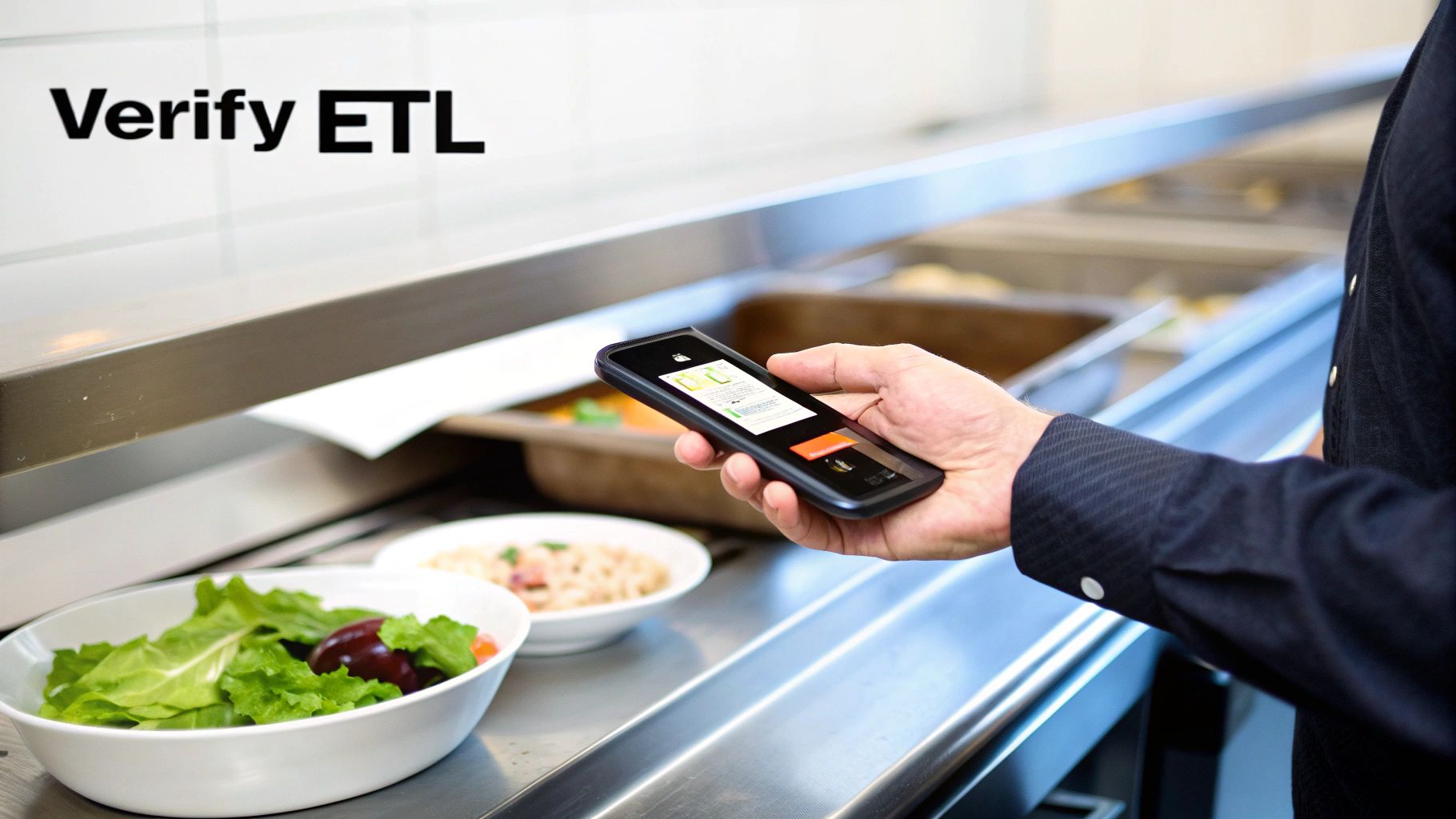
In a market where counterfeit goods can look surprisingly authentic, just seeing an ETL mark isn't enough. You have to know how to verify it. Taking a few moments to confirm the certification is a critical step that protects your investment, keeps your kitchen safe, and ensures you stay on the right side of the health inspector.
Luckily, the verification process is incredibly straightforward and gives you immediate peace of mind. Every genuine ETL Listed Mark is more than just a sticker; it's a direct link to a detailed record in a public database.
The trust in ETL certification is growing fast. The market size is projected to hit $10.24 billion in 2026 and then more than double to $21.25 billion by 2031, with North America making up the biggest slice at 38.8%. This rapid expansion highlights just how important it is to make sure your equipment is genuinely part of this trusted network. You can find more details about this expanding market on Mordor Intelligence.
Step 1: Physically Inspect the Data Plate
First thing's first: find the equipment's data plate. This is usually a small metal plate or sticker attached to the back or side of the appliance, containing all the essential info like the model number, serial number, and electrical ratings.
The ETL Listed Mark should be clearly visible right on this plate. A legitimate mark will include a few specific details that are crucial for the next step.
Keep an eye out for these key elements on or near the mark:
- The ETL Listed logo itself.
- A unique control number or file number.
- The phrase "Conforms to" followed by the specific UL or CSA standard it was tested against.
Step 2: Use the Intertek Online Directory
Once you've got the control number or manufacturer details from the data plate, the final, definitive step is to check Intertek's official online directory. This public database is the single source of truth for all things ETL certified.
Think of the online directory as the official registry. If a product isn't listed here, its certification is not valid—no matter what the sticker says. This simple check is your best defense against counterfeit marks.
To verify the listing, just head over to Intertek's directory and search using the control number, manufacturer name, or model number. If the product is the real deal, its listing will pop right up with details that match the equipment in front of you. This whole process takes just a few minutes, but it provides priceless assurance that your equipment is compliant, safe, and ready for service.
Got Questions About ETL? We've Got Answers
Stepping into the world of equipment certifications can feel a little confusing at first. As a restaurant owner, you just need clear, straight answers to make smart choices for your kitchen's safety and compliance. Let's tackle some of the most common questions that pop up.
Is ETL Certified Gear More Expensive?
Yes, there can be a slight price difference, but maybe not in the way you'd expect. While the intense testing process definitely adds value, getting an ETL certification is often a more cost-effective and faster path for manufacturers compared to some of the older certification bodies.
That efficiency can actually lead to more competitively priced equipment for you, the buyer, without cutting any corners on safety. The most important thing to remember is that a small upfront investment in certified equipment protects you from much bigger costs down the road—think fines from the health inspector, denied insurance claims, or even having to shut down. It's a non-negotiable part of your risk management.
Is ETL Certification Recognized Everywhere?
The ETL Listed Mark is the gold standard for compliance throughout the United States and Canada. It’s your proof that a piece of equipment meets all North American safety standards. But Intertek, the company behind ETL, is a global powerhouse that tests products to international standards, too.
While the ETL mark itself is specifically for North America, the fact that it's backed by a globally respected company like Intertek gives it serious credibility worldwide. If you operate outside the US or Canada, you’ll always want to double-check local regulations.
For anyone running a mobile business like a food truck, ETL certification is especially critical for keeping liability in check. For example, certified refrigeration like your prep tables is essential for preventing overheating failures—a real risk when you consider the 20-30% annual spikes in mobile data traffic that can affect equipment in dense urban areas. You can dig deeper into how mobile operations are evolving in various global market analyses.
Does ETL Certify All Types of Kitchen Equipment?
Absolutely. The ETL certification process covers a massive range of commercial kitchen equipment. From gas ranges and deep fryers to electric convection ovens, ice machines, and commercial refrigerators, you can find an ETL mark on just about any appliance you can think of.
The testing standards are specifically tailored to the unique risks of each product. Whether it’s a potential gas combustion hazard or an electrical safety issue, ETL has a specific protocol to ensure it’s safe for your kitchen.
At The Restaurant Warehouse, we make it simple to find reliable, fully-certified equipment that fits your needs and your budget. You can explore our huge collection of ETL and NSF-certified products to build a safe, compliant kitchen by visiting us at https://therestaurantwarehouse.com.
About The Author

Sean Kearney
Sean Kearney is the Founder of The Restaurant Warehouse, with 15 years of experience in the restaurant equipment industry and more than 30 years in ecommerce, beginning with Amazon.com. As an equipment distributor and supplier, Sean helps restaurant owners make confident purchasing decisions through clear pricing, practical guidance, and a more transparent online buying experience.
Connect with Sean on LinkedIn, Instagram, YouTube, or Facebook.