

Mastering Multi Unit Restaurant Management to Scale Your Brand
When you’re running multiple restaurants, you’re not just managing locations; you're leading a brand. It’s all about creating standardized systems, repeatable processes, and a strong leadership structure that keeps the experience consistent and the business profitable as you grow. This means trading in your hands-on, single-store mindset for a strategic, data-driven approach that gives your teams the tools they need to win on their own.
Building Your Foundation For Multi-Unit Success
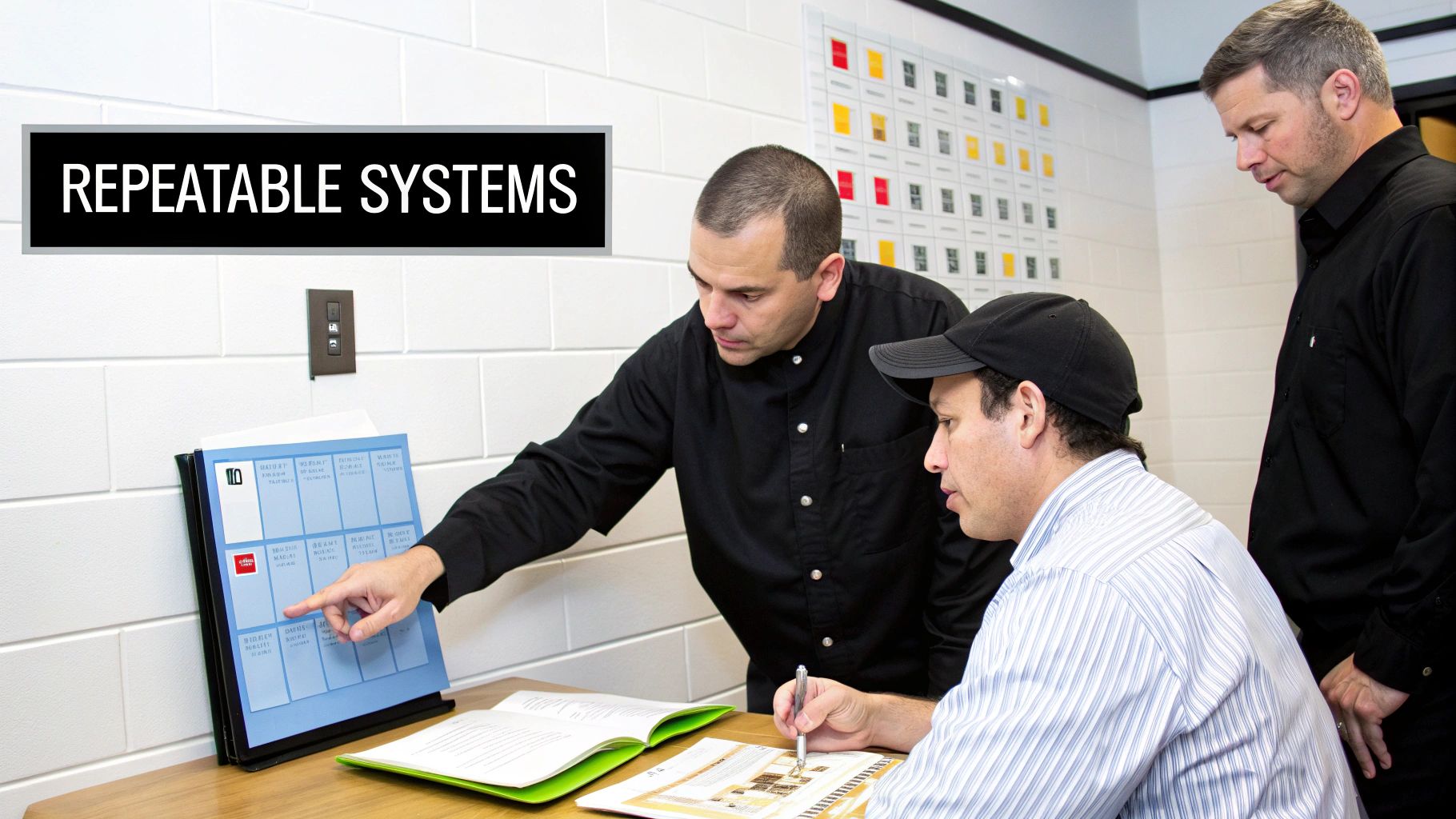
Making the jump from one beloved spot to a multi-unit operation is one of the toughest—and most rewarding—moves you can make. The very skills that made your first location a hit, like being there for every shift and knowing every regular by name, can actually hold you back when you're juggling two, three, or even five locations. The game isn't about working harder anymore. It’s about working smarter by building a rock-solid foundation of repeatable systems.
This journey starts with a big shift in how you think. You have to evolve from being the main problem-solver into the architect of a system that solves problems for you. The goal is to clone the magic of your first restaurant so it can thrive, even when you're not physically there. That’s the absolute core of effective multi-unit restaurant management.
Designing Your Scalable Organizational Structure
As you expand, your org chart needs to grow up. A flat structure of "owner" and "staff" just won't cut it when you have multiple locations to support. You need to build a leadership hierarchy that can provide support, uphold standards, and push for performance at every single unit.
For a growing five-location group, a solid structure might look something like this:
- Owner/Operator: You focus on the big picture—strategy, brand direction, financing, and scouting new sites.
- Director of Operations (or Regional Manager): This person is your right hand, overseeing all locations, coaching General Managers, and making sure the customer experience is consistent. They're accountable for the region's P&L.
- General Manager (GM): The leader of a single restaurant. They own the day-to-day operations, staffing, local marketing, and hitting their unit’s targets.
- Kitchen Manager & Front of House Manager: They support the GM by running their specific departments and managing the crew.
This layered approach empowers your GMs to truly own their restaurants while giving you a single point of contact—your Director of Operations—for performance updates. It pulls you out of the daily grind so you can focus on strategic growth.
Creating Your Standard Operating Procedures Playbook
Your "secret sauce" isn't just a recipe. It's everything you do, big and small, that creates an amazing guest experience. To scale that, you have to document it all in a set of Standard Operating Procedures (SOPs).
An SOP isn't just a rulebook; it's a blueprint for consistency. It guarantees that a guest gets the same amazing meal and service whether they're at your downtown spot on a Tuesday or the suburban location on a Saturday.
Think about everything that makes your restaurant work and write it down. This isn't about creating red tape; it's about quality control when you can't be everywhere at once.
Start by documenting the most critical areas:
- Kitchen Operations: Precise recipes with weights and measures, plating diagrams with photos, and exact cooking times and temperatures.
- Customer Service: Scripts for greeting guests, answering the phone, and handling common complaints with grace and efficiency.
- Opening & Closing Checklists: Detail every single task, from firing up the ovens to cashing out the registers and setting the alarm.
- Cleaning & Maintenance Schedules: Outline daily, weekly, and monthly cleaning duties to keep every location looking sharp.
By creating this playbook, you set a clear baseline for performance and make training new teams incredibly efficient. It becomes the one source of truth for how your brand operates, which is the bedrock of successful multi-unit restaurant management.
Standardizing Your Supply Chain And Equipment
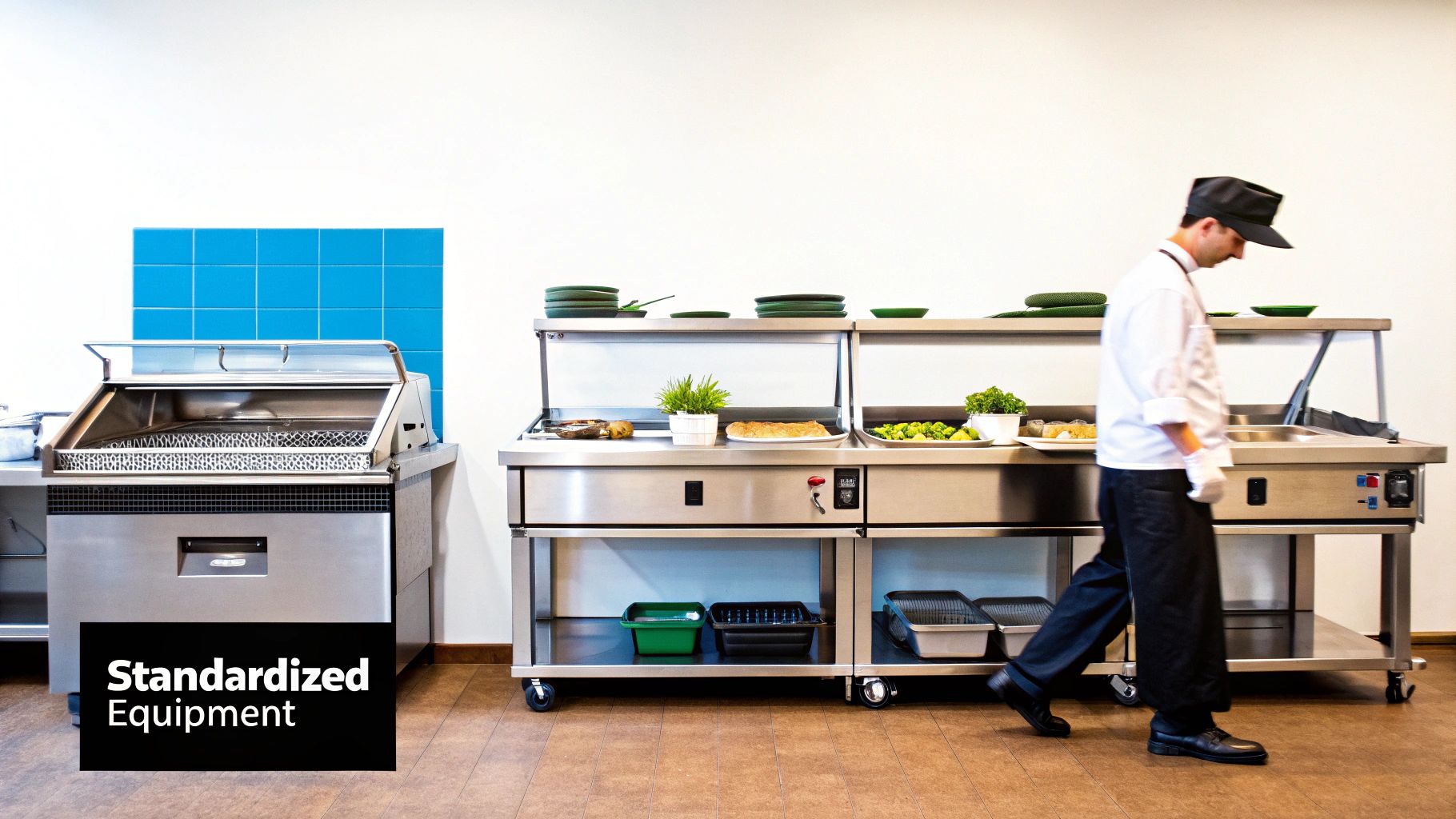
As you scale from one restaurant to several, consistency stops being a goal and becomes the very currency of your brand. Customers expect that amazing burger and those perfectly crispy fries to taste exactly the same, whether they're at your flagship location or the new spot across town.
That level of quality control doesn't just happen. It's built, intentionally, on a rock-solid foundation of a standardized supply chain and uniform kitchen equipment.
Centralizing your purchasing is one of the most powerful financial levers you can pull. When each manager orders their own supplies, you're left with a handful of small, low-volume vendor relationships. By consolidating those orders, you instantly gain massive negotiating power. You're no longer buying a few cases of chicken; you're buying a pallet. That kind of volume unlocks better pricing, more favorable payment terms, and stronger partnerships with suppliers who truly value your business.
This strategic approach is a cornerstone of successful multi-unit restaurant management. It transforms your supply chain from a simple necessity into a profit-driving machine.
Unlocking Efficiency Through Centralized Procurement
Centralized purchasing delivers more than just savings on ingredients; it creates a ripple effect of efficiency that touches nearly every part of your operation. When every single kitchen receives the same products from the same approved suppliers, you eliminate a huge operational variable.
This means your recipes taste identical everywhere, sure, but it also radically simplifies inventory management. Instead of five different managers tracking five different types of tomatoes, your operations director gets a clean, unified view of one single product across the board.
This leads to some serious benefits:
- Improved Cost Control: You can lock in pricing for key commodities, shielding your margins from volatile market swings.
- Simplified Accounting: Instead of processing a mountain of invoices from dozens of vendors, your accounting team handles a smaller, more manageable set of accounts.
- Enhanced Quality Assurance: You can vet and approve a single source for critical items, guaranteeing every location lives up to your quality standards.
The real power of a centralized supply chain isn't just bulk discounts. It's the operational simplicity and brand consistency that comes from knowing every location is working with the exact same ingredients, every single day.
Why Every Kitchen Needs The Same Equipment
Beyond ingredients, standardizing your kitchen equipment is non-negotiable for scaling. Imagine having the same Atosa fryers, True prep tables, and commercial ovens in every single one of your locations. The operational upside is immediate and profound.
First off, training becomes dramatically simpler. A line cook can jump from one location to another to cover a shift and instantly know how to operate every piece of equipment. No fumbling, no downtime, no learning curve. That kind of labor flexibility is invaluable as your portfolio grows.
Second, it makes maintenance predictable and cost-effective. Your in-house maintenance team or third-party service provider becomes an expert on your specific equipment package. They can stock common replacement parts, diagnose issues faster, and perform preventative maintenance more efficiently, which means less costly downtime for you.
You can learn more about how to manage your restaurant's supply chain effectively in our detailed guide.
The Financial Upside Of A Standardized Kitchen
Investing in a uniform equipment package might feel like a big upfront cost, but the long-term financial returns are huge. Those efficiency gains in training and maintenance translate directly to your bottom line by cutting down on labor hours and repair bills.
Think about it. One of your restaurants has a unique, off-brand freezer that breaks down. Your team wastes hours trying to find a tech who knows that model, then waits days for a special part to be shipped. All that downtime means lost revenue and spoiled inventory.
With a standardized kitchen, you probably have a replacement part on hand, or a technician who can get you back up and running in hours, not days. For operators looking to manage cash flow while upgrading, smart financing is the way to go. Programs like lease-to-own plans make it affordable to equip new locations or retrofit existing ones without a massive capital outlay. This lets you achieve that crucial consistency while preserving your working capital for growth.
Leveraging Technology For Centralized Control
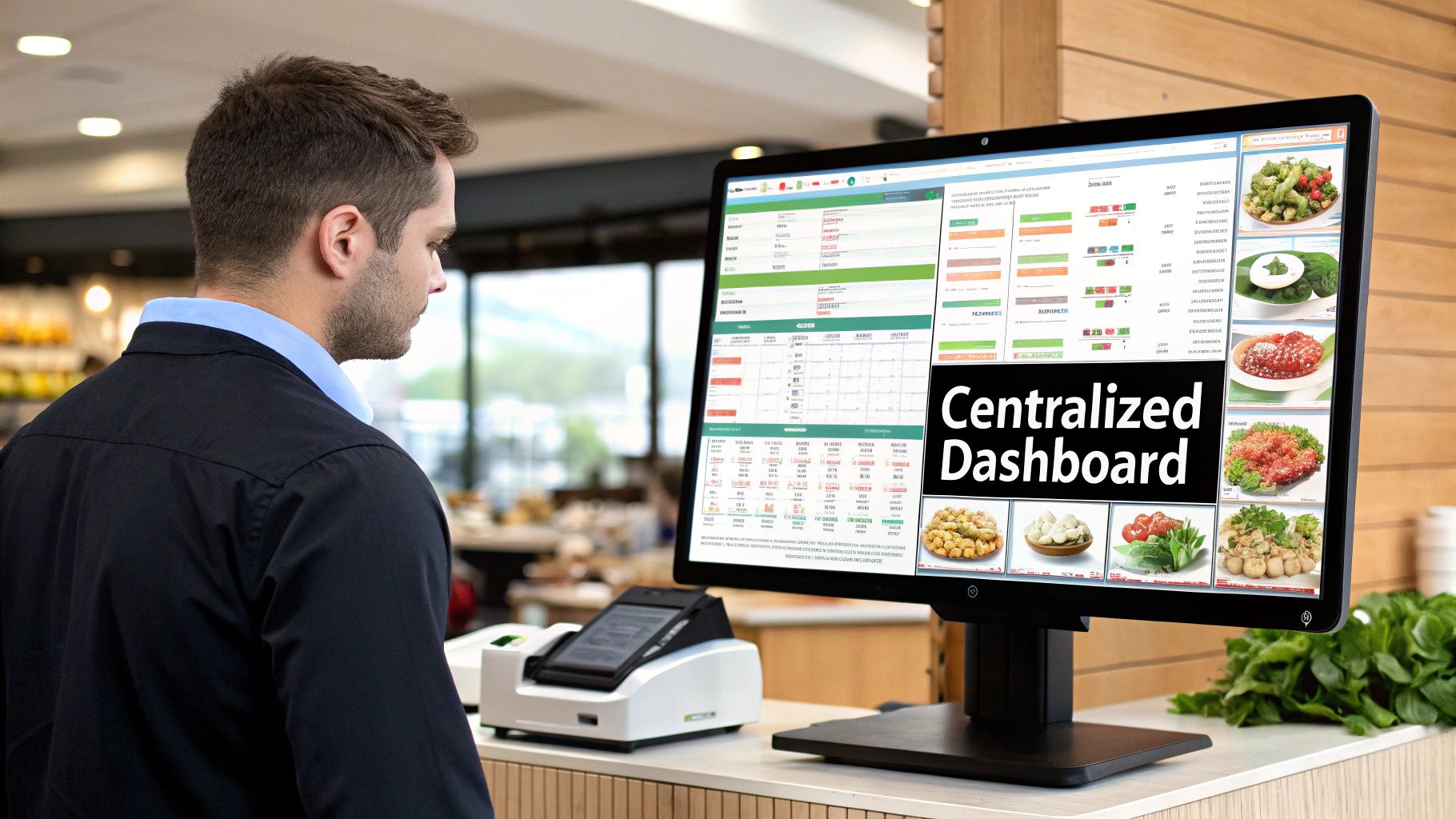
Trying to manage multiple restaurant locations without the right tech is like conducting an orchestra blindfolded. You can hear the noise, but you have no idea which section is out of tune. To really succeed at multi-unit restaurant management, you need a tech stack that gives you a crystal-clear, real-time view of your entire operation, all from a single screen.
This is where a modern, cloud-based Point of Sale (POS) system becomes the central nervous system of your entire brand. These systems do so much more than just process transactions; they are absolute data goldmines. A unified POS platform pulls sales, labor, and inventory data from every single location and feeds it into one centralized dashboard. From there, you can spot trends, identify outliers, and make smarter decisions on the fly.
Forget waiting for managers to email you end-of-day reports. With the right system in place, you can see which location is crushing its sales goals and which one is struggling with high labor costs, all before you’ve finished your morning coffee. This isn’t about micromanaging—it’s about having the visibility to offer support exactly where it’s needed most.
From Data Overload To Actionable Insights
A classic pitfall for operators is drowning in data they don't know what to do with. The goal is to build a tech stack that translates raw numbers into clear, actionable strategies that actually boost profitability across your portfolio.
This all starts by integrating your POS with smart inventory and reporting tools. A recent industry report revealed a stark reality: while 76% of multi-unit operators believe technology provides a decisive competitive advantage, a mere 13% are fully satisfied with the tech they have. This gap is driving a major push toward more intelligent tools, which have helped operators slash food costs by an average of 1% to 1.5%.
By connecting your systems, every sale of a burger automatically depletes buns, patties, and cheese from your digital inventory count. This gives you an accurate, real-time look at your stock levels, preventing over-ordering and costly waste.
To get the most out of your data, you have to practice good data hygiene. It's crucial to standardize how every single item is named and categorized across all locations. If one spot calls it a "Chk Burger" and another calls it a "Chicken Burger," your reports will be skewed, making any accurate analysis impossible.
Using Dashboards To Replicate Success
One of the most powerful tools in your multi-unit management arsenal is a performance dashboard that lets you compare key metrics side-by-side. Imagine seeing the prime cost, average ticket size, and labor percentage for all five of your locations on a single screen.
This kind of setup allows you to quickly answer critical questions:
- Why is Location B's food cost consistently 2% lower than everyone else's?
- What is the manager at Location D doing to keep labor at 25% while sales are booming?
- Which location is the most effective at upselling appetizers and desserts?
By identifying your top performers, you can dig into their processes and turn their local successes into new best practices for the entire company. Maybe the manager at Location B is just incredibly disciplined about waste tracking, or perhaps the team at Location D has a more efficient prep schedule. These are the invaluable, money-making lessons that technology helps you uncover and scale. You can find more details on how to build a robust system in our guide to choosing a restaurant inventory management system.
Choosing Your Core Tech Stack
Building a tech stack where every piece talks to each other is essential for centralized control. Each component should work in harmony to provide a seamless flow of information. To keep everyone on the same page, many operators are now adopting a dedicated communication tool for cafes, bars, and restaurants to keep their teams aligned.
A solid technology foundation is non-negotiable for scaling your restaurant group. Below is a breakdown of the essential components every multi-unit operator should have in their toolkit.
Core Technology Stack For Multi-Unit Operators
| Technology Type | Key Function | Primary Benefit for Scaling |
|---|---|---|
| Cloud-Based POS | Centralizes sales, labor, and menu data from all units. | Provides a single source of truth for real-time performance tracking. |
| Inventory Management | Tracks stock levels, manages ordering, and analyzes food costs. | Reduces waste, prevents stockouts, and protects profit margins. |
| Business Intelligence | Aggregates data into visual dashboards for easy analysis. | Uncovers hidden opportunities and performance issues across locations. |
| Scheduling Software | Optimizes labor deployment based on sales forecasts. | Controls labor costs and ensures adequate staffing at peak times. |
Each of these technologies plays a critical role, working together to create a cohesive system that provides clarity and control.
Ultimately, technology is what allows you to enforce standards, monitor performance, and drive profitability without having to be physically present in every location, every single day.
Driving Profitability Through Financial Discipline
Scaling your brand is a thrill, but let’s be honest—profitability is what keeps the lights on and pays for the next location. As you grow from one restaurant to a small empire, your financial oversight has to get sharper. Gut feelings won't cut it anymore; it's time to let the numbers do the talking.
This shift to financial discipline is a cornerstone of successful multi unit restaurant management. It’s not about micromanaging every penny from a distance. It's about understanding the core metrics that tell you the story of each restaurant's health—and the health of your entire group.
Mastering Your Key Performance Indicators
To really get a handle on the financial pulse of your restaurants, you need to live and breathe your restaurant key performance indicators. We’re not talking about a spreadsheet with 50 columns. It’s about relentlessly tracking a few critical numbers across every single location.
- Food Cost Percentage: This is your cost of ingredients divided by your food revenue. It’s a simple number with a powerful story. If Location A is humming along at 28% but Location B is creeping up to 33%, that’s a red flag. Is it waste? Portion control issues? Maybe even theft? You now know exactly where to start digging. For a deeper dive, check out our complete breakdown of how to calculate and control restaurant food cost percentage.
- Labor Cost Percentage: This is your total labor spend (wages, taxes, benefits) as a percentage of your total revenue. If one location suddenly spikes, it could be a sign of inefficient scheduling. Maybe a manager isn't sending people home when things slow down after the lunch rush. This metric tells you instantly.
- Prime Cost: This is the king of all restaurant metrics. It’s simply your food cost + your labor cost, and it represents the biggest chunk of expenses you can actually control. A healthy prime cost, typically sitting under 60%, is one of the strongest signs of a well-run, profitable operation.
When you set clear targets for these KPIs and review them on a simple weekly dashboard, you start seeing patterns. You can spot problems before they snowball, reward your top-performing GMs, and take the best practices from your most efficient kitchens and share them across the entire company.
The Art of Data-Driven Menu Engineering
Your menu is more than just a list of what you sell. It’s your number one sales tool. With a little data, you can turn it into a profit-generating machine. This is where menu engineering comes in—using sales data and profit margins to subtly guide customers toward your most profitable items.
The process is straightforward. You categorize every single menu item based on how popular it is (how many you sell) and how profitable it is (the margin on each one). This gives you four clear buckets:
- Stars (High Profit, High Popularity): These are your champions. Promote them, feature them, and make sure they are executed perfectly every single time.
- Plow-Horses (Low Profit, High Popularity): Customers love them, but they aren't making you much money. Can you re-engineer the recipe with a lower-cost ingredient? Or maybe a tiny price bump that won't scare anyone away?
- Puzzles (High Profit, Low Popularity): These are your hidden gems. They make you great money, but not enough people are ordering them. Give them a better spot on the menu, use a mouth-watering photo, or run them as a server special.
- Dogs (Low Profit, Low Popularity): These items are dead weight. Unless there's a compelling strategic reason to keep one, it’s probably time to let them go.
By focusing your marketing and server training on your 'Stars' and 'Puzzles,' you can systematically lift your average check size and overall profitability without any dramatic operational changes.
This data-driven approach ties directly back to your centralized purchasing strategy. A recent industry analysis showed that while average profit margins for multi-unit groups hover around 8-12%, smart menu pricing combined with solid supplier negotiations can boost that by an extra 3-5 percentage points. The most successful operators do this by engineering their menus so that the top 20% of items (their high-margin stars) drive 70% of sales.
Knowing which ingredients are in your most popular and profitable dishes gives you incredible leverage. You can go to your suppliers and negotiate better volume deals on those specific items, adding even more to your bottom line.
Your Playbook For Opening New Restaurant Locations
So, you're ready to expand. It's a huge milestone, but growing your restaurant brand successfully hinges on having a repeatable, proven process in place. Opening a new location shouldn't feel like you're reinventing the wheel every single time.
Instead, a systematic rollout plan transforms expansion from a chaotic scramble into a predictable, well-oiled machine. This is a critical part of multi unit restaurant management. This playbook is your guide to launching new units smoothly, making sure each one opens on schedule, on budget, and ready to uphold your brand standards from day one. The real goal here is to minimize those costly rookie errors and get that new spot profitable, fast.
This whole process boils down to a continuous cycle: you track your numbers, you adjust your strategy, and you execute with discipline. It's the core principle of scaling successfully.
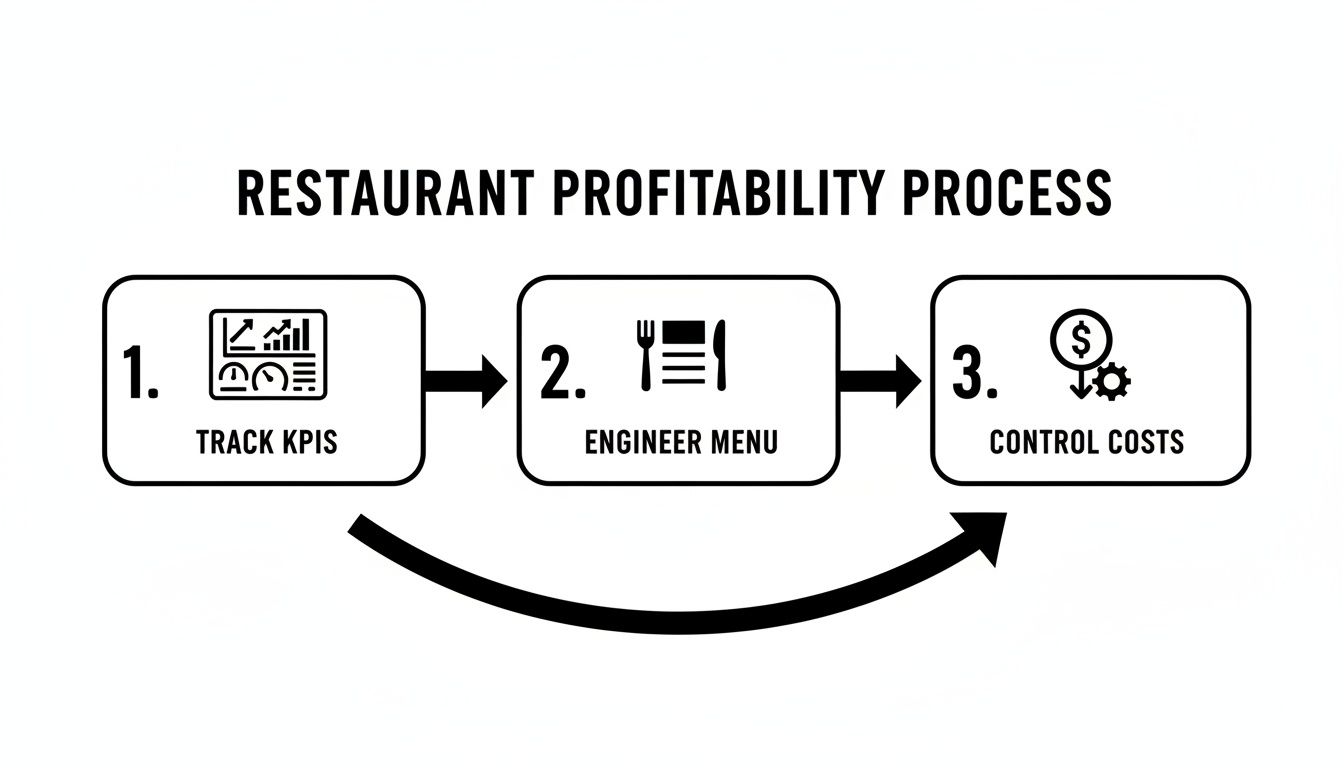
This constant loop of measurement and adjustment is what separates the brands that grow smart from the ones that just get bigger.
Assembling Your Dedicated Opening Team
One of the smartest moves you can make is creating a dedicated "opening team." This is your A-team, a small, experienced crew who knows your brand inside and out. Typically, this includes a top general manager, a kitchen lead, and a front-of-house trainer who travel to the new location.
Their sole mission? Execute the launch flawlessly.
This team isn’t just there to plug in the new fryer. They are your culture carriers. They're responsible for instilling your brand’s values and operational standards in the new staff. They run the pre-opening training, oversee the initial supply orders, and make sure every system is humming perfectly before handing the keys to the permanent management team.
The Standardized New Store Kit
To keep things consistent and moving quickly, you need a standardized "new store kit." Think of it as a comprehensive package containing everything a new location needs to get up and running, removing all the guesswork and preventing those last-minute emergencies.
This kit should include things like:
- Equipment Checklists: A master list of every single piece of equipment, from the walk-in cooler down to the last spatula, all based on your standardized kitchen design.
- Initial Supply Orders: Pre-set opening orders for food, beverages, paper goods, and cleaning supplies. This ensures the store is stocked but not over-ordered from the jump.
- Marketing & Branding Assets: A literal box of goodies—grand opening banners, promotional flyers, staff uniforms, and menu boards—to ensure brand consistency from the moment the doors open.
- Tech & Admin Package: Laptops, POS terminals pre-loaded with your menu, and a binder with all the necessary permits and HR paperwork ready to go.
This "plug-and-play" approach makes each launch faster and more efficient than the last one.
The Critical Pre-Opening Training Schedule
The week before you open is arguably the most important. A structured, immersive pre-opening training schedule is non-negotiable for getting your new team ready. This isn’t just about teaching them the menu; it’s about fully immersing them in your brand’s culture and the "why" behind what you do.
The goal of pre-opening training is to have a team that operates with confidence and consistency from the very first customer. It's an investment that pays dividends in guest satisfaction and long-term operational excellence.
There's a bit of a disconnect in the industry right now. A recent survey found that while 80% of multi-unit operators are planning significant expansion, there's a critical bottleneck. The same survey showed that while 80% want real-time visibility into their key metrics, only 48% are actually achieving it across their locations. You can read more about the findings on restaurant expansion and data visibility. A standardized opening process helps close that gap.
Your training schedule should blend classroom-style learning about your brand story with intensive, hands-on practice sessions in the new kitchen and dining room. By the time you host a "friends and family" soft opening, your team should feel prepared, confident, and genuinely excited to represent your brand.
Your Questions, Answered
Growing from a single, beloved restaurant into a multi-unit brand is a huge step, and it naturally comes with a lot of questions. We get it. Here are some of the most common challenges and questions we see from operators making that leap, along with some straight-up advice from our experience.
What’s The Biggest Hurdle In Multi-Unit Management?
Honestly? The biggest challenge is the mental shift from being a hands-on owner to a systems-driven leader. When you had one spot, you were the brand. Now, your systems have to be the brand. The real test is learning to let go of that day-to-day control without letting quality slip an inch.
Your number one priority becomes maintaining unwavering brand consistency across every single location. We're talking about everything from the taste and presentation of your signature burger to the way your team handles a customer complaint. Without rock-solid Standard Operating Procedures (SOPs) and a strong, empowered management team, that special guest experience you built can start to crumble as you grow.
How Can Technology Help Me Manage Multiple Restaurants?
Think of technology as the central nervous system for your growing restaurant group. It gives you the visibility and control you need without having to be physically present in every kitchen, every single day. The foundation is a centralized, cloud-based Point of Sale (POS) system like Toast or SpotOn, which gives you a real-time pulse on sales, labor, and inventory across all your restaurants.
But it goes way beyond the POS. This is where a smart tech stack becomes essential:
- Inventory Management Tools are your key to controlling food costs. They track stock levels, flag waste, and can even suggest purchase orders based on sales forecasts.
- Scheduling Software helps you nail your labor spend by building smarter schedules that line up with customer traffic, preventing that profit-killing overstaffing.
- Communication Platforms make sure everyone—from your GMs down to the newest line cook—gets the same message, keeping the whole team aligned on new promos, policy changes, and company goals.
This tech stack turns a flood of raw data into insights you can actually use, helping you make faster, smarter decisions that protect your bottom line.
The right technology doesn't just show you what happened yesterday; it helps you see what's happening right now across your entire organization. It’s the difference between reacting to problems and getting ahead of them.
When Is It The Right Time To Open A Second Location?
The time to expand is when your first location is running like a well-oiled machine—profitably and smoothly—without you needing to be there every single day. If you're still the one putting out fires, jumping on the line during a rush, or handling routine operational tasks, you're not ready. Full stop.
Before you even dream of signing a new lease, you absolutely must have these three things locked down:
- Documented Systems: Your recipes, service steps, and opening/closing checklists are all written down in clear, easy-to-follow SOPs.
- A Proven Leader: You have a General Manager you trust completely, someone who can successfully run the original location on their own.
- Solid Capital: You have the financing lined up to cover the entire build-out and initial operating costs of the new restaurant without sucking the cash flow dry from your first, profitable spot.
How Do I Keep Our Company Culture Consistent Across Locations?
Building a unified culture is something you have to do on purpose; it never happens by accident. It starts with you and your leadership team and flows down through every person you hire and train. You can't just slap your mission statement on the wall and call it a day.
First, you have to hire for cultural fit, especially for your management team. Your GMs need to be living, breathing examples of your brand’s values. Second, your training program has to go beyond just teaching skills. It needs to fully immerse new hires in your brand's story, its mission, and the unique way you do things.
Finally, you need to actively foster connections between your locations. Things like regular all-manager meetings, friendly competitions between stores, and cross-location team events can break down those silos. It helps everyone feel like they're part of one big team, not just a bunch of separate restaurants.
Ready to standardize your kitchens and build a foundation for scalable growth? The experts at The Restaurant Warehouse can help you select and finance the right equipment package to ensure consistency and efficiency across all your locations. Explore your options at https://therestaurantwarehouse.com.
About The Author

Sean Kearney
Sean Kearney is the Founder of The Restaurant Warehouse, with 15 years of experience in the restaurant equipment industry and more than 30 years in ecommerce, beginning with Amazon.com. As an equipment distributor and supplier, Sean helps restaurant owners make confident purchasing decisions through clear pricing, practical guidance, and a more transparent online buying experience.
Connect with Sean on LinkedIn, Instagram, YouTube, or Facebook.