

Cook Smarter, Not Harder—Top Commercial Food Service Equipment Picks
The Engine of Your Culinary Business
Commercial food service equipment is the backbone of any successful culinary business. Designed to handle high-volume operations and meet strict health codes, this specialized equipment ensures you can deliver consistent results, meal after meal. It encompasses everything from refrigeration and cooking equipment to food prep tools, warewashing systems, and holding units.
The right equipment creates an efficient workflow that saves time, reduces waste, and boosts productivity. With diner spending on the rise, operators need every advantage to maximize profitability. Quality equipment drives three critical outcomes: consistency in food preparation, efficiency in kitchen operations, and safety through proper temperature control and sanitation. For example, a commercial dishwasher can sanitize 60 racks per hour, a feat impossible for residential models.
Understanding these equipment categories is key to making smart investments that support your business goals.

Quick commercial food service equipment terms:
The Essential Categories of Commercial Food Service Equipment
Every successful restaurant kitchen has distinct zones, each requiring specialized commercial food service equipment to work together seamlessly. Understanding these categories is about building a foundation for quality, efficiency, and happy customers. The investment in proper equipment pays dividends through improved workflow, reduced labor costs, and consistent food quality that keeps customers returning.
Refrigeration & Cold Storage: The Foundation of Freshness
Reliable cold storage is critical for food safety and quality. Your system should support your workflow with a mix of essential units. Reach-in refrigerators keep daily ingredients accessible, while walk-in coolers handle bulk inventory. For space-conscious kitchens, undercounter freezers tuck storage beneath work surfaces. Specialized units like sandwich prep tables combine refrigerated storage with a workspace for rapid assembly, and bar refrigeration keeps beverages perfectly chilled for service.
Temperature consistency is paramount in commercial refrigeration. Units must maintain precise temperatures even during frequent door openings throughout busy service periods. Modern commercial refrigerators feature advanced compressor systems and improved insulation that can maintain temperatures within 1-2 degrees of the set point. This precision prevents food spoilage, extends ingredient shelf life, and ensures compliance with health department regulations.
Making the right choice is crucial; our resources can help you find the best commercial refrigerators and understand proper commercial refrigerator and freezer storage, including top picks for best 2 door commercial freezers.
Cooking Equipment: The Heart of the Kitchen
This is where your menu comes to life. Your cooking line is the heart of the operation, equipped with tools to create your signature dishes. The layout and selection of cooking equipment directly impacts kitchen efficiency, food quality, and staff productivity during peak service hours.
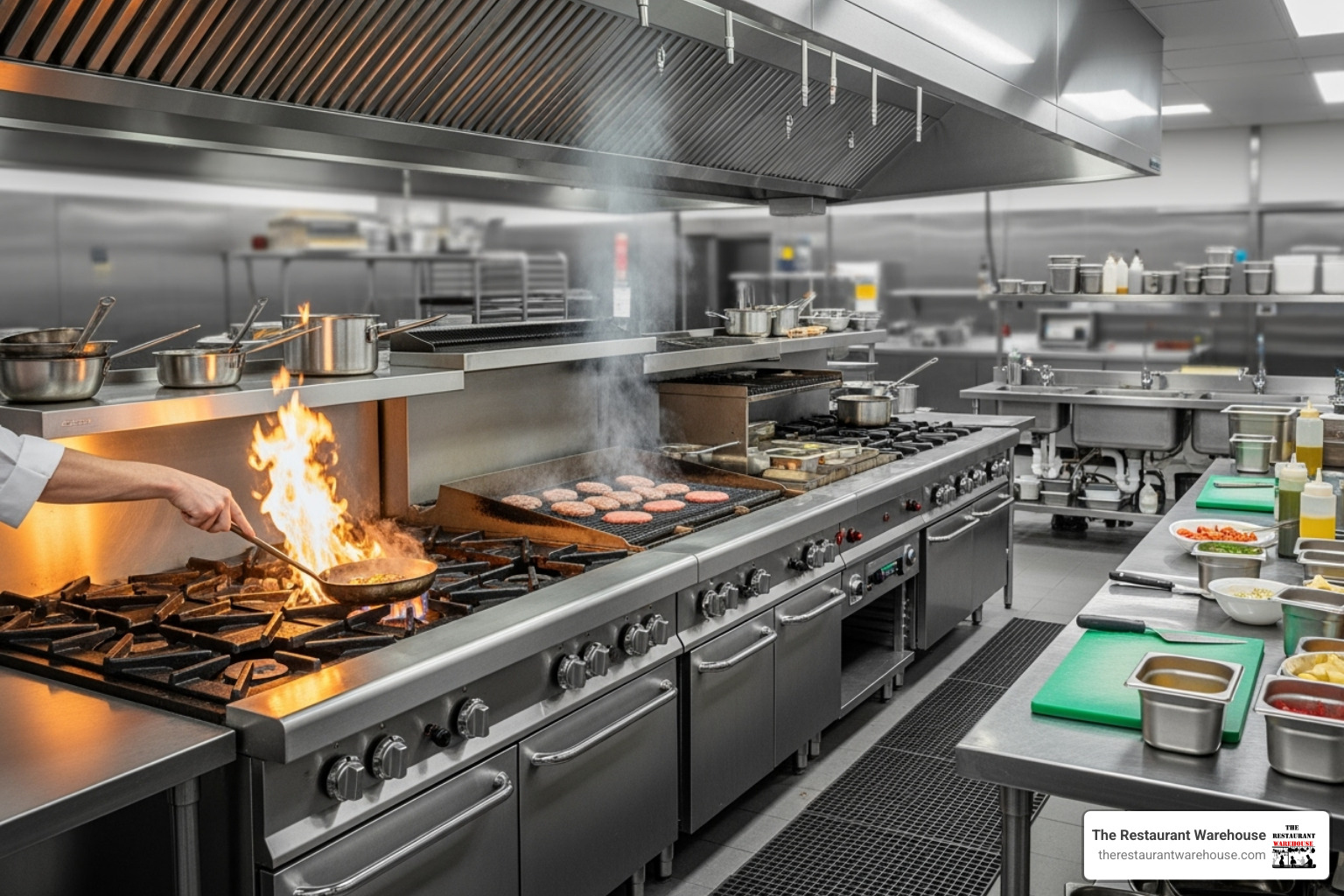
Commercial ranges are the multi-functional command center of the cook line, offering multiple high-powered burners in a single, durable unit. These workhorses typically feature 25,000-30,000 BTU burners that provide instant, precise heat control and consistent performance for sautéing, boiling, and pan-frying. Their robust construction is designed to handle the weight of heavy stockpots and the demands of a busy service, making them a versatile foundation for any cooking operation.
Griddles offer a large, flat surface for high-volume items like pancakes and burgers. Commercial griddles maintain even heat distribution across their entire surface, preventing hot spots that can cause uneven cooking. Modern units feature thermostatic controls that maintain precise temperatures, essential for consistent results during busy breakfast rushes or lunch periods.
For authentic grill marks and smoky flavor, charbroilers are essential. These units use radiant heat from gas burners or electric elements to create the distinctive char marks that customers expect from grilled items. Professional charbroilers can reach temperatures exceeding 700°F, searing proteins quickly to lock in juices while creating appealing visual presentation.
Deep fat fryers produce crispy customer favorites, with modern units offering oil-saving filtration systems. Today's commercial fryers feature computerized controls that maintain precise oil temperatures, automatic basket lifts for consistent cooking times, and built-in filtration systems that extend oil life and improve food quality. Energy-efficient models can reduce oil consumption by up to 40% compared to older units.
Finally, steamers provide a healthy cooking method that preserves nutrients and flavor. Commercial steamers use pressureless steam to cook vegetables, seafood, and proteins while maintaining their natural colors, textures, and nutritional value. These units are essential for health-conscious menus and can significantly reduce cooking times compared to traditional methods.
Choosing the right pieces depends on your menu; explore our commercial gas range guide and learn how to choose a commercial deep fryer to make an informed decision.
Food Preparation Equipment: The Key to Efficiency
Efficient prep work is the secret to a smooth-running kitchen. The right equipment transforms time-consuming tasks into streamlined processes, allowing your staff to focus on creativity and presentation rather than laborious manual tasks.
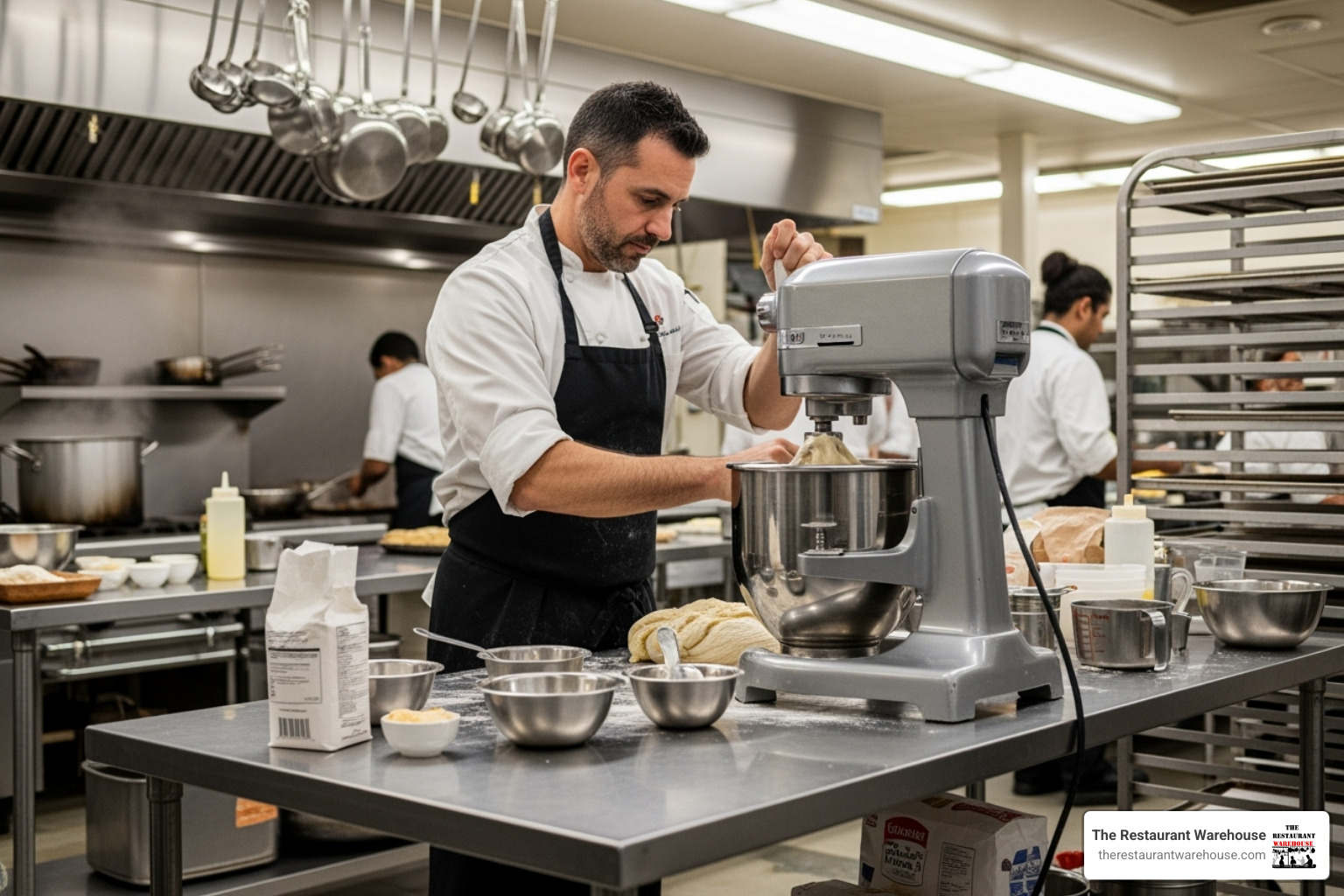
Food processors chop, slice, and purée ingredients in seconds, ensuring consistency. Commercial-grade processors feature powerful motors ranging from 1-4 horsepower, capable of handling large volumes without overheating. Variable speed controls allow precise texture control, from coarse chopping to smooth purées. The time savings are substantial – tasks that might take 30 minutes by hand can be completed in under 2 minutes.
Commercial mixers are indispensable for bakeries and pizzerias, handling everything from heavy dough to light batters. These units range from 20-quart countertop models to massive 140-quart floor units. Planetary mixing action ensures thorough ingredient incorporation, while multiple attachments expand functionality beyond mixing to include meat grinding, vegetable slicing, and pasta making.
For perfect, uniform slices of meats and cheeses, a meat slicer is key for presentation and portion control. Commercial slicers feature precision thickness controls, typically adjustable from paper-thin to 1-inch thick slices. Consistent portioning reduces food waste and ensures uniform presentation, critical factors in controlling food costs and maintaining quality standards.
Commercial-grade blenders create silky soups and sauces. High-performance blenders with 3+ horsepower motors can pulverize ice, blend hot soups directly from the stove, and create smooth emulsions impossible with residential units. Sound enclosures on commercial models reduce noise levels, important in open kitchen designs.
The foundation of any prep station is a sturdy, hygienic stainless steel prep table. These work surfaces must withstand constant use, frequent cleaning, and the weight of heavy equipment. Quality prep tables feature reinforced legs, adjustable feet for uneven floors, and integrated storage shelves or drawers to maximize efficiency.
Finally, don't overlook quality kitchen utensils, as these hand tools are used constantly and impact efficiency. Commercial-grade knives, cutting boards, and hand tools are designed for professional use, featuring ergonomic designs that reduce fatigue during long prep sessions and materials that withstand commercial dishwashing cycles.
Our guides on meat slicer machines and stainless steel prep tables can help you select the best options.
Warewashing & Sanitation: The Unsung Heroes
Proper sanitation protects your staff, customers, and reputation. This equipment ensures you meet health codes and prevent cross-contamination. The warewashing area is often overlooked during planning, but inadequate sanitation equipment can shut down operations and damage your reputation permanently.
High-temperature dishwashers are built for commercial speed, sanitizing up to 60 racks per hour. These units use 180°F rinse water to achieve sanitization without chemicals, meeting health department requirements while ensuring spotless results. Modern commercial dishwashers feature built-in booster heaters, automatic chemical dispensing, and energy recovery systems that capture heat from wastewater to preheat incoming water.
For manual washing, 3-compartment sinks are essential for the wash, rinse, and sanitize process. These sinks must be properly sized to accommodate your largest pots and pans, with each compartment large enough for complete submersion. Proper installation includes adequate drainboards on both sides and easy access to hot water supplies.
Strategically placed handwash sinks promote staff hygiene, while grease traps protect your plumbing and ensure environmental compliance. Hand sinks must be dedicated solely to handwashing, equipped with soap dispensers, paper towel dispensers, and waste receptacles. Grease traps require regular maintenance but prevent costly plumbing blockages and environmental violations.
A clean kitchen is a safe kitchen; use our commercial dishwashing machine guide and restaurant kitchen cleaning checklist to maintain the highest standards.
Holding & Display: Keeping Food Perfect for Serving
Maintaining food quality from the kitchen to the table is the final, critical step. This equipment ensures your dishes are served at the optimal temperature and texture, preventing food safety issues while maintaining the culinary experience you've worked to create.
Holding cabinets use precise temperature and humidity controls to keep food ready for service. These units maintain foods at safe serving temperatures (above 140°F for hot foods) while preventing overcooking or drying. Advanced models feature multiple temperature zones, allowing different foods to be held at their optimal temperatures simultaneously.
Food warmers, from soup kettles to heat lamps, maintain ideal serving temperatures. Soup kettles keep liquid foods at proper serving temperatures while preventing scorching, while heat lamps provide gentle warming for plated foods during brief holding periods. Modern warming equipment features precise temperature controls and energy-efficient heating elements.
Merchandising refrigerators both chill and display items to encourage impulse buys. These units combine refrigeration with attractive lighting and clear viewing areas to showcase desserts, beverages, and grab-and-go items. Strategic placement near checkout areas can significantly increase average ticket sizes.
For self-service operations, buffet equipment like chafing dishes provides an organized and appealing presentation. Professional buffet equipment maintains proper food temperatures while creating attractive displays that encourage customer selection. Sneeze guards and proper lighting are essential components of any self-service setup.
When choosing display fridges, consider both function and visual impact to best showcase your products.
How to Choose the Right Equipment for Your Business
Selecting the right commercial food service equipment is a strategic decision that impacts your kitchen's workflow, efficiency, and bottom line. A high-volume burger joint needs different tools than a cozy café, so every piece should serve your specific needs. The wrong equipment choices can create bottlenecks, increase labor costs, and frustrate both staff and customers, while the right selections can transform your operation into a model of efficiency and profitability.
Assessing Your Needs: Menu, Space, and Volume
Before buying, analyze your business requirements to avoid costly mistakes. This assessment phase is crucial and should involve your entire management team, including chefs, managers, and financial stakeholders.
Menu Analysis: Your menu dictates your equipment needs. A taco shop needs a powerful griddle, while a soup-and-salad spot requires steam kettles and refrigerated prep tables. List your core dishes and identify the mission-critical equipment for each. Consider not just current menu items, but planned additions and seasonal variations. Analyze your menu's complexity – simple menus may require fewer specialized pieces, while complex menus demand versatile, multi-functional equipment. Document cooking methods, preparation techniques, and holding requirements for each menu category.
Kitchen Footprint: Space is money. Measure your kitchen carefully, accounting for door clearances and staff movement. Maximize your area with vertical solutions like wall-mounted shelves and stacking units. A well-planned space prevents chaos during busy hours. Consider traffic patterns during peak service – equipment placement should facilitate smooth workflow without creating collision points. Account for ventilation requirements, electrical connections, and plumbing access when planning equipment placement. Cramped kitchens reduce efficiency and increase accident risk.
Workflow Efficiency: Design a logical flow from receiving to plating. Place prep tables near coolers and the grill near the plating station to minimize steps and prevent bottlenecks. A good layout is crucial for productivity. Map out your kitchen's workflow during different service periods – breakfast, lunch, and dinner may require different traffic patterns. Consider the "kitchen triangle" concept, positioning cooking, prep, and storage areas for maximum efficiency. Our restaurant kitchen layout examples can provide inspiration.
Customer Capacity: Your equipment must handle peak demand. Calculate your busiest service and choose equipment sized to meet that volume, with some room for growth. It's more cost-effective to buy slightly larger upfront than to replace outgrown equipment later. Analyze your seating capacity, average table turns, and peak hour volumes to determine equipment sizing. Consider seasonal fluctuations and special events that might create demand spikes. A detailed commercial kitchen floor plan can help visualize this.
Key Factors for Your Investment in commercial food service equipment
Focus on these factors to ensure you're investing in professional-grade equipment that will last. Each factor contributes to the total cost of ownership and long-term success of your operation.

Durability: Commercial kitchens are harsh environments. Look for heavy-gauge materials and commercial-grade components designed to withstand constant use. Equipment should feature reinforced construction, heavy-duty motors, and components rated for continuous operation. Consider the manufacturer's warranty and parts availability – equipment from established manufacturers typically offers better long-term support. Durability directly impacts your bottom line through reduced replacement costs and minimized downtime.
Stainless Steel Construction: Type 304 stainless steel is the industry standard for its resistance to corrosion and ease of cleaning. Cheaper grades can rust or pit over time. Quality stainless steel maintains its appearance and functionality even after years of heavy use and aggressive cleaning. Look for seamless construction and smooth finishes that prevent bacterial growth and simplify sanitation. Our commercial kitchen stainless steel guide explains the differences.
Energy Efficiency: Energy Star certified equipment can significantly reduce utility bills. Consider the total cost of ownership, as an efficient model often saves more in the long run than a cheaper, less efficient alternative. Energy-efficient equipment also generates less heat, reducing air conditioning costs and improving kitchen comfort. Calculate potential energy savings over the equipment's lifespan – the results often justify higher upfront costs. Modern efficient equipment also tends to have better temperature control and more consistent performance.
Ease of Cleaning: Equipment with smooth surfaces, rounded corners, and removable parts saves labor costs and improves food safety. Avoid complex designs with hard-to-reach areas. Consider how equipment will be cleaned during daily operations and deep cleaning procedures. Equipment that's difficult to clean properly becomes a food safety liability and increases labor costs. Look for features like removable drip trays, accessible drain valves, and smooth interior surfaces.
Certifications: Look for certifications like NSF, ETL, and UL. NSF rated equipment is certified for food safety and cleanability, while ETL and UL verify electrical safety. These certifications are your assurance of quality and compliance. Health inspectors specifically look for NSF certification, and insurance companies may require UL listing for electrical equipment. These certifications also indicate that equipment meets industry standards for performance and safety.
Gas vs. Electric: Making the Right Utility Choice
The choice between gas and electric equipment affects cost, performance, and installation. This decision impacts not just equipment purchase price, but long-term operating costs, kitchen design, and cooking performance.
Cost: Natural gas is often cheaper per BTU, leading to lower operating costs. However, check your local utility rates, as this can vary. Electric equipment can also incur high demand charges. Calculate the total energy cost for each option based on your local utility rates and expected usage patterns. Consider peak demand charges for electric equipment, which can significantly impact monthly utility bills. Factor in installation costs – new gas lines are expensive, but electrical upgrades can also be costly.
Performance: Chefs often prefer gas for its instant, responsive heat control. Electric equipment, especially induction, offers precise temperature control and even heating, which is ideal for griddles and fryers. Gas provides immediate heat adjustment and visual flame indication, while electric offers consistent, even heating and precise temperature control. Consider your menu requirements – delicate sauces might benefit from electric precision, while high-heat searing favors gas responsiveness.
Infrastructure: Installing new gas lines can be expensive and complex, requiring professional installation and robust ventilation. Electric equipment needs adequate voltage and amperage, which may require panel upgrades. Gas equipment requires proper ventilation systems and gas line sizing, while electric equipment may need dedicated circuits and adequate electrical capacity. Consider future expansion needs when planning utility infrastructure.
Evaluate your kitchen's existing infrastructure and your menu's cooking needs before deciding. For a detailed breakdown, see our guide on electric or gas restaurant equipment pros and cons.
Sourcing and Financing Your Kitchen Arsenal
Acquiring commercial food service equipment is a major investment. Smart sourcing and financing decisions are critical for your restaurant's financial health, whether you're just starting or upgrading an existing kitchen.
Where to Buy: Finding Reliable Suppliers
Finding the right supplier is like finding a trusted business partner. Online restaurant supply stores have revolutionized the industry, offering convenience and competitive pricing due to lower overhead. You can browse thousands of products without the pressure of a showroom. Local dealers offer the benefit of seeing equipment in person and can provide immediate pickup, but their prices are often higher.
At The Restaurant Warehouse, we combine convenience with value by eliminating middleman markups. You get straightforward wholesale pricing on quality equipment, allowing your budget to go further. We leverage technology and purchasing power to make your investment as cost-effective as possible. For more tips, see our guides on navigating a restaurant supply store and how to buy commercial kitchen equipment.
Smart Financing: Leasing vs. Buying Your commercial food service equipment
How you pay for your equipment impacts cash flow and long-term strategy.
Leasing is popular for startups because it requires lower upfront costs, preserving capital for other needs like inventory and marketing. Lease payments are predictable and often tax-deductible. The downside is that you won't own the equipment and may pay more over the lease term.
Buying equipment outright provides ownership and builds equity. Once paid off, the expense is gone, improving cash flow. You can also claim depreciation on your taxes. The main challenge is the high initial cost, which can strain a new business.
For startups, leasing often makes the most sense to preserve cash. However, if you have the capital, buying can offer better long-term value. Analyze your financial situation and goals before deciding. Our guides on restaurant equipment financing and how to lease commercial kitchen equipment can help you make the right choice, especially with our advice for restaurant equipment leasing for start ups.
The Future is Now: Trends and Innovations in Food Service
The restaurant industry is constantly evolving, and commercial food service equipment is getting smarter and more efficient. These innovations aren't just gadgets; they are tools that can transform your kitchen's operations and profitability.
Automation, Smart Tech, and Sustainability
Modern kitchens are embracing technology that combines performance with environmental responsibility. Kitchen automation, including kitchen robots, is handling repetitive tasks, freeing up skilled chefs to focus on creativity. IoT-enabled appliances monitor their own performance and send alerts to your phone, preventing costly breakdowns before they happen.
Energy efficiency is now a business imperative. Energy Star certified equipment can reduce utility bills by 20-30%, offering a significant return on investment. Similarly, water conservation technology in dishwashers and ice machines lowers operating costs. Ventless cooking systems are another game-changer, using advanced filtration to allow cooking equipment installation in locations without traditional hoods. These restaurant equipment trends show a clear move toward smarter, more sustainable kitchens.
Adapting to New Dining Habits
Consumer behavior has shifted, requiring flexible kitchen solutions. With shrinking kitchen footprints, compact, multi-functional equipment that can perform several tasks is essential. The rise of solo dining also influences equipment choices, demanding tools that can efficiently prepare single servings without waste.
Delivery and takeout models have created a need for specialized holding and packaging equipment to ensure food quality during transport. This has led to flexible kitchen design, using modular and mobile equipment that can be reconfigured to meet changing demands. Food trucks are a prime example of this efficiency, and their setups offer valuable lessons for any operator. Our food truck equipment list showcases how to maximize a compact space. Investing in adaptable equipment today prepares your business for tomorrow's challenges.
Frequently Asked Questions about Commercial Food Service Equipment
Choosing the right commercial food service equipment raises many questions. Here are answers to some of the most common concerns for restaurant operators.
What is the main difference between commercial and residential kitchen equipment?
The difference is fundamental and goes beyond appearance. Commercial equipment is engineered for a professional environment, focusing on three key areas:
- Durability and Power: Commercial units are built with stronger motors and higher BTU outputs to handle relentless, high-volume use. They are designed to run for hours without failing.
- NSF Certification: This is a critical distinction. NSF standards ensure equipment meets public health requirements for cleanability and food safety, something health inspectors look for.
- High-Volume Design: From dishwashers that clean 60 racks per hour to mixers that handle 60-quart batches, every aspect is built for speed and efficiency that residential appliances can't match. They often use superior materials like 304 stainless steel for longevity.
How important is regular maintenance for my equipment?
Regular maintenance is not optional—it's essential for protecting your investment and ensuring smooth operations. It extends equipment lifespan, often doubling or tripling it compared to neglected units. More importantly, it prevents costly breakdowns during peak service hours, saving you from lost revenue and emergency repair bills. Properly maintained equipment also runs more efficiently, lowering utility costs, and ensures food safety by operating at correct temperatures. A consistent schedule of cleaning and professional servicing is crucial. Our guides on cleaning restaurant equipment and how to maintain commercial refrigerators can help you establish a routine.
Is buying used commercial food service equipment a good idea?
Used equipment can be a smart move, but it requires caution. The primary benefit is significant cost savings, which can free up capital for a new restaurant. However, there are risks, as used items come with an unknown history and typically no warranty.
To mitigate risk, buy from reliable sources like reputable used equipment dealers who inspect and service their inventory. When inspecting items yourself, check for rust, wear, and missing parts, and see the equipment operate if possible. Focus on simpler items like prep tables and shelving for the safest used purchases. For complex machinery, the risk of expensive repairs is higher. Balancing cost savings with risk is key. Our used commercial kitchen equipment guide provides a detailed roadmap for making smart used purchases.
Conclusion: Equipping Your Business for Success
Building a successful kitchen begins with smart equipment choices. This guide has served as your roadmap, from understanding the essential categories of commercial food service equipment to selecting pieces that fit your unique menu, space, and workflow.
Quality is a long-term investment. The durability of stainless steel, the compliance of NSF certification, and the savings from energy-efficient models all contribute directly to your bottom line. Whether you choose gas or electric, lease or buy, these decisions shape your kitchen's efficiency and your business's financial health.
The future of foodservice is here, with smart technology and flexible designs helping operators adapt to new trends like delivery and solo dining. The right equipment empowers your team, ensures consistency, and promotes safety, allowing you to focus on creating memorable culinary experiences.
At The Restaurant Warehouse, we're committed to helping you build your dream kitchen without breaking your budget. We offer wholesale pricing without the retail overhead, making quality equipment accessible. Your investment in commercial food service equipment is an investment in your vision. Explore our complete commercial kitchen equipment guide to take the next step toward a thriving, profitable reality.
About The Author

Sean Kearney
Sean Kearney used to work at Amazon.com and started The Restaurant Warehouse. He has more than 10 years of experience in restaurant equipment and supplies. He graduated from the University of Washington in 1993. He earned a BA in business and marketing. He also played linebacker for the Huskies football team. He helps restaurants find equipment at a fair price and offers financing options. You can connect with Sean on LinkedIn or Facebook.
Leave a comment