

How to Make a Smart Commercial Dishwasher Buy
Nothing stops a busy kitchen faster than a dishwashing bottleneck. Piles of dirty plates, a line of waiting servers, and the looming threat of a health inspection can turn a dinner rush into a disaster. These problems often stem from a single source: the wrong dishwasher. Making a smart commercial dishwasher buy is your best defense against these operational headaches. It’s about matching the machine’s power and capacity to your unique demands. This guide will walk you through the different types, key features, and maintenance tips to ensure your dish pit is a source of efficiency, not stress.
How to Make a Smart Commercial Dishwasher Buy
When you're ready to commercial dishwasher buy, you're making one of the most critical equipment decisions for your foodservice operation. The right machine ensures food safety, maintains operational efficiency, and protects your bottom line. The wrong choice leads to bottlenecks during peak hours, sky-high utility bills, and potential health code violations.
Quick Decision Guide for Your Commercial Dishwasher Purchase:
- Undercounter: Best for small cafes, bars, or restaurants with 20-40 racks per hour
- Door-Type: Mid-volume operations needing 30-90 racks per hour with pass-through workflow
- Conveyor: High-volume facilities requiring 200-1200+ racks per hour
- High-Temperature: Sanitizes with 180°F rinse, requires booster heater and condensate hood
- Low-Temperature: Uses chemical sanitizers, lower energy costs, no special ventilation needed
- Key Features: Look for ENERGY STAR certification, low water consumption (0.28-0.74 gallons/rack), and proper capacity for your peak demand
Commercial dishwashers aren't just about getting dishes clean. They're the backbone of your kitchen's sanitation system. High-temperature models use heated water to achieve sanitization at 180°F, while low-temperature units rely on chemical sanitizers. The type you choose impacts your utility bills, installation requirements, and ongoing operational costs. According to the research, ENERGY STAR certified models can be 40% more energy-efficient and 40% more water-efficient than standard units.
The market offers everything from compact undercounter models perfect for small establishments to massive conveyor systems capable of processing 1,200 racks per hour. This guide breaks down everything you need to know to make a confident, informed purchase.
A Breakdown of Commercial Dishwasher Types
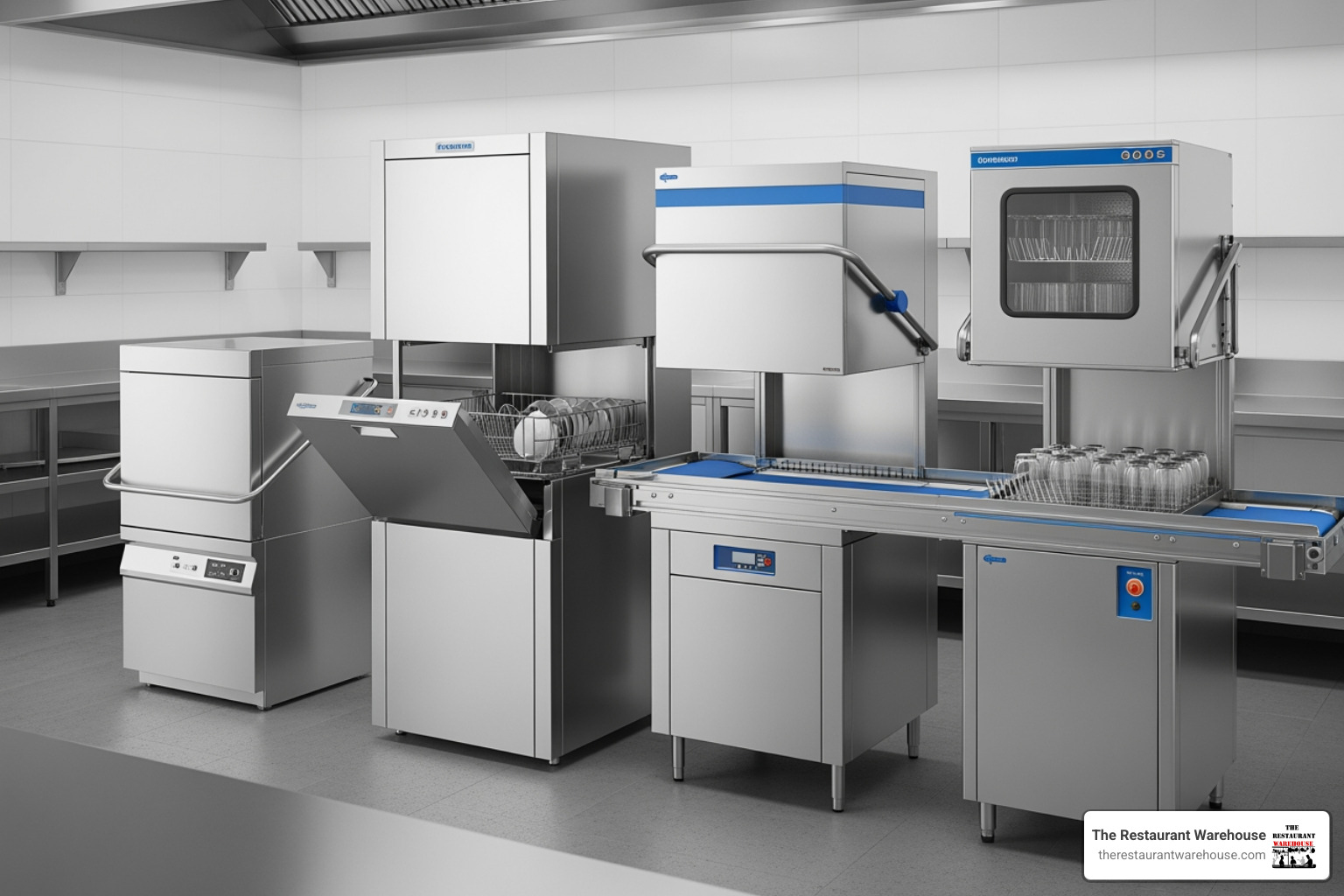
Choosing the right type of commercial dishwasher is the first step in ensuring your kitchen runs smoothly. It's all about matching the machine's capabilities to your operation's unique demands. From busy cafeterias to cozy cafes, there's a dishwasher designed to fit the bill. Let's explore the main types you'll encounter when you're ready to make a commercial dishwasher buy.
The Compact Choice: Undercounter Dishwashers
Think of undercounter dishwashers as the compact workhorses of smaller establishments. They're designed to fit neatly under standard countertops, making them ideal for businesses with limited space such as bars, coffee shops, and small restaurants. While they might look similar to residential units, don't be fooled—these machines are built with commercial-grade durability and speed in mind. You can explore a range of undercounter dishwashers to see the options available.
Their capacity typically ranges from 20 to 40 racks per hour, with cycle times as quick as 2 minutes for 30 racks. This makes them perfect for operations with moderate dishwashing needs throughout the day, ensuring a steady supply of clean wares without overwhelming your staff or space.
The Workhorse: Door-Type Dishwashers
Stepping up in capacity from undercounter models, door-type dishwashers are a popular choice for mid-volume foodservice operations. They require a bit more space, usually featuring dirty and clean dishtables on either side to facilitate a smooth workflow. The operator slides a rack of dirty dishes into the machine, closes the hood (or "door"), and the wash cycle begins. Once complete, the door is opened, and the clean rack is pulled out onto the clean dishtable.
These "pass-through" machines greatly improve workflow efficiency, allowing for continuous loading and unloading. They typically handle between 30 and 90 racks per hour, making them suitable for restaurants, hotels, and guesthouses that experience consistent, but not necessarily overwhelming, peaks in dishwashing demand. The ability to quickly process racks helps prevent bottlenecks during busy meal services.
For High-Volume Kitchens: Conveyor Dishwashers
When we talk about high-volume dishwashing, we're talking about conveyor dishwashers. These are the giants of the dishroom, designed for operations that process hundreds, if not thousands, of dishes per hour. Hospitals, university cafeterias, large catering facilities, and busy all-you-can-eat restaurants are prime candidates for a conveyor system.
In a conveyor dishwasher, racks of dishes are placed on a motorized belt that moves them through different washing stages. These machines often feature multiple tanks for pre-wash, main wash, and final rinse cycles, ensuring thorough cleaning and sanitization. Capacities can range from 200 racks per hour to an astounding 1,200+ racks per hour. While they represent the highest initial investment, their efficiency for large-scale operations is best, making them a wise commercial dishwasher buy for high-demand environments. Some advanced models can process up to 348 racks per hour with as little as 0.29 gallons of water per rack, showcasing incredible efficiency.
Flight-Type Conveyor Dishwashers
Flight-type conveyor dishwashers are the ultimate solution for the highest-volume dishwashing environments. These machines are built to handle the intense demands of places like university cafeterias, hospitals, and large-scale catering facilities that clean thousands of dishes every hour. Instead of manually loading and unloading, your team simply places racks on a motorized conveyor belt. The belt automatically pulls them through multiple cleaning stages, including pre-wash, wash, and final rinse cycles. This automated process guarantees that every dish meets the highest standards of cleanliness and sanitation, keeping your entire operation moving without a single bottleneck.
While the initial investment for a flight-type model is significant, their efficiency is unmatched. Some models can process over 340 racks per hour using as little as 0.29 gallons of water per rack, leading to substantial long-term savings on utilities. For an operation where speed and volume are everything, this is a strategic choice that pays for itself in productivity. Because this is a major purchase, it's smart to explore restaurant equipment financing to manage the upfront cost and get the powerful machine your kitchen needs to thrive.
For Sparkling Results: Specialized Glasswashers
For bars, pubs, and any establishment where glassware is a primary concern, specialized glasswashers are indispensable. These compact machines are often undercounter models, specifically designed to handle delicate glasses with care. They use lower water pressure than standard dishwashers to protect fragile rims and stems, while still delivering sparkling clean results.
Glasswashers excel at tackling common bar challenges like lipstick stains, dried beverage residue, and citrus pulp, ensuring every drink is served in a pristine glass. This specialization helps maintain the quality of beverages and improves the customer experience, proving that sometimes, a dedicated machine is the best solution.
For Tough Jobs: Pot and Pan Washers
Sometimes, a standard dishwasher just won't cut it. For the baked-on, caked-on messes that come with high-volume food prep, you need a pot and pan washer. These heavy-duty machines are engineered to blast away the toughest food soils from sheet pans, mixing bowls, and large utensils. With powerful, X-shaped wash arms and large openings, they can handle oversized ware that wouldn't fit in a standard machine. Some models can wash up to 400 sheet pans per hour using adjustable two, four, or six-minute cycles. This kind of efficiency saves your team countless hours of manual scrubbing, freeing them up for more important tasks in the kitchen. It's a serious piece of restaurant equipment for kitchens that demand serious cleaning power.
The Modern Solution: Ventless Dishwashers
What if your kitchen doesn't have space for a bulky ventilation hood? That's where ventless dishwashers come in. These innovative machines use advanced technology to handle steam and condensation internally, eliminating the need for an overhead hood and expensive ductwork. This makes them a perfect fit for smaller kitchens, historic buildings, or any space where traditional venting is impractical or too costly. Beyond the space-saving benefits, ventless models are often highly efficient, using less water and energy than their vented counterparts. This translates directly to lower utility bills, making them a smart choice for any cost-conscious operator. Investing in this technology can simplify installation and reduce ongoing operational expenses, making it easier to finance your equipment needs.
Choosing Between High-Temp and Low-Temp Sanitizing
When you're planning your commercial dishwasher buy, one of the most critical decisions you'll face is choosing between a high-temperature and a low-temperature sanitizing system. This isn't just a technical detail; it's a decision that impacts your utility costs, chemical usage, installation requirements, and overall operational preferences. Understanding the differences is key to selecting the system that best fits your business model.
How High-Temperature Dishwashers Work
High-temperature dishwashers sanitize wares using intense heat. After the wash cycle, these machines perform a final rinse with water heated to a minimum of 180°F (82°C) at the manifold. The extreme heat effectively kills bacteria and other pathogens, ensuring your dishes meet strict health code standards.
These machines typically require a built-in or external booster heater to achieve and maintain the necessary rinse temperature. An added benefit of high-temp sanitization is that the residual heat on the dishes causes them to "flash-dry" quickly, often eliminating the need for manual towel drying and reducing labor costs. However, the high heat also means higher energy consumption for water heating. Additionally, high-temp dishwashers usually require a condensate hood for proper ventilation, as they produce a significant amount of steam.
How Low-Temperature Dishwashers Work
In contrast, low-temperature dishwashers sanitize using chemical agents rather than high heat. After a wash cycle with water typically between 120-140°F (49-60°C), these machines dispense a chemical sanitizer in the final rinse. The chemicals then neutralize bacteria, achieving the required level of sanitation.
The primary advantage of low-temp systems is their lower energy consumption, as they don't need to heat water to extremely high temperatures. This often translates to lower utility bills. They also typically don't require a condensate hood, simplifying installation and reducing upfront costs. However, the trade-off is the ongoing cost of purchasing chemical sanitizers. Furthermore, dishes processed in low-temp machines take longer to air dry, and sometimes require a drying agent to prevent spotting, or even manual drying, which can add to labor.
High-Temp or Low-Temp: Making the Right Choice
The choice between high-temp and low-temp boils down to your specific operational needs, budget, and priorities. We've put together a table to help you compare:
| Feature | High-Temperature Dishwashers | Low-Temperature Dishwashers |
|---|---|---|
| Sanitization Method | Heat (180°F rinse) | Chemical sanitizers (120-140°F wash) |
| Initial Cost | Potentially higher (booster heater, condensate hood) | Potentially lower (no booster heater, no condensate hood) |
| Operating Cost | Higher energy usage for water heating | Lower energy usage, but ongoing chemical costs |
| Drying Time | Fast (flash-drying) | Longer (air-drying, may require drying agent) |
| Installation Needs | May require condensate hood, dedicated power for booster | Simpler installation, no special ventilation typically |
| Environmental Impact | Higher energy consumption, but no chemical residue on dishes | Lower energy consumption, but chemical discharge in wastewater |
Beyond the Machine: Essential Dishwashing Station Accessories
A top-tier commercial dishwasher is the heart of your dishwashing station, but it can't do the job alone. To create a truly efficient and sanitary workflow, you need to surround it with the right accessories. These tools handle everything from pre-washing tough messes to storing clean dishes so they're ready for service. Setting up your entire dishwashing area for success ensures you get the most out of your machine and keep your kitchen running smoothly, even during the busiest rushes.
Pre-Wash and Disposal Equipment
Before a dish enters your dishwasher, it's essential to get rid of leftover food and loosen stubborn grime. Proper prep work makes your dishwasher more effective and protects your plumbing from expensive clogs. Investing in the right pre-wash and disposal equipment is a non-negotiable part of a professional kitchen setup.
Heated Soak Tanks
For pots and pans with caked-on food, a heated soak tank is a game-changer. These tanks use warm water and a soaking solution to break down tough grease and food particles before the main wash cycle. This pre-soaking step significantly reduces manual scrubbing, saving your staff valuable time. It also allows your dishwasher to focus on sanitizing, leading to a more consistent and effective clean.
Garbage Disposals and Grease Traps
Proper waste management starts at the dish pit. A heavy-duty garbage disposal quickly handles food scraps, preventing drain clogs. Just as important is a grease trap, which is designed to intercept fats, oils, and grease (FOG) before they enter the wastewater system. This prevents costly plumbing issues and is often required by local health codes to protect public sewers.
Polishing and Finishing Tools
Once your dishes and glassware come out of the dishwasher sanitized, there's one final step to make them truly table-ready. Water spots, streaks, and minor residue can leave otherwise clean items looking dull. Polishing and finishing tools provide that final touch, ensuring every plate and glass you present to a customer is spotless and sparkling. This attention to detail speaks volumes about your restaurant's commitment to quality.
Cutlery and Glass Polishing Machines
Hand-polishing every fork, knife, and wine glass is a tedious and time-consuming task that can quickly become a bottleneck in a busy restaurant. Cutlery and glass polishing machines automate this process, saving you hundreds of hours in labor costs over time. These machines use gentle, absorbent materials to quickly dry and polish large volumes of items, leaving them free of water spots and streaks. The result is a consistently pristine presentation that enhances the dining experience for your guests.
Storage and Organization
The dishwashing process doesn't end when the cycle is finished. Having a well-organized system for storing clean dishes is essential for maintaining sanitation and efficiency. Without proper storage, clean wares can become contaminated, damaged, or simply lost in the chaos of a busy kitchen. A dedicated storage area keeps everything in its place and ready for the front of house.
Dish Cabinets and Racks
Dish cabinets and specialized racks are the foundation of an organized dish pit. Using the right racks for plates, bowls, glasses, and cutlery not only protects them from chipping and breaking but also allows them to air dry completely, which is crucial for sanitation. Storing clean items in designated cabinets or on wall-mounted shelves keeps them off countertops and away from potential contaminants. This systematic approach ensures your staff can quickly find what they need during service, making the entire operation run more smoothly. You can find a wide selection of essential restaurant equipment, including storage solutions, to complete your setup.
What to Look For in a Commercial Dishwasher
Once you've decided on the type and sanitization method, it's time to dive into the specific features that will truly define a machine's performance, efficiency, and long-term value for your establishment. This is where the details matter most for your commercial dishwasher buy. We invite you to Explore our selection of commercial dishwashers to see these features in action and understand how they can benefit your operation.
First, Assess Your Kitchen's Needs
Before you even start looking at models, take a moment to assess your kitchen's specific requirements. We recommend asking yourselves a few key questions:
- What is your peak meal service volume? How many customers do you serve during your busiest hours?
- How many dishes and racks do you typically use per hour during these peak times?
- What is the available space in your dishroom? Measure the width, depth, and height carefully.
- What utility connections are available? Check for water pressure, hot water supply, drainage, and electrical power (voltage, phase, amps).
- Do you know the water hardness in your area? Hard water can significantly impact dishwasher performance and longevity.
Understanding these factors will guide you toward machines that can truly meet your demands without over- or under-sizing your investment.
Matching Capacity and Speed to Your Volume
These three metrics are crucial for evaluating how efficiently a dishwasher can handle your workload:
- Racks per hour (RPH): This tells you how many standard dish racks the machine can process in 60 minutes. Our research shows capacities ranging from 30 racks per hour for smaller units to 1200+ racks per hour for large conveyor systems. For example, some door-type models can achieve 30 racks per hour with a 2-minute cycle, while high-performance conveyor models can hit 255 RPH, 209 RPH, or even 348 RPH.
- Cycle time: This is the duration of a single wash and rinse cycle, typically ranging from 1 to 4 minutes. Shorter cycle times mean faster turnaround and greater efficiency during busy periods.
- Throughput: This is the true measure of efficiency—how many clean dishes you get back into service per hour. It’s a combination of RPH and cycle time, ensuring your machine can match your peak demand and prevent frustrating bottlenecks that can bring your kitchen to a halt.
Calculating Long-Term Efficiency and Costs
Efficiency isn't just good for the planet; it's great for your bottom line. When making a commercial dishwasher buy, prioritizing models with low water, energy, and chemical consumption can lead to significant savings over the lifetime of the machine.
- Water consumption per rack: This metric tells you how many gallons of water are used for each rack of dishes. Our research highlights impressive figures, such as 0.60 – 0.74 gallons per rack for some models, and as low as 0.39 gallons/rack, 0.48 gallons/rack, or even 0.28-0.29 gallons/rack with advanced features like Energy Sentinel. Lower consumption means lower water bills.
- ENERGY STAR certified models: We can't stress this enough! Look for dishwashers with the ENERGY STAR label. These machines are independently certified to be significantly more efficient. As noted in our research, ENERGY STAR dishwashers are on average 40% more energy-efficient and 40% more water-efficient than standard models. This translates directly into lower utility bills and a reduced environmental footprint.
- Low consumption reduces utility bills significantly: Over years of operation, the savings from reduced water and energy use can easily offset a higher initial purchase price.
Checking the Technical Specs: Size, Power, and Drainage
Beyond the general features, you'll need to pay close attention to the technical specifications to ensure compatibility and optimal performance:
- Dimensions (Width, Depth, Height): Crucial for fitting the machine into your available space. Conveyor models, for instance, can be quite large, with widths reaching 102 inches and depths around 32.5 inches. Undercounter units, on the other hand, might require a niche width of 24 inches.
- Power Requirements (Voltage, Phase, Amps): Commercial dishwashers often have specific electrical needs, such as 480V, 3 phase, 26 Amps for larger conveyor units. Always verify that your electrical supply matches the machine's requirements to avoid installation headaches.
- Water Inlet Size (e.g., 3/4"): The standard water inlet size is often 3/4 inches, but it's important to confirm this to ensure proper plumbing connections.
- Pump Horsepower (HP): A higher pump HP generally indicates more powerful washing action. Our research shows pump motors typically around 2 HP for wash and rinse cycles.
- Construction Material (Stainless steel is standard): Commercial dishwashers are built for durability, and stainless steel construction is the industry standard. It ensures longevity, resistance to corrosion, and ease of cleaning in a demanding kitchen environment.
Top Commercial Dishwasher Brands to Consider
After you’ve narrowed down the type, size, and features you need, the final piece of the puzzle is choosing a brand. This decision is about more than just a nameplate; it’s about investing in a company’s reputation for reliability, performance, and customer support. A great brand delivers a machine that stands up to the daily grind of a commercial kitchen and provides peace of mind. While many companies produce quality equipment, a handful of names consistently lead the pack with their innovative designs and durable engineering. Focusing on these trusted brands can help ensure your investment pays off for years to come.
Industry Leaders and Innovators
When you start comparing models, you’ll likely see a few names appear repeatedly. These are the brands that have earned the trust of chefs and restaurant owners everywhere. Here are some of the top brands that are widely recognized in the industry for their commitment to quality and performance:
- Hobart: A true giant in commercial kitchen equipment, Hobart is known for its cutting-edge technology and exceptional reliability. Many of their models are ENERGY STAR certified, making them a top choice for kitchens focused on efficiency and sustainability.
- Champion: If you run a high-volume operation, Champion is a brand to watch. They specialize in robust machines built for demanding environments, and their conveyor dishwashers are particularly praised for their power and efficiency.
- Jackson: Known for building durable and efficient dishwashers, Jackson offers a wide variety of models. They provide both high-temperature and low-temperature options, giving you the flexibility to choose the sanitizing method that best fits your kitchen’s needs.
- Noble Warewashing: This brand is a strong contender, especially for those looking for innovative and energy-conscious designs. Noble focuses on creating sustainable and high-performance models that meet the needs of modern foodservice operations.
- Moyer Diebel: With a strong reputation for quality, Moyer Diebel produces dishwashers designed to withstand the rigorous demands of a busy kitchen while remaining user-friendly and efficient.
Protecting Your Investment: Installation and Maintenance
Making a smart commercial dishwasher buy is just the beginning. Proper installation and diligent routine maintenance are non-negotiable for protecting your investment, ensuring consistent, hygienic performance, and extending the lifespan of your machine. Skimping on these steps can lead to costly repairs, operational downtime, and even health code violations.
Getting Your Installation Right
Professional installation is almost always required for commercial dishwashers. These aren't plug-and-play appliances, and improper setup can void warranties or create safety hazards. Here’s what we look for:
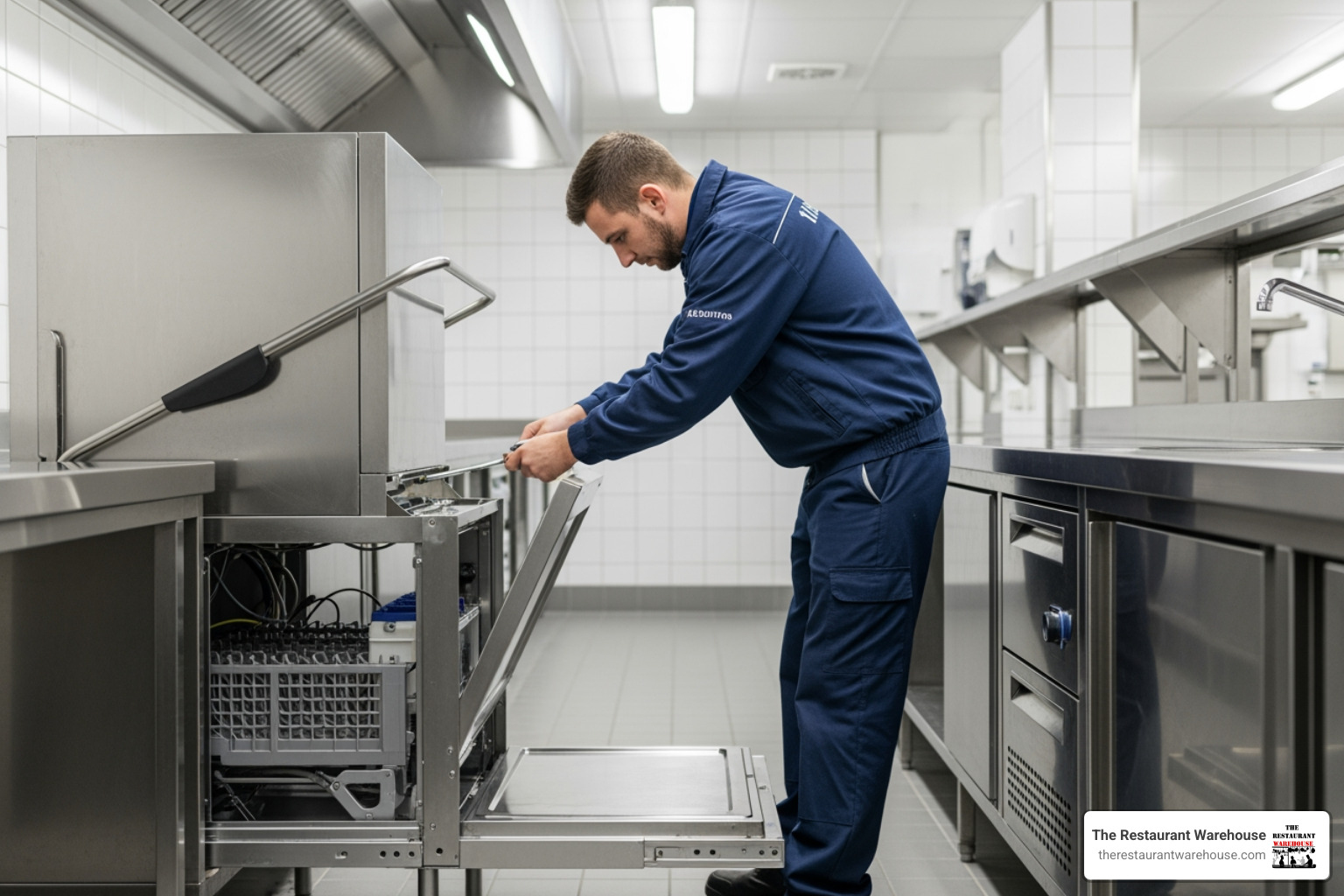
- Professional installation required: Always use certified technicians who are familiar with commercial equipment.
- Check plumbing for correct pressure and temperature: Adequate water pressure is essential for effective spraying, and for high-temp machines, the correct inlet water temperature (e.g., 140°F, 60°C) is crucial for efficient heating.
- Verify electrical connections match machine specs: As discussed, commercial units have specific voltage, phase, and amperage requirements. Incorrect electrical hookups can damage the machine or pose fire risks.
- Ensure proper drainage and ventilation: Effective drainage prevents water backup, while good ventilation (especially with a condensate hood for high-temp units) manages steam and heat, maintaining a comfortable and safe kitchen environment.
- Level the machine for optimal operation: A properly leveled dishwasher ensures water drains correctly, spray arms function efficiently, and internal components are not unduly stressed.
Proper Loading Techniques for Cleaner Dishes
You can have the most powerful, efficient dishwasher on the market, but if it’s loaded improperly, you’ll still end up with dirty dishes. Mastering a few simple loading techniques is one of the easiest ways to guarantee sparkling results with every cycle. It’s not about spending more time; it’s about working smarter to let the machine do what it was designed for. A well-loaded rack ensures water and detergent reach every surface, preventing costly and time-consuming rewashes during a busy service.
General Loading Rules
To get the best performance from your machine, think about water flow. Start by loading flat plates side by side, beginning from a corner of the rack. This method maximizes space and prevents them from shielding each other from the water jets. For bowls, always place them upside down or tilted downwards in a rack with tines. This position allows the interior to get a full spray and ensures all the water drains out, so you aren't left with a pool of dirty water at the end of the cycle. The most common mistake is overcrowding the rack, so remember to give your dishes enough space to get thoroughly cleaned.
How to Load Flatware Correctly
Flatware is notorious for nesting, which is when spoons or forks stick together and block water from cleaning them. The best way to prevent this is to load them into the flatware basket with the handles facing down. This simple step exposes the heads of the utensils to the full force of the wash cycle. It also adds a layer of safety, as your staff will be grabbing the handles, not the sharp tines or soiled ends, when unloading. Taking a moment to load correctly ensures you get the most out of your restaurant equipment and keeps your operation running smoothly with consistently clean results.
Simple Steps for Daily and Weekly Care
A clean dishwasher is a happy dishwasher—and one that won't let you down during the dinner rush. Establishing a routine cleaning and maintenance schedule is vital.
-
Daily cleaning: At the end of each shift or day, make it a habit to:
- Drain and clean the interior of the unit, removing any food debris.
- Remove and clean all filters and scrap screens to prevent clogs.
- Check and clean spray arms to ensure all jets are clear and not blocked by food particles or mineral buildup.
-
Weekly tasks:
- Delime the machine: This is crucial, especially if you're in an area with hard water. Limescale (mineral buildup) can reduce heating efficiency, clog spray jets, and even damage internal components. Use appropriate deliming chemicals as recommended by the manufacturer. The process typically involves draining the tank, refilling with fresh water, adding the deliming agent, running the machine, and then thoroughly rinsing to remove all residue.
- Check chemical levels (for low-temp models): Ensure your sanitizer and drying agent reservoirs are sufficiently full.
- Deliming is crucial for removing mineral buildup from hard water: White vinegar can also be used to clean targeted spray nozzles to prevent hard water buildup. Ignoring limescale can drastically reduce your dishwasher's efficiency and lifespan.
Daily Cleaning Checklist
To keep your machine running at its best, this quick checklist should be a non-negotiable part of your closing duties. At the end of every single shift, your team should take a few minutes to perform these essential tasks. First, drain the tank completely and wipe down the interior to remove any lingering food particles that can cause clogs or unpleasant odors. Next, pull out all the filters and scrap screens, giving them a thorough rinse to clear away trapped debris—this is one of the most common causes of poor wash performance. Finally, check the spray arms and use a small brush to gently clear any food bits or mineral buildup from the jets. This ensures a powerful, even spray pattern for every wash cycle.
Post-Cleaning Best Practices
Once the main cleaning tasks are done, a couple of final steps will set you up for success. After everything is clean and dry, properly reassemble all the parts you removed, like the filters and spray arms, making sure they click back into place securely. Here’s a simple but effective trick: leave the dishwasher door slightly ajar overnight. This allows the interior to air out completely, which prevents the growth of mildew and keeps the machine smelling fresh for the next day's service. It’s a small habit that makes a big difference in maintaining your machine's hygiene and extending its lifespan, protecting your investment in the long run.
Verifying Sanitization: A Critical Safety Check
Getting dishes visually clean is only half the battle; ensuring they are properly sanitized is a critical food safety requirement. For high-temperature dishwashers, this means the surface of the dishes must reach a specific temperature to kill harmful bacteria. According to the FDA Food Code, that magic number is 160°F (71°C). If your machine isn't hitting this temperature during its final rinse, you're not just risking poor results—you're risking the health of your customers and a potential health code violation. Regularly verifying that your dishwasher is reaching this sanitizing temperature is a fundamental part of maintaining all your restaurant equipment to the highest safety standards.
Using a Dishwasher Thermometer
So, how do you know if your machine is reaching that crucial 160°F? You can’t just guess. The most reliable method is to use a waterproof dishwasher thermometer or single-use temperature test strips. These simple tools are designed to record the highest temperature reached during a cycle. Simply place the thermometer or strip on a dish or in a rack and run a normal cycle. Once it's finished, check the reading. If it’s consistently at or above 160°F, you’re in the clear. If it’s falling short, it’s a clear sign that your machine needs maintenance, possibly with its booster heater, before it’s used again for service.
Frequently Asked Questions about Commercial Dishwashers
We know you've got questions, and we're here to provide clear, concise answers to some of the most common inquiries we receive about commercial dishwasher buy decisions and operation.
What temperature does a commercial dishwasher need to reach for sanitizing?
The required temperatures for sanitization are critical for food safety and are often regulated by local health codes. According to the FDA Food Code, high-temperature machines must achieve a final rinse temperature of at least 180°F (82°C) at the manifold, or ensure the utensil surface reaches 160°F (71°C) to properly sanitize. This extreme heat is what kills harmful bacteria. Low-temperature machines, on the other hand, rely on chemical sanitizers in their final rinse, operating at lower water temperatures (typically 120-140°F) but still achieving the necessary level of pathogen reduction.
How often should I delime my commercial dishwasher?
The frequency of deliming largely depends on two factors: the hardness of your local water supply and how often you use your dishwasher. In areas with particularly hard water, mineral buildup can occur rapidly, and you may need to delime your machine as often as once a week to maintain optimal performance and prevent damage. For softer water areas or less frequent use, once a month might suffice. Always consult your dishwasher's owner's manual for specific recommendations and watch for signs of scale buildup, such as cloudy dishes, reduced water pressure, or visible white deposits on heating elements. Proactive deliming is a simple step that significantly extends your machine's lifespan and efficiency.
Can I use a residential dishwasher in my commercial kitchen?
Absolutely not. While a residential dishwasher might seem like a cost-saving solution, it is fundamentally unsuitable for a commercial kitchen environment. Residential units are not designed for the volume, speed, or durability required in a foodservice setting. They lack the robust construction, powerful pumps, and rapid cycle times needed to keep up with commercial demand. More importantly, residential dishwashers do not meet the stringent NSF (National Sanitation Foundation) sanitation standards that commercial machines adhere to. Using a residential dishwasher in a commercial kitchen would not only lead to frequent breakdowns and operational inefficiencies but would also violate health codes, compromising food safety and potentially leading to fines or closure. Always invest in a commercial-grade machine when making a commercial dishwasher buy for your business.
Ready to Choose Your Commercial Dishwasher?
Choosing the right commercial dishwasher is a major decision that impacts your kitchen's efficiency, safety, and budget. By evaluating your specific needs and understanding the different types, temperature systems, and key features, you can confidently select a machine that will serve your business well for years. Remember to prioritize ENERGY STAR certified models for long-term savings and always adhere to proper installation and maintenance protocols. For affordable, high-quality options, The Restaurant Warehouse provides a wide selection to meet the demands of any foodservice operation. Contact us today for expert guidance on your commercial dishwasher buy.
Key Takeaways
- Size Your Dishwasher to Your Busiest Hour: Before you buy, calculate the number of racks you clean during your peak service. This number will directly point you to the right machine type—undercounter, door-type, or conveyor—ensuring you have the capacity you need without overspending.
- Weigh Energy Costs Against Chemical Costs: Your sanitizing method is a major budget decision. High-temperature machines use more energy for a fast, chemical-free rinse, while low-temperature models save on utilities but require a consistent budget for sanitizing chemicals.
- Protect Your Investment with Daily Maintenance: An efficient, ENERGY STAR certified model will lower your utility bills, but only proper care will make it last. Simple daily habits like cleaning filters, checking spray arms, and regular deliming are non-negotiable for preventing costly repairs and ensuring a consistent clean.
Related Articles
About The Author

Sean Kearney
Sean Kearney is the Founder of The Restaurant Warehouse, with 15 years of experience in the restaurant equipment industry and more than 30 years in ecommerce, beginning with Amazon.com. As an equipment distributor and supplier, Sean helps restaurant owners make confident purchasing decisions through clear pricing, practical guidance, and a more transparent online buying experience.
Connect with Sean on LinkedIn, Instagram, YouTube, or Facebook.