

What Is Par Level Inventory? A Quick Guide to Smarter Stocking
Picture this: It’s the middle of a chaotic Saturday night service, and your lead cook shouts from the line, “We’re 86 the calamari!” Why? Because you’ve just run out of a key ingredient for your best-selling appetizer. On the flip side, imagine the sinking feeling of discovering a case of expensive, beautiful produce has spoiled in the walk-in.
These are the exact headaches that a par level inventory system is designed to eliminate. It’s a tried-and-true method for setting a “just right” stock level for every single item in your kitchen, ensuring you have enough to meet demand without tying up cash in costly overstock.
Your Guide to Smarter Restaurant Inventory Management
This guide is here to help you turn inventory management from a constant source of stress into a real strategic advantage. We'll break down how this straightforward concept stops waste in its tracks, slashes costs, and brings a welcome dose of predictability to your kitchen operations.
So, what exactly is par level inventory in practice? Think of it as setting a target for each item on your shelves—the ideal amount you should have on hand right after a delivery arrives.
This approach isn't some new fad; it has a long, proven history of making restaurant operations more efficient. The idea of par levels—short for Periodic Automatic Replacement (PAR)—really took hold in the mid-20th century as restaurants grappled with unpredictable supply chains. By the 1980s, fast-food giants like McDonald's had made it a global standard, helping them maintain incredible consistency across their now 40,000+ locations and cut down food cost swings by as much as 15%. You can dig deeper into how the system evolved on Nory.ai.
A well-managed par level system acts as an early warning signal. It tells you exactly when to reorder and how much, removing guesswork and preventing the dual threats of stockouts and spoilage.
Key Components of Par Level Inventory at a Glance
Before we get into the nitty-gritty of formulas and real-world examples, let's get comfortable with the core terms you'll need to know. Getting these components down is the first step toward building an inventory system you can actually rely on.
This table gives you a quick summary to help you grasp the essential concepts.
| Component | What It Means | Why It's Important |
|---|---|---|
| Par Level | The ideal quantity of an item to have on hand right after a delivery. | Sets a clear target to prevent both overstocking and running out. |
| Usage Rate | The amount of an item you typically go through over a specific period. | Forms the foundation of your ordering math, ensuring you buy what you need. |
| Lead Time | The time between placing an order with a supplier and when it actually arrives. | Tells you how far in advance you have to order to avoid an empty shelf. |
| Safety Stock | A small buffer of extra inventory you keep on hand for unexpected events. | Protects you from a sudden dinner rush or a supplier delay. |
Once you’re familiar with these building blocks, you’ll be ready to start calculating and setting pars for your own kitchen.
Understanding the Core Par Level Concept
Ever glanced at your car’s fuel gauge? You probably don’t wait until it’s bone-dry to refuel, but you also don’t top it off after every short trip. You have a sweet spot—maybe when the needle hits a quarter tank—that tells you it's time to head to the gas station. That’s exactly what a par level is for your kitchen’s ingredients.
Simply put, a par level is the ideal amount of an item you should have sitting on your shelves right after a new delivery arrives. It’s not the minimum you need before placing an order; it’s the full, optimal stock level that gets you through to the next shipment with confidence.
Following this simple idea creates a powerful, predictable rhythm for your entire inventory process.
Finding the Balance Between Too Much and Too Little
The real magic of setting a par level is that it helps you strike a perfect balance, steering you clear of two of the costliest problems in any kitchen. On one hand, it puts a stop to the frantic chaos and lost sales that happen when you run out of a key ingredient mid-service—a nightmare that leaves customers unhappy and your staff stressed out.
On the other hand, it keeps your cash from being tied up in overstocked goods. Piling up too much inventory, especially with perishables like fresh produce or dairy, is a direct path to spoilage and waste. In fact, sloppy inventory management is one of the biggest drivers of food waste, which can absolutely cripple a restaurant's profits.
A par level is like an automated control system for your inventory. It takes the guesswork and gut feelings out of ordering and replaces them with a data-driven process that builds consistency and financial health.
By defining what "just right" looks like for every single item, you build a buffer against a surprise dinner rush while keeping your walk-in and storerooms lean and efficient. This one system solves a ton of common kitchen headaches, from wildly inconsistent food costs to cluttered, disorganized storage. At the end of the day, it's all about creating a stable foundation so your team can focus on what they do best: making incredible food.
How to Calculate Par Levels for Your Restaurant
Alright, let's move from theory to the practical side of things. Calculating your par levels is where you stop guessing and start taking real control of your ordering. With a simple formula, you can ditch the reactive scramble and build a proactive system that’s based on your actual numbers. This is the moment you become the boss of your stockroom.
This whole process is about finding that sweet spot, helping you dodge the costly mistakes of having too much cash tied up in overstocked inventory or, even worse, 86ing a popular dish because you ran out of something.
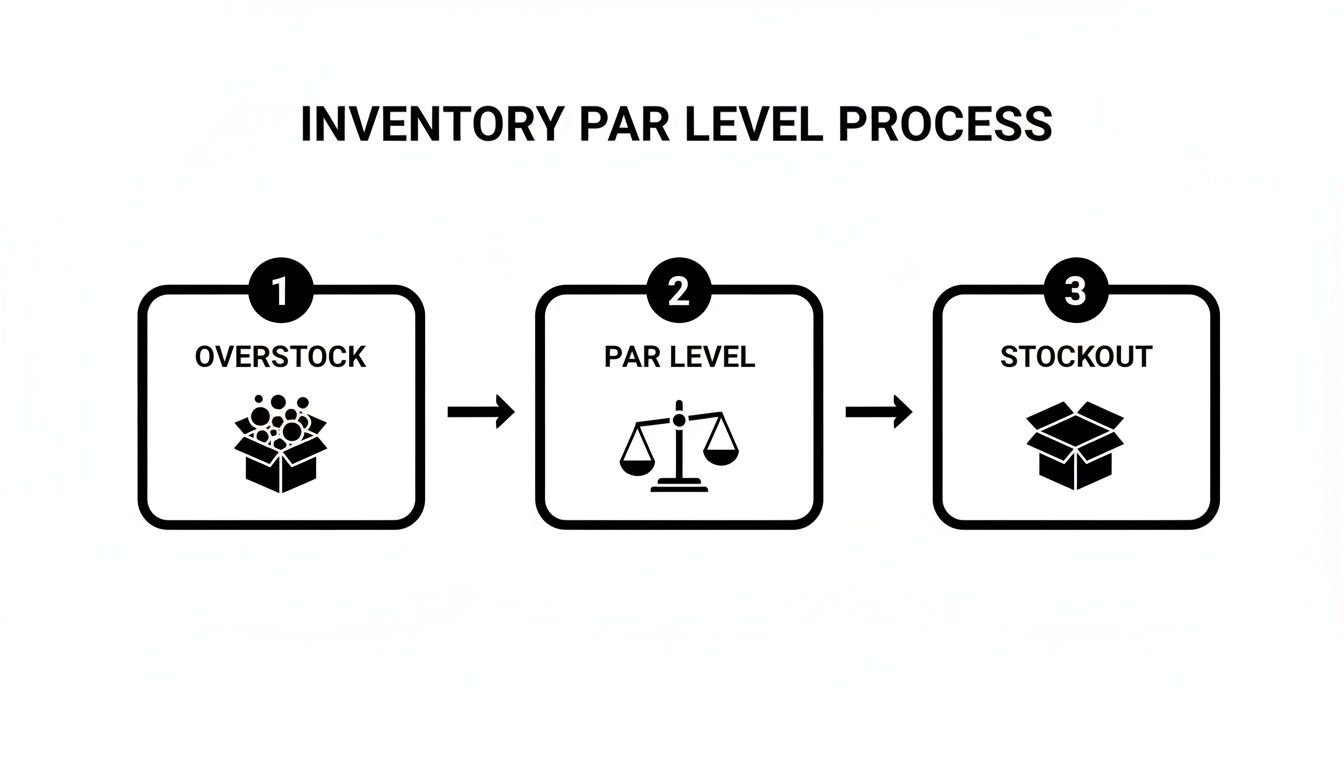
The key thing to remember is that a par level isn't just a minimum number. It's the optimal amount you need on hand to keep your kitchen humming along without a hitch.
The Core Par Level Formula
At its heart, figuring out the par level for any ingredient is built on a pretty simple foundation. The go-to formula pulls together how much you use, how long it takes to get more, and a little buffer for when things get crazy.
Par Level = (Average Daily Usage × Lead Time in Days) + Safety Stock
Let's break down what each piece of that puzzle means:
- Average Daily Usage: This is simply how much of an item you go through on a typical day. Your Point of Sale (POS) system is your best friend here; it tracks every dish you sell, giving you the hard data you need to see how fast you’re using ingredients.
- Lead Time in Days: This is the time between placing an order with your supplier and that order actually showing up at your back door. If you call in your order on Monday and the truck arrives Wednesday, your lead time is two days.
- Safety Stock: This is your "just in case" stash. It’s a small, extra amount of an item you keep on hand to cover you during an unexpected dinner rush or if your supplier gets delayed. Think of it as your insurance policy against running out of a key ingredient.
Getting this formula right has saved restaurants a fortune. Picture a place that’s all about its fried chicken. They use 10kg of chicken a day, their delivery takes 3 days to arrive, and they keep a 5kg safety buffer. Their par level is 35kg. As soon as they hit that number, it’s time to reorder. This simple habit helps them avoid the 25% food cost spikes from spoilage that plague roughly 60% of restaurants that don’t use par levels. You can dig into more examples of how restaurants apply this over at Restaurant365.
Putting the Formula into Action
To really see how this works in the wild, let's run the numbers for two totally different items in your pantry: a perishable and a dry good.
Example 1: A Perishable Item (Fresh Salmon)
Fresh salmon has a super short shelf life, so you’re ordering it frequently. Let's say your kitchen uses an average of 8 pounds of salmon per day. Your supplier’s lead time is 2 days, and you like to keep a safety stock of 4 pounds just in case.
- Par Level = (8 lbs/day × 2 days) + 4 lbs
- Par Level = 16 lbs + 4 lbs
- Par Level = 20 pounds
This means that right after your delivery truck pulls away, you should have 20 pounds of fresh salmon ready to go.
Example 2: A Non-Perishable Item (All-Purpose Flour)
Flour, on the other hand, lasts a long time, so you can order it less often. Let’s imagine you use 10 pounds of flour daily, your supplier's lead time is a bit longer at 5 days, and you keep a safety stock of 25 pounds.
- Par Level = (10 lbs/day × 5 days) + 25 lbs
- Par Level = 50 lbs + 25 lbs
- Par Level = 75 pounds
Your target for flour after a delivery would be 75 pounds. See how the same formula adapts perfectly to any item, whether it's fish or flour? That’s the beauty of it.
Setting and Adjusting Par Levels Like a Pro
A solid inventory system isn't something you can just "set and forget." Think of it as a living, breathing part of your restaurant that needs to adapt to the natural rhythm of your business. Nailing down your initial par levels is a massive first step, but the real art comes in knowing exactly how and when to tweak them. This is how you turn a rigid process into a smart, adaptive asset that actually helps you hit your goals.
Your pars should move with the seasons, your customers' tastes, and even shifts in your supply chain. A par level that worked beautifully in the quiet of January will almost certainly leave you scrambling during a summer patio rush.
Reading the Signals for Change
The key is to treat your par levels like dynamic targets, not numbers carved in stone. Adjusting them regularly is the only way to maintain that delicate balance between preventing stockouts and avoiding a fridge full of expensive, aging ingredients. You just have to pay attention to a few critical signals that tell you it’s time for a review.
These triggers are your cues to take action:
- Seasonal Shifts: As the weather changes, so do your customers' cravings. You’ll naturally need more iced tea ingredients in the summer and a whole lot more hot chocolate mix in the winter. Your pars need to reflect that.
- Menu Updates: Rolling out a new dish or a limited-time special will instantly change how fast you burn through certain ingredients. Adjusting your pars before you launch is the pro move that prevents those "we're out of it" moments.
- Supplier Changes: If you switch suppliers or your current one changes their delivery schedule, your lead time just got an update. Your par level formula has to be updated to reflect that new reality. You can learn more about managing your restaurant supply chain to stay ahead of these kinds of issues.
- Consistent Overages or Shortages: This is the most obvious sign. If you’re constantly tossing expired product or running out of something before the next truck arrives, your par level is flat-out wrong.
Using Variance to Refine Your Pars
One of the most powerful tools you have for fine-tuning your system is variance analysis. It sounds technical, but it’s really just comparing your actual, on-hand inventory count against what your POS system thinks you should have. A big difference between those two numbers—the variance—is a major red flag.
This is why regular inventory counts are so crucial; they help you catch these discrepancies early. A high variance might point to problems like unrecorded waste from a dropped pan, portion control issues on the line, or even theft.
By digging into these variances, you get a crystal-clear picture of what’s actually happening in your kitchen. This data empowers you to make precise, surgical adjustments instead of just taking a wild guess.
For example, tracking variance can quickly flag much bigger financial leaks. If your actual usage consistently comes in 20% under your par level for a pricey item, that's a signal to trim that number down. According to experts at Restaurant365, this simple adjustment can prevent you from tying up $10,000+ per location in inventory that just sits there. It transforms your inventory management from a chore into a smart, responsive system that saves you real money.
Adjusting your par levels isn't just about tweaking numbers; it's about responding to the real-time story your restaurant is telling you. Certain events should always trigger an immediate review of your pars to ensure they're still working for you.
When to Adjust Your Par Levels
This table is a quick-reference guide to help you spot those key business triggers and know exactly what to do.
| Triggering Event | Action to Take | Example |
|---|---|---|
| New Menu Launch | Proactively increase pars for new ingredients and decrease pars for retired items. | You're adding a popular avocado toast. Before launch day, you significantly raise the par for avocados and sourdough bread. |
| Seasonal Change | Adjust pars for seasonal items up or down based on historical sales data. | Heading into summer, you increase the par for lemonade ingredients and decrease the par for hot soup components. |
| Supplier Delivery Change | Recalculate your par level formula to reflect the new lead time. | Your produce supplier switches from daily to every-other-day delivery. You must increase your par levels to cover the extra day. |
| Consistent Stockouts | The par level is too low. Increase it incrementally until shortages are eliminated. | You run out of burger buns every Friday. Increase the par level by 10% and monitor the results for two weeks. |
| Excess Spoilage | The par level is too high. Decrease it to reduce waste and free up cash. | You're consistently throwing away half a case of lettuce. Lower the par level to align with your actual weekly usage. |
| Upcoming Holiday or Event | Temporarily increase pars for high-demand items based on event forecasts. | For Valentine's Day week, you double the par level for chocolate, strawberries, and sparkling wine. |
Think of these triggers as your inventory playbook. By responding to them quickly, you keep your pars aligned with reality, ensuring you have what you need without tying up cash in what you don't.
Tools and Templates to Get Par Levels Working For You
Knowing the par level formula is one thing, but actually putting it to work in the fast-paced reality of your kitchen is another. It’s about bridging that gap between the math and the day-to-day grind. The secret isn't just about crunching numbers; it’s about creating a consistent, easy-to-follow system that your entire team can get behind. Let’s look at the tools—from simple pen-and-paper to modern tech—that make this whole process click.
You don’t need to drop a ton of cash on fancy software to get started. Honestly, a basic par sheet template is an incredibly powerful first step. This can be as simple as a laminated sheet on a clipboard in your walk-in or a basic spreadsheet on a tablet. This sheet lists each inventory item, its par level, the amount you have on hand, and a final column for how much you need to order.
Starting with a manual method like this forces you to truly understand your inventory flow. It builds a solid foundation that makes any future transition to more advanced systems way easier.
Bring in Technology and Your Team
Modern Point of Sale (POS) systems can be a total game-changer for managing par levels. They automatically track what you sell, so you don’t have to manually count how many burger patties you went through last week. This real-time sales data gives you the accurate "average usage" numbers you need to make your par level calculations razor-sharp.
But even the best technology is only half the solution. Your team is your most valuable asset in this process.
- Establish a Consistent Ordering Rhythm: Pick specific days and times for counting inventory and placing orders. When it becomes part of the weekly routine, things stop falling through the cracks.
- Train Your Staff: Turn your team into your eyes and ears on the floor. Train them to accurately record all waste—whether it’s a dropped tray of tomatoes or a burnt steak—and to give you a heads-up when an item is running low before it becomes a crisis.
This approach creates a culture of ownership. When everyone from the line cook to the manager understands their role in tracking inventory, your par level system becomes incredibly powerful and effective.
Getting this well-oiled machine running has a massive impact on your bottom line. Research shows restaurants using par systems can slash food waste by as much as 40%. Think about those last-minute emergency orders—a weekly headache for 35% of independent restaurants—that often cost 25% more than planned deliveries. A solid par system can cut those costly rush orders by up to 70%. You can explore studies on par level efficiency to see just how much of an impact this can have.
The final piece of the puzzle is simple organization. Clearly labeled shelves and designated storage areas make inventory counts faster and way more accurate. When your team can quickly find and count what they need, the whole process feels less like a chore and more like the strategic advantage it truly is. Check out our guide on choosing the right restaurant inventory management system to see how technology can support all these efforts.
What Do You Gain by Mastering Par Level Inventory?
Getting a handle on your par levels isn't just another task on your to-do list; it's a fundamental shift in how you run your restaurant that pays off in a big way. It directly attacks some of the biggest, most frustrating profit killers in our industry, starting with food waste.
When you dial in your pars, you stop the guesswork and only order what you truly need. This means no more overstocking perishable items that end up in the bin, and it frees up cash that used to be tied up in excess inventory just sitting on your shelves.
This discipline brings a sense of calm and predictability to your entire operation. Instead of constantly putting out fires, you’re proactively managing your stock. That means consistency for your kitchen team and a better, more reliable experience for your guests. No more 86ing a popular dish on a busy Friday night.
Avoid the Pain of Costly Stockouts
Running out of an item is more than just a minor hiccup; it's a direct hit to your revenue. A 2022 report brought this into sharp focus, revealing that a staggering 41% of U.S. restaurant operators were dealing with stockouts every single week. Those missed sales add up to billions across the industry.
Mastering par levels is your best defense against having to tell a customer, "Sorry, we're out of that." It keeps your menu reliable and your guests happy. You can see more on how restaurants are tackling these inventory challenges on Nory.ai.
At the end of the day, a solid par level system is the bedrock of a more profitable and sustainable restaurant. It gives you the operational peace of mind to stop worrying about inventory and start focusing on what really matters: creating an amazing guest experience.
By keeping stockouts at bay and slashing waste, you're taking direct control of your restaurant food cost percentage and building a much stronger, more resilient business.
Your Par Level Questions, Answered
Even when you’ve got the formulas down, putting a new system into practice always brings up a few questions. Let's tackle some of the most common things operators ask when they start using par levels. The goal here is to give you the confidence to roll this out in your own restaurant.
How Often Should I Recount and Adjust Pars?
This really depends on the item. For anything with a short shelf life or high turnover—think fresh produce, dairy, or seafood—you’ll want to do counts daily or at least weekly. For your non-perishables like dry pasta, canned goods, or spices, a monthly check-in usually works just fine.
As for adjusting the par levels themselves, plan on a full review at least quarterly to keep up with seasonal menu changes and customer habits. But you’ll want to reassess them immediately if something big changes, like:
- You roll out a major menu update.
- You switch suppliers, and their delivery schedule is different.
- You consistently find yourself overstocked or, even worse, 86’ing an item.
What Is the Difference Between Par Level and Safety Stock?
This is a super common point of confusion, but the relationship is actually pretty simple. Safety stock isn't a separate number; it's a crucial part of your par level.
Think of it this way: Your par level is the total amount of an item you want sitting on the shelf right after a delivery truck leaves. That total number is made up of two things: the amount you expect to use before the next delivery arrives, plus your safety stock.
The safety stock is just that little extra buffer you build in to protect yourself from a surprise Friday night rush or a supplier delay. It’s your insurance policy against running out.
Can I Use Par Levels for Non-Food Items?
Absolutely! The logic behind par level inventory is just as effective for any consumable item your restaurant burns through. It works perfectly for managing takeout containers, napkins, cleaning chemicals, and even glassware.
The process is exactly the same. You figure out your average usage, confirm the supplier's lead time, and add a reasonable safety stock. Applying this discipline to your non-food inventory ensures you never run short of those essential supplies that keep your service smooth and professional.
At The Restaurant Warehouse, we provide the durable, high-quality equipment you need to manage your inventory effectively, from commercial shelving to walk-in coolers. Equip your kitchen for success by visiting us at https://therestaurantwarehouse.com.
About The Author

Sean Kearney
Sean Kearney is the Founder of The Restaurant Warehouse, with 15 years of experience in the restaurant equipment industry and more than 30 years in ecommerce, beginning with Amazon.com. As an equipment distributor and supplier, Sean helps restaurant owners make confident purchasing decisions through clear pricing, practical guidance, and a more transparent online buying experience.
Connect with Sean on LinkedIn, Instagram, YouTube, or Facebook.