

What is a Speed Oven and How It Transforms Your Kitchen
Picture this: a high-powered microwave, a convection oven, and targeted jets of hot air all crammed into one compact, seriously powerful machine. That, in a nutshell, is a speed oven.
It’s a hybrid piece of commercial equipment engineered to cook food up to 15 times faster than the traditional ovens you're used to, but here's the kicker—it does it without wrecking the quality, texture, or flavor.
Your Kitchen’s Secret Weapon, Explained
Think of a speed oven as a highly efficient pit crew for your food. Instead of one cooking method slowly doing its thing, you have several technologies blasting away at once to get the job done in record time.
This tag-team approach is exactly how a café can toast a perfect panini in under a minute or a food truck can serve up a crispy, bubbly flatbread pizza in just 90 seconds. The goal is simple: deliver top-notch results at a pace that keeps up with demanding customers and long lines.
This way of cooking is quickly becoming a must-have for high-volume kitchens. The global high-speed oven market was valued at USD 1.76 billion and is expected to keep climbing, which tells you just how important these machines are in modern food service. If you're curious, you can find more details about high-speed oven market trends on intelmarketresearch.com. This growth is all thanks to the clear, immediate advantages these ovens bring to the table.
Core Benefits for Busy Kitchens
For any fast-paced spot—from a local coffee shop to a bustling quick-service restaurant—the benefits are instant and game-changing. A speed oven isn't just about cooking faster; it's about operating smarter.
Here are the big wins:
- Drastically Reduced Ticket Times: Getting food out faster means serving more people. That directly translates to higher throughput and more revenue, especially when you’re slammed during peak hours.
- Menu Flexibility and Expansion: Because of their compact, often ventless designs, you can suddenly add high-margin items like toasted sandwiches, quesadillas, and baked goods without needing a full kitchen overhaul.
- Unmatched Consistency: You can pre-program recipes so every single dish comes out exactly the same, every time. This empowers even your newest staff members to produce perfect results with just one touch of a button.
By blending multiple cooking technologies, a speed oven solves that age-old kitchen dilemma: choosing between speed and quality. It delivers both, making it a strategic investment for boosting your efficiency and your bottom line.
The Science Behind High Speed Cooking
Cooking a perfect sandwich in under a minute can feel like straight-up kitchen magic, but what’s happening inside a speed oven is actually a brilliant symphony of three distinct heating technologies working in perfect harmony. Each one tackles a different part of the cooking process at the same time, which is the secret to getting both incredible speed and top-notch results. It's a coordinated attack on cooking times.
Let's say you're toasting a panini. The first hero in this process is microwave energy. Now, unlike a standard microwave that can leave bread soggy, a speed oven uses this power with precision. The microwaves agitate the water molecules deep inside the fillings—like the cheese and meat—generating heat from the inside out. This internal heating happens almost instantly.
To get a better handle on how this part works in a commercial kitchen, you can check out our comprehensive industrial microwave oven guide.
While the microwaves are busy working on the interior, the convection system gets to work on the outside. A powerful fan circulates intensely hot air all around the oven cavity. This rapidly moving air makes sure the exterior of the food, like the panini bread, cooks evenly and develops that golden-brown color and crispy texture everyone loves.
The Power of Impingement
The final, and maybe most impactful, piece of the puzzle is air impingement. The best way to picture it is as focused, high-pressure jets of superheated air blasting directly onto the food's surface. These jets are strong enough to strip away the "cold halo"—that little layer of cool, insulating air that naturally surrounds food—letting heat penetrate way faster than convection could on its own.
This triple-threat combination is what truly sets a speed oven apart. Microwaves cook the core, convection browns the outside, and impingement jets slam the accelerator on the whole process, ensuring every part of the food is cooked perfectly, all at once.
This diagram breaks down how these three core technologies—microwave, convection, and impingement—team up to deliver such fast, high-quality results.
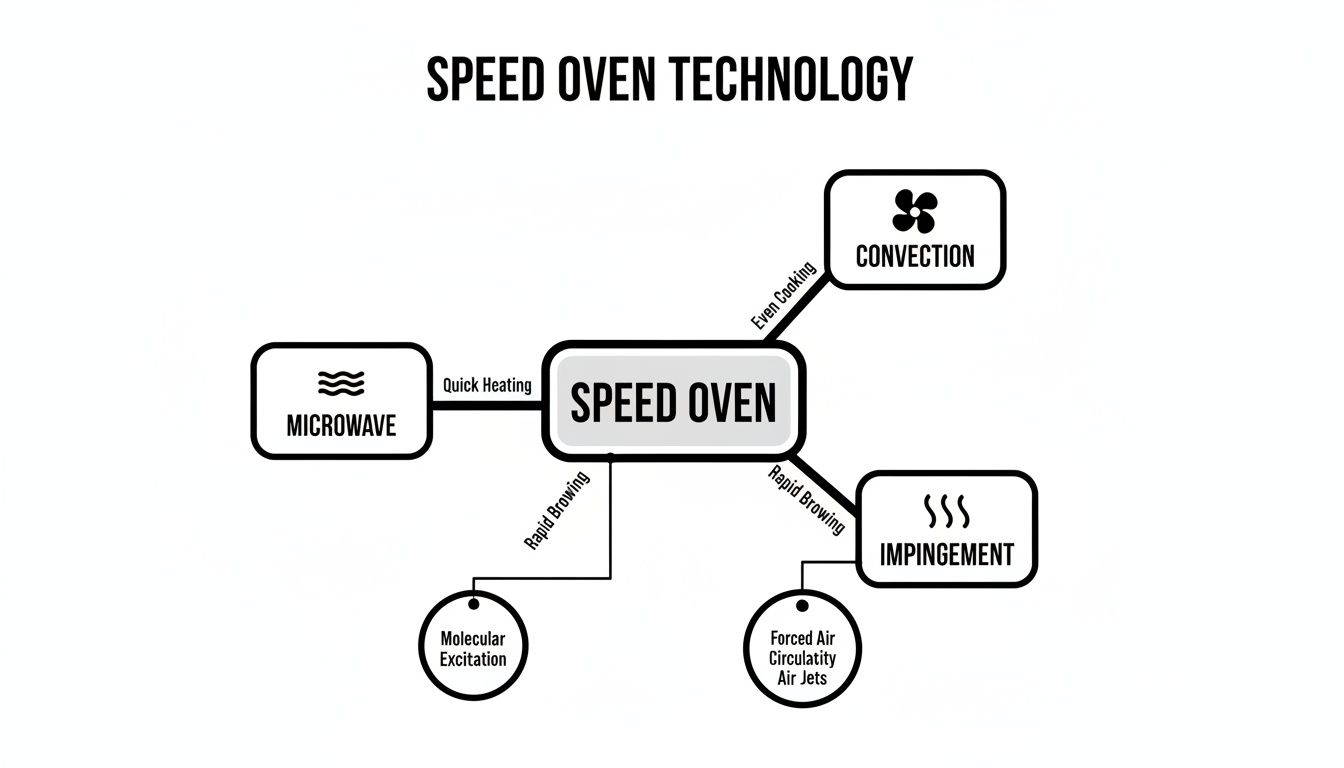
You can see it's the synergy of these forces, not just one method, that makes a speed oven work the way it does. This integrated approach is how you can get cheese completely melted on the inside while achieving a perfectly toasted exterior, all in a tiny fraction of the time it would take a traditional oven.
Choosing Your Commercial Oven
Picking the right oven is a huge decision for any food business. You're not just buying a piece of equipment; you're investing in the very engine of your kitchen's speed, what you can put on your menu, and how smoothly everything runs. Getting a handle on the real differences between a speed oven, a convection oven, and a combi oven is key to making a choice that actually helps you hit your goals.
Let's break it down. Say you run a bustling café known for its killer toasted paninis and other grab-and-go bites. A convection oven just isn't going to get the job done right. Sure, it’s a master at baking big, even batches of cookies or pastries, but it doesn't have the raw velocity you need for quick-service. It circulates hot air beautifully, but it's missing the microwave power that makes a speed oven so fast.
Then you have the combi oven, which is a different kind of powerhouse altogether. Its secret weapon is steam, making it perfect for delicate jobs like roasting super juicy proteins or baking artisan bread with that perfect, crackly crust. But it’s not built for the kind of sub-minute cooking that speed ovens are famous for, which makes it less ideal when every second counts.
Finding the Right Fit for Your Menu
The choice really boils down to your main priority. Are you focused on baking big batches, or do you need to get a hot, finished sandwich into a customer's hands in less than two minutes? The market for this kind of accelerated cooking equipment is booming for a reason: more and more operators are putting speed at the top of their list.
The built-in high-speed oven market was valued at $929.175 million back in 2021 and is expected to climb to $1,306.8 million by 2025. You can dig into more insights on this impressive market development on cognitivemarketresearch.com. This growth really shows how the industry is shifting toward equipment that can push out more orders without sacrificing quality.
A speed oven shines where others fall short: it's a finisher and a rethermalizer designed for pure, unadulterated velocity. It's the perfect tool for turning pre-assembled ingredients into a finished, hot, and crispy product right when a customer orders it.
For a deeper dive into how these ovens stack up, check out our practical guide to comparing commercial oven options.
Head-to-Head Oven Comparison
To help you really see where each oven excels, here’s a straightforward breakdown of their core strengths and what they're best used for. This comparison should make it crystal clear what each machine brings to your kitchen.
Speed Oven vs Convection Oven vs Combi Oven
| Feature | Speed Oven | Convection Oven | Combi Oven |
|---|---|---|---|
| Primary Function | Rapid cooking & finishing | Even, dry-heat baking | Roasting, steaming, baking |
| Cooking Speed | Extremely Fast (10-15x) | Standard | Moderate to Fast |
| Key Technology | Microwave, Convection, Impingement | Fan-circulated hot air | Convection and Steam |
| Ideal Use Case | Toasted sandwiches, pizzas, reheating | Bulk baking, pastries, cookies | Meats, breads, delicate items |
| Best For | Cafés, QSRs, food trucks | Bakeries, high-volume catering | Full-service restaurants |
This table lays it all out, showing how each oven is engineered for a specific job. Your menu, your service style, and your customers' expectations will ultimately point you to the right one.
Unlock Business Growth with a Speed Oven
Let's get down to brass tacks. Beyond the cool technology, a speed oven is a serious engine for real, tangible business growth. Its features translate directly into smarter operations, more revenue in the register, and a healthier bottom line. This isn't just about cooking a sandwich faster; it's about fundamentally changing how your business serves customers and controls costs.
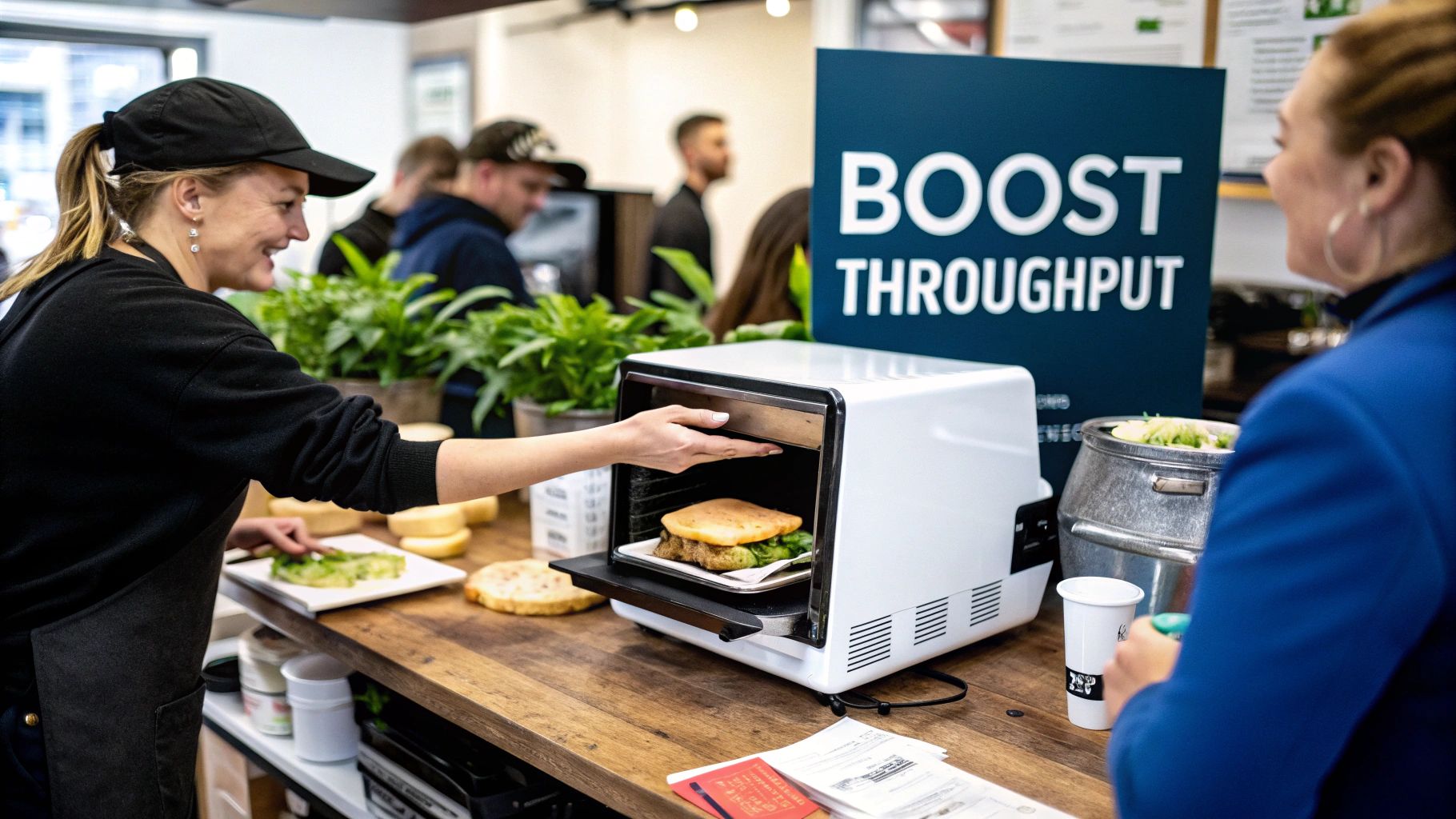
The most immediate thing you'll notice is how it impacts customer throughput. By slashing cook times, you can serve way more people in the same amount of time. That’s a massive advantage during your peak lunch or dinner rush. A line that once looked impossible to get through can be managed with ease, which means more sales and fewer frustrated customers walking away.
Streamline Operations and Reduce Costs
A speed oven also offers a powerful solution to today's labor challenges. With pre-programmable recipes, even your newest staff member can deliver perfectly consistent results with the touch of a single button. This one-touch operation slashes training time, cuts down on costly cooking errors, and empowers your whole team to maintain high quality without a manager hovering over their shoulder.
This operational ease is a huge reason for the appliance's growing popularity. The commercial high-speed oven market is projected to jump from USD 3.2 billion to USD 6.1 billion by 2035. This boom reflects a global demand from QSRs and other operators for cooking solutions that are efficient and save on labor.
If you're looking for other great ideas, check out these ways to make your kitchen more efficient.
Expand Your Menu Without Expanding Your Kitchen
Maybe the biggest game-changer is the ability to expand your menu without a costly, disruptive kitchen renovation. Many speed ovens are compact and completely ventless, which means you can install them just about anywhere without needing to run an expensive ventilation hood.
This flexibility unlocks incredible potential, especially for businesses with limited space:
- Cafés can suddenly add high-margin items like toasted sandwiches, breakfast burritos, and fresh-baked pastries.
- Food trucks can introduce personal pizzas, quesadillas, and other hot foods that were impossible before.
- Convenience stores can launch a fresh, hot food program to compete directly with quick-service restaurants.
A speed oven isn't just another piece of equipment; it's a strategic investment that pays dividends. It allows you to increase revenue, control labor costs, and innovate your menu, directly fueling your business's growth and profitability. This makes understanding what is a speed oven crucial for any modern food service operator.
Selecting and Installing Your Speed Oven
Choosing the right speed oven isn't just another equipment purchase; it's a strategic investment that can seriously boost your kitchen's efficiency and your bottom line. Before you even look at a price tag, it’s essential to think beyond the initial cost and picture how a specific model will actually fit into your daily grind.
Get it right, and your new oven will feel like the most valuable member of your team. Get it wrong, and you’re stuck with a frustrating bottleneck that just causes headaches.
The very first step is to be brutally honest about your capacity needs. Think about your absolute busiest hour—how many sandwiches, pizzas, or pastries are you trying to pump out? A cozy little café might get by just fine with a compact unit, while a high-volume QSR might need a larger model or even a couple of stacked ovens to keep the line moving.
Technical and Practical Considerations
Once you’ve got a handle on capacity, it's time to dive into the technical details. These are the non-negotiables that will determine which models are even an option for your space.
- Electrical Requirements: Speed ovens are powerful machines. You absolutely have to check the voltage (e.g., 208V or 240V) and phase (single-phase or three-phase) requirements of any oven you’re considering. Make sure your building’s electrical system can handle it, because a mismatch here can lead to some seriously expensive electrical work.
- Ventilation Needs: This is one of the biggest selling points for speed ovens. The vast majority are ventless, thanks to built-in catalytic converters that zap grease and odors right out of the air. This feature alone can save you thousands of dollars and endless headaches by letting you skip the installation of a costly commercial hood.
- Warranty and Service: Don’t just skim the fine print. Dig into the warranty details and, more importantly, confirm that there are certified service technicians for that brand in your area. A fantastic oven is completely useless if you can’t get it fixed quickly when it goes down.
Choosing a ventless speed oven is one of the smartest financial decisions an operator can make. It not only reduces upfront installation costs but also offers the flexibility to place the oven anywhere—from the back-of-house line to a front-facing customer counter—without major renovations.
Ventilation rules can get complicated, and knowing for sure when you do or don't need a hood is crucial. To get a clearer picture, it’s a good idea to review a detailed guide on whether your commercial oven needs a hood to make sure you’re squared away with local codes. Taking the time to sort through these key points before you buy will ensure a smooth installation and set your kitchen up for success.
Mastering Your Speed Oven Day to Day
Getting a speed oven is a fantastic move, but the real win comes from weaving its use and care into your kitchen’s daily rhythm. To get the most out of your investment, you need to master its operation and maintenance. A little bit of know-how ensures your machine is always running at its best, minimizes the risk of downtime, and consistently pumps out top-quality food for years.
The first step is to really lean into its programmable features. Take the time to dial in and save custom recipes for your most popular menu items. By programming the perfect mix of microwave, convection, and impingement for each dish, you create a simple, one-touch system. This is a game-changer because it means any team member can deliver perfect results every single time, which drastically cuts down on mistakes and training headaches.
Essential Usage and Cleaning Tips
Smart day-to-day habits are what will protect your investment. A few small changes, especially around cookware and cleaning, can make a huge difference in the oven's performance and how long it lasts.
- Select the Right Cookware: This one is a big deal—never use metal pans or foil. The microwave power in a speed oven demands microwave-safe materials like certain plastics, ceramics, or the specially designed accessories that come with the unit. Using the wrong pan can cause arcing and seriously damage the oven.
- Arrange Food Smartly: Don't crowd the oven cavity. Giving your food a little breathing room allows that hot convection and impingement air to circulate properly. That's the secret to getting everything cooked evenly with that perfect crispy texture you're looking for.
- Follow a Cleaning Schedule: Consistent cleaning is absolutely non-negotiable. It protects the sensitive internal components and is critical for food safety.
A well-maintained speed oven is a reliable profit center. A neglected one quickly becomes an expensive liability. A simple, consistent cleaning routine is the single best way to protect its delicate technology and ensure it delivers for the long haul.
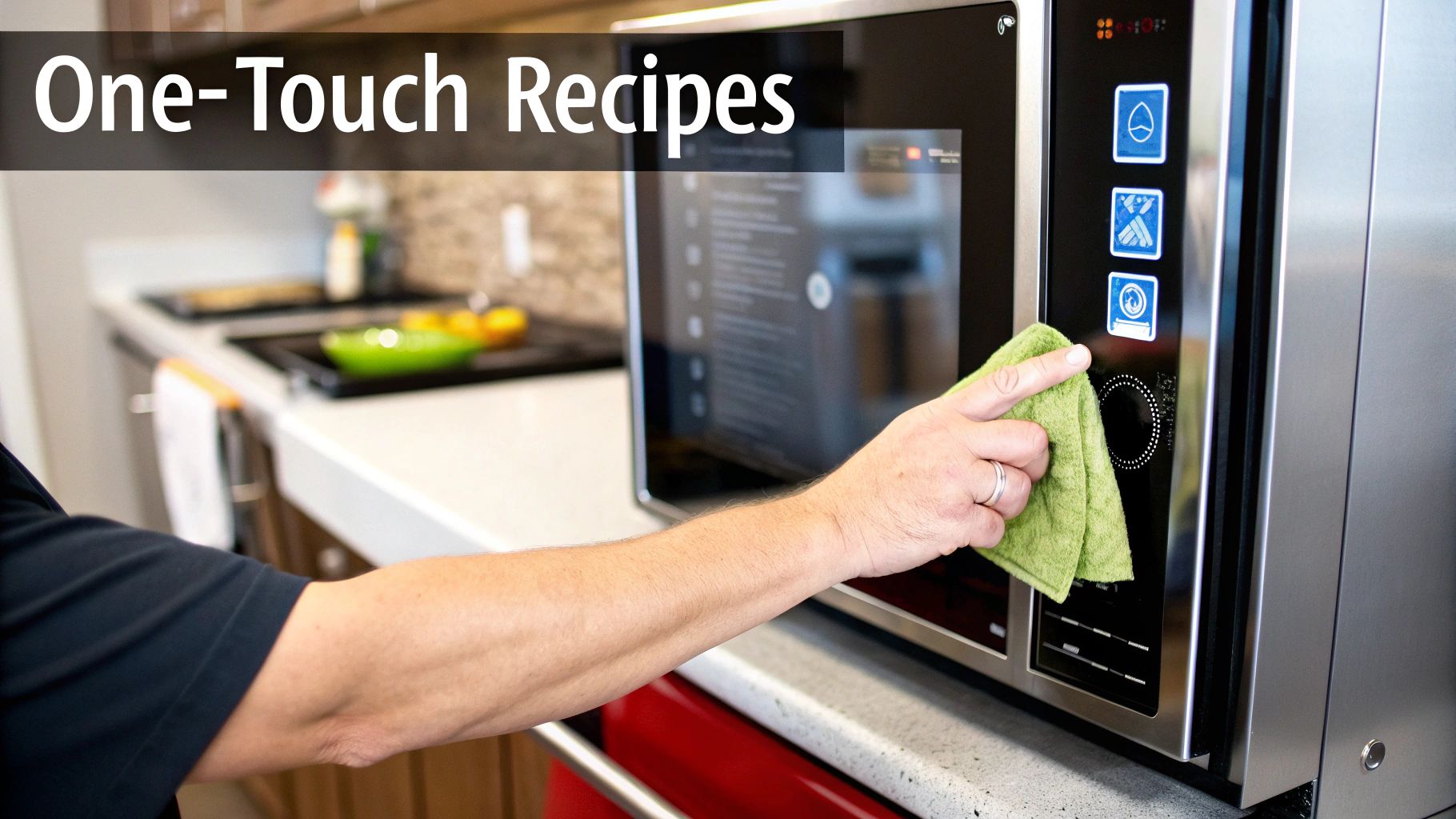
Putting a structured cleaning plan in place is easy and absolutely vital for keeping your oven in top shape.
Your Speed Oven Cleaning Checklist
- Daily: Wipe down the interior with a damp, non-abrasive cloth and an approved cleaner to get rid of any food spills and grease. Don't forget to clean the door and seals to keep the fit nice and tight.
- Weekly: Take out and soak any detachable parts like racks or trays. Give the interior a more thorough cleaning, paying extra attention to the air vents.
- Monthly: Inspect and clean the air filters. Proper airflow is crucial for both cooking performance and preventing the machine from overheating.
Got Questions About Speed Ovens? We’ve Got Answers.
Even after seeing all the ways a speed oven can boost your kitchen, it’s completely normal to have a few practical questions before you commit. Making sure this piece of equipment fits into your daily workflow is the key to feeling confident in your choice. Let's tackle some of the most common things we hear from operators.
Can It Really Replace My Microwave and Convection Oven?
This is the big one. For a lot of businesses, especially those that do a lot of reheating, toasting, and finishing, the answer is a definite yes.
A speed oven beautifully merges the zippy internal heating of a microwave with the browning, crisping power you get from convection. You’re essentially consolidating two bulky appliances into one compact, powerful unit. That's a huge win for saving precious counter or line space.
Now, if your kitchen is built around large-batch baking—think dozens of muffins or sheet pans of cookies at a time—you’ll probably still want to hang on to your dedicated convection oven for that specific task.
Do I Really Need a Ventilation Hood?
Here’s a huge selling point and a major cost-saver: in almost all cases, the answer is no. Most commercial speed ovens are engineered to be ventless. They have built-in catalytic converters that scrub the air of grease and cooking odors before it ever leaves the machine.
This gives you incredible flexibility. You can place the oven almost anywhere—right on the front counter in front of customers, for example—without spending thousands on a traditional ventilation hood system. Just be sure to double-check the specific model’s certifications and your local health codes, but this feature is an absolute game-changer for installation costs and kitchen design.
The ventless design of most speed ovens is one of their most significant advantages. It not only drastically cuts down on upfront installation costs but also opens up menu possibilities for businesses in locations where traditional vented hoods are impractical or prohibited.
Are Speed Ovens Hard to Use?
That’s a fair concern, but these machines are built for simplicity in a fast-paced environment. Honestly, they’re incredibly easy for staff to get the hang of.
Most models come with intuitive, icon-based touchscreens that are as easy to use as a smartphone. The real magic, though, is in the pre-programmable recipes. A manager can dial in the perfect settings for a menu item just once. From then on, any team member can cook that item perfectly just by tapping a single button.
This design slashes training time, cuts down on human error, and ensures every customer gets the exact same high-quality product, every single time.
Ready to revolutionize your kitchen's speed and efficiency? Explore a wide range of top-tier speed ovens and find the perfect fit for your business at The Restaurant Warehouse. Visit https://therestaurantwarehouse.com to see our selection and unlock flexible financing options today.
About The Author

Sean Kearney
Sean Kearney used to work at Amazon.com and started The Restaurant Warehouse. He has more than 10 years of experience in restaurant equipment and supplies. He graduated from the University of Washington in 1993. He earned a BA in business and marketing. He also played linebacker for the Huskies football team. He helps restaurants find equipment at a fair price and offers financing options. You can connect with Sean on LinkedIn or Facebook.
Leave a comment