

Choosing Your Perfect Prep Partner: A Guide to Commercial Sandwich Prep Tables
Streamlining Your Sandwich Service
Commercial sandwich prep tables are specialized refrigerated workstations that keep ingredients fresh and provide an organized space for assembling sandwiches, salads, and other cold items. These units combine a refrigerated base for bulk storage, a cutting board work surface, and a refrigerated top rail that holds ingredient pans at food-safe temperatures.
If your staff constantly moves between the cooler and the assembly station during a lunch rush, you're losing time, energy, and potentially compromising food safety. A commercial sandwich prep table solves these problems by centralizing cold ingredients right where you need them. This results in faster service, fresher food, and a more profitable operation.
The difference between a struggling sandwich shop and a thriving one often comes down to workflow. A well-designed prep station allows staff to assemble orders in seconds. For a growing deli or cafe, even saving 10–15 seconds per order can translate into dozens of additional customers served per day and a noticeable bump in revenue.
To understand why, think about the typical lunchtime rush:
- One employee is constantly opening and closing a reach-in just to grab tomatoes, lettuce, or cheese.
- Another is waiting for space at a cramped cutting board.
- Orders pile up, customers wait longer, and staff stress levels skyrocket.
A properly sized commercial sandwich prep table turns that chaos into a linear, predictable process. Ingredients are prepped, portioned, and clearly organized before service. During peak hours, staff simply move down the rail, assemble, and finish.
Modern prep tables with refrigerated rails ensure uniform temperatures by circulating cold air below food pans, while insulated covers minimize condensation and reduce warm-air infiltration. Units that use R290 refrigerant can also yield meaningful energy savings over the life of the equipment.
I'm Sean Kearney from The Restaurant Warehouse, and I've spent years helping restaurants, cafes, food trucks, and delis select the right refrigeration and prep solutions. I've seen firsthand how the right prep table transforms a chaotic operation into a smooth, highly efficient service line.
If you’re planning a new deli, remodeling your line, or simply tired of bottlenecks during lunch, a dedicated commercial sandwich prep station should be one of the first upgrades you evaluate. To talk through your layout and volume, you can contact us for one-on-one assistance and we’ll help you match a table to your menu, space, and budget.
The Core Benefits: Why Your Deli Needs a Commercial Sandwich Prep Table
Investing in a quality commercial sandwich prep table transforms your operation's success. These units offer improved workflow, increased efficiency, better food safety, and consistent product quality. A dedicated prep table is essential for any establishment serving sandwiches, salads, or cold items.
Boosting Kitchen Efficiency and Speed
During lunch rush, a commercial sandwich prep table creates organized efficiency. By centralizing ingredients and tools, these tables establish a dedicated workstation that minimizes staff movement. With everything at their fingertips, your team assembles orders faster.
Pre-portioned items arranged in the refrigerated rail allow precise, speedy assembly. This speeds service, reduces errors, and minimizes waste. Instead of grabbing backup ingredients from a distant cooler, staff rotate fresh pans from the refrigerated base directly into the top rail.
This efficiency translates to serving more customers and boosting daily sales. A well-organized commercial sandwich prep station makes a significant difference in busy delis, restaurants, or cafes. Our prep tables come in various sizes and configurations. Explore our sandwich prep table options to compare features.
Beyond speed, efficiency shows in labor management. When your line centers around a dedicated commercial sandwich prep table, you can:
- Reduce staff needed during slower periods
- Cross-train employees more easily
- Shorten training time for new hires
Ensuring Food Safety and Ingredient Freshness
Food safety is paramount. A commercial sandwich prep table maintains consistent, food-safe temperatures. By circulating cold air below food pans, these units keep ingredients at or below 40°F (4°C), aligning with safe cold-holding practices.
The FDA Food Code emphasizes keeping cold foods at appropriate temperatures to slow bacterial growth and protect guests.
These tables prevent cross-contamination. Dedicated pans and spacious cutting boards minimize risks of mixing allergens or transferring bacteria. Insulated covers protect ingredients from airborne contaminants. Stainless steel construction is durable, non-porous, and easy to sanitize. Look for NSF-certified models meeting recognized health standards.
By keeping ingredients at proper temperatures in clean, organized workspaces, prep tables support safer food, better texture, and extended freshness.
Reducing Waste and Protecting Profit Margins
A commercial sandwich prep table cuts food waste through:
- Better visibility: Staff quickly see what needs using first
- Portion control: Standardized utensils ensure accurate portioning
- Improved rotation: Labeled backup product supports FIFO practices
Small improvements in waste reduction protect your margins over time.
Enhancing Customer Experience and Consistency
Customers notice consistency. A streamlined commercial sandwich prep setup helps your team build the same sandwich every time. That consistency leads to fewer remakes, higher satisfaction, and predictable food costs.
By building your service line around a well-planned prep table, you're investing in a smoother guest experience from order to pickup.
Anatomy of a Prep Table: Key Features to Look For
Choosing the right commercial sandwich prep table means understanding its key features. It's not just a cold box; it's a multi-functional workstation that will be the heart of your assembly line. This section will guide you in selecting a unit that meets your operational and food safety needs.

From durable materials to precise temperature controls, each component is vital for performance and longevity.
Construction, Material, and Durability
The foundation of a robust commercial sandwich prep table is its material, and stainless steel is the top choice. It's durable, resisting dents, scratches, and daily wear. Its non-porous surface is also easy to clean and sanitize, helping prevent bacteria from embedding and supporting high hygiene standards. This corrosion resistance is crucial in a busy foodservice environment.
Pay attention to these construction details:
- Interior liner: Stainless interiors are more durable than plastic liners and hold up better to heavy daily use.
- Reinforced frames and hinges: Doors and drawers are opened constantly during a shift. Reinforced hinges and frames can reduce long-term maintenance needs.
- Cutting board quality: A thick, removable cutting board provides a stable work surface and can be swapped or resurfaced over time.
A heavy-duty design with a stainless steel exterior and interior ensures the prep table can withstand continuous commercial use and regular cleaning with sanitizing chemicals.
Refrigeration, Energy, and Temperature Control
The refrigeration system is the heart of a commercial sandwich prep table. Digital controls and temperature readouts are essential for monitoring and adjusting temperatures accurately, helping ingredients stay within safe cold-holding guidelines. This precision is vital for food safety and for extending ingredient shelf life.
Energy efficiency is also a key consideration. Many modern units use eco-friendly R290 refrigerant, which can lead to energy savings and lower utility bills across the life of the equipment. These tables are designed to circulate cold air below food pans, keeping everything consistently chilled even when the rail is frequently accessed.
You’ll also want to consider:
- Top rail design: Some units use forced air around the pans, while others rely on cold-wall or glycol systems. The goal is even, dependable cooling.
- Defrost cycles: Automatic defrost can minimize ice buildup and help the unit run more efficiently.
- Door and drawer gaskets: Intact, easily replaceable gaskets maintain the seal and reduce temperature fluctuations.
Size, Capacity, and Mobility
Size, capacity, and mobility are crucial for integrating a commercial sandwich prep table into your workflow. Widths can range from a compact 27.5 inches to over 72 inches for high-volume kitchens. Always measure your space, leaving clearance for airflow and comfortable staff movement.
Key questions to ask:
- How many menu items will be assembled at this station?
- How many people need to work the line at once during peak periods?
- Do you plan to expand your menu soon, requiring more ingredient pans?
Pan capacity, typically measured by the number of 1/6-size pans the rail can hold, is another key factor. This can range from 8 pans on smaller models to 30 or more on extended units. Consider your menu complexity when choosing. Operations with build-your-own sandwiches and salads usually benefit from higher-capacity rails.
Finally, casters provide mobility for cleaning and reorganization. Most tables include locking casters to ensure stability during use while offering flexibility in a dynamic kitchen. Rolling the unit forward regularly makes it far easier to deep clean behind and beneath the station, supporting both safety and health inspection readiness.
Ergonomics and Staff Comfort
Beyond the basic specs, think about how your staff will interact with the commercial sandwich prep table for hours every day:
- Working height: A comfortable cutting surface height helps reduce strain on backs and shoulders.
- Pan depth: Shallow pans may need more frequent refills but are lighter to lift and quicker to swap.
- Reach distance: Ensure that the top rail layout allows staff of varying heights to reach all ingredients without overextending.
Well-planned ergonomics can reduce fatigue and help employees maintain speed and accuracy during long shifts.
Types of Tables for Different Commercial Sandwich Prep Needs
Not all kitchens have the same needs, and commercial sandwich prep tables come in different types to match your menu, workflow, and space. Understanding these variations is key to finding the perfect fit and optimizing your prep process.
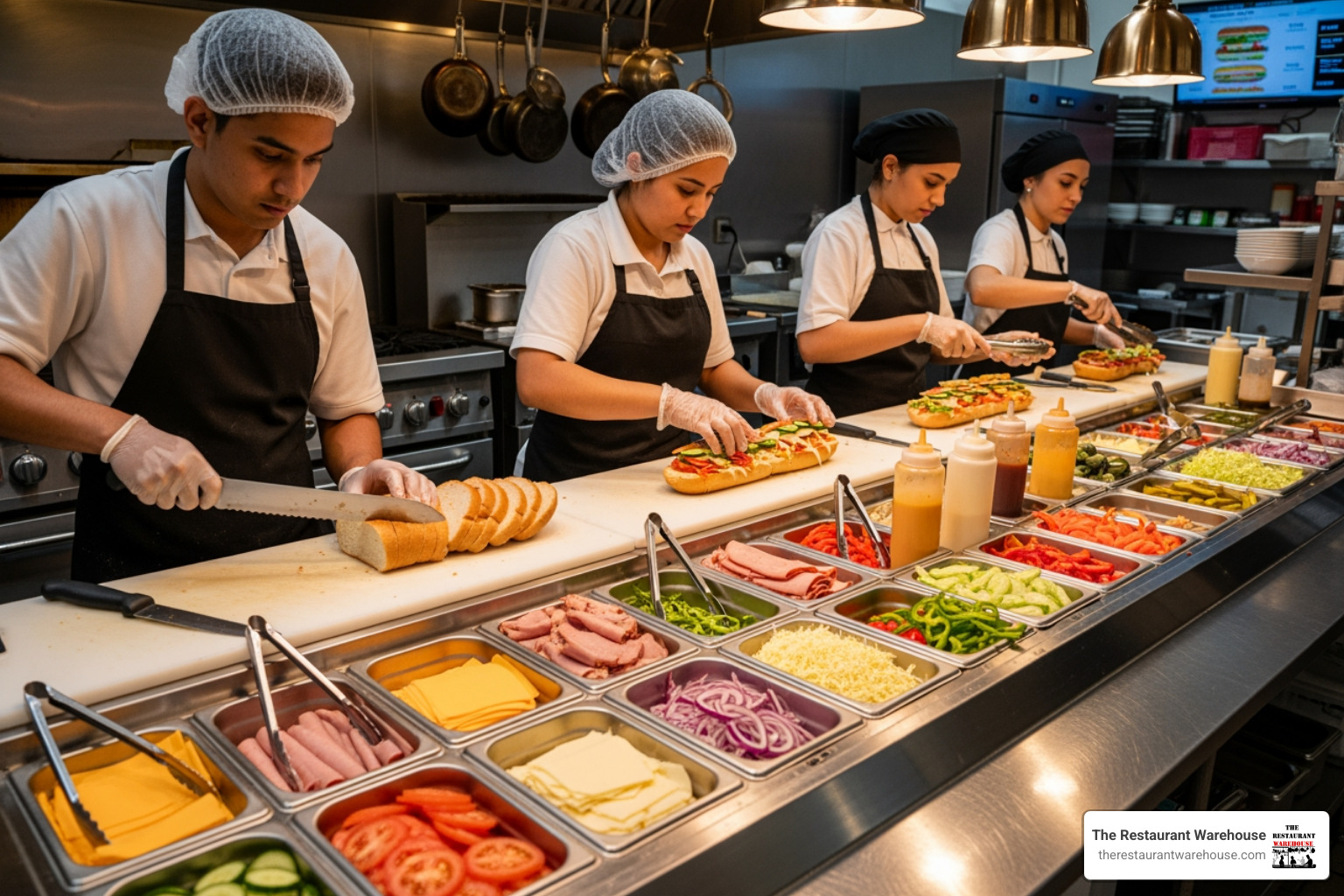
Whether you run a small deli or a high-volume sandwich shop, there's a prep table designed for you.
Standard Top vs. Mega Top Tables
The main difference between prep tables is the top configuration: standard or mega top. Both have a refrigerated rail and a cutting board, but they differ in ingredient capacity.
A standard top table has a single row of ingredient pans, perfect for focused menus or smaller spaces. It's a compact, efficient solution for keeping essential ingredients accessible—ideal if you mostly serve a core lineup of sandwiches and only a few salads.
Mega top tables offer increased pan capacity, often with an additional row of pans. This allows for a wider variety of toppings, making them ideal for extensive menus or high-volume custom orders. A mega top is an all-in-one solution for complex sandwich, salad, and bowl prep, especially in build-your-own concepts.
| Feature | Standard Top Prep Table | Mega Top Prep Table |
|---|---|---|
| Pan Capacity | Single row of ingredient pans (e.g., 8–15 x 1/6 size) | Double row of ingredient pans (e.g., 18–30 x 1/6 size) |
| Ingredient Storage | Good for essential, frequently used ingredients | Excellent for wide variety, high volume, and diverse menus |
| Footprint | More compact, suitable for smaller kitchens | Larger footprint, ideal for busy, larger operations |
| Ideal Use Case | Delis with focused menus, smaller sandwich shops | High-volume shops, build-your-own lines, and extensive cold prep |
When choosing between standard and mega top, consider:
- Your current and future menu.
- How many toppings guests can choose from.
- Whether you plan to add additional lines like grain bowls, wraps, or cold appetizers.
Doors vs. Drawers: Accessing Your Cold Storage
The cold storage base of a commercial sandwich prep table comes with either doors or drawers, each impacting workflow differently.
Models with doors offer excellent bulk storage. The adjustable shelving is perfect for larger containers of backup ingredients, bulk condiments, or covered hotel pans. This is ideal if you need to store items that don't fit neatly in standard food pans.
Units with drawers provide superior organization and ergonomic access. Drawers are often designed to hold food pans, allowing you to store backup ingredients directly below the rail. This reduces bending and reaching, improves ergonomics, and speeds up refills because staff can quickly swap out pans.
Here are some guidelines:
- Choose doors if you buy in large bulk containers or rely heavily on larger storage vessels.
- Choose drawers if your operation is highly pan-driven and you prioritize rapid, low-effort refilling of the top rail.
Specialized Configurations and Use Cases
Beyond standard and mega top configurations, there are additional variations that may suit specific operations:
- Narrow-depth units: Helpful for tight galley-style layouts where aisle space is limited.
- Extended cutting boards: Useful if you need more work surface for slicing, wrapping, and finishing sandwiches or salads.
- Different pan layouts: Some units support a mix of pan sizes (e.g., 1/3, 1/9) so you can allocate more space to high-use ingredients and less to low-use items.
Thinking about your specific use case will help you choose a prep table that feels custom-built for your line rather than forcing your workflow to adapt to the equipment.
For guidance tailored to your menu and floorplan, you can book a layout review with our team. We’ll walk through your space and help you pick a configuration that fits both your current needs and planned growth.
Maintenance, Safety, and Best Practices
A commercial sandwich prep table requires proper care to support longevity, safety, and performance. Consistent cleaning and smart operating practices safeguard customer health and operational efficiency.
Daily Cleaning and Sanitization
Daily cleaning is essential. At day's end, turn off the unit as directed, and remove all pans, cutting boards, and removable parts. Wash these with warm, soapy water, then rinse and sanitize according to health guidelines. Wipe stainless steel surfaces with food-safe, non-abrasive cleaner.
Clean door and drawer gaskets regularly to maintain tight seals. After cleaning, sanitize food-contact surfaces and air dry. This routine limits bacterial growth, avoids cross-contamination, and extends your table's life. Follow manufacturer instructions and local health requirements.
Weekly and Monthly Maintenance Tasks
Schedule routine maintenance:
- Weekly: Clean rail cavity, check gaskets for tears, inspect casters
- Monthly: Vacuum condenser coils to remove dust, verify temperatures with calibrated thermometer
Regular temperature verification supports strong food safety management. The USDA food safety resources provide extensive guidance on cold food storage and safe handling.
Best Practices for Commercial Sandwich Prep Workflow
Establishing smart workflow for your commercial sandwich prep station improves efficiency. "Mise en place" (everything in its place) is key. Prep, portion, and organize ingredients before service.
Practical workflow tips:
- Group similar ingredients together
- Place high-volume ingredients in accessible positions
- Use squeeze bottles for sauces
- Label and date backup pans for FIFO rotation
Ergonomic setup matters. Place frequently used ingredients closest to assemblers, position heavy items for easy reach. These practices create efficient, less stressful environments, leading to faster service.
A well-organized station combines hardware with the system you build around it. Clear labeling, setup diagrams, and line checklists ensure every shift starts ready.
For deeper integration of prep tables into your foodservice layout: https://therestaurantwarehouse.com/blogs/restaurant-equipment/restaurant-prep-table-guide.
For customized maintenance and workflow checklists, contact our team for recommendations. We'll help create simple, repeatable routines keeping your commercial sandwich prep station clean, efficient, and inspection-ready.
Frequently Asked Questions about Commercial Sandwich Prep Tables
Here, we address common inquiries about commercial sandwich prep tables to help you make an informed decision.
How do I choose the right size prep table for my kitchen?
To choose the right size, consider your menu complexity to determine pan capacity needs. A wider variety of toppings requires more pan slots. Next, measure your kitchen space, ensuring adequate clearance for airflow, door swing, and comfortable movement along the line.
Also think about your peak volume to see how many staff will use the station at once. A busy operation may need a longer table to accommodate multiple assemblers, while a smaller cafe may prefer a compact model that frees up space for other tasks.
What is the ideal temperature for a sandwich prep table?
The refrigerated sections of a commercial sandwich prep table should typically hold ingredients at or below 40°F (4°C). This aligns with commonly accepted guidelines for cold holding and helps reduce the risk of bacterial growth. Many health departments and food safety frameworks refer to similar cold-holding thresholds.
Modern prep tables feature digital controls to make it easier to monitor and maintain appropriate temperatures. It’s also wise to keep an independent thermometer inside the cabinet so you can periodically verify that the readout is accurate.
Can I use a sandwich prep table for salads or other cold items?
Yes. Commercial sandwich prep tables are versatile and ideal for assembling salads, wraps, grain bowls, and other cold dishes. Their design—with accessible ingredient pans, a cutting board, and refrigerated base storage—makes them suitable for any station that requires holding multiple cold ingredients in an organized manner.
Many operators successfully run hybrid lines where the same prep rail supports sandwiches during lunch and salads, bowls, or cold small plates during dinner.
What features should I look for in a commercial sandwich prep table?
Different models emphasize specific features. Consider:
- Energy-efficient refrigeration: Systems using R290 refrigerant and efficient compressors can help manage utility costs.
- Durable construction: Higher-grade stainless steel and reinforced components stand up to heavy daily use.
- Pan capacity and layout: Ensure the top rail layout supports your menu’s ingredient mix.
- Mobility: Locking casters make cleaning and reconfiguring your line much easier.
- Storage style: Decide whether doors or drawers best support your storage and refill strategy.
Focus on the features that matter most to your operation's efficiency, food safety practices, and long-term maintenance needs.
What factors influence the cost of a commercial sandwich prep table?
Several factors influence the cost of a new commercial sandwich prep table:
- Size and capacity: Larger units with more pan capacity and extended cutting boards typically cost more.
- Features: Digital controls, specialized pan layouts, and energy-efficient refrigerants all affect price.
- Material quality: Higher-grade stainless steel and more robust construction contribute to a higher price but offer greater durability.
- Configuration: Mega top units, drawer bases, or specialty sizes may carry different price points.
At The Restaurant Warehouse, we focus on providing competitive wholesale pricing for new equipment to give you strong value while still offering the core features operators need.
How do sandwich prep tables differ from other refrigerated units?
Commercial sandwich prep tables are unique because they integrate three functions:
- A refrigerated top rail for ingredient pans.
- A dedicated cutting board work surface for assembly.
- A refrigerated base for backup and bulk storage.
Unlike standard reach-in or undercounter refrigerators, prep tables are specifically designed for the rapid assembly of multi-ingredient items. That combination of organized storage and an integrated work surface makes them indispensable for efficient sandwich and salad preparation.
How can I get help choosing and installing the right table?
If you’re unsure which configuration fits your space and service style, our team can walk you through:
- Sizing based on your menu and expected volume.
- Choosing between doors and drawers.
- Planning where the table should sit in relation to other stations.
You can contact us to discuss your project, and we’ll help you select a commercial sandwich prep solution that supports your goals and budget.
Conclusion: Finding Your Ideal Prep Station
In foodservice, efficiency, food safety, and consistency are the pillars of success. A commercial sandwich prep table is a key investment that addresses all these aspects, making your operation more productive and hygienic. Throughout this guide, we’ve looked at how these units streamline workflow, boost efficiency, support temperature control, and help protect product quality.
From durable stainless steel construction and thoughtful ergonomics to energy-conscious refrigeration systems and flexible storage configurations, a well-chosen prep table is built to handle the day-in, day-out demands of a busy food business. Whether you run a neighborhood deli, a high-volume sandwich concept, a cafe, or a multi-unit operation, aligning your station design with your menu and service style pays off in faster ticket times and more consistent food.
Whether you choose a standard top or a mega top, doors or drawers, the right table becomes the cornerstone of a successful sandwich or salad line. It centralizes ingredients, organizes your staff's workspace, and leads to faster service and happier customers.
At The Restaurant Warehouse, we understand the pressures today’s operators face—tight labor markets, rising ingredients costs, and high guest expectations. Our goal is to help you find commercial sandwich prep equipment that delivers reliable performance and value.
If you’re ready to upgrade your station or plan a new build-out, you can:
- Browse our sandwich prep table collection to compare sizes, features, and layouts.
- Contact us for a personalized prep table recommendation based on your menu, space, and budget.
With the right prep table in place and a solid workflow around it, your team can focus on what matters most: serving fresh, delicious food quickly and consistently to every guest who walks through your door.
About The Author

Sean Kearney
Sean Kearney used to work at Amazon.com and started The Restaurant Warehouse. He has more than 10 years of experience in restaurant equipment and supplies. He graduated from the University of Washington in 1993. He earned a BA in business and marketing. He also played linebacker for the Huskies football team. He helps restaurants find equipment at a fair price and offers financing options. You can connect with Sean on LinkedIn or Facebook.
Leave a comment