

The Ultimate Guide to Restaurant Furniture
Choosing the right restaurant furniture shapes guest comfort, table turn times, and how long your seating, dining tables, and barstools survive in a high-traffic commercial space. A residential chair is engineered to be sat in twice a day by the same person. A commercial restaurant chair must survive 15 different people of varying weights sitting in it day in and day out for years. That is not a decor choice; it is an engineering requirement. This 2026 buyer's guide walks operators through the dimensions, materials, weight ratings, price tiers, and supplier strategy used by independent restaurants, bars, cafes, and hospitality groups.
Key Takeaways
- Standard dining table height is 29 to 30 inches; bar tables are 40 to 42 inches. Match table height to restaurant dining chairs (17 to 18 inch seat) or bar stools (29 to 30 inch seat).
- Allow 24 to 30 inches between tables and 36 to 48 inches for main walkways so guests and staff move freely.
- Commercial-grade chairs are rated 250 to 500 lbs static weight. Look for ANSI/BIFMA testing, kiln-dried hardwood or fully welded steel frames, and corner-block reinforcement.
- Budget realistically: chairs $50 to $150, barstools $75 to $200+, tables $185 to $500, booths $284 to $456. A new restaurant build typically spends $100,000 to $300,000 on furniture and equipment together.
- Order 10 to 20 percent extra seating above max capacity to cover damage, busy nights, and replacements without shutting down service.
- Vet suppliers for commercial certification, lead times, warranty, and replacement parts. Restaurant Warehouse ships commercial-grade dining sets, bar furniture, and chairs with the specs operators actually need.
Quick Reference: Restaurant Furniture Specs and Pricing
Standard Heights and Clearances
- Dining table height: 29 to 30 inches
- Counter table height: 34 to 36 inches
- Bar table height: 40 to 42 inches (extra-tall 48 inches)
- Dining chair seat height: 17 to 18 inches
- Counter stool seat height: 24 to 26 inches
- Bar stool seat height: 29 to 30 inches (extra-tall 34 to 36 inches)
- Gap from stool seat to tabletop: 10 to 12 inches
- Space between tables (table edge to table edge): 24 to 30 inches
- Clearance between chair backs of adjacent tables: minimum 18 inches
- Primary path / main walkway: 36 to 48 inches
- Tabletop width per guest: 24 to 30 inches wide, 12 to 18 inches deep
Commercial Price Tiers (2026)
- Restaurant dining chairs: $50 to $150 per chair (commercial-grade up to $310 for premium cross-back and wood-frame styles)
- Wood chairs (X-back, cross-back, cherry): Budget under $75, mid-range $75 to $150, premium $150+
- Metal chairs: Budget under $100, mid-range $100 to $250, premium $250+ (range $25 to $300+)
- Cafe chairs (commercial-grade): $40 to $350+ per unit
- Bar and counter stools: $75 to $200+ per stool ($101 to $114 average)
- Restaurant tables (top + base): $100 to $500+ ($185 to $224 average)
- Booths and banquettes: $284 to $456 per booth section
- Leather loveseats and lounge seating: Budget under $800, mid $800 to $1,500, premium $1,500+ (commercial models from $348 budget to $8,269 luxury)
- Drafting stools (back-of-house): Budget $100 to $300, mid $300 to $600, premium $600+
- Total new-restaurant furniture and equipment budget: $100,000 to $300,000
Commercial Weight Ratings and Construction
- Static weight capacity (commercial chairs): 250 to 500 lbs (150 to 250 kg)
- Cross-back and wood-frame commercial chairs: rated up to 500 lbs
- Outdoor Adirondack chairs: 300 to 400 lbs (cedar, teak, poly lumber)
- Construction standards: ANSI/BIFMA tested, kiln-dried hardwood frames, mortise and tenon joinery or tongue-and-groove joinery, corner-block reinforcement, fully welded cold-rolled steel frames, powder-coated finishes for scratch and rust resistance, heavy-duty L brackets, high-density foam cushioning
- Recommended hardwoods: Beech, oak, ash, maple, elm, rubberwood, cherry
- Stackability: Many commercial wood and metal chairs stack 6 to 8 high for off-hours storage
- Outdoor fabric: Solution-dyed acrylic such as Sunbrella for fade, mildew, and UV resistance
- Spare inventory buffer: 2 to 5 percent of total chair count for daily damage; 10 to 20 percent over peak capacity for surge nights and events
Why Restaurant Furniture is the Foundation of Your Dining Experience
Restaurant furniture is more than just tables and chairs - it's the foundation of your guest experience, brand identity, and operational success. From the moment a customer walks through your door, your furniture communicates your concept, sets expectations, and directly impacts comfort and satisfaction. The right pieces create atmosphere and tell your brand story while supporting your operational needs.
Key factors when choosing restaurant furniture:
- Durability: Commercial-grade construction with reinforced joinery and high-traffic materials.
- Style: Match furniture to your concept, whether it's modern, industrial, classic, or rustic.
- Space Utilization: Maximize seating capacity while maintaining a comfortable flow for guests and staff.
- Budget: Balance upfront costs with long-term value and replacement frequency.
Your furniture selection affects everything from seating capacity to maintenance costs. For example, booths can increase seating capacity by up to 30% compared to traditional tables and chairs. Materials matter, too - commercial-grade upholstery tested to 40,000+ double rubs will outlast residential alternatives by years in a busy dining environment. Smart furniture choices are one of the most strategic investments you can make for your establishment's success.
The Core Types of Commercial Restaurant Furniture
When furnishing your restaurant, understanding the different categories of restaurant furniture helps you make smarter decisions. Each piece serves a specific purpose, from welcoming guests to supporting your staff through busy rushes.
Essential Restaurant Seating
Seating is where your guests spend most of their time, making it critical to get right. Restaurant chairs are the backbone of your dining room, available in styles from classic wood ladder-backs to sleek metal designs. When choosing, consider more than appearance: Are they stackable for events? Are they light enough for staff to move? Most importantly, are they built with commercial-grade construction, including reinforced joinery to withstand daily use?
Bar stools maximize vertical space at bars and high-top tables, creating a casual, social atmosphere. You can find swivel stools, backless options for a clean look, or upholstered versions for extended comfort.
For a serious capacity boost, booths and banquettes are a powerful tool. They can increase seating by up to 30% over table-and-chair setups. Booths also create intimate, semi-private spaces that improve the guest experience. Available in various configurations (single, double, L-shape, U-shape), they can fit nearly any layout. High-back booths offer even more privacy and help reduce noise levels in a busy dining room.
Finally, don't forget booster seats and high chairs. Providing safe, sturdy, and easy-to-clean options shows families they are welcome, significantly expanding your customer base.
Commercial restaurant chair styles operators specify most:
- Cross-back and X-back chairs: Solid elm, beechwood, or rubberwood with mortise and tenon joinery and corner blocks. Commercial-rated to 500 lbs static weight. Price range $50 to $310 depending on wood and finish.
- Ladder back, window back, and X back metal chairs: Fully welded cold-rolled steel with powder-coated finishes for scratch and rust resistance. Stackable up to 8 high. Available in black, silver, and custom colors.
- Wood dining chairs (beech, oak, ash, cherry): ANSI/BIFMA tested with tongue-and-groove joinery and corner-block reinforcement. Cherry darkens to a deep reddish-brown patina over time.
- Cafe and bistro chairs: $40 to $350+ per unit, often stackable, ideal for small-footprint cafes, coffee shops, and bakeries.
- Leather and faux-leather loveseats and lounge seating: Kiln-dried hardwood frames with high-density foam cushioning. Pricing from $348 (budget) to $8,269 (luxury stainless-steel frame).
- Specialty function chairs: Bariatric seating, chairs with built-in power outlets for events, and bench seating for booth-style layouts.
Restaurant Tables and Bases
Your tables are where the dining experience unfolds. Table tops come in a variety of materials. Laminate offers durability and easy cleaning at an affordable price. Solid wood brings warmth and timeless character. For outdoor spaces, materials like aluminum and composite resist weather and UV damage. We stock tops in round, square, and rectangular shapes, many of which are reversible to give you two looks in one.
A beautiful top is useless without a stable table base. We carry bases in cast iron, aluminum, and steel with various finishes. Most feature adjustable floor glides to eliminate wobbling on uneven floors - a feature your servers will appreciate. For flexible spaces, folding bases make reconfiguration simple.
To simplify purchasing, our complete table sets pair durable table tops with complementary bases and sometimes matching chairs, ensuring a coordinated look. When choosing, consider the differences between indoor and outdoor tables. Our outdoor collection features weather-resistant materials engineered to handle sun, rain, and temperature changes, protecting your investment season after season.
Ready to design your perfect dining space? Contact us today to discuss your specific needs and get expert guidance on selecting the right furniture mix for your restaurant.
Commercial restaurant table dimensions and pricing:
- Dining tables: 29 to 30 inches tall, $185 to $224 average ($100 to $500+ range for premium tops and cast-iron bases)
- Counter tables: 34 to 36 inches tall - bridges the gap between dining and bar height for hybrid bar-top seating
- Bar and high-top tables: 40 to 42 inches tall (extra-tall pub format 48 inches) - paired with 29 to 30 inch bar table bases and matching barstools
- Tabletop space per guest: 24 to 30 inches of width, 12 to 18 inches of depth - this is what separates a comfortable two-top from a cramped one
- Common round sizes: 24-inch (2 guests), 30-inch (2 to 3 guests), 36-inch (4 guests), 48-inch round bar height (5 to 6 guests)
- Common square sizes: 24x24 (2 guests), 30x30 (2 to 4 guests), 36x36 (4 guests)
- Spacing between tables: 24 to 30 inches edge-to-edge for primary path, minimum 18 inches between chair backs of adjacent tables
Specialty and Functional Furniture
Beyond the basics, other pieces of restaurant furniture complete your space and support smooth operations.
- Host Stands: This is your first impression. A good host stand is both aesthetic and practical, with storage for menus and reservation systems.
- Wait & Bussing Stations: These behind-the-scenes workhorses give staff a place to organize orders and clear tables efficiently, keeping the dining room clean and service flowing.
- Outdoor Patio Furniture: An inviting al fresco space can significantly boost your bottom line. Our commercial outdoor collection is built to withstand the elements year after year.
- Umbrellas and Bases: Essential for outdoor comfort, these provide shade and weather protection, ensuring your patio is as comfortable as your dining room.
- Partitions and Dividers: Use these to create distinct dining zones, manage traffic flow, improve acoustics, and add visual interest to your layout.
Specialty furniture and back-of-house seating:
- Booths and banquettes: $284 to $456 per section. Kiln-dried hardwood frames with high-density commercial foam. Booth seating maximizes guests-per-square-foot vs free-standing chair-and-table layouts.
- Drafting stools for back-of-house and pass-line work: 3+ feet tall (vs 1.5 to 2 feet for standard office chairs). Polyurethane or vinyl seats are non-porous and wipe clean for kitchen and prep environments. Heavy-duty steel or aluminum frames. Budget $100 to $300, mid-range $300 to $600, premium $600+.
- Outdoor and patio furniture: Adirondack chairs (35 to 38 inches tall, 30 inches wide, 300 to 400 lb capacity) start under $100 in plastic and run $200 to $600+ for cedar, teak, or poly-lumber commercial models. Use solution-dyed acrylic fabrics like Sunbrella for cushions to resist fade, mildew, and UV damage.
- Bar table bases and counter bases: Cast-iron, stainless, and chrome bases for round and rectangular tops. Match the base to expected table weight (heavier tops need wider footprints to prevent tipping).
- Furniture financing for new and expanding restaurants: Terms commonly run 12 to 72 months. Lower credit profiles may require 10 to 25 percent down. Some lenders offer 1 to 3 month deferred-payment kickoff and approval in 24 to 48 hours. Lease options include $1 Buyout and Fair Market Value (FMV) at term end.
Materials and Durability: Choosing Furniture That Lasts
In a restaurant, furniture endures constant use. Spills, scrapes, and daily cleaning take a toll, which is why selecting the right materials for your restaurant furniture is a critical business decision, not just a stylistic one. The difference between residential and commercial-grade furniture becomes apparent within months.
At The Restaurant Warehouse, we focus exclusively on commercial-grade standards. This means reinforced joinery like mortise-and-tenon joints, scratch-resistant finishes, and high-density foam that won't flatten after a few months. A key specification is the upholstery double-rub count, which measures wear resistance. While residential furniture may be rated for 15,000 double rubs, commercial pieces should withstand 40,000+ to ensure longevity.
Wood Furniture: Classic and Versatile
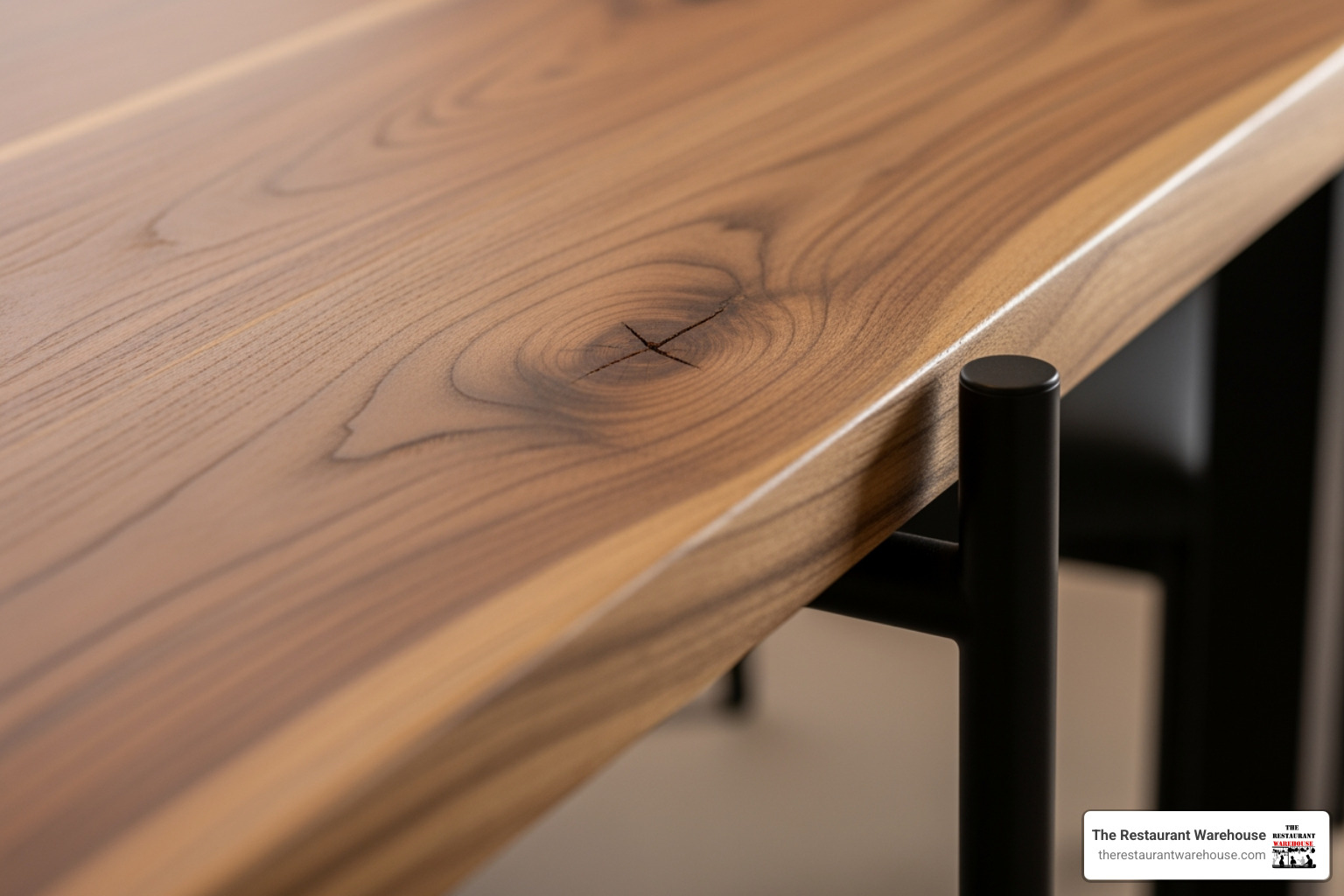
Wood brings a warmth and character that is hard to replicate. Its timeless appeal makes a solid wood table an anchor for any dining room, and it's highly customizable with various stains and finishes. We use durable hardwoods like Oak, Beech, and Walnut for their strength. However, wood is susceptible to scratches and dents, and moisture can be a concern. That's why proper finishing is crucial for commercial use. A well-sealed wood surface will resist spills and wear far better, ensuring it serves you well for years with regular maintenance.
Metal Furniture: Strong and Stylish
Metal restaurant furniture delivers exceptional durability with clean, contemporary aesthetics perfect for modern and industrial designs. The strength of metal is its key advantage; steel and aluminum frames resist loosening and are remarkably easy to clean. Steel offers maximum strength for indoor use, while lighter aluminum is a popular choice for outdoor furniture due to its natural corrosion resistance.
Powder-coating is a standard finish on quality metal furniture. This process creates a hard shell that resists scratches and chipping far better than regular paint. It's available in various colors to match your design concept. While metal can sometimes feel cold, it pairs well with wood tabletops or upholstered seats to add warmth and comfort.
Upholstery, Laminates, and Synthetics
Modern restaurant furniture often incorporates other materials for their practical advantages.
Vinyl upholstery is a hero in restaurant seating. It's highly stain-resistant, easy to sanitize, and, when specified with a high double-rub count, extremely durable. Commercial-grade fabrics are also available for a more sophisticated feel, and we offer customization options to match your brand perfectly.
Laminate and melamine table tops are practical workhorses. They can mimic wood or stone while being scratch-resistant, heat-resistant, and easy to clean. Many are reversible, offering two looks in one piece.
For outdoor dining, resin and polymer furniture is a game-changer. These materials are lightweight, durable, and resistant to UV fading and moisture. They won't rust or rot, and many pieces are stackable for easy storage.
Contact us today to discuss which materials will work best for your specific concept and traffic patterns. Our team can help you create a furniture package that looks great while standing up to the demands of your operation.
Design, Ambiance, and Space: The Art of Restaurant Layout
Your restaurant furniture does more than provide a place to sit - it shapes the atmosphere, influences guest movement, and defines the overall experience. Think of your furniture as the stage set for your restaurant's story.
Matching Furniture Style to Your Restaurant's Theme
Your furniture is one of the first things guests notice, and it should be a natural extension of your concept.
- Modern Style: Characterized by clean lines, minimalist forms, and neutral tones. Think sleek metal frames paired with smooth wood or glass surfaces for a sophisticated, contemporary feel.
- Industrial Style: Celebrates raw materials like exposed metal and distressed wood. This utilitarian approach projects authenticity and an urban edge, perfect for gastropubs and craft breweries.
- Classic/Traditional Style: Uses ornate details, dark woods, and plush upholstery to convey elegance and timelessness. This style is a natural fit for fine dining establishments.
- Rustic/Farmhouse Style: Brings warmth and comfort with natural woods, simple forms, and distressed finishes. It creates a cozy, inviting atmosphere ideal for farm-to-table concepts.
When your furniture aligns with your theme, it builds trust and reinforces your brand identity.
How to Maximize Seating Capacity and Flow with your restaurant furniture
Arranging furniture is a puzzle of maximizing paying guests while ensuring comfort and mobility. Booths are a secret weapon, potentially increasing seating capacity by up to 30% compared to chairs. They are space-efficient and offer a sense of privacy that many guests prefer.
In tight spaces, slim-profile chairs can make a real difference by taking up less floor space. For flexibility, stackable seating is invaluable for private events or reconfiguring your dining room. Bar height seating adds visual interest and provides an informal option that can encourage quicker turnover.
Creating clear traffic paths is critical. Aisles must be wide enough for servers with trays and for guests to move comfortably. Poor flow frustrates everyone and can slow down service. Planning for accessibility is also essential. Following the ADA Standards for accessible seating ensures your restaurant welcomes every guest and saves you from costly renovations later. Adhering to local fire codes and minimum spacing requirements is not just a suggestion - it's a rule that protects your guests and your business.
Enhancing the Guest Experience with your restaurant furniture
Your restaurant furniture exists to make guests comfortable and happy. Ergonomics and comfort are key; a guest who can sit comfortably without fidgeting is more likely to relax, stay longer, and order more. Pay attention to seat height and depth to ensure they match your tables appropriately.
High-back booths are excellent for creating private, intimate spaces while also absorbing sound and reducing noise levels. You can also use furniture to create distinct zones within your restaurant - a cozy lounge area, a vibrant bar, and a more formal dining section. This caters to different guest preferences and occasions within a single space.
Explore our complete restaurant furniture packages to see how we've combined durable, stylish pieces that work together seamlessly. Contact us today to discuss how we can help you create the perfect dining environment.
Sourcing Commercial Restaurant Furniture: Supplier Strategy
Restaurant furniture is a long-term investment. The right supplier matters as much as the chairs themselves. Operators who treat furniture sourcing strategically save money, reduce downtime, and avoid the trap of replacing residential-grade chairs every 12 months.
How to Vet a Commercial Furniture Supplier
Before placing a bulk order, confirm the supplier meets these standards:
- Commercial certification: ANSI/BIFMA testing on chairs and tables, contract-grade construction documentation, weight-capacity ratings (250 to 500 lbs static weight minimum on chairs).
- Materials transparency: Kiln-dried hardwood for wood frames, fully welded cold-rolled steel for metal frames, high-density foam (not residential bedding foam) for upholstery, granite or solid wood tops (not particleboard veneer) for tables.
- Lead times and stocking: Standard models in stock with 1 to 3 week shipping; custom orders 6 to 12 weeks. Avoid suppliers who can't commit to lead times in writing.
- Warranty and replacement parts: Minimum one-year commercial warranty on frames and joinery. Replacement glides, casters, upholstery panels, and fasteners available without reordering entire pieces.
- Spare inventory recommendation: Order 10 to 20 percent extra above your peak seating capacity so you can rotate damaged pieces out without closing tables. Keep an additional 2 to 5 percent of chairs in storage for daily replacements.
- Bulk and wholesale pricing: Volume discounts kick in around 10 to 25 chairs or 5 to 10 table sets. Ask for tiered quotes.
- Custom-finish options: Stain matching, powder-coat colors, upholstery COM (customer's own material) programs for branded fabrics.
Why Restaurant Warehouse
Restaurant Warehouse is a Seattle-based commercial restaurant equipment and furniture supplier serving independent restaurants, bars, cafes, food trucks, hotels, and hospitality groups nationwide. Owner Sean Kearney has spent two decades sourcing commercial-grade equipment for operators who need furniture that holds up to actual restaurant service - not residential pieces dressed up with marketing language.
The furniture catalog covers restaurant dining tables, commercial dining chairs, barstools and counter stools, dining table and barstool sets, bar table bases, bar table and stool sets, and full dining sets from commercial brands. Every product carries a static-weight rating, commercial joinery spec, and lead-time commitment in writing.
Call Sean directly at (206) 419-5801 or email therestaurantwarehouse@gmail.com for bulk-quote pricing, custom-finish options, and lead-time confirmation before you commit a furniture order. Quote-by-quote pricing on bulk orders typically beats the published price on 10+ chair or 5+ table-set quantities.
Engineering and Compliance Specs Operators Should Demand
Commercial restaurant furniture is graded on engineering specs that never appear on residential pieces. These are the technical thresholds to ask suppliers about before placing a bulk order.
Steel Gauge Thickness for Metal Frames
Metal frame thickness is measured in gauge. Lower gauge means thicker, stronger steel.
- 18-gauge steel: approximately 0.048 inches thick. Standard commercial-grade thickness for dining chairs and standard barstools.
- 16-gauge steel: approximately 0.060 inches thick. Preferred for high-volume fast-food, quick-service, and 24-hour environments where chairs see constant use.
- Frame construction: Look for fully welded frames rather than bolt-together kits. Bolt joints loosen from guest "racking" motion (sliding the chair while seated) within months.
Welded Barstool Footrest as a Structural Brace
A 360-degree welded footrest on commercial barstools is not just for guest comfort. It acts as a structural brace that prevents the legs from splaying outward over time. Bolt-on footrests fail this test - they loosen and create leg splay, which leads to wobble, tipping risk, and frame failure within the first year.
Wood Moisture Content (Kiln-Drying)
Commercial hardwood frames and tabletops must be kiln-dried to a moisture content of 6 to 8 percent. This is the threshold that prevents wood from warping, cracking, or loosening at the joints when restaurant HVAC systems shift between heating and cooling seasons. Ask suppliers for the kiln-drying spec in writing - it is the single best predictor of whether wood furniture will last five years or fail in one.
Wyzenbeek Double-Rub Test for Upholstery
Fabric durability for commercial upholstery is measured by the Wyzenbeek test, which runs cotton duck fabric over the test material until it fails. The number reported is the count of double rubs before failure.
- Residential grade: 15,000 double rubs - not approved for commercial use.
- Commercial grade: 30,000+ double rubs - minimum standard for dining rooms.
- Heavy duty: 100,000+ double rubs - recommended for bars, 24-hour diners, fast-casual, and entertainment venues.
Vinyl upholstery on commercial booths and chairs typically tests at 50,000+ double rubs and is the easiest material to clean and disinfect.
Fire Safety Ratings (NFPA 701 and CAL 117)
Most commercial restaurant insurance policies require upholstered furniture to meet NFPA 701 or California Technical Bulletin 117 (CAL 117) fire safety ratings. Residential furniture rarely meets these ratings. Putting residential upholstered pieces in a restaurant can void insurance coverage and trigger fire-marshal compliance citations.
ADA Compliance for Restaurant Seating
Under the 2010 ADA Standards for Accessible Design, at least 5 percent of your restaurant seating must be accessible to wheelchair users.
- Table top height: between 28 and 34 inches from the finished floor.
- Knee clearance: minimum 27 inches from the floor to the bottom of the table apron.
- Knee depth: minimum 19 inches of clear depth under the table for a wheelchair to roll in.
- Main traffic aisle width: minimum 36 inches of clear width (the ADA standard, also a fire code minimum).
- Distribution: Accessible tables should be spread across the dining area, not clustered in one zone.
Table Base Sizing to Prevent Wobble and Tipping
The most common cause of a "wobbly table" in a restaurant is an undersized or under-weight table base.
- 2-top (24x24 or 30x30 inch top): minimum 22 x 22 inch base.
- 4-top (30x48 inch top): minimum 24 x 30 inch base, or two T-style bases positioned to prevent tipping.
- Base weight rule: the base should weigh at least 25 percent of the total table weight. For stone, granite, or heavy hardwood tops, cast-iron bases are required - lighter aluminum or chrome bases will tip.
Seating Type Comparison: Footprint, Weight Capacity, and Use Case
| Seating Type | Average Footprint (sq ft) | Typical Weight Capacity | Best Use Case |
|---|---|---|---|
| Side Chair | 1.5 to 2.0 | 250 to 350 lbs | Standard dining, high turnover |
| Armchair | 2.5 to 3.0 | 300 to 400 lbs | Fine dining, long-stay lounges |
| Barstool | 1.2 to 1.5 | 250 to 350 lbs | Bar counters, communal tables |
| Double Booth | 12.0 to 14.0 | 800+ lbs total | Perimeter seating, families |
Material Comparison: Durability and Technical Advantage
| Material | Durability | Maintenance Level | Technical Advantage |
|---|---|---|---|
| 18-Gauge Steel | High | Low | Impact resistant, 350+ lb capacity |
| Solid Beech Hardwood | Medium to High | Medium | Reinforced joinery, classic aesthetic |
| High-Pressure Laminate | High | Very Low | Heat, scratch, and chemical resistant tabletops |
| Commercial Vinyl Upholstery | Medium | Low | Easy to clean, 50,000+ Wyzenbeek rub count |
Indoor vs Outdoor Material Suitability
Using indoor-rated furniture outside, even under a cover, will void most warranties and trigger rapid structural failure. Match the material to the environment.
| Material | Outdoor Suitability | Common Issues | Maintenance Requirement |
|---|---|---|---|
| Chrome Steel | No | Immediate rusting from humidity | Indoor use only |
| Powder-Coated Aluminum | Excellent | Minimal fading over years | Seasonal power wash |
| Synthetic Teak (poly lumber) | Excellent | UV fading over years | Mild soap and water |
| Natural Teak | High | Turns silver-gray without treatment | Annual oiling to maintain color |
| Solution-Dyed Acrylic Fabric (Sunbrella) | Excellent | Minimal fade, mildew, or UV damage | Spot clean with mild soap |
Preventative Maintenance Protocol for Commercial Furniture
Furniture longevity is directly tied to a preventative maintenance schedule. Skipping these steps is the difference between a 10-year and a 2-year service life.
- Quarterly hardware inspection. On wood furniture, use a 4mm or 5mm hex key to tighten all carriage bolts and corner-block fasteners. On metal furniture, inspect welds for "weld fatigue" - tiny cracks in the powder coating near the joints that signal frame stress.
- Floor glide replacement every 6 to 12 months. Floor glides (the plastic, nylon, or felt feet on the bottom of each leg) are sacrificial parts. Once worn through, the metal or wood legs scrape and damage the flooring underneath. Stock replacement glides as standard inventory.
- Vinyl upholstery cleaning. Use a 1:10 dilution of mild soap to water. Never use bleach, ammonia, or solvent-based cleaners on vinyl - they strip the plasticizers from the material, causing the surface to crack and peel within months. Health-department-approved quaternary ammonium disinfectants are vinyl-safe at proper dilution.
- Wood top conditioning every 6 months. Apply a food-grade mineral oil or commercial wood wax to solid wood tabletops to maintain the moisture barrier and prevent drying or cracking.
- Bolt tightening on chairs monthly. Even on commercial chairs, monthly bolt and bracket checks catch loosening before it becomes structural failure. Document the inspection date on a maintenance log.
Frequently Asked Questions about Restaurant Furniture
We hear from restaurant owners every day who are trying to make smart choices about their furniture. Here are answers to some of the most common questions.
How do I maintain and clean my restaurant furniture?
Consistent, proper care is the key to making your restaurant furniture last. For wood pieces, use a soft cloth and a mild, non-abrasive cleaner; harsh chemicals can strip protective finishes. Metal furniture is more forgiving and can be wiped with a damp cloth, but you should regularly inspect the finish for scratches to prevent rust. For upholstery, vinyl can be cleaned with mild soap and water, while fabric may require specialized commercial-grade cleaners. Always check the manufacturer's care instructions to protect your investment and any warranties.
How much should I budget for restaurant furniture?
This is a common concern for new owners. A general rule of thumb is to allocate 10-15% of your total startup budget for restaurant furniture. The actual cost will depend on your choices. Materials make a huge difference - solid wood costs more than laminate but offers different benefits. Customization also adds to the cost but helps create a unique look.
Buying wholesale dramatically changes the equation. Our direct-from-manufacturer pricing means you can afford higher-quality, commercial-grade pieces while staying within your budget. The smartest approach is to prioritize durability over initial cost. A cheap residential chair may save you money today, but you'll likely replace it multiple times, costing you more in the long run.
What is the difference between commercial-grade and residential furniture?
This is perhaps the most critical question. The difference is about survival in a high-traffic environment. Commercial-grade restaurant furniture is engineered for public use. The construction is fundamentally different, featuring reinforced joints, fully welded steel or solid hardwood frames, and durable finishes. Commercial upholstery is tested to withstand 40,000+ double rubs, a measure of wear resistance, while residential fabrics may only be rated for 15,000.
Residential furniture is not built for restaurant use. A chair in your restaurant might seat 10-15 different guests daily, enduring constant movement and cleaning. Residential pieces will fail quickly under this stress. Choosing contract-grade furniture is an investment in reliability and safety that pays for itself through longevity.
Contact us today to discuss which commercial-grade options make the most sense for your concept and budget.
Why do my chair legs keep loosening?
This is typically caused by the "racking" motion of guests sliding the chair while seated. Commercial chairs need mortise and tenon joinery reinforced with steel corner blocks or L brackets. On metal chairs, fully welded frames hold up - bolt-together kits do not. Tighten all hardware monthly with a 4mm or 5mm hex key and replace stripped bolts immediately.
Can I use residential chairs if I reinforce them?
No. Residential furniture lacks the gauge thickness, joinery density, and material specifications required for commercial use. It also rarely meets NFPA 701 or CAL 117 fire safety ratings, which most commercial restaurant insurance policies require for upholstered pieces. Using residential furniture in a restaurant can void insurance coverage and trigger fire marshal citations.
How do I choose the right table base weight?
The base should weigh at least 25 percent of the total table weight to prevent tipping. For stone, granite, or heavy hardwood tops, cast-iron bases are non-negotiable - lighter aluminum or chrome bases will tip under the load. A 2-top (24x24 or 30x30) needs a minimum 22 x 22 inch base; a 4-top (30x48) needs a 24 x 30 inch base or two T-style bases.
What is the ideal clearance between tables?
Allow 24 to 30 inches between table edges so guests and staff can move. Maintain a minimum of 18 inches between chair backs of adjacent tables. The 2010 ADA standards require a minimum 36 inch clear width on main traffic aisles - this is also a fire code minimum in most jurisdictions.
Related Restaurant Furniture Guides
About The Author

Sean Kearney
Sean Kearney is the Founder of The Restaurant Warehouse, with 15 years of experience in the restaurant equipment industry and more than 30 years in ecommerce, beginning with Amazon.com. As an equipment distributor and supplier, Sean helps restaurant owners make confident purchasing decisions through clear pricing, practical guidance, and a more transparent online buying experience.
Connect with Sean on LinkedIn, Instagram, YouTube, or Facebook.