

From Shawarma to Panini: Finding Your Perfect Commercial Griller
Understanding the Commercial Griller Machine
Choosing the right commercial griller machine is a crucial step for any restaurant, deli, or catering business. These powerful appliances are vital for cooking a wide range of foods, from sizzling steaks and juicy burgers to crispy paninis and authentic shawarma. A good griller can significantly boost your menu and kitchen efficiency.
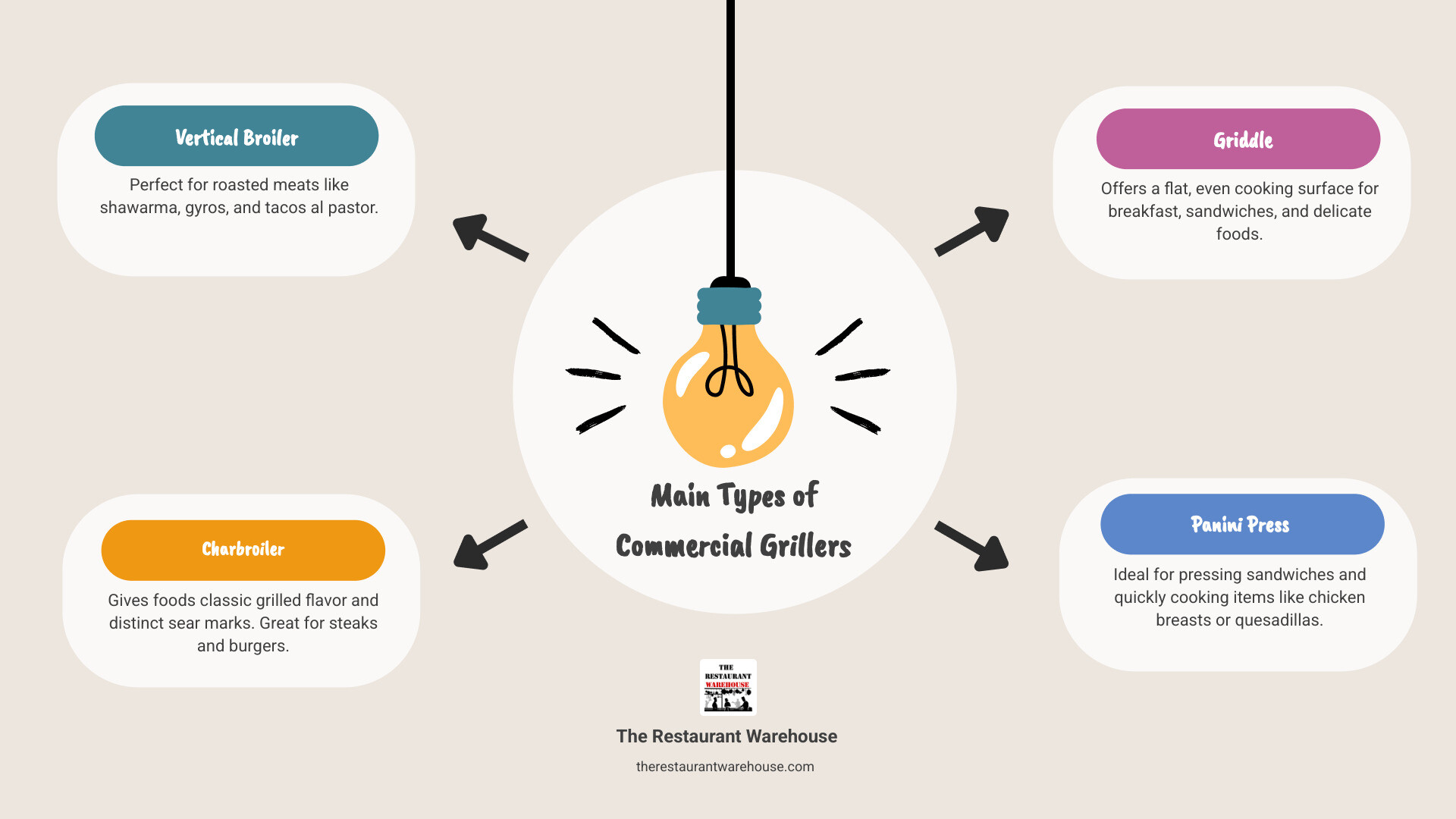
Commercial grillers come in many forms, each designed for specific cooking needs. The main types include:
- Vertical Broiler: Perfect for roasted meats like shawarma, gyros, and tacos al pastor.
- Charbroiler: Gives foods that classic grilled flavor and distinct sear marks.
- Griddle: Offers a flat, even cooking surface for breakfast items, sandwiches, and more.
- Panini Press: Ideal for pressing sandwiches and quickly cooking items.
Selecting the best griller depends on your menu, kitchen space, and volume. This guide will help you understand each type and pick the perfect fit for your operation.
Commercial griller machine terms to know:
- commercial cooking equipment suppliers
- heavy duty kitchen equipment
- ventless hood systems for restaurants
The Griller Lineup: Matching the Machine to Your Menu
This section explores the different types of commercial grillers, their ideal applications, and the delicious foods they can create.
Vertical Broilers: Shawarma, Gyros, and Tacos al Pastor
If your menu features Middle Eastern, Greek, or Mexican roasted meats, a vertical broiler—also known as a shawarma or gyro machine—is an essential commercial griller machine. These units excel at cooking large quantities of meat on a rotating spit, ensuring even roasting and a juicy, flavorful product.
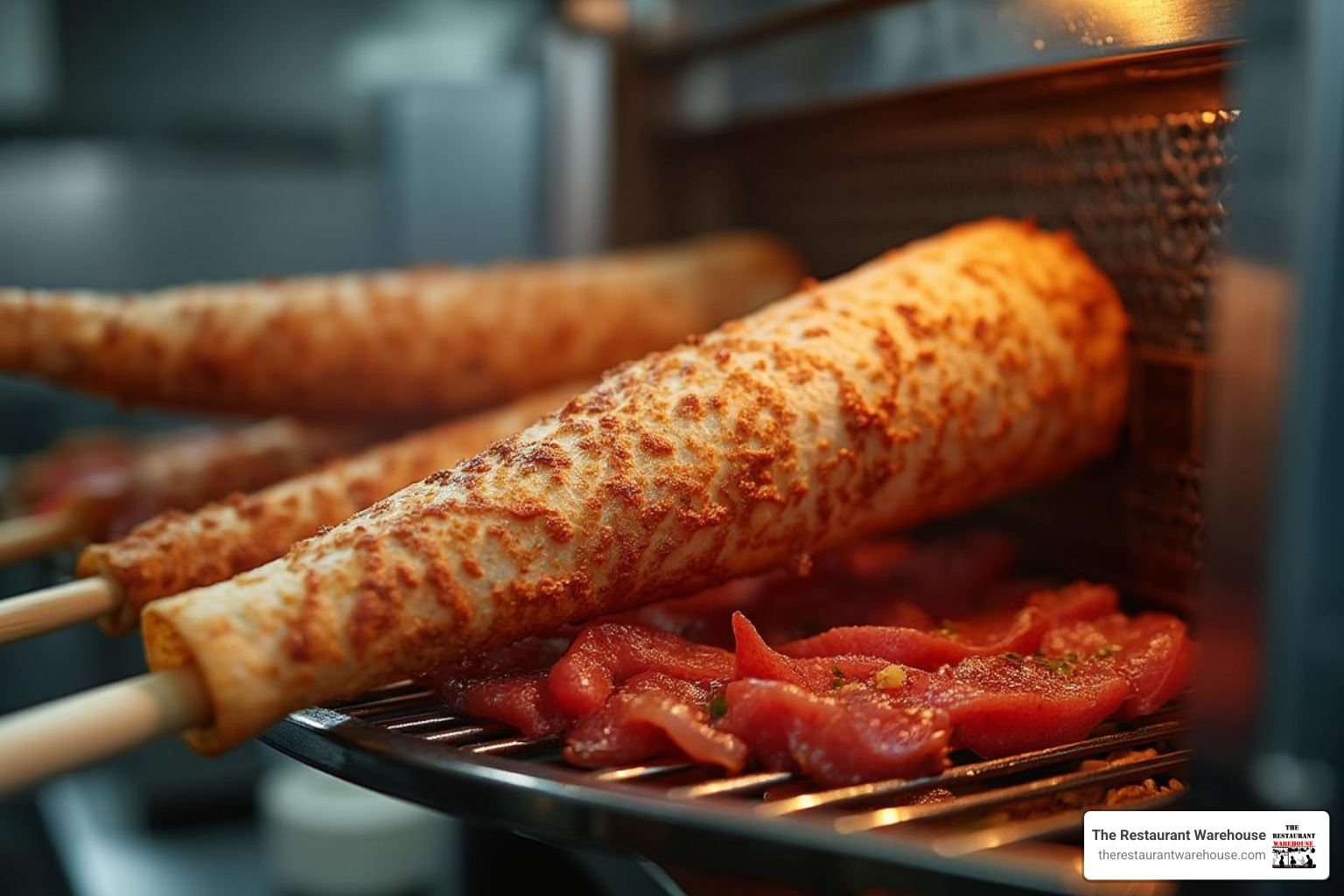
How they work: Meat is stacked on a vertical spit that rotates in front of a heat source, typically ceramic burners. As the outer layer cooks, it's shaved off for serving. This method creates a crispy exterior while keeping the inside tender. Advanced models may feature enclosed motors to prevent grease damage and maneuverable burners for precise heat control.
Ideal Applications and Food Types:
- Kebab shops and Middle Eastern restaurants: For traditional shawarma and doner kebab.
- Greek restaurants: Essential for preparing gyros.
- Mexican taquerias: For cooking tacos al pastor with signature caramelized pork.
These machines are built for high-capacity cooking, with some models handling up to 220 LBS of meat. They are constructed from durable materials like commercial-grade Stainless Steel 310 and meet safety certifications like UL and NSF/ANSI Standard 4. For very high-volume needs, dual vertical broilers are available, doubling the output.
Charbroilers: The Steakhouse Staple
For that quintessential grilled flavor and coveted sear marks, a charbroiler is the commercial griller machine of choice. This equipment is a cornerstone in steakhouses, pubs, and fine dining establishments.

How they work: Charbroilers use gas or electric heat to warm grates. When food is placed on the hot grates, drippings vaporize on heat deflectors or lava rocks below, infusing the food with a smoky aroma and creating classic grill marks. Radiant models use metal radiants for even heat, while lava rock models replicate cooking over coals. A third, increasingly popular option is the infrared charbroiler. Instead of heating the air, infrared burners use ceramic plates to generate intense, direct infrared radiation. This heat cooks food faster and at lower temperatures, locking in moisture for exceptionally juicy results. Infrared grills are known for their rapid preheating and recovery times, making them highly energy-efficient and ideal for high-volume kitchens that need to turn tables quickly. They excel at cooking thick cuts of steak and delicate fish, providing a powerful sear without drying out the product.
Ideal Applications and Food Types:
- Steakhouses: The primary tool for grilling steaks to perfection.
- Pubs and Casual Dining: Excellent for burgers, chicken breasts, and sausages.
- Fine Dining: Used for high-quality seafood and vegetables.
Commercial charbroilers come in various sizes, from compact countertop units to large built-in models. Remember to properly season a charbroiler before first use. For more details, explore our guide on commercial charbroilers.
Griddles & Flat-Top Grills: The All-Day Workhorse
The griddle, or flat-top grill, is one of the most versatile commercial griller machine options. Its expansive, even cooking surface makes it a workhorse for diverse menus.
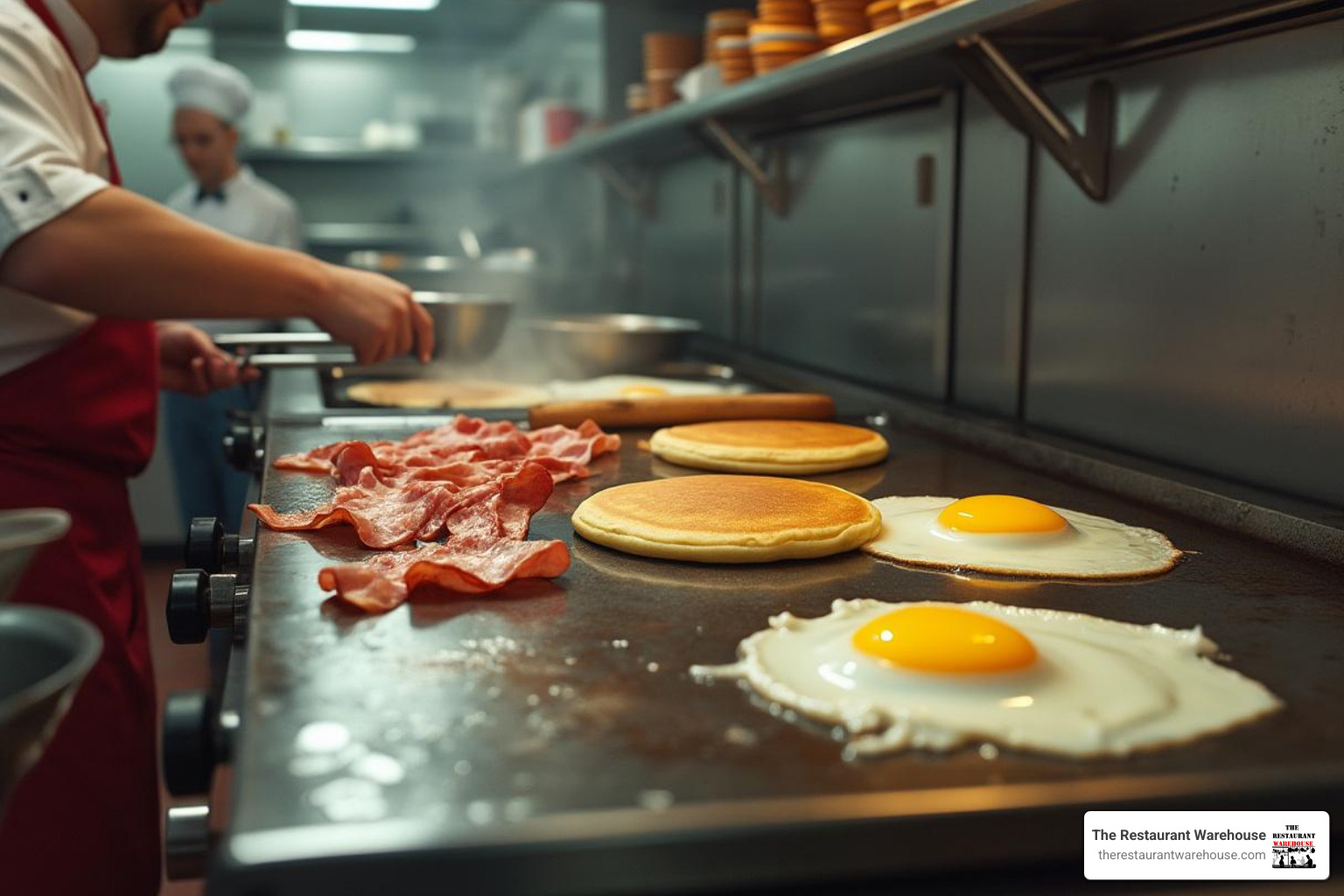
How they work: Griddles have a thick, flat metal plate (steel or cast iron) heated from below. The uniform heat distribution allows for cooking multiple items simultaneously. Thermostatic controls offer precision, while thicker plates (e.g., 1 inch) retain heat better for busy periods.
Ideal Applications and Food Types:
- Diners and Breakfast Spots: The go-to for pancakes, eggs, bacon, and sausage.
- Cafes and Sandwich Shops: Perfect for grilled cheese and quesadillas.
- Lunch and Dinner Establishments: Essential for burgers, cheesesteaks, and stir-fries.
These machines are available as countertop or floor units, powered by gas or electricity. We have a detailed gas flat top grill guide and an overview of commercial griddles to help you choose.
Panini & Contact Grills: Perfecting Sandwiches and More
For cafes, delis, and food trucks, a panini or contact grill is an indispensable commercial griller machine. These units are designed for speed and efficiency.
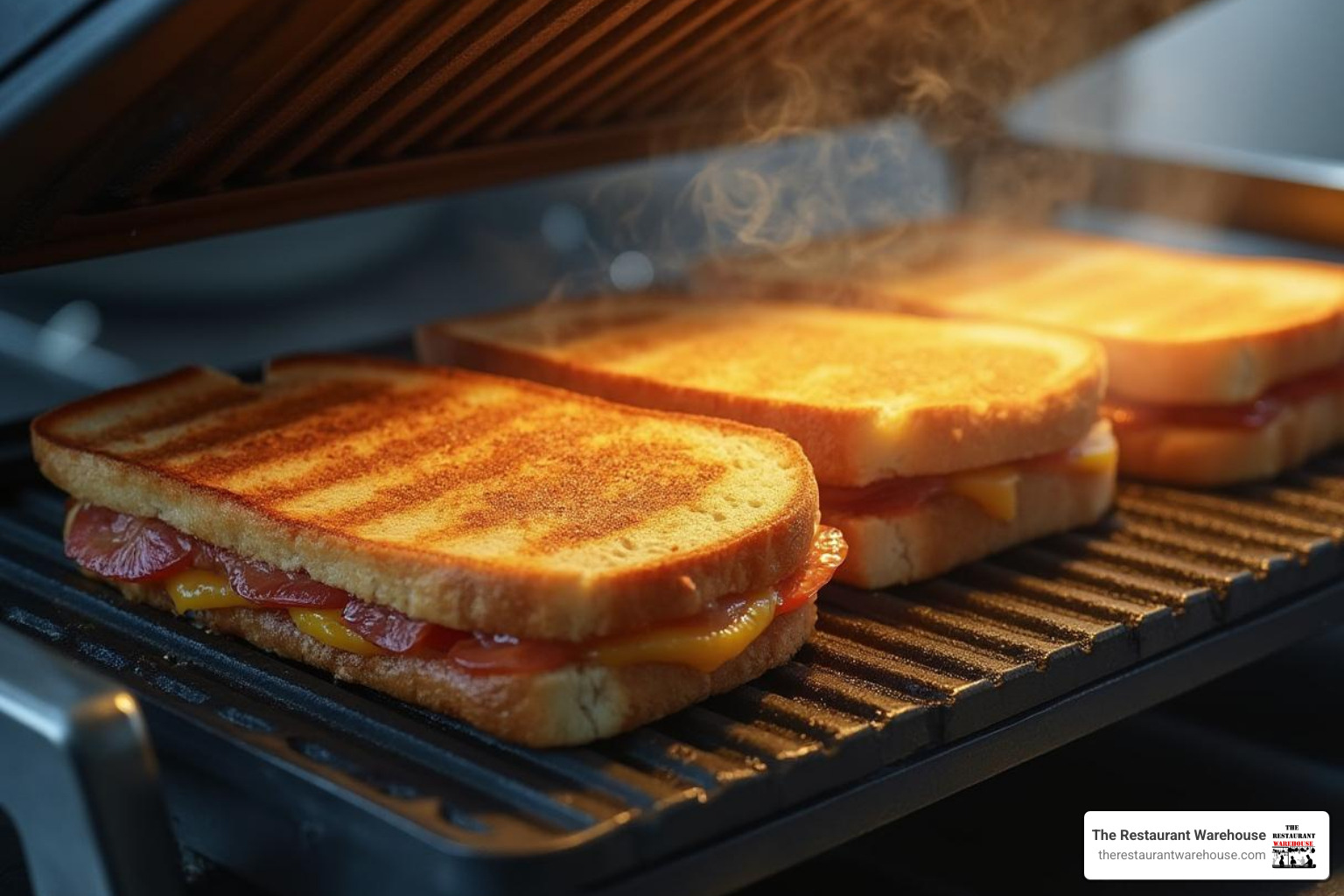
How they work: Panini presses use two heated plates to cook food from both sides at once, significantly speeding up cooking times. Plates can be grooved for grill marks or smooth for a uniform toast. They are typically made of cast iron or aluminum, often with non-stick surfaces. Precise temperature control (up to 300°C/572°F) adds versatility.
Ideal Applications and Food Types:
- Sandwich shops and delis: Paninis, grilled cheese, and other toasted sandwiches.
- Cafes: Quesadillas, wraps, and specialty grilled items.
- Food trucks and concession stands: Quick-cooking chicken breasts, fish fillets, and vegetables.
Commercial panini grills are built with stainless steel bodies and heat-resistant handles for durability. Features like removable oil trays make cleaning easy. For an in-depth look, check out our guide on commercial sandwich presses and panini grills.
Specialty & Automatic Grillers
Beyond the core types, specialty and automatic grillers are designed for niche, high-volume tasks.
Automatic Grillers: These machines can automatically grill items like satay or yakitori, producing up to 850 sticks per hour. The high heat and fast grilling time result in juicier, more tender products. They are ideal for catering or restaurants specializing in skewered items.
Roasted Lamb Machines: For large-format roasts, these specialized machines can cook multiple lambs at once, often over 3-4 hours. They can be gas-powered or wood-fired for distinct flavor profiles.
Salamander Broilers: Often mounted above a range or on a wall, salamander broilers are compact, high-powered overhead broilers. They use intense, direct heat from above, making them perfect for melting cheese on sandwiches or nachos, browning the top of a casserole, caramelizing sugar on a crème brûlée, or quickly finishing a steak. Their speed and versatility make them an invaluable tool in many kitchens for adding the final touch to a dish.
Clamshell Grills: A clamshell grill is essentially a heavy-duty, two-sided contact grill, often with a 'floating' top platen that adjusts to the thickness of the food. These are the workhorses of the fast-food industry, designed for high-volume, consistent cooking of items like burgers and chicken patties. By cooking from both sides simultaneously, they slash cooking times by up to 50%. Many models feature programmable controls and automatic platen lifts, ensuring every item is cooked to the exact same standard, reducing the need for constant staff attention.
Hot Dog Rollers: A staple for concession stands and quick-service spots, these commercial griller machine units cook hot dogs evenly on heated rollers. Learn more in our hot dog grill guide.
Choosing the Right Commercial Griller Machine for Your Kitchen
Now that you know the types of grillers, let's focus on the technical details. Making a smart investment means looking at construction, power, and safety to ensure performance and durability.
Construction Materials: Built to Last
The material of your commercial griller machine dictates its durability, performance, and ease of cleaning. Quality construction is key to longevity.
- Stainless Steel: The industry standard for commercial kitchens (grades 304, 310, 316). It's tough, resists rust and stains, and is easy to sanitize, making it ideal for the main body, splash guards, and grease trays.
- Cast Iron: A heavy-duty material used for griddle plates and panini presses. It offers excellent heat retention for consistent searing and cooking. It develops a natural non-stick surface over time but requires proper maintenance to prevent rust.
- Aluminum: Often used for panini press plates due to its fast heat-up time. While not as heavy-duty as cast iron, its quick heat transfer is perfect for fast cooking.
- Non-stick Surfaces: Applied over aluminum or cast iron plates, these surfaces simplify cooking and cleaning by preventing food from sticking and reducing the need for oil.
Combining these materials creates a commercial griller machine that performs well and withstands the rigors of a professional kitchen.
Heating Technology and Power Sources
A griller's heating technology and power source are critical to its performance, operating cost, and installation.
Good grillers are designed for even and fast heating, using specialized heating elements or well-placed burners to eliminate hot spots. This consistency saves time and improves food quality. Beyond the basic choice of gas or electric, specific heating technologies can dramatically impact your kitchen's output and efficiency.
Infrared Technology: Most commonly used in charbroilers, infrared technology offers a powerful alternative to traditional gas or electric radiants. Infrared burners generate intense electromagnetic waves that cook the food directly, rather than just heating the air around it. This results in dramatically faster pre-heat and cooking times, superior heat penetration, and better moisture retention in meats, leading to juicier products. This efficiency also translates to lower gas consumption compared to standard charbroilers, making them a cost-effective option for high-volume steakhouses and burger joints.
Induction Technology: Primarily found in electric griddles and cooktops, induction represents the pinnacle of efficiency and safety. It uses electromagnetic fields to directly heat the griddle plate itself, while the surface remains relatively cool to the touch. This method is incredibly fast and responsive, offering instantaneous temperature adjustments. The lack of an open flame or heated coil means significantly less waste heat is released into the kitchen, leading to a cooler work environment and lower energy bills. While the initial investment can be higher, the long-term savings on utilities and improved safety make induction a compelling choice for modern, energy-conscious kitchens.
The main power source choice is between Gas or Electric.
Gas grillers are known for powerful, responsive heat. Natural gas can be a budget-friendly option but requires a professional hookup. Liquid Propane (LP) offers portability for food trucks or catering. Gas power is measured in BTU (British Thermal Units)—higher BTU means more power.
Electric grillers provide precise temperature control and are often simpler to install, typically just needing a suitable outlet. They come in various voltages (120V, 208V, 240V) and wattages. As mentioned, high-efficiency models may use induction technology for superior performance.
Here’s a quick comparison:
| Feature | Gas Grillers | Electric Grillers |
|---|---|---|
| Cost | Generally lower operating cost (if natural gas) | Higher operating cost (electricity can be more expensive) |
| Performance | High heat, quick recovery, powerful | Precise temperature control, consistent heat |
| Installation | Requires gas line hookup, professional install | Plug-and-play (for most models), easier install |
| Energy Efficiency | Can be less efficient (heat loss) | More efficient (less heat loss), especially induction |
| Clean-up | Can be messier (combustion byproducts) | Generally cleaner |
| Portability | LP models are portable | Many countertop electric models are portable |
To dig deeper, see our griddle grill electric comparison.
What to look for in a commercial griller machine: Safety & Certifications
In a commercial kitchen, safety is paramount. A commercial griller machine operates at high temperatures, making robust safety features and official certifications non-negotiable.
Essential safety features include non-slip feet to prevent movement, heat-resistant handles to protect from burns, and automatic shut-offs for overheating protection. Proper ventilation via a hood system is vital to remove heat, smoke, and grease. A good grease management system, like a removable tray, helps prevent grease buildup, a potential fire hazard.
Key Certifications are trust badges from organizations like NSF, UL, or CSA, indicating the equipment meets high standards.
- NSF/ANSI (National Sanitation Foundation) certification means the equipment is designed for food safety and is easy to clean. You can learn more about NSF food equipment standards.
- UL (Underwriters Laboratories) and CSA (Canadian Standards Association) are safety seals of approval, confirming the equipment meets strict national safety regulations.
We strongly recommend choosing commercial griller machine models that are ETL, UL, and/or NSF certified. This ensures safety and is often required by health departments and insurance providers.
Operational Excellence: Maintenance and Purchasing
Beyond the initial purchase, the day-to-day use and maintenance of your commercial griller machine are crucial for its longevity and performance.
Ease of Cleaning and Maintenance
In a commercial kitchen, cleanliness is vital for hygiene, preventing flavor transfer, and ensuring equipment longevity. A clean griller is an efficient griller.
Look for features that simplify cleaning, such as removable grease trays or drawers, which make daily cleanup much easier. Non-stick surfaces reduce scrubbing time, and stainless steel construction is easy to wipe down and sanitize. Some automatic grillers even feature components that disassemble without tools for deep cleaning.
Essential cleaning tools include grill brushes, scrapers, and, for flat-tops, a griddle brick and screen. Our guide on bricking the griddle provides detailed instructions. Always use commercial-grade grill cleaners appropriate for your machine.
A daily cleaning routine is non-negotiable. At the end of each shift, thoroughly clean the cooking surface, grease trays, and exterior to prevent hardened grease buildup. Regular preventative maintenance, like checking burners and electrical connections, can prevent costly repairs and extend the life of your commercial griller machine. For more tips, see our article on cleaning a broiler.
Sizing, Capacity, and Essential Accessories
Choosing the correct size and capacity for your commercial griller machine is crucial for kitchen efficiency. An oversized unit wastes space and energy, while an undersized one creates bottlenecks during peak hours.
First, assess your space to decide between a countertop model or a larger floor model. The cooking surface area—ranging from 12 to 72 inches wide—determines how much food you can cook at once. For capacity planning, match the griller's output to your busiest periods. A vertical broiler that holds 220 pounds of meat is essential for a high-volume shop but overkill for a small cafe.
Don't forget essential accessories that make grilling safer and more efficient.
- Sturdy, heat-resistant grill scrapers and spatulas.
- A complete cleaning kit with brushes and proper chemicals.
- Side shields or splash guards to contain grease splatter.
- A hygienic meat scoop for vertical broilers.
- Crumb collect trays for panini presses.
- Specialty items like heat shields or extra spits for vertical broilers.
Equipping your kitchen with the right-sized commercial griller machine and its accessories sets you up for a smooth and profitable operation.
Budgeting: Price Ranges and Ownership Options
Investing in a commercial griller machine is a major financial decision. Understanding price ranges and ownership options is key to making a sound choice.
Prices vary widely based on type, size, power source, and brand. Panini presses can range from a few hundred to over a thousand dollars. Charbroilers and griddles typically start around $1,000 and can exceed $10,000 for large, high-capacity units. Vertical broilers often fall in the $1,500 to $5,000+ range, while specialty automatic grillers can be significantly more.
You can choose between new vs. used equipment. New equipment offers the latest technology and a full warranty, while used equipment can offer significant upfront savings but comes with higher risks and no warranty.
Buying outright isn't the only path. Flexible financing can help manage cash flow. Rent-Try-Buy programs allow you to rent equipment for a set period with an option to buy, often applying a large portion of your rental payments to the purchase price. This is ideal for testing a machine or managing a tight budget. Leasing offers similar benefits with fixed monthly payments.
Finally, consider the return on investment (ROI). A well-chosen commercial griller machine can increase cooking speed and output, leading to more sales. Consistent quality builds customer loyalty, and high-capacity or automated units can reduce labor costs. Energy-efficient models also save on utility bills over time.
Conclusion
We've covered the essential commercial griller machine types: vertical broilers for shawarma and gyros, charbroilers for perfect sear marks, versatile griddles for all-day menus, and efficient panini presses for toasted sandwiches. We also touched on specialty grillers for high-volume, niche tasks.
The key takeaway is that the best commercial griller machine is a perfect match for your specific menu, volume, and kitchen workflow. It's crucial to consider durable construction materials, efficient heating technologies, and essential safety certifications.
We also highlighted the importance of day-to-day operational factors. Ease of cleaning, proper sizing and capacity, and smart budgeting—including flexible ownership options like rent-to-own programs—are all vital for a successful investment. A well-chosen griller not only produces great food but also improves hygiene, workflow, and profitability.
Here at The Restaurant Warehouse, we are committed to supplying high-quality commercial restaurant equipment at affordable, wholesale pricing. We eliminate high commissions and retail overhead to provide great equipment that helps you achieve culinary success and operational excellence.
Ready to find the perfect commercial griller machine for your kitchen? Dive deeper and explore our complete Commercial Kitchen Equipment Guide to make your ideal choice.
About The Author

Sean Kearney
Sean Kearney is the Founder of The Restaurant Warehouse, with 15 years of experience in the restaurant equipment industry and more than 30 years in ecommerce, beginning with Amazon.com. As an equipment distributor and supplier, Sean helps restaurant owners make confident purchasing decisions through clear pricing, practical guidance, and a more transparent online buying experience.
Connect with Sean on LinkedIn, Instagram, YouTube, or Facebook.