

Finding Your Perfect Match: A Guide to Commercial Kitchen Parts
Why Every Restaurant Needs a Strategic Parts Supply Plan
In the high-stakes, fast-paced world of foodservice, operational continuity is not just a goal; it's the foundation of profitability and reputation. Commercial kitchen parts supply is the unsung hero, the critical infrastructure that underpins uninterrupted operations. When a vital system falters during the peak of your busiest service, the ability to source and install the right replacement component with lightning speed is what separates a minor inconvenience from a financial disaster. The difference between a two-hour fix and a two-day closure often boils down to one thing: having a reliable parts partner with a deep, robust inventory and a logistical network built for speed.
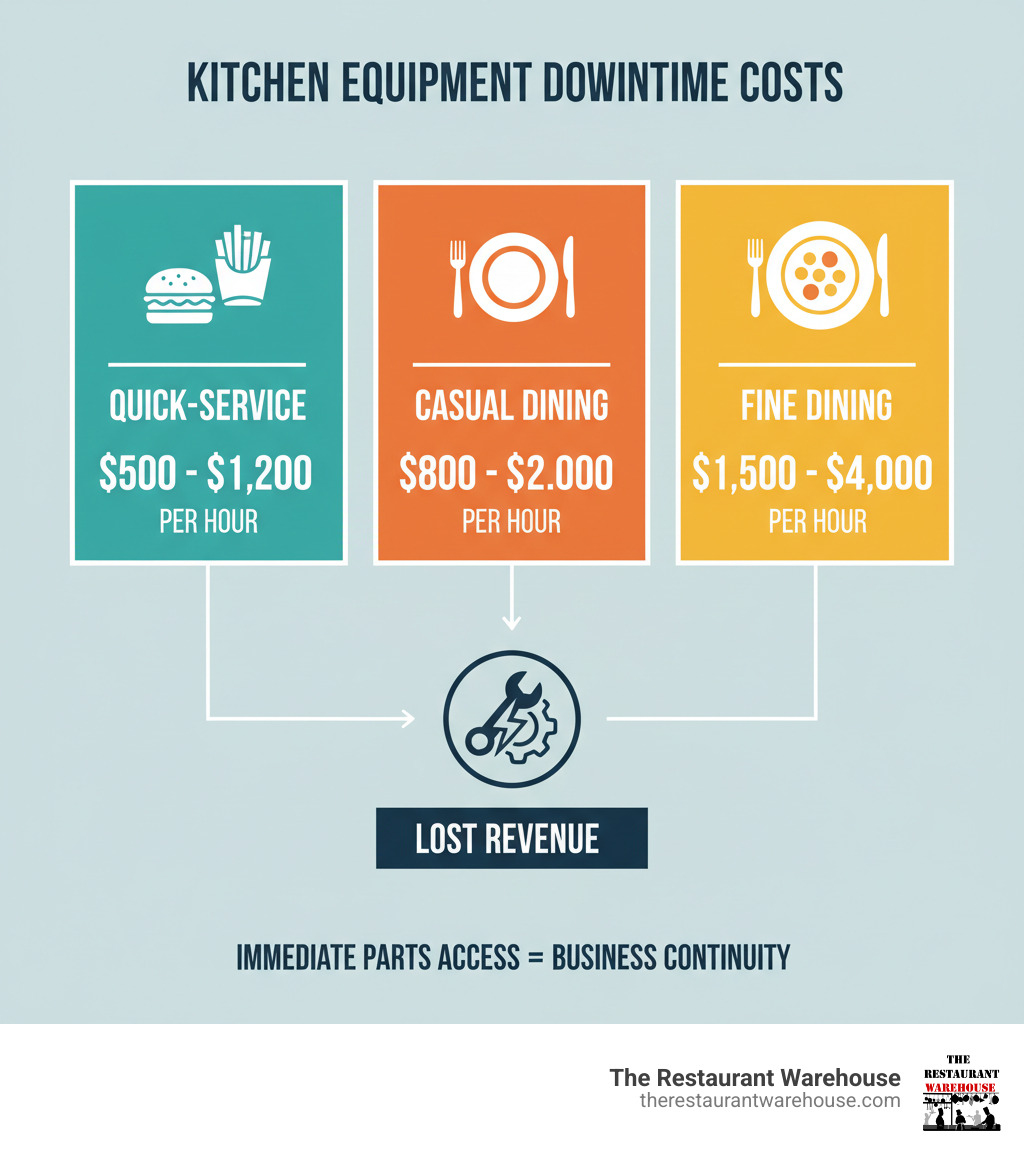
A breakdown doesn't just mean one system is offline. It creates a cascade of negative consequences: lost revenue from unfilled orders, wasted food inventory that spoils, plummeting staff morale as they struggle to work around the failure, and potentially irreparable damage to your restaurant's reputation with disappointed customers. A strategic parts supply plan is your proactive defense against this chaos.
Here's what you need to know to build an effective and resilient parts sourcing strategy:
Key Components of a Reliable Parts Supply Strategy:
- Essential Parts Categories: Proactively identify the components that are most prone to failure within your specific systems. This isn't just about knowing you have a refrigerator; it's about knowing the typical lifespan of its compressor, fan motors, and door gaskets.
- OEM vs. Aftermarket: Develop a clear understanding of the strategic trade-offs between original manufacturer parts and high-quality aftermarket alternatives. This decision impacts not just your budget but also system performance, longevity, and warranty status.
- Supplier Selection: The right partner is more than a vendor; they are an extension of your team. Prioritize suppliers who offer vast, readily available inventories, guaranteed next-day delivery options, and expert technical support that can guide you through complex repairs.
- Value-Added Services: Look beyond the part itself. The best suppliers offer services that save you time and money, such as advanced digital search tools, comprehensive warranty coordination, and flexible financing options for major repairs.
- Proactive Inventory Planning: Don't wait for a failure to order a part. A core element of a smart strategy is stocking a small, curated inventory of the most critical, high-failure-rate parts for your most essential systems to slash downtime from days to minutes.
Understanding a restaurant's unique operational vulnerabilities—and mitigating them through intelligent parts sourcing and management—is a hallmark of a successful, resilient business. This guide will provide a comprehensive roadmap to help you navigate the complex world of foodservice supply chains and build a parts management plan that protects your bottom line and ensures operational excellence.
The Anatomy of a Working Kitchen: Essential Replacement Parts
Behind every perfectly executed dish and seamless service lies a complex ecosystem of mechanical and electrical components, all working in precise harmony. In this demanding environment, even the smallest part plays a starring role. A worn-out gasket, a faulty thermostat, or a clogged filter can trigger a chain reaction, leading to catastrophic system failure during the dinner rush. Anticipating these needs is your best insurance policy against costly, brand-damaging downtime.
Understanding which parts are most essential and have the highest wear rates allows you to build a smart, proactive replacement strategy. This section provides a detailed walkthrough of the common components that frequently require replacement across your core foodservice systems, empowering you to anticipate needs, stock critical items, and keep your operation running at peak performance.
Components for Heating Systems
Your kitchen's heating systems are the workhorses of your operation, enduring extreme temperatures, grease, and relentless daily use. This punishing environment means certain parts will inevitably require replacement, and knowing the warning signs is key.
- Thermostats: As the brain of your heating system, a thermostat ensures precise and consistent temperatures. When a thermostat fails, you'll notice temperature swings, undercooked or burnt food, and potential food safety hazards. Malfunctions can be sudden or gradual, making regular calibration and inspection critical.
- Heating Elements: These components are responsible for generating heat in electric systems. Over time, they can crack, short out, or simply lose efficiency. Telltale signs of failure include slow preheating times, an inability to reach the set temperature, and a noticeable spike in your energy bills as the system works harder to compensate.
- Pilot Assemblies and Ignitors: For gas-powered systems, these parts are essential for safe and reliable ignition. A weak or failing pilot light or a faulty electronic ignitor means your system won't start, bringing a critical part of your production line to a complete halt. Soot buildup or a flickering, yellow pilot flame are early warning signs.
- Gas Valves: These control the flow of fuel and are paramount for both performance and safety. A malfunctioning gas valve can stick open or closed, leading to either a non-functioning system or a dangerous gas leak. Any suspected issue with a gas valve requires immediate attention and professional diagnosis.
- Knobs and Dials: While seemingly simple, these interface components are crucial for operational control. When they crack, strip, or break, your staff loses the ability to set precise temperatures, leading to inconsistent results, frustrated cooks, and compromised food quality.
- Burners: Over time, gas burners can become clogged with grease and carbonized debris, resulting in uneven flame patterns, poor heat distribution, and reduced efficiency. Electric burners can develop hot spots or lose their heating capacity altogether, signaling an urgent need for replacement.
- Safety Valves: Found on gas systems, these crucial devices prevent dangerous gas leaks by shutting off the fuel supply if the pilot light goes out. A faulty safety valve is a significant hazard that cannot be ignored. Regular testing and proactive replacement are vital for kitchen safety.
- Radiant Briquettes: These ceramic or metal pieces sit above the burners to absorb and radiate heat evenly. As they degrade, crack, or become coated in grease, they cause hot and cold spots, directly affecting food quality and consistency.
Maintaining a ready supply of these core components through a reliable commercial kitchen parts supply partner can transform a potential crisis into a quick, manageable repair. Contact our parts specialists today for expert help!
Parts for Cooling and Cold Storage Systems
Your cooling systems are the silent guardians of your inventory, running 24/7 to maintain food safety. This constant operation puts immense stress on their internal components, making them a primary source of unexpected failures.
- Gaskets: These flexible seals around unit doors are your first line of defense against temperature loss. A torn, brittle, or flattened gasket allows cold air to escape and warm, moist air to enter. This forces the compressor to run constantly, driving up energy costs and potentially leading to premature compressor failure.
- Compressors: The heart of any cooling system, the compressor circulates refrigerant to remove heat. Compressor failure is one of the most catastrophic and expensive repairs. Warning signs can include the unit running constantly, unusual noises (clicking or grinding), or a complete loss of cooling. Proactive maintenance can extend its life, but having a plan for replacement is essential.
- Evaporator and Condenser Fan Motors: These motors are critical for air circulation. The evaporator fan blows air over the cold coils inside the unit, while the condenser fan removes heat from the coils outside the unit. If either motor fails, the heat exchange process stops, leading to inefficient cooling, ice buildup, and eventual system shutdown.
- Thermostats and Temperature Controls: A malfunctioning thermostat in a cooling unit can cause dangerous temperature fluctuations, putting your inventory at risk of spoilage and creating a food safety nightmare. It can also cause the unit to short-cycle or run continuously, wasting energy.
- Door Hinges and Closers: Supporting the weight of heavy, frequently opened doors, hinges can wear out, causing the door to sag. A sagging door prevents the gasket from sealing properly, compromising efficiency and putting extra strain on the entire system.
- Shelving and Clips: Subjected to heavy loads and constant sliding of bins, shelving can bend, and clips can break. This not only reduces your usable storage capacity but also creates a significant safety hazard for staff.
- Defrost Timers and Heaters: In freezers, automatic defrost cycles are essential to prevent ice from building up on the evaporator coils. A failed defrost timer or heater will lead to a solid block of ice, which chokes off airflow and stops the unit from cooling effectively.
Ensuring your commercial kitchen parts supply includes these vital cooling components is fundamental to protecting your inventory and upholding food safety. According to the USDA's food safety guidelines, maintaining proper temperature control is a non-negotiable aspect of preventing foodborne illness.
Warewashing and Plumbing System Components
Nowhere is the environment harsher than in your warewashing area. A constant barrage of hot water, harsh chemicals, and food debris takes a heavy toll on mechanical parts, making this area a frequent source of operational bottlenecks.
- Wash and Rinse Arms: These arms spray water to clean and sanitize dishes. Over time, the spray nozzles can become clogged with mineral deposits or food particles, and the arms themselves can crack or warp. This leads to poor cleaning performance, forcing staff to re-wash dishes and slowing down your entire operation.
- Pump Motors: The pump motor is the powerhouse of your dish machine, driving water circulation. A failing motor, often indicated by a humming or grinding noise, will result in low water pressure and inadequate cleaning, creating a backlog of dirty dishes during your busiest hours.
- Drain Filters and Screens: These components prevent food scraps and other debris from entering and clogging your plumbing. If a filter becomes torn, warped, or clogged, it can cause the dish machine to back up and shut down your entire dish station.
- Faucets and Spray Valves: Pre-rinse spray valves and faucets in a commercial kitchen endure thousands of cycles per day. This heavy use inevitably leads to worn seals and gaskets, causing leaks, drips, or a complete loss of water pressure that wastes water and slows down staff.
- Water Filtration Cartridges: Essential for protecting your systems from scale buildup and improving beverage quality, these cartridges must be replaced regularly. A neglected filter can lead to mineral deposits clogging the sensitive components in your ice machines and coffee makers, leading to costly repairs.
- Hoses and Fittings: Under constant pressure and temperature fluctuations, water hoses can become brittle, crack, or burst. A failed hose can cause significant water damage, create a slip hazard, and bring operations to a standstill.
- Booster Heater Elements: To meet health code sanitization requirements, dish machines use a booster heater to raise the final rinse water to 180°F or higher. If the heating element in this booster fails, your dishes won't be properly sanitized, putting you at risk of a health code violation.
OEM vs. Aftermarket: Making the Right Choice for Your Business
When a critical system breaks down, you're faced with a pivotal decision that extends beyond the immediate repair: do you source an Original Equipment Manufacturer (OEM) component, or do you opt for an aftermarket alternative? This is not merely a question of price; it's a strategic choice that has long-term implications for your commercial kitchen parts supply budget, your system's performance, its operational lifespan, and your warranty coverage.
Understanding OEM Parts
OEM parts are components made directly by or for the company that originally manufactured your system. They are, in essence, identical to the part you are replacing. The foremost benefit of choosing OEM is the manufacturer-guaranteed compatibility and performance. There is no guesswork involved; you have absolute certainty that the part will fit perfectly, integrate seamlessly with other components, and function exactly as the original designers intended.
These parts are manufactured to meet the stringent quality standards and precise specifications set by the original brand. They undergo the same rigorous testing and quality control processes as the components in a brand-new system. This provides invaluable peace of mind, especially when dealing with complex or expensive machinery where reliability is non-negotiable.
Crucially, if your system is still under the manufacturer's warranty, using OEM parts is often a strict requirement to maintain that coverage. Installing a non-OEM component could be grounds for voiding your warranty, potentially leaving you financially responsible for much larger and more catastrophic failures down the road.
The trade-off for this guaranteed quality and compatibility is cost. OEM parts typically carry a higher price point. This premium covers the manufacturer's investment in research and development, precision engineering, branding, and extensive quality assurance protocols. You are paying for risk mitigation and assured performance.
Exploring Aftermarket and Exclusive Brand Parts
Aftermarket parts are components produced by third-party companies. These parts are engineered to be compatible with and function as replacements for specific OEM parts. The most compelling advantage of aftermarket parts is the potential for significant cost savings, often ranging from 30-50% less than their OEM counterparts. For restaurants operating on tight margins, these savings can accumulate rapidly and have a meaningful impact on the maintenance budget.
Another benefit is often wider availability. Because multiple third-party companies may produce a popular replacement part, they are often stocked by a broader range of suppliers. This can sometimes mean faster access when you need a part immediately and the original manufacturer has a backorder.
However, the primary challenge with the aftermarket is variable quality. The market includes a wide spectrum of manufacturers, from highly reputable firms that may even exceed OEM quality to those producing inferior products. This is where your choice of supplier becomes paramount. A reputable commercial kitchen parts supply partner does the vetting for you, curating a selection of reliable aftermarket options. Many large, established suppliers also offer their own supplier-exclusive brands. These parts can represent an ideal middle ground, providing a balance of affordability and reliability that is backed by the supplier's reputation, warranty, and customer service.
How to Decide: A Framework for Value, Warranty, and Performance
Making the right choice between OEM and aftermarket requires a nuanced evaluation of your specific circumstances. It's a strategic decision that should be based on a combination of factors.
First, consider the system's age, criticality, and warranty status. For a brand-new, mission-critical refrigerator that is still under warranty, choosing an OEM part is almost always the wisest decision. The warranty protection alone justifies the higher cost. Conversely, for a ten-year-old prep table that is long out of warranty, a high-quality aftermarket component from a trusted supplier can provide excellent value and keep the system running effectively at a fraction of the cost.
Next, evaluate the component's function. For a simple mechanical part like a knob, hinge, or shelf clip, a well-made aftermarket version is often indistinguishable in performance from the OEM original. However, for a complex electronic control board or a precision-engineered compressor, the R&D and quality control behind an OEM part might provide a tangible performance and longevity advantage that is worth the investment.
| Factor | OEM Parts | Aftermarket Parts |
|---|---|---|
| Initial Cost | Higher upfront investment | Lower initial expense, significant savings |
| Long-Term Value | Guaranteed fit and performance, potentially longer lifespan | Value depends on quality; can be excellent but requires vetting |
| Warranty Coverage | Maintains system warranty; includes manufacturer's part warranty | Does not affect system warranty; includes part-specific warranty from supplier/manufacturer |
| Quality Assurance | Manufacturer-certified, highly consistent quality | Variable; depends heavily on the aftermarket producer and supplier's vetting |
| Availability | Tied to manufacturer's supply chain; potential for backorders | Wider range of suppliers, often more readily available |
| Technical Documentation | Includes precise schematics and installation guides | Documentation can vary; relies on supplier support |
For your workhorse systems that run 12+ hours a day, investing in OEM parts for core components might prevent more frequent replacements and reduce long-term labor costs. For less critical items or systems nearing the end of their planned service life, aftermarket parts make excellent financial sense.
Regardless of your choice, proper installation and ongoing maintenance are paramount for food safety. The USDA provides essential guidance on the importance of proper maintenance for food safety, a principle that applies directly to ensuring all replacement parts, whether OEM or aftermarket, are installed correctly to keep your systems in safe working order.
The best commercial kitchen parts supply partners empower you by offering both OEM and high-quality aftermarket options, giving you the flexibility to make the right call for each unique situation. At The Restaurant Warehouse, we believe you shouldn't be forced into a one-size-fits-all solution. Contact our parts specialists today to discuss which option makes the most sense for your specific needs and budget!
Selecting Your Partner: What to Look for in a Commercial Kitchen Parts Supply
Choosing a parts supplier is one of the most critical long-term decisions you'll make for your restaurant's operational health. This isn't a simple transactional relationship; it's a strategic partnership. The right partner understands that when your systems fail, your entire business is on the line. The difference between a mediocre supplier and a great one is measured in hours of downtime, thousands of dollars in revenue, and the preservation of your hard-won reputation.
Inventory and Availability: The Need for Speed
When a vital system goes down during a packed service, your first and only question is, "How fast can I get the part?" This is where inventory depth and logistical prowess become the most important metrics of a supplier. A top-tier supplier invests heavily in maintaining a massive, diverse inventory of products. This dramatically increases the probability that the exact component you need is in stock and ready to ship at a moment's notice. We've built our reputation on this principle because we know that "we can order it for you" is the wrong answer when your revenue is bleeding away by the minute.
In the modern era, real-time stock information on a supplier's website is a non-negotiable feature. You must be able to see instantly whether a part is available, how many are in stock, and from which warehouse it will ship. This transparency eliminates guesswork and allows you to make informed decisions quickly. But availability is only half the equation. Next-day delivery is not a luxury in the foodservice industry—it's an operational necessity. Look for suppliers with multiple distribution centers strategically located across the country, as this is what makes rapid fulfillment possible. Fast, reliable shipping directly translates to minimized downtime, which is money straight back into your pocket.
Beyond the Part: Value-Added Services from Your Commercial Kitchen Parts Supply
The best suppliers recognize that you're not just purchasing a physical component; you're buying a solution to a critical problem. You're buying expertise, support, and peace of mind. These value-added services are often what distinguish a true partner from a simple parts seller.

Exceptional customer support means access to real, knowledgeable people who understand the urgency of foodservice operations. Technical assistance for part identification is a lifesaver when you're faced with a broken component with no visible part number. A skilled support team can use schematics, model numbers, and even photos to cross-reference information and ensure you order the correct replacement on the first try, avoiding costly delays and returns.
Navigating warranty claims can be a bureaucratic nightmare. A quality supplier acts as your advocate, handling the coordination and paperwork on your behalf. For larger, unexpected repairs that strain your cash flow, flexible financing options can be the difference between fixing the problem immediately or trying to limp along with a failing system. Furthermore, price match guarantees provide confidence that you're receiving competitive pricing without having to spend hours comparison shopping during a crisis.
The Modern Commercial Kitchen Parts Supply: Technology and Tools
The digital revolution has fundamentally transformed the process of sourcing and ordering replacement parts. The tools offered by a modern supplier are not just flashy features; they are practical, time-saving instruments designed to get your kitchen back to full operational capacity faster.
Advanced search engines are a game-changer. Instead of being limited to searching by an exact part number, you can now use descriptive terms, system model numbers, or even problem symptoms (e.g., "refrigerator not cooling fan not spinning") to find potential solutions. Some of the most innovative suppliers now offer visual search functionality, allowing you to upload a photo of the broken component directly from your phone. The system's AI analyzes the image and suggests matching parts, dramatically simplifying the identification process.
For routine maintenance and recurring needs, technology offers immense convenience. Personalized recommendations based on your purchase history can streamline reordering of common items like filters and gaskets. The system learns what your kitchen uses regularly and surfaces these items for quick access. One-click reordering and customized shopping lists for each of your key systems take this a step further, allowing you to replenish your on-site parts kit with minimal effort.
Finally, a comprehensive online account management portal puts you in the driver's seat. From a single dashboard, you should be able to view your complete order history, track shipments in real-time, access and pay invoices, and manage your account details. This level of transparency and control is essential for managing your maintenance budget and planning effectively. Ready to experience a truly seamless parts procurement process? Contact our parts specialists today for expert help!
Frequently Asked Questions about Sourcing Restaurant Parts
Navigating the world of commercial kitchen parts supply can be a daunting task, especially when you're in the middle of a crisis. You're an expert at running a restaurant, not managing a parts warehouse. To provide clarity, we've compiled detailed answers to the most common questions restaurant owners and managers ask about finding, buying, and managing replacement parts.
How do I find the right part number for my system?
Finding the correct part number is the single most critical step in the entire replacement process. An incorrect number leads to ordering the wrong part, which means more shipping costs, more delays, and extended, costly downtime.
- Locate the Data Plate: Your system's data plate is the Rosetta Stone for parts identification. This small metal label or sticker is typically located on the back, side, or inside the door of the unit. It contains the essential trifecta of information: the manufacturer's name, the model number, and the serial number. Before you ever have a problem, make it a practice to take clear photos of the data plates on all your critical systems and store them in a designated cloud folder. This five minutes of prep work can save you hours of panic later.
- Consult the Manual: If the data plate is missing or unreadable, your owner's or service manual is the next best resource. Most manufacturers include detailed schematics with exploded diagrams and corresponding part numbers. If you've lost the physical copy, a quick search on the manufacturer's website often yields a downloadable PDF version.
- Use Your Supplier's Expertise: If you've exhausted the above options and still can't find the number, a great commercial kitchen parts supply partner is your best resource. Before you call, take clear photos of the data plate (if available), the system itself, and the broken part from multiple angles. Our specialists are experts at visual identification and can often pinpoint the exact component you need using just your system's model and serial number, combined with your photos. This expertise is invaluable in preventing ordering mistakes.
Can I get a warranty on aftermarket parts?
Yes, absolutely. It's a common misconception that choosing an aftermarket part means forgoing warranty protection. In reality, many reputable aftermarket manufacturers offer competitive warranties on their products that are often just as comprehensive as OEM warranties. The key is to source these parts from a trustworthy supplier that has already vetted its third-party manufacturing partners for quality and reliability.
Before you purchase, always confirm the specific warranty policy with your supplier. Ask about the duration of the coverage, what specifically is covered (e.g., part replacement, shipping costs), and what the claims process entails. A strong warranty on a high-quality aftermarket part provides the best of both worlds: significant cost savings without the sacrifice of peace of mind.
What are the most important parts to keep on hand in an on-site kit?
While you can't stock a full warehouse, keeping a small, strategic on-site parts kit can reduce downtime for the most common failures from hours or days to mere minutes. The contents should be tailored to your specific systems, but a great starting point includes:
- For Cooling: A set of door gaskets for your most-used refrigerators and freezers, and at least one common evaporator or condenser fan motor.
- For Heating: Extra knobs, a spare thermostat, and a replacement ignitor or pilot assembly for your primary gas systems.
- For Warewashing: A spare pre-rinse spray valve head, extra drain filters, and common pump seals.
- General: A small assortment of common fuses, switches, and light bulbs.
Start by reviewing your purchase history for the last 1-2 years to identify your most frequently ordered parts. This data is the best guide for building a kit that will have the biggest impact on your uptime.
What's the biggest benefit of having a reliable parts partner?
While there are many benefits, the single greatest advantage of a reliable commercial kitchen parts supply partner is the radical minimization of downtime. It is that simple and that profoundly important.
A dependable partner acts as your logistical backbone, ensuring you get the correct part delivered with maximum speed—often with next-day delivery. This rapid response capability is the core function that directly reduces the time your systems sit idle. Every hour of downtime represents a direct financial loss from lost revenue, potential food spoilage, and wasted labor costs, not to mention the intangible damage to customer satisfaction.
Beyond speed, a true partner provides invaluable expertise. They act as a safety net, helping you correctly identify parts, offering technical guidance during a stressful situation, and handling complex warranty coordination. This partnership transforms a potential business-threatening crisis into a manageable, structured repair, allowing you to stay focused on what you do best: creating amazing food and memorable dining experiences for your guests.
Conclusion: Ensuring Operational Excellence with the Right Parts Strategy
In the relentless pace of the restaurant industry, success is built on a foundation of consistency, reliability, and resilience. A proactive, well-considered approach to commercial kitchen parts supply management is not an administrative burden; it is a powerful strategic advantage that separates thriving operations from those constantly battling unforeseen disruptions.
Throughout this guide, we have delved into the critical components that form the mechanical heart of your kitchen, from the high-temperature demands of heating systems to the 24/7 vigilance of your cooling and cold storage. We've navigated the crucial decision-making process between OEM and high-quality aftermarket parts, highlighting how to balance cost, performance, and warranty considerations. We've also outlined the essential criteria for selecting a supply partner—one whose value is measured not just in the parts they sell, but in the speed, expertise, and support they provide.
Downtime is the single most corrosive force affecting a restaurant's profitability. Every minute a critical system is offline, revenue is lost, food costs rise, and customer confidence erodes. This is precisely why developing a commercial kitchen parts supply strategy before a crisis occurs is one of the most impactful investments you can make in your business. The question is not if a component will eventually fail—it is when, and how prepared you will be to respond.
A supplier that maintains a vast, accessible inventory, prioritizes rapid, nationwide delivery, and backs its products with expert technical support and value-added services becomes a true partner in your success. This partnership is your insurance policy against chaos, transforming potential crises into controlled, manageable repairs that keep your staff productive, your kitchen humming, and your customers happy.
At The Restaurant Warehouse, we are fundamentally committed to being that partner for you. We understand the immense pressures you face every day, which is why we've built our business model around providing wholesale pricing on a comprehensive selection of parts. Our goal is to help you achieve operational excellence without compromising your budget. By eliminating high commissions and the overhead of traditional retail, we pass those substantial savings directly on to you, our customer.
Don't wait for a catastrophic failure to force your hand. The time to build your defense is now. Begin by identifying the most critical components in your operation, build a small on-site kit of essential parts, and establish a relationship with a reliable supplier who understands the unique demands of your business.
Your kitchen is the heart of your enterprise. By taking decisive control of your commercial kitchen parts supply strategy today, you are making a direct investment in a future of uninterrupted service, enhanced profitability, and enduring success.
Ready to build a parts strategy that protects your operation and your bottom line? Browse our extensive catalog of parts to keep your kitchen running smoothly. Or, for personalized guidance, contact our parts specialists today to discuss your specific needs.
About The Author

Sean Kearney
Sean Kearney is the Founder of The Restaurant Warehouse, with 15 years of experience in the restaurant equipment industry and more than 30 years in ecommerce, beginning with Amazon.com. As an equipment distributor and supplier, Sean helps restaurant owners make confident purchasing decisions through clear pricing, practical guidance, and a more transparent online buying experience.
Connect with Sean on LinkedIn, Instagram, YouTube, or Facebook.