

Dishwasher Deals: Compare and Shop ENERGY STAR Certified Models
Why ENERGY STAR Dishwashers Save Money and Time for Your Kitchen
Image metadata: Alt text describes an ENERGY STAR certified dishwasher in a modern kitchen; Source: Bannerbear; File type: JPEG; Usage: editorial; Subject: front-control dishwasher; Context: residential kitchen efficiency.
An energy star dishwasher is a certified appliance that meets strict efficiency standards set by the U.S. Environmental Protection Agency (EPA). This certification is not just a sticker; it's a guarantee that the appliance uses significantly less energy and water than standard models while delivering superior, lab-verified cleaning performance. Specifically, a certified model uses at least 20% less energy and 30% less water than the federal minimum standard for dishwashers.
The Compelling Benefits of an ENERGY STAR Dishwasher
The advantages of upgrading to an ENERGY STAR certified model extend far beyond simple utility savings, touching on your finances, your time, and your home's overall environment.
Significant Water Efficiency: A certified standard-sized dishwasher uses 3.5 gallons of water or less per cycle. To put that in perspective, older dishwashers manufactured before 1994 can use more than 10 gallons per cycle. Handwashing the same number of dishes can easily consume up to 27 gallons of water. Over a year, this efficiency translates to saving thousands of gallons of water, reducing strain on local water supplies and lowering your water bill.
Impressive Energy Savings: These appliances are engineered to consume less than 270 kWh of electricity annually. The primary source of energy consumption in a dishwasher is heating the water. By using less water, ENERGY STAR models inherently use less energy. They also incorporate advanced technologies like more efficient motors and smarter heating elements to further reduce power draw.
Substantial Cost Savings: The combination of water and energy efficiency results in a low annual operating cost, typically around $50 per year. When compared to the cost of handwashing—which relies heavily on your home's water heater—you could save up to $220 annually. Over the typical 10-year lifespan of a dishwasher, this can add up to over $2,000 in savings.
Invaluable Time Savings: The average American spends a significant amount of time washing dishes by hand. An ENERGY STAR dishwasher can save you over 230 hours of personal time per year. That's nearly six full 40-hour work weeks that you can reclaim for family, hobbies, or simply relaxing.
Positive Environmental Impact: By conserving water and energy, these dishwashers reduce the demand on power plants and water treatment facilities. This leads to a smaller carbon footprint and fewer greenhouse gas emissions over the appliance's lifetime, contributing to a healthier planet.
Does anyone in your home want to wash that greasy lasagna pan by hand? This simple question highlights why an energy-efficient dishwasher has become essential for any busy kitchen. The right appliance can transform your daily routine while cutting utility costs. While standard dishwashers can waste precious resources, ENERGY STAR certified models flip this equation. They employ advanced soil sensors, efficient water jets, and smart drying systems to clean better with less. Beyond the headline savings, these dishwashers also improve day-to-day living. Quieter operation makes open-concept homes more relaxing, while gentler yet smarter wash action protects delicate dishware. Modern racks and third-level trays maximize usable space, so you run fewer loads without compromising on cleanliness.
If you want to narrow your search to top-performing models quickly, start with certified options and then compare features that matter to your household—noise, capacity, drying performance, and cycle flexibility. You can browse a curated selection here: https://therestaurantwarehouse.com/collections/dishwashers
What follows is a practical, plain-English guide to help you pick, use, and maintain an ENERGY STAR dishwasher that fits your life—so your dishes sparkle, your bills drop, and your evenings are a little quieter and easier. For personalized help choosing the right appliance, our team is ready to assist. Book a Strategy Call or Contact Us here: https://therestaurantwarehouse.com/pages/contact-us
What Makes a Dishwasher ENERGY STAR Certified?
When you see the blue ENERGY STAR logo on a dishwasher, it signifies that the appliance has passed a battery of rigorous tests defined by the U.S. Environmental Protection Agency (EPA). This emblem is a trusted mark of superior energy and water efficiency, backed by third-party verification and well-documented cleaning performance. The EPA establishes strict efficiency standards that compel manufacturers to innovate, pushing them to create appliances that use significantly fewer resources than standard models without sacrificing the pristine results you expect.
The ENERGY STAR program is not a one-time standard. It evolves, with criteria becoming progressively stricter over the years. This means a dishwasher certified today is far more efficient than one that earned the label five or ten years ago, ensuring the program continues to drive technological advancement in the industry.
To earn the certification, an energy star dishwasher must meet a comprehensive set of criteria that cover every aspect of its performance:
Strict Water Consumption Limits: For a standard-sized dishwasher, the maximum allowable water use is just 3.5 gallons per cycle. For compact models, the limit is even lower at 3.1 gallons per cycle. This stands in stark contrast to older models, which could guzzle 10 gallons or more, and even non-certified modern models that may use 5-6 gallons. This limit is tested using a standardized load of dishes to ensure real-world accuracy.
Aggressive Energy Usage Limits: The annual energy consumption is capped to ensure efficiency. For standard models, this limit is 270 kWh/year, while for compact models, it's 203 kWh/year. This is achieved through a combination of technologies, including highly efficient motors that use less electricity to pump water, intelligent cycle controls that optimize heating, and advanced drying systems that avoid power-hungry heating elements.
Verified Cleaning Performance: A common misconception is that efficiency comes at the cost of cleaning power. The ENERGY STAR program directly addresses this by requiring that all certified models pass a standardized cleaning performance test. This test, often based on ANSI/AHAM DW-1-2010 standards, involves washing a full load of dishes coated with a specific, difficult-to-clean food soil mixture. The dishwasher must achieve a minimum cleaning score to qualify, ensuring that you get both efficiency and spotless results.
How Certification Translates to Real Life:
- Lower Utility Bills: The direct result of using less electricity and less hot water is a noticeable reduction in your monthly energy and water bills. Every load you run costs less.
- Meaningful Conservation: The water and energy savings are not trivial. Over its lifetime, a single ENERGY STAR dishwasher can save thousands of gallons of water and significantly reduce the carbon emissions associated with your home.
- Reliability and Trust: Because ENERGY STAR is a standardized, government-backed, third-party program with transparent testing protocols, you can trust the claims. It cuts through marketing jargon and provides a reliable benchmark for comparing different models.
Key Differences from Standard Models:
- Resource Use: The most significant difference is the dramatic reduction in water and electricity consumption per cycle. This is the core of the ENERGY STAR promise.
- Intelligent Controls: Certified models almost universally feature advanced soil sensors (often called turbidity or optical sensors). These sensors measure how dirty the water is during the pre-rinse and main wash cycles. The dishwasher's computer then uses this data to adjust the cycle time, water temperature, and water pressure in real-time, ensuring a perfect clean without wasting resources on lightly soiled loads.
- Advanced Drying Technology: Instead of relying on a traditional, high-wattage heating element to bake dishes dry, ENERGY STAR models use smarter methods. These include condensation drying (using a stainless steel tub's cool surface to attract moisture), fan-assisted drying (circulating air to speed up evaporation), or automatic door-opening features that release steam at the end of the cycle.
What this means for you is a smarter, more economical, and environmentally friendly appliance that doesn't compromise on its primary job: getting your dishes clean. If you're ready to narrow down options that meet these high standards, you can compare featured models here: https://therestaurantwarehouse.com/collections/dishwashers
Tip: If you entertain frequently or cook daily, focus on models that pair ENERGY STAR efficiency with robust racks and sensor-driven cycles. You'll clean more in fewer loads while keeping noise and costs down.
Want a short list of models customized to your household size and habits? Get a free recommendation here: https://therestaurantwarehouse.com/pages/request-quote
How an ENERGY STAR Appliance Delivers Superior Efficiency and Cleaning
Did you know that about 80% of a dishwasher’s energy use can go toward heating water? An energy star dishwasher tackles this primary energy consumer head-on, using a suite of advanced technologies to heat water more efficiently while using significantly less of it to begin with. This two-pronged approach is the secret to its remarkable performance.
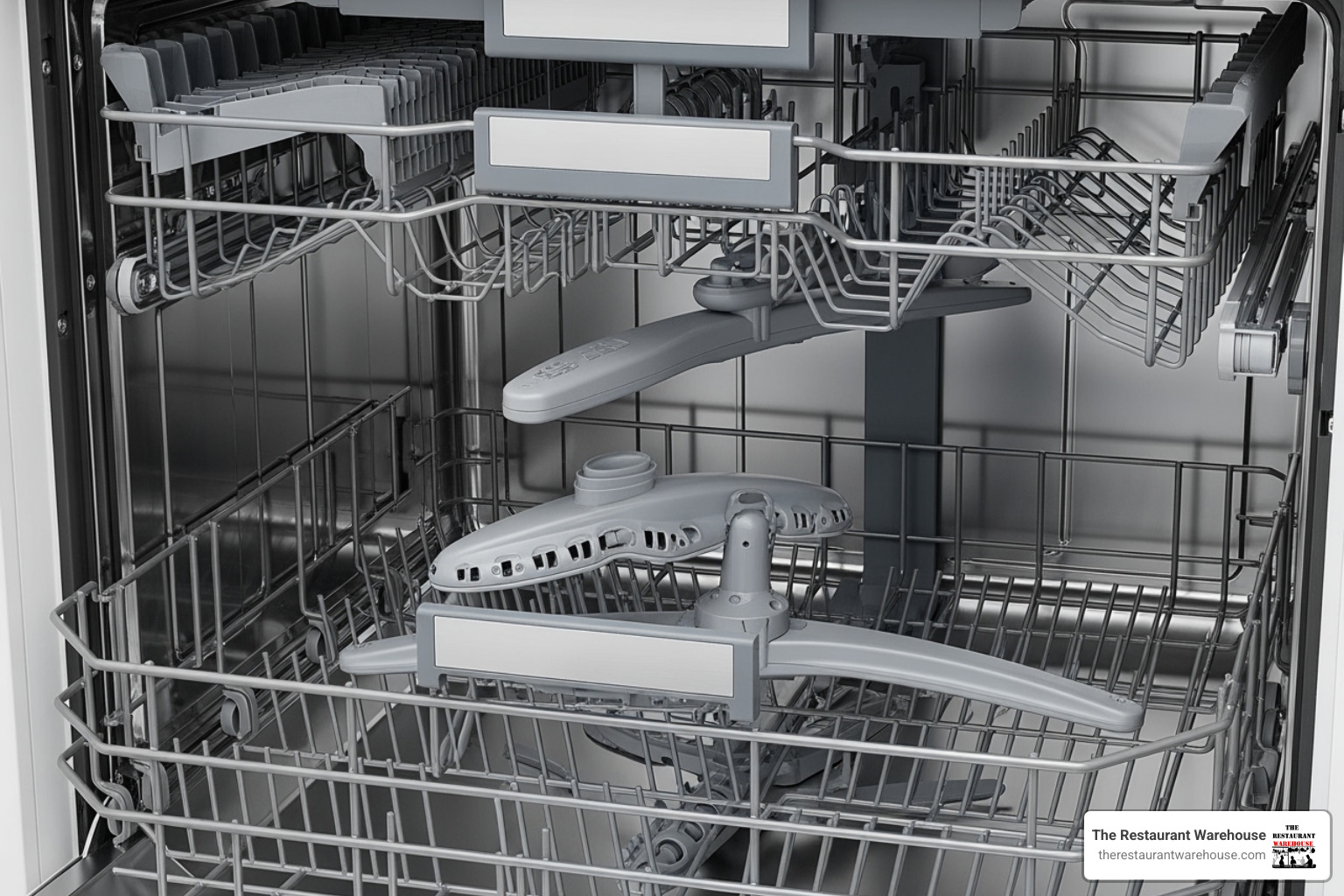
Image metadata: Alt text highlights the dishwasher interior with spray arms and third rack; Source: Bannerbear; File type: JPEG; Usage: editorial; Subject: interior components that influence efficiency; Context: feature overview.
Modern ENERGY STAR models don’t just wash dishes—they analyze each load to clean with maximum efficiency. Sophisticated engineering, including specialized spray arms, improved filtration, and precise temperature controls, ensures sparkling results while using the fewest possible resources.
Core Features That Boost Efficiency and Results:
- Soil Sensors (Turbidity Sensors): These are the brains of the operation. Using an infrared light beam, these sensors detect the amount of food particulate in the wash water. If the water is relatively clear, the dishwasher knows the dishes are not very dirty and shortens the cycle. If the water is murky, it extends the cycle and may increase the temperature to ensure a thorough clean. This automatic adjustment means a lightly soiled breakfast load receives a shorter, gentler treatment than a post-holiday feast, optimizing resource use every time.
- Efficient Water Jets and Spray Arms: It's not just about how much water is used, but how it's used. Engineers have redesigned spray patterns and developed advanced, variable-pressure spray arms that reach into every corner and crevice without over-spraying. Some models feature satellite spray arms or bottle-wash jets that provide targeted, high-pressure cleaning for specific items, ensuring complete coverage and eliminating the need for wasteful extra rinses.
- Advanced Filtration Systems: To conserve water, modern dishwashers recirculate it throughout the wash cycle. Advanced multi-stage filtration systems are crucial for this process. They use a combination of coarse and fine-mesh filters to trap food particles, keeping the wash water cleaner for longer. This reduces the need for the machine to drain and refill with fresh water, saving both water and the energy needed to heat it.
- Precision Heating and Temperature Control: Instead of blasting water to a single high temperature, these dishwashers use efficient inline water heaters and precise thermostats. They maintain the optimal temperature needed to activate detergent enzymes (around 120-140°F) without overshooting and wasting energy. Some cycles use multiple temperature stages for different phases of the wash.
-
Smarter Drying Systems: The traditional heated dry cycle is a massive energy drain. ENERGY STAR models employ more intelligent solutions:
- Condensation Dry: This passive method is common in models with stainless steel tubs. The final rinse uses very hot water, which heats up the dishes. The cooler stainless-steel walls of the tub then attract the warm, moist air, causing water to condense on the walls and drain away. It's highly efficient and gentle on plastics.
- Fan-Assist Dry: Some models include a small fan that circulates air within the tub or vents humid air out and pulls drier, ambient air in. This speeds up the drying process without engaging a high-wattage heating element.
- Auto Door-Open: A feature on many premium models, the dishwasher door automatically pops open a few inches at the end of the cycle. This releases steam and allows dishes to air-dry much faster and more effectively.
- Optimized Motors & Pumps: Gone are the noisy, single-speed motors of the past. Modern dishwashers often use variable-speed and electronically commutated motors (ECMs). These DC motors are quieter, more durable, and can ramp up or down as needed, using only the precise amount of power required for a given task, which lowers total energy use and operational noise.
Handwashing vs. Your ENERGY STAR Dishwasher: A Clear Winner
- Cost: Running a certified dishwasher is typically around $50 per year in combined utility costs. In contrast, handwashing the same volume of dishes can cost several times more in hot water alone—often an additional $220 more annually.
- Time: You can reclaim over 230 hours per year by letting the machine do the work. That's nearly six full work weeks of your time back.
- Water: An efficient machine can save thousands of gallons of water annually compared to typical handwashing habits, which can use up to 27 gallons for a single sink-full of dishes.
- Hygiene: Dishwashers offer a significant hygiene advantage. They use high-temperature water and often have a sanitize rinse option that reaches 150°F or higher, killing 99.9% of common household bacteria like E. coli and Salmonella. It is nearly impossible and unsafe to achieve these temperatures when washing by hand.
Real-World Tips to Maximize These Benefits:
- Run Full Loads: Your dishwasher uses nearly the same amount of energy and water for a half load as it does for a full one. Maximize efficiency by waiting until it's full.
- Scrape, Don’t Rinse: Modern detergents contain enzymes that are designed to bind to and break down food soils. Pre-rinsing not only wastes gallons of water but can actually reduce your detergent's efficacy.
- Use Rinse Aid: This is not just for shine. Rinse aid is a surfactant that breaks the surface tension of water, causing it to sheet off dishes rather than form droplets. This dramatically improves drying performance, especially on plastics.
Want personal guidance on models with the quietest operation, best third-rack designs, or strongest drying performance? Contact us: https://therestaurantwarehouse.com/pages/contact-us
Your Smart Shopping Guide for the Best ENERGY STAR Dishwasher
Shopping for an energy star dishwasher is a smart move that automatically narrows your search to models guaranteed to save money and resources. However, within that certified category, there's a wide range of features, sizes, and designs. To find the perfect fit for your kitchen and lifestyle, it helps to understand the labels, installation details, and long-term ownership factors that matter most.
Decoding the Labels: EnergyGuide vs. ENERGY STAR
When you're in the appliance aisle, you'll see two important labels. It's crucial to know what each one means:
- The EnergyGuide Label: This mandatory yellow sticker is a comparison tool. It provides the estimated annual energy consumption in kilowatt-hours (kWh) and an estimated yearly operating cost based on a national average electricity rate. This allows you to compare the projected running costs of different models side-by-side. It is a tool for transparency. You can learn how to interpret it in detail here: https://www.consumer.ftc.gov/articles/0072-shopping-home-appliances-use-energyguide-label
- The ENERGY STAR Logo: This voluntary blue logo is a mark of excellence. It signals that the appliance is among the most efficient in its class, having met the strict guidelines for both energy and water use set by the EPA. Not all dishwashers have this logo.
When a dishwasher has both labels, you have found an efficiency leader with transparent, predictable operating costs. To explore a range of certified options in one place, start here: https://therestaurantwarehouse.com/collections/dishwashers
What to Look For When You Buy: A Detailed Checklist
- Size and Capacity: Standard dishwashers are 24 inches wide and typically hold 12–16 place settings. A 'place setting' is a standardized measure including a dinner plate, dessert plate, bowl, glass, mug, and cutlery. For a family of four that cooks regularly, a 14-16 place setting model with a third rack is ideal. Compact (18-inch) models are perfect for smaller kitchens, apartments, or couples, but they hold fewer dishes (around 8 place settings) and may require more frequent cycles.
- Noise Levels (dBA): For today's open-concept homes, noise level is a critical factor. It's measured in decibels (dBA). A lower number is quieter. Look for models in the 38–50 dBA range. For reference: under 44 dBA is considered whisper-quiet, similar to a library; 44–50 dBA is still very quiet, like a soft conversation, and comfortable for most homes. Anything over 50 dBA will be more noticeable.
- Rack Flexibility and Third Racks: Look for adjustable middle racks that can be raised or lowered to accommodate tall items like wine glasses or large pots. Fold-down tines in the lower and upper racks allow you to customize the space for bulky bowls or pans. A third rack at the very top is a game-changer for freeing up space below; it's perfect for silverware, long utensils like spatulas, and small espresso cups.
- Soil Sensors & Auto Cycles: An 'Auto' or 'Sensor' wash cycle is a must-have feature. It uses turbidity sensors to determine how dirty the dishes are and automatically optimizes the cycle time, water usage, and temperature. This set-it-and-forget-it feature ensures you're never wasting resources on a lightly soiled load.
- Drying System: As discussed, condensation and fan-assisted systems are the most energy-efficient. If you use a lot of plastic items (which don't dry well with condensation), look for a model with fan-assist or an 'extra dry' option that extends the drying time. Auto-door release is an excellent feature for perfect, energy-free drying.
- Interior Tub Materials: The tub can be either stainless steel or plastic. Stainless-steel tubs are more durable, resist stains and odors, and can operate more quietly. They are also essential for effective condensation drying. Plastic tubs are less expensive but can be more prone to discoloration over time.
- Filtration & Maintenance: All dishwashers have a filtration system to keep wash water clean. Some models have self-cleaning systems with a built-in grinder (which can be noisier), while most have a manual filter that you need to remove and rinse periodically. A manual filter is often quieter and more effective at capturing fine particles. Check how easy it is to access and clean the filter.
- Hard-Water Features: If your home has hard water (high mineral content), it can leave spots on glassware and cause scale buildup inside the machine. Look for models with a built-in water softener, which uses salt to treat the water. At a minimum, ensure you use a high-quality detergent and rinse aid designed for hard water.
- Installation Fit and Requirements: This is crucial. Before you buy, carefully measure the width, height, and depth of your cabinet opening. Don't forget to measure the clearance needed for the door to swing open fully without hitting an island or adjacent cabinets. Confirm the location of your water supply line (hot water is required), drain, and electrical outlet. Most dishwashers require a dedicated 15-20 amp circuit.
Budgeting for Total Cost of Ownership
- Upfront vs. Long-Term: ENERGY STAR models can sometimes have a slightly higher purchase price, but they quickly pay for themselves through lower utility bills. The payback period is often just a couple of years.
- Consumables: Factor in the ongoing cost of high-quality detergent pods and rinse aid, which are essential for optimal performance.
- Warranty & Service: Look for a manufacturer's warranty that covers at least one year for parts and labor. Some brands offer longer warranties on specific components like the racks, electronics, or the stainless-steel tub.
Pro tip: Read the EnergyGuide label closely and consider the trade-offs. An ultra-quiet model with a 40 dBA rating might have a longer standard cycle time than a 48 dBA model. This is often perfectly acceptable if you typically run your dishwasher overnight.
Prefer help from a specialist to navigate these options? Book a Strategy Call or Contact Us: https://therestaurantwarehouse.com/pages/contact-us
Maximizing Savings and Performance with Your Appliance
Owning an energy star dishwasher is a fantastic first step toward a more efficient kitchen. However, how you use and maintain it can further amplify your savings and elevate its cleaning performance. Adopting simple habits and performing light, regular maintenance will compound into significant benefits over the appliance’s 10+ year lifespan.
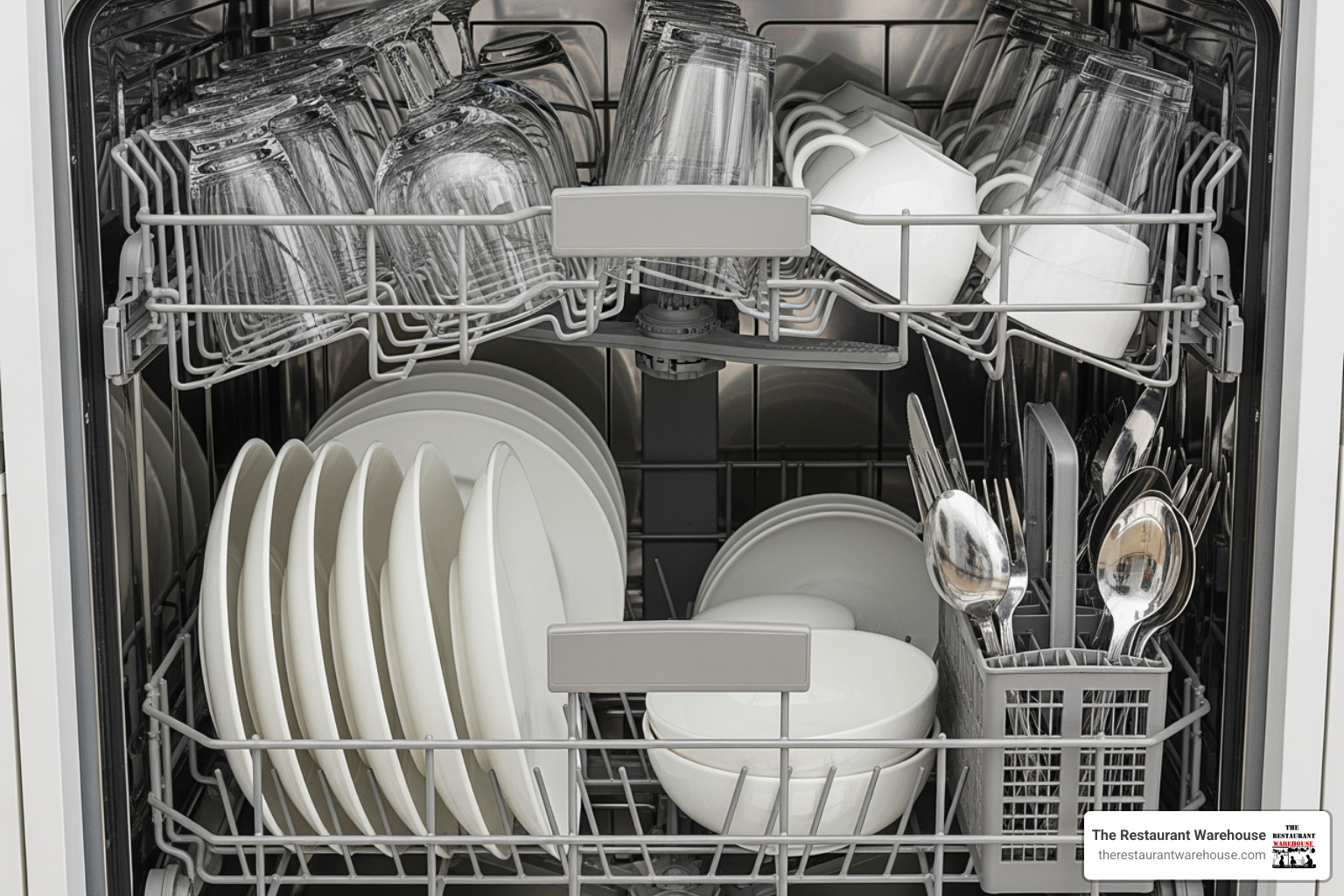
Image metadata: Alt text depicts efficient loading; Source: Bannerbear; File type: JPEG; Usage: editorial; Subject: loading best practices; Context: consumer guidance.
Best Practices That Pay Off Immediately
- Scrape, Don’t Rinse: This is the golden rule of modern dishwashing. Pre-rinsing dishes under the tap before loading is a major waste of water, time, and energy. It can waste up to 20 gallons of water per load. Furthermore, modern dishwasher detergents contain enzymes that are specifically designed to attach to and break down food particles. If there's no food for them to work on, they are less effective, and the dishwasher's soil sensor may mistakenly run a shorter, lighter cycle.
- Run Only Full Loads: A dishwasher uses nearly the same amount of water and energy whether it’s half-full or packed to capacity. Make it a household habit to wait until the machine is full before starting a cycle. If you must wash a smaller load, use the 'Half Load' or 'Top Rack Only' setting if your model has one.
- Load for Maximum Water Coverage: Proper loading is key to getting everything clean. Face the dirty surfaces of plates and bowls toward the center spray arms. Angle bowls and cups so water can't pool in them. Avoid nesting items, as this blocks water flow. Place long utensils like spatulas and knives flat on the third rack. Ensure nothing is blocking the rotation of the spray arms before you start the cycle.
- Always Use a Rinse Aid: Rinse aid is essential for modern dishwashers, especially those with condensation drying. It's a surfactant that helps water sheet off surfaces instead of forming droplets, which dramatically improves drying and prevents spots and streaks on glassware.
- Choose the Smartest Cycle: For most mixed loads, the 'Auto' or 'Sensor' cycle is your best bet. It will automatically adjust to the soil level for the most efficient clean. Use the 'Eco' cycle for lightly soiled loads to save the most energy. Reserve the 'Heavy' or 'Pots & Pans' cycle for tough, baked-on messes.
- Embrace No-Heat Drying: Select the air-dry, no-heat dry, or energy-saver dry option whenever possible. These modes slash electricity use by skipping the power-hungry heating element. If your model has an auto-open door feature, it will provide the best air-drying results.
Simple Care Tips to Extend Life and Performance
- Clean the Filter Monthly: This is the single most important maintenance task. A clogged filter restricts water flow, leads to poor cleaning, and can cause odors. Most are easy to access at the bottom of the tub. Simply twist to remove, rinse under the tap to clear food debris, and lock it back in place.
- Wipe the Door Gasket: Periodically wipe down the rubber seal around the door with a damp cloth. This prevents the buildup of grime and mildew, ensuring a tight seal and preventing odors.
- Descale as Needed (Especially with Hard Water): If you live in an area with hard water, mineral deposits (limescale) can build up on the heating element and interior components over time, reducing efficiency and performance. Use a commercially available dishwasher cleaner or run an empty cycle with a cup of white vinegar in a bowl on the top rack every few months to descale the machine.
- Inspect and Clear Spray Arms: The small holes in the spray arms can get clogged with food particles or mineral deposits. Periodically check them and use a toothpick or pin to clear any blockages to restore full spray pressure and coverage.
Looking for a model that pairs top-tier efficiency with ultra-quiet operation and excellent drying? Explore options here: https://therestaurantwarehouse.com/collections/dishwashers
Want a quick checklist and model shortlist tailored to your kitchen layout and family size? Contact Us: https://therestaurantwarehouse.com/pages/contact-us
Frequently Asked Questions about ENERGY STAR Dishwashers
Navigating the world of new appliances can bring up a lot of questions. Here are detailed answers to some of the most common queries about ENERGY STAR certified dishwashers.
How much money can I really save with an ENERGY STAR dishwasher? A new certified model typically costs only about $50 per year to run in combined electricity and water costs. When compared to handwashing the same number of dishes, which uses much more hot water from your home's water heater, an average household can save around $220 annually. Over the dishwasher’s 10-year lifespan, that can easily exceed $2,200 in savings, not to mention the value of reclaiming over 230 hours of your time each year.
Do energy-efficient dishwashers actually clean as well? Absolutely. This is a common concern, but it's unfounded. To earn the ENERGY STAR label, a dishwasher must pass a rigorous, standardized cleaning performance test. The efficiency gains come from smarter technology—like soil sensors, better water circulation, and precision heating—not from weaker washing. They are designed to clean more effectively with fewer resources.
Why do the cycles on new dishwashers seem so long? Modern dishwasher cycles, especially 'Auto' and 'Eco' modes, can run for 2–3 hours. This is a deliberate design choice that is key to their efficiency. By using less water and lower temperatures, the dishwasher needs more time to allow the detergents to work and to thoroughly clean the dishes. It's a trade-off: using less energy and water intensity requires more time. Most people run their dishwasher overnight, so cycle length is rarely an issue. For times when you need dishes faster, 'Quick' or 'Express' cycles (usually around 60 minutes) are perfect for lightly soiled items.
Are these dishwashers quiet enough for my open-concept living space? Yes. Manufacturers have made incredible strides in noise reduction. Look for the dBA (decibel) rating. Any model rated between 38 and 50 dBA is an excellent choice for an open floor plan. Models under 44 dBA are considered whisper-quiet and are often inaudible from a few feet away, blending completely into the ambient noise of a home.
What's the deal with drying? Can I really skip the heated dry cycle? Yes, and you should for maximum energy savings. Most ENERGY STAR models use condensation drying, fan-assisted drying, or an auto-open door feature. When combined with a rinse aid (which is crucial for this process), these methods are very effective. Plastics may remain a bit damp because they don't retain heat like ceramic or glass, but this is a small trade-off for the significant energy savings.
Do I really not need to pre-rinse my dishes anymore? Correct. You should scrape large food scraps into the trash or compost, but you should not pre-rinse. Modern detergents have powerful enzymes that need food soil to work on. Rinsing them clean can actually make the detergent less effective. Trust the machine and the detergent to do their jobs.
What should I do if I have very hard water? Hard water can cause cloudy glassware and mineral buildup. The best solution is a dishwasher with a built-in water softener. If your model doesn't have one, always use a high-quality rinse aid and a detergent specifically formulated for hard water. Additionally, you should descale your dishwasher every few months using a commercial cleaner or white vinegar to keep it running efficiently.
Is a third rack really worth it? For most families, yes. A third rack provides a dedicated space for cutlery, flatware, and long utensils. This not only ensures they get a better clean than when they are jumbled in a basket, but it also frees up a significant amount of valuable space on the lower rack for more pots, pans, and bowls.
Are there rebates available for buying an ENERGY STAR dishwasher? Often, yes. Many local utility companies and municipalities offer rebates as an incentive for purchasing energy-efficient appliances. These programs vary by location and can change frequently. You can use the official ENERGY STAR Rebate Finder to check for current offers in your zip code: https://www.energystar.gov/rebate-finder
How do I get personalized help selecting the right model? Our team of specialists can help you build a short list of models based on your specific needs, including budget, kitchen dimensions, water hardness, and noise preferences. Request a personalized recommendation here: https://therestaurantwarehouse.com/pages/request-quote
Ready to compare certified models and pricing now? Start browsing our curated collection: https://therestaurantwarehouse.com/collections/dishwashers
Conclusion: A Smarter Clean for a Modern Home
Investing in an ENERGY STAR certified dishwasher is one of the most practical and impactful decisions you can make for your kitchen, your budget, and the environment. The benefits are clear, consistent, and compelling: dramatically lower utility bills, hundreds of hours of reclaimed personal time, and a significantly reduced environmental footprint. With advanced features like soil-sensing cycles, precision water and heat control, and innovative drying systems, today’s models deliver a superior, hygienic clean while using a fraction of the resources of older machines or handwashing.
Remember that the technology is only half of the equation. By adopting small, smart habits—like scraping instead of pre-rinsing, always running full loads, using a quality rinse aid, and performing simple monthly filter maintenance—you can maximize your appliance's performance and compound your savings over its entire lifespan. Over the life of the appliance, you can save thousands of dollars and hundreds of hours, all while enjoying quieter operation and consistently sparkling dishes.
Choosing the right appliance can feel overwhelming, but it doesn't have to be. By focusing on the factors that matter most to your household—capacity, noise level, rack flexibility, and drying performance—you can confidently select a model that will serve you well for years to come.
If you want help choosing the perfect model, we’re here to make it simple and stress-free. Our experts can guide you through the options to find the ideal match for your needs.
- Explore certified options and compare pricing: https://therestaurantwarehouse.com/collections/dishwashers
- Contact Us for tailored recommendations: https://therestaurantwarehouse.com/pages/contact-us
Book a Strategy Call today and let our team match you with an energy star dishwasher that fits your space, budget, and routine: https://therestaurantwarehouse.com/pages/contact-us
With the right appliance and a few smart habits, your dishwasher will do more than just clean your plates—it will streamline your day, trim your bills, and help you build a more efficient and sustainable home.
About The Author

Sean Kearney
Sean Kearney is the Founder of The Restaurant Warehouse, with 15 years of experience in the restaurant equipment industry and more than 30 years in ecommerce, beginning with Amazon.com. As an equipment distributor and supplier, Sean helps restaurant owners make confident purchasing decisions through clear pricing, practical guidance, and a more transparent online buying experience.
Connect with Sean on LinkedIn, Instagram, YouTube, or Facebook.