

Your Guide to Choosing Cafe Equipment Suppliers
Let's talk about one of the biggest hurdles in opening a cafe: the cost of equipment. The initial investment in espresso machines, grinders, ovens, and refrigeration can be substantial, often feeling like a barrier to entry. However, a massive upfront payment isn't the only way to get the high-quality machinery you need. Smart cafe equipment suppliers understand that cash flow is critical for a new business. They provide a range of flexible options, from direct purchasing to leasing and financing, designed to help you manage your budget effectively. This allows you to equip your cafe for success without draining your financial reserves from day one.
Why Your Cafe Equipment Supplier is Your Most Important Partner
In the busy and competitive world of coffee shops, success is brewed from a blend of passion, quality beans, and exceptional service. However, behind every perfectly pulled espresso shot and satisfied customer lies a foundation of reliable, efficient equipment. This is where cafe equipment suppliers become the unsung heroes of the industry. These specialized vendors are far more than just storefronts; they are crucial partners who provide the essential machinery, supplies, and expert services that bring a cafe's vision to life. From high-capacity espresso machines to the smallest cleaning brush, they offer a comprehensive inventory that covers every aspect of a coffee shop's operations, often including vital support like installation, maintenance, and flexible financing.
Top-tier suppliers typically provide a full spectrum of products and services, including:
- Brewing & Food Prep Equipment: The heart of any cafe, this includes commercial espresso machines, high-speed grinders, batch brewers, blenders, and panini presses.
- Refrigeration & Storage: Essential for freshness and safety, this category covers everything from neat refrigerated display cases to undercounter fridges, freezers, and high-volume ice machines.
- Tools, Smallwares & Consumables: The details that ensure consistency and quality, such as professional barista tools, precision scales, milk pitchers, custom-branded cups, coffee beans, syrups, and specialized cleaning supplies.
- Comprehensive Support Services: The value-added offerings that separate a vendor from a partner, including professional installation, staff training, preventative maintenance programs, and accessible financing options.
Starting on the journey of starting a cafe is an exhilarating prospect, but the task of sourcing, vetting, and purchasing equipment can quickly become overwhelming. The sheer volume of choices, technical specifications, and financial considerations can be a significant hurdle. This is where the distinction between success and struggle often hinges on choosing the right supplier. A subpar choice can lead to mismatched equipment, unexpected costs, and crippling downtime, while a great partner streamlines the entire process.
As one satisfied customer aptly shared: "Great one stop for almost everything you need for your restaurant, catering." This sentiment perfectly encapsulates the value proposition. The best cafe equipment suppliers function as an invaluable, centralized resource, becoming a true extension of your team.
The right supplier acts as your one-stop shop, a strategic move that saves countless hours of painstaking research, price comparison, and vendor coordination. More importantly, they bring a wealth of industry expertise to the table, guiding you away from common, costly mistakes and helping you select equipment that is not only durable but perfectly suited to your specific business model and volume projections. A reliable supplier provides deep industry knowledge, competitive and transparent pricing, and robust, ongoing support that extends far beyond the initial transaction, ensuring your cafe is built on a foundation of quality and reliability.
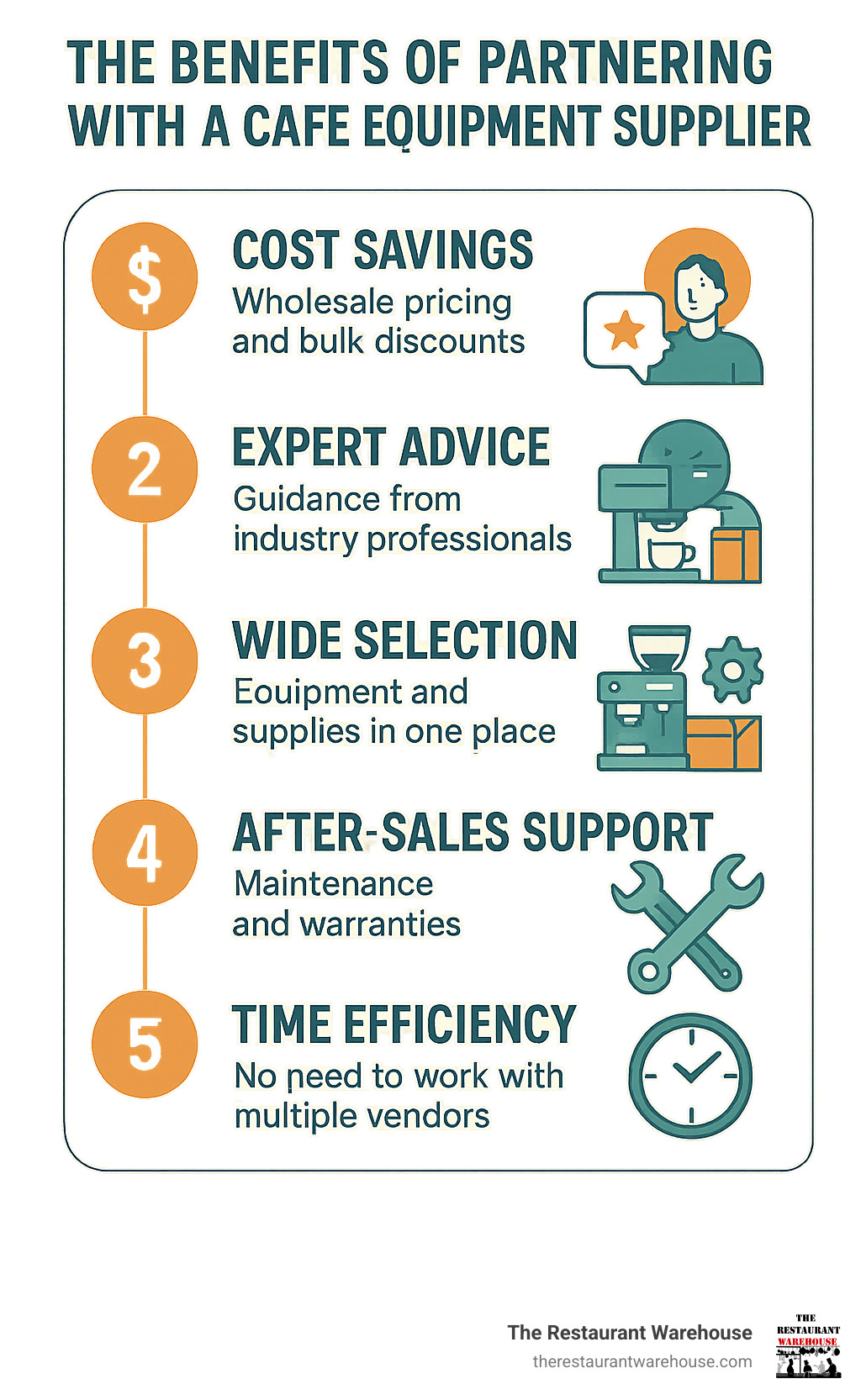
Cafe equipment suppliers terms you need:
- commercial kitchen stainless steel tables
- commercial sinks for restaurants
- ventless hood systems for restaurants
Your Essential Cafe Equipment Checklist
When mapping out a new cafe, the sheer volume and variety of necessary equipment can be daunting. This is precisely where cafe equipment suppliers demonstrate their immense value, serving as a comprehensive partner for every item on your checklist, from the most sophisticated espresso machine down to the last napkin dispenser. They curate and stock the extensive inventory required to transform an empty commercial space into a vibrant, functional, and profitable coffee haven.
For those just starting, our detailed Coffee Shop Equipment Checklist and overarching Restaurant Equipment Guide are excellent resources to help you organize and prioritize your acquisition strategy.
The Heart of Your Cafe: Brewing & Grinding Gear
Your coffee and espresso equipment is the undisputed heart of your operation, directly influencing the quality of your core product.
- Commercial Espresso Machines: These are the workhorses of any cafe, engineered for high-volume output and consistent temperature stability. They range from compact single-group models for smaller cafes (starting around $2,000-$5,000) to large two, three, or four-group machines for high-traffic locations (costing upwards of $30,000). Key considerations include boiler type (heat exchange vs. dual boiler), automation level (semi-automatic, automatic/volumetric, or super-automatic), and brand reputation for reliability.
- Commercial Coffee Grinders: Just as critical as the espresso machine, a quality grinder ensures a consistent particle size for proper extraction. You'll choose between doser grinders, which pre-grind into a chamber, and on-demand grinders, which grind directly into the portafilter for maximum freshness. Burr type (flat vs. conical) and size are also key factors affecting grind quality and speed.
- Drip Coffee Brewers: Essential for serving the classic cup of coffee quickly and efficiently, especially during morning rushes. Look for batch brewers with thermal carafes to maintain temperature without scorching the coffee. Models with programmable features allow for fine-tuning of brew cycles.
- Pour-Over Stations: For cafes wanting to offer a more artisanal, hand-crafted experience, a dedicated pour-over station with gooseneck kettles, drippers (like V60 or Kalita), and scales can be a major draw for coffee connoisseurs.
- Water Filtration System: This is a non-negotiable component. A quality filtration system not only dramatically improves the taste of your coffee (which is over 98% water) but also protects your expensive brewing equipment from scale buildup, preventing costly repairs and extending its lifespan.
Specialized Brewing Systems
Beyond a standard drip brewer, your specialized systems are what create a truly memorable coffee experience. Your commercial espresso machine is the centerpiece, a powerful workhorse designed for consistency and high volume. These machines can be a significant investment, which is why it’s smart to explore flexible financing options to make top-tier models more accessible. Just as crucial is a quality commercial grinder that delivers a uniform particle size for balanced extraction. To cater to coffee purists, a dedicated pour-over station showcases craftsmanship and allows you to offer premium, hand-brewed options. Finally, don't overlook a water filtration system; it’s essential for protecting all your restaurant equipment from scale and ensuring every cup tastes clean and delicious.
Beyond Coffee: Food & Drink Prep Tools
Today's successful cafes offer a diverse menu beyond coffee. Your supplier can equip you for a full range of food and beverage options.
- High-Performance Blenders: Crucial for smoothies, frappes, and other blended drinks. Commercial models are built with powerful motors and durable containers designed for continuous use. Consider models with sound enclosures to minimize noise and maintain a pleasant cafe ambiance.
- Panini Presses and Contact Grills: Perfect for offering hot sandwiches, wraps, and quesadillas. Look for models with cast-iron or non-stick plates, and decide between grooved plates for classic grill marks or smooth plates for easier cleaning. Dual-press models can significantly increase throughput.
- Commercial Microwaves: A 1000W+ commercial microwave is vital for quickly reheating pastries, breakfast sandwiches, and other items. Unlike residential models, they are built to withstand the rigors of constant use in a commercial kitchen.
- Specialty Equipment: Depending on your menu's ambition, suppliers can provide items like induction cooktops for making syrups or sauces, soup kettles for a lunch special, or high-speed toasters.
Our Juice Dispensers Guide, Commercial Microwaves Guide, and Slushies Machine Guide offer more detail on these items.
Keeping It Cool: Refrigeration & Storage Solutions
Proper refrigeration is paramount for food safety, product quality, and visual merchandising.
- Undercounter & Worktop Refrigeration: These units provide convenient, accessible cold storage for milk, ingredients, and backups right at the prep station, optimizing workflow. Worktop models offer a refrigerated base with a durable stainless steel surface for food prep.
- Refrigerated Display Cases: These are essential for merchandising. A well-lit, attractive display case can significantly boost sales of pastries, cakes, sandwiches, and bottled drinks. Choose between forced-air models for consistent cooling and gravity-coil models for more delicate items.
- Ice Machines: A reliable ice machine is critical for iced lattes, cold brew, and other cold beverages. Your supplier will help you calculate the required production capacity based on your projected drink volume. Consider the type of ice as well—cubed, nugget, or flake—as it impacts drink quality and displacement.
Check out our Commercial Refrigeration For Your Restaurant and Commercial Ice Machine Guide for detailed guidance.
The Little Things: Essential Smallwares & Accessories
The difference between an amateur and a professional setup often lies in the smallwares. These are the tools that enable baristas to work efficiently and consistently.
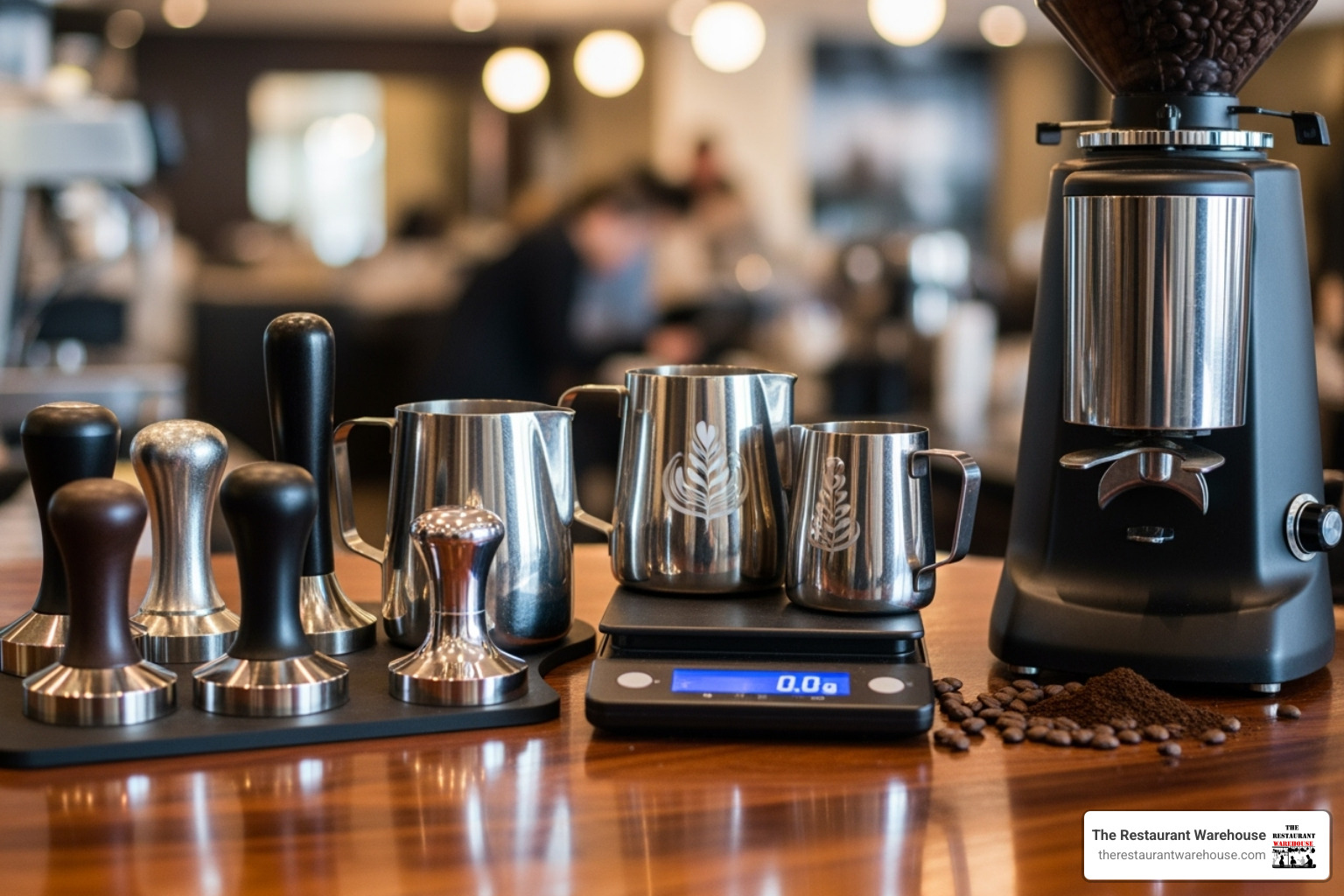
- Barista Tools: This is a broad category that includes precision tampers (calibrated models ensure consistent pressure), WDT (Weiss Distribution Technique) tools to break up clumps, dosing funnels to reduce waste, knock boxes for spent pucks, milk thermometers, and digital timers.
- Milk Pitchers & Scales: A variety of pitcher sizes (e.g., 12oz, 20oz) are needed for different milk volumes and latte art. Highly accurate, fast-reading digital scales are crucial for weighing coffee doses and measuring extraction yield, forming the basis of any quality control program.
- Cups & Glassware: Your choice of ceramic, glass, and paper cups is a key branding element. A full set includes demitasses for espresso, cappuccino cups, and larger latte mugs. Offering branded reusable cups is also a popular and sustainable option.
Our Barista Supplies Guide covers these essential tools in greater detail.
Front-of-House Organizational Tools
A seamless front-of-house operation is what separates a good cafe from a great one. It’s the organized, calm-amidst-the-storm environment that keeps customers relaxed and your team efficient. This is where the right organizational tools come into play, creating a smooth workflow from the moment a customer walks in until they leave with their order. A great supplier provides the full suite of tools needed to keep your service area tidy, efficient, and inviting, ensuring your staff has everything they need right at their fingertips.
- Point of Sale (POS) System: This is the command center of your cafe. A modern POS system does more than just process payments; it tracks sales data, manages inventory, and helps you understand customer behavior. Investing in a reliable system means faster checkouts, fewer errors, and valuable insights to help you grow your business.
- Display Cases: Your display case is your best salesperson for pastries, sandwiches, and drinks. A well-lit, clean, and attractive refrigerated display case not only keeps food fresh but also encourages impulse buys. Whether you need a large case for baked goods or smaller refrigerators for bottled drinks, this piece of equipment is essential for showcasing your offerings.
- Organizational Bins and Racks: A cluttered counter creates stress for both staff and customers. Simple, effective storage solutions like bins for lids, sleeves, and sugar packets, along with racks for cups and napkins, are non-negotiable. They keep your service area looking professional and make it easy for baristas to grab what they need during a rush.
- Menu Boards and Signage: Clear, easy-to-read menu boards are vital for quick and efficient ordering. They guide your customers through their choices and can be used to highlight specials or new items. Good signage helps manage customer flow and communicates your brand's personality.
Stocking Up: Cups, Lids, Syrups, and More
While equipment is a one-time purchase, consumables are the lifeblood of your daily operations. A reliable supplier ensures you never run out and that quality remains consistent.
- Coffee, Syrups & Powders: This includes your primary product—whole bean coffee—as well as a portfolio of flavor syrups, sauces (chocolate, caramel), and specialty powders for chai, matcha, and hot chocolate.
- Cleaning Supplies: Hygiene is non-negotiable. This requires machine-specific cleaners like Cafiza for backflushing, descaling solutions, grinder cleaners, as well as general-purpose sanitizers and detergents for maintaining a clean environment.
- Takeaway Items: High-quality takeaway cups, lids, sleeves, stirrers, and food packaging are essential. These items carry your brand out the door and contribute to the overall customer experience.
Beverage Ingredients and Mixes
A modern cafe thrives on customization, and your supplier is your gateway to a world of flavor. Beyond the beans, they provide the essential ingredients that turn a simple coffee into a signature drink. This includes a wide array of flavoring syrups—from classic vanilla and caramel to unique seasonal options—and rich sauces for mochas and macchiatos. Many suppliers also offer sugar-free, natural, and organic versions to cater to every customer's preference. You can also source powders for making creamy hot chocolate, spicy chai lattes, and vibrant matcha drinks. Having a single, reliable source for these diverse ingredients simplifies your inventory management and ensures you can consistently craft the creative beverages that keep customers coming back for more.
Coffee and Tea Varieties
The quality of your coffee and tea is the foundation of your business. While you might work directly with a roaster, many full-service restaurant equipment suppliers also offer wholesale coffee and tea programs. This can be a huge advantage, allowing you to consolidate vendors and streamline your ordering process. Look for suppliers who provide a diverse selection, including single-origin beans, versatile espresso blends, and even decaf options. A great partner can also connect you with a wide range of loose-leaf and bagged teas, from traditional black and green teas to herbal infusions. This ensures you have a high-quality, core offering that appeals to both coffee purists and tea lovers alike.
Ready-to-Serve Food Items
Expanding your menu with food is one of the fastest ways to increase your average ticket size. Your supplier can be an invaluable partner here, offering a range of easy-to-prepare and ready-to-serve food items that don't require a full kitchen build-out. Think about sourcing frozen pastries, scones, and muffins that can be baked fresh each morning. Many also provide breakfast sandwiches, bagels, and parfaits that are simple to assemble. By using your existing equipment, like a panini press or a commercial microwave, you can offer a satisfying food menu that complements your beverage program, turning a quick coffee stop into a complete meal for your customers.
Specialty Disposable Goods
Your takeaway items are a crucial part of your branding—they're walking advertisements for your cafe. High-quality takeaway cups, lids, sleeves, stirrers, and food packaging are essential for a professional image and a positive customer experience. A comprehensive supplier will offer a variety of options, from standard paper and plastic to eco-friendly, compostable alternatives. They can also help you source custom-branded items that put your logo directly into your customers' hands. Consolidating the purchase of these disposables with your other supplies not only saves time but also ensures you never run short of the essential items that carry your brand out the door.
What Else Can a Great Supplier Offer?
The most reputable cafe equipment suppliers understand that their role extends far beyond a simple transaction. They differentiate themselves from mere online retailers by becoming long-term strategic partners, wrapping their product offerings in a suite of support services designed to ensure a smooth launch, efficient operation, and sustained success for your business.
Cafe layout and workflow design is one of the most critical upfront services a top supplier can offer. Leveraging their experience from hundreds of cafe setups, they can help you design a floor plan that optimizes the flow of staff and customers. This includes creating an ergonomic 'barista triangle' between the grinder, espresso machine, and milk fridge to maximize speed and reduce physical strain. They also consider factors like ADA compliance, plumbing and electrical placement, and the strategic positioning of display cases to maximize impulse buys.
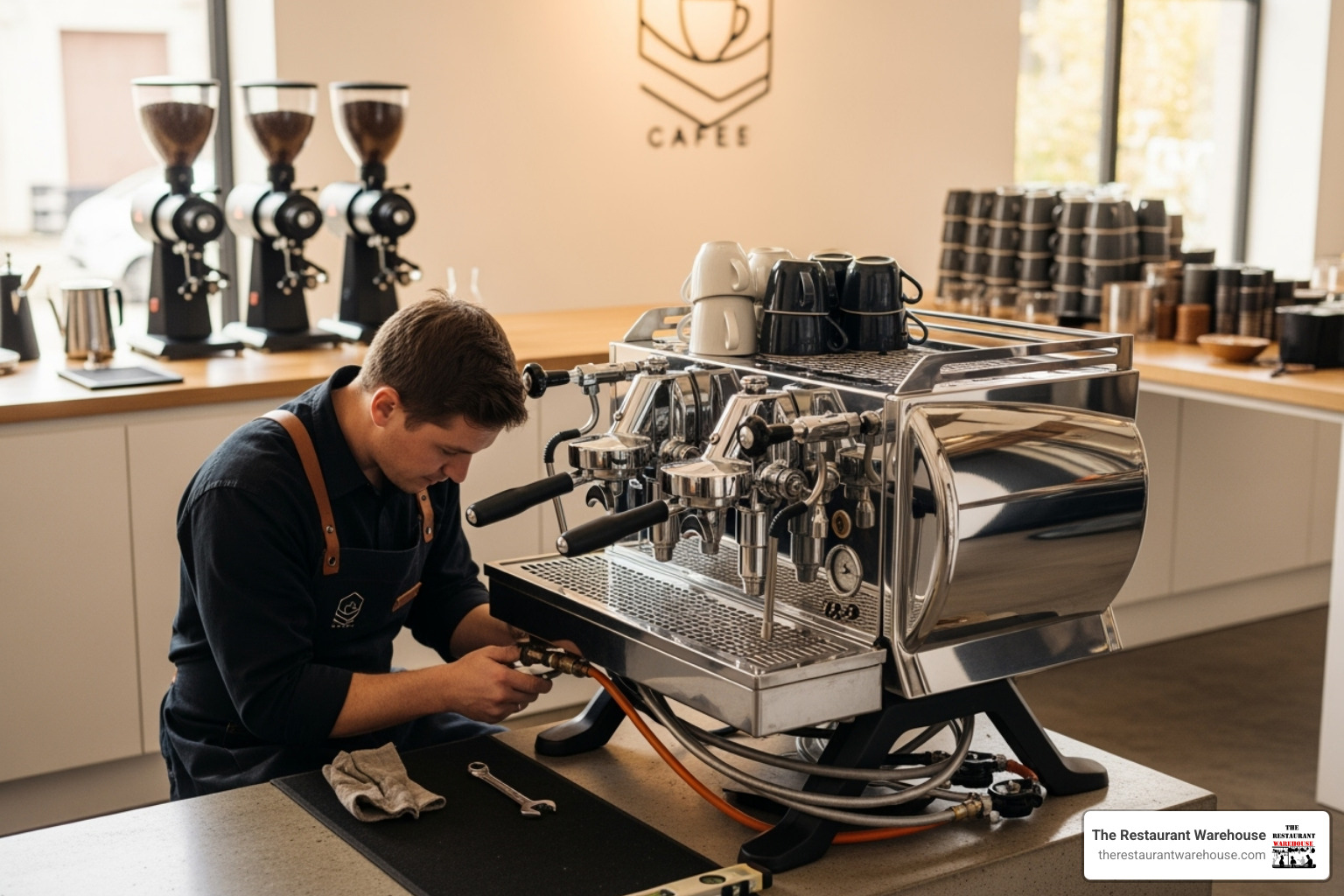
Once the equipment is selected, their technical teams handle professional equipment installation. This is not a simple delivery service. It involves correctly positioning the machinery, ensuring proper electrical and plumbing connections are made, calibrating the equipment to manufacturer specifications, and testing everything to confirm it's running perfectly. Proper installation is key to preventing early malfunctions and ensuring your warranty remains valid.
Ongoing maintenance and technical support are arguably the most valuable services. A broken espresso machine during the morning rush can be catastrophic for a day's revenue. A great supplier offers preventative maintenance plans, where technicians regularly service your equipment—descaling boilers, replacing worn-out gaskets, and calibrating grinders—to prevent problems before they start. When emergencies do happen, having access to responsive, knowledgeable technical support and a ready supply of spare parts can be the difference between a minor hiccup and a major crisis.
Furthermore, many suppliers provide comprehensive staff training. This ensures your team not only knows how to operate the equipment correctly and safely but also how to perform daily cleaning and basic maintenance tasks. This empowers your staff to take ownership of the equipment's health, extending its lifespan and improving performance. For larger or more complex projects, suppliers may offer dedicated project support and site visits, acting as a consultant to guide you through every phase, from initial concept to grand opening.
You'll find more insights on comprehensive supplier support in our guide to Best Catering Suppliers.
Expert Guidance and Training
A great supplier doesn't just drop off boxes at your door. They invest in your success by sharing their industry knowledge. This guidance is invaluable, especially when you're figuring out how to outfit a new cafe or upgrade an existing one. They act as a true partner, offering expert advice and hands-on training that sets your team up for success from day one. This support transforms a simple purchase into a long-term relationship built on trust and shared goals, ensuring you get the most out of your investment and feel confident in your choices.
Personalized Equipment Consultations
A top-tier supplier offers personalized consultations to help you select equipment that perfectly fits your business. Instead of pushing the most expensive model, they take the time to understand your menu, your projected customer volume, and the physical constraints of your space. This guidance is crucial for avoiding common pitfalls, like buying a refrigerator that's too small or an espresso machine that can't handle your morning rush. The right supplier acts as your one-stop shop, a strategic move that saves you countless hours of research and vendor coordination. They help you build a cohesive and efficient equipment package that works for your budget and your operational needs.
Hands-On Equipment Training
Beyond the initial setup, many suppliers provide comprehensive staff training. This is a game-changer for your team's confidence and your equipment's longevity. The training covers everything from proper daily operation and safety protocols to essential cleaning and basic maintenance tasks. When your baristas know how to correctly backflush an espresso machine or clean a grinder, it prevents minor issues from becoming major, costly repairs. This empowers your staff to take ownership of the equipment's health, extending its lifespan and improving performance. It’s an investment that pays off through consistent product quality and reduced downtime.
Financing and Leasing Support
Commercial cafe equipment represents a significant capital investment, often one of the largest problems for a new business. Recognizing that cash flow is king, intelligent cafe equipment suppliers provide a range of creative financing and acquisition solutions to make top-tier equipment accessible without crippling your startup budget.
- Leasing Options: Leasing allows you to acquire brand-new equipment for a fixed, predictable monthly payment over a set term (e.g., 2-5 years). This preserves your working capital for other essential expenses like inventory, marketing, and payroll. At the end of the lease term, you often have the option to purchase the equipment for a predetermined price, upgrade to new models, or simply return it. Lease payments are typically considered an operating expense and are often fully tax-deductible.
- Rental Programs & 'Rent-Try-Buy' Models: These offer maximum flexibility, especially for startups or businesses testing a new concept. A 'Rent-Try-Buy' model allows you to rent equipment for a shorter period (e.g., 12 months). This lowers the barrier to entry and lets you prove your business model before committing to a large purchase. A key benefit is that a significant portion of your rental payments (often 60-75%) can be applied toward the final purchase price if you decide to buy. Like leasing, rental payments are also typically 100% tax deductible, providing a cash-flow-friendly way to get started.
These innovative financing options democratize access to high-quality, reliable equipment, removing the immense pressure of large upfront capital expenditures and allowing you to build your dream cafe on a solid, financially sustainable foundation. Our Lease Commercial Kitchen Equipment Guide dives deeper into these valuable financial strategies.
How to Choose the Right Cafe Equipment Supplier
Selecting the right cafe equipment suppliers is one of the most consequential decisions you'll make as a cafe owner. This choice is not merely about finding the lowest price on a machine; it's about forging a long-term partnership that will directly impact your daily operations, product quality, and overall profitability. The right partner can be a catalyst for growth, while the wrong one can become a constant source of frustration and unexpected costs. The key is to approach the selection process with a clear, methodical strategy.
Our Restaurant Supply Guide and guide to Restaurant Equipment Online Stores offer more insight into navigating this critical choice.
Check Their Product Range and Quality
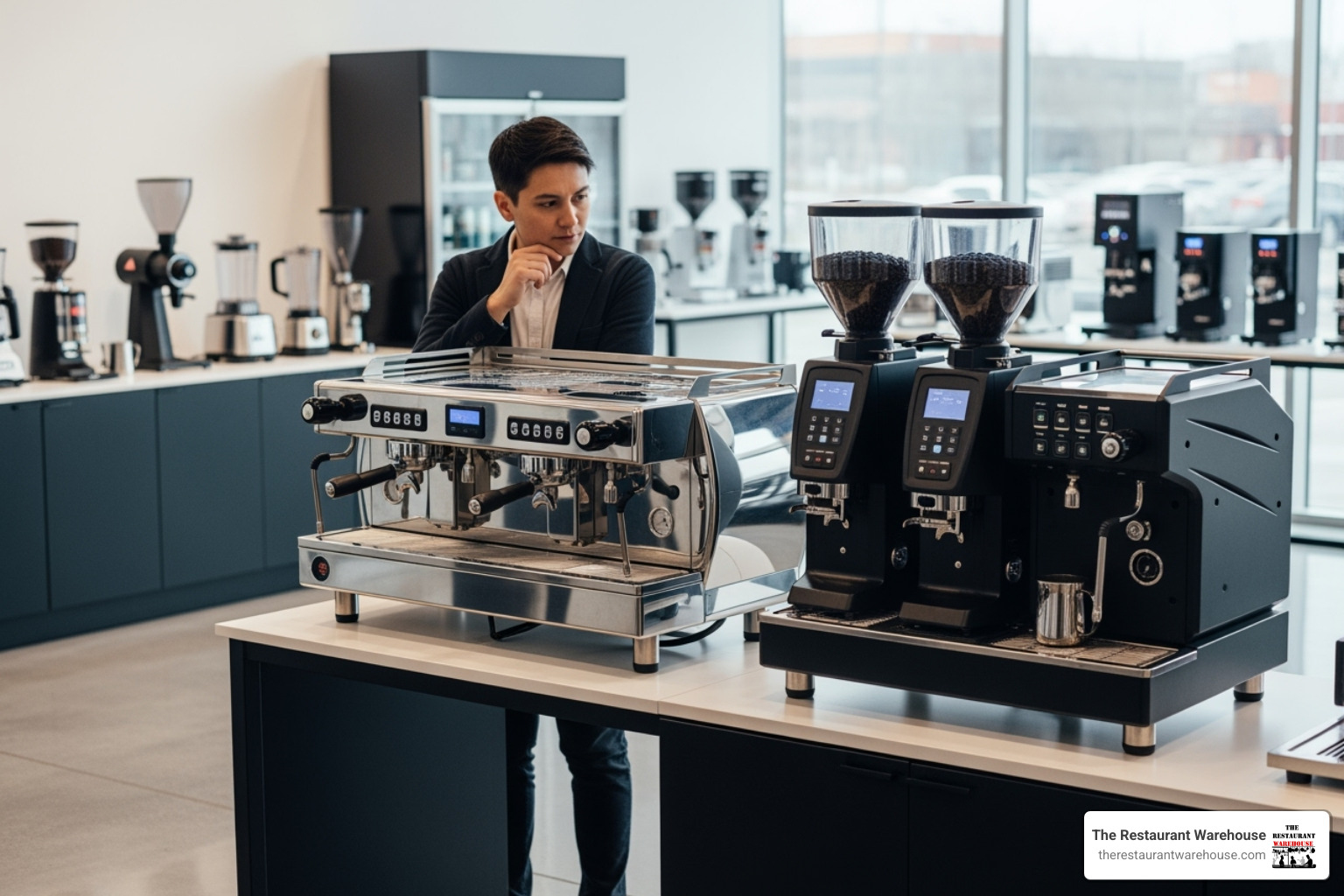
A premier supplier should function as a one-stop shop, saving you the immense hassle of coordinating with multiple vendors. Look for a deep and wide brand variety, offering a spectrum of choices from industry-leading manufacturers to reliable budget-friendly alternatives. This allows you to find the perfect equipment that aligns with your specific concept, volume, and budget. High stock levels and access to a robust supply chain are also critical; you need a partner who can get you a replacement part or an additional piece of equipment quickly, without long lead times. A truly valuable supplier should also have the network to source specialized equipment, whether it's a unique cold brew system or a specific type of display case, to help your cafe stand out from the competition. Always check that the equipment carries necessary certifications like NSF for sanitation and UL for safety. See the Top Commercial Kitchen Brands quality manufacturers work with.
Look for Established Brands and Variety
Your supplier should act as a true one-stop shop, offering a wide variety of established brands. This saves you from the headache of juggling multiple vendors for different needs. Look for a supplier that provides a spectrum of choices, from premium, industry-leading names to reliable, budget-friendly alternatives. This flexibility allows you to mix and match equipment to fit your budget without compromising on quality for key items. For instance, you might invest in a top-tier espresso machine but choose a more economical prep table. A deep inventory across all categories, from refrigerators to blenders, is also a must. It signals that they can quickly get you what you need, minimizing downtime if a piece of equipment fails. When you shop restaurant equipment, always confirm that items have the necessary NSF and UL certifications to meet health and safety codes.
Look Beyond the Price Tag: Evaluating Overall Value
While price is an important factor, the cheapest option is rarely the best value. A savvy buyer focuses on the bigger picture. Wholesale vs. retail pricing can have a dramatic impact on your startup costs. At The Restaurant Warehouse, we offer true wholesale pricing by operating with a lean business model, cutting out the high commissions and expensive retail showroom overhead that inflate prices elsewhere. Inquire about bulk discounts on packages or consumables like cups and syrups, which can lead to significant long-term savings. It's crucial to clarify the total cost of acquisition to avoid hidden fees. Ask specifically about charges for crating, liftgate services for delivery, inside delivery, and installation. Finally, always evaluate the long-term value. A slightly more expensive machine from a reputable brand known for its reliability will almost always save you money in the long run by avoiding costly repairs and revenue-killing downtime.
How Good Is Their Customer Service and Support?
This is the area that truly defines a supplier as a partner. Excellent, responsive service is non-negotiable. You need access to expert advice from a sales team that possesses deep knowledge of the foodservice industry, not just a catalog. Test their responsiveness during the inquiry phase; if they are slow to respond to a potential sale, imagine how they'll be when you have an urgent problem. The most critical element is after-sales support. Before you buy, understand their process for troubleshooting, sourcing spare parts, and handling warranty claims. A great supplier will advocate on your behalf with the manufacturer. Check their warranty handling policies—do they have their own technicians, or do they simply refer you to a third party? Read online reviews and, if possible, ask for references from other local cafes to see what other businesses are saying.
Understanding Delivery Times and Service Areas
Efficient and reliable logistics are vital to getting your cafe open on time. Look for a supplier with clear, transparent shipping costs and policies. Many offer incentives like free shipping over a certain order value, which can add up to substantial savings. Delivery speed is another key consideration. Suppliers with multiple distribution centers and policies like same-day dispatch can be a lifesaver when you need something urgently. If you plan to expand, consider a supplier with national coverage to ensure you receive consistent pricing and service as your business grows. Finally, check for local pickup options. If you are located near one of their warehouses, picking up equipment yourself can save you hundreds of dollars in shipping fees and give you more control over the timing.
Shipping Policies for Freshness
While you might associate "freshness" with your coffee beans, the principle of receiving goods in perfect condition is universal. For equipment, this translates to integrity on arrival. A supplier's shipping policy is a direct reflection of their commitment to quality. Look for partners who detail their process for crating heavy machinery and insuring shipments against damage. A clear, straightforward process for reporting and resolving any transit damage is non-negotiable. This ensures your new freezer or display case arrives ready for installation, not as a logistical headache. Suppliers who understand the full scope of cafe operations, including consumables, often have the most thoughtful policies, which is a great indicator of a customer-focused partner.
Delivery Costs and Incentives
The price on the website isn't always the final price you'll pay, as shipping can add a significant amount to your total investment. The best suppliers are completely transparent about their delivery costs. Before you commit, ask for a full breakdown of potential charges, including fees for liftgate service or residential delivery. More importantly, look for partners who offer cost-saving incentives. Many suppliers provide free shipping on orders that meet a certain threshold, which can save you hundreds, if not thousands, of dollars. This is a huge advantage when you're trying to manage a tight budget. Smart financial planning is key, and finding a supplier who helps you control costs is a critical part of your equipment financing strategy.
How to Pay for Your Cafe Equipment
Launching a successful cafe requires a substantial capital investment, with equipment often being the largest line item. However, a massive upfront cash payment is not the only path to securing the high-quality machinery you need. Astute cafe equipment suppliers provide a range of flexible acquisition models designed to help you manage cash flow effectively, allowing you to equip your cafe for success without depleting your financial reserves from day one.
| Model | Key Features | Best For | Cash Flow Impact | Ownership & Tax Implications |
|---|---|---|---|---|
| Direct Purchase | Full ownership from day one; equipment becomes a balance sheet asset. | Established businesses with ample capital; those with a long-term, fixed vision for their equipment needs. | Large initial cash outlay, which can strain startup capital. No recurring equipment payments. | Full ownership immediately. The asset can be depreciated over time for tax benefits. |
| Leasing | Fixed, predictable monthly payments over a set term (e.g., 2-5 years). Option to buy, upgrade, or return at term end. | Businesses wanting to preserve capital, needing the latest technology, and seeking predictable expenses. | Low initial cost, preserving capital for operations. Predictable monthly operating expense. | No ownership during the lease term. Lease payments are typically 100% tax-deductible as an operating expense. |
| Rent-to-Own | Flexible rental period (e.g., 12 months) with a portion of payments (e.g., 60-75%) credited towards purchase. | New businesses, those uncertain about long-term needs, or those wanting to test equipment before committing. | Minimal upfront cost with manageable weekly/monthly payments. Maximum flexibility. | No ownership during the rental period. Option to gain ownership by exercising the purchase option. Rental payments are also typically tax-deductible. |
For more detailed insights, explore our guide on Buy Commercial Kitchen Equipment.
Option 1: Buying Your Equipment Outright
Direct purchase is the most straightforward acquisition method: you pay the full price upfront and gain immediate, complete ownership of the equipment. The machinery is then listed as an asset on your balance sheet, which you can depreciate over its useful life for a tax advantage. There are no ongoing payments or interest charges to worry about. However, the higher initial cost is a significant barrier for most startups, as it ties up a large amount of cash that could be used for marketing, inventory, or unforeseen expenses. This route is generally best suited for well-capitalized, established businesses or entrepreneurs with deep financial backing and a very clear, long-term vision for their equipment needs.
Option 2: Leasing and Rent-to-Own
These flexible financing models have become game-changers for new and growing cafe owners. Their primary benefit is the preservation of capital through lower upfront costs and predictable monthly payments. This frees up cash for the critical early stages of business. These payments are almost always 100% tax deductible as an operating expense, offering a significant financial advantage over a depreciating asset. Another major benefit is the flexibility to upgrade. At the end of a lease, you can easily acquire the latest, more efficient technology. The Rent-Try-Buy model is particularly powerful for startups, as it allows you to test a specific piece of equipment in your real-world operations. If it's a perfect fit, a large portion of your rental payments contributes to the purchase. If not, you can return it without being locked into a long-term commitment.
Option 3: Choosing Certified Used Equipment
For the budget-conscious entrepreneur, the certified used equipment market offers a treasure trove of value. This is not the same as buying from a private seller on a classifieds site. Reputable suppliers offer professionally refurbished equipment that provides a powerful combination of benefits. The most obvious is significant cost savings, often allowing you to acquire a higher-end, more durable brand and model that would be out of reach if purchased new. Refurbished quality means the equipment has been professionally cleaned, serviced, and rigorously tested by technicians to ensure it meets operational standards. Unlike risky private sales, certified used equipment from a trusted supplier often comes with a limited warranty (e.g., 30-90 days), providing crucial peace of mind. Finally, choosing used equipment is a more sustainable choice, as it extends the life of valuable machinery and reduces waste.
Learn more about maximizing your budget in our Used Commercial Kitchen Equipment Guide.
Frequently Asked Questions about Finding Cafe Equipment Suppliers
Navigating commercial equipment can bring up many questions. Here are detailed answers to the most common queries we hear from both aspiring and experienced cafe owners.
How much does essential cafe equipment cost?
There is no single answer, as costs vary dramatically based on the scale of your operation, brand choices, and whether you buy new or used. However, cafe equipment suppliers can provide a range for planning purposes.
- Espresso Machines: This is typically the largest single investment. A reliable two-group commercial machine, the standard for most cafes, can range from $5,000 to $15,000. High-end, technologically advanced models can exceed $30,000, while smaller one-group units might start around $2,000.
- Commercial Grinders: A high-quality, on-demand espresso grinder is crucial and typically costs between $1,000 and $3,000. A separate grinder for drip or decaf coffee might add another $500-$1,000.
- Brewing & Blending: A good commercial batch brewer can cost $500 to $2,000. A high-performance blender with a sound enclosure will likely be in the $500 to $1,500 range.
- Refrigeration & Ice: An undercounter milk fridge can cost $1,000-$3,000. A glass-door display case can range from $1,500 to $5,000+. An ice machine appropriately sized for a cafe can cost anywhere from $1,500 to $5,000, depending on production capacity.
Costs are influenced by new versus used, brand reputation, and the specific features and capacity. The cheapest initial price is not always the best long-term value; focus on equipment that reliably meets your projected business volume.
Should I buy new or used cafe equipment?
Both strategies have distinct advantages. New equipment provides the peace of mind of a full manufacturer's warranty, the latest technology for efficiency and performance, and pristine aesthetics. However, it comes at a significantly higher upfront price. Used equipment offers substantial cost savings, allowing you to stretch your budget further or afford higher-tier brands. It's also a more environmentally sustainable choice. The main risks are the potential lack of a warranty and a shorter operational lifespan, which could lead to repair costs sooner.
A highly recommended middle ground is certified used equipment from a reputable supplier. This equipment is typically only a few years old, has been professionally inspected, serviced, and tested by technicians, and often comes with a limited warranty (e.g., 30-90 days). This option mitigates much of the risk of buying used while still providing significant savings compared to new.
What's the difference between a supplier and a manufacturer?
A manufacturer (e.g., La Marzocco, Vitamix, Hoshizaki) is the company that designs, engineers, and builds the equipment. They are the source of the product. A cafe equipment supplier (or dealer/distributor) is a business that sells equipment from various manufacturers. Think of the supplier as the specialized retailer. The best suppliers don't just sell; they curate a selection of brands, offer expert advice on which product fits your needs, handle logistics, and provide after-sales support and service. While you can sometimes buy direct from a manufacturer, a supplier offers a much broader selection and can be your single point of contact for an entire kitchen package.
What should I know about warranties and repairs?
The warranty is extremely important—it's your primary protection against defects and premature failure. Before purchasing, you must understand the warranty's length, what it covers (parts, labor, or both), and its exclusions. A key question for your supplier is: "How do you handle warranty claims?" A great supplier will act as your advocate. They will have a dedicated process to help you file the claim with the manufacturer and will assist in coordinating service from a certified technician. A less helpful supplier might simply give you a phone number and leave the entire process up to you. This level of support can be a major differentiating factor.
Do these suppliers only serve cafes?
Not at all. While they have deep expertise in the needs of a coffee shop, their inventory and services are applicable to the entire foodservice industry. Their client base is diverse and typically includes:
- Restaurants of all sizes and concepts
- Catering companies requiring mobile and durable equipment
- Food trucks needing compact, high-efficiency gear
- Bakeries and pastry shops
- Bars and pubs
- Hotels with food and beverage programs
- Schools, hospitals, and corporate cafeterias
Essentially, any commercial operation that prepares and serves food or beverages can benefit from the products, pricing, and expertise offered by a comprehensive equipment supplier. Our Commercial Bakery Equipment Guide and Food Truck Equipment Guide illustrate the versatility of these suppliers.
Finding the Right Partner for Your Cafe's Success
Opening, running, or upgrading a cafe is a complex endeavor that beautifully merges the art of coffee with the science of business. Throughout this guide, we've explored the critical role that cafe equipment suppliers play in this journey. They are far more than simple vendors or online storefronts; the right suppliers evolve into indispensable partners, providing the foundational tools and support systems necessary for your cafe to thrive in a competitive market.
A truly great supplier helps you steer every stage of the process. They provide expert guidance in selecting the ideal brewing equipment, designing an efficient workflow, and securing the right consumables. They offer value-added services like professional installation, crucial staff training, and ongoing maintenance that protect your investment and prevent costly downtime. Furthermore, they understand the financial realities of the foodservice industry and provide flexible financing, leasing, and rental options that make top-tier equipment accessible.
The most important takeaway is that choosing your supplier is a long-term strategic partnership. When making your decision, prioritize suppliers who demonstrate a deep understanding of your business, offer a comprehensive range of quality products, maintain transparent and fair wholesale pricing, and have a proven track record of exceptional, responsive customer support.
At The Restaurant Warehouse, we are built on the principle of being that strategic partner for cafe owners. We provide a vast selection of commercial restaurant equipment and food service supplies at true wholesale prices. By eliminating high sales commissions and the expensive overhead of traditional retail showrooms, we ensure that you never have to compromise between quality and affordability.
Whether you are drafting the business plan for your very first cafe or expanding a successful operation, forging the right supplier partnership will provide the stability and confidence you need. It allows you to focus your energy on what truly matters most: crafting exquisite coffee and creating unforgettable moments for your customers, one perfect cup at a time.
Ready to build the cafe of your dreams? Explore our comprehensive commercial kitchen equipment guide and find how our partnership approach and wholesale pricing can turn your vision into a reality.
Making the Call: Why New Equipment is Often Recommended
While certified used equipment offers a fantastic way to manage a tight budget, there are compelling reasons why investing in new machinery is often the recommended path for long-term success. The primary advantage is unmatched reliability. New equipment comes straight from the factory with no wear and tear, no hidden history of neglect, and no surprise breakdowns waiting to happen during your busiest hours. This peace of mind is invaluable, as unexpected downtime can cost you far more in lost revenue and reputation than the initial savings from a used machine. Every piece of new equipment is also backed by a full manufacturer's warranty—your ultimate safety net against defects.
This protection, covering parts and labor, ensures that any early issues are resolved without draining your operational budget. Modern equipment also brings the latest advancements in energy efficiency and performance, leading to lower utility bills and a more consistent, high-quality product for your customers. When you shop for restaurant equipment, viewing the initial purchase as an investment in stability and future growth often makes new the smartest choice. For those looking to get the benefits of new equipment without the large upfront cost, exploring restaurant equipment financing can be a great way to manage cash flow effectively.
Key Takeaways
- Look for a Partner, Not Just a Price Tag: A great supplier invests in your success with services like layout design, professional installation, and ongoing technical support, which is far more valuable than simply finding the lowest initial price.
- Think Beyond the Espresso Machine: Your cafe's efficiency depends on a complete equipment package. Plan for everything from quality grinders and blenders to the right refrigeration and smallwares to support your full menu and ensure a smooth workflow.
- Protect Your Cash Flow with Smart Financing: Avoid draining your startup capital by exploring leasing or rent-to-own options. These programs let you get the high-quality equipment you need with manageable monthly payments, freeing up funds for inventory and marketing.
Related Articles
About The Author

Sean Kearney
Sean Kearney is the Founder of The Restaurant Warehouse, with 15 years of experience in the restaurant equipment industry and more than 30 years in ecommerce, beginning with Amazon.com. As an equipment distributor and supplier, Sean helps restaurant owners make confident purchasing decisions through clear pricing, practical guidance, and a more transparent online buying experience.
Connect with Sean on LinkedIn, Instagram, YouTube, or Facebook.