

The Ultimate Guide to Countertop Sandwich Prep Stations
Don't let the name fool you; this piece of equipment is one of the most versatile tools you can add to your kitchen. While it’s perfect for assembling sandwiches, a countertop sandwich prep station is a workhorse for so much more. It can be an efficient salad bar, a build-your-own burrito bowl station, or an organized topping station for tacos and desserts. By keeping a wide variety of ingredients chilled, safe, and ready to go, it opens up new possibilities for your menu. This guide will help you understand the different models and features available for your business.
Your Guide to Countertop Sandwich Prep Stations
A countertop sandwich prep station is a vital piece of equipment for any foodservice business preparing sandwiches, salads, or other cold items, helping you work smarter, not harder.
Here's why a countertop sandwich prep station is a smart choice:
- Combined Cold Storage and Workspace: It keeps fresh ingredients chilled and ready right at the prep area, reducing trips to the refrigerator.
- Improved Workflow: With ingredients at your fingertips, you can assemble orders quickly, speeding up service during peak hours.
- Guaranteed Food Safety: Built-in refrigeration maintains safe temperatures (33°F to 41°F), protecting customers and ensuring health code compliance.
- Space Efficiency: These units sit on existing counters, making them ideal for smaller kitchens or food trucks where space is a premium.
This guide will help you understand the types, features, and benefits of these essential units, showing you how to choose the right one to improve operations and satisfy customers.
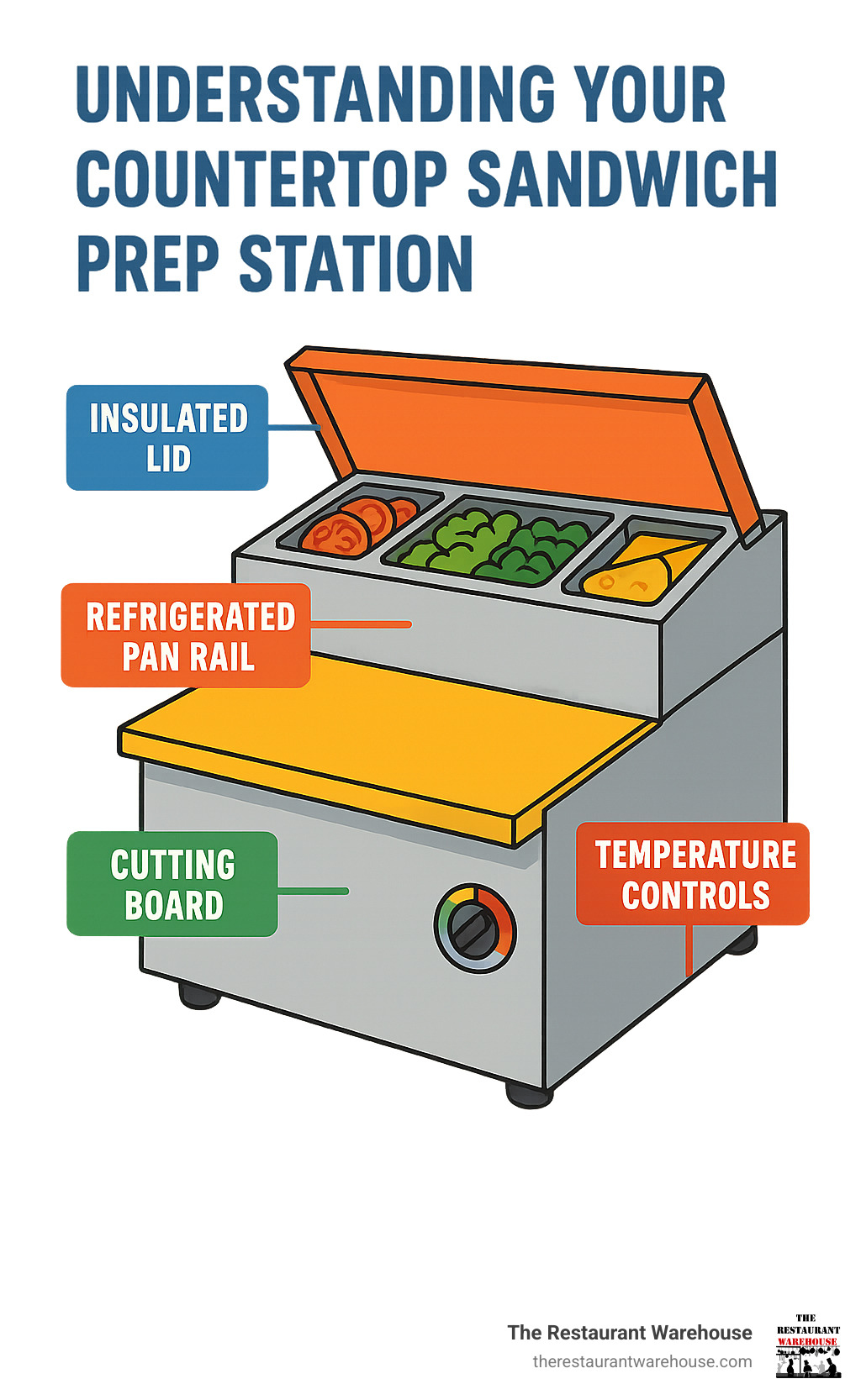
What Is a Countertop Prep Station & Why Your Kitchen Needs One
During a lunch rush, scrambling between the cooler and prep area for ingredients slows down service. A countertop sandwich prep station solves this by becoming your kitchen's command center. It's a compact, refrigerated workstation that keeps fresh ingredients organized and chilled right where you need them. Everything from lettuce and tomatoes to deli meats and cheeses is held at the perfect temperature, just an arm's reach away.
These units combine three essential functions: organization, with a designated spot for every ingredient; food safety, by keeping perishables in the critical 33°F to 41°F zone; and workflow improvement, by eliminating unnecessary trips for ingredients. This efficiency can cut assembly time in half, leading to happier customers and a less stressed staff. It also promotes consistency in recipes and reduces food waste.
More info about Sandwich Prep Tables
Refrigerated or Non-Refrigerated: Which Is Right for You?
When choosing a countertop sandwich prep station, the main decision is between refrigerated and non-refrigerated models.
Refrigerated models are the standard for commercial kitchens. They feature cooling systems that maintain precise temperatures between 33°F and 41°F, which is crucial for perishable ingredients like deli meats, cheeses, and vegetables. This temperature control is essential for food safety and quality. These units are ideal for any operation serving fresh ingredients, from delis and cafes to food trucks, as their advanced airflow systems maintain consistent temperatures even during busy periods.
Non-refrigerated models are simpler, offering organization without active cooling. They consist of a cutting board and pan rails, suitable for ingredients that don't require refrigeration, such as condiments or dry seasonings. They are also an option for operations with extremely fast ingredient turnover.
The choice is clear for most businesses. Refrigerated units cost more and require electricity, but they are essential for meeting food safety standards and maintaining ingredient quality. Non-refrigerated units are budget-friendly but severely limit the types of ingredients you can safely store. For any commercial operation, the holding temperatures provided by refrigerated models are mandatory for protecting customers and complying with health regulations.
Standard vs. Mega-Top: What's the Difference?
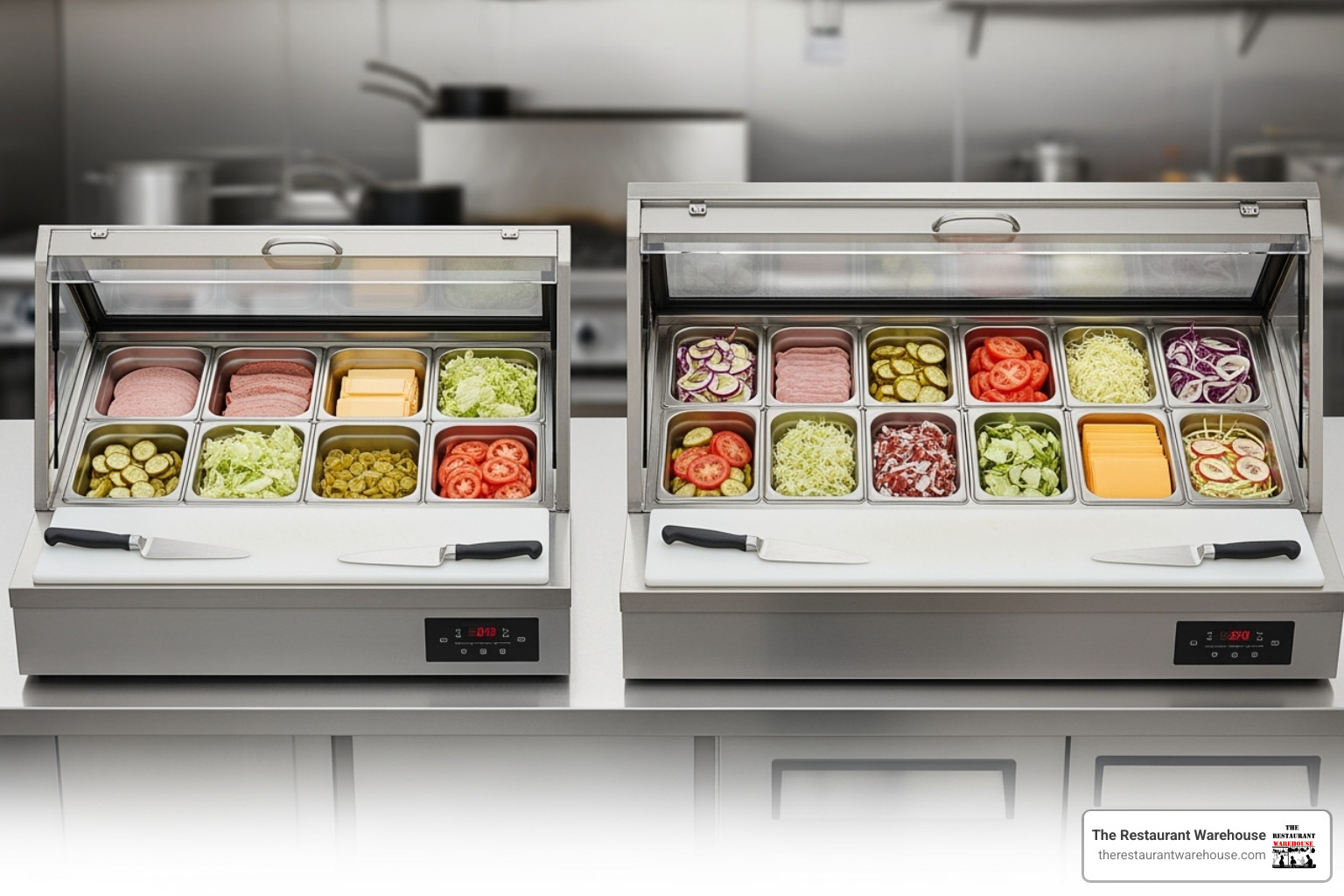
After choosing a refrigerated model, consider the pan capacity by selecting a standard or mega-top design.
Standard prep stations have a single row of food pans (typically 1/6 size) behind the cutting board. This setup is effective for businesses with focused menus or moderate volume, providing space for essential ingredients in a clean, space-efficient layout.
Mega-top designs expand the refrigerated pan rail to accommodate two or more rows of pans. The increased ingredient variety is a major advantage for businesses offering extensive customization. More pans also mean less frequent refilling, reducing downtime during peak hours and creating a smoother workflow. A busy deli with a mega-top countertop sandwich prep station allows a team member to assemble any order without moving, boosting efficiency and customer satisfaction. The trade-off is a larger footprint, but the consolidated storage often proves more space-efficient than multiple smaller units.
More info about Freshness on Demand: Top Commercial Prep Fridge Options
Sandwich Prep vs. Pizza Prep: Key Differences
While they both keep ingredients chilled, sandwich and pizza prep tables are designed for different workflows.
The primary difference is cutting board depth. Countertop sandwich prep stations have cutting boards around 8-10 inches deep, ideal for assembling sandwiches or salads. Pizza prep tables feature much deeper boards (12+ inches) to accommodate large pizza dough.
Pan size compatibility is also distinct. Sandwich stations are optimized for 1/6 size pans, perfect for organizing a wide variety of ingredients like sliced meats, cheeses, and vegetables. This setup aids in portion control and prevents cross-contamination. Pizza prep tables use larger 1/3 size pans to hold bulk ingredients like shredded cheese and pepperoni, reducing the need for refills during high-volume service.
These workflow differences are critical. Sandwich prep stations support detailed, customized work, while pizza prep tables are built for a more expansive creation process. Choosing the wrong type will hinder your kitchen's efficiency.
More info about Pizza Prep Tables
How to Choose the Right Countertop Sandwich Prep Station
Choosing the right countertop sandwich prep station requires balancing key features with your specific needs. Focus on fundamentals like temperature control for food safety, material quality for longevity, energy efficiency for lower operating costs, and proper certifications to meet health codes. The best unit fits your kitchen's workflow, whether you run a small café, busy deli, or food truck.
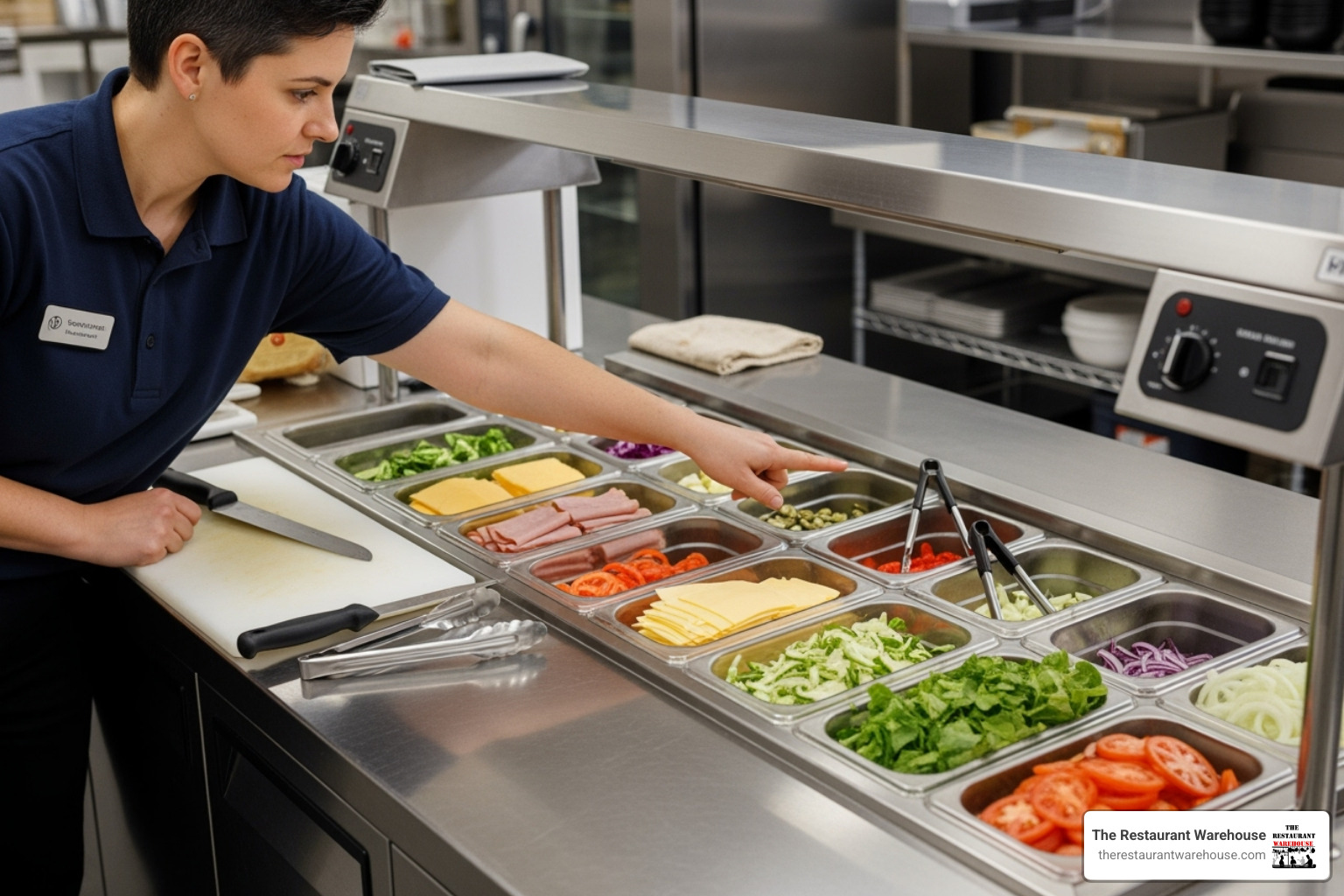
More info about Choosing Sandwich Prep Station
Must-Have Features for Your Prep Station
Your countertop sandwich prep station's performance depends on key features working together:
- Digital temperature controls provide precise readings and maintain the safe zone of 33°F to 41°F, ensuring health code compliance
- Quality airflow systems circulate cold air evenly, preventing warm spots and maintaining ingredient quality
- Removable cutting boards enable thorough cleaning to eliminate cross-contamination
- Insulated lids and hoods lock in cold air and protect ingredients when not in use
- Consider pan compatibility - most units use standard 1/6 size pans, but some accommodate deeper 4" or 6" pans for high-volume ingredients
Additional performance considerations include pan-rail cooling methods with forced-air distribution, lid design options (full-length integrated vs. individual hinged), digital controllers with high-temp alarms, and effective condensate management systems. According to FDA food safety guidelines, maintaining proper cold holding temperatures is critical for preventing foodborne illness.
Lid Options: Insulated Covers vs. Glass Sneeze Guards
The type of lid on your countertop prep station plays a huge role in both food safety and kitchen efficiency. It’s not just a cover; it’s a functional part of your workflow. The two main choices you’ll encounter are insulated covers and glass sneeze guards, and each serves a very different purpose. Choosing the right one depends entirely on where and how you’ll be using the unit. An insulated cover is perfect for a back-of-house setup focused on speed and temperature control, while a sneeze guard is essential for any customer-facing operation where presentation and hygiene are on display.
Insulated lids are designed to do one thing exceptionally well: lock in cold air. When your prep station isn't in use, a solid, insulated cover keeps the refrigerated compartment at the optimal temperature, ensuring your ingredients stay safely within the 33°F to 41°F range. This is non-negotiable for meeting health codes and preserving the quality of your perishables. By minimizing how much cold air escapes, these covers also help the refrigeration system work more efficiently, which can lead to lower energy bills over time. This makes them the standard choice for kitchens where the prep station is purely for staff use.
Glass sneeze guards, on the other hand, are all about protection and presentation. They create a clear barrier that shields food from airborne contaminants while allowing customers to see all the fresh, delicious ingredients you have to offer. This is a must-have for build-your-own sandwich bars, salad stations, or any front-of-house setup. These guards are typically made from tough materials like tempered glass or polycarbonate, which is known to be incredibly impact-resistant. When you need to combine food safety with customer appeal, a sneeze guard is the clear winner for your restaurant equipment lineup.
Why Construction and Durability Matter
In commercial kitchens, your countertop sandwich prep station must be durable. Stainless steel construction is the industry standard, resisting corrosion from moisture and food acids while providing a smooth, non-porous surface that's easy to clean and sanitize. This corrosion resistance and ease of cleaning are critical in demanding kitchen environments.
Some units feature aluminum liners on the interior - a practical choice that's lighter than steel while offering excellent corrosion resistance. The most important quality marks are certifications from organizations like NSF, which verify that the unit meets strict public health standards.
What to Know About Certifications and Energy Use
Beyond basic construction, official certifications provide assurance of safety, sanitation, and efficiency, which are critical for both compliance and cost savings.
- NSF Certification: The most recognized mark in foodservice, NSF certification from the National Sanitation Foundation means a unit has been rigorously tested for public health and safety. This goes beyond just material safety; it certifies that the unit is designed for easy and thorough cleaning, with features like coved corners and the absence of tight crevices where bacteria could grow. Many local health departments mandate NSF-certified equipment, making it a crucial factor for passing inspections.
- ETL Sanitation Mark: Similar to NSF, the ETL Sanitation Mark is another Nationally Recognized Testing Laboratory (NRTL) certification. It verifies that equipment meets the same NSF/ANSI standards for sanitation. Seeing either an NSF or ETL mark confirms the unit is designed for commercial food safety.
- ENERGY STAR Certification: For refrigerated equipment, the ENERGY STAR label is a key indicator of energy efficiency. This program, run by the U.S. Environmental Protection Agency, certifies products that are significantly more energy-efficient than standard models. An ENERGY STAR certified prep station can use 30-40% less energy through features like high-efficiency compressors, advanced fan motors, and superior insulation. While they may have a slightly higher initial cost, the long-term savings on utility bills are substantial, and some utility companies offer rebates for purchasing certified equipment.
Common Electrical Requirements
Before you decide on the perfect spot for your new prep station, let's talk about power—it’s a small detail that can make a huge difference. Most commercial countertop sandwich prep stations run on a standard 115-Volt connection, which powers the refrigeration system keeping your ingredients fresh and safe. It's essential to plug the unit directly into its own dedicated outlet. I know it can be tempting to grab an extension cord, but you should avoid them completely, as they can create serious electrical hazards and even damage your new equipment. Taking a moment to confirm your kitchen's electrical setup can support the unit is a key step for maintaining operational efficiency and safety from day one.
How to Find the Right Size for Your Kitchen
Sizing your countertop sandwich prep station correctly avoids frustration and wasted space. First, measure available counter space, ensuring clearance for ventilation and cleaning. Your menu complexity and business volume determine capacity needs - simple menus require smaller units, while build-your-own concepts need greater pan capacity needs.
This table breaks down common sizes:
| Width (Inches) | Typical Pan Capacity (1/6 size) | Footprint Consideration | Ideal Use Case |
|---|---|---|---|
| 27-32 | 8-12 | Compact | Small cafes adding a lunch menu, food trucks with limited space, or as a secondary station for specific items like salads. |
| 40-48 | 12-18 | Medium | Busy delis, mid-sized restaurants with a popular sandwich/salad menu, or ghost kitchens handling moderate order volumes. |
| 55-60 | 18-24 | Large | High-volume sandwich shops, university cafeterias, or kitchens where two staff members may work at the station simultaneously. |
| 71-72 | 24-30 | Extra Large | Large-scale institutional food service, busy catering operations, or central kitchens preparing items for multiple locations. |
A larger initial investment can pay for itself through improved efficiency and reduced labor costs. Consider ingredient variety versus refill frequency, workflow zoning for multiple staff, and future menu expansion when selecting your size.
Understanding Pan Capacity with Real Examples
When you're selecting a countertop sandwich prep station, its pan capacity is one of the most important factors for an efficient workflow. Most units are designed for standard 1/6 size pans, which are ideal for organizing a wide variety of ingredients like sliced meats, cheeses, and vegetables. This setup not only helps with portion control but also minimizes cross-contamination. The number of pans a unit can hold directly relates to its size; for instance, a compact 40-inch station might hold six pans, while a larger 71-inch model could accommodate eight or more. A higher capacity allows you to offer a more complex menu and reduces the need for constant restocking during peak hours. Ultimately, matching the pan capacity to your menu and volume is how you ensure you're choosing the right restaurant equipment for your kitchen.
Top Brands in the Market
When you start shopping for a countertop sandwich prep station, you'll see a few key brands. The market has everything from premium manufacturers to affordable newcomers, so understanding the main players helps you match a unit to your budget. High-end brands like True Manufacturing and Beverage-Air are built for intense use, while Delfield and Turbo Air offer a great balance of performance and price. For new businesses or those watching their budget, brands like Koolmore provide reliable functionality without the premium cost, ensuring there's a solid option for every kitchen.
Trusted Names like True Manufacturing and Beverage-Air
For kitchens where equipment failure is not an option, True Manufacturing and Beverage-Air are the industry benchmarks. These brands have built a reputation for producing durable, high-performance refrigeration that can withstand demanding environments. Their prep stations are engineered for precise temperature consistency and longevity, featuring powerful compressors and heavy-duty stainless steel construction. While they come with a higher price tag, many chefs consider them a long-term investment in reliability that minimizes downtime and future repair costs.
Quality Options from Delfield, Turbo Air, and Arctic Air
For a balance of price and performance, several brands deliver excellent quality and innovative features. Delfield and Turbo Air are widely recognized for their reliable and efficient prep stations that offer great value, often including thoughtful design elements that improve workflow. Arctic Air is another strong contender, providing dependable commercial refrigeration for many restaurants and cafes. These brands are a fantastic choice for businesses that want high-quality performance without committing to the highest price point, offering a balanced and dependable solution.
Affordable and Reliable Choices like Koolmore
Starting a new restaurant or managing a tight budget doesn't mean you have to compromise on essential functions. Brands like Koolmore specialize in providing affordable and reliable equipment that gets the job done. These prep stations offer core features like consistent cooling and durable construction at an accessible price, making them a great fit for smaller cafes or food trucks. We believe in making quality accessible, which is why we offer dependable brands that provide great value, ensuring you can shop for restaurant equipment that fits your budget without sacrificing performance.
Where to Find Your Prep Station
Once you know the features and brands you want, the next step is knowing where to look. You can find countertop sandwich prep stations at specialized restaurant supply stores or large online marketplaces. Each has its advantages, from expert advice at a specialist to the vast selection on a major retail site. The key is to find a supplier that has the product you need and also offers the support and pricing that works for your business. Exploring your options will help you make a confident purchase and find the perfect unit for your kitchen.
Shopping at Restaurant Supply Stores
Restaurant supply stores are an excellent resource because they cater specifically to the foodservice industry. Whether you visit a showroom or browse an online store, you'll find a curated selection of commercial-grade equipment. The staff often have deep product knowledge and can offer practical advice to help you choose the right unit. Online suppliers like The Restaurant Warehouse combine this expertise with convenience. We offer a wide range of refrigerators and prep tables, and our focus on affordability ensures you get competitive pricing on quality equipment designed for professional kitchens.
Shopping Online: From Major Retailers to Specialists
The internet offers many options for purchasing kitchen equipment. Major online retailers like Amazon carry some commercial prep stations, offering convenience and fast shipping. However, buying from a specialist often provides a better experience. Specialists understand the nuances of commercial kitchens, from electrical requirements to health code certifications, and have more robust customer support. Dedicated suppliers can also offer flexible purchasing options, such as restaurant equipment financing, which helps you manage cash flow while getting the high-quality tools your business needs.
Using Filters to Find the Perfect Fit
With so many choices available online, using search filters is key to an efficient shopping experience. Start by filtering by physical dimensions to ensure the unit will fit your counter space. From there, you can narrow your options based on essential criteria like brand, price, or specific features such as pan capacity or certifications like NSF and ENERGY STAR. Taking a few moments to apply these filters will transform a long list of products into a manageable selection of prep stations that meet all your critical requirements, making your final decision much easier.
Getting the Most Out of Your Prep Station
Investing in a countertop sandwich prep station is just the first step - maximizing ROI requires proper care, understanding cost factors, and using it to boost kitchen efficiency. A well-maintained unit saves time and money for years.
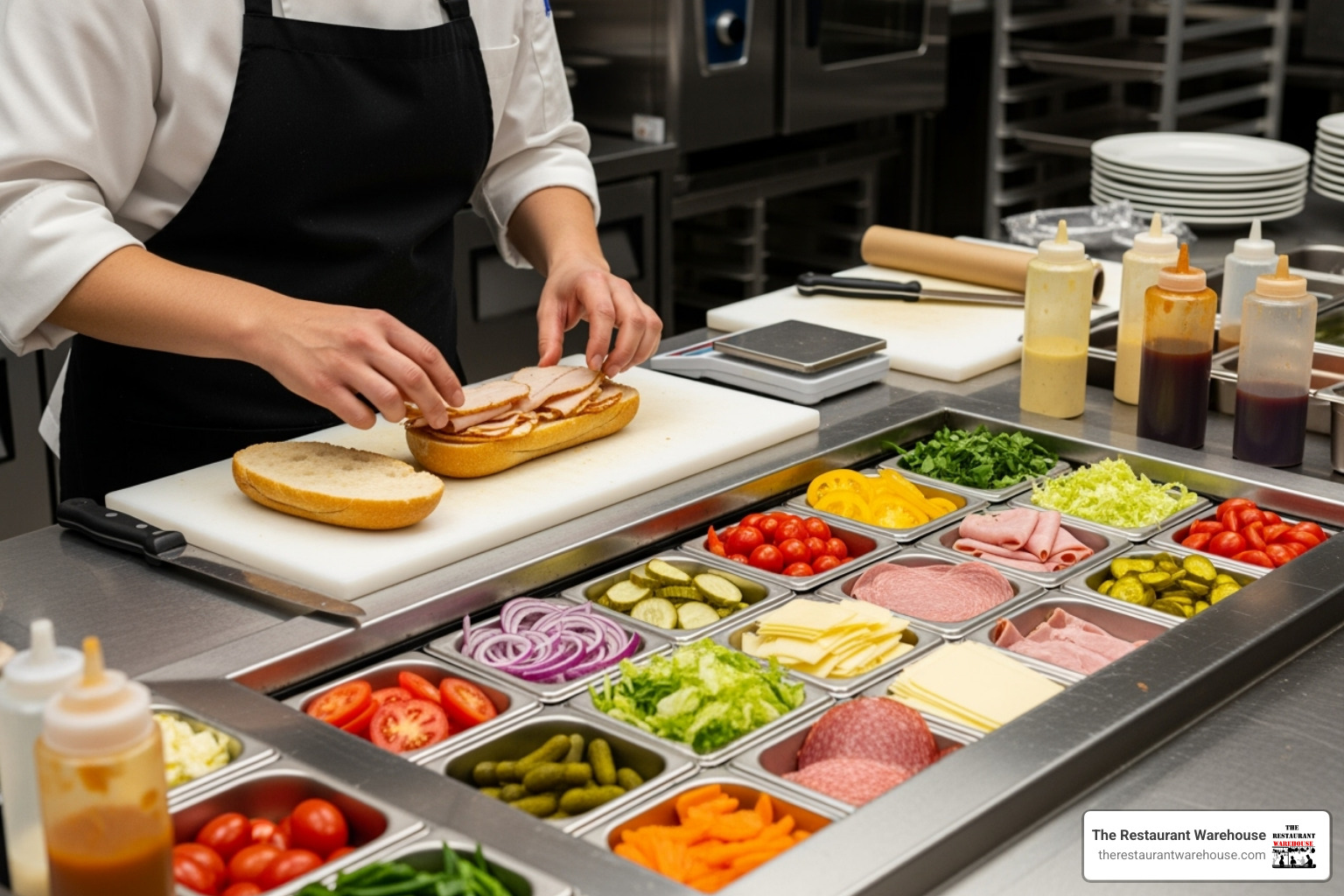
Simple Maintenance to Keep Your Station Running
Consistent maintenance is non-negotiable. It ensures your unit runs efficiently, maintains food-safe temperatures, and lasts for its full expected lifespan. Neglecting maintenance leads to higher energy bills, costly repairs, and potential health code violations. Here is a detailed maintenance schedule:
Daily Tasks:
- Sanitize all food contact surfaces, including the cutting board, pan rail, and lids, with a food-safe cleaner.
- Wipe down the unit's exterior and handles.
- Check that door gaskets create a proper seal to prevent cold air loss.
- Empty and clean the condensate evaporator pan, if accessible.
Weekly Tasks:
- Remove all food pans and wash, rinse, and sanitize them thoroughly.
- Deep clean the interior of the pan rail.
- Remove and deep clean the cutting board to remove any stains or embedded particles.
- Clean the condenser coils. This is one of the most critical tasks. Use a stiff brush or vacuum to remove dust, grease, and debris. Clogged coils force the compressor to work harder, wasting energy and leading to premature failure.
- Inspect gaskets closely for any cracks, brittleness, or tears. A poor seal is a major source of energy waste.
Monthly Tasks:
- Use a calibrated external thermometer to verify temperature accuracy. Ensure the unit consistently holds between 33°F and 41°F.
- Check and tighten any loose hardware, such as door hinges, handles, and legs.
More info about Sandwich Prep Table Maintenance
Quick troubleshooting guide:
- Rail won't maintain temperature: Clean coils, clear airflow, reduce product load
- Frost forming: Allow complete defrost, dry components thoroughly
- Excess condensation: Inspect gaskets, verify setpoint
- Unusual noise: Check fan area, tighten hardware, re-level feet
How Much Does a Countertop Sandwich Prep Station Cost?
Prices vary from a few hundred to several thousand dollars. At The Restaurant Warehouse, we offer wholesale pricing by cutting out the middleman. Key cost factors include:
- Size and Capacity: Larger units cost more than compact models
- Brand and Reputation: Established brands command higher prices
- Features and Technology: Digital controls and superior airflow add cost but improve performance
- Materials and Construction: High-grade stainless steel increases price but offers better durability
- Warranty: Comprehensive coverage reflects manufacturer confidence
Total cost of ownership includes purchase price, energy use (typically a few kWh per day), maintenance supplies, and potential downtime. Keeping coils clean and lids closed reduces operating costs over the unit's lifetime.
Example Pricing for Different Models
To give you a clearer picture, let's look at some real-world examples. A brand like Koolmore offers countertop condiment prep stations perfect for smaller spaces. You might find a 40-inch, three-pan station for around $865, while a larger 71-inch, eight-pan model could be closer to $1,270. Another popular name, Arctic Air, produces commercial-grade refrigerated units; their 40-inch, six-pan model often falls in a similar price range. These figures show how price scales with size and capacity. When you shop for restaurant equipment, you'll see this pattern across all quality brands, allowing you to find a unit that fits both your counter space and your budget.
Additional Costs to Consider
The sticker price is just the beginning; it's smart to think about the total cost of ownership. Refrigerated models have ongoing electricity costs, but this is a non-negotiable expense for maintaining food safety and ingredient quality. Beyond utilities, factor in maintenance supplies like cleaners and brushes for the condenser coils. The biggest hidden cost, however, is potential downtime. A cheap, unreliable unit that breaks during a lunch rush costs you far more in lost sales and reputation than you saved upfront. Investing in a quality unit from a trusted supplier minimizes these risks. If the initial investment feels steep, options like restaurant equipment financing can help you get the right equipment now without compromising your cash flow.
How to Improve Your Kitchen's Workflow
A well-placed countertop sandwich prep station is the physical embodiment of the culinary principle of mise en place (everything in its place). It revolutionizes cold food prep by changing a chaotic scramble into a streamlined, ergonomic process. The primary benefit is reduced prep time; with ingredients chilled and organized in one place, staff eliminate wasted motion during peak hours. This also minimizes cross-contamination with dedicated, refrigerated pans for each ingredient.
Order accuracy improves with clear organization, leading to fewer mistakes and happier customers. Visual organization simplifies staff training, helping new employees learn the menu and workflow quickly. The ergonomics of having ingredients at a comfortable working height reduces physical strain on staff, improving morale and productivity.
Here are operational tactics to amplify throughput and maximize your station's potential:
- Create a Visual Planogram: Design and post a labeled map of the pan rail. This ensures every ingredient has a permanent, logical home, making service intuitive for all staff and simplifying restocking.
- Establish Smart Par Levels: Use sales data to define clear par levels for each ingredient. Prep backups during slower periods and store them in an adjacent reach-in, ready for a quick swap. This prevents running out of a key item mid-rush.
- Implement Strict Allergen Controls: Dedicate specific sections of the rail and distinct, color-coded utensils for common allergens like gluten, dairy, or nuts. This visual system is crucial for customer safety and building trust.
- Practice Economy of Motion: Analyze the build process for your most popular items. Arrange pans to minimize hand travel, placing the most-used items closest to the operator's dominant hand. Shaving seconds off each order adds up to significant labor savings.
- Design a Two-Person Workflow: For larger stations (48" and up), design a workflow that allows two employees to work without crossing over each other. One might handle the sandwich base and proteins, while the other adds vegetables and sauces, effectively doubling throughput during peak times.
Frequently Asked Questions about Countertop Prep Stations
It's natural to have questions when considering a countertop sandwich prep station. We've compiled answers to the most common inquiries to help you make an informed decision for your kitchen.
What is the ideal temperature range for a refrigerated prep station?
The ideal temperature for your countertop sandwich prep station is between 33°F and 41°F. This range is mandated by the FDA food code to keep perishable foods at or below 41°F, which prevents the growth of harmful bacteria. Quality prep stations are engineered to maintain this temperature even when pans are exposed to ambient kitchen air. For best practice, use a separate, reliable thermometer to regularly verify the unit's internal temperature, ensuring you always serve fresh, safe food.
What does NSF-certified mean and why does it matter?
NSF International is an independent organization that sets public health standards for foodservice equipment. An NSF-certified countertop sandwich prep station has passed rigorous testing. This certification guarantees material safety, ensuring that food-contact surfaces won't leach harmful chemicals. It also verifies a design for cleanability, meaning the unit has smooth, accessible surfaces without crevices where bacteria can hide. Many health departments require NSF-certified equipment, so it helps you pass inspections and demonstrates a commitment to food safety.
Can I use a sandwich prep table for salads or other cold food items?
Absolutely. Despite the name, these units are highly versatile. Think of them as a command center for all cold ingredients.
- Salad Preparation: The refrigerated rail is perfect for keeping greens, vegetables, and proteins crisp and safe, creating an efficient salad bar.
- Burrito and Taco Bowls: The organized pans allow for a logical assembly line of rice, beans, meats, salsas, and toppings.
- Topping Stations: They are ideal for serving cold toppings for frozen yogurt, hot dogs, or other build-your-own concepts.
This menu flexibility is a key advantage, allowing your countertop sandwich prep station to adapt as your menu evolves. It's a smart investment for any business wanting to maximize equipment utility.
How much energy do countertop sandwich prep stations use?
Usage varies by size, ambient conditions, and how often the lid is opened. Small countertop rails typically consume a few kilowatt-hours per day. You can lower energy use by keeping lids closed between orders, pre-chilling ingredients before loading, cleaning condenser coils routinely, and maintaining proper ventilation clearances around the unit.
Can I load warm food into the pans?
No. Loading warm or hot product forces the unit to work harder, risks raising adjacent items out of the safe zone, and can cause icing. Always cool food properly in a reach-in or blast chiller to 41°F or below before transferring to the rail.
What's the best room temperature for my prep station?
Most rails are designed for typical indoor kitchen conditions. Very high ambient heat, direct sunlight, or strong HVAC drafts over the pan rail can compromise performance. Place the station away from heat sources and maintain recommended airflow clearances.
Can I use a countertop prep station in a food truck or mobile setup?
Yes, provided you manage power and ventilation. Ensure your generator or power source meets the unit’s voltage and amperage requirements, allow adequate airflow for the condenser, level the unit so lids seal correctly, and secure it against movement. Because mobile environments are often hotter, be extra diligent with temperature logs.
How do I prevent condensation around the pan rail?
Keep lids closed when not in active use, avoid overfilling pans, and ensure gaskets and lid alignments are intact. In humid environments, brief lid openings and proper defrost cycles help reduce moisture accumulation.
What pan sizes fit, and can I mix them?
Most countertop sandwich prep stations are optimized for 1/6-size pans but accept combinations of 1/9, 1/6, 1/3, and sometimes 1/2 pans using adapter bars. Mixing sizes is a smart way to match pan capacity to ingredient turnover.
How can I pass a health inspection with my prep station?
- Keep a temperature log with readings at opening, mid-shift, and closing.
- Date-mark all pans; practice FIFO.
- Sanitize cutting boards and rails on a defined schedule and document your cleaning.
- Maintain clear separation of raw and ready-to-eat foods and dedicate utensils to allergens.
What cleaners are safe to use?
Use food-safe detergents and sanitizers approved for food-contact surfaces. Avoid abrasive pads on stainless that can scratch and harbor bacteria. Follow labeled dilution ratios and contact times for sanitizers.
How noisy are these units?
Noise levels vary by design, but countertop units are generally moderate and suitable for open kitchens. Keeping coils clean, ensuring the unit is level, and verifying that nothing is obstructing the condenser fan will minimize noise.
Do I need to leave space around the unit?
Yes. Follow manufacturer guidance for ventilation clearances. Insufficient airflow leads to higher energy use, warmer pans, and premature component wear.
How should I organize my station for speed and safety?
Arrange pans in the exact order of your build sequence, label each pan, color-code utensils for proteins/dairy/produce, and set par levels that match rush periods. Keep backups prepped in nearby refrigeration for fast swaps.
Can I remove the cutting board?
On many models, yes. Removable cutting boards make deep cleaning easier. Always reinstall it securely and verify that it sits flush and stable before service.
What’s the typical maintenance schedule?
Sanitize daily, clean pans and inspect gaskets weekly, clean condenser coils weekly to monthly depending on grease load, and verify temperatures monthly. Replace worn gaskets promptly.
What if my station ices up frequently?
Check for warm product being loaded, overfilled pans, high ambient humidity, excessive lid-open time, or a defrost schedule that needs adjustment. Dry all components after cleaning before restarting. If icing persists, consult a qualified technician.
These answers should help you configure, operate, and maintain your countertop sandwich prep station with confidence so it delivers safe, fast, and consistent results every shift.
Ready to Upgrade Your Kitchen?
In conclusion, a countertop sandwich prep station is more than just equipment; it's a cornerstone of efficiency, food safety, and organization for any foodservice business. These units transform kitchen chaos into a streamlined workflow, keeping ingredients perfectly chilled and accessible. This not only speeds up service but also protects your customers and your reputation.
At The Restaurant Warehouse, we believe every business deserves the best tools without breaking the bank. We provide commercial restaurant equipment and food service supplies at lower prices by eliminating high commissions and retail overhead. Our mission is to make top-tier equipment affordable, empowering your business to succeed.
Choosing the right countertop sandwich prep station is a smart investment in your kitchen's future. We hope this guide provides the insights you need to select the perfect unit for a faster, safer, and smoother operation.
Explore our complete guide to Sandwich Prep Tables
Key Takeaways
- It's More Than a Sandwich Station: Use this versatile tool to streamline your entire cold prep line, from salads and burrito bowls to dessert toppings. Keeping ingredients organized and safely chilled in one place opens up new menu possibilities and speeds up service.
- Choose the Right Features for Your Menu: Always opt for a refrigerated model to meet food safety standards. Then, decide between a standard top for a simple menu or a mega-top for more ingredient variety, and pay attention to cutting board depth to ensure the unit fits your specific workflow.
- Focus on Durability and Simple Upkeep: Look for stainless steel construction and essential certifications like NSF to ensure your unit is built to last and meets health codes. A little regular maintenance, especially keeping the condenser coils clean, goes a long way in preventing costly repairs and keeping your station running efficiently.
Related Articles
- Dukers DSP48-12-S2 48-Inch Sandwich Prep Table | Salad Prep Table
About The Author

Sean Kearney
Sean Kearney is the Founder of The Restaurant Warehouse, with 15 years of experience in the restaurant equipment industry and more than 30 years in ecommerce, beginning with Amazon.com. As an equipment distributor and supplier, Sean helps restaurant owners make confident purchasing decisions through clear pricing, practical guidance, and a more transparent online buying experience.
Connect with Sean on LinkedIn, Instagram, YouTube, or Facebook.