

The Power of the Base: How Refrigerated Chef Bases Optimize Your Hot Line

Why a Refrigerated Chef Base Changes the Math on Your Hot Line
The commute between your grill and the walk-in is a profit killer. Every step your cook takes away from the fire is lost time, slower tickets, and more chaos on the line. If your burgers are on the charbroiler but your steaks, pans, and backups are parked across the kitchen, you’re bleeding efficiency one drawer pull at a time.
That’s why the refrigerated chef base earns its footprint.
It’s not just a stand for heavy cooking equipment. It’s the piece that turns a station into a fortress. Your proteins are below. Your heat is above. Your cook stays planted. Instead of bouncing between the line and a distant refrigerator, you keep the cold storage directly under the action, where it belongs.
On a real hot line, that setup matters. A chef base tightens the station, cuts wasted motion, and helps you protect ticket times when the rush gets ugly.

Saving Steps: The ROI of Labor Efficiency
Let’s talk owner to owner. If your cook makes 50 trips to the walk-in or a distant refrigerator during one shift, and each trip burns 30 seconds, that’s 25 minutes of production gone. Not prep. Not cooking. Not plating. Just walking. In a busy kitchen, that “commute” is the difference between clean service and backed-up tickets.
By adding a refrigerated chef base to your hot line, you kill that commute. Your steaks, burger patties, and garnishes stay at a safe 34°F to 40°F in the drawers below, while the cooking happens on top. That’s why operators love these units. They turn one station into a fortress where everything is within reach, and that matters when the board is full and the grill is lit up.
Less movement means faster recovery, better focus, and fewer chances for a cook to get pulled out of rhythm. That is real labor efficiency, and labor efficiency is profit.
Defying the Laws of Physics: Heat Stability Under Pressure
One of the most common questions we get is: "How does the refrigerator stay cold when there's a 400-degree griddle sitting right on top of it?"
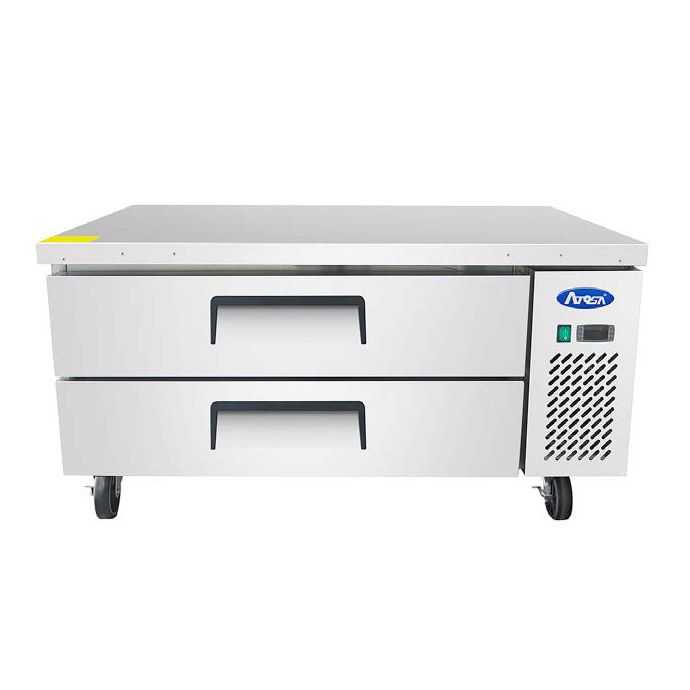
It sounds like a recipe for a broken compressor, but Atosa engineering is built for this exact scenario. These units feature high-density insulation and specialized heat-shielding tops. The Atosa MGF8454, for example, is built to withstand the punishing environment of a hot line without breaking a sweat.
The refrigeration system uses R290 Hydrocarbon refrigerant, which is not only environmentally friendly but also incredibly efficient at heat exchange. This means the unit doesn't have to work overtime to keep your steaks at food-safe temperatures, even when the charbroiler above is running at full tilt. This thermal consistency is vital for maintaining food safety standards and passing those surprise health inspections.

The Anatomy of a Heavy-Duty Drawer
Not all drawers are created equal. In a high-volume kitchen, those drawers are going to be slammed, kicked, and pulled hundreds of times a day. If the tracks are flimsy, the unit becomes a 500-pound paperweight.
Atosa's refrigerated chef base models utilize heavy-duty stainless steel drawer slides and rollers that are designed for longevity. They feature a self-closing mechanism, which is a lifesaver when a cook has their hands full and can't manually shove the drawer shut.
Moreover, these units come standard with stainless steel pans. For instance, the smaller MGF8450GR includes 12x20 pans that fit perfectly into the drawers, allowing you to swap out empty bins for full ones in seconds. This modularity is key for "mise en place", everything in its place, and a place for everything.
Does Size Really Matter? Choosing Your Base
When selecting a chef base, you need to balance your current menu needs with your available floor space.
- The Compact Powerhouse: Units like the 36-inch MGF8448GR are perfect for small cafes or food trucks where every square inch is precious.
- The High-Output Anchor: The 76-inch MGF8454 (pictured above) offers four drawers and an extended top, giving you enough surface area to run a full-scale burger operation with a griddle and a two-basket deep fryer side-by-side.
Remember, the top of these units is reinforced to hold hundreds of pounds. You aren't just buying a fridge; you're buying a foundation.

Why Atosa is the Practical Choice
At The Restaurant Warehouse, we focus on equipment that offers the best return on investment. We don't employ commission-based salespeople, which is why we can offer these Atosa units at a significant discount compared to big-box retailers.
We know that when a piece of equipment goes down, you don't just lose money on the repair; you lose money on every order you can't fulfill. That’s why we prioritize Atosa's reliability. They use high-quality components, like 1/7 HP compressors and digital temperature controllers that are easy for your staff to monitor at a glance. If the temp starts to creep up, you'll know it immediately, not when the meat starts to spoil.
Fast Shipping and Financing: Getting You Back to Work
We understand that most of our customers are either starting a new concept or replacing a broken unit that has left them in a lurch. That’s why we offer fast 1-3 day delivery from our 12 distribution centers across the country. We don't want you waiting two weeks for a delivery while your kitchen struggles to function.
For those who are "cash-strapped" but need to upgrade to stay competitive, we offer flexible restaurant equipment financing. Our lease-to-own and 12-month rental programs allow you to get the equipment you need today without a massive upfront capital hit. You can let the equipment pay for itself through the labor savings and increased efficiency it provides.
Key Benefits of a Refrigerated Chef Base
- Drastic Labor Savings: Reduces the "step count" for line cooks, keeping them at their station.
- Enhanced Food Safety: Keeps high-risk proteins at precise temperatures right under the heat.
- Space Optimization: Combines a equipment stand and a refrigerator into one footprint.
- Durability: Stainless steel construction and heavy-duty drawer slides built for commercial abuse.
- Energy Efficiency: Uses R290 refrigerant to lower utility costs and improve cooling recovery times.
Key Takeaways
- Efficiency is Profit: Every second saved in movement is a second spent on plate quality and ticket speed.
- Invest in the Foundation: A chef base isn't just a luxury; it's the anchor of a high-performance hot line.
- Watch the Heat: Ensure your unit has the proper heat shielding to protect the refrigeration system from the cooking equipment above.
- Buy for the Future: Choose a size that can accommodate your current equipment and potentially one extra piece if you expand your menu.
Frequently Asked Questions
Can I put a heavy charbroiler on any refrigerated base? Not just "any" base. You need a unit specifically rated as a "chef base." These have reinforced tops and heat-resistant barriers. A standard undercounter refrigerator is not designed to support the weight or the heat of cooking equipment.
How do I clean the drawers? Most Atosa chef bases feature removable drawer gaskets and slides. You should wipe down the stainless steel daily and deep-clean the tracks weekly to ensure they continue to glide smoothly.
What is the "clearance" required for these units? Since these are side-mounted compressors, you need to ensure the side vents are not blocked. This allows the unit to breathe and prevents the compressor from overheating.
Does it come with the pans? Yes, most of our Atosa chef bases include the stainless steel pans required for the drawers, so you are ready to go as soon as the unit arrives.
What if I'm not sure which size I need? Measure the footprint of the equipment you plan to put on top. Ensure the chef base top is at least 1-2 inches wider than your equipment to allow for stable placement. If you're still stuck, give us a call: we're here to help you get the right fit the first time.
SEO Meta Description: Maximize your kitchen's efficiency with a refrigerated chef base. Learn how these heavy-duty units save labor, improve food safety, and optimize your hot line.
JSON-LD Schema:
About The Author

Sean Kearney
Sean Kearney is the Founder of The Restaurant Warehouse, with 15 years of experience in the restaurant equipment industry and more than 30 years in ecommerce, beginning with Amazon.com. As an equipment distributor and supplier, Sean helps restaurant owners make confident purchasing decisions through clear pricing, practical guidance, and a more transparent online buying experience.
Connect with Sean on LinkedIn, Instagram, YouTube, or Facebook.