Why Commercial Freezer Dimensions Matter for Your Restaurant's Success
Commercial freezer dimensions are one of the most critical decisions you'll make when outfitting your restaurant kitchen. The wrong size can cost you thousands in wasted energy, spoiled inventory, and lost efficiency.
Quick Reference: Common Commercial Freezer Dimensions
| Freezer Type |
Width Range |
Depth Range |
Height Range |
Capacity Range |
| Reach-In (Single Door) |
27" - 31" |
24" - 36" |
35" - 82.5" |
23 - 25 cu ft |
| Reach-In (Double Door) |
36" - 91" |
24" - 36" |
31" - 84" |
40 - 49 cu ft |
| Undercounter |
27" - 48" |
24" - 32" |
32" - 36" |
7 - 12 cu ft |
| Chest Freezers |
47" - 84" |
24" - 34" |
31" - 36" |
7 - 25 cu ft |
| Walk-In |
72" + |
72" + |
96" - 144" |
Custom |
As restaurants adapt to changing demands like delivery and takeout, freezer storage needs have evolved. Whether you're launching a new restaurant or upgrading your current setup, getting the dimensions right affects everything from your daily workflow to your monthly electric bill.
A 14 cubic foot freezer can hold approximately 350 pounds of food, but its physical dimensions determine whether it fits your kitchen. The difference between a 30-inch and a 36-inch wide freezer can mean the difference between smooth operations and constant frustration.
The stakes are high. Choose too small, and you risk overcrowding, poor airflow, and spoiled inventory. Go too large, and you'll waste energy, money, and precious kitchen real estate. With the right measurements and planning, you can find the perfect fit that saves you money for years to come.
Decoding Commercial Freezer Types and Their Standard Dimensions
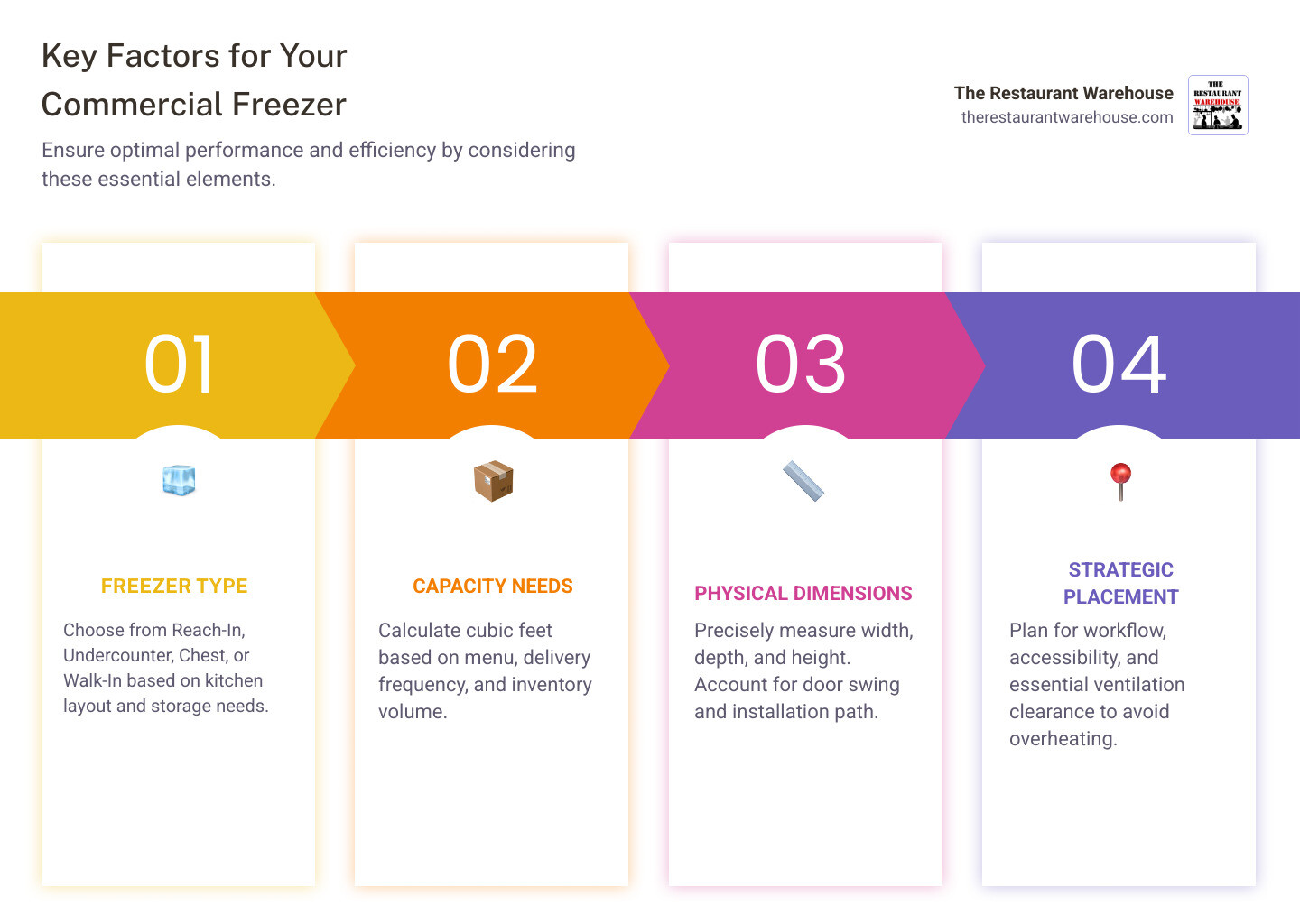
Choosing a commercial freezer is like picking the right tool for the job. Commercial freezer dimensions vary dramatically by type, and understanding these differences is crucial for your operation. Each freezer type is designed for a specific purpose, from the high-volume access of a reach-in to the bulk storage efficiency of a chest freezer.

Your choice depends on three key factors: available space, frequency of access, and the type of food stored. A busy pizza kitchen has different needs than a bakery or fine dining establishment. For a complete overview, our Commercial Freezer Guide breaks down all your options.
Upright and Reach-In Freezer Dimensions
Upright and reach-in models are the backbone of most restaurant kitchens, maximizing storage on a minimal footprint. They keep everything organized vertically for quick access during service.
Single-door reach-in freezers are ideal for smaller operations. They typically measure 27 to 31 inches wide and 35 to 82.5 inches tall. A 25 cubic foot model can hold around 625 pounds of frozen food, offering substantial storage for cafes or specialty food businesses.
Double-door reach-in freezers are built for high-volume kitchens, ranging from 36 to 91 inches wide and 31 to 84 inches tall. A typical unit provides 40 to 49 cubic feet of storage, or more than 1,000 pounds of inventory. The dual-door design improves efficiency because staff can access one section without affecting the entire unit's temperature. Our guide to the Best 2-Door Commercial Freezers can help you find top choices.
Most reach-in freezers maintain a standard depth of 24 to 36 inches, fitting well within standard kitchen layouts.
Undercounter Freezer Dimensions
Undercounter freezers are the secret weapons of smart kitchen design, tucking valuable frozen storage directly into your workspace. These units transform wasted space into productive real estate.
They typically measure 32 to 36 inches tall, the perfect height to slide under standard commercial countertops. Their width ranges from 24 to 48 inches, with depths of 24 to 32 inches to align with most layouts.
These units excel in point-of-use storage, keeping frozen ingredients or desserts right at your prep or service station. This eliminates unnecessary trips across the kitchen mid-service. Modern undercounter freezers offer 7 to 12 cubic feet of capacity, providing significant storage while maintaining an efficient workflow. For more details, see our Undercounter Commercial Freezer Guide and our picks for the Best Under Counter Fridges.
Chest Freezer Dimensions
For bulk storage and energy efficiency, chest freezers are the undisputed champions. While they take up more floor space, they offer superior energy performance and massive capacity.
Chest freezers span 47 to 84 inches wide, with a depth of 24 to 34 inches and a consistent height of 31 to 36 inches. Their top-loading design is a key feature. Since cold air is dense, it stays inside when the lid is opened, leading to lower energy costs and more stable temperatures.
These freezers are perfect for businesses that buy in bulk, such as catering companies or bakeries. With a 7 to 25 cubic foot capacity, they can store hundreds of pounds of inventory. The main trade-off is accessibility, as items at the bottom can be harder to reach. For long-term storage, however, they are incredibly cost-effective. Our Chest Freezer 10 cu ft Guide explores a popular size for many operations.
How to Choose the Right Size: A Step-by-Step Measurement Guide
Getting the perfect commercial freezer dimensions requires more than just measuring the freezer's footprint. You must account for the space it needs to operate efficiently, including room for ventilation, door swings, and the path to get it into your kitchen.
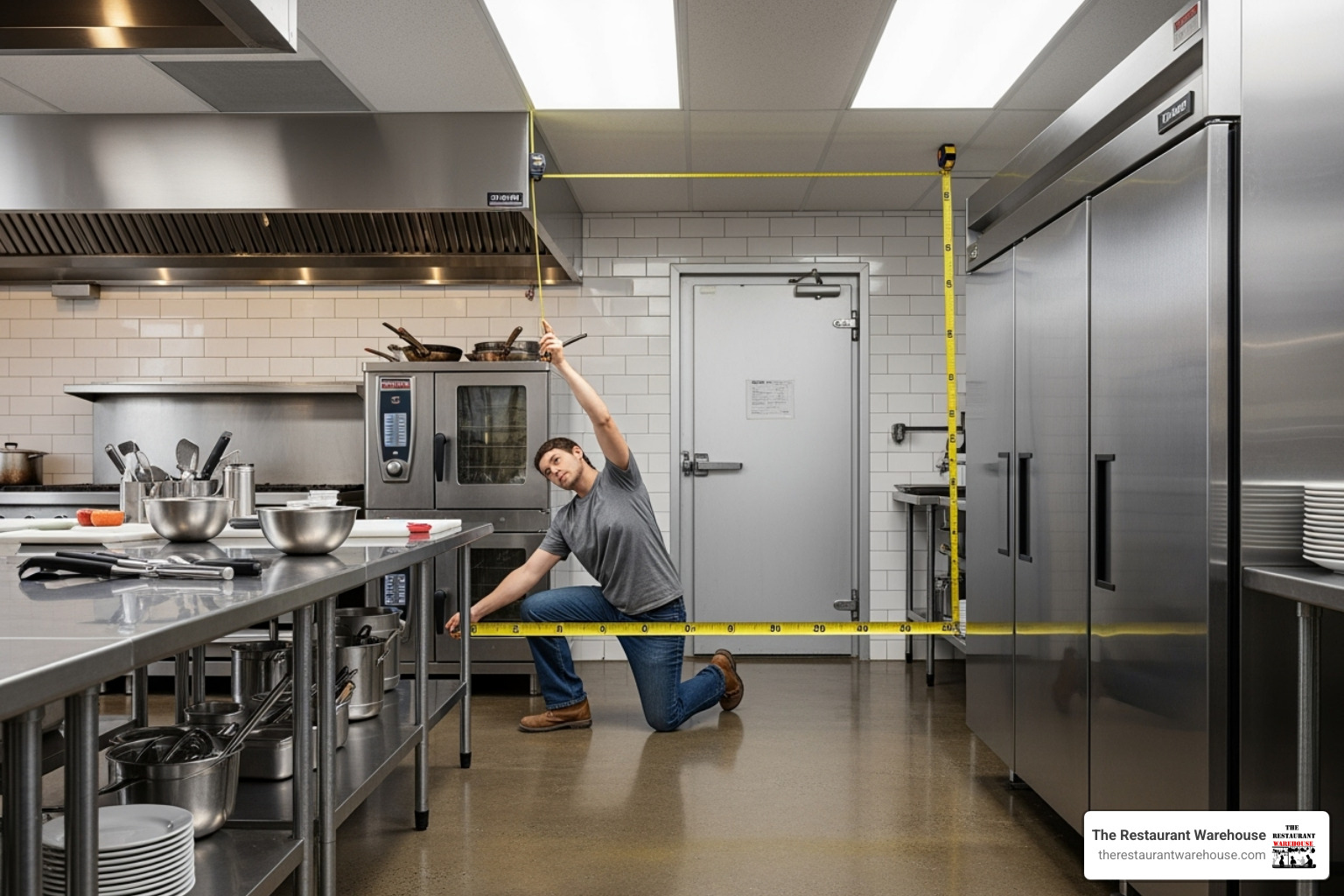
Measuring for a commercial freezer means planning for how it will integrate into your kitchen's workflow. For ideas on optimizing your space, check out our Restaurant Kitchen Layout Examples.
Measuring Your Physical Space
Before choosing a model, grab a tape measure. Think about the entire space the freezer will occupy.
-
Height: Measure from floor to ceiling, accounting for low-hanging pipes, shelves, or ductwork. Casters or legs can add a few inches to the listed height.
-
Width: Measure the space where the freezer will sit. Include any protruding door hinges or handles in your calculation. It's always better to have a little extra room.
-
Depth: Measure from the back wall to where the front of the freezer will be. Ensure there's enough clearance for doors to open without blocking high-traffic areas.
Crucially, don't forget the installation path. Measure every doorway, hallway, and tight corner from the delivery truck to the freezer's final spot. A standard commercial door is often 36 inches wide, but always measure it yourself. Double-check all your measurements to avoid a costly delivery error.
Accounting for Critical Clearance and Ventilation
A commercial freezer is a hardworking machine that generates heat and needs proper airflow. Without adequate clearance, the unit will work overtime, increasing energy costs and shortening its lifespan.
-
Heat Dissipation: The compressor removes heat from inside the freezer and releases it into the kitchen. Most manufacturers recommend at least 2 to 3 inches of clearance on the sides and back, though some units require more.
-
Top and Rear Clearance: Top-mounted condensers need at least 6 inches of clearance above the unit to let hot air escape. The rear of the freezer is where most heat is expelled, so never push the unit flush against a wall.
-
Airflow: Proper airflow is essential for efficiency. It allows the freezer to run cooler, use less energy, and last longer. A freezer door that can't open fully because it hits a wall will also slow down your kitchen.
Planning for proper clearance will save you headaches and money. For more on creating optimal kitchen conditions, see our guide on Commercial Kitchen Ventilation Requirements.
Beyond the Tape Measure: Key Factors for Your Commercial Freezer Dimensions
While measuring your space is essential, selecting the perfect commercial freezer dimensions goes deeper. You must also consider how it fits your daily workflow, its true usable capacity, and how its design helps or hinders your team. It's about finding the sweet spot where physical size meets practical utility.
When you're ready to explore options, our range includes selections from the Top Commercial Freezer Brands for 2025, designed to meet diverse operational needs.
Beyond the exterior, pay attention to interior ergonomics. The position of evaporator housings, shelf spacing, and door gaskets all impact how much product you can actually store and how quickly staff can retrieve it. Details like handle placement and door swing direction can shave seconds off every pull, which adds up during peak service. Think through the flow: who accesses the freezer, how often, and from where.
From Cubic Feet to Kitchen Fit: Understanding Capacity
The internal capacity of a freezer is measured in cubic feet, but cubic footage does not always equal usable space. Shelving, internal components, and compressor housings can reduce the amount of food you can actually store. Deep shelves that cannot be fully loaded because of airflow needs also reduce real capacity.
A reliable rule of thumb is that 1 cubic foot of freezer space holds approximately 25 pounds of food. A 14 cubic foot freezer, for example, can hold around 350 pounds of inventory. This is a significant amount of storage for a busy kitchen.
Consider these real-world examples: an Atosa MBF8001GR offers 21.4 cubic feet (approximately 525 to 735 pounds), while an Atosa MBF8504GR provides 71 cubic feet (1,750 to 2,800 pounds). These numbers represent your kitchen's ability to handle bulk purchasing and prep-ahead strategies. When calculating your needs, consider your menu's complexity and your delivery frequency. For more on specific capacities, our guides on How Big Is 16 Cubic Foot Freezer and the 24 Cubic Foot Freezer Buyers Guide offer detailed breakdowns.
Also evaluate the configuration of shelves and compartments. Adjustable shelving lets you switch between full hotel pans, sheet pans, and bulk boxes without losing vertical space. If you routinely store tall cambros or stacked proteins, ensure the shelf clip spacing can accommodate those heights while maintaining airflow gaps around product.
Single, Double, or Triple Door: How Configuration Impacts Commercial Freezer Dimensions
The number of doors on your freezer impacts its overall dimensions, workflow efficiency, and energy bills. More doors allow simultaneous access but require more aisle space for door swings. Door gaskets, closers, and hinges are also parts you will rely on daily, so quality matters.
Single-door freezers (27 to 31 inches wide, 23 to 25 cu. ft.) are perfect for smaller kitchens or as supplementary units. Compact Atosa single-door models fit tight spaces while still delivering reliable commercial performance.
Double-door configurations (36 to 91 inches wide, 40 to 49 cu. ft.) are the backbone of many kitchens. Units like the Atosa MBF8002GR or the Atosa MBF8503GR offer a strong balance of storage and footprint.
Triple-door units (81 to 96 inches wide, 60 to 72+ cu. ft.) are designed for high-volume operations. Atosa triple-door freezers provide maximum storage and multiple access points to keep large kitchens running efficiently.
If your team frequently accesses different product categories at once, multiple doors can mean less temperature loss and quicker recovery. Conversely, if space is tight and the aisle is narrow, a single-door unit with the right swing configuration may be the safer and more efficient option.
Sizing for Your Industry: Restaurants vs. Bakeries
The "one size fits all" approach does not work for freezers. The right commercial freezer dimensions depend on your specific foodservice type and the patterns of your operation.
Restaurants have dynamic needs, storing everything from bulk proteins to pre-portioned sauces. Reach-in freezers with adjustable shelving are crucial for quick access during peak hours. A high-volume restaurant might use a combination of large reach-ins and chest freezers for bulk items.
Bakeries have different challenges, storing delicate frozen dough, butter, and finished products. Chest freezers are great for bulk dough, while upright units with adjustable shelving are better for organizing finished goods.
Ice cream shops require specialized temperature control. Atosa freezers, which can reach temperatures as low as -8°F, are ideal for maintaining proper product consistency and quality. Understanding these nuances helps you invest in equipment that matches your workflow. Learn more in our guide on What's a Commercial Freezer.
Finally, consider future menu changes and seasonal volume. If you plan to expand your frozen offerings or increase catering, build in a buffer. It is often more cost-effective to plan for moderate growth than to replace undersized equipment after a busy season.
Maximizing Efficiency: Smart Features and Organization
Having the right commercial freezer dimensions is the first step, but smart features and organization are what truly unlock operational efficiency. A well-organized freezer, regardless of its size, can transform your kitchen's workflow from chaotic to choreographed.
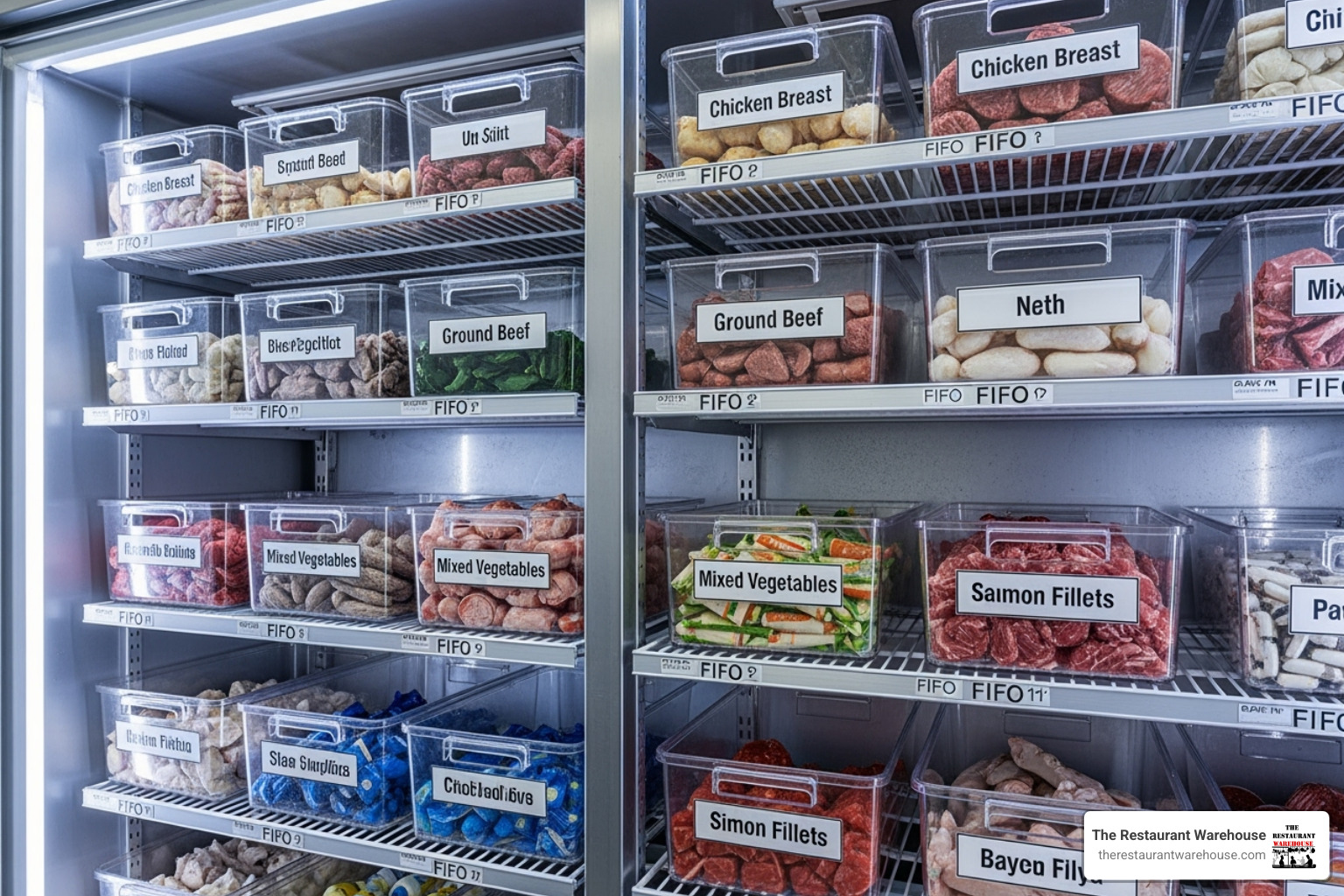
Even a spacious freezer feels cramped if it's a mess. When staff can find what they need quickly, doors stay closed longer, improving energy efficiency. For more strategies, explore our insights on Commercial Refrigerator and Freezer Storage.
Think beyond simple shelf space. Define zones for proteins, prepared sauces, desserts, and backups. Standardize container sizes to maximize stacking efficiency and reduce dead space between items. Map your shelves so new staff can find inventory fast, and place high-turn products at chest height to minimize door-open time during service.
The right features can make a freezer work for you, not against you. Prioritize features that improve access, visibility, and temperature stability, especially if your team opens doors frequently.
-
Adjustable shelves are non-negotiable for customizing the internal layout. Many Atosa freezers include multiple heavy-duty adjustable shelves rated for high weight capacity.
-
Heavy-duty casters are invaluable for cleaning and maintenance. Most Atosa models come standard with casters installed.
-
Self-closing doors with stay-open features help reduce energy loss while making loading easier and are standard on many Atosa units.
-
Digital temperature controls and LCD displays provide precision and consistency. Atosa freezers feature easy-to-use digital controls.
-
LED lighting improves visibility and reduces door-open time.
-
NSF certification helps ensure compliance with food safety standards. Atosa equipment is widely NSF certified for commercial use.
Additional helpful touches include door locks for closing shifts, field-reversible doors when available to better fit your layout, and heated door frames on low-temp units that help reduce frost on gaskets. If you routinely load full pans, check the door opening width to ensure it clears your largest pans without tilting.
Tips for Maximizing Internal Freezer Space
Once you have your freezer, make every cubic foot count. A well-organized freezer improves efficiency and reduces waste.
-
FIFO Method: Use the "First-In, First-Out" principle to ensure older items are used first, reducing spoilage.
-
Clear, Stackable Containers: Use transparent, stackable bins for better visibility and space efficiency.
-
Labeling: Clearly label all items with names and dates to support proper inventory rotation.
-
Vacuum Sealing: This protects food from freezer burn and reduces its volume, saving space.
-
Vertical Space: Use adjustable shelves to create zones and prevent items from being crushed.
-
Airflow: Don't overpack the freezer. Leave space around items for air to circulate, ensuring even temperatures.
-
Regular Maintenance: A clean, well-maintained freezer runs more efficiently. Some commercial units may require periodic defrosting depending on the model. For more tips, see our guide on how to Maintain Commercial Refrigerators.
-
Shelf Maps and Par Levels: Post a shelf map on the door and assign par levels to key items. This reduces time with doors open and prevents over-ordering.
-
Door Discipline: During prep, consolidate pulls so the door opens fewer times. If your unit has a stay-open feature, use it only when staging product, then return to self-close mode.
-
Rotate Bulk and Line Stock: Keep bulk cases in deeper zones and line-ready portions in front. This keeps service moving while protecting long-term inventory.
Good organization paired with the right features narrows the gap between the freezer's listed capacity and the capacity you can actually use. That is how you get true value from the dimensions you selected in the first place.
The Cost of Miscalculation: Sizing's Impact on Operations and Your Bottom Line
Getting commercial freezer dimensions wrong creates a domino effect that impacts your daily operations and financial health. A correctly sized freezer is a silent partner that keeps operations smooth and costs down. An incorrectly sized one becomes an expensive problem.
This choice directly affects your operational efficiency, energy use, and your ability to manage your Restaurant Food Cost Percentage. The goal is to find the sweet spot where capacity aligns perfectly with your needs.
The Problems with a Freezer That's Too Small
A cramped freezer creates a cascade of problems that hurt your bottom line.
-
Overcrowding and Spoilage: Stuffing a freezer blocks airflow, creating warm spots that can lead to food spoilage. The compressor works overtime to compensate, driving up energy costs and shortening the unit's lifespan.
-
Inefficient Workflow: Staff waste valuable time digging through disorganized shelves. During a busy service, these delays add up and create frustration.
-
Lost Savings: A small freezer prevents you from taking advantage of bulk purchasing discounts and may lead to more frequent, costly deliveries. You also risk running out of key ingredients during peak hours.
The Downsides of a Freezer That's Too Large
Bigger isn't always better. An oversized freezer creates its own set of expensive problems.
-
Wasted Energy: You're paying to cool empty space, which can add hundreds of dollars to your monthly utility bills.
-
Higher Upfront Cost: Larger freezers cost more to purchase, tying up capital that could be invested elsewhere in your business.
-
Wasted Kitchen Space: Every square foot in a kitchen is valuable. An oversized freezer occupies real estate that could be used for prep areas, other equipment, or better traffic flow.
Frequently Asked Questions about Commercial Freezer Dimensions
Getting your commercial freezer dimensions right the first time is crucial. Here are answers to some of the most common questions we hear from restaurant owners.
How much clearance does a commercial freezer need for ventilation?
Commercial freezers generate significant heat and need room to breathe. Most models require at least 2 to 3 inches of clearance on the back and sides, and often more space on top. Some manufacturers recommend at least 10 cm, or about 4 inches, on both sides for proper heat dissipation.
Without proper airflow, the compressor can overheat, leading to premature failure and higher energy bills. Always check your specific model's spec sheet for its exact clearance requirements. Those few extra inches will save you money in the long run.
How do I calculate the freezer capacity I need for my restaurant?
This is a critical question. A common rule of thumb is 1.5 to 2.5 cubic feet of freezer space per restaurant seat, but this is just a starting point. Your actual needs depend on several factors:
-
Your Menu: A seafood restaurant or pizzeria will need more freezer space than a farm-to-table bistro using mostly fresh ingredients.
-
Your Delivery Schedule: Daily deliveries mean you can operate with less storage space than if you only receive shipments twice a week.
-
Bulk Purchasing: If you buy in bulk to save money, you'll need the extra capacity to store that inventory.
A practical tip is to track your inventory for a few weeks to understand your real-world needs. A 14 cubic foot freezer holds about 350 pounds of food, which can serve as a useful reference point. It's often wise to plan for peak demand and future growth.
Are commercial freezers more energy-efficient than residential models?
The answer is nuanced. Commercial freezers are built for performance and durability in demanding environments. They prioritize consistent temperatures and quick recovery after door openings, which means their powerful compressors typically consume more total power than a home freezer.
However, modern commercial units are increasingly energy-efficient. Many Atosa freezers use eco-friendly R290 refrigerant, which can improve efficiency. Other features like cyclopentane insulation, self-closing doors, and LED lighting also reduce energy use. Many Atosa models are ENERGY STAR certified.
While a commercial freezer may use more total energy, its efficiency per cubic foot can be competitive. The most important factor for energy savings is choosing the right size. An oversized freezer wastes energy cooling empty space, while an undersized one works too hard.
Conclusion
Choosing the right commercial freezer dimensions is a critical decision for your restaurant's success. It's the difference between a smooth, efficient kitchen and one that struggles with daily limitations. The right freezer is an invisible partner in your operations; the wrong one is a constant headache.
Proper sizing leads to better airflow, less food waste, a more efficient staff, and lower energy bills. When you're in a dinner rush, seconds matter. When you're paying utility bills, wasted energy adds up. Whether you need a compact undercounter unit or a large double-door reach-in, the perfect freezer is out there.
The key is to measure carefully, assess your true storage needs, and consider how the unit will fit into your daily workflow. Don't rush this decision. Use the guidelines we've shared, measure twice, and choose once. Your future self, and your staff, will thank you.
At The Restaurant Warehouse, we understand that every dollar counts. We provide quality commercial equipment without the high retail markup, helping you build a foundation for efficient, profitable operations. From compact solutions to expansive storage, we're here to help you find the perfect fit.
For those looking to explore reliable, affordable options, our selection of Atosa Freezer models offers excellent value without compromising on performance. Because the right freezer isn't just about keeping things cold. It's about keeping your business running successfully for years to come.


