

Ready to Slice? The Best Commercial Jerky Slicers to Buy Now
Why Commercial Jerky Slicers Matter for Your Food Business
A commercial jerky slicer transforms meat into perfectly uniform strips with speed and precision that manual cutting simply cannot match. If you're comparing commercial slicers for jerky production, here's what you need to know:
Top Commercial Jerky Slicer Options:
- American Eagle AE-JS12: 1 HP motor, 64 circular knives, cuts 1/4" strips, $930 (best value for small to mid-size operations)
- Grote 613 Multi Slicer: 90 strokes/minute per lane, industrial-grade automation, slice thickness up to .5" (best for high-volume production)
- Grote Slicer/Applicator: 150 strokes/minute per lane, automatic slice-and-apply system, 2+ lanes (best for fully automated lines)
- Berkel #330M Flywheel: 13" blade, handles products up to 8 3/8" round, slices up to 3/16" thickness (best for traditional operations)
Jerky has become one of the most profitable snack foods in the foodservice industry. It's high in protein, low in carbs, and incredibly convenient for today's on-the-go consumers. But there's a catch: making quality jerky at scale requires perfect slicing consistency.
Manual slicing creates uneven strips. Thick pieces stay chewy while thin ones turn into brittle chips. You waste meat, waste time, and deliver an inconsistent product that frustrates customers.
That's where a commercial jerky slicer changes everything. These machines slice beef, poultry, pork, or meat alternatives into uniform strips in seconds—no wasted product, no hand fatigue, and no bottlenecks in your production line. Whether you're a small butcher shop preparing a few batches per week or a large-scale processor producing hundreds of pounds daily, the right slicer pays for itself through efficiency gains and reduced waste.
As Sean Kearney from The Restaurant Warehouse, I've helped countless food businesses find the right equipment to scale their operations, including many who've transformed their jerky production with the right commercial jerky slicer. My background in sales and deep understanding of foodservice needs means I know exactly what separates a smart investment from an expensive mistake.
Why a Commercial Jerky Slicer is a Game-Changer for Production
Investing in a commercial jerky slicer is more than just buying a piece of equipment; it's an investment in the efficiency, productivity, and profitability of your food service operation. For businesses looking to scale their jerky production, or even just improve their current process, these machines are indispensable. They offer a multitude of benefits that directly impact your bottom line and product quality.
At The Restaurant Warehouse, we've seen how the right tools can revolutionize a business. A commercial jerky slicer is a prime example, providing unparalleled efficiency and consistency. The core principle is simple: quality in, quality out. When your raw product starts with perfectly uniform slices, every subsequent step in the jerky-making process becomes more predictable and effective. From marinating to dehydrating, consistency is king, and a commercial slicer delivers it every time.
The advantages are clear: improved product quality leads to higher customer satisfaction, increased productivity means you can meet growing demand, and reduced meat waste directly translates to maximizing profitability. Consider it the backbone of a successful jerky operation. You can learn more about how these specialized tools make a difference by reading our guide on Commercial Food Slicers That Make the Cut, Literally.
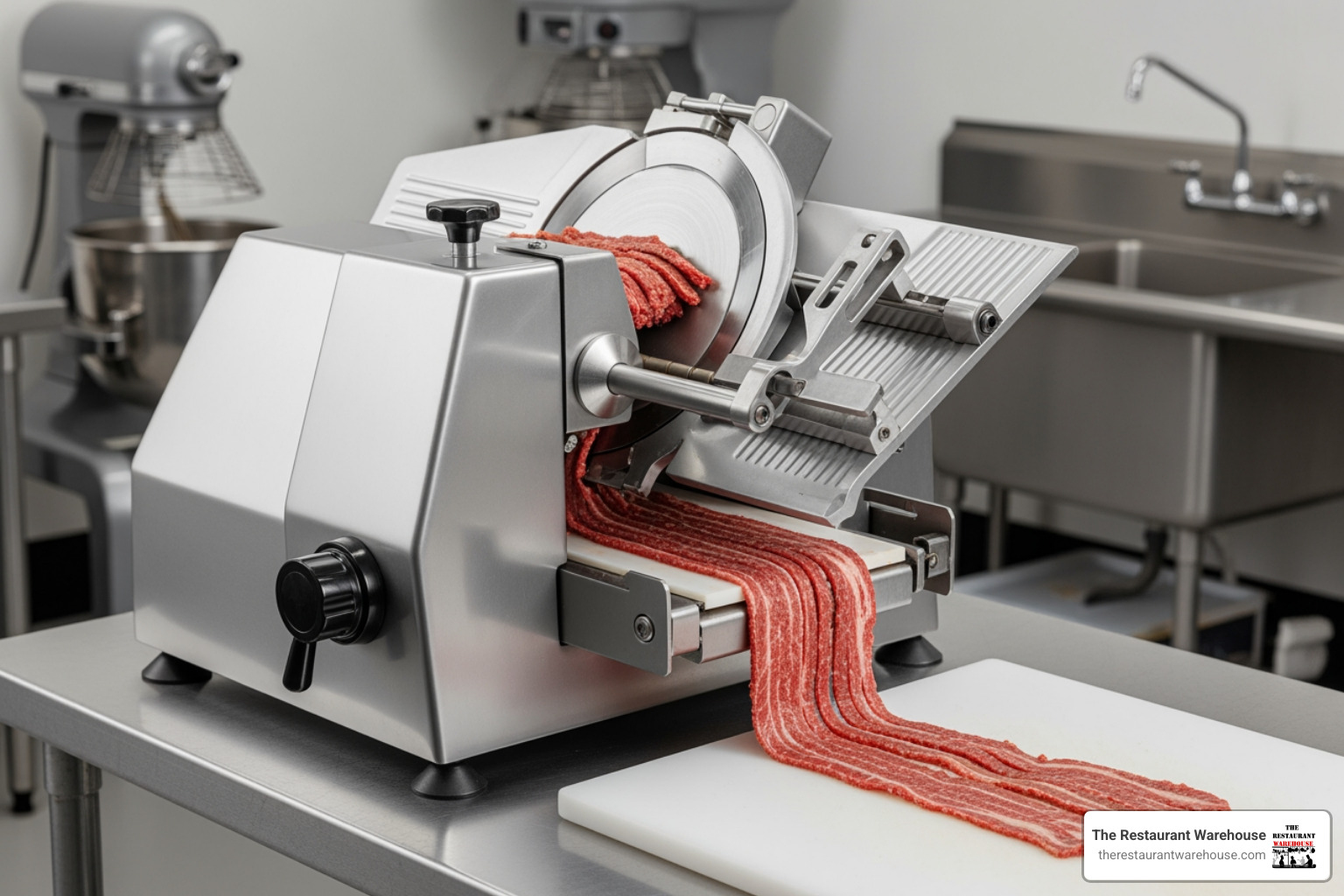
Image: A stainless steel commercial jerky slicer processing uniform strips of beef in a spotless production room, with operators wearing gloves and hairnets to emphasize food safety and professional throughput.
Boosting Speed and Throughput
One of the most immediate and impactful benefits of a commercial jerky slicer is the dramatic increase in speed and throughput. Imagine the sheer difference between slicing meat by hand and having a machine do it for you. What once took hours of painstaking manual labor can now be accomplished in mere minutes. This isn't an exaggeration; it's the reality of automation.
Take, for instance, industrial models like the Grote Slicer/Applicator, capable of an impressive 150 strokes per minute, per lane. Even more compact options, like the American Eagle AE-JS12, with its powerful 1 HP motor, make "slicing jobs effortless" and can process meat into 1/4" thick strips in seconds. This level of output is simply unattainable with manual methods, which are prone to fatigue, inconsistency, and slower processing times.
For high-volume operations, this speed translates directly into the ability to meet high demand without expanding your labor force. The continuous operation of an automated slicer eliminates bottlenecks in your production line, allowing for a steady flow of product. This means more jerky produced, faster, and with less effort, ultimately leading to greater revenue potential. It's about optimizing every second of your production day.
If you’re unsure how much capacity you actually need, our team can walk through your current and projected volume with you and suggest a realistic starting point. Book a quick strategy call with The Restaurant Warehouse to match slicer capacity to your goals instead of guessing.
Ensuring Consistency and Quality
Beyond speed, the precision offered by a commercial jerky slicer is paramount for product quality. The goal for any jerky producer is uniform thickness, and these machines deliver it flawlessly. Why does uniform thickness matter so much? Because it ensures even drying. When every strip of meat is the same thickness, it dehydrates at the same rate. This means no more guessing games in the dehydrator and no more inconsistent batches where some pieces are over-dried and brittle, while others are under-dried and still too moist.
The result is a consistent texture and flavor profile across your entire product line. This consistency is crucial for customer satisfaction and building brand loyalty. Customers expect a certain quality when they purchase your jerky, and a commercial slicer helps you deliver on that promise every time. By eliminating thick and thin spots, you achieve professional-grade results that stand out in a competitive market. This precision also minimizes wasted product, as fewer pieces are rejected for being improperly sliced or dried.
Consistency also supports food safety and regulatory compliance. When your product dries uniformly, it’s easier to create and validate a safe process. For additional guidance on safe jerky production practices, you can consult resources from the U.S. Department of Agriculture Food Safety and Inspection Service, which provide science-based best practices for drying meat safely.
If you’re ready to tighten up product consistency and reduce waste, contact The Restaurant Warehouse for tailored slicer recommendations before your next production upgrade.
Key Features of a High-Performance Commercial Jerky Slicer
When considering a commercial jerky slicer, understanding its key features is crucial. These elements dictate the machine's performance, durability, and suitability for your specific operational needs. From the motor's power to the blade's design, each component plays a vital role in delivering efficient, consistent, and safe slicing. Our comprehensive Commercial Meat Slicer Guide offers even more insights into what makes these machines tick.
The Powerhouse: Motor and Drivetrain
At the heart of any effective commercial jerky slicer is a robust motor and drivetrain. This is what provides the raw power to slice through tough cuts of meat with ease. Many high-performance models, such as the American Eagle AE-JS12, come equipped with powerful 1 HP motors. This significant horsepower ensures that slicing jobs are effortless, even when dealing with dense or semi-frozen meats.
Beyond the motor's strength, the quality of the drivetrain is critical for durability and longevity. We look for machines featuring all-metal gears and shafts. This construction is designed to withstand the harsh demands of professional food operations, ensuring many years of reliable service. A permanently lubricated, sealed motor design is another advantage, contributing to both food safety by preventing contaminants and reducing maintenance requirements. This thoughtful engineering means less downtime for your business and a more consistent output.
The Cutting Edge: Blade Systems
The blades are, quite literally, the cutting edge of a commercial jerky slicer. The technology behind these blades is diverse, catering to different needs and types of meat.
- Circular Knife Sets: Many commercial jerky slicers, like the American Eagle models, use multiple circular knives mounted on stainless steel shafts. The American Eagle AE-JS12, for example, features 64 durable, circular knives. This design is highly effective for creating uniform strips.
- Dual Comb Systems: To prevent meat from jamming between these knives, some slicers incorporate a dual comb system. This ingenious feature ensures a smooth operation, preventing costly interruptions and wasted product.
- Band Blade Systems: For industrial-scale operations, Grote Company offers advanced band blade systems. Their AccuBand® disposable stainless steel blades are a game-changer. They provide optimal slice quality, yields, and consistency, and because they're disposable, they allow for quick changeouts and significantly decreased downtime. This also simplifies sanitation, as there's no need for laborious resharpening.
-
Blade Edge Technology: Different products require different blade edges. Grote, for instance, offers:
- Knife Edge: Ideal for emulsified, soft products, and most produce.
- V-Tooth Edge: Perfect for dense products like pepperoni and hard salami.
- Modified V-Tooth Edge: Designed for whole muscle meats with skin and tissue, such as bacon.
- Sabre Tooth Edge: Best suited for bread products.
Regular blade maintenance, whether it's replacing disposable blades or ensuring fixed blades are sharp, is crucial for maintaining slice quality and machine efficiency.
Built to Last: Construction and Design
Durability and ease of cleaning are paramount in a commercial setting. High-performance commercial jerky slicers are typically constructed from heavy-duty stainless steel. This material is not only robust and resistant to corrosion but also incredibly easy to clean and sanitize, which is vital for food safety. Features like high-polish finishes and designs with no sharp corners or seams further facilitate cleaning, preventing the accumulation of food particles and bacteria.
Despite their power and robust construction, many commercial jerky slicers are designed with a compact footprint, making them suitable for various kitchen layouts. An important design consideration for integration into existing setups is a standard #12 hub. This design allows for compatibility with other equipment, such as meat grinders and mixers, providing versatility and maximizing your equipment investment. The American Eagle AE-JS12, for example, boasts this standard #12 hub design, making it a flexible addition to many food service operations. This commitment to quality materials and thoughtful design ensures that your slicer will provide reliable service for years to come, standing up to the rigorous demands of daily commercial use.
How to Choose the Right Commercial Jerky Slicer for Your Business
Selecting the ideal commercial jerky slicer involves careful consideration of your specific business needs, production volume, and budget. It's not a one-size-fits-all decision, as the market offers a range of models from compact, entry-level units to fully automated industrial systems. Making the right choice ensures you invest in equipment that optimizes your operations without unnecessary overhead. Our Industrial Meat Slicer Guide offers valuable insights to help you steer these decisions.
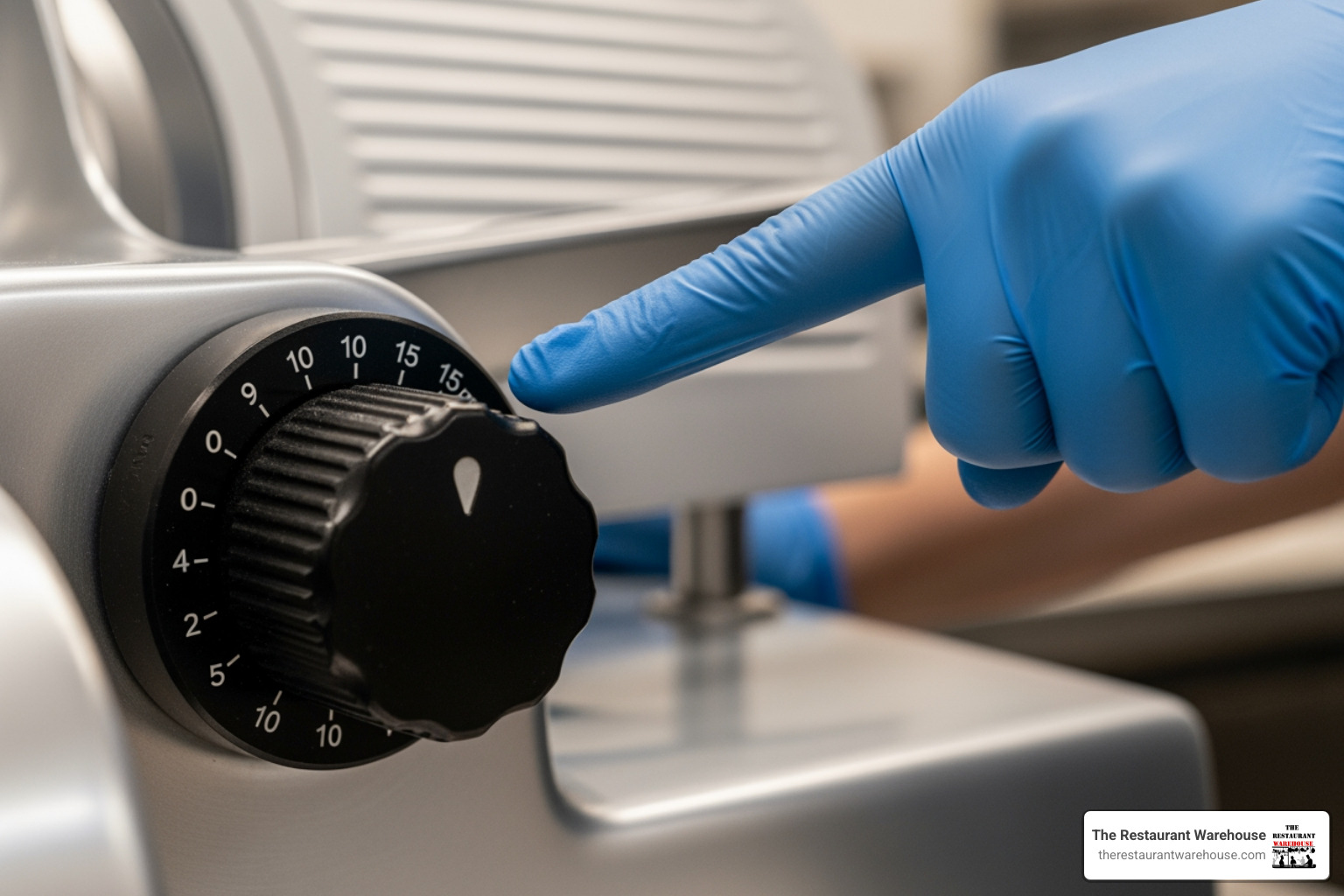
Image: A gloved operator adjusting the thickness control knob on a stainless steel jerky slicer, illustrating how to fine-tune slice thickness for different recipes and textures.
Assessing Your Production Needs
Before diving into specific models, take an honest look at your current and projected production volume.
- Small-Batch Producers, Hunters, and Home Enthusiasts: If you're a small butcher shop, a local market, a dedicated hunter processing your own game, or even a serious home enthusiast, a compact and heavy-duty unit like the American Eagle AE-JS12 might be the perfect fit. These models are designed for reliability and efficiency without requiring a massive investment or footprint. They are excellent for slicing boneless chuck, skirt steak, venison, flank, or round steak into thin strips for jerky, as well as preparing meat for fajitas or shawarma. The American Eagle AE-JS12 can handle cuts up to 1" thick with its 1.1" x 7" input chute.
- High-Volume Food Service and Industrial Operations: For businesses that produce jerky on a larger scale, such as large restaurants, food processors, or industrial facilities, high-capacity and automated solutions are essential. Brands like Grote offer industrial beef jerky slicers designed to handle significant throughput. Their systems can process beef, poultry, pork, and meat alternatives directly onto drying screens or belts, eliminating manual handling and dramatically increasing production. The Grote 613 Multi Slicer offers 90 strokes/minute per lane, while the Slicer/Applicator boasts 150 strokes per minute per lane, catering to the most demanding environments.
Consider your slicing capacity (how many pounds per hour you need to process) and the dimensions of the meat cuts you typically work with. This will help you determine the necessary input chute size and overall processing power.
If you want help sizing a machine to your current and future volume, schedule a no-pressure consultation with our team and get a personalized equipment roadmap instead of relying on trial and error.
Automation Level: Manual vs. Automated
The degree of automation you need is another critical factor.
- Manual Feed Slicers: While some commercial slicers require manual loading, even these offer significant advantages over hand-slicing. They still provide consistent thickness and reduce physical strain. However, for jerky, which often involves specific strip cuts, dedicated jerky slicers are usually preferred over general deli slicers.
- Automatic Feed Slicers: These machines automatically feed the meat into the blades, further increasing efficiency and consistency. The Berkel #330M and #300M, for example, are automatic feed flywheel slicers, traditionally used for prosciutto but showcasing the benefits of automated product delivery.
- Slice-and-Apply Systems: For the highest level of automation, particularly in industrial jerky production, slice-and-apply systems are the gold standard. Grote's industrial jerky slicers are engineered to automatically slice and apply product directly onto a drying screen or belt. This eliminates hand placement, significantly increases production rates, and improves food safety by minimizing human contact with the product. These systems can be integrated with conveyors, weigh cells, and tray or card inserters to create a fully automated production line. This level of automation is ideal for businesses looking to maximize throughput and efficiency, especially when scaling up operations.
Sanitation, Safety, and Maintenance
Food safety and operational safety are non-negotiable in any commercial kitchen or food processing facility. When choosing a commercial jerky slicer, prioritize models designed for easy disassembly and cleaning. Stainless steel construction with high-polish finishes and minimal seams is crucial for preventing bacterial growth and ensuring thorough sanitation. Many models are designed to be easily detached for cleaning, simplifying the process.
Look for equipment that meets industry standards, such as NSF certification, which indicates compliance with public health and safety standards. Safety features like blade guards, emergency stops, and sealed motor designs are also essential to protect your staff during operation.
Regarding maintenance, consider the blade technology. Disposable blade systems, like Grote's AccuBand ae, can simplify maintenance by eliminating the need for resharpening and reducing downtime. For slicers with fixed blades, an integrated sharpener (as seen in models like the Waring WCS250SV) is a valuable feature for maintaining optimal blade sharpness. Adhering to USDA guidance on jerky processing and safe meat handling is also paramount for your operation; a good starting point is the jerky-specific resources from the USDA Food Safety and Inspection Service.
Ready to find the perfect machine for your needs? Contact The Restaurant Warehouse for expert advice. We're here to help you steer the options and choose the best commercial jerky slicer for your business.
Frequently Asked Questions about Commercial Jerky Slicers
We often get asked a range of questions about commercial jerky slicers, from ideal slice thickness to cleaning protocols. Here are some of the most common inquiries and our expert answers, drawing on our experience and the technical specifications of leading machines.
What is the ideal slice thickness for making jerky?
The ideal slice thickness for jerky typically falls around 1/4 inch (6.35 mm). Many commercial jerky slicers, like the American Eagle AE-JS12, are specifically designed to produce strips of this exact thickness. However, some industrial models, such as Grote's 613 Multi Slicer and Slicer/Applicator, offer a standard slice thickness of up to .5 inches (12.7 mm). This adjustability is key, as different recipes or customer preferences might call for slightly thicker or thinner jerky.
The slice thickness significantly impacts several factors:
- Dehydration Time: Thinner slices will dehydrate faster, reducing processing time and energy costs. Thicker slices will take longer.
- Final Texture: A 1/4-inch slice usually results in the classic chewy texture associated with jerky. Thinner slices can become crispier, while thicker ones might retain more moisture and chewiness.
- Flavor Absorption: Uniform, consistent thickness ensures that marinades penetrate evenly across all pieces, leading to a more consistent flavor profile.
The ability to adjust slice thickness, even within a narrow range, provides flexibility for your product line.
How do you properly clean and maintain a commercial jerky slicer?
Proper cleaning and maintenance are critical for both food safety and the longevity of your commercial jerky slicer. Neglecting these steps can lead to bacterial contamination, machine malfunction, and a reduced lifespan.
Here's a general procedure for cleaning and maintaining your slicer:
-
Daily Cleaning Procedure:
- Disassembly: Most commercial jerky slicers, especially those designed for ease of use in busy kitchens, are built for easy disassembly. Components like cutting knives, chutes, and feed trays should be removable without special tools. For example, American Eagle slicers are known for being easy to detach and clean.
- Wash: Thoroughly wash all disassembled parts with warm, soapy water. Use brushes designed for food equipment to reach crevices and ensure all meat residue is removed.
- Rinse: Rinse all parts completely with clean water.
- Sanitize: Apply an approved food-grade sanitizer to all food-contact surfaces according to the manufacturer's instructions. Allow it to air dry or wipe with a clean, sanitized cloth.
- Wipe Down: Wipe down the machine's body (motor housing, exterior) with a damp, sanitized cloth.
- Reassemble: Once all parts are dry, carefully reassemble the slicer.
-
Blade Maintenance:
- Sharpening: For slicers with fixed blades, an integrated sharpener is a valuable feature. Follow the manufacturer's instructions for regular sharpening to maintain a keen edge. A sharp blade ensures clean cuts and reduces strain on the motor.
- Replacement: For systems using disposable blades, like Grote's AccuBand® blades, ensure you have a stock of replacements. Change blades as needed to maintain slice quality and sanitation, as this also significantly reduces downtime.
-
Motor Maintenance:
- Sealed Motors: Many modern commercial jerky slicers feature permanently lubricated, sealed motors. This design largely eliminates the need for internal motor lubrication and protects against moisture and contaminants, contributing to low maintenance and food safety.
- External Cleaning: Keep the motor housing clean and free of grease buildup. Ensure proper ventilation around the motor to prevent overheating.
By following these steps, you ensure your commercial jerky slicer operates efficiently, safely, and delivers consistent results for many years.
Can you use a standard deli slicer to make jerky?
While a standard deli slicer can slice meat, it is generally not ideal for making jerky, especially in a commercial setting. Here's why:
- Deli Slicer Limitations: Deli slicers are designed to produce very thin, uniform slices of cooked or cured meats and cheeses. Their primary function is often for stacked or shingled product for sandwiches.
- Jerky Slicer Design: A commercial jerky slicer, on the other hand, is specifically engineered to cut raw meat into strips. This requires a different blade configuration and often more robust motor power. Jerky slicers typically use multiple circular knives to create strip cuts, rather than a single rotating blade.
- Blade Configuration Difference: A deli slicer's single, large, rotating blade is excellent for flat, thin slices. However, it struggles to produce the long, consistent strips needed for jerky without significant manual effort and potential tearing of the meat. A dedicated jerky slicer's multiple blade setup ensures clean, parallel cuts.
- Motor Power Requirements: Raw, often semi-frozen meat, can be tougher to slice than cooked deli meats. A dedicated jerky slicer typically has a more powerful motor (e.g., 1 HP) designed to handle this resistance without bogging down.
- Achieving Strip Cuts: To get jerky strips from a deli slicer, you would first have to slice the meat thinly, then manually cut those slices into strips. This adds an extra, time-consuming, and inconsistent step, negating the efficiency gains a commercial operation seeks.
While you could technically use a deli slicer, a commercial jerky slicer is specifically designed for the task, offering superior efficiency, consistency, and product quality for jerky production. It's the right tool for the job.
Conclusion: Make the Cut with the Right Slicer
The journey to producing high-quality, profitable jerky in a commercial setting hinges significantly on one piece of equipment: the commercial jerky slicer. We've explored how these powerful machines are game-changers, offering unparalleled consistency, boosting speed and throughput, and enhancing food safety. From the robust 1 HP motors and advanced blade technologies to durable stainless steel construction and automated "slice-and-apply" systems, the right slicer can transform your production line.
Choosing the best commercial jerky slicer means carefully assessing your business's unique needs, whether you're a small-batch producer or an industrial operation. Considerations like production volume, desired automation level, and the critical aspects of sanitation and safety will guide your decision. By investing in a high-performance slicer, you're not just buying a machine; you're investing in the future of your business – ensuring consistent product quality, reducing waste, saving labor costs, and maximizing your profitability.
At The Restaurant Warehouse, we understand the demands of the foodservice industry and the importance of reliable, efficient equipment. We're committed to providing the tools you need to succeed.
Image: Multiple trays of evenly cut beef strips laid out in rows, showcasing the uniformity and professional appearance achieved with a commercial jerky slicer before drying.
If you’re ready to streamline production, improve consistency, and protect your margins, explore our curated selection of meat and jerky slicers to compare specifications and pricing side by side.
When you’re close to a decision or want help narrowing your options, reach out to The Restaurant Warehouse. A short conversation can save you from costly missteps and ensure you invest in the right commercial jerky slicer to support your business for years to come.
About The Author

Sean Kearney
Sean Kearney is the Founder of The Restaurant Warehouse, with 15 years of experience in the restaurant equipment industry and more than 30 years in ecommerce, beginning with Amazon.com. As an equipment distributor and supplier, Sean helps restaurant owners make confident purchasing decisions through clear pricing, practical guidance, and a more transparent online buying experience.
Connect with Sean on LinkedIn, Instagram, YouTube, or Facebook.