


Reach in cooler: How to Choose the Right Model for Your Business
A reach-in cooler is the real workhorse of a commercial kitchen. It’s the upright refrigerated cabinet that keeps all your essential ingredients and prepped foods perfectly chilled, safe, and right within arm’s reach. Think of it as the refrigerated pantry that keeps your inventory fresh, organized, and ready for the daily dinner rush.
Why Your Reach In Cooler Is Your Kitchen's MVP
You should think of your reach-in cooler less like a simple appliance and more like your kitchen's Most Valuable Player. This is the machine that stands ready on the prep line, safeguarding thousands of dollars in perishable inventory. While your walk-in cooler acts as the bulk storage warehouse for big weekly deliveries, the reach-in is your frontline soldier, holding everything you need for service right now.
That distinction is a huge deal for your kitchen’s workflow. Just picture a busy dinner service where a line cook has to sprint to a backroom walk-in for every handful of cheese or container of sauce. That constant back-and-forth completely kills momentum, slows down ticket times, and just creates chaos. A strategically placed reach-in cooler gets rid of all that inefficiency by keeping critical ingredients close.
More Than Just Cold Storage
A quality reach-in cooler does so much more than just keep things cold. It's a cornerstone of your business’s success, with a direct impact on three critical areas:
- Food Safety and Compliance: Keeping a consistent temperature below 40°F is completely non-negotiable. A reliable cooler stops harmful bacteria from growing, making sure you meet health code standards and protect your customers.
- Profitability and Waste Reduction: Food spoilage is a direct punch to your bottom line. An efficient cooler with stable temperatures gives your ingredients a longer shelf life, which dramatically cuts down on costly food waste.
- Kitchen Efficiency and Workflow: Quick, organized access to ingredients means faster prep times and a much smoother service. This lets your team work more effectively, especially when the kitchen is slammed.
A well-chosen reach-in cooler isn’t an expense; it’s an investment in operational excellence. It protects your inventory, empowers your staff, and ensures the quality of every single dish that leaves your kitchen.
At the end of the day, picking the right model is a foundational business decision. It's about more than just cubic feet and stainless steel; it’s about choosing a reliable partner that will support your kitchen's daily grind. This guide will walk you through everything you need to know to make a smart choice, ensuring your kitchen's MVP is the right one for your team.
Matching Cooler Size and Design to Your Kitchen
Choosing the right size and design for your reach-in cooler isn't just about filling an empty space; it's a strategic move that directly impacts your kitchen's entire rhythm. Think of it like organizing a toolbox. You wouldn’t use a massive chest for just a few wrenches, nor would you cram everything into a tiny bag. You want the perfect fit that keeps what you need organized, accessible, and ready for action.
Your kitchen's footprint and how busy you are should be your two main guides. A slim, single-door reach-in cooler is a lifesaver in tight spots, like tucked behind a coffee shop counter or inside a food truck. It gives you that essential cold storage without getting in the way. As your needs grow, your equipment should too.
Decoding Cooler Capacity and Door Configurations
A bustling restaurant kitchen that serves hundreds of people a night needs a much bigger unit. This is where two-door and three-door models become absolutely essential. But instead of just looking at the cubic footage, it’s much more helpful to think about what can actually fit inside.
For example, a standard 23 cubic foot one-door cooler might hold about 18 full-size sheet pans. A massive 72 cubic foot three-door model, on the other hand, can handle over 60.
To help you visualize how to balance your kitchen's needs with factors like food safety and efficiency, we've put together a simple flowchart.
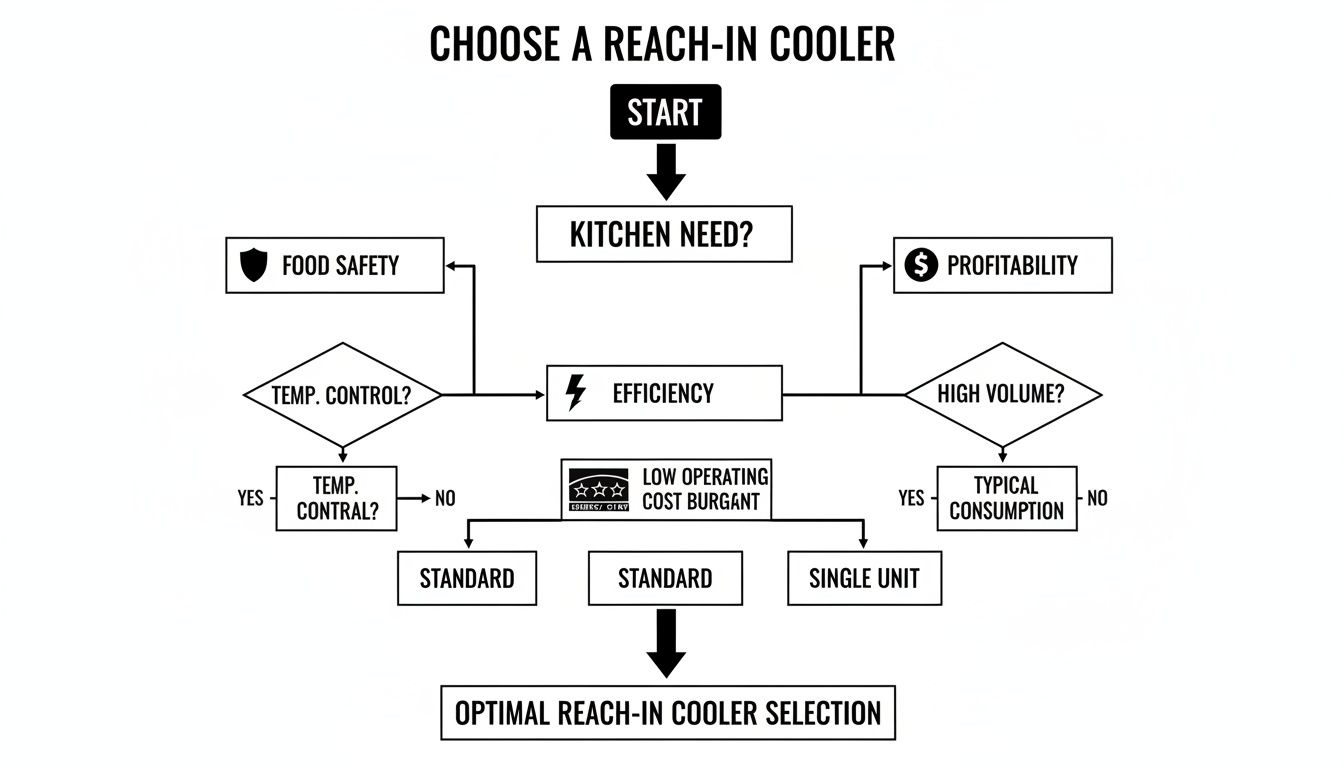
As you can see, the path to the right cooler starts with your kitchen's core needs and then branches out based on priorities like workflow, safety, and your bottom line. The right unit will support all three.
Solid Doors vs. Glass Doors: A Strategic Choice
Once you’ve settled on the size, the next decision is the type of door. This choice is all about function, with each style offering clear advantages for different kitchen environments.
Solid Doors:
- Superior Insulation: These doors, usually made from stainless steel with foam insulation, are the champs of energy efficiency. They are fantastic at holding a consistent temperature, making them perfect for back-of-house storage where ingredients sit for longer.
- Durability: In the controlled chaos of a commercial kitchen, solid doors can take a bump or a ding much better than their glass counterparts.
Glass Doors:
- Quick Inventory Checks: The biggest win for glass doors is visibility. Your staff can find ingredients with just a glance without opening the door, which saves time and stops the temperature from fluctuating.
- Merchandising Power: For any customer-facing areas like cafes or grab-and-go spots, glass doors turn your cooler into a display case, encouraging impulse buys of drinks, salads, and desserts.
The choice is simple: for back-of-house efficiency and energy savings, go with solid doors. For front-of-house merchandising or busy prep lines where speed is everything, glass doors are the clear winner.
To give you a quick reference, here’s a table that breaks down the most common configurations.
Reach In Cooler Configuration At a Glance
| Configuration | Typical Capacity (Cu. Ft.) | Best For | Pros | Cons |
|---|---|---|---|---|
| Single-Door | 12 - 29 | Small kitchens, food trucks, cafes, specific stations | Compact footprint, energy-efficient, great for tight spaces | Limited storage, not ideal for high-volume operations |
| Double-Door | 30 - 55 | Medium-sized restaurants, busy prep lines, catering businesses | Balanced storage and footprint, good organization options | Requires more floor space than a single door |
| Triple-Door | 60 - 80+ | High-volume restaurants, large institutional kitchens, bulk storage | Massive storage capacity, excellent for inventory organization | Large footprint, higher initial and running costs |
This table should help you quickly pinpoint the configuration that best matches your kitchen's size and service volume.
Making the right choice between solid and glass doors can have a real impact on your daily operations and your energy bills. If you want to dive deeper into optimizing your entire cooling setup, check out our guide on choosing the right commercial refrigeration system for your restaurant.
Energy efficiency isn't just a buzzword anymore; it's reshaping how kitchen professionals outfit their businesses. The refrigeration coolers market hit $4.4 billion and is projected to climb to $8.02 billion by 2035, largely because operators are replacing outdated units with models that can offer up to 30% better energy savings. Ultimately, getting the door type and capacity right ensures your reach-in cooler works for you, not against you.
Understanding the Heart of Your Cooler: The Compressor
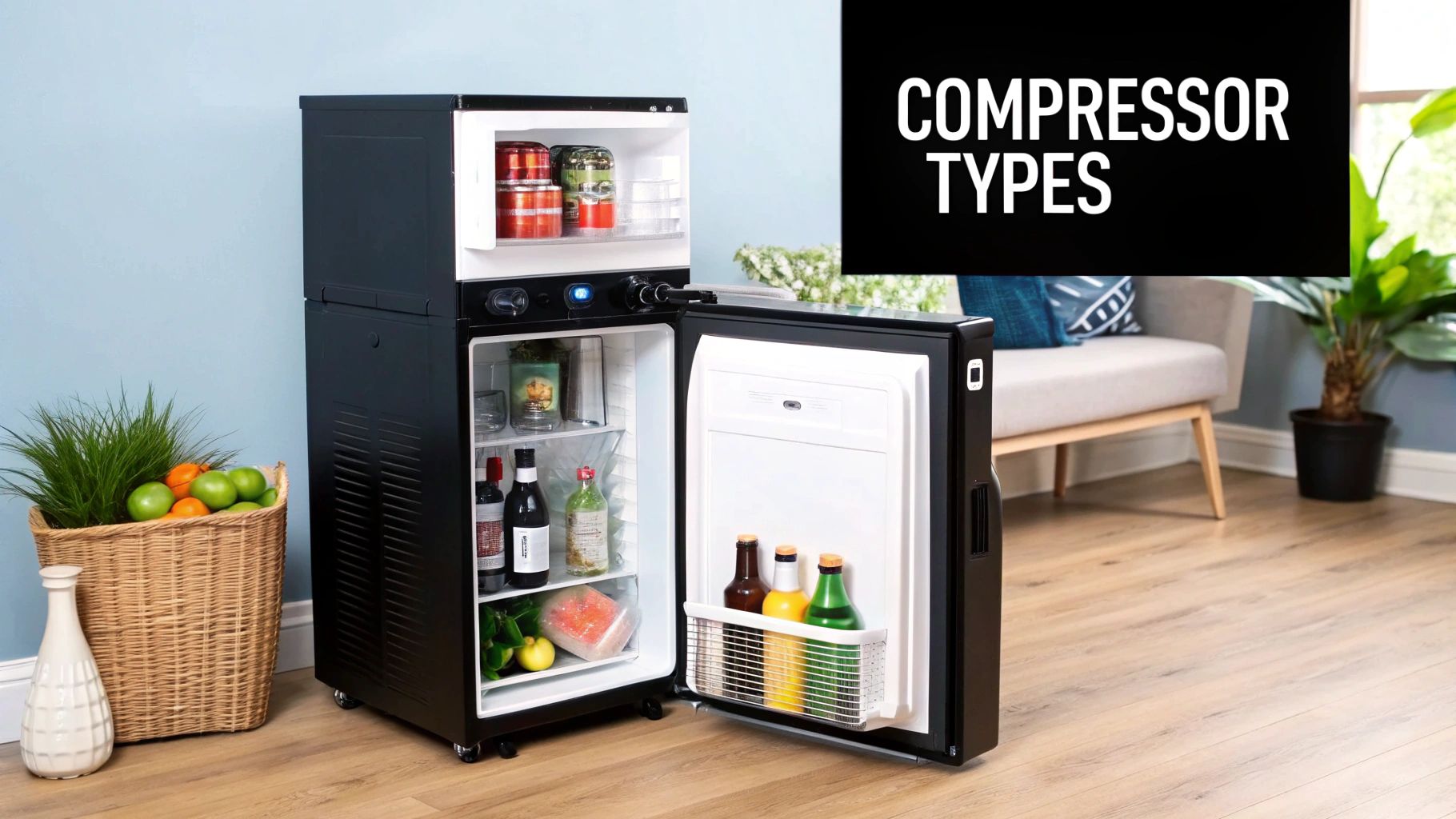
If your reach-in cooler is a key player in your kitchen, then the compressor is its heart. It’s the component that tirelessly pumps refrigerant through the system to keep your valuable inventory chilled and safe. One of the biggest decisions you'll make is where that heart is located—either on the top or the bottom of the unit.
This choice directly impacts the cooler's performance, how you'll handle maintenance, and even the ambient temperature of your kitchen. Getting your head around the difference between these two setups is the key to choosing a cooler that truly fits your workspace. Each design has its own clear advantages, tailored for specific kitchen layouts and daily challenges.
Top-Mounted Compressors: A Breath of Fresh Air
Think of a top-mounted compressor like a ceiling fan. By placing the whole refrigeration system on top of the reach-in, it stays high above the floor, far from the dust, grease, and flour that naturally cloud the air in a busy kitchen. This placement is a huge win in certain environments.
Take a bakery, for instance. With flour constantly in the air, an elevated compressor is a lifesaver. Its coils and fans are less likely to get clogged with airborne particles, which means it runs more efficiently and needs less frequent cleaning.
- Cleaner Operation: It pulls in cleaner air from higher up, reducing the risk of a clogged condenser coil.
- Better Heat Dissipation: Since hot air rises, a top-mounted unit vents heat upwards and away from your workspace, helping keep the kitchen a bit cooler.
- Ideal Environments: Perfect for bakeries, pizzerias, and any prep area where flour or fine dust is a common sight.
Of course, the height that keeps it clean can also make it a little tougher to get to for service and maintenance.
Bottom-Mounted Compressors: Ergonomic and Efficient
On the flip side, a bottom-mounted compressor is more like an easy-access floor vent. The entire refrigeration system is positioned at the base of the cooler, making it incredibly easy to reach for routine cleaning and scheduled maintenance. This is a huge ergonomic plus—no ladders required for your technicians.
This design also has a performance advantage in really hot kitchens. Because hot air rises, the air near the floor is usually a few degrees cooler. A bottom-mounted unit pulls in this cooler ambient air, allowing it to work more efficiently and use less energy to hold the right temperature.
The bottom shelf is also slightly elevated in these models, which means staff don't have to bend down as far to grab heavy items. It’s a small ergonomic tweak that makes a real difference during a hectic service.
For a deeper dive into how these systems work, our complete guide to commercial refrigerator compressors offers a more detailed comparison.
The Shift to Eco-Friendly Refrigerants
Beyond just where the compressor sits, the type of refrigerant it uses is becoming more and more important. When you're looking into the mechanics, it’s helpful to understand the role of refrigerants like Freon in the cooling cycle. The industry is making a big move away from older hydrofluorocarbons (HFCs) and toward natural, eco-friendly options like R290 (propane).
These modern refrigerants have a much lower Global Warming Potential (GWP) and are often more energy-efficient, which can translate into real savings on your utility bills. This shift is part of a bigger trend in foodservice, where efficiency and sustainability are top priorities. Reach-in coolers are at the forefront of this movement, with the global refrigeration coolers market forecasted to grow from around $4.5 billion to over $5.7 billion by 2029. This growth is largely driven by operators like you seeking smarter, energy-saving units.
Essential Features That Impact Your Bottom Line
Once you’ve settled on the big things like size and where the compressor goes, it’s the smaller details of a reach-in cooler that really shape its day-to-day value and long-term cost. These features can seem minor at first, but in a busy kitchen, they add up to real savings on your energy bills, labor, and food costs. Think of this as your buyer's checklist for making a smart investment that actually pays you back over time.
It’s easy to get lost in the technical specs when you're comparing different models. But if you focus on just a few key features, you’ll end up with a unit that doesn’t just keep your food safe but actively makes your kitchen more efficient and profitable. These are the elements that separate a basic cold box from a high-performance workhorse.
The Power of ENERGY STAR Certification
One of the most important things to look for on any reach-in cooler is the ENERGY STAR certification. This isn't just some marketing sticker; it's a guarantee from the U.S. Environmental Protection Agency that the unit is built to strict energy efficiency standards. On average, an ENERGY STAR certified commercial refrigerator is 20% more efficient than a standard model.
What does that actually mean for your restaurant? Lower monthly utility bills, plain and simple. For a busy kitchen, those savings can easily add up to hundreds of dollars a year for just one cooler. These units achieve that efficiency with things like high-performance compressors, better insulation, and more effective fan motors—all designed to do the exact same job using less power.
Construction Materials: The Foundation of Durability
The materials your reach-in cooler is made from will determine how well it holds up to the chaos of a commercial kitchen. While there are some budget-friendly options out there, the industry standard is pretty clear.
- Stainless Steel: This is the top choice for both the inside and outside of a commercial reach-in. It’s tough, resists corrosion, and is non-porous, which makes it incredibly easy to clean and sanitize. This helps you maintain high food safety standards and ensures the unit can take the inevitable bumps and spills of a busy kitchen.
- Aluminum: You’ll often find aluminum on the interior of more economical models. It’s a decent alternative, but it's softer than stainless steel and more prone to dents and scratches. Over time, those little imperfections can become a place for bacteria to hide if you're not careful with maintenance.
A full stainless steel model might cost a bit more upfront, but its durability and how easy it is to keep clean make it the smarter investment in the long run.
Smart Features That Boost Efficiency and Safety
Modern reach-in coolers now come with features that used to be considered luxuries but are now essential for managing workflow and controlling costs. These "smart" details actively work to cut down on waste and improve safety every single day.
One of the most critical is a reliable digital temperature control and display. This gives you a precise, at-a-glance reading of the internal temperature, ensuring your inventory is always held in the safe zone (at or below 40°F). Keeping your cooler's layout optimized and its temperature just right are crucial steps in managing spoilage and implementing effective strategies for reducing food waste.
Don’t underestimate the impact of small design choices. Features like self-closing doors prevent energy loss from being left ajar, while bright, efficient LED lighting makes it easier for staff to find what they need quickly without holding the door open.
These features all work together to create a smarter system. For example, self-closing doors with a stay-open feature (which usually kicks in at 90 degrees) give you the best of both worlds. They prevent energy waste during quick grabs but make it easy to load and unload big orders without needing to prop the door open. Each of these components plays a part in keeping your energy use down and making your ingredients last longer.
Before you make a final decision, it's helpful to organize your thoughts. Use this checklist to compare different reach-in coolers and make sure you're focusing on the features that will have the biggest impact on your kitchen's daily operations and long-term success.
Decision Checklist for Your Next Reach In Cooler
Use this checklist to evaluate and compare reach-in cooler models based on the most important features for a commercial kitchen.
| Decision Factor | What to Look For | Why It Matters for Your Business |
|---|---|---|
| Energy Efficiency | ENERGY STAR certification, modern refrigerants (like R290). | Directly lowers your monthly utility bills and reduces your environmental footprint. The savings add up significantly over the life of the unit. |
| Construction Materials | Stainless steel interior and exterior for maximum durability. | A well-built unit withstands the daily grind of a commercial kitchen, resists dents and corrosion, and is easier to keep sanitized. |
| Temperature Control | Precise digital controls with an easy-to-read external display. | Ensures food safety by maintaining consistent temperatures, helping you avoid costly spoilage and stay compliant with health codes. |
| Door Features | Self-closing doors to prevent energy loss, with a stay-open feature for easy loading. | Improves kitchen workflow and efficiency. Self-closing doors save energy, while the stay-open function saves time and frustration. |
| Lighting | Bright, energy-efficient LED lighting. | Helps staff find ingredients quickly, reducing the time the door is open and saving energy. It also improves inventory visibility. |
| Shelving | Adjustable, heavy-duty shelves that can accommodate your specific storage needs (e.g., sheet pans). | Flexible shelving allows you to organize your inventory effectively, maximize storage space, and adapt as your menu changes. |
| Warranty | A comprehensive warranty that covers parts, labor, and especially the compressor. | A strong warranty is a sign of a quality product and protects you from unexpected, costly repairs down the road. |
Running through this checklist helps ensure you're not just buying a cooler, but investing in a piece of equipment that truly supports your kitchen's efficiency and profitability. It helps you look beyond the price tag to the total value the unit will bring to your business.
Protecting Your Investment with Proper Maintenance
Buying a quality reach-in cooler is a major step, but protecting that investment for the long haul is what really makes a difference to your bottom line. Consistent, proper care is the secret to a long and efficient service life. It's what keeps you from dealing with unexpected breakdowns, keeps your energy bills in check, and ensures every ingredient inside stays safe and fresh.
Think of your cooler’s refrigeration system like a person who needs to breathe. If its airflow is blocked, it can't "exhale" the heat it pulls from inside the cabinet. This forces the compressor to work way harder than it should, leading to sky-high energy bills and, eventually, premature failure. Good ventilation isn’t just a suggestion—it's absolutely essential for the health of your unit.
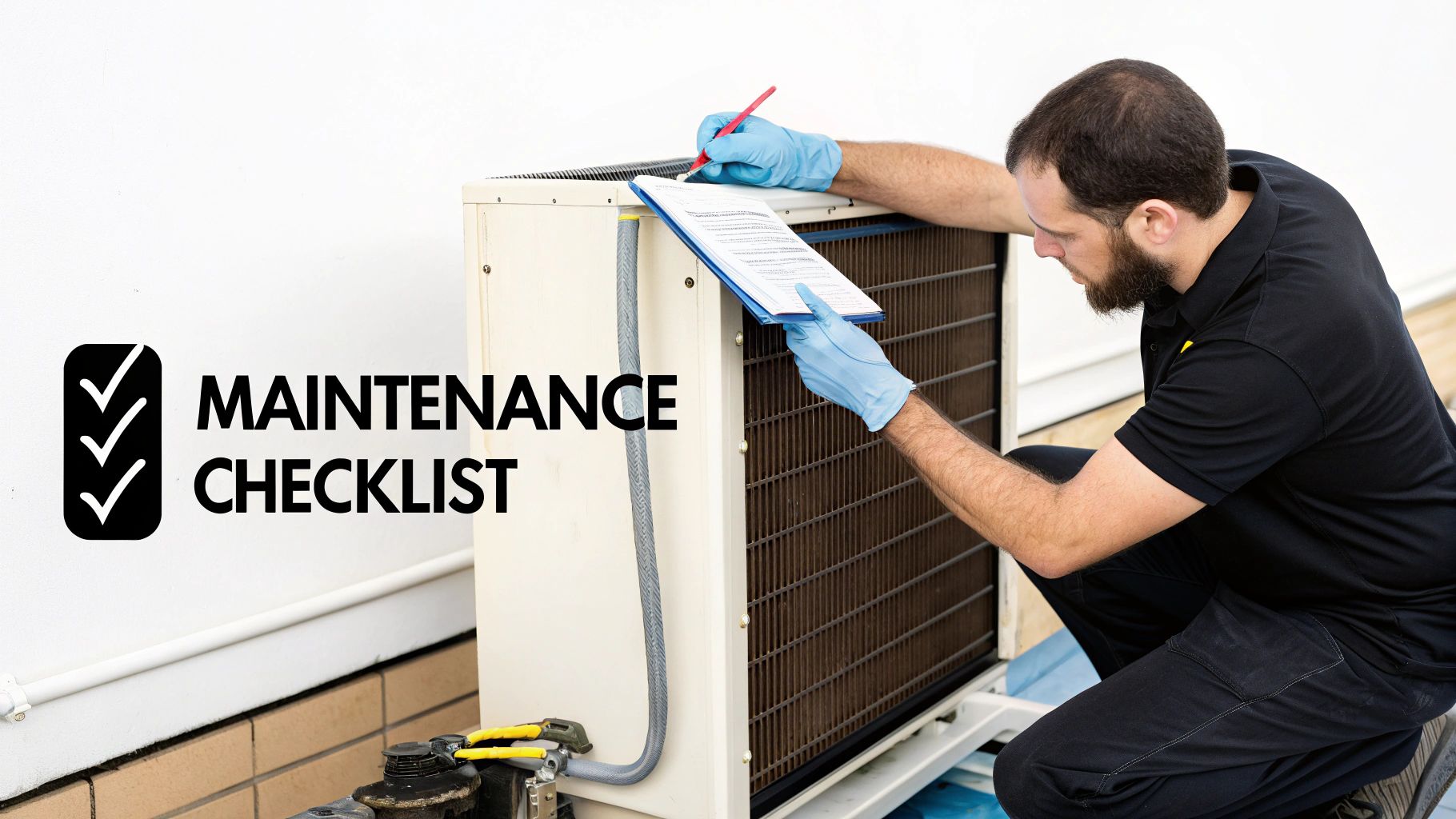
This is exactly why you should never shove a reach-in cooler right up against a wall. Always follow the manufacturer's clearance requirements, which usually means leaving at least 3-5 inches of breathing room around the back and sides.
Your Simple Maintenance Checklist
The good news is that the most impactful maintenance tasks are simple habits any staff member can pick up. Building these routines into your daily and monthly closing procedures can prevent up to 75% of emergency service calls. These aren't complicated technical jobs; they're quick checks that protect your equipment.
Here's a straightforward checklist to get you started:
- Clean Condenser Coils Monthly: The condenser coil is where your cooler gets rid of heat. When it gets clogged with dust, grease, and kitchen grime, the unit has to work overtime. A quick brushing or vacuuming every month is the single most effective thing you can do.
- Inspect Door Gaskets Weekly: Those rubber seals around the doors, called gaskets, are what keep the cold air in and the warm air out. If they get cracked, brittle, or torn, cold air is constantly escaping. This forces the compressor to run nonstop, wasting energy and causing serious wear and tear.
- Wipe Down Interior Surfaces Daily: Spills and crumbs should be cleaned up right away to prevent bacteria and funky odors. A clean interior also promotes better airflow around your products, which means more consistent cooling for everything.
- Check and Clear Drain Lines: Make sure the interior drain line is free of any blockages. If it gets clogged, water can back up and pool inside the unit, creating a major sanitation headache.
Proactive maintenance is always cheaper than reactive repair. A few minutes of care each week can save you from a mid-service breakdown, a cooler full of lost inventory, and a four-figure repair bill.
Long-Term Care and When to Call a Pro
While your daily and monthly checks are crucial, it’s also smart to schedule a professional service visit once a year. A qualified technician can check refrigerant levels, inspect electrical components, and catch potential problems before they turn into catastrophic failures. They have the right tools and expertise to give your system a deep health check.
By combining these simple in-house routines with an annual professional check-up, you'll extend the life of your reach-in cooler and make sure it’s always running at peak efficiency. For more in-depth tips, our guide on how to maintain commercial refrigerators provides even more detail to keep your equipment running smoothly.
Ultimately, a well-maintained cooler is a reliable partner in your kitchen's success.
Alright, you’ve done the hard work. You’ve mapped out your kitchen’s flow, weighed the pros and cons of different compressors, and have a solid list of must-have features. Now for the exciting part: making this key piece of equipment a reality. Getting a new reach-in cooler doesn’t mean you have to drain your bank account with a massive upfront payment, especially when you’re just starting out or growing your food truck.
There are smart ways to get top-tier equipment into your kitchen while keeping your cash flow healthy for everything else—like payroll, inventory, and getting the word out. Think of it as another strategic tool in your business toolkit.
Smart Financing That Works for You
Instead of tying up thousands of dollars in one go, leasing programs let you make predictable, easy-to-manage monthly payments. This keeps your capital free for other things and often gives you the option to own the equipment when the term is up. For a lot of new businesses, this is the secret to getting the right reach-in cooler from day one, without having to compromise on quality.
The perks are pretty clear:
- Hold Onto Your Capital: Keep cash available for daily operational needs and those unexpected opportunities that always pop up.
- Get Better Equipment: You can often afford a more durable, energy-efficient model than if you were buying it outright.
- Budget with Confidence: Fixed monthly payments make financial planning way simpler and more accurate.
Choosing a supplier that offers flexible financing isn’t just about convenience. It’s about finding a partner who gets the real-world financial pressures restaurant owners are under and is invested in your growth.
Logistics and Support Matter, A Lot
Your job isn’t over once you’ve picked a model. The last, and honestly, one of the most critical pieces of the puzzle, is working with a supplier who understands that in the foodservice world, time is money. Delays are costly. Fast, reliable shipping is an absolute must, ensuring your new reach-in cooler shows up exactly when you expect it so you can get up and running without any expensive downtime.
This is truer than ever as the demand for solid commercial refrigeration keeps climbing. The global market for refrigeration coolers, currently valued at $4.19 billion, is expected to hit $5.74 billion by 2029—a growth fueled by the nonstop needs of places just like yours. You can learn more about the trends driving this market growth if you're curious.
In the end, buying a reach-in cooler is about so much more than the unit itself. It’s about choosing a partner like The Restaurant Warehouse who can deliver a smooth experience from start to finish—from financing and selection to speedy delivery and the support you need down the road.
Got Questions About Reach In Coolers? We’ve Got Answers.
Diving into the world of commercial refrigeration can bring up a lot of questions. Now that you're up to speed on the key features and types of reach-in coolers, let's tackle some of the most common things we hear from restaurant owners, chefs, and food truck operators just like you.
How Often Should I Clean My Reach In Cooler Coils?
This is the single most important maintenance task you can do. For your cooler to run efficiently and keep your energy bills from creeping up, you need to clean the condenser coils at least every 90 days.
If your kitchen has a lot of airborne grease or dust—think bakeries with flour or kitchens with busy fryers—you’ll want to bump that up to a monthly cleaning. A dirty coil makes the compressor work way harder, which wastes electricity and seriously increases the risk of a pricey, premature breakdown.
What Is the Ideal Temperature for a Reach In Cooler?
To keep your inventory safe and meet health code standards, the ideal temperature for a commercial reach in cooler is at or below 40°F (4°C). For a reach-in freezer, you’re aiming for a rock-solid 0°F (-18°C).
It's a really smart move to keep a separate, calibrated thermometer inside the unit just to double-check. The built-in digital display can lose a bit of accuracy over time, and an independent check is the best way to be sure everything is safe.
Can I Place a Reach In Cooler Directly Against a Wall?
Absolutely not. You should never install a cooler flush against a wall or another piece of equipment. Commercial refrigeration systems need room to "breathe" so they can properly push out the heat they've pulled from inside the cabinet.
Think of it like a runner after a race—if they can't breathe properly, they'll overheat. Your cooler is the same. Restricting airflow is the fastest way to cause inefficiency, overheating, and eventual component failure.
Most manufacturers call for a minimum of 2-3 inches of clearance on the sides and back. For units with top-mounted compressors, you'll often need even more breathing room above the cooler to make sure it can vent heat effectively.
What Is the Difference Between a Reach In and a Walk In Cooler?
The main difference really boils down to scale, function, and how they fit into your kitchen's workflow. They play two very different, but equally important, roles.
- A Reach In Cooler is your frontline storage. It’s a self-contained, upright cabinet designed to hold ingredients you need for daily service, usually placed right on the prep line for quick access to things like sauces, prepped veggies, and proteins.
- A Walk In Cooler is all about bulk storage. It's basically a refrigerated room where you keep large inventory shipments and weekly deliveries, keeping your main stock fresh until it's ready to be moved to the line.
The most efficient kitchens use a combination of both. Inventory is moved from the walk-in to the reach-in as needed, which keeps the service line stocked without creating clutter or slowing down your team. This strategic flow is fundamental to a smooth and productive kitchen.
Ready to outfit your kitchen with a reliable, high-performance reach in cooler? Explore the huge selection at The Restaurant Warehouse and find the perfect model to fit your space, workflow, and budget. With flexible financing and fast shipping, we make it easy to get the essential equipment you need to succeed.
Find Your Perfect Reach In Cooler Today at therestaurantwarehouse.com
About The Author

Sean Kearney
Sean Kearney is the Founder of The Restaurant Warehouse, with 15 years of experience in the restaurant equipment industry and more than 30 years in ecommerce, beginning with Amazon.com. As an equipment distributor and supplier, Sean helps restaurant owners make confident purchasing decisions through clear pricing, practical guidance, and a more transparent online buying experience.
Connect with Sean on LinkedIn, Instagram, YouTube, or Facebook.