

Prep Like a Pro: Essential Tools for Your Commercial Kitchen
The Foundation of an Efficient Kitchen
Commercial food prep equipment forms the backbone of successful foodservice operations, from busy restaurants to institutional cafeterias. Here's what you need to know:
Essential Commercial Food Prep Equipment Types:
- Slicers - For consistent cuts of meat, cheese, and vegetables
- Mixers - Planetary, spiral, and hand mixers for dough, batters, and more
- Food Processors - Batch bowl and continuous-feed models for chopping, dicing, and pureeing
- Grinders - For fresh ground meat and specialty preparations
- Peelers & Juicers - Specialized tools for high-volume produce prep
The secret to keeping a busy kitchen running smoothly is selecting dependable, high-performance food prep equipment that stands up to high traffic and helps meet health regulations. Slicing, dicing, tenderizing, mixing, and other prep tasks can be some of the most time-consuming duties in the kitchen.
Why proper equipment matters:
Food preparation equipment is the foundation of high-volume kitchens, from busy restaurants and institutional cafeterias to ghost kitchens. Managing limited space, reducing cleaning time, and maintaining precise temperature controls are critical when preparing large batches of ingredients or meals.
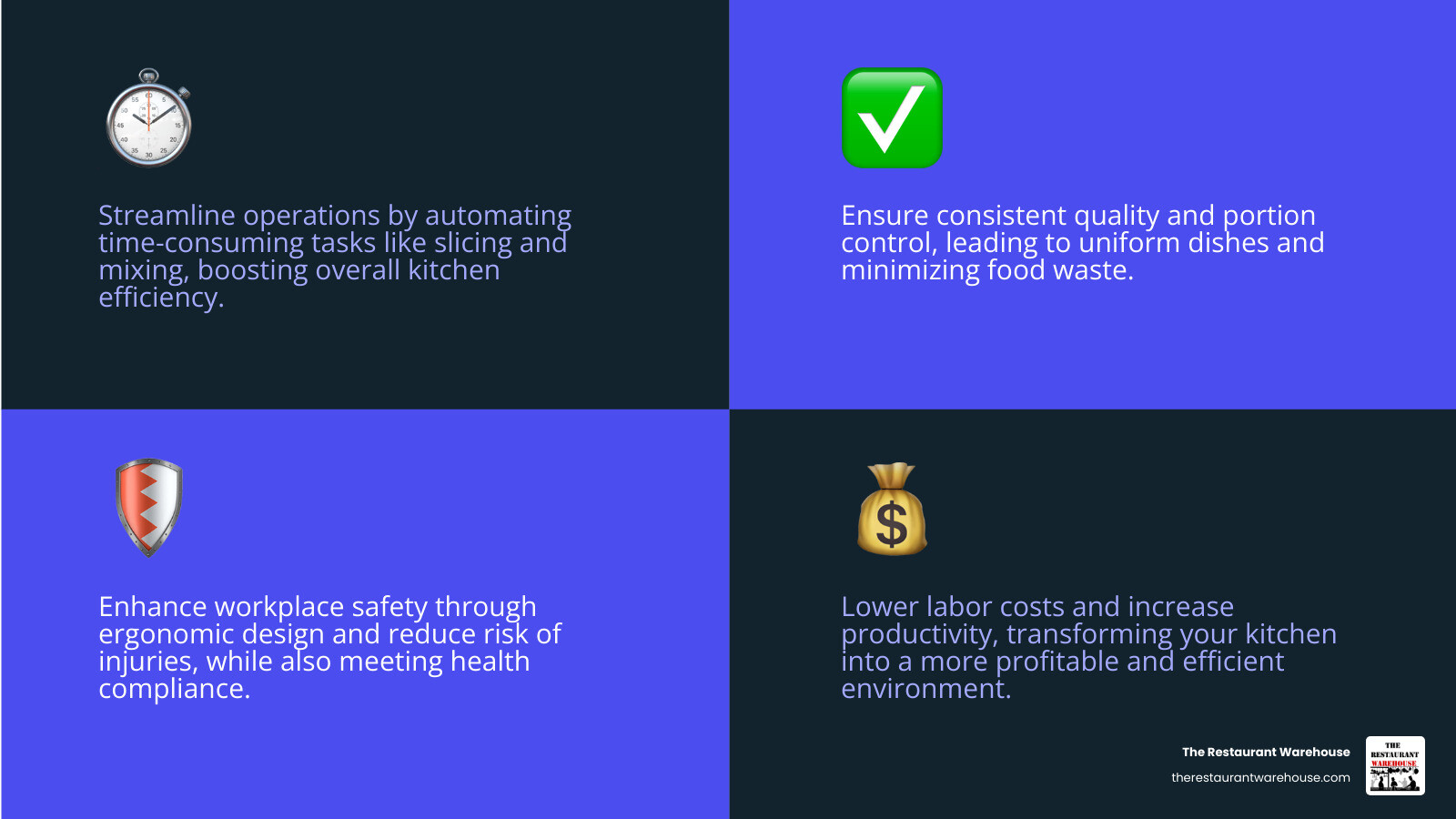
By using the proper prep tools, your kitchen staff will be able to perform tasks safely, ultimately reducing injuries in the workplace. It's important to have the proper food preparation equipment available to your staff so sides, appetizers, entrees, and desserts can be delivered to customers as quickly and efficiently as possible.
Easy commercial food prep equipment glossary:
- commercial kitchen stainless steel tables
- commercial vegetable peeler
- commercial sinks for restaurants
A Breakdown of Essential Commercial Food Prep Equipment
Successful kitchens aren't just about talented chefs—they're powered by smart equipment choices. The right commercial food prep equipment transforms daily operations from chaotic scrambling into smooth, efficient workflows that save time and money.
For any foodservice establishment, from a cozy cafe to a busy cafeteria, high-performance equipment is a secret weapon. These machines speed things up, deliver the consistency customers expect, reduce labor costs, and improve meal quality.
Let's explore the essential categories that form the backbone of professional kitchens.
Slicers: For Precision and Consistency
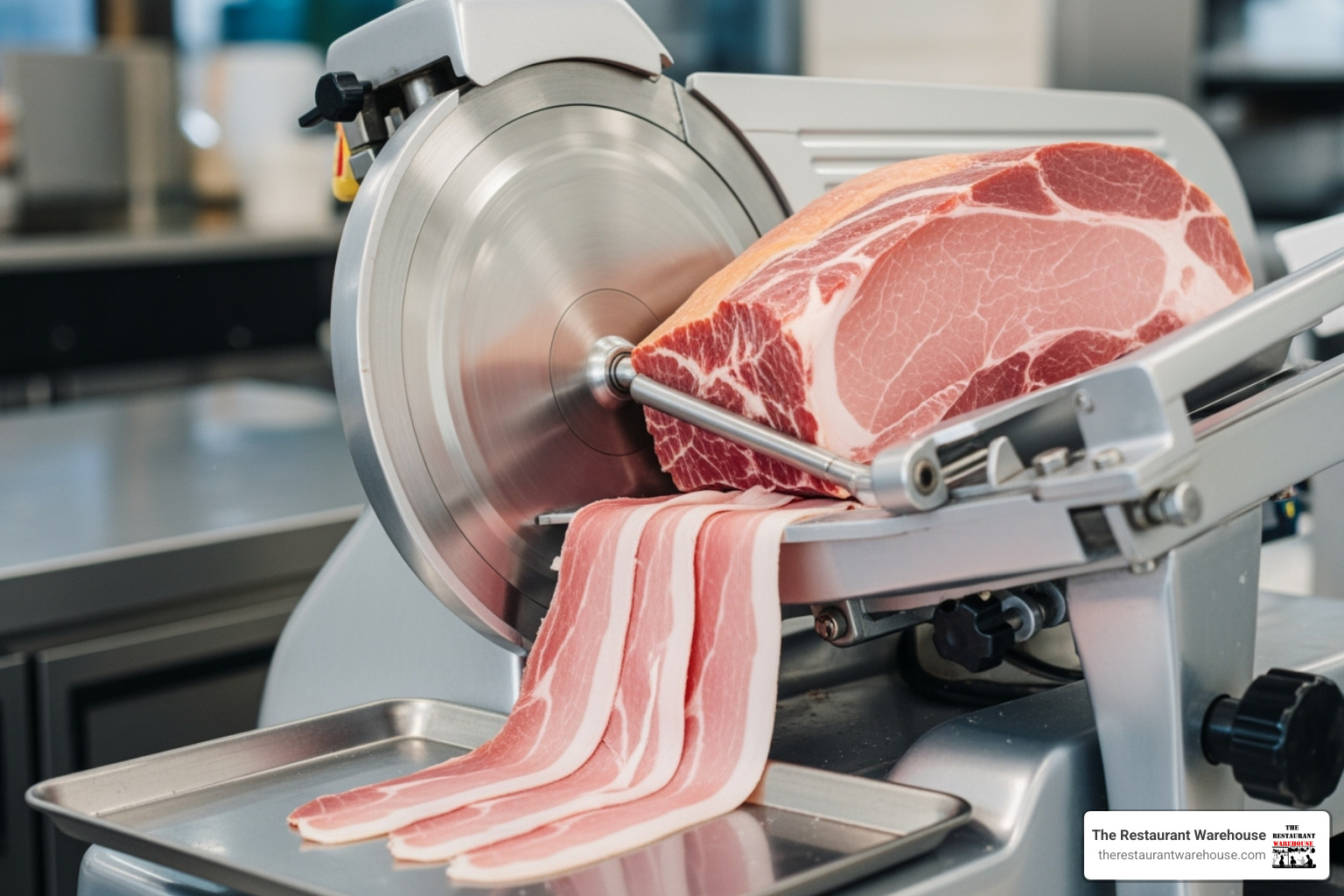
Picture this: your prep cook spending hours hand-slicing deli meat, each piece coming out a different thickness. Now imagine getting perfectly uniform slices in a fraction of the time. That's the magic of a quality commercial slicer.
Meat slicers and bread slicers have become indispensable tools in delis, cafes, and restaurants where consistency matters. Whether you're running a high-volume operation or a smaller establishment, the right slicer ensures every slice meets your exact specifications.
The key features that separate great slicers from mediocre ones include adjustable blade sizes that let you go from paper-thin to thick cuts, powerful horsepower for smooth operation through tough items, and crucial safety guards that protect your team. You'll find both manual and automatic options available, so you can choose the level of automation that fits your kitchen's pace and budget.
Beyond speed, slicers deliver something even more valuable: consistent thickness. This consistency isn't just about looks—it ensures even cooking, professional presentation, and significantly reduces waste. When every slice is uniform, you're maximizing your ingredient investment and delivering the reliability your customers expect.
Mixers: The Powerhouse of Prep
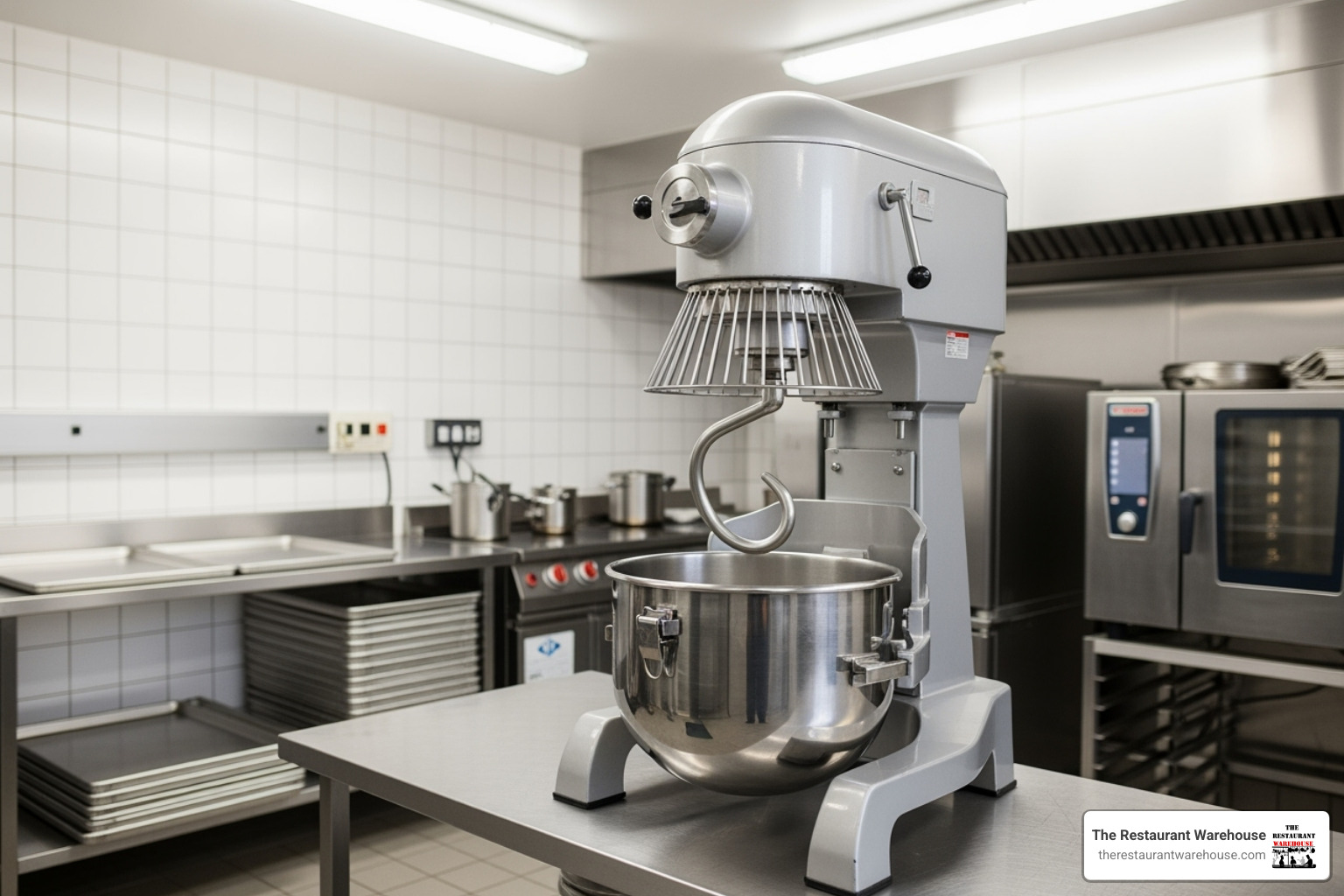
If you've ever tried mixing large batches of dough by hand, you know it's backbreaking work. Commercial mixers eliminate this struggle while delivering results that manual mixing simply can't match.
Planetary mixers offer incredible versatility for most kitchen tasks, while spiral mixers excel at handling large batches of heavy dough. For lighter tasks, hand mixers provide the perfect balance of power and portability.
Capacity becomes your first consideration—mixers range from compact countertop models to massive floor units that can handle industrial volumes. The real versatility comes from the attachments: dough hooks for bread and pizza dough, whisks for whipping cream and aerating batters, and paddles for everything from cookie dough to mashed potatoes.
Whether you're running a bakery perfecting artisanal breads, a pizzeria cranking out fresh dough daily, or a restaurant needing consistent results across multiple menu items, the right mixer becomes an extension of your culinary team. Modern commercial mixers feature robust construction, reliable motors, and safety features that let your staff work confidently and efficiently.
Food Processors: The Ultimate Multitasker
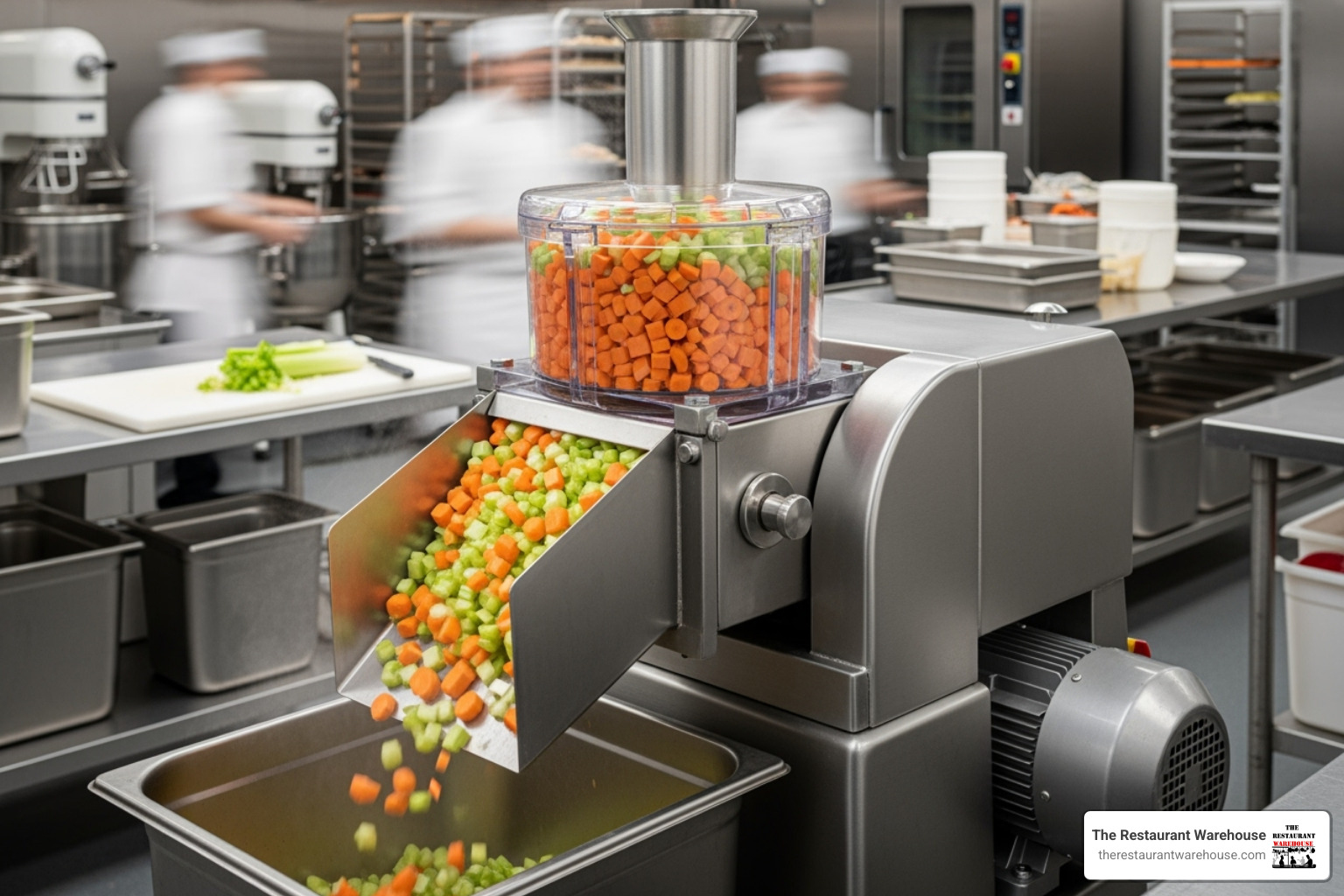
Here's where commercial food prep equipment gets really exciting. Food processors are the Swiss Army knives of professional kitchens, tackling dicing, chopping, pureeing, and shredding with remarkable speed and precision.
You'll encounter two main types: batch bowl processors that handle contained tasks perfectly, and continuous-feed processors that can process ingredients non-stop as long as you keep feeding them. For high-volume operations, continuous-feed models are game-changers, capable of processing massive quantities without stopping to empty bowls.
The magic happens with specialized S-blades for chopping and pureeing, plus various dicing kits and cutting discs that slice, grate, and julienne with professional precision. This versatility means one machine can replace multiple prep stations and several staff hours of manual work.
Modern food processors have revolutionized commercial kitchens by turning time-intensive prep work into quick, consistent processes. The consistency they deliver ensures every dish meets your standards, while the speed keeps your kitchen running smoothly during busy periods.
Grinders, Peelers, and Juicers: Specialized Taskmasters
Some kitchen tasks are so specific—and so labor-intensive—that they demand specialized equipment. These machines might seem niche, but they're absolute lifesavers for operations that need them.
Meat grinders transform tough, time-consuming work into effortless operation. Whether you're grinding meat for fresh burgers, sausages, or specialty preparations, these powerful machines handle large volumes while maintaining the texture and quality that sets your food apart. Butcher shops and restaurants focusing on fresh, house-ground meats find these machines indispensable.
Vegetable peelers tackle one of the most tedious prep tasks imaginable. Peeling potatoes by hand for a busy cafeteria is practically torture, but commercial peelers handle pounds of produce in minutes. Cafeterias and high-volume operations see immediate returns on these investments.
Commercial juicers have become essential for establishments running fresh juice programs. Health-focused cafes and restaurants offering fresh-squeezed beverages need equipment that maximizes yield while maintaining quality and speed.
Before investing in specialty equipment, ask yourself these critical questions: What's your daily volume for this specific task? How important is consistency for this ingredient? And most importantly, what's your return on investment when you factor in labor savings? Often, these specialized machines pay for themselves faster than you might expect.
Key Features to Look For in Your Equipment
Investing in commercial food prep equipment is a decision that affects your kitchen's efficiency, safety, and bottom line for years. Making the right choice ensures long-term value, operational efficiency, and compliance with health regulations.
The cheapest option upfront can cost more in repairs, replacements, and lost productivity. Focus on finding equipment that delivers real value—the kind that works hard every day without letting you down.
Durability and Material
Your kitchen is a battlefield, and your equipment needs to be built like armor. In a busy commercial environment, machines face constant use, high temperatures, moisture, and the occasional bump and scrape. This is where stainless steel construction becomes your best friend.
Stainless steel isn't just shiny and professional-looking – it's practically indestructible. It resists corrosion, won't crack under pressure, and can withstand the daily chaos of a high-traffic kitchen. When you see equipment with high-grade components and stainless steel construction, you're looking at a machine that's built to last.
But here's something equally important: always look for NSF-listed equipment. This certification isn't just a fancy badge – it's your guarantee that the equipment meets strict public health standards. NSF-listed machines are engineered to be easily cleaned and sanitized, which prevents bacterial growth and keeps your kitchen safe.
Reputable brands have earned their reputation by consistently delivering equipment that stands up to years of heavy use. When you invest in quality from the start, you're not just buying a machine – you're buying peace of mind and protecting your kitchen's productivity.
Ease of Cleaning and Food Safety Compliance
Let's be honest: nobody loves cleaning equipment, but it's absolutely critical for food safety. The good news? Modern commercial food prep equipment is designed to make this necessary task as painless as possible.
Look for machines with removable parts that can pop right into your dishwasher. Dishwasher-safe components save your staff time and ensure thorough sanitization every time. Smooth, non-porous surfaces are another game-changer – they don't give bacteria anywhere to hide and make wiping down equipment quick and effective.
These design features do more than just make cleaning easier – they help you prevent cross-contamination and meet health codes without breaking a sweat. When your equipment is designed for easy cleaning, you're reducing cleaning time and freeing up your staff to focus on what they do best: preparing great food.
Some manufacturers even go the extra mile with special coatings and materials that actively fight bacteria. It's like having an extra layer of protection built right into your equipment.
For detailed guidance on maintaining food safety standards, consult resources from your local health department or look into accredited food safety training programs.
Space, Ergonomics, and Workplace Safety
Every square inch in your kitchen matters, so choosing between countertop models and floor models isn't just about capacity – it's about maximizing your kitchen's footprint and workflow. But smart space planning goes beyond just fitting equipment into available spots.
User-friendly controls and intuitive interfaces make a huge difference in daily operations. When your staff can operate equipment easily and confidently, everything runs smoother. Look for machines with ergonomic designs that reduce strain during repetitive tasks – your team will thank you, and you'll see the difference in productivity.
Safety features like safety interlocks and automatic shut-offs aren't just nice-to-have extras – they're essential for preventing workplace injuries. These features protect your staff during operation and cleaning, creating a safer work environment for everyone.
Reducing operator fatigue should be a top priority when selecting equipment. Machines that are comfortable to use and easy to operate help prevent injuries and keep your team working efficiently throughout long shifts. When your equipment works with your staff instead of against them, everyone wins.
Smart Acquisition: Maximizing Your Investment
Investing in commercial food prep equipment can feel overwhelming when balancing quality with budget. Every dollar matters, and you want your investment to pay off. With smart planning, you can maximize every penny and set your kitchen up for long-term success.
Choosing the Right Commercial Food Prep Equipment for Your Business
Here's the truth: there's no one-size-fits-all solution when it comes to commercial food prep equipment. What works perfectly for a busy bakery might be overkill for a cozy café, and what suits a high-volume cafeteria could leave a small deli struggling with unnecessary complexity.
The secret lies in honest self-assessment. Start by looking at your daily volume – how much food are you actually preparing each day? Then consider your menu needs. A pizzeria will prioritize different equipment than a sandwich shop. Don't forget about your staff skill level either. The most sophisticated machine won't help if your team isn't comfortable using it.
Let's talk numbers for a moment. Consider this eye-opening comparison of manual prep versus machine prep when dicing 50 pounds of onions:
| Task: Dicing 50 lbs of Onions | Manual Prep (approx.) | Machine Prep (approx.) |
|---|---|---|
| Time | 3-4 hours | 10-15 minutes |
| Labor Cost (at $15/hr) | $45-$60 | $2.50-$3.75 |
| Consistency | Variable | High, Uniform |
The difference is staggering, isn't it? While that food processor might seem like a big upfront cost, it pays for itself incredibly quickly when you factor in labor savings and consistency benefits.
Your restaurant type plays a huge role too. Delis need reliable slicers for consistent sandwich prep, while cafeterias benefit from high-capacity mixers and continuous-feed processors. Take time to really understand your operation's rhythm before making decisions.
Exploring Rent–Try–Buy and Financing Options
Let's be honest – not every business has thousands of dollars sitting around to buy equipment outright. And frankly, that's perfectly normal! Smart business owners look for creative ways to manage their cash flow while still getting the tools they need.
Rent–Try–Buy programs are game-changers for many of our customers. Think of it as a test drive for your kitchen equipment. You get to use the equipment in your actual working environment, see how it performs under real conditions, and make sure it's the right fit before committing to a purchase.
Here's how it typically works: you start with a flexible 12-month rental agreement with manageable weekly payments that won't strain your budget. The beauty is that about 60% of your rental payments can go toward the purchase price if you decide to buy. Plus, those rental payments are often 100% tax-deductible (though you'll want to check with your tax professional about your specific situation).
Equipment leasing offers another path forward, especially for larger purchases. It allows you to spread costs over time while preserving your working capital for other business needs. Many of our customers find that the tax-deductible payments and ability to upgrade equipment as their business grows make leasing an attractive option.
The real advantage of these financing benefits goes beyond just cash flow management. They give you the flexibility to test equipment thoroughly, ensuring you're making the right choice for your specific needs. If your business grows faster than expected or takes a different direction, you have upgrading options without being stuck with equipment that no longer serves you well.
Maintenance Tips for Your Commercial Food Prep Equipment
You've made the investment – now let's make sure it lasts. Proper maintenance isn't just about extending equipment life; it's about protecting your investment and ensuring consistent performance day after day.
Daily cleaning should become second nature. After each shift, give your equipment a thorough wipe-down. Those removable parts we talked about earlier? If they're dishwasher-safe, run them through for a deep clean. For delicate components like blades and cutting discs, gentle hand cleaning often works better to preserve their sharpness.
Regular inspection might sound tedious, but it's your best defense against unexpected breakdowns. Check blades for sharpness, ensure safety guards are secure, and test that all controls are working properly. Catching small issues early can save you from costly repairs down the road.
Don't neglect blade sharpening – dull blades aren't just inefficient, they can be dangerous. Follow manufacturer guidelines for when and how to sharpen, or establish a relationship with a professional service technician.
Some equipment needs lubricating of moving parts occasionally. Always use food-grade lubricants and stick to the manufacturer's recommendations. Over-lubricating can be just as problematic as under-lubricating.
The golden rule? Following manufacturer guidelines religiously. That user manual isn't just paperwork – it's your roadmap to getting the most out of your equipment. Every machine has its quirks and specific needs, and the manufacturer knows them best.
By building these simple practices into your daily routine, you're not just maintaining equipment – you're protecting your investment, ensuring consistent performance, and upholding the food safety standards your customers depend on.
Frequently Asked Questions about Commercial Food Prep Equipment
Investing in commercial food prep equipment naturally brings up questions. To help you make the smartest choices for your kitchen, here are the most common questions we receive, along with straightforward answers to help you feel confident in your decisions.
What is the difference between a food processor and a blender?
This question comes up all the time, and honestly, it's easy to see why people get confused! Both machines have spinning blades and can transform ingredients, but they're designed for completely different jobs.
Think of a food processor as your solid food specialist. It's built to handle ingredients you can grab with your hands - vegetables, fruits, nuts, cheese, even dough. The blades and attachments are specifically designed to chop, slice, dice, shred, and puree solid or semi-solid foods.
When you're prepping vegetables for a big batch of soup, dicing onions for salsa, shredding cabbage for coleslaw, or making fresh pesto, that's food processor territory. These machines excel at repetitive prep tasks that would otherwise take your staff hours to complete by hand. They're absolute game-changers for high-volume kitchens.
A blender, on the other hand, is your liquid specialist. Its blade design creates a powerful vortex that pulls ingredients down and blends them into smooth, pourable consistency. Blenders are perfect for smoothies, milkshakes, pureed soups, sauces, and bar drinks. If you're making something you'd drink through a straw or pour from a pitcher, reach for the blender.
The key difference? Food processors keep some texture and structure in your ingredients, while blenders completely break everything down into a uniform liquid. Both have their place in a well-equipped kitchen, but they're not interchangeable.
How do I know what size mixer my bakery needs?
Getting the right mixer size is crucial - too small and you'll be running batch after batch, wearing out your equipment and frustrating your staff. Too big and you're wasting money and counter space on capacity you'll never use.
Start by thinking about your largest typical batch size. If you regularly make 20 pounds of bread dough, you'll need a mixer that can handle that comfortably without straining. Mixers are sized by their bowl capacity, typically ranging from compact 7-quart models up to massive 60-quart floor units.
Here's where it gets a bit technical, but stick with us - the absorption ratio of your dough matters a lot. This is basically how much water your flour absorbs. A stiff pizza dough puts more strain on a mixer than a loose cake batter, even if they're the same volume. Some manufacturers provide handy calculators to help match your specific recipes to the right mixer size and horsepower.
Don't forget to consider your daily production needs. Sometimes it's more efficient to run a smaller mixer continuously than to invest in a huge one that sits idle most of the day. Think about your peak hours and how quickly you need to turn out products.
The attachments you'll use also matter. Heavy dough hooks require more power than wire whisks. Make sure your mixer's motor can handle all the tasks you'll throw at it, from kneading dense bread dough to whipping light cream.
When in doubt, talk to our equipment specialists. We've helped countless bakeries find their perfect mixer match, and we're happy to walk through your specific needs to find the sweet spot between capacity and cost.
Is an ENERGY STAR rating important for prep equipment?
Absolutely! For electric commercial food prep equipment that qualifies for ENERGY STAR ratings, this certification can make a real difference in your operation - both for your wallet and your conscience.
ENERGY STAR ratings mean the equipment uses significantly less energy than standard models while delivering the same performance. In a commercial kitchen where equipment runs for hours every day, those energy savings add up fast. We're talking about potentially hundreds of dollars in reduced utility bills over the equipment's lifespan.
The upfront investment in ENERGY STAR equipment might be slightly higher, but smart operators know to look at the total cost of ownership, not just the purchase price. When you factor in the energy savings over several years, the more efficient equipment often costs less in the long run.
There's also the environmental benefit to consider. Using less energy means reducing your carbon footprint, which is increasingly important to customers who care about sustainability. It's a selling point that can set your business apart.
That not all prep equipment categories qualify for ENERGY STAR ratings, as the program typically focuses on equipment with continuous energy consumption like refrigeration units. But when the rating is available, we always recommend considering it as part of your decision-making process.
The bottom line? ENERGY STAR ratings represent a smart investment in your operation's future efficiency and profitability.
Conclusion: Equip Your Kitchen for Success
Choosing the right commercial food prep equipment isn't just about buying machines—it's a strategic investment in your business's future success. Throughout this guide, we've shown how these essential tools create the foundation for a streamlined workflow, consistent quality, rock-solid food safety compliance, and significant reductions in manual labor.
Every slice from a precision slicer, every perfectly mixed batch from a powerful mixer, and every uniform dice from a versatile food processor plays a crucial role. These aren't just conveniences—they're the building blocks of efficiency that can make or break your daily service.
The smart money goes toward equipment that delivers on durability, ease of cleaning, and safety features that protect your team. But you don't have to break the bank to get there.
Smart acquisition strategies are key. Understanding your kitchen's needs, exploring flexible options like Rent–Try–Buy programs, and using financing solutions can help you get the equipment you need without straining your cash flow. It's about being strategic.
At The Restaurant Warehouse, we've built our reputation on a simple promise: supplying commercial food prep equipment and food service supplies at prices that make sense for your bottom line. By cutting out the middleman—no high commissions, no retail overhead—we pass those savings directly to you. Whether you're running a busy restaurant in downtown Seattle, managing a cafeteria operation, or starting fresh with a new concept, our wholesale pricing approach means you get professional-grade equipment without the professional-grade markup.
Investing in quality commercial food prep equipment is an investment in three core needs of any successful foodservice operation: efficiency, safety, and profitability. When you equip your team with the right tools, you're not just making their jobs easier—you're empowering them to deliver the consistent, high-quality results that turn first-time customers into regulars.
Your kitchen is the heart of your operation. When it runs like a well-oiled machine, everything else falls into place. Your staff feels confident, your customers leave satisfied, and your business thrives.
Ready to take the next step? We've put together everything you need to know about outfitting your entire kitchen operation: A complete guide to outfitting your kitchen
About The Author

Sean Kearney
Sean Kearney is the Founder of The Restaurant Warehouse, with 15 years of experience in the restaurant equipment industry and more than 30 years in ecommerce, beginning with Amazon.com. As an equipment distributor and supplier, Sean helps restaurant owners make confident purchasing decisions through clear pricing, practical guidance, and a more transparent online buying experience.
Connect with Sean on LinkedIn, Instagram, YouTube, or Facebook.