

How to Start a Restaurant Business from Scratch
Starting a restaurant is a thrilling mix of pure culinary passion and sharp business sense. The journey breaks down into several critical stages, from nailing down your unique concept and writing a rock-solid business plan to securing financing, wading through permits, designing your kitchen, hiring a killer team, and pulling off a strong launch. It's a complex road, for sure, but focusing on these core pillars builds a foundation that can actually stand up to the pressure.
What It Really Takes to Open a Restaurant
Before you get lost daydreaming about signature dishes and five-star reviews, we need to get real about the restaurant industry. It’s a world defined by fierce competition and notoriously thin profit margins. But for entrepreneurs who show up prepared, the rewards are immense. A successful launch all comes down to having a clear-eyed view of the financial and operational hurdles waiting for you.
From the moment you start, you'll be facing significant capital needs and constant challenges that can easily sideline even the most dedicated founders. Building your dream on a foundation of solid data—not just passion—is absolutely non-negotiable.
The Financial and Operational Realities
Opening a restaurant means you’re jumping into an industry with a massive financial scale and intense operational demands. The global foodservice market is enormous, hitting about $3.09 trillion and on track to blow past $4.1 trillion by 2033. Here in the U.S., sales topped $1.5 trillion in 2023.
But despite that massive market, the average profit margins are razor-thin, typically landing somewhere between 3% to 5%. The top performers might see margins closer to 10%, but that’s the exception, not the rule. You can find more insights in these restaurant industry statistics and what they mean for new owners like you.
Adding to the pressure, chronic staff shortages are a huge operational hurdle. Roughly 70% of restaurants report struggling to fill open positions, which puts a ton of strain on service quality and consistency. This landscape just hammers home the need for meticulous financial planning and efficient operational strategies right from day one.
Success in this industry isn't just about great food. It's about mastering your numbers—from prime costs to cash flow—and building resilient systems that can withstand market pressures.
To ground your strategy in facts, you have to do your local market research. The infographic below gives you a visual on the key data points you should be analyzing for your specific area, like local restaurant density, what cuisines are popular, and how much customers are typically spending.
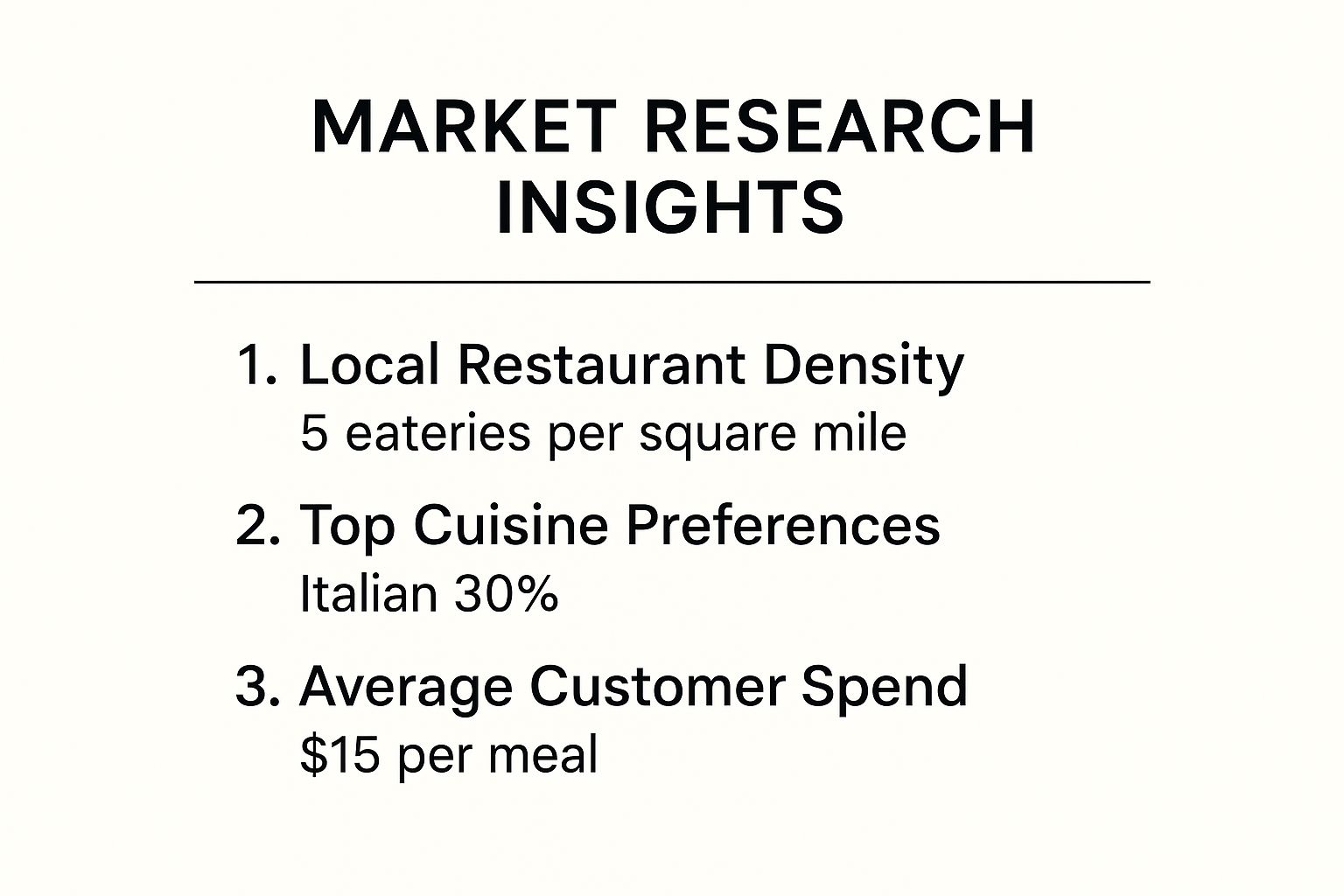
Getting a handle on these metrics helps you spot gaps in the market and shape your concept to meet real local demand. That’s how you give yourself a critical edge right out of the gate.
Developing a Winning Restaurant Concept and Plan
A memorable concept is your restaurant's soul, but a solid business plan is its backbone. This is where you get serious, turning that amazing culinary vision swirling in your head into a business that actually works on paper and in the real world. Without this blueprint, even the most incredible food and perfect vibe can fall flat.
Your journey kicks off by carving out a unique angle in what's often a very crowded market. Are you dreaming of a farm-to-table bistro, a slick ghost kitchen built for delivery, or that cozy neighborhood cafe that becomes everyone’s second home? Nailing down this identity is the first real step toward building a brand people connect with.
Finding Your Niche in the Market
Choosing your concept isn't just about what you love to cook; it's a strategic move based on what people actually want to eat. You’ve got to find an unmet need or a fresh spin on things in your local food scene. For instance, if your town is already swimming in pizzerias, opening another one means you need a killer hook—maybe you’re the only spot with authentic Neapolitan pies or a completely vegan menu.
Think about the big picture of the restaurant industry. Full-service spots are projected to grow steadily from $1.65 trillion to nearly $1.97 trillion globally between 2025 and 2032. But the quick-service (QSR) game is expanding even faster, hitting a projected $381.79 billion by 2033, all thanks to our modern craving for convenience. Knowing these trends helps you position your concept for success right from the start. You can dig into more stats on the global restaurant industry on Restroworks.
To find your sweet spot, ask yourself some tough questions:
- Who is my ideal customer? Are you feeding budget-conscious students, families looking for a kid-friendly night out, or professionals wanting a polished dining experience?
- What problem am I solving? Is there a serious lack of healthy lunch options, late-night food, or authentic international cuisine in your area?
- What makes my concept different? Your edge could be your menu, where you source your ingredients, your service style, or the atmosphere you create.
Conducting Practical Market Research
Once an idea starts to form, it’s time to hit the streets and see if it has legs. Market research isn't some stuffy academic project; it's about gathering real, actionable intelligence to sharpen your idea and dodge expensive mistakes. That means getting away from the computer and into the community.
Start by scoping out your direct and indirect competitors. Go visit their places at different times. Watch the flow of customers, really study their menus, and take note of their pricing. What are they absolutely nailing, and where are the cracks? A rival's notoriously long wait times could be your golden opportunity to offer quicker service.
Don't just look at what other restaurants are doing. Talk to potential customers. Ask people in your target demographic what they're looking for in a dining experience and what's currently missing in the local market.
Crafting a Business Plan That Gets Funded
Your restaurant business plan is the single most important document you will create. It’s not just a formality for getting a loan; it's your operational roadmap. A fuzzy or incomplete plan is a giant red flag to lenders and investors—it screams "unprepared" and is the fastest way to get a "no."
A business plan that actually gets you funded needs to be driven by data, realistic, and incredibly thorough. It should tell a clear and compelling story of what your restaurant is, who it's for, and exactly how it will make money.
Your plan needs to have a few key sections:
- Executive Summary: A short, powerful snapshot of your entire plan. A busy investor might only read this part, so it has to hook them immediately.
- Company Description: Get into the details of your concept, mission, legal structure, and the unique experience you're going to offer.
- Market Analysis: Show your work. Present the research you did on the industry, your target audience, and your competitors. Use data to prove you've found a real opportunity.
- Operations Plan: Describe the day-to-day grind. This covers staffing, suppliers, service flow, and the tech you'll use, like your Point of Sale (POS) system.
- Marketing and Sales Strategy: How are you going to get people in the door and keep them coming back? Lay out your launch plan, social media approach, loyalty programs, and advertising budget.
- Financial Projections: This is the heart of the plan. You'll need detailed startup cost estimates, a break-even analysis, and projected profit and loss statements for the first three to five years. Be conservative and show you understand the razor-thin margins of this industry.
Putting this document together can feel like a mountain to climb, but it forces you to think through every single detail of your business. For a step-by-step guide, check out our article on how to write a restaurant business plan that will seriously impress investors.
4. Get Your Finances in Order to Secure Funding
Let's be real: even the most incredible restaurant idea will remain just an idea without the cash to make it happen. Turning your vision into a real, buzzing eatery takes a serious financial commitment. Getting this part right isn't just a box to check—it’s the foundation for your restaurant’s stability and future growth.
This whole process starts way before you ever sit down with a lender. It begins with you, a spreadsheet, and an honest look at what you’ll need. You have to move past a ballpark guess and dig into the details of every single cost, from the big-ticket items down to the small stuff.
Figure Out Exactly How Much You Need
Before you can ask anyone for money, you need a rock-solid answer to two questions: "How much?" and "What for?" Startup costs can swing wildly, often landing somewhere between $250,000 to over $750,000, depending on your city, square footage, and concept. Walking into a bank and asking for "some money to start a restaurant" is a surefire way to get a quick "no."
Your business plan is your best friend here. It needs a detailed budget that spells everything out.
- One-Time Costs: Think lease down payments, construction, all that shiny new kitchen equipment, your first big food and beverage order, and the fees for licenses and permits.
- Recurring Costs: This is your monthly nut—rent, payroll, utilities, marketing, and paying your suppliers. Your plan should show you can cover these for at least six months, even with zero revenue coming in.
To get your numbers as accurate as possible, using a restaurant startup costs calculator can be a huge help. It forces you to think through every line item, from commercial ovens to your POS system, which shows potential backers you’ve done your homework.
Having a meticulously detailed budget isn't just about securing a loan; it's about building a financial buffer that allows your business to survive the unpredictable first year when cash flow is tightest.
Explore All Your Funding Avenues
Once you know your number, it’s time to figure out where the money will come from. There's no single magic bullet here; most restaurant owners end up using a mix of funding sources. Each path has its own rules, benefits, and drawbacks.
Here are the most common routes people take:
| Funding Source | Pros | Cons | Best For |
|---|---|---|---|
| SBA Loans | Lower down payments, longer repayment terms, government-backed. | Lengthy application process, strict eligibility requirements, requires strong credit. | First-time owners with a solid business plan but limited collateral. |
| Traditional Bank Loans | Competitive interest rates, builds business credit. | Difficult to secure for new businesses without a proven track record. | Established entrepreneurs or those with significant personal assets. |
| Angel Investors | Provide capital in exchange for equity, often bring valuable industry expertise. | You give up a percentage of ownership and control in your business. | High-growth concepts with a unique and scalable business model. |
| Crowdfunding | Validates your concept, builds a community of early supporters. | Can be all-or-nothing, requires a strong marketing effort. | Niche concepts with a compelling story that resonates with the public. |
The financial landscape can feel like a maze. To get a better handle on your choices, it’s worth reading up on different small business funding options to see what truly aligns with your situation and goals.
Set Up Your Financial Systems From Day One
Getting the check is a huge milestone, but the real work starts the moment it clears. One of the most common—and fatal—mistakes new owners make is failing to set up solid financial systems right away.
First thing's first: open a dedicated business bank account. Do not mix your personal and business finances. Just don't. Next, get yourself some good accounting software built for restaurants. This will be your command center for tracking sales, managing payroll, and seeing where your money is actually going.
From there, you need to become obsessed with your numbers. The two most important KPIs to live and die by are your food cost percentage and your prime cost. Your prime cost, which is the total of all your food, beverage, and labor costs, should ideally stay at or below 60% of your total sales. Tracking these numbers like a hawk lets you spot trouble early and make smart decisions to keep your restaurant profitable.
Navigating the Maze of Permits and Licenses
Let's be honest, nobody gets into the restaurant business because they love paperwork. Dealing with city hall and navigating bureaucracy is rarely the exciting part of the dream, but getting this right is the absolute foundation for a legal, successful opening.
Skipping a step or missing a deadline here doesn't just create a headache; it can completely shut down your launch, leaving you with a fully built-out space you can't even open. Think of this as your roadmap for slicing through the red tape as efficiently as possible.
The first big decision you'll make on paper is your business structure. This isn't just a box to check on a form—it has huge implications for your personal liability and how you're taxed. Most new restaurant owners I know form a Limited Liability Company (LLC). Why? Because it builds a legal wall between your business debts and your personal assets, like your home and car.
A sole proprietorship is simpler to set up, sure, but it offers zero protection. If the business goes under, you're personally on the hook for everything.
The Essential Permit and License Checklist
Once you've legally structured your business, the real scavenger hunt for permits begins. The specific requirements can vary wildly depending on your city and state, so your first stop should always be your local health department and small business administration office. They'll give you the definitive list.
That said, pretty much every new restaurant is going to need these core documents:
- Business License: This is the basic permission slip from your city or county to operate a business there. It's usually one of the first and most straightforward licenses you'll get.
- Food Service License: This one's critical and comes from your local health department. It certifies that your restaurant meets all the required food safety and sanitation standards. Expect a thorough inspection of your kitchen and premises before they grant this.
- Certificate of Occupancy: This document confirms your building is safe for the public and complies with all building and zoning codes. You cannot legally open your doors to a single customer without it.
- Food Handler's Permit: This isn't just for you; it's for every single person on your team who will touch food. It usually involves a short training course and a test on food safety basics.
This list is just the starting point. Depending on your concept, you might need extra permits for things like outdoor signage, a patio, or even playing music.
Don't treat this like a simple checklist to blast through. Each application needs careful preparation and stacks of supporting documents. A single missing piece of info can send your application to the bottom of the pile, easily causing weeks of delay.
Securing Your Liquor License
If you plan to serve alcohol—and for many, that's where the real profit is—buckle up for a separate, often lengthy, and expensive process. A liquor license can be one of the toughest permits to lock down.
The type you need will depend on whether you'll serve only beer and wine or want a full bar with spirits. The application process is notoriously rigorous, often involving public notices, community board hearings, and extensive background checks.
In some areas, the number of licenses is capped, forcing you to buy one from an existing business for a jaw-dropping price. Start this process the moment you sign your lease—I'm not kidding. It can sometimes take a year or more to get approved. Failing to plan for this timeline is a classic rookie mistake that leaves new owners with a beautiful, fully built bar they can't legally use for months.
Designing Your Space and Building Your Kitchen

The physical layout of your restaurant is so much more than just picking out nice furniture and paint colors. It's the silent partner in your business, directly influencing everything from a customer's first impression to how quickly your kitchen team can get plates out during a chaotic dinner rush.
We’ll break this down from two critical angles: the front-of-house (FOH), where your guests have their experience, and the back-of-house (BOH), where all the culinary magic happens. Nailing both is absolutely fundamental to building a restaurant that truly works.
Crafting the Front-Of-House Experience
The moment a guest walks through your door, their experience begins. Your FOH design has to feel welcoming and comfortable, but it also needs to be strategic, maximizing your seating capacity and, by extension, your revenue. A poorly planned dining room can lead to cramped tables, frustrated servers, and lost profits.
Your floor plan should create a natural, easy flow for both staff and guests, avoiding those awkward bottlenecks near the entrance or restrooms. Think hard about the ambiance you're trying to create. Is it lively and energetic, or more intimate and quiet? Your choices in lighting, furniture, and decor should all pull in the same direction, reinforcing your restaurant's core concept.
As you dial in the look and feel of your dining area, don't overlook your menu displays. It’s worth exploring some inspiring menu board design ideas to find a style that fits your brand and makes ordering a breeze for customers. A great menu board is both a marketing tool and a functional part of the dining experience.
Designing A High-Efficiency Kitchen Workflow
Your kitchen is the engine of the entire operation. A logical, well-planned layout isn't a luxury; it's an absolute necessity for speed, safety, and consistency. A badly designed BOH is a recipe for service delays, cross-contamination risks, and a stressed-out, unhappy team.
The goal is to map out a workflow that follows the natural journey of an order, from receiving raw ingredients all the way to plating the final dish. This means creating designated stations for different tasks so your staff aren't constantly tripping over one another.
An efficient kitchen layout is built around minimizing movement. A cook shouldn't have to walk across the kitchen to grab a pan or a key ingredient. Everything they need for their station should be within arm's reach.
To make this happen, you need to think in terms of distinct zones within your kitchen:
- Receiving and Storage: A clear area for deliveries with easy access to dry storage, refrigerators, and freezers.
- Food Preparation: Workstations for washing, chopping, and mixing, kept separate from the main cooking line.
- Cooking Line: This is the main event, with your ovens, grills, and fryers arranged for maximum efficiency.
- Washing Station: A designated area for dishwashing that keeps dirty dishes separate from clean ones and well out of the main kitchen traffic.
For a much deeper dive into organizing this crucial space, our guide on creating a [https://therestaurantwarehouse.com/blogs/restaurant-equipment/commercial-kitchen-floor-plan] offers fantastic layouts and tips to help you design a workspace that performs under pressure.
Sourcing Your Essential Kitchen Equipment
Equipping your kitchen is easily one of the biggest line items in your startup budget. Deciding where to splurge on new gear and where you can save with used equipment is a critical financial decision when you're learning how to start a restaurant business.
New equipment comes with reliability, warranties, and the latest tech—which can be a lifesaver for core items like your range or refrigeration. But that initial cost is high. Used equipment, on the other hand, can save you a ton of cash but carries the risk of breakdowns and comes with no warranty.
The key is finding a smart balance. You need to work with a vendor you trust to provide quality equipment, whether it's brand new or pre-owned.
Essential Kitchen Equipment: New vs. Used
Deciding between new and used gear for your kitchen is a classic balancing act of cost versus risk. Here’s a quick breakdown to help you weigh the options for some of the most critical pieces of equipment.
| Equipment Type | Considerations for Buying New | Considerations for Buying Used |
|---|---|---|
| Refrigeration | Essential for food safety; new units offer better energy efficiency and warranties, preventing costly failures. | Risky. An older unit could fail unexpectedly, leading to massive food spoilage and lost revenue. |
| Ovens & Ranges | The heart of the kitchen. A new, reliable unit ensures consistent cooking performance during peak hours. | Can be a good place to save money if the unit has been well-maintained and inspected by a professional. |
| Work Tables | Stainless steel tables are durable. Used tables are often a smart, cost-effective choice with little downside. | A great option for saving capital. Ensure they are sturdy and meet health code standards. |
| Dishwashers | New commercial dishwashers are fast and efficient, critical for high-volume service to maintain sanitation. | An older model may be slower or less reliable, creating a bottleneck during busy shifts. |
Ultimately, your decision will come down to your budget and your tolerance for risk. For mission-critical items like refrigeration, buying new often provides peace of mind that's well worth the cost. For simpler items like work tables, saving with a quality used piece is a smart move.
Hiring Your Team and Planning Your Launch
In the restaurant world, you can have the perfect location, the most brilliant concept, and the shiniest equipment, but at the end of the day, it's your people who make or break you. The human side of your business—from the line cook who perfectly sears every steak to the server who makes a guest feel truly welcome—is what defines the experience and builds your reputation.
This final sprint to opening day is all about two things: assembling a crew that genuinely buys into your vision and planning a launch that creates some serious, lasting buzz.
Assembling Your Core Staff
Let's get one thing straight: writing a generic job post for a "line cook" will get you a pile of generic applicants. You have to sell your vision. Instead of just listing duties, talk about the opportunity to work with amazing locally sourced ingredients or the chance to master a specific culinary technique. This is how you attract passionate professionals, not just people looking for their next paycheck.
When it comes to interviews, toss out the standard script. Ask a potential server how they’d turn around a bad experience for an unhappy customer. Give your chef candidates a "mystery basket" challenge and see how their creativity and skills hold up under a little pressure. You're not just filling slots on a schedule; you're building the foundation of your restaurant's culture.
Once you’ve made your hires, training is everything. A well-thought-out training program isn't optional—it's how you instill your service standards right from the get-go.
- Role-play real scenarios: Run your team through common situations, from navigating a serious food allergy to upselling daily specials without sounding pushy.
- Menu tasting and education: Your front-of-house team needs to be able to describe every single dish with genuine knowledge and a bit of excitement. They're your storytellers.
- Master your systems: Make sure everyone is confident using your POS system and any other tech before the first real customer walks through the door.
This kind of hands-on prep is what turns a group of new hires into a cohesive, high-performing team ready for anything.
Staging a Successful Opening
With your team geared up and ready to go, it’s time to think about the opening itself. One of the classic rookie mistakes is jumping straight into a massive grand opening. Don't do it.
Instead, start with a soft opening. This is your dress rehearsal—a limited, invitation-only event for friends, family, and maybe a few local food bloggers. It gives your team a chance to work through all the service kinks and timing issues in a low-pressure environment. You’ll spot operational bottlenecks before you're staring down a full dining room of paying customers.
A soft opening isn't about making a profit; it's an investment in a smoother grand opening. Use the feedback to fine-tune everything from ticket times to table turnover.
After you've nailed the soft launch and worked out the bugs, you can go all-in on your grand opening. Now's the time to build real excitement in the community. Collaborate with local influencers, run some targeted social media ads announcing your official opening date, and maybe offer a compelling promotion for the first week.
Your goal is simple: create a line out the door. That buzz generates the social proof and word-of-mouth marketing that will carry your new restaurant through those critical first few months.
Common Questions About Starting a Restaurant

Even after you've mapped out every detail, a few big questions always seem to pop up. It's totally normal. Getting some straight answers to these common worries can make the whole journey feel a lot less intimidating and prepare you for what’s really ahead.
How Much Money Do I Really Need?
This is the big one, and the honest answer is: it varies wildly. Your concept, location, and the size of your space are the three biggest factors.
You might be able to get a small, leased café or a food truck rolling for anywhere between $50,000 to $250,000. On the other hand, if you're dreaming of a large, full-service restaurant in a bustling downtown area, you could easily be looking at costs soaring over $1 million.
Don't forget to budget for these key expenses:
- Deposits for rent and the initial build-out or renovations.
- All your kitchen equipment and the first big inventory order.
- Every single permit and license you'll need to operate legally.
- A cash cushion of at least six months of operating capital. This is critical.
What Is the Biggest Mistake New Owners Make?
Hands down, the most common reason new restaurants fail is undercapitalization. So many passionate owners simply run out of money before they have a chance to build a customer base and turn a profit. It happens faster than you'd think.
Another huge pitfall is a lack of real industry experience, which often shows up as poor financial tracking. If you aren't watching your food and labor costs like a hawk from day one, you're flying blind. Picking a bad location or having a muddled concept that customers don't connect with are also classic, and very costly, mistakes.
The most successful new restaurants are run by owners who are realistic about their finances and deeply understand their operational numbers from the very first day.
How Long Until My Restaurant Is Profitable?
Being profitable from day one is practically a myth. The reality is that most new restaurants operate at a loss for the first six to twelve months. This is the time you spend building your reputation, ironing out the kinks in your service, and growing your base of regulars.
If you’re managing costs effectively and seeing steady growth, aiming for consistent profitability within one to two years is a realistic goal. The key is having enough cash reserves to survive that initial ramp-up period.
Equipping your kitchen is one of the biggest investments you'll make. Find reliable, affordable new and used equipment at The Restaurant Warehouse to manage your startup costs and get the gear you need to succeed. Visit The Restaurant Warehouse to browse our extensive inventory.
About The Author

Sean Kearney
Sean Kearney is the Founder of The Restaurant Warehouse, with 15 years of experience in the restaurant equipment industry and more than 30 years in ecommerce, beginning with Amazon.com. As an equipment distributor and supplier, Sean helps restaurant owners make confident purchasing decisions through clear pricing, practical guidance, and a more transparent online buying experience.
Connect with Sean on LinkedIn, Instagram, YouTube, or Facebook.