

How to Design Restaurant Menu: Boost Profits
Your menu is so much more than a list of food. It's the first real taste anyone gets of your restaurant's personality, and honestly, it’s your single most powerful sales tool. Before you even think about fonts or photos, you need to nail the foundation: a strategic blend of brand alignment, audience research, and competitor analysis.
This isn’t just about making things look pretty. It's about building a core document that tells your story, speaks directly to your ideal guests, and makes sure every single item you sell is both purposeful and profitable.
Aligning Your Menu with Your Brand and Guests
The most critical work happens long before a single description gets written. A truly great menu is a direct reflection of your restaurant's soul. It has to answer two simple but profound questions: "Who are we?" and "Who are we serving?"
Getting this alignment right is everything. It ensures your menu feels authentic and connects with the people you want filling your seats.
Think of your menu as your restaurant's constitution. It's where your brand identity—your story, your values, your whole vibe—comes to life on the page. If you're a rustic, farm-to-table bistro, that menu had better scream freshness and simplicity. A sleek, modern sushi bar? Its menu needs to feel precise, elegant, and focused on incredible ingredients. This is how you create a cohesive experience that makes sense the moment a guest walks through the door.
Define Your Restaurant's Core Identity
First things first, you need to get crystal clear on your brand’s unique story. Are you a bustling, fast-casual joint known for quick service and bold flavors, or are you a fine-dining destination offering an exclusive, curated experience? The answer will shape every decision you make from here on out.
Get specific about these core aspects of your brand:
- Concept: What's your culinary flag? Italian, Mexican, fusion? This sets the creative boundaries.
- Service Style: The pace and formality of your service—counter-service versus full table service—directly impacts how long and complex your menu can be.
- Price Point: Your menu has to deliver on the perceived value you're offering, whether that's a budget-friendly meal or a premium night out.
- Ambiance: The look, feel, and even the sound of your space should be echoed in the menu's design and tone.
Once you've defined these elements, you've created a filter. A dish might be delicious, but if it doesn’t fit your brand’s story, it doesn’t belong on your menu. Simple as that.
Understand Who You Are Serving
Once you know who you are, you have to get to know your ideal customer—and I mean really know them. Are they health-conscious professionals grabbing a quick lunch, families looking for familiar comfort food, or adventurous foodies chasing the next big thing?
Doing your homework on your audience isn't optional; it's essential. You can pull this info from your POS data, run a simple survey, or just pay attention and talk to your regulars. For a deeper dive, our guide on how to start a restaurant business covers market research from top to bottom.
This insight has a direct impact on what you should offer. For instance, diner preferences are always shifting. By 2025, data shows that 43% of diners actively seek out globally inspired dishes, a trend that’s especially strong with younger crowds.
Even more telling? A massive 87% of Gen Z diners want to see more international flavors at chain restaurants. You can learn more about these evolving restaurant menu statistics to stay on top of what people crave. This kind of data makes it clear: a one-size-fits-all menu just doesn’t cut it anymore.
Mastering the Science of Menu Engineering
Alright, once you've nailed down your menu concept, it's time to shift from the art of cooking to the science of selling. This is where menu engineering comes in. It’s a game-changing, data-driven process for designing a menu that doesn't just list your food—it actively maximizes your profitability.
Forget about guesswork or gut feelings. We're talking about making strategic decisions based on real numbers that can boost your bottom line with every single order.
The whole idea is to get a crystal-clear picture of how every dish performs, not just by how many you sell, but by how much money each one actually puts in your pocket. By digging into your sales data and food costs, you can classify every item and make smarter choices about its placement, price, and promotion. This turns your menu from a simple list into your most powerful sales tool.
This process illustrates the essential flow: a killer menu starts with your brand, truly connects with your guests, and makes you stand out from the competition.
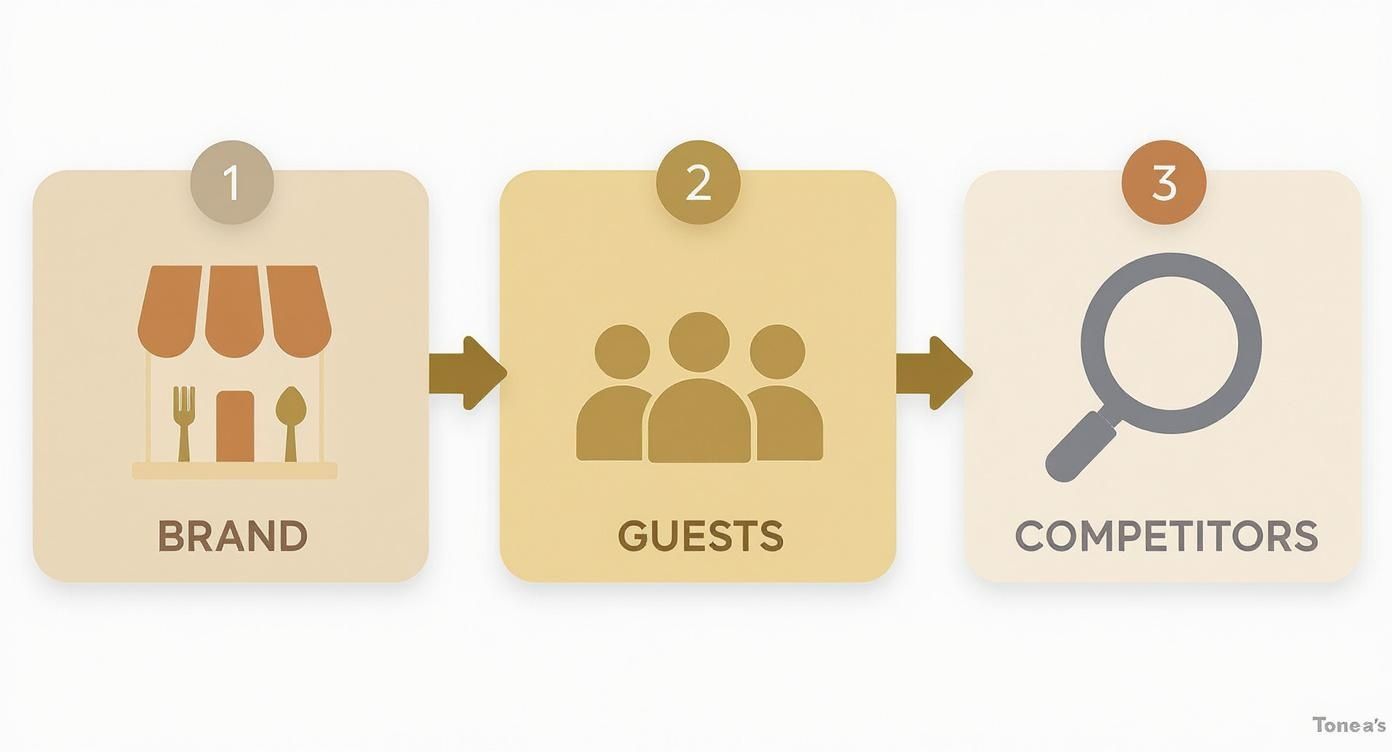
Before you can engineer a menu for profit, you've got to make sure it’s a perfect reflection of your restaurant's identity and its place in the market.
The Four Menu Categories
Menu engineering breaks down every single item into one of four categories, based on its profitability (how much money it makes you) and its popularity (how often it's ordered). Getting these labels right is the key to knowing exactly what to do next.
- Stars: These are your rockstars—high profitability and high popularity. They're the dishes your guests rave about and that make you fantastic money. Your job is simple: feature them prominently and never let the quality slip. Ever.
- Plowhorses: People love these dishes, but they don't make you much money. They're the popular crowd-pleasers with low profitability. The goal here is to gently nudge their profitability up without scaring away customers.
- Puzzles: These are your high-profitability, low-popularity items. Think of them as hidden gems. For some reason, these dishes just aren't selling, even though they could be making you a lot of money. The challenge is to figure out why and get guests to give them a shot.
- Dogs: Low profitability and low popularity. These are the underperformers just taking up valuable real estate on your menu. In most cases, the best move is to get rid of them.
Your menu isn't just a list; it's a grid of performance data. Every item tells a story about profitability and popularity. Your job is to listen to that story and act on it.
Calculating Costs and Margins
To figure out where each dish belongs, you need two key numbers: the food cost for that item and how many you've sold over a set period (say, the last 30 days).
The most important metric here is the contribution margin, which is simply the selling price minus the food cost. This number tells you exactly how much pure profit each dish generates.
Getting these calculations right is absolutely non-negotiable. For a deep dive, our guide on mastering the restaurant food cost percentage is an excellent resource to make sure your numbers are spot-on.
Applying Pricing Psychology
Once you have your items sorted, you can start using some subtle psychological tactics to guide your customers' choices. These aren't sneaky tricks; they're proven techniques that help diners feel great about ordering your most profitable dishes.
Techniques for Smarter Pricing:
-
Price Anchoring: Place a very high-priced item at the top of a menu section. This "anchor" makes everything else nearby seem more reasonably priced by comparison. For example, putting a $45 steak at the top of the entrées makes that $28 pasta dish look like a fantastic deal.
-
Remove Currency Signs: It sounds small, but it works. Studies have shown that removing dollar signs ($) makes customers focus less on the price and more on the food itself. Simply listing a price as "18" instead of "$18.00" can actually lead to guests spending more.
-
Use Decoy Items: A "Plowhorse" can sometimes work as a decoy. If you have a popular but low-margin chicken dish, you could try slightly increasing its price or featuring a highly profitable "Star" steak right next to it. You’d be surprised how many customers will see the steak as a better value and make the switch.
By combining this kind of rigorous data analysis with smart psychological principles, you can design a menu that actively works to increase your revenue. It's a continuous cycle—analyze, adjust, and test until you find that perfect balance that keeps both your customers and your accountant happy.
Designing a Layout That Guides Your Guests
Alright, you’ve done the behind-the-scenes work to engineer your menu for profit. Now, let's focus on what your guests actually see and touch. The physical layout of your menu has a massive impact on what people order—it’s not just about listing dishes. It's about using smart design to grab attention and steer your guests' eyes exactly where you want them to go, making your most profitable items practically irresistible.
Think of your menu as a roadmap for your guests. A cluttered, confusing one will leave them feeling overwhelmed and likely defaulting to the "safe" (and often low-margin) burger. But a clean, thoughtfully designed map? That will guide them straight to the dishes you're most proud of, creating a better experience for them and a much healthier bottom line for you.
Harnessing the Power of Eye Movement
Here's something most people don't realize: when we read a menu, our eyes don't just go from top to bottom. Eye-tracking studies have shown that diners' eyes follow a pretty predictable pattern. Tapping into this is the secret sauce for a menu that truly sells.
The classic concept here is the "Golden Triangle." It refers to the three spots where a diner's gaze almost always lands first.
- First Look: The eye is naturally drawn to the middle of the page.
- Second Look: From there, it moves up to the top-right corner.
- Third Look: Finally, it travels over to the top-left corner.
These three points are your menu’s prime real estate. This is exactly where you should place your "Star" items—those high-profit, high-popularity dishes you identified during menu engineering. By putting them in these high-visibility zones, you dramatically increase the odds they'll be ordered.
Your most profitable items deserve the spotlight. Don't bury them at the bottom of a long list; place them where your customers are already looking.
To help you visualize this, we've broken down the key areas of a standard menu and how you can use them to your advantage.
Menu Layout Hotspots and Their Strategic Use
| Menu Hotspot | Description | Strategic Placement Tip |
|---|---|---|
| The Middle | This is the initial landing spot for most diners' eyes. It's the first impression. | Place your #1 "Star" item or a special feature here. A visually appealing box or subtle graphic can draw even more attention. |
| Top-Right Corner | After the middle, the gaze naturally drifts here. It’s a powerful secondary position. | This is the perfect spot for your second-most profitable dish or a high-margin category like "Chef's Specials" or "House Favorites." |
| Top-Left Corner | The final point in the "Golden Triangle," where readers traditionally start a page. | Use this for your third "Star" or a popular appetizer category to get the meal started on a high-profit note. |
| First Item in a List | Within any category, the first one or two items listed receive the most attention. | Lead each category (Appetizers, Entrées, etc.) with a profitable "Star" or "Puzzle" item, not your lowest-margin seller. |
| Last Item in a List | The very last item in a section also gets a surprising amount of attention. | This is a great secondary spot to place another high-profit item, catching the eyes of guests who scan the entire list. |
Understanding these hotspots is a game-changer. It allows you to be intentional with your layout, turning a simple list into a powerful sales tool that works for you, table after table.
The Strategic Use of White Space
One of the most common menu design mistakes is trying to cram too much onto a single page. A cluttered menu creates "analysis paralysis." When guests feel overwhelmed by too many choices, they often default to something familiar and safe—which, for you, is probably a low-margin item.
White space—that empty area around your text and photos—is your best friend here. It gives your menu room to breathe, makes it easier to read, and creates a more relaxed, upscale feeling. A menu with plenty of white space communicates confidence. It tells your guests that every single item listed is special and deserves their full attention.
Use white space to:
- Separate Categories: Create clean, obvious visual breaks between appetizers, entrées, and desserts.
- Highlight Key Items: Isolate a "Star" dish with some extra breathing room around it to make it pop off the page.
- Improve Readability: Ditch the dense blocks of text. Short, scannable descriptions are always better.
Choosing Typography That Fits Your Brand
The fonts you pick do so much more than just display words; they whisper things about your restaurant's personality and reinforce your brand identity. Think of typography as a subtle but powerful tool that helps set the tone for the entire dining experience before a single plate of food even hits the table.
For an upscale steakhouse, an elegant script or a classic serif font might convey sophistication. A trendy, modern cafe, on the other hand, would probably go for a clean, minimalist sans-serif font to feel fresh and current. The key is consistency. Your menu's typography should feel like it belongs with your logo, your website, and your restaurant's decor.
When you're picking out fonts, keep these practical tips in mind:
- Prioritize Readability: Fancy, elaborate fonts can be tempting, but if your guests are squinting to read the descriptions, you've already failed. Make sure the font size is large enough, especially if your restaurant has dim lighting.
- Create a Hierarchy: Use different font sizes, styles, or weights (like bolding item names) to distinguish between dishes, their descriptions, and the prices. This helps organize the information and guides the reader's eye through each section.
- Limit Your Choices: Stick to two or three complementary fonts at the absolute most. Any more than that, and the menu starts to look chaotic and unprofessional.
Writing Descriptions That Make Mouths Water
Now that you’ve mapped out the structure of your menu, it's time to give it a voice. Your menu descriptions are your silent sales team, working tirelessly to turn a simple list of dishes into a compelling story. A generic list of ingredients is just data; a well-crafted description, on the other hand, is an experience waiting to happen.
Think about it. "Chicken, rice, and vegetables" does nothing to spark a customer's imagination or justify a premium price. But what about "Pan-seared, free-range chicken breast served over a saffron-infused wild rice pilaf with garden-fresh asparagus tips"? That sells a meal. This is how you transform a list into a powerful sales tool.
Go Beyond Ingredients
The best descriptions engage the senses. Your words should make customers imagine the taste, smell, and texture of the dish before it ever hits the table. Instead of just listing what's in it, describe how it's made and where those beautiful ingredients came from.
Sensory and descriptive words are your best friends here. They paint a vivid picture in the customer's mind.
- Evoke Freshness: Use words like garden-fresh, line-caught, seasonal, or farm-stand.
- Highlight Technique: Mention preparation methods like wood-fired, slow-roasted, pan-seared, or hand-crafted.
- Describe Texture: Words such as creamy, crispy, tender, flaky, or velvety add another layer of appeal.
Telling a brief story can also build an emotional connection. Mentioning "Grandma Sofia’s secret meatball recipe" or "heirloom tomatoes from Miller Family Farms" makes a dish feel special and authentic—not just another item on a list.
Keep It Short and Punchy
While you want to be descriptive, nobody wants to read a novel. A long, rambling paragraph can be just as off-putting as a boring, sterile list of ingredients. The sweet spot is a description that's long enough to entice but short enough to be easily scanned.
Aim for one or two sentences packed with impactful adjectives and flavor profiles. This keeps your menu looking clean and easy to navigate, preventing the kind of overwhelm that leads to customer indecision. If you want to dive deeper, check out this great resource on how to write compelling recipe descriptions.
A study found that using descriptive labels can increase sales by as much as 27%. Simply calling a dish "Grandma's Zucchini Cookies" instead of just "Zucchini Cookies" made a significant difference in perception and sales.
The Strategic Use of Images
Photography is another powerful tool, but you have to use it with care. A single, stunning photo of a signature dish can dramatically boost its sales, turning it into an instant "Star." But lean too heavily on images, and it can seriously backfire.
A menu cluttered with photos, especially if they're low-quality, often signals a lower-end, fast-food joint. For mid-range to fine-dining spots, this can cheapen the brand and detract from the perceived quality of your food.
Here’s how to use visuals the right way:
- Be Selective: Use one or two high-quality photos to showcase your absolute bestsellers or most visually impressive dishes. Let them be the heroes of the menu.
- Invest in Professionals: Never, ever use amateur, poorly lit photos. A professional food photographer knows how to make your dishes look as incredible as they taste.
- Consider Illustrations: For a more unique or elegant touch, subtle, custom illustrations can be a fantastic alternative. They can highlight key ingredients or add brand personality without the potential tackiness of photos.
By blending sensory-rich copy with a thoughtful approach to imagery, your menu will do more than just list options. It will actively guide guests toward a more delicious—and profitable—dining experience.
Choosing Your Format: Print, Digital, and Dynamic Menus
You've put in the hard work engineering your menu—now, how are you going to present it to your guests? This isn't just a final detail; the format you choose is a huge part of the dining experience and can seriously impact your kitchen's efficiency. Whether you go with a classic printed menu, a modern digital version, or a super-smart dynamic system, each has its own strengths. The best choice often isn't one or the other but a smart mix of all three.
The whole print versus digital debate is about more than just old-school versus new-tech. It's about knowing your restaurant, understanding your guests, and picking the right tool for the job. The satisfying feel of a high-quality printed menu can signal luxury, while a digital menu gives you incredible flexibility and the ability to gather useful data.
The Enduring Appeal of Print Menus
There's something special about a physical menu. It's a tangible piece of the dining experience that doesn't need a phone or a decent Wi-Fi signal to work. For many restaurants, especially in fine dining, a beautifully designed printed menu reinforces the brand's commitment to quality and attention to detail.
If you're designing for print, here are a few things I've learned really matter:
- Material Matters: The paper you choose sends a powerful, subconscious message. A heavier, more durable paper stock just feels premium and holds up better to constant handling.
- Readability is Key: Make sure your fonts and text sizes are easy to read, especially in the kind of low-light ambiance so many of us create in our dining rooms.
- Strategic Sizing: The menu's size should feel right for your concept. A big, single-page menu can be perfect for a bustling cafe, whereas a multi-page book makes more sense for a place with an extensive wine list.
A printed menu is a focused, distraction-free tool. It keeps the guest engaged with your offerings without the risk of them getting sidetracked by notifications on their phone.
The Rise of Digital and QR Code Menus
Digital menus, usually pulled up via a QR code, really took off out of necessity, but they've stuck around because they're just so convenient and powerful. They let you make instant updates—no more reprinting a hundred menus because a supplier ran short on an ingredient or you need to tweak a price. That kind of agility is a massive win for day-to-day operations.
But a good digital menu is much more than just a PDF of your printed one. It has to be designed with a screen in mind. When you're thinking about digital or dynamic menus, working with specialized restaurant web design services can be a smart move to ensure your online menu is seamless and user-friendly.
A few must-haves for a strong digital menu include:
- Mobile-First Design: It absolutely has to be easy to read and navigate on a small smartphone screen.
- Fast Loading Times: A slow-loading menu is a frustrating way to start a meal and can kill the vibe immediately.
- Interactive Elements: Think about adding high-quality photos, ingredient tags for allergens, or even helpful links to wine-pairing notes.
The Future of Menus: AI and Dynamic Pricing
The next step in this evolution is the AI-powered dynamic menu. This isn't just a menu; it's an intelligent sales and operations tool. It can automatically update item availability based on your real-time inventory, which stops that disappointing moment when a guest orders a dish you've just 86'd.
These systems can even adjust what's featured based on outside factors. Imagine a menu that automatically highlights hearty soups on a cold, rainy day or promotes refreshing cocktails during a heatwave. That level of real-time responsiveness was just a dream a few years ago.
The data backs this up, too. A 2024 report showed that 58% of restaurants using AI-based menu engineering saw a boost in profits. The AI in the food service sector is projected to grow at a compound annual rate of 39.3%, hitting $8.8 billion by 2028. It’s clear this is where things are headed. You can find more insights on these top restaurant menu trends on rivieraproduce.com.
Comparison of Menu Formats: Print vs. Digital QR vs. AI-Dynamic
Choosing the right menu format can feel like a big decision, but seeing the options side-by-side makes it much clearer. This comparison highlights the key differences between printed, digital, and AI-powered dynamic menus to help you figure out the best strategy for your restaurant.
| Feature | Printed Menu | Digital QR Menu | AI-Powered Dynamic Menu |
|---|---|---|---|
| Guest Experience | Tactile, traditional, focused, and distraction-free. | Convenient, interactive with photos/videos, requires a personal device. | Highly personalized, real-time suggestions, can feel futuristic or intrusive to some. |
| Updating & Agility | Requires costly and slow reprints for any change. | Instant updates to prices, items, and availability. | Automatic, real-time updates based on inventory, demand, and even external factors like weather. |
| Cost | High recurring printing and design costs. | Lower long-term costs; initial setup fee plus potential subscription. | Highest initial investment and ongoing subscription fees, but with high potential ROI. |
| Data & Analytics | No direct data collection. | Tracks popular items, clicks, and viewing times. | Gathers deep data on guest preferences, sales patterns, and pricing elasticity. |
| Best For | Fine dining, establishments focused on tradition, low-tech environments. | Fast-casual, high-volume restaurants, concepts needing frequent updates. | Data-driven chains, tech-forward concepts, operations focused on maximizing profit per seat. |
Ultimately, the best approach for your restaurant might be a hybrid one. You could offer a beautifully printed menu for that classic in-person feel while using a dynamic digital version for online ordering and to keep your kitchen perfectly in sync. By understanding what each format does best, you can build a menu system that truly serves both your guests and your bottom line.
Answering Your Top Menu Design Questions
Even with the best game plan, you're bound to run into a few specific questions when designing your menu. I see it all the time. Restaurant owners get stuck on the details, and navigating these common hurdles can feel like a real roadblock. Getting clear, practical answers is the best way to dodge costly mistakes and build a menu that actually works.
Think of this section as your quick-reference guide. We'll tackle the most frequent questions I hear from operators, from how often you should refresh your offerings to the great debate over food photos.
How Often Should I Update My Menu?
This is one of the most critical operational questions out there. A static menu is a recipe for stale profits, especially as food costs and customer tastes are constantly shifting. As a solid rule of thumb, you should be digging into your menu's performance quarterly. Use your sales data to make small, strategic tweaks.
A full redesign, however, is a much bigger project. Most restaurants will see the biggest benefit from a complete menu overhaul every 12-18 months. This timeline gives you the chance to:
- Finally ditch those underperforming "Dog" items.
- Readjust your pricing to reflect current food costs and protect your margins.
- Roll out fresh, seasonal dishes that keep your regulars excited and coming back.
- Make sure the overall design and feel still align with your brand.
Should I Put Photos on My Menu?
The only right answer here is: "it depends." On one hand, a single, high-quality, professional photo of a signature "Star" dish can boost its sales in a big way. When a guest sees a stunning image of your absolute best dish, it takes the guesswork out of ordering and makes the choice incredibly easy.
But here’s where things can go wrong. A menu cluttered with a bunch of low-quality, amateur photos can instantly make a great restaurant feel cheap, like a fast-food chain. For most mid-range to fine-dining concepts, you're far better off using vivid, compelling descriptions to let your food shine. If you absolutely decide to use photos, hire a professional food photographer. This is not the place to cut corners.
Is a Digital QR Code Menu Better Than Print?
Neither one is inherently "better"—they just serve different functions. The move toward digital menus is impossible to ignore. It’s projected that by 2025, over 52% of U.S. restaurants will be using QR code menus. A recent survey also found that 51% of consumers felt digital menus actually improved their dining experience. And this isn't just a U.S. trend; it's happening globally, from India to the UK. You can check out more of these interesting restaurant industry statistics on menutiger.com.
Digital menus give you incredible flexibility for on-the-fly updates, while printed menus offer that classic, tactile experience that keeps guests off their phones. Honestly, the smartest strategy is often a hybrid one: a beautifully designed printed menu for the in-house dining experience, paired with a user-friendly digital version for online orders and quick, easy updates.
What Is the Biggest Menu Design Mistake?
The single most common—and most damaging—mistake I see is an overwhelming menu. When you offer too many choices, you trigger "analysis paralysis." This is a real psychological state where customers feel so stressed by the options that they just default to something familiar, which is often a less profitable item. A massive menu also puts a huge strain on your kitchen, makes inventory a nightmare, and can lead to inconsistent food quality.
Your menu should be a curated collection of your best work, not an encyclopedia of every dish you know how to make. A focused menu communicates confidence and makes it easier for guests to choose a fantastic meal.
A well-designed menu is focused and intentional. It’s a tool to guide customers toward your most profitable and popular dishes, a key strategy we cover in our guide on how to increase restaurant sales through smart operational choices.
At The Restaurant Warehouse, we provide the high-quality, affordable commercial kitchen equipment you need to bring your menu to life. From reliable refrigeration to powerful cooking ranges, we help you build a kitchen that can execute your vision flawlessly. Equip your restaurant for success at https://therestaurantwarehouse.com.
About The Author

Sean Kearney
Sean Kearney used to work at Amazon.com and started The Restaurant Warehouse. He has more than 10 years of experience in restaurant equipment and supplies. He graduated from the University of Washington in 1993. He earned a BA in business and marketing. He also played linebacker for the Huskies football team. He helps restaurants find equipment at a fair price and offers financing options. You can connect with Sean on LinkedIn or Facebook.
Leave a comment