

How to Start a Business Restaurant From Dream to Reality
Starting a restaurant isn't just about a passion for food; it's about turning that passion into a business that works. The journey begins long before you fire up the first stove, starting with a clear vision and a rock-solid, practical plan. These first steps are everything—they set the stage for your concept, your funding, and ultimately, your success.
Building Your Restaurant's Foundation

Before you even think about scouting locations or tasting menu items, you’ve got to lay the groundwork. This is the strategic, research-heavy phase where your exciting idea gets turned into a defensible business concept. I've seen too many passionate people skip this part, and it's like building a house without a blueprint. It’s a surefire way to run into expensive problems down the road.
The very first thing to do is crystallize your restaurant concept. This goes way beyond just the type of food you want to serve. It’s the entire experience. What’s the atmosphere? The service style? The price point? Are you picturing a bustling, fast-casual spot for quick lunches or an intimate fine-dining restaurant for special occasions? Get specific.
Define Your Unique Selling Proposition
Your Unique Selling Proposition (or USP) is the thing that makes you different. In today's crowded market, just serving "good food" is never enough. You need a compelling reason for customers to walk past a dozen other spots and choose yours.
Your USP could be anything that sets you apart. For example:
- A hyper-local focus: Sourcing 100% of your ingredients from farms within a 50-mile radius.
- A unique culinary fusion: Combining two unexpected cuisines, like Japanese-Peruvian fusion (Nikkei).
- An exceptional service model: A "no-tipping" policy with higher wages for staff, creating a totally different dining culture.
Without a strong USP, your restaurant is just another eatery. Figure out what makes your idea special and build your entire brand around it.
Conduct Practical Market Research
Once your concept feels solid, it's time to see if it holds up in the real world. Market research isn't some boring academic exercise; it's your best tool for minimizing risk. You have to know the neighborhood you're moving into.
Start by getting laser-focused on your target audience. Who, specifically, are you trying to attract? "Everyone" is not an answer. Think about demographics like age, income level, and lifestyle. A vegan cafe, for instance, might target health-conscious millennials and Gen Z students in a specific urban neighborhood.
Next, go spy on your future competitors. Seriously. Visit the nearby restaurants that will be your direct rivals. Don't just eat there—observe.
- When are they busiest?
- What are their prices like?
- What are people saying about them in online reviews?
- What are their weaknesses? Maybe their service is slow, or their menu is uninspired. Those are your opportunities.
This research will help you tweak your concept and confirm there’s a real gap in the market for you to fill.
Create a Comprehensive Business Plan
Your business plan is your roadmap. It's a living document that guides your decisions from day one. It forces you to think through every single detail of how to start a business restaurant, from your financial projections to your day-to-day operations.
A business plan is more than a document for lenders; it's your personal guide to success. It forces you to answer the tough questions early, ensuring you have a clear path forward for operations, marketing, and financial management.
This plan needs an executive summary, a detailed company description, your market analysis, an operational plan, and most importantly, financial projections. Knowing your numbers is absolutely crucial. The global foodservice sector is projected to hit $4.03 trillion in 2025 and contributed around $684 billion to the U.S. GDP in 2023. To get your slice of that pie, you need a plan. You can discover more insights about the global restaurant industry on Restroworks.com.
Before diving deeper into menus and marketing, it’s helpful to summarize these foundational tasks. Think of the following checklist as your blueprint for getting the core strategy in place.
Initial Restaurant Startup Checklist
| Task | Objective | Key Considerations |
|---|---|---|
| Finalize Concept & USP | Clearly define what makes your restaurant unique and appealing. | Atmosphere, service style, price point, core brand promise. |
| Define Target Audience | Identify your ideal customer to tailor your offerings and marketing. | Demographics (age, income), psychographics (lifestyle, values). |
| Analyze Competition | Understand the local market to find gaps and opportunities. | Strengths, weaknesses, pricing, customer reviews of nearby rivals. |
| Write Business Plan | Create a detailed roadmap for launching and running the business. | Executive summary, market analysis, operations, financial projections. |
Completing these steps gives you a solid, well-researched foundation. It confirms your idea is not just a passion project, but a viable business ready for the next stage of planning.
Securing Capital and Mastering Your Finances
Your restaurant concept is the engine, but capital is the fuel that keeps it running. A brilliant culinary idea will never make it out of the kitchen without proper funding. This part of the journey can feel pretty intimidating, but getting a firm grip on your numbers and understanding your options is the key to launching with confidence and, more importantly, staying in the black.
A lot of aspiring owners think their passion and a few killer recipes are enough to get a loan. The reality is that lenders and investors need to see a clear, realistic financial plan. They need proof that your concept isn't just a dream, but a business with a real shot at success. Your business plan is the very first place they'll look for that proof.
Exploring Your Funding Avenues
There’s no magic bullet when it comes to funding your restaurant. The right path for you will depend on your personal finances, the strength of your business plan, and how much risk you're comfortable taking on. It’s always a smart move to explore a few different avenues at the same time.
- SBA Loans: These are a popular starting point for a reason. Backed by the Small Business Administration, they often come with more favorable terms than a conventional loan. Lenders are more willing to say yes because the government guarantees part of the loan, which lowers their risk.
- Traditional Bank Loans: If you have great credit, a solid financial history, and a business plan that’s buttoned up, a conventional loan from a bank or credit union is a strong contender. Just be prepared for some intense scrutiny of your financial projections.
- Private Investors or Partners: This route means selling a piece of your business in exchange for capital. The huge plus is that you get the money you need without going into debt. The trade-off? You’re giving up a percentage of ownership and future profits. It is absolutely critical to find partners who share your vision and to get clear legal agreements in place from day one.
- Crowdfunding: Platforms like Kickstarter or Indiegogo can work wonders for unique concepts that have a strong community vibe. Instead of one big investor, you raise smaller amounts from a lot of people, usually in exchange for cool rewards like gift cards or exclusive access to your opening night.
Understanding Your True Startup Costs
One of the biggest traps for new owners is underestimating just how much it costs to get the doors open. It’s not just the big-ticket items that get you; it’s the hundreds of small expenses that add up and can drain your capital before you’ve even served your first customer. A meticulous, line-by-line budget is completely non-negotiable.
Don’t just budget for the best-case scenario. Smart financial planning is all about building a cushion for the unexpected—a construction delay, a permit holdup, or a key piece of equipment that dies a week after you buy it. Having 3-6 months of operating expenses in reserve is a benchmark for a reason. It can be the difference between survival and failure.
Your initial investment will be spread across a few key areas. To really get a handle on it, you need to create a detailed breakdown. You can get a more in-depth guide by reviewing a comprehensive list of restaurant startup costs.
Here’s a quick snapshot of what you need to account for:
| Category | Description & Examples |
|---|---|
| Lease & Renovations | Security deposit, first month's rent, construction, plumbing, electrical, interior design. |
| Licenses & Permits | Business license, health permit, liquor license, food handler permits. |
| Kitchen Equipment | Ovens, refrigerators, freezers, prep tables, dishwashers, POS system. |
| Initial Inventory | All the food, beverages, and paper goods needed for your first week of service. |
| Professional Services | Fees for lawyers, accountants, and consultants to ensure compliance and proper setup. |
| Working Capital | Funds to cover payroll, utilities, and rent for the first few months. |
Projecting and Managing Your Financial Health
Once you’re funded and open for business, managing your finances becomes a daily discipline. You have to know your numbers inside and out to make smart, proactive decisions instead of just reacting to problems. It all starts with creating realistic financial projections.
Your Profit and Loss (P&L) Statement is your financial report card. It tracks your revenue against your expenses over a set period, showing you flat-out whether you’re making money. The two biggest numbers to watch here are your Cost of Goods Sold (COGS)—the direct cost of your ingredients—and your labor costs.
Just as important is managing your cash flow, which is simply the money moving in and out of your business. It's a hard truth, but a profitable restaurant on paper can still go under if it runs out of cash to pay its bills. You should be looking at your cash flow weekly to see any shortfalls coming.
Finally, you need to calculate your break-even point. This is the magic number—the amount of revenue you need to bring in just to cover all your costs. Knowing this figure tells you the exact sales target you need to hit every single day, week, and month just to keep the lights on. It turns profitability from a vague hope into a clear, achievable goal.
5. Navigating Legal Hurdles and Finding Your Perfect Spot

With your finances starting to firm up, your restaurant concept is beginning to feel real. This is the exciting part where you move from spreadsheets to the streets, locking down your legal framework and hunting for that perfect location. Be prepared—this stage is a mix of thrilling progress and some seriously tedious paperwork, but getting every detail right is non-negotiable for a smooth opening.
First up, you need to decide on a legal structure for your business. This is a big decision that impacts everything from your personal liability to how you'll handle taxes, so it's not a step to rush through.
Choosing the Right Business Structure
The structure you pick legally defines your restaurant as an entity. For most first-time restaurant owners, the choice usually comes down to a few common options, each with its own pros and cons.
-
Sole Proprietorship: This is the simplest way to get started. You and your business are legally one and the same, giving you total control. The downside? You are also personally on the hook for all business debts and lawsuits, which puts your personal assets on the line.
-
Limited Liability Company (LLC): An LLC is often the sweet spot for independent restaurateurs. It creates a crucial wall between your personal assets and your business liabilities. If the restaurant runs into debt or legal trouble, your personal savings and home are generally protected.
-
Corporation (S-Corp or C-Corp): A corporation offers the strongest liability protection but comes with a lot more red tape—think complex regulations, meticulous record-keeping, and more complicated tax requirements. It's less common for a single restaurant, but it can be a smart move if you're planning for major growth or looking to bring in outside investors.
For most folks figuring out how to open their first restaurant, an LLC strikes the best balance between protection and simplicity. It's always a good idea to chat with a lawyer or an accountant to make the final call based on your specific situation.
Demystifying Licenses and Permits
The amount of paperwork can feel overwhelming, but every single license and permit is a green light you need to operate legally. Missing just one can lead to massive fines or even a complete shutdown before you ever serve a single customer. The requirements vary wildly by state and city, so your first call should be to your local health department and business licensing office.
On top of finding the right location, you'll also have to tackle various legal steps, including understanding development applications if any construction or major renovation is involved. Here are the core permits pretty much every restaurant needs:
- Business License: This is the fundamental permit to operate in your city or county.
- Food Service License: Your local health department issues this after an inspection confirms you meet all safety and sanitation codes.
- Liquor License: If you plan on serving alcohol, this is a must. The application process can be long and expensive, so get started on this one early.
- Employer Identification Number (EIN): A federal tax ID you'll need from the IRS if you plan to hire any employees.
Pro Tip: Create a master checklist of every permit you need, its cost, the application deadline, and the contact person for the agency. This simple organizational tool will save you from major headaches and delays down the road.
The Art of Selecting the Perfect Location
Your location is one of the single biggest factors in whether your restaurant succeeds or fails. A brilliant concept in a bad spot will almost always struggle, while a prime location can make an average concept thrive. Your business plan, which details your target customer and concept, should be your North Star here.
You can learn more about how your location fits into the bigger picture by reviewing our guide on how to write a restaurant business plan.
When you're out scouting spots, here's what you need to analyze:
| Factor | What to Look For |
|---|---|
| Visibility & Foot Traffic | Is the location easy to see from the street? How many people walk or drive by each day? High visibility can save you a fortune in marketing. |
| Neighborhood Demographics | Does the local population match your target audience? A high-end steakhouse isn't going to fly in a college town full of budget-minded students. |
| Accessibility & Parking | Can customers get to you easily? A lack of convenient parking can be a huge deal-breaker for potential diners, especially in suburban areas. |
| Zoning & Past Use | Is the property zoned for a restaurant? A space that was previously a restaurant can save you tens of thousands in build-out costs for essentials like plumbing and ventilation. |
Once you find a spot that feels right, be ready to negotiate the lease carefully. Look for clauses on renewal options, rent increases, and who's responsible for major repairs (like the HVAC). A good lease can be a powerful asset, but a bad one can bleed you dry and cripple your chances of long-term success.
Engineering Your Menu And Assembling Your Kitchen
Your menu is the heart and soul of your restaurant. Think of it as your single most important marketing tool and the clearest expression of your brand. At the same time, the kitchen is the engine room where you bring that menu to life. Getting both right is fundamental if you want to run a restaurant that doesn't just pull in customers but actually turns a consistent profit.
This goes way beyond just listing dishes that sound delicious. True menu engineering is a smart blend of culinary art and cold, hard data. It’s all about strategically designing, costing, and pricing every single item to maximize your profitability while delivering on the unique promise you’ve made to your guests.
Crafting A Profitable Menu
First things first, you need to turn that list of creative dish ideas into a curated collection that works financially. This process, known as menu engineering, means getting real about the popularity and profitability of every single thing you sell. You absolutely have to know the exact cost of every ingredient that goes into a dish.
This detailed breakdown is called food costing. It involves taking each recipe, piece by piece, and calculating the cost per serving. For instance, if your signature burger costs you $4.25 in raw ingredients (bun, patty, cheese, sauce, lettuce) and you sell it for $16.00, your food cost for that one item is about 26.5%. This number is your North Star.
A huge mistake new owners make is pricing their menu based on what the competition is doing. Don't. You need to price based on your actual costs. A good target for your blended food cost across the entire menu is somewhere between 28-35%—that's a widely accepted industry benchmark for maintaining healthy profit margins.
When you understand these costs, you can start to identify your menu's stars (popular and profitable), puzzles (profitable but not popular), plowhorses (popular but not profitable), and dogs (neither). The game plan is simple: heavily promote your stars, figure out how to sell more puzzles, fix the margins on your plowhorses, and seriously consider getting rid of the dogs.
Sourcing Ingredients And Building Supplier Relationships
Your menu is only ever as good as the ingredients you start with, and that makes reliable suppliers your absolute lifeline. Don't just sign up with the first or cheapest option you find. You need partners who deliver consistent quality, on time, every single time. A late delivery on a Friday afternoon can cripple your entire weekend service.
It's smart to build a diverse network of suppliers so you aren't left in a bind if one has an issue.
- Broadline Distributors: Companies like Sysco or US Foods are the big players. They offer a massive range of products, from fresh produce to paper goods, which makes them a super convenient one-stop shop.
- Specialty Suppliers: For those unique items that define your brand—like artisanal cheeses, premium dry-aged meats, or imported spices—you'll want to find specialized vendors who are experts in their niche.
- Local Farms: Partnering directly with local producers can be a massive marketing win. It often provides you with fresher, higher-quality ingredients and a story your customers will love.
The market is always shifting. We saw in early 2024 that diners were trading down to more affordable options, giving a sales boost to quick-service and fast-casual spots while fine dining had a tougher time. To stay competitive, you need an agile menu with value-driven promotions and ingredients that deliver high quality without breaking the bank. You can find more insights into 2024 restaurant industry trends on Blackboxintelligence.com.
The image below gives a snapshot of how different factors like foot traffic and rent play into a location's viability—all things that directly impact your bottom line and what you can afford to spend on suppliers.
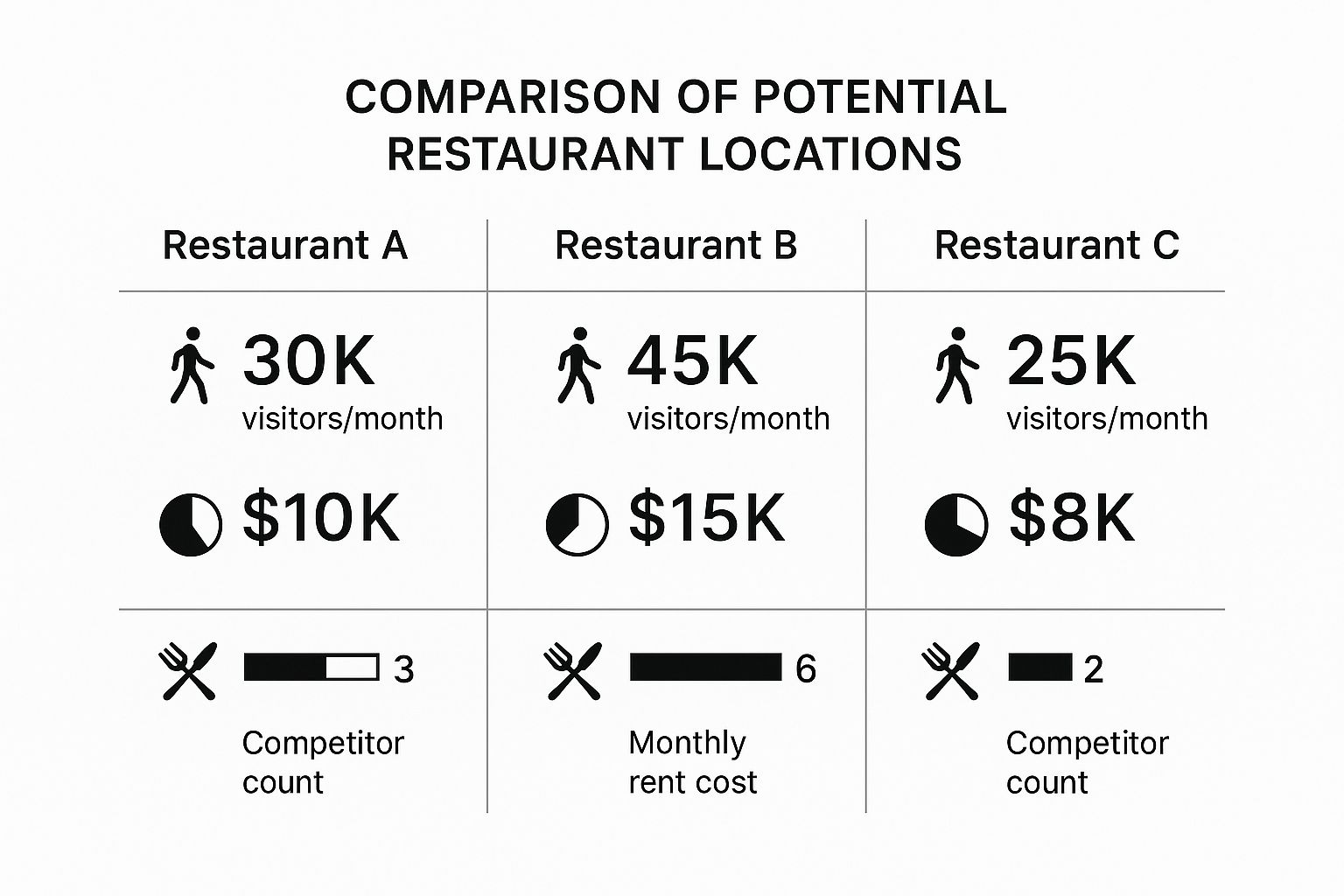
As you can see, the location with the most foot traffic also comes with the highest rent and the most competition. It's a constant balancing act between potential revenue and the real-world costs of operation.
Designing An Efficient Kitchen Layout
Once your menu is locked in, you can finally design the kitchen you'll need to execute it. The layout of your kitchen has a direct impact on your speed, your team's safety, and even their morale. A poorly designed kitchen creates instant chaos during a busy service, leading to slow ticket times, frustrated staff, and inconsistent food. No one wants that.
The goal is to create a logical workflow that minimizes steps and confusion. Usually, this follows the natural path of the food:
- Receiving & Storage: This is where deliveries arrive. It needs to be close to your dry storage, refrigerators, and freezers.
- Food Preparation: The prep area, with its tables, sinks, and cutters for washing and chopping all your ingredients.
- Cooking Line: The heart of the whole operation. This is where your ranges, ovens, fryers, and grills live.
- Service Area: The "pass" where finished dishes are plated, garnished, and picked up by servers.
- Warewashing Station: The dish pit. Ideally, this is tucked away from the cooking line to prevent any cross-contamination.
Think of it like an assembly line. This approach cuts down on unnecessary movement, reduces the risk of accidents, and ensures your team can work like a well-oiled machine, even when the pressure is on.
Building Your Team and Preparing for Opening Day
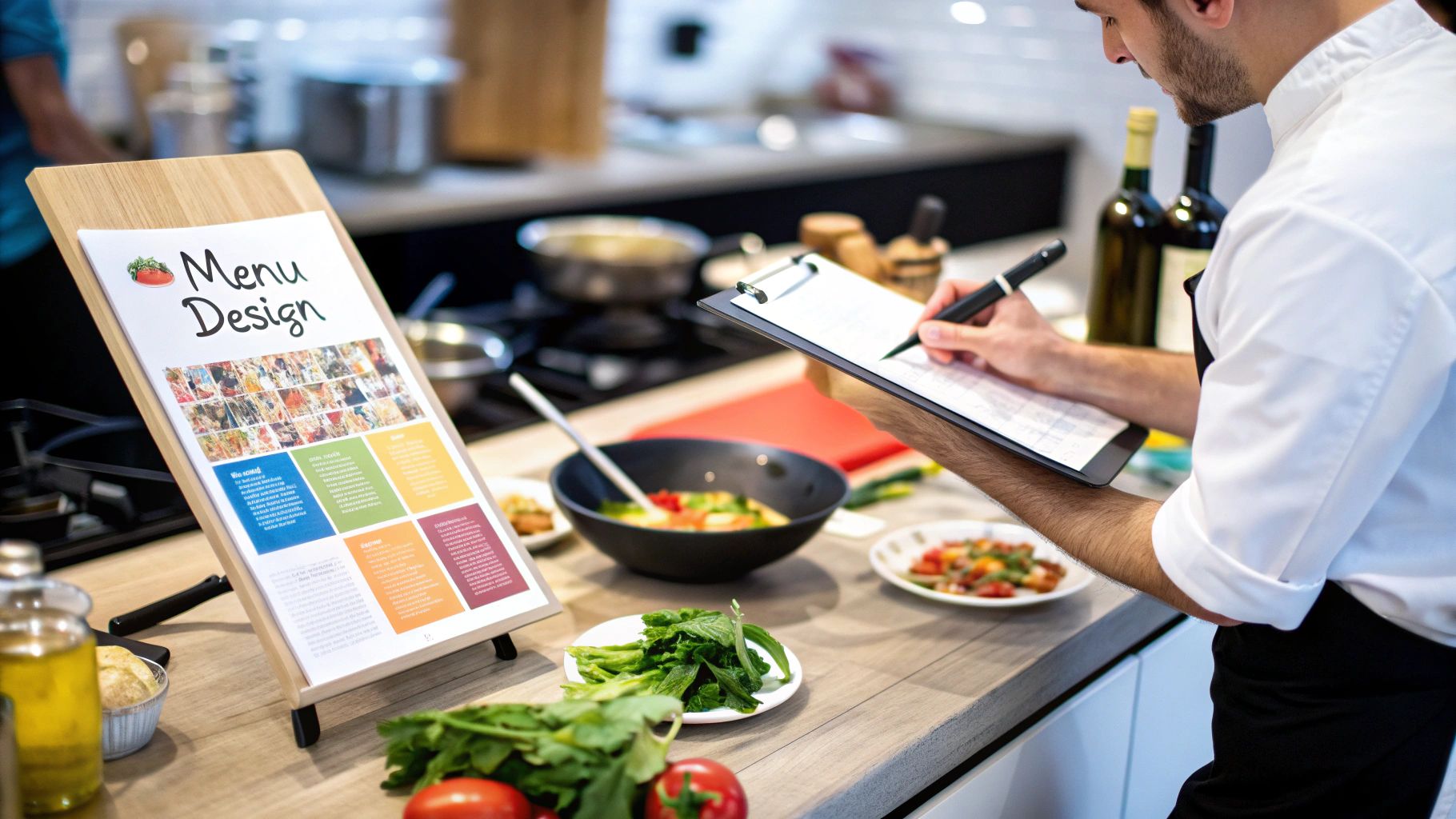
A restaurant is just a room with tables until the right people walk in—and I’m not just talking about customers. Your team is the absolute lifeblood of your business. They're the ones who will bring your vision to life, create the atmosphere you've imagined, and turn first-time visitors into loyal regulars.
As you get closer to opening, your focus has to shift from blueprints and contracts to culture and coaching. Hiring well is arguably the most important thing you’ll do. It's about so much more than finding a line cook who can handle a Saturday night rush or a server who can carry three plates.
You’re building a cohesive unit that needs to function under intense pressure. My advice? Look for personality and attitude first, then experience. You can teach someone how to use your POS system, but you can’t teach genuine passion or a solid work ethic.
Assembling Your Core Restaurant Team
Before you even think about posting a job opening, you need to be crystal clear on what you're looking for in your key roles. What specific skills and temperaments are needed to make your restaurant's unique concept succeed?
- Kitchen Staff (Chefs, Cooks, Dishwashers): You need people who are organized, consistent, and thrive under pressure. During an interview, I always ask how they’d handle a situation where an order gets sent back. Their answer tells you more about their temperament than their resume ever could.
- Front-of-House (Servers, Hosts, Bartenders): These are your brand ambassadors. They need to be personable, attentive, and excellent communicators. Look for people who genuinely enjoy hospitality and can think on their feet to solve guest issues.
- Management (General Manager, Kitchen Manager): Your managers are your leaders. They need a blend of operational know-how, financial smarts, and strong interpersonal skills to motivate the team and keep your standards sky-high.
A common mistake I see is hiring too quickly out of desperation. Rushing to fill positions often leads to a poor culture fit, which can poison your entire team and lead to crushing turnover. Take your time. Find people who not only have the skills but also truly believe in your vision.
The restaurant industry is a massive employer, projected to provide jobs for 15.9 million people in the U.S. by the end of 2025. But it also battles notoriously high staff turnover. This reality, especially when average net profit margins are a slim 3% to 5%, makes every hiring decision critical to your bottom line. You can explore more about these restaurant industry statistics and their implications on Sculpturehospitality.com.
Creating an Effective Training Program
Once you've hired your team, your next job is to set them up for success. A well-structured training program isn’t an expense; it’s an investment that pays dividends in consistency, efficiency, and guest satisfaction. Don't just hand them a manual and hope for the best.
Your training needs to be hands-on and comprehensive. This means deep dives into the menu where they taste every single dish and learn the story behind it. It means role-playing service scenarios, from handling a simple reservation to de-escalating a customer complaint. Your team should feel completely confident with your menu, service standards, and tech before the first guest ever walks through the door.
The Final Sprint to Opening Day
The last few weeks before you open are a total whirlwind. This is when all your planning comes together in a final push to get your restaurant ready for the public. A detailed checklist is your best friend here, making sure no small detail falls through the cracks. For a thorough guide, our own opening a restaurant checklist can be a lifesaver.
One of the most valuable things you can do in this final stage is run a "soft opening." This is a controlled, invite-only event for friends and family before your official grand opening. It’s your chance to pressure-test everything in a low-stakes environment.
A soft opening allows you to:
- Work Out Kitchen Kinks: Pinpoint bottlenecks on the line and fine-tune your workflow.
- Test Your Service Flow: See how your front-of-house team manages taking orders, running food, and handling payments.
- Gather Honest Feedback: Get crucial input on the food, service, and vibe from people you trust.
Use the lessons from your soft opening to make final adjustments. This dress rehearsal ensures that when your grand opening finally arrives, your team is confident, your operations are smooth, and you’re ready to make a fantastic first impression.
Got Questions? We've Got Answers
Stepping into the restaurant business is exciting, but let's be honest—it also brings a flood of questions. Getting clear answers before you're deep in the weeds is one of the smartest things you can do. Here are some of the most common questions we hear from first-time owners, along with the straight-up, practical advice you need to get moving.
How Much Capital Do I Realistically Need to Start a Small Restaurant?
This is always the first question, and the honest answer is: it's all over the map. You might get a tiny leased cafe with second-hand equipment up and running for around $50,000. On the other hand, a more ambitious concept in a prime downtown spot could easily chew through $500,000 or more. Your specific concept, location, and size will ultimately write the final price tag.
That said, some costs are pretty much universal. You absolutely have to budget for:
- Rent Security Deposit: Landlords often want 3-6 months of rent upfront.
- Kitchen Equipment: This is a major expense, whether you buy new or used.
- Initial Inventory: All the food, drinks, and supplies to get you through the first week.
- Licensing & Permits: These fees can pile up fast, easily hitting several thousand dollars.
The single most critical cost, and the one people underestimate most often, is working capital. You need a cash buffer to cover payroll, rent, and vendors for at least six months. This is the cushion that keeps your doors open long enough for the business to find its footing and start making money.
What Are the Most Common Reasons New Restaurants Fail?
It’s rarely one single thing that sinks a restaurant. It’s usually a mix of problems that feed off each other. A bad location with sky-high rent is a classic killer, putting a financial chokehold on the business from day one. A great concept can be completely undone by a lease it simply can't support.
Another huge factor is just not having enough cash in the bank. Far too many owners burn through their startup money before the restaurant has a chance to build a following and become self-sufficient. This is what we mean by inadequate capitalization.
A lack of direct industry experience is often the root issue that makes every other problem worse. Without a real-world understanding of how a kitchen runs, an owner is more likely to mismanage food costs, wrestle with staffing, and fail to deliver a consistent experience—all of which quietly drain the life out of the business.
Other critical mistakes include having an unfocused concept that doesn't appeal to a clear audience, inconsistent food quality, and simply not knowing your numbers. If you don't know your daily food and labor costs, you're flying blind.
Should I Lease or Buy My Restaurant Property?
For the vast majority of new restaurant owners, leasing is the smarter, more practical move. It requires way less capital upfront compared to buying a commercial property. That frees up critical cash for equipment, marketing, and that all-important working capital we just talked about.
Leasing also gives you flexibility, which is huge. If the location doesn't take off like you hoped or you need to pivot your concept, you aren't shackled to a massive real estate asset that’s tough to sell.
Buying, of course, gives you long-term stability and full control. You won't have to worry about rent hikes, and the property itself can grow into a valuable asset. The right call really comes down to your personal finances, your comfort with risk, and your long-term vision.
How Important Is a POS System for a New Restaurant?
A modern Point of Sale (POS) system isn't just a "nice-to-have" anymore—it's absolutely essential. A good POS is the central nervous system for your entire restaurant, doing so much more than just swiping credit cards.
Think of it as your business intelligence hub. A quality system gives you the power to:
- Track Sales in Real-Time: See which dishes are hot and which are not, right now.
- Manage Inventory: Keep an eye on stock levels to cut down on expensive food waste and avoid 86-ing a popular item.
- Streamline Operations: Help your front-of-house and back-of-house communicate better for faster, more accurate orders.
- Monitor Performance: Dig into the data on everything from server sales to your busiest hours.
This data is gold. It helps you make smarter decisions about your menu, your staffing levels, and your marketing efforts. A reliable POS system is one of the best investments you can make to run a more efficient and profitable restaurant.
Ready to build your kitchen with equipment that works as hard as you do? The Restaurant Warehouse offers everything from commercial refrigeration to cooking essentials, all at prices that respect your startup budget. Explore our financing options and get your dream kitchen equipped for less. Find what you need today.
About The Author

Sean Kearney
Sean Kearney used to work at Amazon.com and started The Restaurant Warehouse. He has more than 10 years of experience in restaurant equipment and supplies. He graduated from the University of Washington in 1993. He earned a BA in business and marketing. He also played linebacker for the Huskies football team. He helps restaurants find equipment at a fair price and offers financing options. You can connect with Sean on LinkedIn or Facebook.
Leave a comment