

How to Write a Restaurant Business Plan That Secures Funding
Before you even think about ordering a single napkin or scouting locations, you need a blueprint. A restaurant business plan isn't just some formality you check off a list for the bank; it's the strategic compass for your entire venture. It guides everything from securing funding to making tough operational calls on a slow Tuesday night. Honestly, a solid plan is often the single biggest factor separating thriving restaurants from those that shut their doors within the first year.
Why Your Business Plan Is More Than Just a Document
Think of your business plan as a living, breathing guide that grows with your business—not a static report you write once and then shove in a drawer. It forces you to get brutally honest about every single aspect of your restaurant.
It's your #1 tool for convincing investors, partners, and even key employees that your vision isn't just a dream, but a viable, profitable business. A well-researched plan is your roadmap for getting capital, making smart operational choices, and actually tracking your progress toward your goals.
A Blueprint for Success in a Competitive Market
Let's be real: the restaurant industry is both incredibly promising and fiercely competitive. A meticulously crafted plan is your best defense against the common pitfalls that trip up so many new owners.
For instance, while the average restaurant operates on a razor-thin 3-5% profit margin, the top performers can hit nearly 10%. That massive difference often comes down to the precise financial planning and operational strategy first laid out in their business plan.
By digging into the data, you create a realistic path for both investors and yourself. Including details on your market analysis, supplier contracts, and staffing strategies—especially with the industry projected to fill 15.9 million jobs by 2025—proves you understand the challenges ahead. This level of prep shows you can navigate tight margins and rising costs, turning your plan from a simple document into a powerful tool for success. You can explore more of these trends in this in-depth report from the National Restaurant Association.
Key Takeaway: Your business plan isn’t just about what you’ll do; it's about proving why it will work. It must be backed by solid research and realistic financial projections.
To give you a clear roadmap of what you'll be building, here's a quick look at the core components every winning restaurant business plan needs.
Core Components of a Winning Restaurant Business Plan
Every great plan is built on the same foundational pillars. This table breaks down what each section covers and, more importantly, why it matters to the people holding the purse strings.
| Section | What It Covers | Why It Matters to Investors |
|---|---|---|
| Executive Summary | A concise overview of your entire plan, including your concept, mission, and financial highlights. | This is their first impression. It must be compelling enough to make them want to read the rest. |
| Company Description | Your restaurant's legal structure, ownership details, and the story behind your brand. | It establishes credibility and shows you've handled the foundational legal and business setup. |
| Market Analysis | A deep dive into your target audience, local competition, and industry trends. | Proves there is a real, tangible demand for your specific restaurant concept in your chosen location. |
| Operations Plan | Day-to-day logistics, including staffing, suppliers, and your technology stack (POS, etc.). | Shows you have a realistic plan for running the business efficiently and consistently. |
| Financial Projections | Startup costs, sales forecasts, P&L statements, and break-even analysis. | This is the ultimate proof of viability, showing how and when their investment will generate a return. |
Think of these sections as chapters in your restaurant's story. Getting each one right is how you turn a great idea into a fundable, successful business.
Crafting Your Executive Summary and Company Story

Think of your executive summary as the movie trailer for your restaurant. It's the very first thing an investor or lender will read, and it has one critical job: to hook them so completely that they have to read the rest of the script. This single page needs to distill your entire vision—your concept, your mission, and your key financial numbers—into a powerful, compelling pitch.
This isn't just a formality; it's a strategic sales tool. I've seen too many great concepts get passed over because the first page failed to land. In fact, some data shows that 62% of investors might not read past the executive summary if it doesn’t immediately grab their interest. Your mission is to be concise but comprehensive, hitting all the high notes that prove your restaurant isn’t just another new spot, but a solid, well-thought-out investment.
Distilling Your Vision into One Page
Here’s a piece of advice I always give: write the executive summary last. I know it sounds counterintuitive since it goes at the front, but once you've fleshed out every other part of your business plan, you can pull the most potent details and present them with total confidence. It needs to stand on its own and tell a complete story.
Make sure you nail these key elements:
- Mission Statement: In one clear sentence, what is your restaurant's core purpose and values?
- Concept: Be specific. Describe your restaurant type (fast-casual, fine dining, etc.), your service style, and the kind of atmosphere you're creating.
- Financial Highlights: Don't be shy. State your projected startup costs, your expected first-year revenue, and most importantly, the exact funding amount you're requesting.
- Competitive Edge: What makes you different? Briefly explain your unique selling proposition.
This section truly sets the stage. A strong summary instantly communicates your professionalism and proves you have a deep understanding of your venture, making a potential backer eager to dig into the details.
Telling Your Company Story
Once you've hooked them with the summary, the company description is where you bring your brand to life. This part of your plan moves beyond the numbers to tell the story behind the business. It's your chance to share your passion and build some serious credibility.
This is also where you cover the foundational—and often legal—details. You’ll lay out your restaurant's legal name, its formal structure (LLC, S-Corp, etc.), and the ownership breakdown. It’s also the place to introduce the key players on your management team.
Pro Tip: Don't just list names and titles. Briefly highlight the relevant experience your team brings to the table. An investor isn't just funding an idea; they're investing in the people who will make it happen. A chef with 15 years of experience in Michelin-starred kitchens adds a massive dose of credibility.
Tailoring Your Narrative to Your Concept
Your company story must feel authentic to your specific restaurant concept. The narrative you'd write for a community-focused, farm-to-table bistro will sound completely different from one for a tech-heavy ghost kitchen optimized for delivery.
Scenario 1: The Farm-to-Table Bistro Your story here would likely lean into your personal connections with local farmers, your commitment to seasonal ingredients, and your vision for creating a warm, gathering place for the neighborhood. The mission would probably emphasize community and sustainability.
Scenario 2: The Ghost Kitchen Here, the story shifts. You'd highlight efficiency, scalability, and how you're using market data to drive menu development. The narrative would focus on leveraging technology for order management and your strategy for dominating the local delivery market through partnerships with third-party apps.
Both of these are compelling stories, but they appeal to very different investor sensibilities. When you align your narrative with your operational model, you create a cohesive and much more convincing case. This alignment proves you've thought through every angle of how to write a restaurant business plan that actually works in the real world.
Analyzing Your Market and Competitive Landscape
A killer recipe or a brilliant concept is a fantastic start, but it's not enough. You need to prove there’s a hungry audience waiting for what you're serving. No restaurant exists in a bubble, and this section of your business plan is where you show investors you understand the world outside your own kitchen.
Think of it this way: this is where you pivot from passionate chef to sharp, strategic business owner. It shows you’ve done your homework and truly studied the playing field. This analysis becomes the bedrock for everything else—it validates your concept, informs your pricing, and shapes how you'll market your restaurant. When you get this right, you're not just guessing; you're making smart, data-driven decisions.
Defining Your Ideal Customer
Before you can win over your perfect customer, you have to know exactly who they are. I mean, in granular detail. It’s about going way beyond basic demographics like age and income. You need to build a complete profile of the person you envision becoming a regular.
What are their dining habits? Are they looking for a quick lunch on a Tuesday, a leisurely weekend brunch spot, or a place for big family celebrations? What do they care about most? Is it convenience, atmosphere, price point, or a one-of-a-kind culinary experience? Nailing these psychographics is everything.
- For a fast-casual taco shop: Your target might be a 25-35 year old professional working nearby. They value fresh ingredients and speed, are active on social media, and want a quality lunch for under $15.
- For a high-end steakhouse: You're likely targeting affluent couples aged 45-65, probably celebrating a special occasion. For them, impeccable service and a sophisticated ambiance are non-negotiable, and they're far less sensitive to price.
This level of detail proves you’ve thought deeply about who you’re serving. It’s a make-or-break part of writing a restaurant business plan that actually gets investors excited.
The image below breaks down some of the key financial projections you'll be developing.
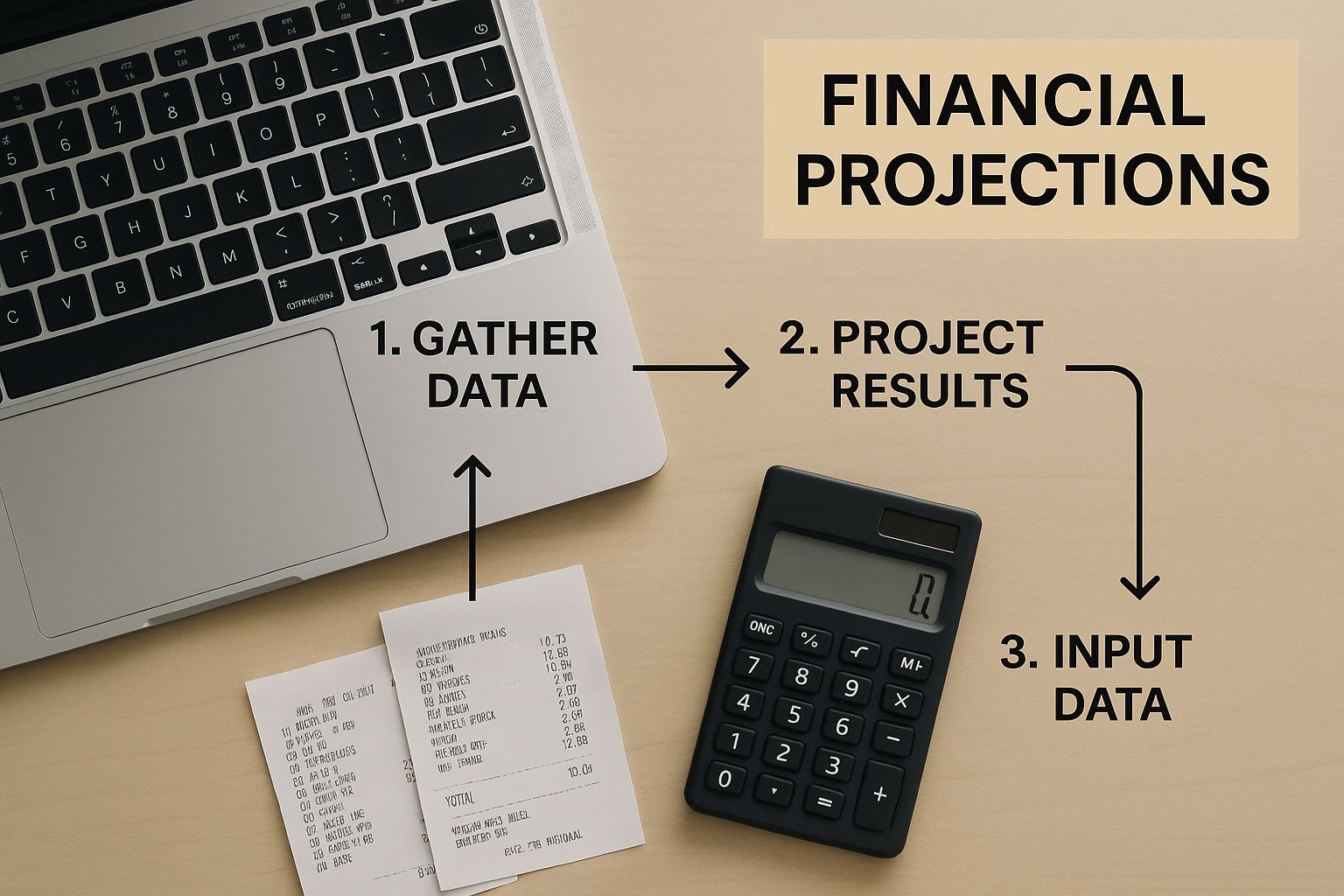
These numbers are only believable when they’re built on a solid foundation of market demand and a deep understanding of your customer base.
Sizing Up the Competition
Next, it’s time to do some ethical spying on your competition. This means identifying every single direct and indirect competitor in your chosen neighborhood. Direct competitors are the obvious ones—similar food, similar price. But don’t forget the indirect ones. That could be any other spot your target customer might spend their dining dollars, like a gourmet grocery store with a great hot-food bar or a different type of restaurant altogether.
Get out there. Create a spreadsheet and actually visit these places. What are their prices? When are they busiest? What’s the vibe from the staff? What are people saying in online reviews? You need to pinpoint what they do exceptionally well and, more importantly, where their weaknesses are. This isn't about copying anyone; it's about finding the gaps in the market that your restaurant is perfectly positioned to fill.
A common mistake I see is underestimating the competition. Just because that Italian place down the street seems mediocre to you doesn't mean it lacks a loyal following. Your job is to figure out why people go there and then give them a much better reason to try your place instead.
A structured approach is your best friend here. I'd recommend using a competitive analysis template to keep your research organized and ensure you’re evaluating everyone on the same criteria. This makes it so much easier to spot your unique selling points.
Leveraging Industry and Local Trends
Your plan also needs to zoom out and look at the bigger picture. Understanding what's happening on a macro level gives crucial context to your local ambitions. For example, industry stats project the global restaurant and foodservice market to grow from $3.48 trillion in 2024 to $4.03 trillion in 2025. That’s a massive jump.
In major markets like the U.S., foodservice sales are expected to hit $1.5 trillion in 2025. Weaving in data like this shows potential investors that you grasp both the sheer scale of the opportunity and the challenge ahead. It helps you set realistic targets for market share, staffing, and cash flow, balancing your ambitious goals with grounded financial planning.
This foresight is all about translating broad trends into local, actionable strategy. Is your city seeing a boom in demand for plant-based dining? Are people clamoring for more contactless payment and delivery options? Showing that you can connect these dots proves your concept isn’t just relevant today—it’s built for the future. It turns your market analysis from a boring report into a strategic weapon.
Designing Your Operations and Management Blueprint
You’ve painted a picture of your market and your concept. Now it's time to get into the nuts and bolts. This is where you prove you can actually run the show. The operations and management section of your business plan is the practical blueprint that shifts from the "what" and "why" to the "how."
An investor needs to see a well-oiled machine on paper before they'll ever believe you can build one in real life. This part of your plan details the day-to-day mechanics of your restaurant, covering everything from your team structure and staffing to your supply chain and technology. Think of it as the tactical guide that shows you’ve thought through every angle of bringing your vision to life.
Building Your Dream Team
Your management team is, without a doubt, one of the most critical parts of your operational plan. An investor isn’t just funding an idea; they are betting on the people who will bring it to life. You don’t need every single position filled right now, but your key leadership roles must be clearly defined and, ideally, assigned to individuals with proven track records.
Start by mapping out a simple organizational chart. Who reports to whom? What are the specific responsibilities of the General Manager, Head Chef, and Front of House Manager? For each key player you have on board, write a short, impactful bio that highlights their relevant experience—not just their past job titles. For example, a Head Chef with 10+ years of experience successfully managing food costs in a similar style of restaurant is a massive asset.
This is also where you’ll detail your overall staffing strategy. Labor is a huge operational cost, and a smart plan shows you’re prepared. With the U.S. restaurant industry projected to employ around 15.9 million people in 2025, you have to show how you'll attract and retain top talent. Your plan needs to cover your hiring timeline, proposed wage structures, and training programs, especially since labor costs often eat up 30-35% of a restaurant's total revenue. Showing you grasp these pressures is a crucial step in writing a restaurant business plan that builds serious confidence. You can discover more about restaurant industry statistics to help ground your projections in reality.
Mapping Your Supply Chain and Technology
A reliable supply chain is the lifeblood of any restaurant. It's not enough to say you'll use "local suppliers." Name them. Who are your primary vendors for produce, meat, dairy, and dry goods? Have you already negotiated pricing or secured backup suppliers in case of shortages? Listing specific, vetted partners shows you’ve done your homework and won't be derailed if one provider has an issue.
Beyond food, think about your other operational partners. This includes:
- Linen and Uniform Services: Who is handling the cleaning and supply of aprons, tablecloths, and kitchen towels?
- Waste Management: What’s your plan for trash and recycling, including essential services like grease trap maintenance?
- Maintenance and Repairs: Do you have contacts lined up for those inevitable emergency HVAC or plumbing calls?
Your technology stack is another core piece of modern restaurant operations. This is about more than just having a website. You need to get specific about the systems you’ll use to run the business efficiently.
Key Insight: A well-integrated tech stack isn't a luxury anymore; it's an operational necessity. Your choices here directly impact your efficiency, customer experience, and ultimately, your bottom line.
Think through the tools that will power your daily workflow. What Point of Sale (POS) system will you use? What about reservation and waitlist software, or an inventory management platform? Explaining why you chose a particular system—for instance, selecting a POS known for its robust reporting features—shows investors you're making strategic choices to drive profitability. These practical details even extend to the physical setup. When planning your dining room, you might even use professional furniture assembly services to get your tables and chairs set up quickly and correctly, minimizing downtime before you open your doors.
Building Realistic Financial Projections
Numbers tell a story, and this is the chapter that investors and lenders read most carefully. If your market analysis is the heart of your business plan, your financial projections are the brain. This is where you prove your brilliant concept is also a viable, profitable business.
This isn’t about just plugging numbers into a spreadsheet. It’s a detailed, bottoms-up approach that builds a believable financial narrative. You’re showing potential backers that you have a firm grasp on the economic realities of running a restaurant and that you'll be a responsible steward of their investment.
Detailing Your Startup Costs
The first piece of your financial puzzle is a complete and honest list of all your startup costs. We're talking about every single expense you'll incur before you even open your doors and serve your first guest. Getting this right is absolutely critical—underestimating here is one of the fastest ways to run out of cash.
Break down these costs into clear categories:
- One-Time Expenses: This covers things like business incorporation fees, liquor license applications, and the initial down payments for your lease.
- Build-Out and Renovation: All the costs for construction, plumbing, electrical work, and the interior design needed to transform the space.
- Kitchen and Bar Equipment: This is a major expense. It includes everything from your commercial ovens and refrigeration down to the glassware and smallwares.
- Initial Inventory: Your first big order of food and beverage supplies to get your pantry and bar fully stocked.
- Pre-Opening Marketing: The budget for creating your website, running initial ad campaigns, and hosting any grand opening events.
Creating this list can feel overwhelming. To make sure you don't miss anything crucial, you can reference a detailed guide on common restaurant startup costs to build out a thorough and realistic budget.
Forecasting Your Sales Realistically
Your sales forecast is the engine of your financial projections. It needs to be optimistic enough to be exciting but grounded in the reality of your market analysis. The most credible way to do this is with a capacity-based forecast.
Start by calculating your total number of seats. Then, estimate your table turnover rate for different meal periods (like lunch, dinner, and weekend brunch). For instance, a casual spot might turn a table 3 times during a packed dinner service, while a fine dining restaurant might only turn it 1.5 times.
Multiply your number of tables by that turnover rate and the estimated average check per table. Do this for each day of the week, accounting for the natural rhythm of slower weekdays versus bustling weekends. This detailed approach is far more convincing than just pulling a number out of thin air.
Investor Insight: A huge red flag for investors is seeing a wildly aggressive sales forecast for the first few months. It shows a lack of real-world understanding. It's much smarter to project a gradual ramp-up in sales as your marketing kicks in and word-of-mouth starts to build.
Projecting Profit and Loss
Your Profit and Loss (P&L) statement, sometimes called an income statement, maps out your financial performance over time. You’ll want to create monthly P&L statements for your first year, then switch to annual statements for years two and three. This statement simply subtracts your costs from your revenue to show your projected profit or loss.
Here are the key components of your P&L:
- Revenue: This is your total sales, pulled directly from that sales forecast you just built.
- Cost of Goods Sold (COGS): The direct costs of your food and beverages. Industry benchmarks usually put food costs between 28% and 35% of revenue.
- Gross Profit: Your revenue minus your COGS.
- Operating Expenses: All the other costs to keep the lights on—labor, rent, utilities, marketing, and insurance. Labor is another huge piece, often running 25-35% of revenue.
- Net Profit (or Loss): This is the bottom line—your gross profit minus all those operating expenses.
It’s crucial to check your assumptions against industry benchmarks. If you claim your food cost will be 22% but your concept is a prime steakhouse, experienced eyes will spot that disconnect immediately. Your P&L is where you prove you understand the key financial levers of this business.
Conducting Your Break-Even Analysis
Finally, your break-even analysis is a powerful tool that pinpoints the exact moment your restaurant will stop losing money and start turning a profit. It calculates the amount of revenue you must generate to cover all your costs, both fixed and variable.
You'll need three numbers to calculate it:
- Total Fixed Costs: Expenses that don't change with sales volume (like rent, salaries, insurance).
- Total Variable Costs: Expenses that do change with sales (like food, beverages, hourly labor).
- Total Sales: Your projected revenue.
This analysis answers the single most important question for any potential investor: "When will I start seeing a return?" Presenting a clear break-even point—whether it's hitting $45,000 in monthly sales or serving 2,500 customers a month—provides a tangible, confidence-inspiring goal. It’s the final piece of evidence that your plan isn’t just a dream, but a sound financial investment.
Presenting a Clear and Compelling Funding Request
You’ve done the heavy lifting. You've proven your concept is solid, your market analysis is sharp, and you've built financial projections that can stand up to some serious scrutiny. Now, it's time for the moment of truth: making the ask.
This is where your entire business plan comes together. It’s the part where you translate all that research and hard work into a specific, professional, and compelling funding request. Ambiguity is your absolute enemy here; clarity and confidence are your best friends. This isn't just about asking for money—it's about proposing a strategic partnership, and you need to kick it off with total transparency.
Specifying Your Funding Needs
First things first, get straight to the point with a clear statement of the total capital you need. Don't be vague or offer a loose range. A specific figure like $450,000 shows you've done your homework and is far more credible than a ballpark estimate like "$400k-$500k."
The very next step is to show them exactly where every single one of those dollars is going. This detailed breakdown is crucial. It’s your chance to demonstrate that you’re a responsible and diligent planner who has thought through every aspect of the launch. A potential backer needs to see that you have a sound plan for their investment.
Your breakdown should be itemized and look something like this:
- Kitchen Equipment: The total cost for every piece of cooking, refrigeration, and prep equipment.
- Leasehold Improvements: Your budget for construction, renovations, and all the interior design elements.
- Initial Inventory: The funds needed to stock your pantry, walk-in cooler, and bar for a successful opening.
- Pre-Opening Expenses: This covers things like permits, licenses, legal fees, and your initial marketing push.
- Operating Capital: A cash reserve to cover payroll and other expenses for the first 3-6 months, giving you a runway before you start turning a profit.
This level of detail proves you've anticipated the real-world costs of getting your doors open and surviving those critical first few months.
Justifying the Ask and Outlining Returns
After you've detailed how you'll spend the money, you need to connect the dots for the investor and talk about their return. This is where you lay out the terms you’re offering, whether that’s an equity stake in your restaurant or a structured loan with an interest rate. Be ready to discuss different scenarios—flexibility can be a real asset here.
Pro Tip: Remember, investors aren’t just funding a passion project; they're investing in a financial return. Your job is to clearly outline the projected return on investment (ROI) and the expected timeline for profitability, all based on the financial forecasts you’ve already built. Show them you respect their primary motivation.
It’s also smart to have a solid grasp of the different funding avenues available before you walk into that meeting. To make the most informed decision, take some time to compare various restaurant financing options and understand their different requirements and expectations.
When you present a well-justified request that lines up perfectly with the rest of your comprehensive plan, you make it incredibly easy for a potential backer to get excited and give you an enthusiastic "yes."
Common Questions About Restaurant Business Plans
Even with a detailed guide in hand, writing your restaurant business plan is going to bring up some tricky questions. That's completely normal. Honestly, tackling these common sticking points is what polishes a good plan into a great one. Let's clear up some of the most frequent hurdles I see aspiring restaurateurs run into.
How Do I Project Finances With No Sales History?
This is the classic chicken-and-egg problem for every new restaurant owner. Projecting future sales without any past data can feel like you're just guessing, but it doesn't have to be that way. The key is to build your forecast from the ground up, based on the physical capacity of your space.
Start with what you know for sure: the number of seats in your restaurant. From there, you can make some smart, educated assumptions based on your concept and the market research you've already done.
- Estimate Your Table Turnover: How often will a table get used during a service? A bustling fast-casual spot might turn tables 3-4 times during a lunch rush. A fine-dining restaurant, on the other hand, might only turn them once or twice over an entire evening. Be realistic about your style of service.
- Calculate Your Average Check Size: Pull out your mock-up menu and do some simple math. What will an average two-top likely spend? Maybe $50. What about a four-top? Perhaps $95. This gives you a tangible number to work with.
- Factor in the Daily Rhythms: Your sales on a slow Tuesday will look a whole lot different than on a packed Saturday night. Build your forecast day by day to reflect this reality. It creates a much more believable and defensible monthly total.
This bottoms-up approach is infinitely more credible to investors than just pulling a big, round number out of thin air. It proves you've thought critically about the operational realities of your specific restaurant.
Key Takeaway: Investors don't expect you to have a crystal ball. What they want to see is a logical, well-reasoned methodology for your projections that’s grounded in the real-world details of your operation.
How Often Should I Update My Business Plan?
Your business plan should never be a document you write once, print, and then shove in a filing cabinet to collect dust. Think of it as a living, breathing guide for your business. Once you're open and operating, it's a smart habit to review and update it at least once a year.
That said, you should also pull it out anytime a major change is on the horizon. This could be anything from a significant menu overhaul and a plan to expand to a new location, to a major shift in your local competitive landscape. Keeping your plan current keeps you focused and is absolutely essential if you ever decide to go after a second round of funding.
What Do Investors Look For Besides the Numbers?
While the financial projections are absolutely critical, savvy investors know they are betting on the jockey, not just the horse. They are looking for passion, genuine expertise, and a deep, nuanced understanding of the restaurant industry. They want to see a management team with a proven track record of success.
Your story matters. Your unique concept, your unwavering commitment to a specific guest experience, and the "why" behind your restaurant are all incredibly powerful persuaders. Investors need to feel confident that you have the resilience and industry know-how to navigate the inevitable challenges that will come your way.
How Detailed Should My Menu Be?
For your initial business plan, you don’t need a perfectly designed, finalized menu ready for printing. What you absolutely do need is a detailed mock-up menu. This sample menu should be a strong representation of what you plan to offer and, most importantly, must include your proposed pricing.
Those prices are essential. They feed directly into all of your financial projections, from your sales forecasts to your food cost analysis. It's a foundational piece of the puzzle that proves your concept is not just creative, but also financially sound. As you get closer to opening, you'll need a comprehensive list of every single item to properly equip your kitchen and bar. Using a detailed opening a restaurant checklist can be a lifesaver here, ensuring you don't miss any critical details for your back-of-house and front-of-house operations.
At The Restaurant Warehouse, we know that building a restaurant from the ground up takes more than just a great idea—it requires the right equipment and the right support. We offer top-quality commercial kitchen equipment at discounted prices, flexible financing, and fast delivery to help you turn your business plan into a reality. Equip your dream kitchen affordably and efficiently by visiting us at https://therestaurantwarehouse.com.
About The Author

Sean Kearney
Sean Kearney is the Founder of The Restaurant Warehouse, with 15 years of experience in the restaurant equipment industry and more than 30 years in ecommerce, beginning with Amazon.com. As an equipment distributor and supplier, Sean helps restaurant owners make confident purchasing decisions through clear pricing, practical guidance, and a more transparent online buying experience.
Connect with Sean on LinkedIn, Instagram, YouTube, or Facebook.