

Food Truck Business Plan Template | Start Your Success Today
Starting a food truck is way more than just a passion project—it’s a serious business, and a solid plan is the most critical tool you’ll have for success. A detailed food truck business plan template is your roadmap, guiding you through everything from startup costs to securing loans and winning over investors.
Your Blueprint for Food Truck Success
The dream of owning a food truck usually kicks off with a killer recipe and a romantic idea of life on the open road. And while that passion is absolutely essential, the truth is, successful food trucks are built on a foundation of careful planning, not just culinary magic.
Think of your business plan as the architectural blueprint for your mobile eatery. It’s the document that turns your creative vision into a real, fundable, and profitable business.
Without a plan, you're pretty much navigating a complex industry blindfolded. Lenders and investors won’t just take your word for it—they need to see hard numbers, solid market research, and a clear operational strategy. Your plan is your proof that you’ve thought through every single challenge, from daily operations to long-term growth.
Why This Plan is Your Most Important Tool
A comprehensive business plan does a lot more than just help you get funding. It forces you to think critically about every piece of your venture before you sink a ton of time and money into it. For a deeper dive into those initial steps, our guide on how to start a food truck provides some great context. This whole process helps you spot obstacles early and sharpen your strategy.
So, let's break down the essential sections that every great food truck business plan needs. Having this structure is your key to making a professional impression and covering all your bases.
Core Components of a Winning Food Truck Business Plan
| Section Name | What It Accomplishes | Key Information to Include |
|---|---|---|
| Executive Summary | Grabs attention and gives a powerful overview of your entire plan. It's your first impression. | Your mission, concept, funding request, and key financial highlights. |
| Company Description | Explains the "who" and "what" behind your business, detailing your legal structure and unique concept. | Legal structure (LLC, etc.), your story, and what makes your food truck special. |
| Market Analysis | Proves you understand your industry, target customers, and competitors. | Industry trends, target audience demographics, and a competitive analysis. |
| Organization & Management | Outlines your team's structure and highlights the experience of key personnel. | Bios of owners/managers, roles, responsibilities, and staffing plan. |
| Menu & Services | Details your culinary offerings and any other services you'll provide (e.g., catering). | Full menu with pricing, signature dishes, and sourcing information. |
| Marketing & Sales Strategy | Explains how you'll attract and retain customers. | Branding, social media plan, event strategy, and customer loyalty ideas. |
| Operations Plan | Describes the day-to-day logistics of running your food truck. | Daily workflow, location strategy, permits/licenses, and supplier details. |
| Financial Projections | Provides a detailed financial forecast for the next 3-5 years, proving your viability. | Startup costs, profit & loss, cash flow, and break-even analysis. |
| Funding Request | Clearly states how much money you need and exactly how you'll use it. | Loan amount, use of funds, and proposed repayment terms. |
This table gives you a bird's-eye view, but we're about to get into the nitty-gritty of each section.
A well-crafted business plan is the difference between a food truck that survives and one that thrives. It’s your strategic guide for turning a passion into a sustainable and successful business.
In this guide, we’ll break down every one of these components. We'll move from crafting a compelling executive summary that hooks readers right from the start to building realistic financial projections that will stand up to scrutiny. As you read, you can follow the template structure we provide, giving you a practical framework to build upon.
Crafting Your Executive Summary and Company Vision
Think of your executive summary as the powerful, one-page sizzle reel for your entire food truck business plan. It’s the very first thing a lender or investor reads, and honestly, it might be the only thing if it doesn’t immediately hook them. This isn't just a brief intro—it's your complete elevator pitch, boiled down to its most persuasive form.
Its job is to give a high-level tour of your whole business, making the reader genuinely eager to dive deeper. It needs to be concise, confident, and compelling, touching on your core concept, what you need financially, and exactly why your truck is destined for success.
Here's a pro tip: while it appears first in the document, you should always write it last. You can only effectively summarize your market, operations, and financials after you've actually detailed them.
Defining Your Culinary Concept and Brand
This is where you paint a vivid, mouth-watering picture of your food truck. Don't just say you're opening a taco truck; explain what makes your taco truck special. Is it your grandmother's secret barbacoa recipe? Your unwavering commitment to locally sourced ingredients? Or maybe it's your unique fusion of Korean BBQ and traditional Mexican street food.
Your concept is your story. Let’s look at two distinct examples to see what I mean:
-
Scenario 1: "The Melt"
- Concept: A gourmet grilled cheese truck specializing in artisanal cheeses, house-made sourdough, and inventive pairings like fig jam and prosciutto. The brand feels nostalgic, comforting, and just a little bit upscale.
-
Scenario 2: "Donut Dash"
- Concept: A specialty vegan donut van offering unique, rotating flavors like lavender-honey and maple-pecan. The brand is fun, modern, and perfectly tailored to a health-conscious but indulgent crowd.
Clearly articulating your unique selling proposition (USP) is everything. It’s the "why" behind your business and the reason customers will line up at your window instead of the competition's.
Structuring Your Company Description
Beyond the creative concept, you need to lay out the fundamental details of your business. This section grounds your vision with practical information, proving to anyone reading that you’ve thought through the legal and structural components.
Your company description must include these three things:
- Business Name and Legal Structure: State your official business name and whether you're operating as a Sole Proprietorship, LLC, or Partnership. An LLC is a really common choice for food trucks because it separates your personal assets from business liabilities.
- Mission Statement: This is a short, powerful declaration of your purpose. For "The Melt," it might be: "To serve nostalgic comfort food with a modern, gourmet twist, creating a memorable meal one perfect sandwich at a time."
- Core Objectives: List 2-3 clear, measurable goals for your first year. Avoid vague statements. Instead of "become popular," use specific objectives like "Secure three weekly recurring lunch spots at corporate parks within six months" or "Achieve a 15% profit margin by the end of year one."
A compelling company description balances passion with professionalism. It showcases your exciting culinary vision while proving you have a solid, well-structured business foundation ready to support it.
This section, combined with the other parts of your plan, forms a complete picture. For more guidance on fitting all these pieces together, our article on how to write a restaurant business plan offers a great framework that can be adapted for any food service venture.
Analyzing Your Local Market and Competition
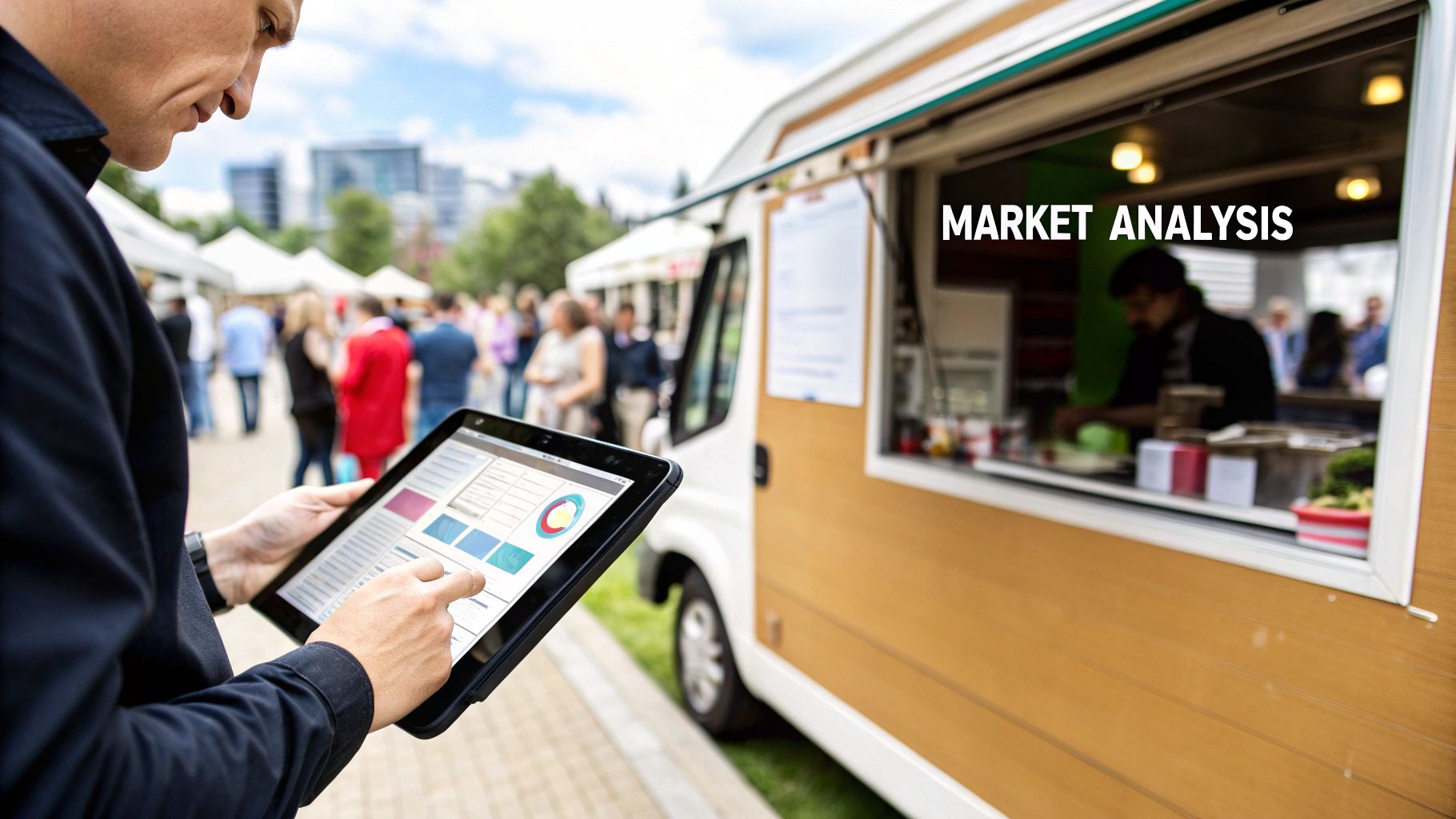
Let’s be honest: no food truck is an island. Your success is going to hinge entirely on how well you get the lay of the land—the people, the places, and the other players already out there. This section of your business plan is where you prove that a hungry, paying crowd is actually waiting for you. It's time to move beyond guesswork and get into some real-world data.
The food truck industry is definitely growing, which is both good news and a challenge. More opportunity, but also more competition. Globally, the market was valued at over $5 billion in 2024 and is expected to keep climbing at a rate of around 7% through 2030. But those big numbers don't mean a thing if your concept can't win on your specific city block. For a deeper dive into industry trends, you can find more insights on the booming food truck industry on futuremarketinsights.com.
Identifying Your Target Audience
So, who are you really cooking for? "Everyone" is the fastest way to connect with no one. A solid analysis drills down into specific groups of people. You need to paint a clear picture of your ideal customer, because that picture will guide everything from your menu and pricing to where you park your truck.
Think about who you might be serving:
- The Downtown Lunch Rush: These are office workers on a tight schedule, looking for something quick, delicious, and reasonably priced between 11 AM and 2 PM. For them, speed and convenience are everything.
- Weekend Festival-Goers: Think families and friends at community events, concerts, or farmers' markets. They're usually less worried about price and are looking for a unique or shareable food experience.
- The Late-Night Crowd: College students or people spilling out of bars and venues after 10 PM. They're craving something satisfying—often indulgent—and are drawn to spots that are well-lit and easy to find.
Once you’ve zeroed in on your main audience (and maybe a secondary one), dig deeper. What's their average income? What are their dining habits? Do they lean toward spicy, healthy, or comfort food? You can find this info in local census data, chamber of commerce reports, or even by running a few polls on social media.
Conducting a Competitive Analysis
You've got to know who you're up against. And I'm not just talking about other food trucks. Your competition includes brick-and-mortar restaurants, fast-casual spots, and even the corner store that sells hot dogs to your target customers. A thorough competitive analysis is how you find your unique edge.
Start by creating a simple competitor map. List every direct and indirect competitor in the areas you plan to operate. For each one, do a little intel gathering:
- Concept and Menu: What kind of food do they serve? What are their best-sellers and what do they charge?
- Locations and Hours: Where do they usually park? Do they have a set schedule or do they move around?
- Strengths: What do they absolutely nail? Is it their lightning-fast service, incredible food, or a massive social media following?
- Weaknesses: Where do they miss the mark? Do customers complain about long waits, inconsistent quality, or high prices online?
Your Unique Selling Proposition (USP) lives in the gap between what your competitors offer and what your target audience truly wants. This analysis is how you find that gap.
For example, maybe you find three taco trucks in your area, but none of them offer legit vegan options. If your research shows a growing demand for plant-based food, you’ve just found your opening. Your USP could be "The best plant-based tacos in the city."
Finding Your Unique Selling Proposition
Your USP is the heart of your brand. It’s the one thing that makes you different—and better—than everyone else. It’s the clear, simple answer to the question: "Why should I eat at your truck instead of theirs?"
Your USP could be built on things like:
- A Secret Recipe: "The only truck serving Grandma’s authentic Sicilian arancini."
- Sourcing: "Farm-to-truck burgers using beef from local ranchers."
- Speed of Service: "Your complete lunch order, guaranteed in under five minutes."
- Niche Specialization: "Exclusively gluten-free comfort food."
This part of your business plan should wrap up with a clear, confident statement that defines your place in the market. By digging into your audience and competition, you’re turning a simple food idea into a strategic business ready to compete—and win.
Detailing Your Operations and Management Plan
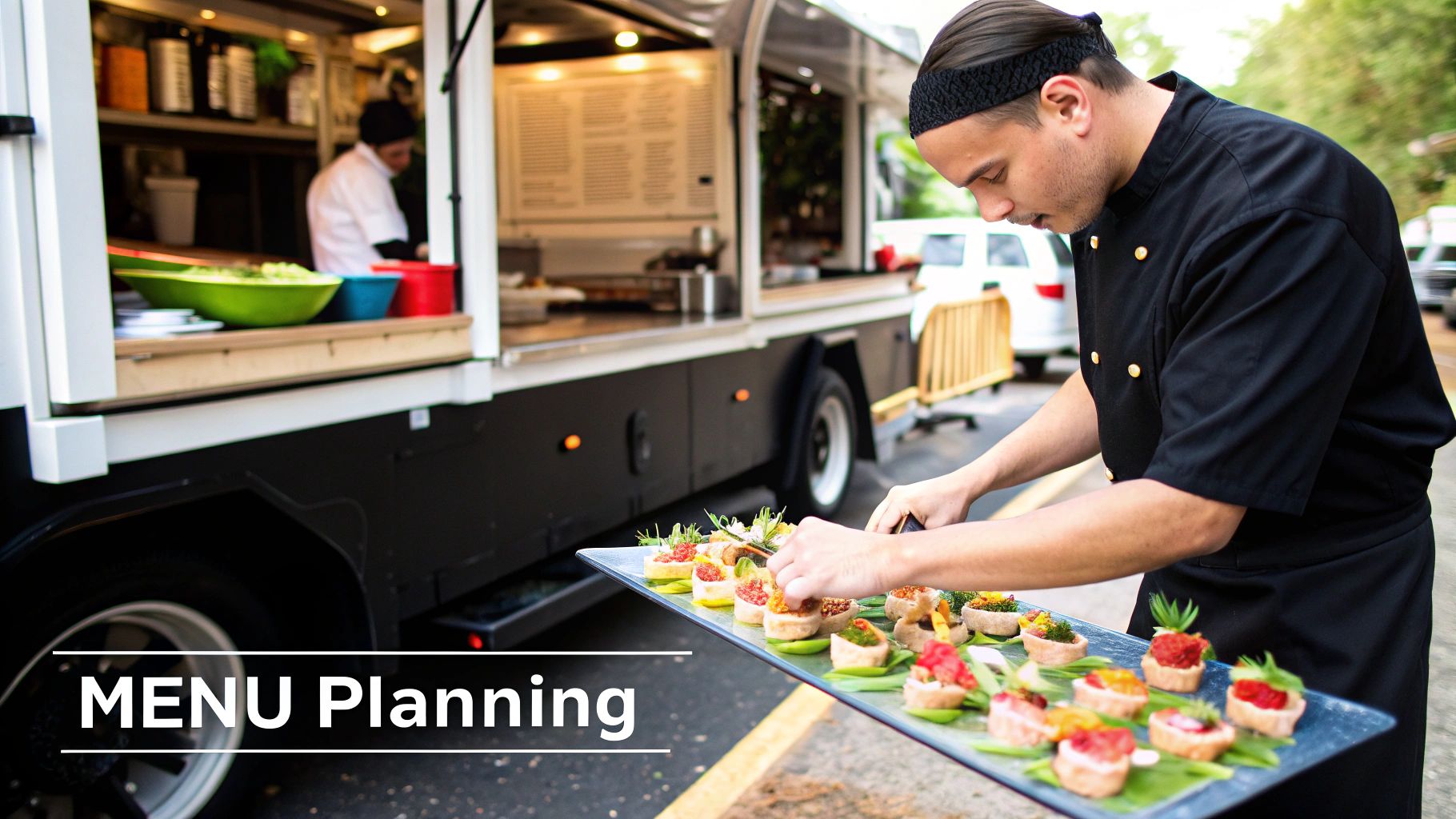
This is where your brilliant food concept gets real. Your operations and management plan is the part of your business plan that shows lenders you’ve thought through the day-to-day grind of actually running a food truck. It’s the nuts-and-bolts section that proves your business isn't just a dream—it's a well-oiled machine ready to hit the streets.
Think of this as the "how" behind your business. It covers everything from where you'll source your beef to how you'll handle a dinner rush with a two-person crew. A strong plan here removes uncertainty and shows you've got a handle on the practical side of things.
Mapping Out Your Daily Workflow
The daily life of a food truck is a rhythm, a repeatable process you and your team will follow every single day. Outlining this workflow shows you’ve considered the logistics beyond just cooking. A typical day isn't just serving customers; it's a full cycle of prep, service, and breakdown.
Your plan needs to break this down clearly. For example:
- Morning Prep (7 AM - 10 AM): Get specific. Will you use a commissary kitchen to chop veggies and simmer sauces? List your key prep tasks.
- Travel and Setup (10 AM - 11 AM): Don't forget this part. Account for driving to your spot, parking, firing up the generator, and setting up the service window.
- Service Window (11 AM - 3 PM): Define your core service hours for a key location, like the downtown lunch rush.
- Teardown and Cleanup (3 PM - 5 PM): Detail your process for cleaning the truck, restocking for tomorrow, and driving back to your commissary or parking spot.
This schedule proves you understand the real-time commitment and helps you accurately forecast your labor costs.
Building Your Supplier and Inventory System
Your menu is only as good as your ingredients, and your profit margins depend entirely on how you manage them. This part of your plan details your entire supply chain. Don’t just write down "vegetable supplier"; get specific.
Name your primary and backup suppliers for key ingredients. If you run a gourmet burger truck, this means listing the local butcher you prefer for your 80/20 ground beef and a secondary option in case they have an issue. This shows you have contingency plans.
As you detail your operational plan, it's crucial to consider the legal aspects of contract formation that will govern your relationships with suppliers, employees, and venues. These agreements are the backbone of your operational stability.
A solid inventory system is your best defense against waste and lost profits. Your plan should specify how you'll track it—whether it's a simple daily checklist on a clipboard or a slick inventory app—and set par levels for reordering.
Structuring Your Management and Staffing
Finally, you need to outline who’s running the show. Even if you're a one-person operation to start, you need to clearly define your own role and responsibilities.
If you have a team, create a simple organizational chart. Define each role and who reports to whom.
- Owner/Head Chef: Responsible for menu creation, supplier relationships, and big-picture strategy.
- Truck Manager/Cashier: Handles customer orders, payment processing, and daily cash reconciliation.
This is the place to highlight the experience of your key people. Did your head chef work in a high-volume kitchen for five years? Does your partner have a background in marketing? This kind of experience adds massive credibility, assuring investors that the business is in capable hands. Don't forget to factor in compliance with local rules; understanding the details of food truck regulations is non-negotiable for smooth operations.
Designing Your Menu and Marketing Strategy

Let's be real: your menu is the heart of your brand, and your marketing is the megaphone. You can have the best tacos in town, but if no one knows you exist, you're just cooking for yourself. Likewise, all the Instagram hype in the world won't save you if your food is forgettable.
This part of your food truck business plan template is where you prove you're both a chef and a strategist. It's where you detail your killer dishes and lay out exactly how you'll get hungry customers lining up at your window, day after day.
Engineering a Smart and Profitable Menu
A food truck menu is a masterclass in efficiency. You're working in a tiny space, speed is everything, and every single order needs to count toward your bottom line. This isn't the time to list every dish you've ever perfected; it's about engineering a menu that works within your truck's limits.
The most successful trucks I've seen build their menus around a handful of absolute bangers. Think five to seven core offerings that you can nail every single time, even with a line wrapped around the block. This tight focus slashes your food waste, makes inventory a breeze, and dramatically speeds up service time—a non-negotiable for the lunch rush.
Keep these menu engineering principles in mind:
- Scalability: Can you prep ingredients for 100 orders just as easily as for 20? Your recipes need to scale without any drop in quality.
- Profitability: You have to calculate the food cost for every item. Seriously, every pickle slice. Aim for a food cost percentage between 28-35% to make sure you're building healthy margins.
- Cross-Utilization: This is a food truck secret weapon. Design items that share ingredients. If your signature burger uses a special chipotle aioli, can that same sauce go on your loaded fries? This genius move cuts down on the amount of inventory you have to cram into your truck.
Don't forget to look at the bigger picture. Market reports consistently show that fast food grabs the biggest share of the market (over 30%), which tells you people want quick, convenient options. On the hardware side, medium-sized trucks tend to bring in the most revenue, while vans make up nearly half (46%) of sales because they're so nimble in cities. Weaving these insights into your plan gives you a serious edge. For a deeper dive, you can check out the full food truck market report on Grand View Research.
Setting Your Pricing Strategy
Pricing your menu can feel like walking a tightrope. Go too high, and you'll scare customers away. Go too low, and you'll run yourself ragged without ever turning a profit. The goal is to find that sweet spot that reflects your quality, covers all your costs, and feels fair for your local market.
Start by calculating your "cost of goods sold" (COGS) for each menu item. This includes everything—down to the pinch of salt and the paper tray you serve it on. Once you know your cost, the formula is simple:
Item Cost / Target Food Cost % = Menu Price
For example, if your signature sandwich costs $3.50 to make and you're aiming for a 30% food cost (0.30), your math looks like this: $3.50 / 0.30 = $11.67. You’d probably round that up to a clean price like $12.00.
Building a Buzz with Smart Marketing
Your truck itself is a rolling billboard, but you can't just rely on people happening to drive by. A smart, modern marketing strategy is absolutely essential for building a loyal following and making sure you have consistent business, not just a few good days here and there.
Your plan needs to cover what you'll do online and offline.
Digital Marketing Must-Haves
For a food truck, social media is your best friend. It’s visual, immediate, and the perfect way to build a real community around your brand.
- Instagram & TikTok: These are non-negotiable. Post high-quality, drool-worthy photos and short, snappy videos of your food. Your daily or weekly location schedule should be front and center in your bio, and use Stories for real-time updates and daily specials.
- Engage Your Community: Don't just post and ghost. Respond to comments, run polls asking what specials people want to see, and share photos from your customers (with their permission, of course!). This makes people feel like they're part of your journey.
- Local Foodie Outreach: Find the food bloggers and influencers in your city. A simple invitation for a free meal can turn into valuable exposure to their thousands of dedicated, food-loving followers.
Offline Tactics for Local Impact
While the digital world is powerful, don't sleep on good old-fashioned, real-world marketing.
- Secure High-Traffic Spots: This is where the hustle comes in. Partner with office parks for the lunch rush, breweries for evening crowds, and apply for spots at every local farmers' market and festival you can find.
- Loyalty Programs: Never underestimate the power of a simple punch card. A "buy nine, get the tenth free" offer is an incredibly effective way to turn a first-time customer into a regular.
- Collaborate Locally: Team up with another local business. A coffee truck could partner with a nearby bookstore for a "coffee and a book" discount. It's a win-win that introduces you to a whole new customer base.
By pairing a cleverly engineered menu with a savvy marketing plan, you create a powerful engine for growth. This section of your business plan proves you not only know how to make amazing food but also know how to build a business that will thrive.
Building Your Financial Projections
Alright, this is where your culinary dream meets the cold, hard numbers. For a lot of aspiring food truck owners, the financial section is the most intimidating part of the whole business plan. I get it. But breaking it down into smaller, more manageable pieces makes it far less scary.
Think of this section as translating your menu, your marketing plan, and your day-to-day operations into the language that lenders and investors actually understand: money.
To get your food truck's financial future on paper, you'll need to know how to create a few key documents. Learning about preparing comprehensive financial statements is a great way to build a solid foundation. These documents will tell the complete financial story of your mobile kitchen.
Your Startup Costs Breakdown
First things first, you need a brutally honest list of every single expense required to get your truck's window open. This is no time for guesstimates; you need to research real-world costs for everything. Being overly optimistic here is one of the most common—and costly—mistakes I see people make.
Your startup cost list should include:
- The Truck Itself: This is your biggest line item, whether you're buying new, used, or leasing. Don't forget to budget for wrapping it with your awesome branding!
- Kitchen Equipment: List every single piece. I'm talking from the flat-top grill and deep fryer right down to the spatulas and squeeze bottles.
- Initial Inventory: This is all the food, packaging, and supplies you'll need to get through your first week of service.
- Licenses, Permits, and Insurance: These costs can vary a ton by city, but they are absolutely non-negotiable.
- Point-of-Sale (POS) System: A modern system is a must-have. It's crucial for tracking sales, managing orders efficiently, and seeing what's really selling.
Projecting Your Profit and Loss
Your Profit and Loss (P&L) statement is where you map out your projected revenue and then subtract all your expenses over a specific period—usually, you'll do this for the first 12 months. This is how you prove your business model can actually make money.
Start by forecasting your sales, but be realistic. How many customers can you reasonably serve per hour? What’s a sensible average ticket price for your menu?
This infographic breaks down the core steps for creating your financial projections, from adding up all your initial costs to figuring out your profitability.
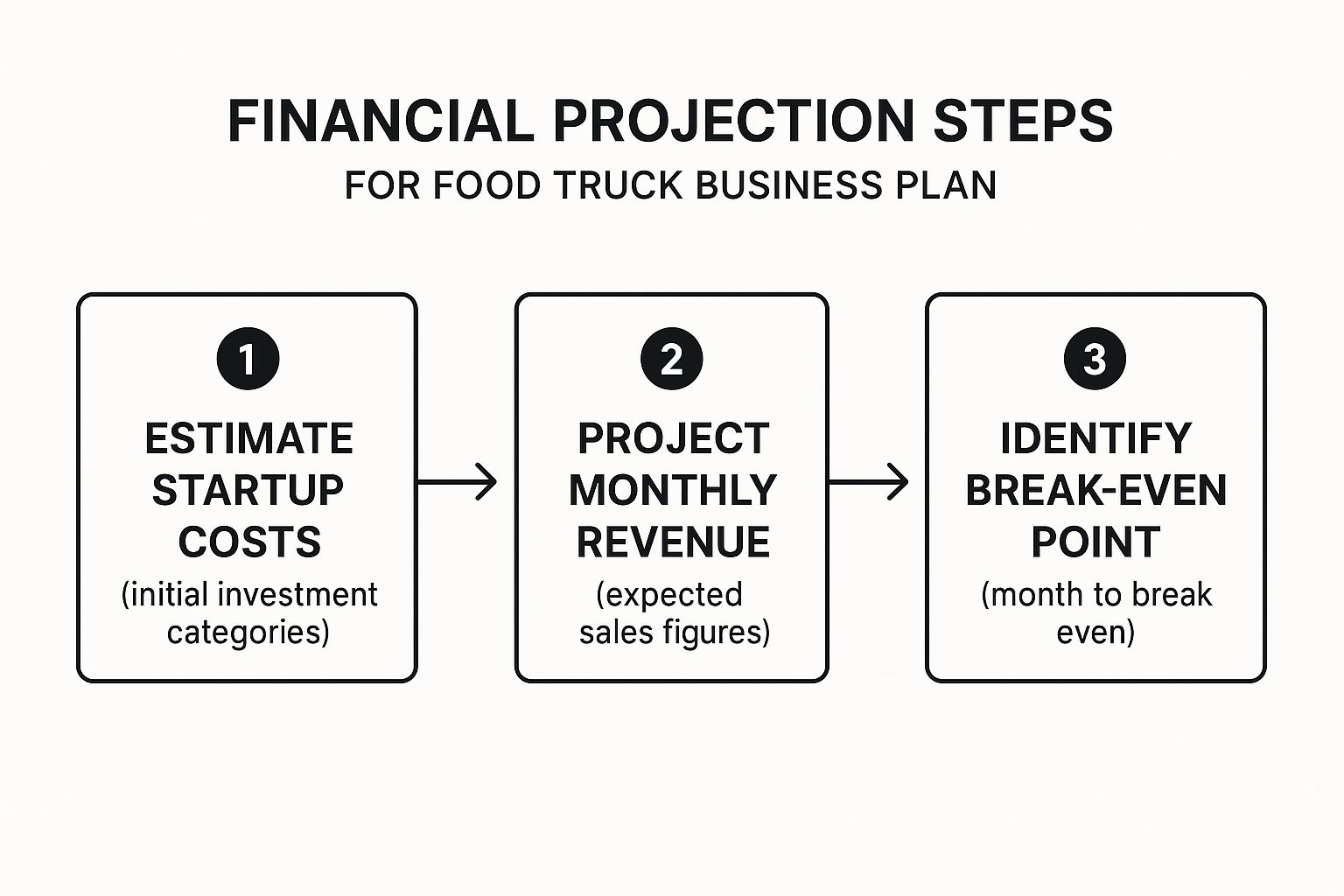
As you can see, it's a clear path from understanding your initial investment to calculating the exact point where your revenue covers all your costs. That's the goal.
Break-Even Analysis: This calculation is your North Star. It tells you exactly how much you need to sell each month just to cover all your fixed and variable costs. Knowing this number—for example, "I need to sell 200 burgers a day to break even"—is incredibly empowering and essential for setting sales goals that are actually achievable.
Answering Your Top Food Truck Business Plan Questions
Even with a solid template in front of you, a few questions always come up when you’re in the thick of planning. It’s completely normal. Let’s go over some of the most common hurdles I see new owners face so you can get your plan buttoned up and feel great about it.
How Detailed Do My Financials Really Need to Be?
This is probably the number one question, especially when a bank loan is on the line. The short answer? Very detailed.
Lenders need to see you’ve done your homework. At a minimum, you'll need a 12-month profit and loss projection, a cash flow statement, and a solid break-even analysis. Every single number has to be backed up by your local market research. You can't just guess; you need to show clear, logical assumptions for your average daily sales, customer traffic, and food cost percentages.
My best tip: Don't just show one set of numbers. Create 'best-case,' 'worst-case,' and 'most likely' financial scenarios. It shows lenders you’ve thought through all the possibilities and have a realistic grasp of the risks involved.
What Are the Biggest Mistakes People Make?
Knowing where others have stumbled is the best way to avoid falling into the same traps. Here are the most frequent mistakes I see pop up in first-draft plans:
- Dreamy Financials: Projecting $500 in daily sales with no local data to back it up. Lenders will see right through this.
- A Vague Target Market: Saying your customer is "everyone" is the same as saying you have no customer. Get specific.
- A Weak Location Strategy: Just planning to "park where people are" isn't a strategy. It's a wish. You need data on foot traffic, competitor locations, and event schedules.
- Forgetting Hidden Costs: It's easy to budget for food and fuel, but what about insurance, monthly permit fees, truck maintenance, and propane refills? These ongoing expenses can sink you if you don't plan for them.
A strong plan addresses all these points head-on from the very beginning.
Should I Write This Myself or Hire Someone?
Honestly, you can absolutely write this yourself—and you probably should.
The process of writing your own business plan forces you to think critically about every single piece of your future business. That deep-dive understanding is priceless. That said, it’s always a smart move to have an accountant or an experienced mentor review your financial section before you finalize it. A second set of expert eyes can catch things you might have missed.
What Goes in the Appendix?
Think of the appendix as your supporting evidence folder. It’s for all the important documents that add credibility but would just clutter up the main body of the plan.
Good things to include are photos of your truck design or branding mockups, detailed resumes for you and any partners, your full menu with pricing, and copies of any permits or licenses you’ve already secured.
Ready to get your dream truck rolling? The Restaurant Warehouse has all the commercial-grade cooking and refrigeration equipment you need. We offer competitive prices and fast shipping to get your business off the ground.
About The Author

Sean Kearney
Sean Kearney used to work at Amazon.com and started The Restaurant Warehouse. He has more than 10 years of experience in restaurant equipment and supplies. He graduated from the University of Washington in 1993. He earned a BA in business and marketing. He also played linebacker for the Huskies football team. He helps restaurants find equipment at a fair price and offers financing options. You can connect with Sean on LinkedIn or Facebook.
Leave a comment