

Fix Your Fridge: Essential Atosa Prep Table Parts & Where to Find Them
Why Atosa Prep Table Parts Are Critical for Your Kitchen
In the world of a commercial kitchen, the refrigerated prep table is the undisputed command center. It's where ingredients are organized, dishes are assembled, and the culinary magic happens. When your Atosa prep table is running smoothly, the entire service flows effortlessly. But when a critical component fails, the workflow doesn't just slow down—it can grind to a complete and costly halt. Understanding the role of genuine atosa prep table parts is the first step toward preventing this crisis.
Your Atosa prep table runs 24/7, making it one of the hardest-working pieces of equipment in your kitchen. Most operators wait for a complete breakdown before thinking about parts, but a smarter, more profitable strategy is to understand the common failure points and keep essential components on hand. Fortunately, genuine Atosa parts are widely available with fast shipping options. This guide will help you identify the parts you need, find authentic components, and avoid the costly mistakes that come from using inferior substitutes.
Most Common Failing Parts and Their Lifespans:
- Compressors (Embraco brand): The heart of the refrigeration system. These durable components typically have a 5-7 year lifespan but can fail sooner under heavy strain from poor maintenance.
- Door Gaskets: These vinyl seals are essential for efficiency. Expect to replace them every 2-3 years as they harden, crack, or tear from constant use.
- Fan Motors (Evaporator and Condenser): These motors are crucial for air circulation and heat exchange. They generally last 3-5 years before bearings wear out or windings fail.
- Digital Controllers (Dixell): The brain of the unit, managing temperature. Their lifespan is variable and can be cut short by power surges or moisture.
- Thermostats and Probes: These sensors feed temperature data to the controller. They are reliable but can fail after 5-8 years, leading to erratic cooling.
- Door Hinges and Closers: Subject to immense physical stress, these parts can wear out, causing doors to sag and leak cold air.
Where to Find Genuine Parts:
- Authorized Atosa dealers with access to the full manufacturer catalog and same-day shipping.
- Reputable online restaurant supply stores that specialize in OEM inventory.
- Direct-from-supplier channels offering genuine, warrantied components.
Key Model Numbers to Know:
- MSF8301, MSF8302, MSF8303, MSF8304: The workhorse Sandwich/Salad Prep Table series.
- MPF8201GR, MPF8202GR, MPF8203GR: The robust Pizza Prep Table series designed for larger pans.
- MSF8305GR through MSF8308GR: The high-capacity Mega Top models for kitchens with extensive ingredient needs.
This guide is your comprehensive resource for maintaining, diagnosing, and repairing your Atosa prep table, ensuring it remains a reliable asset for years to come.
Identifying the Problem: Common Atosa Prep Table Parts That Fail
Your Atosa prep table operates in one of the most demanding environments imaginable: a commercial kitchen. The constant temperature swings, ambient heat from cooking lines, and relentless exposure to grease and food acids mean certain atosa prep table parts will inevitably wear out. The refrigeration system, in particular, works overtime to combat the kitchen's heat, while physical components like door gaskets and hinges are subjected to hundreds of cycles of use every single day.

Understanding which parts fail most often is not about predicting doom; it's about smart management. It allows you to shift from a reactive, emergency-driven repair model to a proactive maintenance strategy. Most of these parts have predictable lifespans, enabling you to budget for and schedule replacements before they cause a catastrophic failure. For more in-depth strategies to extend the life of every component, see our comprehensive guide on Sandwich Prep Table Maintenance.
Refrigeration System Components: The Heart of Your Prep Table
The sealed refrigeration system is a closed loop where the most critical and complex failures occur. These parts work in concert, and if one fails, the entire system is compromised, leading to food loss and downtime.
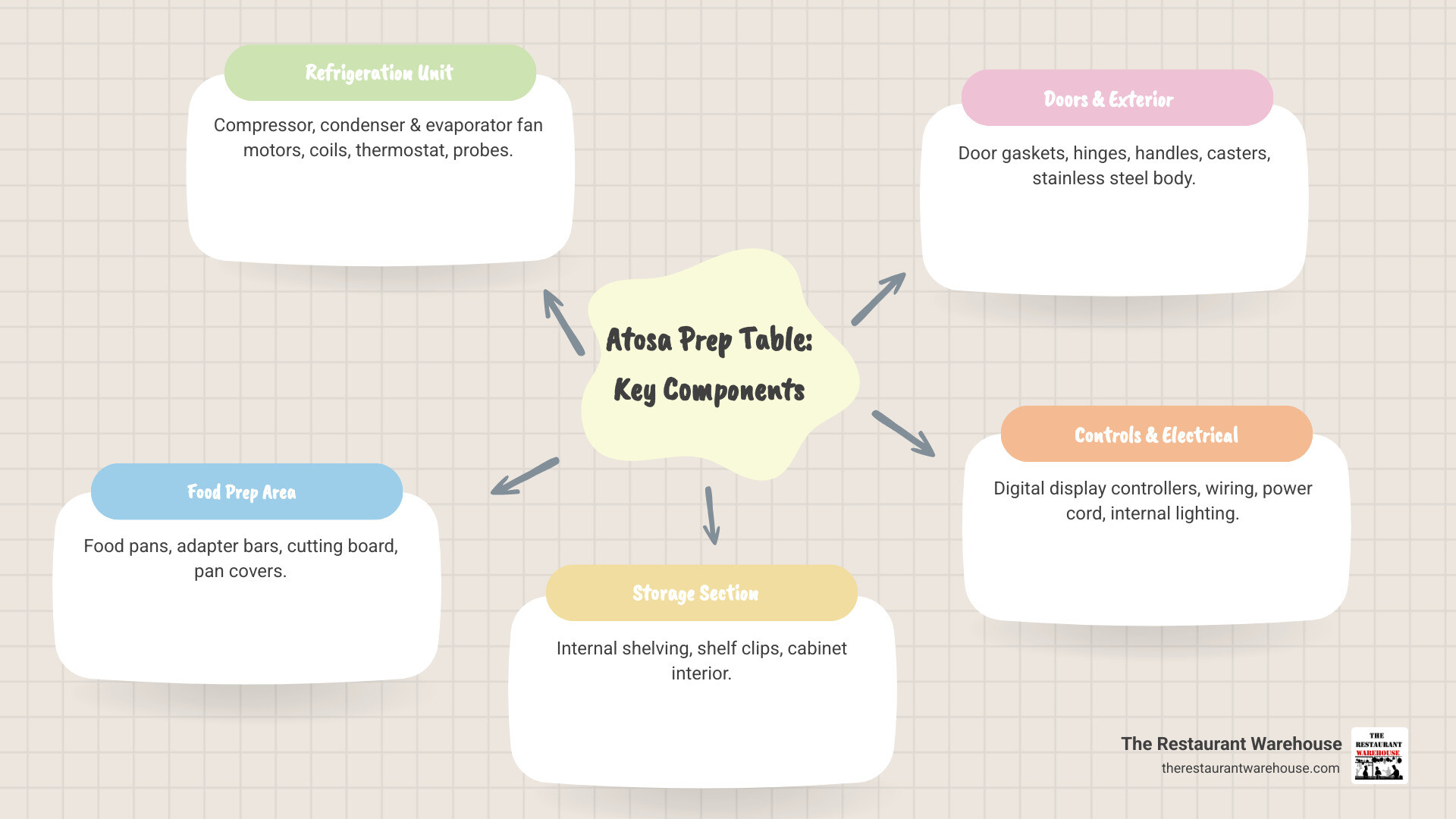
- Compressors: As the powerhouse of the unit, the compressor is responsible for pressurizing the refrigerant and pumping it through the system. Atosa uses high-quality, durable Embraco compressors with an expected 5-7 year lifespan. Telltale signs of failure include loud grinding or clanking noises, the unit tripping the circuit breaker, or the prep table running constantly without reaching the set temperature. A failing compressor is a major repair that requires a certified professional.
- Condenser & Evaporator Fan Motors: These motors are the lungs of the system. The condenser fan blows ambient air over the condenser coils to release heat from the refrigerant. The evaporator fan circulates cold air inside the cabinet to cool your ingredients. They typically last 3-5 years. Signs of failure include a noticeable decrease in airflow, unusual rattling or squealing noises, hot spots within the cabinet, or excessive frost buildup on the evaporator coils because air isn't circulating properly.
- Evaporator Coils: While robust, these coils are where the cooling magic happens as liquid refrigerant evaporates into a gas, absorbing heat. They can develop microscopic refrigerant leaks over time, often at solder joints, resulting in a total loss of cooling. More commonly, they become encased in a solid block of ice if a door gasket is leaking or the defrost system fails, which blocks all airflow.
- Digital Display Controllers: Modern prep tables use sophisticated Dixell controllers to manage temperature settings, defrost cycles, and fan operation. If the controller malfunctions, you may see erratic temperature swings, a blank display, or a completely unresponsive unit. Their lifespan is highly variable and can be shortened by electrical surges, so using a surge protector is a wise investment.
- Temperature Probes (Thermistors): These small but vital sensors provide the real-time temperature data that the Dixell controller needs to make decisions. A faulty probe can send incorrect readings, causing the compressor to run too often (short-cycling) or not often enough, leading to dangerous temperature instability and spoiled food.
Physical and Accessory Components: The Wear-and-Tear Parts
These are the parts that endure the daily physical demands of a busy kitchen. While less complex than the refrigeration system, their failure can be just as disruptive.
- Door Gaskets: These magnetic seals are your first line of defense against temperature loss. They are designed to wear out and should be replaced every 2-3 years. Cracked, torn, or hardened gaskets create air leaks, allowing warm, moist kitchen air to enter the cabinet. This forces the compressor to work harder and can lead to ice buildup on the evaporator coil. Replacing them is one of the most cost-effective maintenance tasks you can perform.
- Cutting Boards: Heavy daily use with knives can create deep grooves and scratches in your cutting board. These grooves are impossible to properly sanitize and can harbor dangerous bacteria. Regular replacement is essential for food safety and maintaining a professional, clean prep area.
- Door Hinges & Handles: Constant opening and closing, especially in a high-volume environment, wears down hinges, pins, and handles. Broken or sagging hardware can prevent doors from sealing properly, leading to the same problems as a bad gasket and compromising temperature control.
- Shelves & Shelf Clips: The epoxy-coated or stainless steel shelves inside your prep table can bend under heavy loads or corrode over time, especially from acidic spills. Damaged shelving can obstruct proper airflow, creating warm spots inside the cabinet and potentially leading to unsafe food temperatures.
- Casters (Wheels): The ability to move your prep table for cleaning is crucial. Casters can break, seize up from accumulated grease and debris, or lose their locking ability, making the unit unstable or immobile.
- Food Pans & Adapter Bars: These essential organizational components can easily get lost, dented, or damaged during a busy service. Using the correct size and type of pans, along with the proper adapter bars, is critical for ensuring proper cold air circulation around the food and maintaining safe temperatures in the rail area. Learn more about the importance of quality materials in our Stainless Steel Prep Table Guide.
The Ultimate Guide to Finding Your Exact Atosa Prep Table Parts
When your prep table fails, the pressure is on to get it fixed fast. Ordering the wrong atosa prep table parts can turn a simple, quick fix into a prolonged and frustrating shutdown. The absolute key to a fast, efficient, and successful repair is accurate part identification. Taking a few extra minutes to gather the right information upfront will save you time, money, and the headache of return shipping.

Step 1: Locate Your Prep Table's Data Plate
Every piece of commercial kitchen equipment has a data plate, and it's the Rosetta Stone for repairs. This small metal plate or sticker contains the two most important identifiers for your unit: the model number and the serial number. This information is non-negotiable for finding the correct parts.
Look for the data plate in these common locations:
- Inside the refrigerated cabinet: Usually on the upper portion of the left or right interior wall.
- On the exterior of the unit: Check the back or side of the unit, often near where the power cord exits.
- Inside the compressor compartment: This may require removing a front or side grille with a screwdriver. The plate is often placed here to protect it from damage.
Once you find it, take a clear photo with your phone or write down both numbers completely and accurately. The model number identifies the specific type and size of your unit. For example:
- Sandwich Prep Tables: MSF8301GR (a 27-inch, one-door model), MSF8302GR (a 48-inch, two-door model), MSF8303GR (a 60-inch, two-door model), MSF8304GR (a 72-inch, three-door model).
- Mega Top Prep Tables: MSF8305GR through MSF8308GR, which offer extra rows for food pans.
- Pizza Prep Tables: MPF8201GR (a 44-inch model), MPF8202GR (a 67-inch model), MPF8203GR (a 93-inch model).
The serial number is a unique identifier for your specific machine. It's like a VIN for a car. This number is crucial because manufacturers sometimes make small design changes or use different component suppliers during a single model's production run. The serial number allows a parts specialist to pinpoint the exact parts that were installed in your unit at the factory.
Step 2: Use Your Model Number to Find the Right atosa prep table parts
With your complete model number in hand, you can begin your search with confidence. On a quality parts website, you should find a search bar where you can enter the model number. This will take you to a dedicated page listing all compatible atosa prep table parts for your specific unit, from complex compressors and controllers to simple shelf clips and gaskets.
Your original user manual is another excellent resource. It often contains exploded parts diagrams and corresponding part numbers. If you've lost the physical copy, a quick search for your model number online will usually lead you to a digital PDF version from the manufacturer or an authorized dealer's website.
Understanding Atosa's naming convention also helps streamline your search. As a rule:
- "MSF" denotes a Sandwich/Salad Food Prep table. These are designed for smaller 1/6-size pans and a standard-depth cutting board.
- "MPF" indicates a Pizza Food Prep table. These are built with a wider, raised rail to accommodate larger 1/3-size pans and feature a deeper cutting board for pizza assembly.
This knowledge helps you quickly confirm you're looking at the right category of parts, especially for physical components like gaskets or adapter bars that differ between the two styles.
Step 3: Accessing Official Resources and Schematics
For more complex repairs, or if you simply want to understand your equipment better, official documentation is invaluable. These resources can explain the replacement process and ensure you're prepared.
- Parts Diagrams (Exploded Views): Found in user manuals or on supplier websites, these diagrams provide a visual roadmap of your unit. They show how all the components fit together and often include numbered labels that correspond to a parts list. This is incredibly helpful for identifying small, hard-to-name pieces like brackets, screws, or spacers.
- Official CAD Files and Brochures: For an even more in-depth look, Atosa provides detailed technical documentation, including CAD files, through its official portal at Atosa's official CAD portal. These resources are particularly useful for verifying dimensions or identifying the correct mounting hardware for a replacement part.
- Electrical Schematics: These diagrams map the intricate wiring between the compressor, fans, controller, and sensors. While any complex electrical work should be left to a qualified professional, a schematic can help you communicate more effectively with a technician or spot simple, visible issues like a loose or disconnected wire. (Always unplug the unit before inspecting any wiring).
Taking the time to gather your unit's information and consult these resources will save you immense frustration and ensure you order the correct atosa prep table parts on the very first try.
OEM vs. Aftermarket: Why Genuine Atosa Parts Matter
When a critical part on your prep table fails, you're faced with a crucial decision: do you purchase a genuine OEM (Original Equipment Manufacturer) part, or do you opt for a cheaper aftermarket alternative? The lower initial price tag of a generic part can be tempting, especially when facing an unexpected repair bill. However, choosing genuine atosa prep table parts is a strategic decision that protects your equipment, your warranty, and your bottom line in the long run.
| Feature | OEM Atosa Parts | Generic Aftermarket Parts |
|---|---|---|
| Fit & Finish | Precision-engineered for a perfect, drop-in fit. | Variable. May require modifications, drilling, or forcing, leading to poor alignment. |
| Performance | Optimized to meet original factory specifications for efficiency and cooling power. | Unpredictable. May cause the system to run inefficiently, increasing energy costs. |
| Material Quality | Made from high-quality, durable materials that are rigorously tested. | Varies widely. Often made with cheaper, less durable materials to cut costs. |
| Durability | Designed to withstand the harsh commercial kitchen environment for a predictable lifespan. | Prone to premature failure, leading to more frequent replacements and downtime. |
| Warranty | Preserves your Atosa equipment warranty. The part itself is also warrantied. | Can immediately void your equipment warranty. Part warranty is often limited or non-existent. |
| Safety Certifications | Carries safety certifications like ETL and cETLus, ensuring it meets strict standards. | Often lacks proper safety certifications, posing a potential fire or electrical hazard. |
| Long-Term Cost | Higher initial cost but lower total cost of ownership due to reliability and efficiency. | Lower initial cost but higher long-term costs from repeat repairs, food loss, and energy waste. |
Think of your Atosa prep table as a finely tuned ecosystem. Each component is designed to work in perfect harmony with the others. Introducing a generic, reverse-engineered part is like introducing an invasive species—it disrupts the balance and can cause a cascade of problems throughout the entire system.
The Unbeatable Benefits of Genuine OEM Parts
Choosing genuine atosa prep table parts isn't just about buying a brand name; it's about investing in peace of mind, reliability, and long-term performance.
- Perfect Fit & Guaranteed Compatibility: OEM parts are manufactured to the exact specifications of your Atosa model. This guarantees a perfect, hassle-free fit without any need for on-the-fly modifications. This ensures a faster, smoother installation and means components like door gaskets will seal perfectly, and motors will mount correctly.
- Warranty Preservation: Atosa offers a substantial warranty on its equipment (typically 2 years parts and labor, with an additional 5 years on the compressor part). Using non-OEM parts can instantly void this valuable protection. A small saving on a generic fan motor could turn into a massive expense if your compressor fails and the warranty claim is denied.
- Superior Quality & Durability: Genuine parts are constructed from high-quality materials and undergo rigorous quality control testing to ensure they can withstand the heat, grease, and constant use of a commercial kitchen. This translates to a longer lifespan and more reliable performance compared to their generic counterparts.
- Certified Safety: OEM parts carry essential safety certifications like ETL and cETLus. This means they have been independently tested and verified to meet strict safety and performance standards. Aftermarket parts often lack these certifications, posing a potential risk to your equipment and your staff.
The Hidden Dangers and Costs of Aftermarket Alternatives
The initial savings from aftermarket parts are often a mirage, hiding significant long-term costs and risks.
- Voiding Your Entire Warranty: This is the biggest financial risk. Installing a single non-OEM part can give the manufacturer grounds to deny a warranty claim on any other part of the unit, even if the aftermarket part didn't directly cause the subsequent failure.
- Risk of Catastrophic Equipment Damage: Aftermarket parts are often reverse-engineered without access to the original design specifications. An improperly calibrated thermostat can cause the compressor to short-cycle, leading to premature failure. An incompatible fan motor with the wrong amperage draw can overload and destroy the expensive digital controller.
- Inconsistent Quality & Premature Failure: The quality of aftermarket parts is a gamble. You might get a decent part one time and a component that fails within weeks the next. This unreliability makes them a poor choice for critical equipment that your business depends on.
- The Snowball Effect of Hidden Costs: When a cheap part fails prematurely, you're paying for more than just another replacement. You also face the costs of additional service calls, lost food inventory due to temperature fluctuations, higher energy bills from an inefficient system, and, most importantly, lost revenue during unexpected downtime. These hidden costs quickly dwarf any initial savings.
Genuine atosa prep table parts offer superior value, best reliability, and essential protection for your investment. They are a cornerstone of a smart maintenance strategy that prioritizes the long-term health and efficiency of your kitchen.
Sourcing & Repair: Getting Your Kitchen Back Up and Running
When an Atosa prep table goes down, every minute of downtime translates directly to lost revenue and operational chaos. A swift and effective repair hinges on two key factors: having immediate access to reliable parts suppliers and clearly understanding your service and warranty options.
Where to Buy Genuine atosa prep table parts
Finding a trustworthy source for genuine OEM atosa prep table parts is the first and most critical step in any repair. You need a supplier who can provide the right part quickly to minimize your kitchen's downtime.
- Authorized Atosa Dealers: These suppliers have a direct relationship with the manufacturer. This ensures they have access to the complete and most current inventory of parts, as well as the technical knowledge to help you identify the correct component for your specific model and serial number.
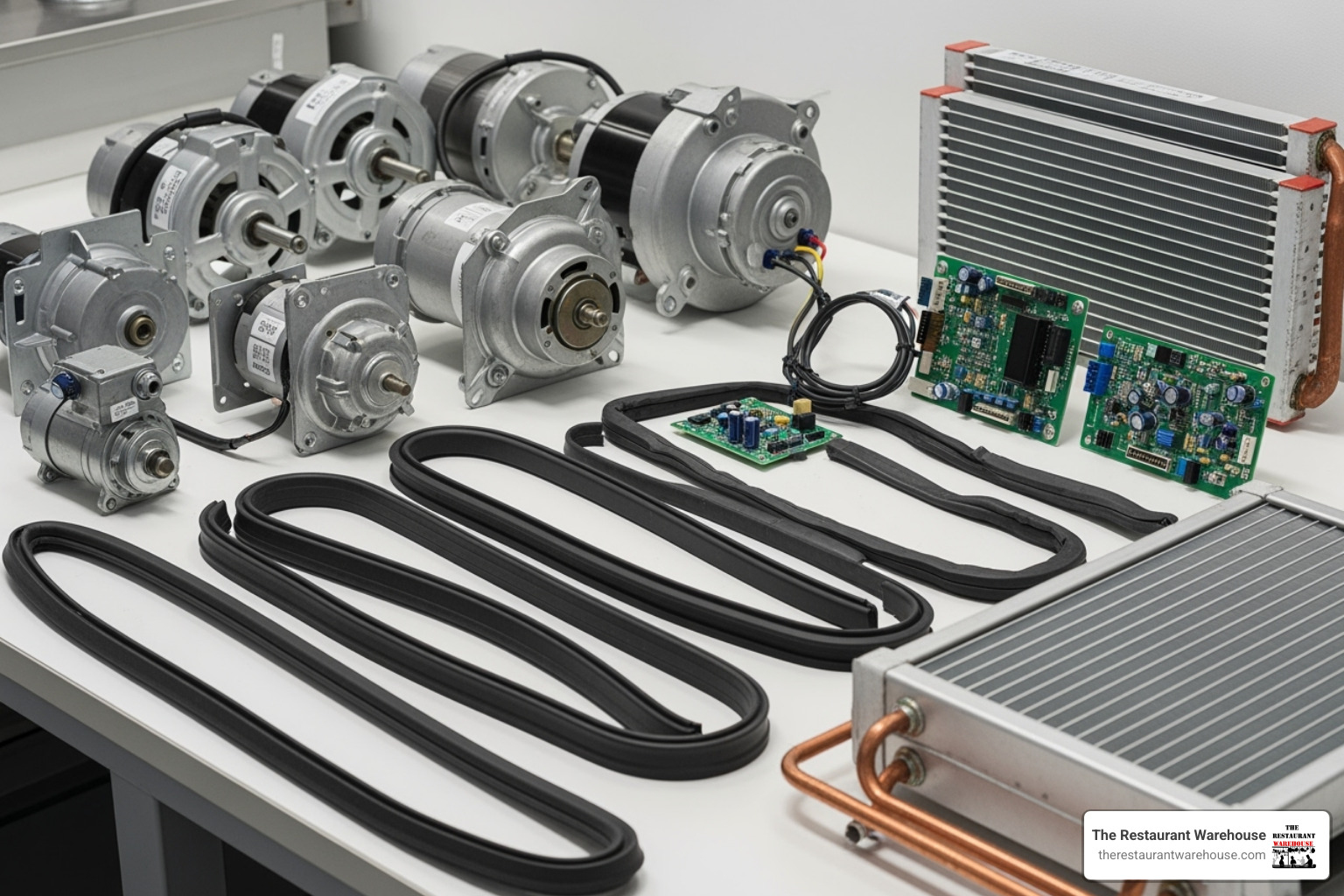
- Reputable Online Restaurant Supply Stores: In today's market, online suppliers offer a powerful combination of convenience and value. At The Restaurant Warehouse, we specialize in providing a vast inventory of genuine OEM Atosa parts at affordable, wholesale prices. By operating with a streamlined business model that avoids high retail overhead, we pass those savings directly to you. We understand the urgency of repairs, which is why we offer fast, same-day shipping for thousands of common atosa prep table parts, including Dixell controllers, Embraco compressors, fan motors, and gaskets for popular models like the MSF8301GR, MSF8302GR, MSF8303GR, MSF8304GR, and the entire Mega Top series (MSF8305GR-MSF8308GR). Our goal is to be your partner in maintenance, helping you get your kitchen back to full operation as swiftly and affordably as possible.
Understanding Atosa's Warranty Coverage
Knowing the details of your warranty provides a crucial financial safety net and dictates your repair path. Atosa offers one of the most comprehensive warranties in the industry.
- Standard Warranty: Atosa equipment typically comes with a 2-year warranty on all parts and labor. This covers any defects in materials and workmanship under normal use and service. If a part fails within this period due to a manufacturing issue, the part and the technician's labor to install it are covered.
- Extended Compressor Warranty: Recognizing the compressor as the most vital component, Atosa provides an additional 5-year warranty on the compressor part itself. After the initial 2-year period, if the compressor fails, Atosa will provide a new compressor free of charge, though you will be responsible for the labor costs of installation.
- Filing a Claim: To initiate a warranty claim, you should contact the authorized dealer from whom you purchased the unit or Atosa's service department directly. Have your model number, serial number, and proof of purchase ready. They will guide you through the process and dispatch a certified technician if necessary.
- The Importance of Professional Installation: To keep your warranty valid, all repairs, especially those involving the sealed refrigeration system or electrical components, must be performed by qualified, certified technicians. Attempting complex DIY repairs can immediately void your coverage, even if the unit is still within the warranty period.
DIY vs. Professional Repair: A Practical Guide
Deciding whether to tackle a repair yourself or call a professional depends on the task's complexity and your own mechanical aptitude. Making the wrong choice can be costly and dangerous.
DIY-Friendly Tasks (with caution):
- Replacing a door gasket
- Swapping out a broken or corroded shelf or shelf clips
- Replacing a cracked cutting board
- Changing a light bulb inside the cabinet
- Replacing a damaged door handle
Always Call a Certified Technician For:
- Any work on the sealed refrigeration system: This includes replacing the compressor, evaporator coil, or filter drier, and recharging refrigerant. This work requires specialized tools, EPA certification, and is illegal to perform without a license.
- Electrical component replacement: Replacing fan motors, digital controllers, thermostats, or relays should be left to a professional to avoid the risk of electrical shock and further damage to the unit.
- Diagnosing complex problems: If you're unsure what is causing the issue (e.g., the unit isn't cooling, but you don't know why), a technician has the diagnostic tools and experience to pinpoint the root cause accurately.
- Any repair while the unit is under warranty: Let the professionals handle it to ensure your warranty remains intact.
For manageable DIY tasks, Atosa's Official YouTube Channel offers some helpful training videos, and your user manual provides basic troubleshooting steps. Always remember the number one rule of any repair: unplug the unit from the power source before you begin and prioritize your safety above all else.
Proactive Care: Extending the Life of Your Atosa Prep Table
Most kitchen managers and owners only think about their prep table when it breaks down. This reactive approach inevitably leads to emergency service calls, spoiled food, and lost revenue during the busiest times. A much smarter and more profitable approach is a consistent preventative maintenance schedule. Simple, routine checks can dramatically extend the life of your equipment, improve its energy efficiency, and help you identify small, inexpensive issues before they escalate into major, costly problems.
Regular maintenance is an investment, not an expense. It ensures your Atosa prep table runs efficiently, safely, and reliably day after day. For more detailed strategies and advanced tips, our comprehensive Sandwich Prep Table Maintenance guide offers additional valuable insights.
Daily and Weekly Maintenance Checklist
Incorporate these simple, quick tasks into your kitchen's opening or closing routines to prevent the slow, corrosive buildup of damage.
- Wipe All Surfaces Daily: At the end of each day, clean all interior and exterior stainless steel surfaces with a mild, food-safe cleaner and a soft cloth. This removes corrosive food acids and grease, preventing pitting and rust.
- Clean Gaskets Weekly: Use warm, soapy water (avoid harsh chemicals like degreasers, which can dry out the vinyl) to wipe down the door gaskets. This removes food debris and keeps the seals supple and effective, preventing them from becoming brittle and cracked.
- Monitor Temperatures Daily: Make it a habit to glance at the digital display multiple times a day. Verify that the unit is holding the correct temperature (typically between 34°F and 40°F). Any significant fluctuations or a gradual upward creep in temperature can be an early warning sign of a developing problem.
- Check for Unusual Noises Daily: A smoothly running prep table should have a consistent, low hum. Listen for any new or unusual noises like grinding, rattling, squealing, or clicking. These sounds are often the first indication of a failing fan motor or compressor.
- Ensure Proper Clearances Weekly: Check that there is adequate space (usually 3-4 inches) around the back and sides of the unit for proper air circulation. Pushing the unit flush against a wall or storing boxes next to it can block airflow to the condenser, forcing the system to work much harder.
Monthly and Quarterly Deep Cleaning & Inspection
These more involved maintenance tasks are crucial for protecting your investment in atosa prep table parts and maximizing your unit's operational lifespan.
-
Clean Condenser Coils Quarterly (or Monthly in high-grease environments): This is the single most important preventative maintenance task you can perform. A dirty condenser coil is a leading cause of compressor failure.
- Safety First: Unplug the unit from the wall.
- Access the Coil: Remove the front or side grille that covers the compressor compartment.
- Clean: Use a stiff-bristled coil brush and a vacuum cleaner to gently remove all accumulated dust, dirt, and grease from the metal fins of the coil. Brush in the same direction as the fins to avoid bending them.
- Inspect Fan Blades Quarterly: While the grille is off, visually inspect both the condenser and evaporator fan blades. Make sure they are free of debris and spin freely. Clean, unobstructed blades operate more efficiently and quietly.
- Check and Clean Drain Lines Monthly: The evaporator coil produces condensation that flows out through a drain line. This line can become clogged with slime and debris, causing water to back up and leak onto the floor or freeze up the evaporator coil. Flush the line with a mixture of warm water and vinegar to keep it clear.
- Inspect Door Seals and Hinges Monthly: Perform the "dollar bill test." Close a dollar bill in the door. If you can pull it out with little to no resistance, the seal is weak. This may require adjusting the door hinges or replacing the gasket. Check that hinges are tight and that doors close securely on their own.
- Calibrate the Thermometer Quarterly: If you suspect the temperature display is inaccurate, you can check its calibration. Place a calibrated food thermometer in a glass of ice water (it should read 32°F) and then place it inside the prep table. If the unit's display is off by more than a few degrees, it may need to be recalibrated per the user manual's instructions, or the probe may need replacement.
Frequently Asked Questions about Atosa Prep Table Parts
We've compiled and answered some of the most common questions we receive from kitchen owners and managers about sourcing atosa prep table parts and performing essential maintenance. Getting clear answers helps you make informed decisions quickly.
How often should I really replace the door gaskets on my Atosa prep table?
As a general rule, we strongly recommend replacing door gaskets every 2-3 years. However, in a very high-volume kitchen where doors are opened and closed hundreds of times a day, you might need to replace them annually. The constant use, combined with exposure to cleaning chemicals and temperature changes, causes the flexible vinyl material to inevitably wear out.
It's time for an immediate replacement if you can physically see cracking, tearing, or areas where the gasket has become hard and brittle. A less obvious sign is a loss of magnetic pull. The most reliable method is the "dollar bill test": close a dollar bill in the door. If it slides out easily with no resistance, your seal is compromised. A leaky gasket is a silent energy thief, forcing your compressor to run constantly, which increases your electricity bill and puts immense stress on other expensive atosa prep table parts like the compressor and fan motors. Replacing a gasket is a small, proactive investment that prevents much larger, reactive repair costs.
Can I use a part from a different Atosa model on my prep table?
The short and definitive answer is no, you should not risk it. While two parts from different models might look identical to the naked eye, there can be critical, unseen differences in voltage, amperage draw, size, mounting points, or internal calibration that are specific to each model's design.
Using the wrong part can trigger a domino effect of failures. An incompatible fan motor could have the wrong impedance, sending feedback that damages the sensitive electronic controller. A poorly fitting gasket designed for another model will cause air leaks and overwork the compressor. This kind of damage is not only expensive to fix but will also immediately void your equipment's warranty. Your model number is the golden key to ensuring you get the correct component. Always use it to find parts that are specifically engineered and certified for your unit. It is always better to wait an extra day for the correct part than to deal with a cascade of failures from using one that is just "close enough."
What does the "MSF" or "MPF" in my Atosa model number mean?
These prefixes are a simple but important code that identifies your prep table's primary function and design. Understanding them helps you quickly find the right atosa prep table parts, especially physical components.
MSF stands for Sandwich/Salad Food Prep. Models like the MSF8301GR or MSF8302GR are designed with a top rail that holds smaller food pans (typically 1/6 size) for common sandwich and salad ingredients. Their cutting boards are usually a standard depth. This series also includes the popular "Mega Top" models (MSF8305GR-MSF8308GR), which feature an extra row of pans for greater ingredient capacity.
MPF means Pizza Food Prep. Models like the MPF8201GR or MPF8202GR are purpose-built for the demands of a pizzeria. They feature a wider, often raised top rail designed to accommodate larger 1/3 size pans for holding bulkier items like cheese, pepperoni, and vegetables. They also typically feature a much deeper cutting board to provide ample workspace for assembling pizzas.
Knowing your unit's type is crucial when ordering parts like cutting boards, pan adapter bars, and even door gaskets, as their dimensions often differ between MSF and MPF configurations.
Why is my prep table not getting cold enough?
This is the most common complaint, and it can have several causes, ranging from simple fixes to major problems. Here's a troubleshooting checklist:
- Check the Condenser Coil: A dirty, clogged condenser coil is the #1 cause of poor cooling. Clean it thoroughly.
- Inspect the Door Gasket: A leaky gasket allows warm air in. Perform the dollar bill test.
- Ensure Proper Airflow: Make sure the unit isn't pushed against a wall and that the interior fans aren't blocked by overstocked product.
- Check the Temperature Setting: Ensure the digital controller is set to the desired temperature (e.g., 38°F).
- Listen to the Compressor: Is it running constantly? Is it making strange noises? This could indicate a more serious issue like a refrigerant leak or a failing compressor, which requires a professional technician.
Conclusion: Your Partner in Kitchen Uptime
Caring for your Atosa prep table and its essential atosa prep table parts is a straightforward and manageable process when you are armed with the right knowledge. This guide has equipped you to confidently identify the most common points of failure, accurately find the correct replacement parts using your model and serial number, and understand the profound, long-term value of a proactive maintenance routine.
Making the deliberate choice to use genuine OEM Atosa parts is one of the smartest business decisions you can make for your kitchen. It is your single best tool for protecting your valuable warranty, ensuring your equipment operates at peak efficiency, and preventing the cascading, costly damage that can easily result from using ill-fitting and unreliable aftermarket alternatives. More importantly, embracing a culture of proactive care—built on simple habits like daily cleaning, weekly inspections, and quarterly condenser coil maintenance—is your strongest defense against unexpected breakdowns, spoiled inventory, and expensive emergency repairs.
When you understand your equipment and prioritize its maintenance, you transform it from a potential liability into a reliable, long-lasting asset. This proactive stance means less downtime, lower energy bills, and more time and energy to focus on what truly matters: creating exceptional food and serving your customers.
At The Restaurant Warehouse, we are committed to supporting your kitchen's ongoing success. We do this by providing a comprehensive inventory of genuine parts and high-quality equipment at affordable, wholesale prices. By eliminating the high overhead of traditional retail, we pass those significant savings directly on to you, the business owner.
Ready to keep your kitchen running at peak performance? Find all your Atosa refrigerator parts here and give your hard-working prep table the quality care and components it deserves.
About The Author

Sean Kearney
Sean Kearney is the Founder of The Restaurant Warehouse, with 15 years of experience in the restaurant equipment industry and more than 30 years in ecommerce, beginning with Amazon.com. As an equipment distributor and supplier, Sean helps restaurant owners make confident purchasing decisions through clear pricing, practical guidance, and a more transparent online buying experience.
Connect with Sean on LinkedIn, Instagram, YouTube, or Facebook.