

A Practical Guide to Commercial Tea Brewing
Commercial tea brewing isn't just about making tea in big batches. It’s about creating a consistent, efficient, and profitable system for preparing large volumes of tea for sale. This involves the right equipment, standardized recipes, and smart workflows to serve top-quality tea in places like cafes, restaurants, and at catered events. Done right, it transforms a simple drink into a real business asset.
Building Your Profitable Tea Program
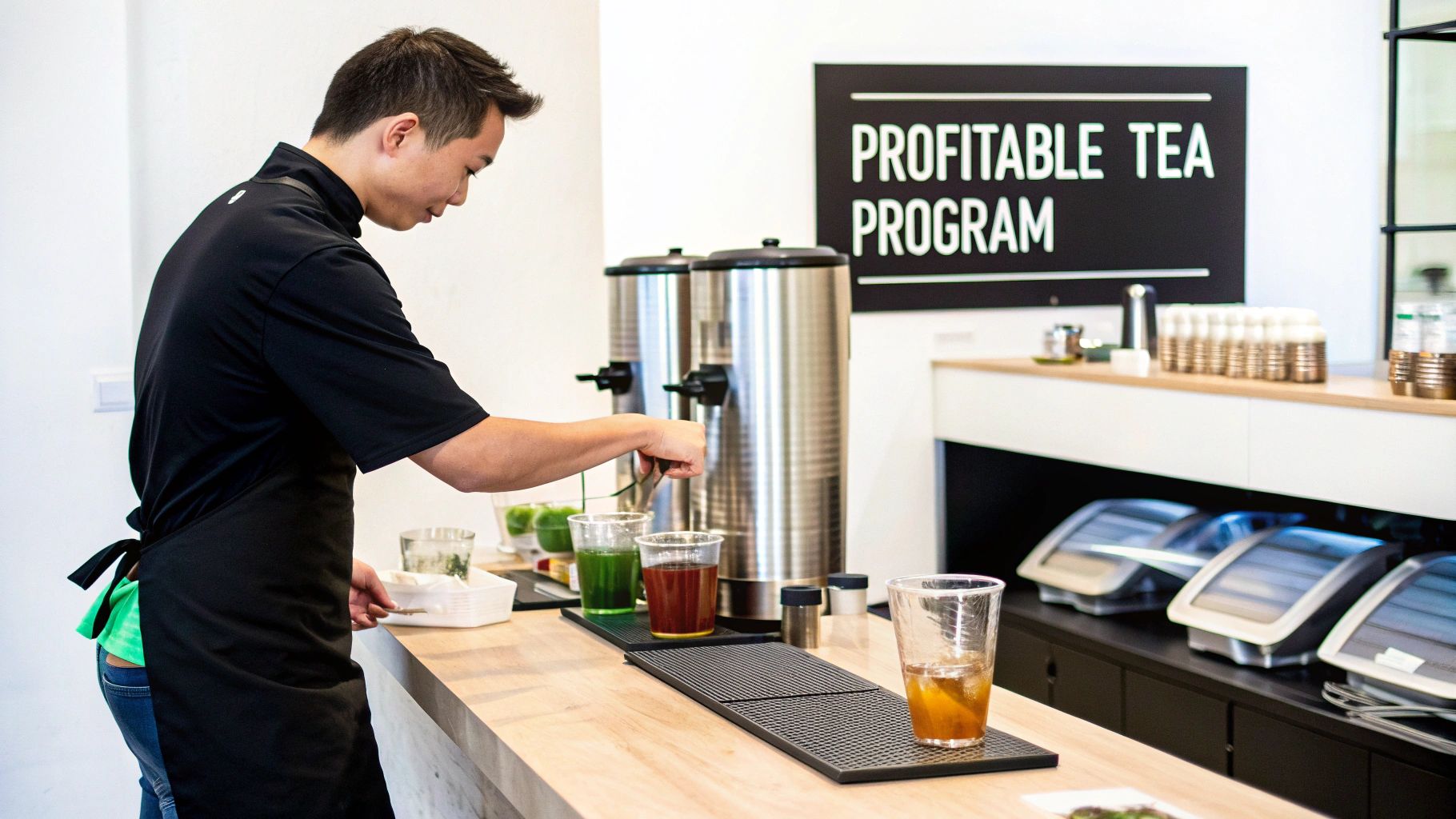
A well-designed tea program is far more than another item on your menu—it's a serious profit center. The real value isn't just in making tea, but in creating a scalable and consistent operation. This guide is your roadmap to turning your tea service from an afterthought into a strategic part of your business.
We'll walk through the essential pillars of a successful setup. This isn't about guesswork; it's about building a system.
The Foundation of a Successful Tea Service
At its heart, any great program rests on a few key elements that have to work together. When you master these fundamentals, your service will run seamlessly, whether you're slammed with a morning rush or prepping for a huge catering event.
Here are the key components:
- The Right Equipment: Your first critical step is selecting brewing equipment that’s actually designed for your specific volume and space.
- Standardized Recipes: You need to ensure every glass tastes exactly the same, no matter who makes it. That’s how you build customer trust and loyalty.
- Efficient Workflow: A logical process from brewing to serving is what cuts down on waste and speeds up service times.
- Quality Ingredients: Great tea starts with high-quality leaves and—just as important—properly filtered water.
This framework lets you manage the numbers that really matter, like your cost-per-serving and overall profit margin. Understanding the broader context of the food and beverages industry can help you refine your strategy even further, aligning your tea program with bigger market trends and what customers are looking for.
A smart system handles a morning rush or a large catering event without breaking a sweat or sacrificing quality. The goal is to make excellence repeatable, scalable, and profitable.
Why Commercial Tea Brewing Matters Now
The demand for high-quality brewed tea is exploding. The global Commercial Tea Brewer Market, valued at USD 1.2 billion, is projected to more than double, hitting USD 2.5 billion by 2034. This surge reflects a booming demand for efficient, high-volume tea preparation in every corner of the food service world, from cafes to food trucks.
This growth represents a massive opportunity. By investing in a proper commercial tea brewing setup, you position your business to capture a piece of this expanding market. It's not just about selling tea; it’s about meeting a clear and increasing consumer demand with a professional, high-margin product. For a comprehensive overview of what you'll need, check out this guide on the essential coffee shop equipment checklist, as many principles apply directly to tea service. From brewing hardware to water filtration, having the right tools is non-negotiable for success.
Choosing the Right Brewing Equipment
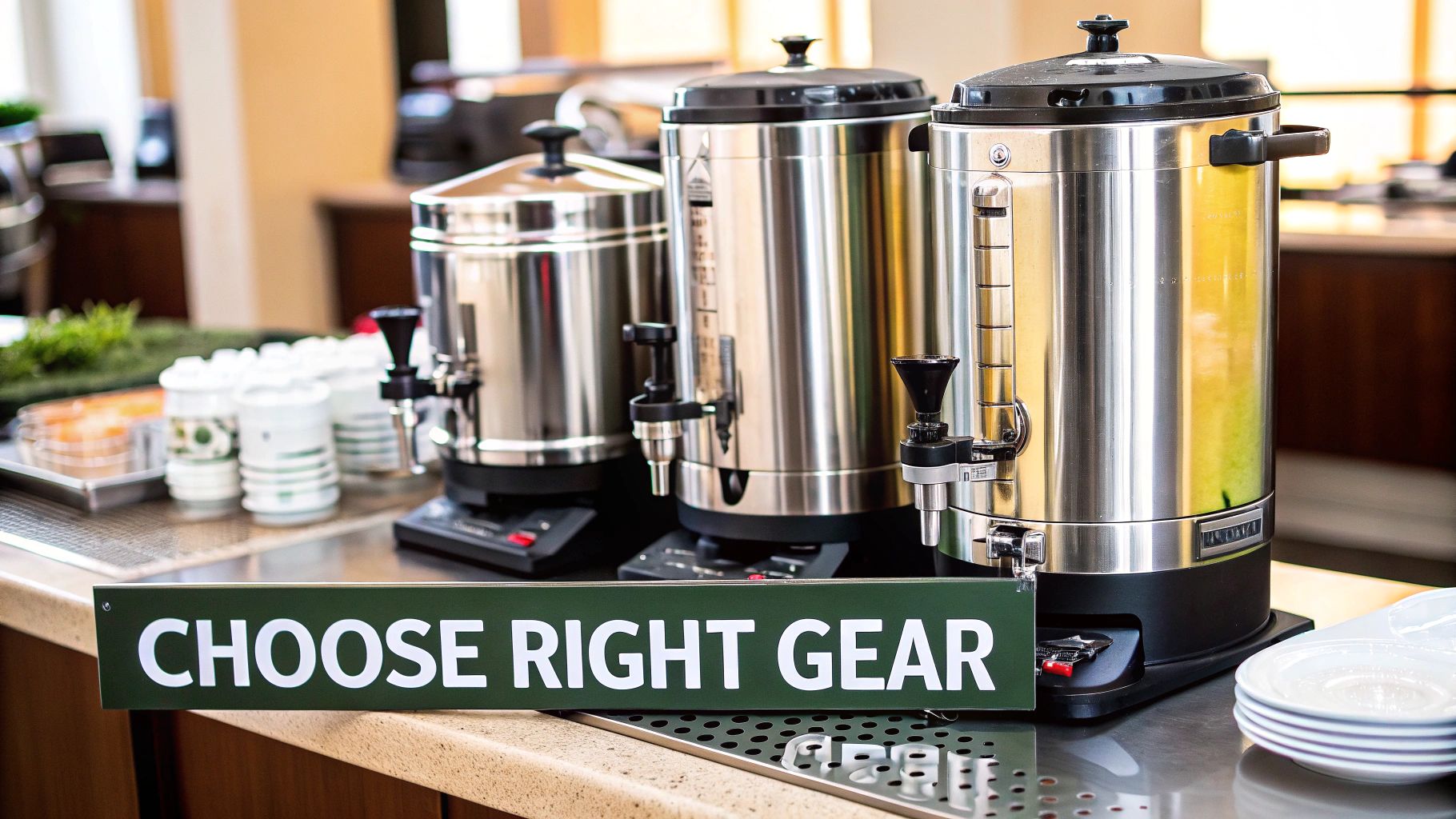
Let's be honest—your brewing hardware can make or break your entire beverage program. The equipment you choose is the foundation of your service, directly shaping your speed, consistency, and ultimately, your profits. It's a decision that sets the stage for every cup of tea you serve.
The market is flooded with options, but this isn't about finding the fanciest or most expensive machine. It's about a smart match between the equipment and your real-world operational needs. A food truck's setup will look completely different from a high-volume hotel's, and your brewer needs to reflect that reality.
Matching Brewers To Your Business Model
Think of your commercial tea brewer as a key employee; you need to hire the right one for the job. For a food truck, where every inch of space is precious and turnaround has to be lightning-fast, a compact, fast-recovery brewer is a perfect fit. Imagine a 3-gallon brewer that can whip up a fresh batch in minutes—that's what keeps the line moving during a short lunch rush.
On the other hand, a bustling restaurant that pours iced tea from open to close needs a multi-gallon system that can handle relentless demand without constant babysitting. A twin 3.5-gallon brewer is a great example. It lets you dispense from one batch while another is brewing, so you're never caught empty-handed during peak hours.
The sheer scale of demand is staggering. Here in the U.S., a massive market for commercial tea, Americans consumed nearly 4 billion gallons of tea in 2023. That breaks down to about 36 million servings every single day, which is exactly why cafes and restaurants depend on professional-grade brewers to keep up. You can dig into the growth of the specialty tea market to see why this is such a critical investment.
Key Features That Actually Matter
When you're comparing different models, it's easy to get bogged down in a sea of technical specs. Instead of getting overwhelmed, just zero in on the features that will give you tangible benefits in your daily workflow and the final quality of your tea.
Here are the non-negotiables to look for:
- Adjustable Temperature Controls: This is absolutely crucial for proper flavor extraction. Green and white teas need lower temperatures (around 175°F) to avoid turning bitter, while black and herbal teas require hotter water (200-212°F) to develop a full, rich body.
- Programmable Brew Cycles: The ability to pre-set steeping times and volumes for all your different teas is the secret to consistency. It ensures every batch comes out perfect, no matter which employee is on duty.
- Ease of Cleaning: A brewer that's a pain to disassemble and clean will, without a doubt, be neglected. Look for models with stainless steel construction, removable brew baskets, and components that are easy to get to. This simplifies daily maintenance and keeps your team happy.
Don't ever underestimate the importance of cleanability. A dirty brewer isn't just a health risk; it introduces off-flavors that will ruin even the highest-quality tea leaves. Trust me, your customers will notice.
Commercial Tea Brewer Feature Comparison
Choosing the right brewer is all about matching its capabilities to your daily volume and operational style. A small café has very different needs from a large-scale catering operation. This table breaks down the key features to consider based on your business type, helping you pinpoint the model that will become your kitchen's workhorse.
| Feature | Small Café / Food Truck | Mid-Size Restaurant | Large Catering / High-Volume Venue |
|---|---|---|---|
| Brew Capacity | 1-3 gallons | 3-5 gallons (often twin brewers) | 5-10+ gallons (twin or multi-brew systems) |
| Recovery Time | Critical: Needs to be very fast for quick turnaround | Important: Must keep up with steady demand during peaks | Essential: Non-stop brewing capability is a must |
| Footprint | Compact, countertop design is ideal | Countertop or slim floor models | Floor models with high capacity; space is less of a concern |
| Temperature Control | Basic adjustable settings are sufficient | Programmable multi-temperature settings for different teas | Advanced digital controls with precise, pre-set recipes |
| Programmable Cycles | "Nice-to-have" but manual is often fine | Highly Recommended for consistency across shifts | Non-Negotiable to ensure quality control at scale |
| Water Line Connection | Can use pour-over models, but direct line is better | Direct water line connection is standard and necessary | High-flow direct water line is essential |
| Ease of Cleaning | Simple design with removable parts | Stainless steel construction with easy-access components | Built for heavy-duty cleaning; often includes clean-in-place features |
Ultimately, the best brewer is the one that fits seamlessly into your workflow. Investing in a unit that's slightly oversized for your current needs can be a smart move if you're planning for growth, while a food truck needs to prioritize a compact design above all else. Use this comparison as a starting point to find the perfect balance for your business.
Building Your Complete Beverage Station
A great brewer is just one piece of the puzzle. To build a truly efficient commercial tea brewing station, you need the right supporting gear. A well-organized, dedicated space cuts down on staff movement and helps prevent any cross-contamination.
Think about adding these essential components to your setup:
- A Commercial Water Filtration System: Tea is over 98% water, so the quality of your H2O is paramount. A good filtration system strips out chlorine, sediment, and other impurities that can completely change the taste of your tea for the worse.
- Stainless Steel Worktables: These tables give you a durable, sanitary surface for all your prep work, from measuring out tea leaves to storing supplies. They're built to withstand the commercial kitchen environment and are a breeze to clean.
- Dedicated Dispensers and Urns: Always use separate, clearly labeled dispensers for your sweetened and unsweetened teas, as well as for different flavors like black or herbal. This is non-negotiable for preventing flavor transfer and meeting customer expectations.
By thinking through the entire workflow from start to finish, you can build a station that's designed for both speed and quality. For a deeper dive on this critical component, check out our guide on water filtration for restaurants. Making this smart investment from the get-go will save you countless headaches and help you serve a superior product that keeps people coming back.
Nailing Down Your Tea Recipes for Consistency and Scale
Consistency is the secret ingredient that turns a first-time customer into a regular. It's the silent promise that the iced tea they loved last week will taste just as crisp and refreshing today. When you're brewing tea for a crowd, a standardized recipe isn't about killing creativity—it's about building a reliable foundation that guarantees that perfect glass every single time, no matter who's on shift.
This is where you move from just making tea to truly running a beverage program. By locking in core details like your tea-to-water ratios, water temperatures, and exact steeping times, you eliminate all the guesswork. You empower your team to get it right, every single time.
Mastering the Core Brewing Parameters
Tea is delicate. Its flavor is incredibly sensitive to how you brew it, and tiny changes in temperature or time can completely transform the final drink. We've all had a grassy green tea turn into a bitter mess, right? Getting these three variables dialed in is absolutely non-negotiable for quality.
- Tea-to-Water Ratio: This is all about strength. For commercial batch brewing, a great starting point is 3-4 ounces of loose-leaf tea for every gallon of water. This creates a potent concentrate that you can dilute for service, a method that works especially well for iced tea.
- Water Temperature: Different teas need different temperatures to shine. Blasting delicate leaves with water that's too hot will scorch them, pulling out all the wrong flavors and leaving you with an astringent, unpleasant brew.
- Steeping Time: This is simply how long the leaves hang out in the water. Under-steep, and you get a weak, watery drink. Over-steep, and you'll extract an army of bitter tannins.
The most common mistake I see in commercial tea brewing is using one temperature for everything. A beautiful green tea steeped at the same 212°F as a black tea will always taste bitter. This precision is what separates the pros from the amateurs.
Starting Points for Different Tea Types
Every tea has its own personality, and you've got to treat it accordingly. While you should always fine-tune your recipes based on your specific tea leaves and the exact flavor profile you're after, these are fantastic, field-tested starting points for your brewing system.
| Tea Type | Water Temperature | Steep Time (for concentrate) | Key Flavor Note |
|---|---|---|---|
| Black Tea | 200–212°F (93–100°C) | 5–7 minutes | Bold & Robust: Makes an ideal iced tea base that won't get watered down by ice. |
| Green Tea | 175–185°F (79–85°C) | 3–4 minutes | Grassy & Delicate: Lower temps stop bitterness in its tracks and protect its fresh character. |
| Herbal Tea | 212°F (100°C) | 6–8 minutes | Varied & Aromatic: Usually needs a full boil and a longer steep to pull out all those botanical flavors. |
For instance, a gutsy Assam black tea is your best friend for a classic iced tea concentrate. Its natural malty notes hold up beautifully to sweeteners and a slice of lemon. On the flip side, a Japanese Sencha green tea demands a much gentler hand, with cooler water to bring out its sweet, vegetal notes without any harshness.
Scaling Recipes From a Single Cup to a 5-Gallon Batch
Here's where things get interesting. Scaling a recipe isn't just about multiplying your ingredients. The way tea extracts can change in larger volumes, so a simple 1-to-1 conversion doesn't always hit the mark. The trick is to brew a concentrate first and then dilute it to your final serving strength.
Let's walk through a real-world example: making a 5-gallon batch of black iced tea for a dispenser.
- Your Goal: Make 5 gallons (640 fluid ounces) of ready-to-drink iced tea.
- The Method: Brew a concentrate, then dilute it. A 1:1 ratio of concentrate to fresh water is a common and effective approach.
- Calculate Concentrate Volume: To hit your 5-gallon target with a 1:1 dilution, you'll need 2.5 gallons (320 oz) of tea concentrate and 2.5 gallons of fresh, filtered water.
- Measure Your Tea: Using our starting ratio of 3.5 ounces of tea per gallon, you’ll need 8.75 ounces of loose-leaf black tea for that 2.5-gallon concentrate. (3.5 oz x 2.5 gallons = 8.75 oz).
- Brew and Steep: Get your 2.5 gallons of water up to 212°F, then steep the 8.75 ounces of tea for exactly 5 minutes.
- Dilute and Chill: Strain your tea concentrate directly into the 5-gallon dispenser. Immediately top it off with the 2.5 gallons of cold, filtered water (and ice, if you're using it). This not only dilutes the tea but also stops the extraction process and chills it down quickly.
This method keeps your final product perfectly consistent and helps cool the tea fast, which is a big deal for both food safety and preserving that fresh flavor.
One last tip: create simple, visual recipe cards to post right at your brewing station. Use photos and clear, bold measurements (8.75 oz tea / 2.5 gal hot water) with the key parameters (212°F, 5 min steep). This simple tool is one of the best ways to make sure every single batch is perfect.
Designing an Efficient Brewing Workflow
A chaotic workflow is a silent profit killer. The actual logistics of how you brew commercial tea—from grabbing the leaves to the final pour—have a massive impact on your speed, consistency, and ultimately, your bottom line. A well-designed workflow isn't just about being neat; it's about creating a logical, repeatable process that saves your staff from running around, cuts down on waste, and shaves precious seconds off service times.
Think of it as choreographing a dance for your beverage station, where every tool, ingredient, and piece of equipment has its own specific spot and purpose. This system is what makes your team's job easier and your service faster, and a clear Standard Operating Procedure (SOP) is its backbone.
At the heart of any great workflow are the three pillars of a consistent brew: the ratio of tea to water, the water temperature, and the steeping time. Nailing these every single time is what separates the pros from the amateurs.
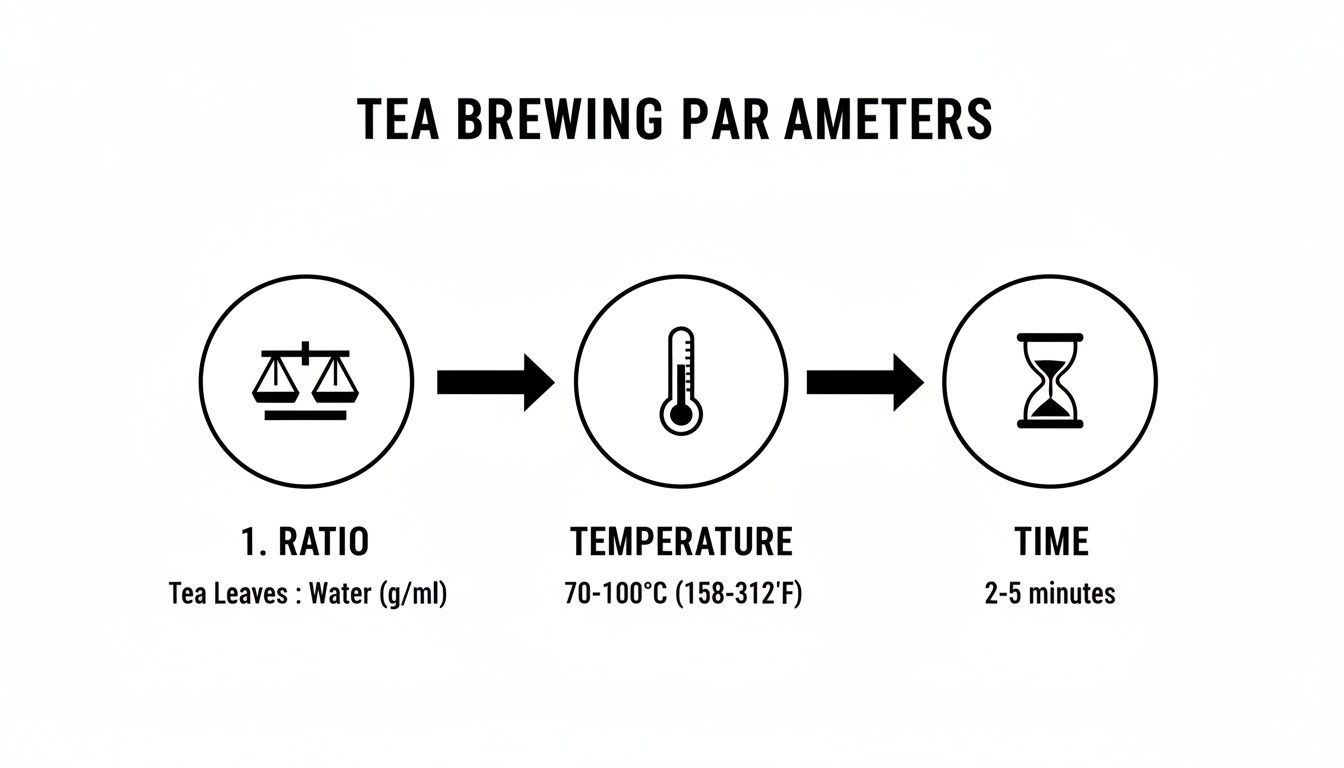
When you master these parameters within a structured workflow, you take all the guesswork out of the equation. Every single batch will hit your quality standards, guaranteed.
Mapping the Brew Station Workflow
Your workflow should follow a straight line from start to finish. Arranging your station to mirror this process is the secret to preventing bottlenecks and wasted motion. A great setup creates a smooth, almost assembly-line-like rhythm for your staff.
Here’s a practical flow you can model your station on:
- Prep & Measurement: This is ground zero. Your station should begin with everything needed to start: your loose-leaf tea, filters, and a calibrated digital scale for dead-on accuracy. An employee should be able to grab a filter, weigh the tea, and pop it in the brew basket without taking more than a step or two.
- Brewing: Your commercial brewer is the star of the show. Make sure there’s clear access to its controls and the water source. Post your recipe cards—with specifics like "Black Tea: 8.5 oz, 210°F, 5 min"—right next to the machine. No one should have to hunt for instructions.
- Transfer & Holding: As soon as the tea is brewed, it needs a home. Place your dispensers or urns directly beside the brewer to make transferring hot liquid safe and spill-free. This isn’t just about efficiency; it's a critical step for employee safety and protecting your product.
This kind of streamlined process can dramatically cut down the time it takes to get a fresh batch ready, which is absolutely crucial during a busy lunch rush.
Holding and Dispensing Tea Effectively
How you hold and serve your finished tea is just as important as how you brew it. The main goal is to maintain both fantastic flavor and food-safe temperatures. For iced tea, that means keeping it below 41°F (5°C). For hot tea, you need to hold it above 135°F (57°C) to stop any bacterial growth.
When it comes to dispensing, you have two main roads you can go down, each with its own pros and cons.
Dispensing Solutions Compared
| Dispenser Type | Pros | Cons | Best For |
|---|---|---|---|
| Traditional Spigot Urns | Easy to clean, durable (stainless steel), offers a classic look. | Spigots can clog, needs more frequent refilling, potential for temperature loss. | High-traffic cafes, restaurants, and buffets where looks and easy cleaning are key. |
| Bag-in-Box (BIB) Systems | Cuts down on oxidation (keeps flavor longer), minimizes contamination risk, offers precise portioning. | Higher cost per serving, creates more plastic waste, can be more complex to set up. | High-volume spots, catering, and places where consistency and speed are everything. |
The right choice really hinges on your business model. A neighborhood cafe might love the classic vibe of a steel urn, while a big catering company will get more mileage out of the sheer efficiency of a BIB system.
Key takeaway: The longer tea sits, the more its flavor degrades. Try to brew in batches you can sell within 4-6 hours for the best possible taste. And a cardinal rule: never, ever top off an old batch with a new one. Always start fresh with a clean, sanitized dispenser.
This focus on operational efficiency also plugs into a bigger industry trend. Sustainability is becoming a huge deal in commercial tea, especially when you consider that 60% of the world's tea comes from nine million smallholder farmers. Operators are actively seeking energy-efficient gear and smarter workflows that cut down on waste. You can get a deeper dive into this by checking out the latest global tea market report. By designing a workflow that minimizes waste, you’re not just helping your own bottom line—you’re aligning with a more responsible future for the entire industry.
Don't Skip This: Essential Cleaning and Quality Control
Let’s be blunt: poorly maintained equipment serves bad tea. Period. A brewer caked with mineral scale or a dispenser spigot hiding bacteria will ruin your product and your reputation faster than you can say "refund." This is why a non-negotiable cleaning and quality control routine is the final, critical pillar of any successful commercial tea brewing operation.
This isn't just about appearances; it's about protecting your investment and ensuring every single customer gets a safe, high-quality drink. Off-flavors from old tea residue, mold, and limescale can turn even the most beautiful tea leaves into a bitter, undrinkable mess. A disciplined routine is your best defense against these silent profit killers.
Your Daily Cleaning Checklist
Daily cleaning should be a rock-solid, end-of-day ritual. We're not talking about a deep scrub here. This is a quick, thorough reset to prevent residue from building up and to guarantee a fresh start the next morning.
Here's what that looks like:
- Empty and Rinse: Drain all dispensers and the brewer completely. Give everything a hot water rinse to wash away any loose tea particles.
- Wash Removable Parts: Pop out the brew basket, filters, and any other removable bits. Wash them with a food-safe detergent, rinse well, and let them air dry completely overnight.
- Clean Dispenser Spigots: This is a crucial step that often gets overlooked. Use a designated spigot brush to scrub the inside of the tap, clearing out any trapped tea residue that can harbor nasty bacteria.
- Wipe Down Surfaces: Sanitize all external surfaces of the brewer, dispensers, and your entire prep station.
This simple, ten-minute process is your first line of defense against flavor contamination. It’s the easiest way to make sure you're always brewing with clean gear.
Weekly and Monthly Deep Cleaning
While daily upkeep is essential, you also need to schedule deeper cleaning sessions to tackle the stubborn gunk that a simple rinse won't solve. To maintain the highest hygiene standards and ensure the longevity of your equipment, think about establishing regular cleaning schedules.
For a weekly deep clean, disassemble as much of the equipment as you can. Soak spigots, gaskets, and lids in a commercial-grade sanitizer solution, following the manufacturer's instructions to the letter. This weekly task is vital for hitting all the nooks and crannies that daily wiping can miss.
Your most important maintenance task will be monthly descaling and deliming. Mineral buildup from water, known as scale, not only makes your tea taste off but can also damage your brewer's heating elements, leading to expensive repairs.
Most commercial brewers require a deliming solution to be run through a full brew cycle. This process dissolves the hard water deposits and keeps your machine running like it should. Always follow the specific instructions for your model to do this safely and effectively. You can learn more by exploring this detailed guide to cleaning restaurant equipment.
Simple Daily Quality Control Checks
Cleaning is only half the battle. You also need a system to catch quality issues before they ever reach a customer. Integrating a few simple checks into your opening routine provides an invaluable safety net.
Your daily quality control should include these three things:
- Taste the First Batch: Always, always taste the first batch of tea you brew each day. It’s the fastest way to detect any off-flavors from improper cleaning or a bad batch of tea leaves.
- Check Temperatures: Grab a calibrated thermometer and verify that your hot tea is holding above 135°F and your iced tea is holding below 41°F. No exceptions.
- Visual Inspection: Take a look at the tea's clarity. If your iced tea looks excessively cloudy, it can be a sign of improper brewing or cooling—a clear signal that a process needs to be adjusted.
Answering Your Commercial Tea Brewing Questions
Even with the best game plan, questions always pop up when you're dialing in a commercial tea program. It's just part of the process. This section is all about tackling the most common hurdles we see restaurant and café operators run into, offering some quick, straight-to-the-point advice that builds on the deeper dives in the rest of this guide.
How Much Tea Should I Actually Buy?
Figuring out your tea inventory can feel like a shot in the dark at first, but you can get surprisingly close with some back-of-the-napkin math. A solid rule of thumb is that one pound of loose-leaf tea will brew up about 10-12 gallons of finished iced tea, give or take, depending on how strong you make it.
Let's walk through a real-world scenario. Say your busy café is slinging around 20 gallons of iced tea a day. You'd be looking at using roughly 2 pounds of loose leaf just to cover that single day's service.
- Daily Need: 20 gallons / 10 gallons per pound = 2 lbs of tea
- Weekly Need: 2 lbs/day x 7 days = 14 lbs of tea
- Monthly Order: 14 lbs/week x 4 weeks = 56 lbs of tea
I always recommend adding a small buffer—maybe 10-15%—to your final order. This covers you for those unexpectedly slammed Saturdays or the occasional minor spill. This approach keeps you from over-ordering (which leads to stale, flavorless tea) while making sure you never have to 86 your most popular drink during a rush.
Can I Brew Hot Tea in a Commercial Iced Tea Brewer?
You technically can, but it's a really bad idea for service. Commercial iced tea brewers are engineered to produce a concentrated brew that’s then diluted and chilled. The tea that comes out of these machines is nowhere near a safe or enjoyable temperature for hot service, which needs to be above 135°F.
Trying to use your iced tea brewer as a hot tea station creates a few headaches:
- Wrong Temperature: The tea will be lukewarm, plain and simple. That's a bad customer experience and a potential food safety red flag.
- Funky Flavor: The brewing specs are all wrong for a hot beverage. The concentrate is designed to taste right after being chilled and diluted, so it will likely taste "off" when served hot.
- Workflow Nightmare: You're tying up your main iced tea machine, which can create a serious bottleneck at your beverage station when you need it most.
For serving hot tea, you are always better off with dedicated hot water towers and a system for brewing by the cup or pot. It’s the only way to nail the temperature and flavor every time.
The most successful beverage programs use equipment for its intended purpose. A dedicated hot water dispenser and a separate iced tea brewer will always outperform a single machine trying to do two jobs poorly.
Why Does My Iced Tea Get Cloudy?
Ah, the dreaded cloudy iced tea. It’s a super common problem, but thankfully, it’s almost always preventable. That haze is caused when caffeine and tannins—natural compounds in the tea—bind together and fall out of the liquid when it gets chilled too quickly.
Here are the usual suspects and how to fix them:
- Shock-Chilling Your Concentrate: Never, ever move a container of hot, fresh-brewed tea concentrate straight into the walk-in. That sudden, extreme temperature drop is the #1 cause of cloudiness.
- Bad Water: Water with a high mineral content, or "hard water," makes it much more likely for the tea to get hazy. A high-quality water filtration system isn't just a recommendation; it's a non-negotiable for clear, fantastic-tasting tea.
- Steeping for Too Long: Over-steeping, especially with black teas, pulls out way too many tannins. Stick to your recipe like glue—most black tea concentrates only need 5-7 minutes.
The best fix is simple patience. Let your tea concentrate cool down on the counter for about an hour before you even think about putting it in the fridge. Diluting the hot concentrate with cold, filtered water is another great trick to help it cool down more gently.
What Is the Ideal Shelf Life for Brewed Tea?
When it comes to flavor, freshness is everything. While tea can be stored safely for a bit, its taste quality drops off a cliff much faster than you’d think. For a product you can be proud of, you need to work within some pretty tight windows.
- Iced Tea: When stored properly in a sealed, sanitized container below 41°F, iced tea is technically food-safe for up to 24 hours. But honestly? Its peak flavor is really within the first 8 hours. After that, it starts tasting flat and stale.
- Hot Tea: Hot tea has an even shorter fuse. You should hold it in a thermal urn or airpot and plan to serve it within 1-2 hours. Any longer, and the flavor gets bitter and stewed as it continues to oxidize.
The golden rule of any serious tea program is to brew smaller batches more often. It might feel like a little extra work, but the superior quality is something your customers will absolutely notice. And please, never top off an old batch with a fresh one. Always start with a clean, empty dispenser. This commitment to freshness is what separates the amateurs from the pros.
At The Restaurant Warehouse, we provide the durable, high-performance commercial tea brewers and beverage dispensers you need to build a profitable and efficient tea program. Equip your kitchen with reliable gear designed for consistency and scale. Check out our full selection of beverage equipment at https://therestaurantwarehouse.com.
About The Author

Sean Kearney
Sean Kearney is the Founder of The Restaurant Warehouse, with 15 years of experience in the restaurant equipment industry and more than 30 years in ecommerce, beginning with Amazon.com. As an equipment distributor and supplier, Sean helps restaurant owners make confident purchasing decisions through clear pricing, practical guidance, and a more transparent online buying experience.
Connect with Sean on LinkedIn, Instagram, YouTube, or Facebook.