

Choosing Commercial Kitchen Shelves That Last
Picking out the right commercial kitchen shelves feels like just another organizational task, but it’s a decision that echoes through your kitchen’s efficiency, safety, and ultimately, your bottom line. These aren't your average home-improvement store units; industrial-grade shelving is built from the ground up to handle the intense, high-traffic environment of a professional kitchen.
Why Your Shelving Choice Matters
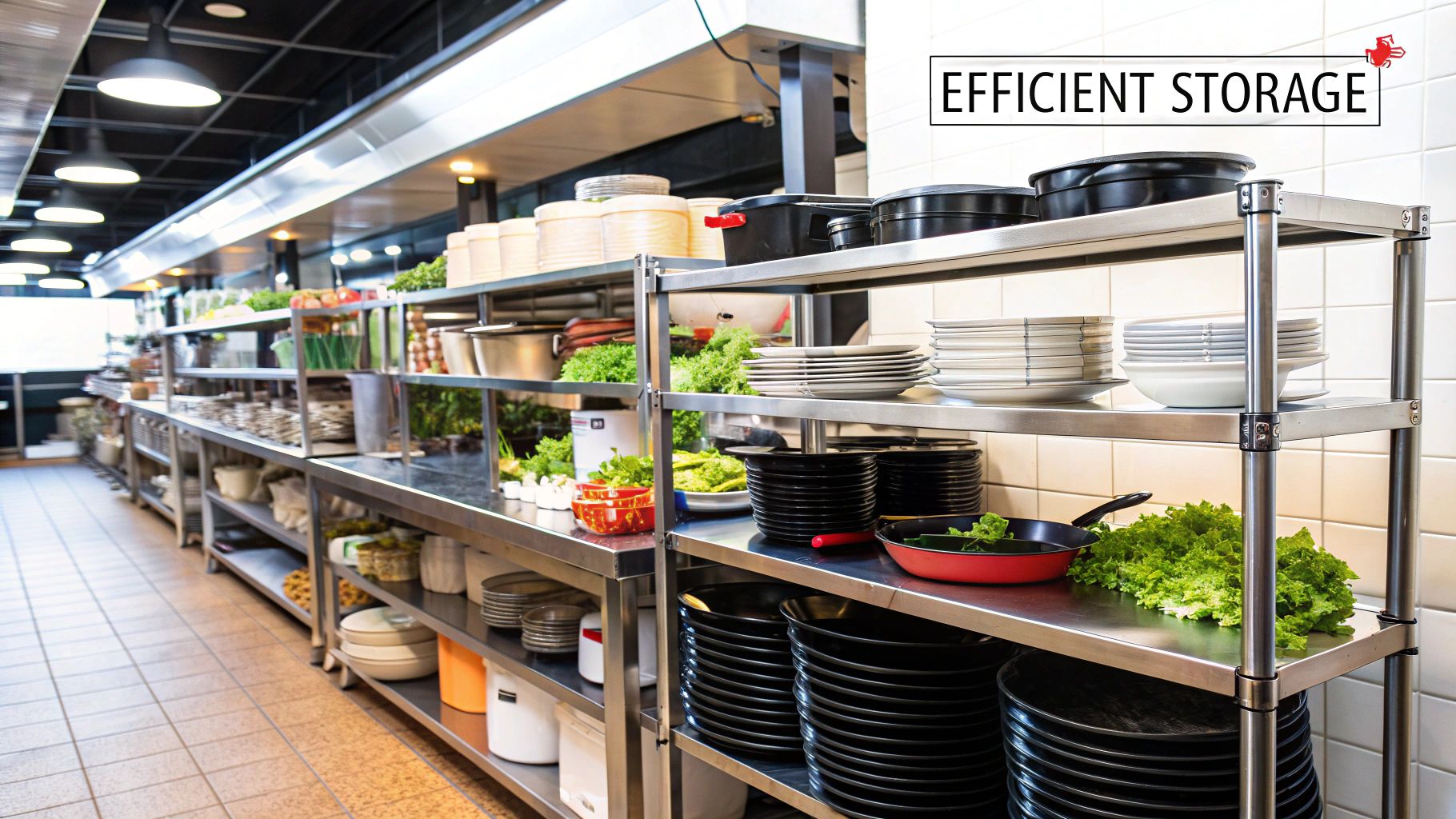
Think of your shelving as the literal backbone of your kitchen. A strong, intelligently designed system keeps the whole operation running smoothly. A weak or poorly planned one? Pure chaos. The demand for quality storage is huge, with suppliers shipping around 100 million units of commercial kitchen shelves every year. This isn't just a number; it shows how vital this equipment is in professional settings where durability and hygiene are non-negotiable.
The Foundation of Kitchen Workflow
The right shelving has a direct impact on how your team moves and works. When ingredients and tools are organized logically and are easy to grab, service speed improves dramatically.
This kind of strategic organization cuts down on clutter and slashes the time staff waste hunting for items. It's a fundamental piece of the puzzle for https://therestaurantwarehouse.com/.
A well-organized kitchen is a profitable kitchen. Every second saved searching for an ingredient is a second gained in preparing an order, directly impacting ticket times and customer satisfaction.
Ensuring Safety and Compliance
Beyond just holding stuff, commercial kitchen shelves are a critical part of your safety plan. They have to be strong enough to support heavy loads without any risk of buckling. Just as important, they need to be made from materials that are a breeze to sanitize to prevent cross-contamination.
Health inspectors pay close attention to storage solutions to make sure they meet strict food safety codes. For instance, storing all food items off the floor on approved shelving is a basic requirement almost everywhere. This guide will walk you through everything—materials, sizing, installation, and maintenance—to help you build a storage solution that works as hard as you do.
Selecting the Right Shelving Material
The material you choose for your commercial kitchen shelves is probably the single most important decision you'll make. Think of it like picking the right tires for a truck—you wouldn't put highway tires on a rig meant for muddy, off-road trails. It’s the same in a kitchen. The material has to match the environment, whether it's a steamy dish pit or a bone-dry pantry.
Get this choice right, and you'll sidestep premature rust, sail through health inspections, and protect your investment for years to come. Each material strikes a different balance between durability, cost, and how well it stands up to corrosion.
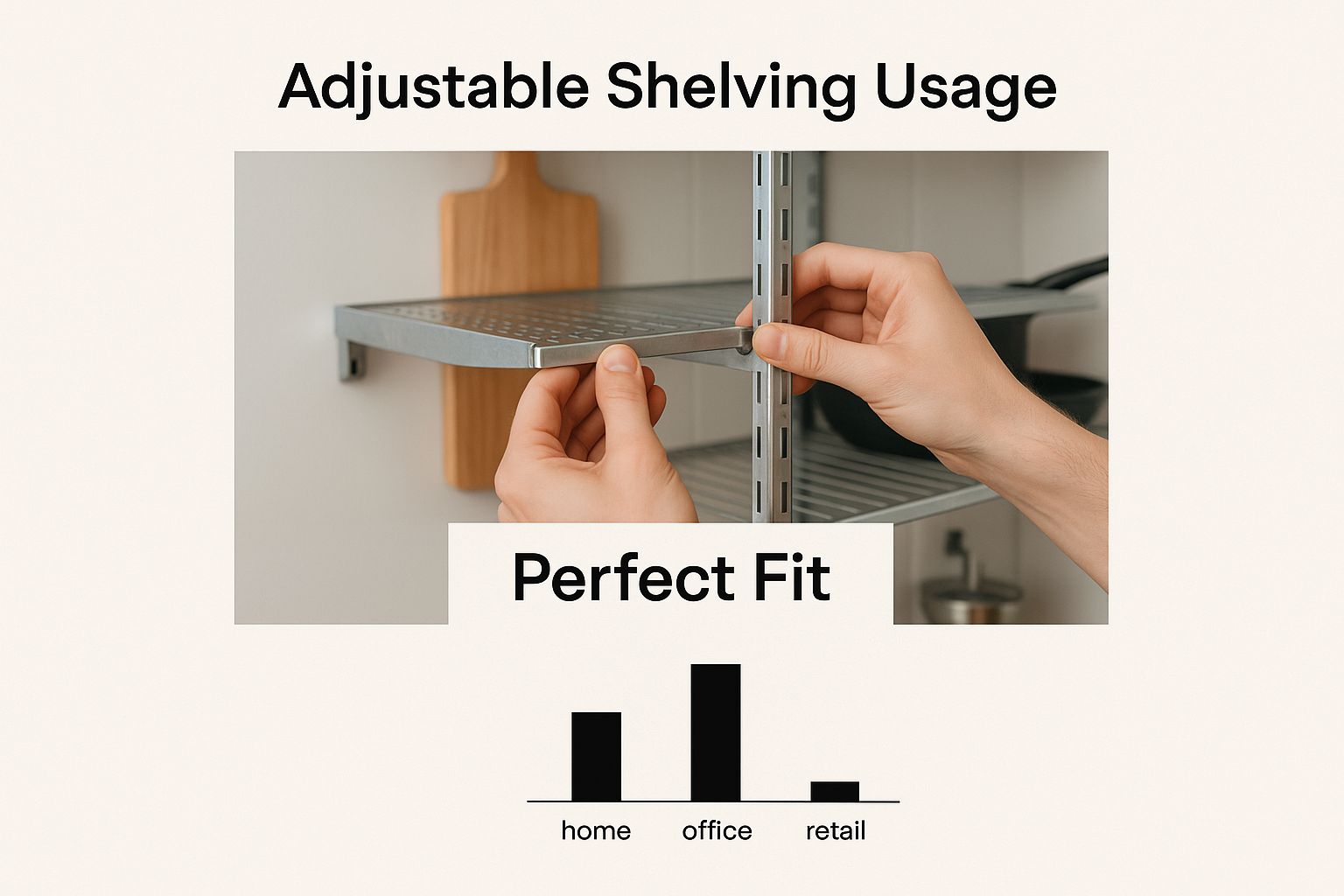
As this image shows, being able to adjust your shelving is just as crucial as the material it's made from. This flexibility lets you fine-tune your storage to perfectly match your workflow and the specific items you need to organize.
Before we dive into the specific materials, here's a quick comparison to help you see how they stack up against each other at a glance.
Material Comparison for Commercial Kitchen Shelves
| Material | Corrosion Resistance | Cost Level | Cleaning Ease | Best Use Case |
|---|---|---|---|---|
| Stainless Steel | Highest | High | Excellent | Walk-in coolers, freezers, dishwashing areas |
| Chrome Plated | Low | Low-Medium | Good | Dry storage, pantries, storerooms |
| Aluminum | High | Medium | Very Good | Walk-in coolers & freezers |
| Polymer/Plastic | Highest | Medium | Excellent | Humid areas, acidic food storage, coolers |
Each of these has a place in a commercial kitchen, but putting them in the wrong place can be a costly mistake. Let's break down where each one truly shines.
Stainless Steel for Ultimate Durability
When your shelves are going to face a constant battle with moisture, humidity, or harsh cleaning chemicals, stainless steel is the undisputed champion. Its natural resistance to rust and corrosion makes it the only real choice for walk-in coolers, freezer units, and anywhere near a dishwashing station.
Yes, it comes with a higher price tag upfront. But its incredible long-term durability often makes it the most economical option over time. It simply won't chip, peel, or rust, giving you a hygienic surface that can take whatever your kitchen throws at it.
Chrome Plated Steel for Dry Storage
For dry storage areas, chrome-plated steel offers a brilliant, polished look at a much friendlier price point. It’s a fantastic choice for pantries, storerooms, and any area where you're stocking canned goods, flour, sugar, and other non-perishables. Dry storage only is the key phrase here.
Here’s the catch: chrome is just a plating over steel. If that shiny layer gets scratched or chipped, the steel underneath is exposed to air and moisture, and rust is sure to follow. That's why it's so critical to keep chrome shelving far away from any wet or humid environments.
The global demand for reliable storage solutions is immense, especially in regions with strict health regulations. Europe, for instance, drives a significant portion of the shelving market by prioritizing innovative and compliant designs for commercial kitchens. You can explore more about these market trends in the full shelving units and shelves market report.
Aluminum and Food Safe Plastics
Beyond the different types of steel, a couple of other materials have carved out their own niches in the commercial kitchen.
-
Aluminum: If you want something lighter than stainless steel but still highly resistant to corrosion, aluminum is a great call. It’s an excellent choice for walk-in coolers and freezers because it will literally never rust, making it a lifetime investment for damp environments.
-
Food-Safe Polymer/Plastic: These shelves are completely impervious to moisture and chemicals. They often come with removable shelf plates that are dishwasher-safe, offering the absolute highest level of hygiene. This makes them perfect for storing acidic foods (like tomatoes or vinegar) or for any area that requires frequent, intense cleaning.
Understanding Sizing and Weight Capacity
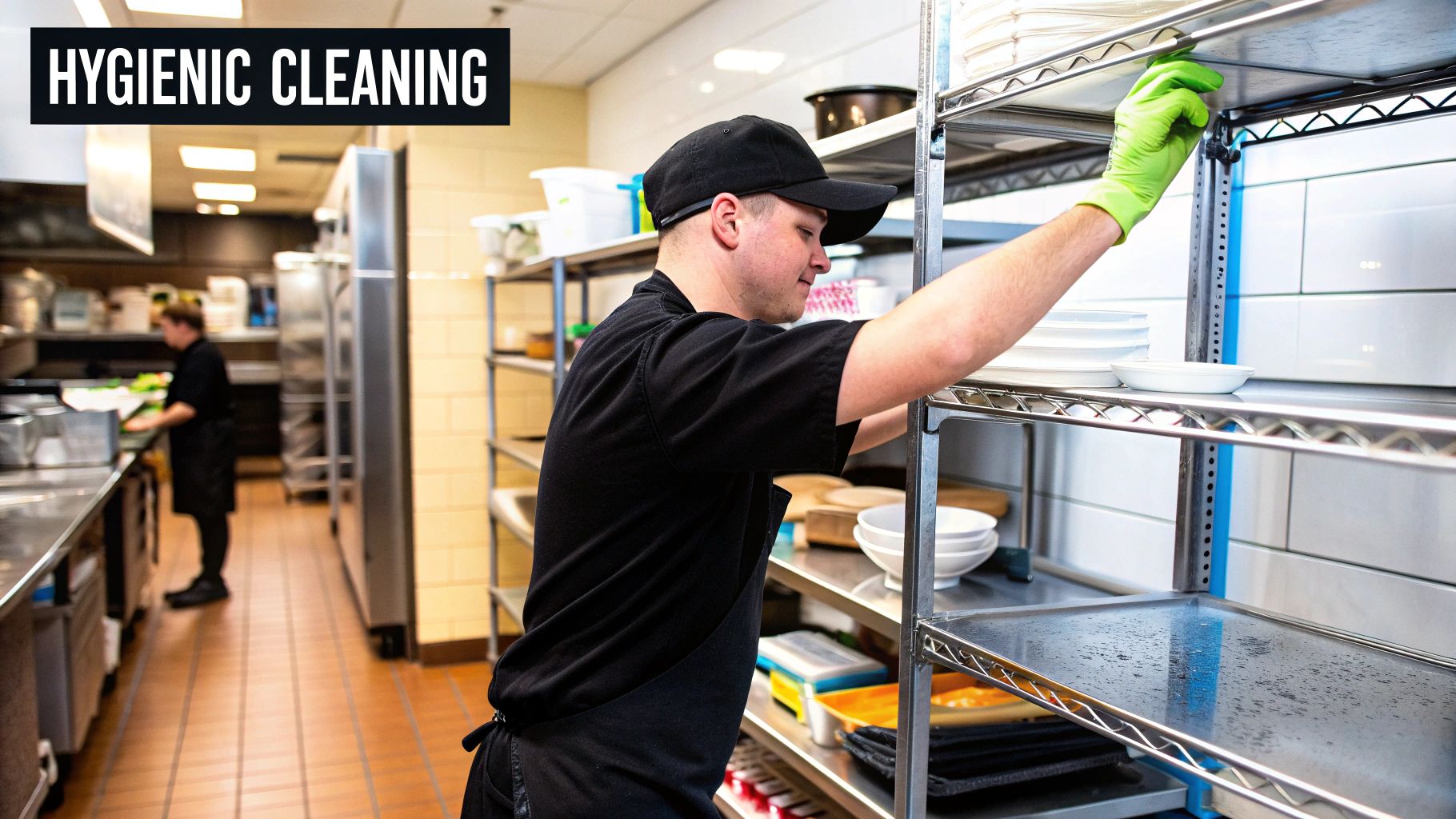
Choosing the wrong size shelving or underestimating what it can hold is more than just a headache—it’s a serious safety hazard. Think of each shelf as a little bridge in your kitchen. It has to be built to handle the traffic, whether that’s heavy sacks of flour, bulky cases of canned goods, or essential equipment.
When you overload a shelf, you’re asking for trouble. It can start to bow, become unstable, and in a worst-case scenario, collapse entirely. That can lead to serious injuries and thousands of dollars in lost product. It’s why you absolutely have to understand the connection between a shelf’s dimensions and its load-bearing strength before you buy anything. The goal is to build a storage system that’s not just functional, but fundamentally safe for your crew.
Calculating Your Load Requirements
Before you even think about shelf dimensions, you need to figure out what you’re actually storing. A great rule of thumb is to list everything you plan to put on a single shelf, add up their combined weight, and then tack on a 25% safety buffer. This simple step ensures you’re never pushing your shelving to its absolute breaking point.
Let’s say you’re storing four 50-pound bags of flour on one shelf. That’s a total of 200 pounds. Add your 25% safety buffer, and you know you need a shelf rated for at least 250 pounds.
A shelf rated for 600 pounds sounds impressive, but there's a catch: that capacity is for weight that's evenly distributed. If you pile the entire load right in the center, you dramatically reduce its real-world strength and risk failure. Always spread the weight out across the whole surface.
This is even more critical in specialized areas. For example, the shelving inside a walk-in cooler has to deal with unique demands from the constant cold and moisture. Getting the sizing right in there is a key part of our commercial refrigeration guide.
Matching Shelf Size to Your Space
Once you’ve got your weight needs locked down, you can start looking at the actual dimensions. Standard commercial shelving comes in a ton of sizes, but they commonly range from 18 to 24 inches deep and 36 to 72 inches long.
Here’s how those sizes typically fit into a kitchen:
- Prep Stations: Shorter shelves (36 to 48 inches) are perfect above prep tables. They keep essential ingredients right at hand without making the space feel cluttered or cramped.
- Walk-In Coolers: Deeper shelves (24 inches) are the way to go here. They’re ideal for storing large food containers and boxes, letting you maximize every inch of your cold storage.
- Dry Storage: This is where you go long. Longer shelves (60 to 72 inches) are perfect for bulk goods, helping you store more product efficiently in your stockroom.
Sizing your shelves correctly from the start means you’ll make the most of every square foot of your kitchen, from tight corners to big, open storage rooms.
Comparing Different Shelving Systems
Not all commercial kitchen shelves are created equal, and honestly, the right choice comes down to your kitchen's unique layout and daily rhythm. Think of your shelving system like a city's road network; some roads need to be permanent highways for heavy traffic (freestanding units), while others need to be flexible local streets that can adapt to changing needs (mobile units). Picking the right system is all about creating a smart storage plan that makes the most of every single square foot.
Your choice really boils down to three main types: freestanding, wall-mounted, and mobile. Each one offers its own advantages, and most kitchens actually benefit from a strategic mix of all three to create a truly efficient workspace. Getting a handle on these differences will help you support your team and keep operations running smoothly.
This image shows a well-organized commercial kitchen where different types of shelving are used to maximize space and efficiency.
Notice how the sturdy, stationary shelving lines the walls for bulk storage, while mobile racks might be used closer to prep areas for more flexibility.
Freestanding Shelving: The Workhorse
Freestanding units are the undisputed champions of bulk storage. These are your go-to for storerooms, pantries, and walk-in coolers where you need absolute maximum capacity and stability. Since they don’t need to be anchored to a wall, you can place them just about anywhere—even creating aisles right in the middle of a room to drastically increase your storage footprint.
Their main perks include:
- High Weight Capacity: These are engineered to hold hundreds of pounds per shelf, making them perfect for heavy items like sacks of flour, large cans, and boxes of produce.
- Versatility: You can easily adjust the shelf heights to fit different product sizes, which makes them highly adaptable as your inventory changes over time.
- Simple Assembly: Most systems are designed for quick, tool-free assembly, letting you set up or reconfigure your storage areas with minimal downtime.
Wall-Mounted Shelving: The Space Saver
When floor space is at a premium, wall-mounted shelves are the perfect answer. They keep essential items off your countertops and within easy reach, making them ideal for placement above prep tables, sinks, and cooking stations. By using that valuable vertical space, you open up the kitchen, cut down on clutter, and create a safer, more organized workspace for everyone.
Think of wall-mounted shelves as your kitchen's "first-in, first-out" command center. They're perfect for holding daily-use ingredients, spices, and small tools, ensuring your most frequently used items are always visible and accessible.
Mobile Shelving: The Flexible Solution
Mobile shelving units, or rolling racks, bring an incredible level of flexibility to a dynamic kitchen. These units are essentially freestanding shelves on heavy-duty casters, letting you transport ingredients from the walk-in cooler to a prep station or move clean dishes from the dish pit to the service line with total ease.
They are especially useful for:
- Creating Flexible Prep Zones: Roll a cart with all the necessary ingredients to a station for a specific recipe, then just roll it away when you're done.
- Streamlining Cleaning: Mobile units can be easily moved out of the way, allowing your staff to clean floors and walls thoroughly—a huge plus for maintaining hygiene standards.
- Adapting to Workflow: As your menu or prep needs change, mobile shelving can be instantly repositioned to support the new workflow without any permanent changes.
To help you visualize how these systems stack up against each other, we've put together a quick comparison table. This should give you a clearer picture of which type might be the best fit for different areas of your kitchen.
Comparison of Shelving System Types
| Shelf Type | Capacity (lbs) | Footprint | Customizable | Price Range |
|---|---|---|---|---|
| Freestanding | 400-800 per shelf | High | Shelf heights are adjustable | $$ - $$$ |
| Wall-Mounted | 200-400 per shelf | Low (uses vertical space) | Fixed once installed | $ - $$ |
| Mobile | 300-600 per shelf | Medium | Shelf heights are adjustable | $$$ - $$$$ |
Ultimately, the best approach is often a hybrid one. Combining the bulk storage power of freestanding units, the space-saving convenience of wall-mounted shelves, and the adaptability of mobile carts allows you to create a storage ecosystem that’s perfectly tailored to your kitchen's unique demands.
Getting Installation and Maintenance Right
Choosing the right shelving is a huge first step, but it’s only half the battle. How you install and maintain those shelves is just as important. Think of it like this: you can buy the strongest, most expensive engine in the world, but if it’s not installed correctly or you never change the oil, it’s not going to perform for long.
Proper installation is all about safety and stability right from day one. Good maintenance habits, on the other hand, are what protect that investment for the long haul, keeping you in line with health codes and preventing annoying (and costly) surprises down the road.
Secure Installation from the Start
Before a single screw goes into the wall, take the time to clean and prep the surface. If you’re putting up wall-mounted shelves, finding the wall studs isn't a suggestion—it’s non-negotiable. Trying to anchor heavy-duty shelving into drywall alone is a recipe for disaster. It simply doesn't have the strength to hold the kind of weight you'll be loading onto it.
Stick with the hardware the manufacturer provides; they’ve included it for a reason. If you're drilling into something other than wood studs, like concrete block or tile, make sure you have the right anchors for that specific material. A solid anchor is the difference between a shelf you can rely on and a major safety hazard waiting to happen.
A level isn't just for making things look pretty. A perfectly level shelf distributes weight evenly across all its anchor points and its own structure. When a shelf is crooked, it puts a ton of stress on just a few spots, dramatically increasing the risk of it failing over time. Use a level at every step of the installation process.
A Simple Maintenance Schedule That Works
Once your shelves are up and loaded, a simple, consistent maintenance routine is your best defense against wear and tear. This doesn't need to be some complicated, time-consuming chore. A basic schedule can make a massive difference in extending the life of your shelves and keeping them in great shape.
A solid maintenance plan really just comes down to three core tasks:
- Daily Wipe-Down: At the end of every shift, give the shelves a quick wipe with a clean, damp cloth. This gets rid of spills and food debris before they have a chance to set in, which is especially important for preventing pitting on stainless steel.
- Weekly Sanitizing: Once a week, take the time to empty the shelves completely and give them a thorough cleaning with a food-safe sanitizer. This is a critical step for preventing bacteria buildup and acing your next health inspection.
- Monthly Inspection: Do a quick check-up once a month. Look for any loose bolts, check for wobbly legs on your freestanding units, and inspect chrome shelves for any early signs of rust. Tighten up any loose hardware on the spot and deal with any corrosion right away to stop it from spreading. This simple check can stop a tiny issue from turning into a big, expensive problem.
It’s Not Just Shelving Anymore: What’s Next in Kitchen Storage?
The world of commercial kitchen shelving has moved way beyond simple, static racks. What we're seeing now are storage solutions that are smarter, way more flexible, and designed to integrate right into the flow of a modern kitchen. Keeping an eye on these trends helps you invest in a system that won’t just work for you today, but will be ready for whatever you throw at it tomorrow.
This isn't just change for the sake of it; it's a direct response to the non-stop demand for more efficiency in the kitchen. In fact, the industrial shelving market is expected to hit $596.8 million by 2025, pushed by the need for better space management and smarter inventory control. You can dig into the research shaping the industrial shelving market if you want to see the numbers behind the shift.
The Rise of Smart and Modular Shelving
One of the biggest game-changers is the fusion of storage and technology. We're now seeing smart shelving systems that use sensors to monitor weight, tracking your inventory levels in real time. This can automate reordering and pretty much eliminate the risk of running out of a crucial ingredient in the middle of a dinner rush.
At the same time, modularity is becoming the new standard. Imagine shelving you can completely reconfigure in minutes without a single tool—kind of like building with LEGO bricks. This lets your kitchen adapt on the fly, whether you're adding new menu items or just dealing with seasonal produce demands.
The goal is to create a storage environment that is as dynamic as the kitchen itself. Future-proof commercial kitchen shelves are not just about holding items; they're about actively improving workflow and operational intelligence.
These innovative systems are quickly becoming a core part of modern restaurant design. To get the most out of them, you need a solid plan, which is why understanding your equipment is so important. Our commercial kitchen equipment checklist is a great place to see how these advanced shelving options fit into the bigger picture. By bringing these new technologies into your kitchen, you’re building a more responsive, efficient, and ultimately, more profitable operation.
Got Questions About Kitchen Shelving? We've Got Answers.
When it comes to outfitting your kitchen, shelving might seem straightforward, but a few key questions always pop up. Getting clear, practical answers is the best way to make sure you're investing in equipment that's safe, efficient, and perfectly suited to your needs.
Here are a few of the most common questions we hear from chefs and restaurant owners.
What Does NSF Certified Shelving Mean?
Think of NSF certification as a seal of approval that says your shelving meets strict public health standards. An NSF-certified shelf is made from materials that are non-toxic and corrosion-resistant, and it's designed to be a breeze to clean, which helps prevent bacteria from finding a place to hide.
For most health departments, this certification isn't just a "nice-to-have"—it's a non-negotiable requirement for any commercial food environment.
How Do I Calculate How Much Weight My Shelves Need to Hold?
This is simpler than it sounds. Start by making a quick list of everything you plan to store on a single shelf and add up their estimated weights. To be on the safe side, always give yourself a cushion. We recommend adding a 25% buffer to your total.
So, if all your items weigh in at 400 pounds, you should be looking for shelving with a capacity of at least 500 pounds. This simple step prevents dangerous bowing and keeps your shelves from failing down the road.
Always choose shelving with a weight capacity that comfortably exceeds your maximum calculated load. This simple step prevents dangerous bowing and structural failure over time.
Can I Mix Different Shelving Materials?
Absolutely! In fact, it's a really smart strategy for both your budget and your kitchen's workflow.
It makes perfect sense to use ultra-durable, rust-proof stainless steel in wet areas like your dishwashing station or inside a walk-in cooler. Then, for dry storage rooms, you can opt for more cost-effective chrome or polymer commercial kitchen shelves. This hybrid approach helps you put the right material where it's needed most.
For durable, NSF-certified shelving solutions designed for any kitchen environment, explore the extensive catalog at The Restaurant Warehouse. Find the perfect fit for your operation today at https://therestaurantwarehouse.com.
About The Author

Sean Kearney
Sean Kearney is the Founder of The Restaurant Warehouse, with 15 years of experience in the restaurant equipment industry and more than 30 years in ecommerce, beginning with Amazon.com. As an equipment distributor and supplier, Sean helps restaurant owners make confident purchasing decisions through clear pricing, practical guidance, and a more transparent online buying experience.
Connect with Sean on LinkedIn, Instagram, YouTube, or Facebook.