


Choosing Your Commercial Countertop Deep Fryer
Think of a commercial countertop deep fryer as the perfect way to add a high-performance engine to your kitchen without needing a full garage rebuild. It’s a compact, powerful machine designed to bring high-volume frying to kitchens where every inch of counter space is gold. This is your ticket to adding high-profit fried items like French fries, wings, and appetizers to your menu without a massive, disruptive kitchen overhaul.
Why a Countertop Fryer Is Your Kitchen’s Secret Weapon
It’s easy to dismiss a countertop fryer as just another piece of equipment, but that would be a mistake. This little workhorse is a strategic tool for culinary creativity and business growth, all packed into a small, efficient footprint.
This compact design is a total game-changer for operations where space is at a premium. We're talking food trucks, cafes, ghost kitchens, and concession stands. For these businesses, a countertop fryer unlocks a world of new possibilities. You can instantly expand your menu with items that are always popular and incredibly profitable—from classic golden French fries and crispy onion rings to irresistible donuts.
Maximizing Space and Profitability
The real magic of a countertop fryer is its incredible ability to generate serious revenue from a tiny footprint. Picture the workflow in a bustling café during lunch. A small, dedicated fryer can crank out basket after basket of fresh fries, which dramatically speeds up ticket times and makes for happier customers. That boost in efficiency translates directly into faster table turnover and more sales each day. When you're adding a fryer, it's also critical that your surfaces can handle the heat and daily grind; you can learn more about choosing the right kitchen countertops to support your equipment.
By adding a simple, high-margin item like loaded fries, a small business can create a new revenue stream that pays for the equipment in a matter of weeks, not months. It’s about leveraging a compact asset for maximum financial impact.
Before we dive deeper, let's quickly summarize why adding one of these units can be such a smart move for your business.
Key Benefits of a Countertop Fryer at a Glance
| Benefit | Impact on Your Business | Ideal For |
|---|---|---|
| Space Efficiency | Maximizes your kitchen's earning potential without requiring a large footprint. | Food trucks, cafes, concession stands, and kitchens with limited space. |
| Menu Expansion | Easily add popular, high-profit fried items to attract more customers. | Any operation looking to diversify its menu with minimal investment. |
| Increased Profitability | Fried foods typically have high margins, boosting your overall revenue. | Businesses aiming to increase profit from a small, dedicated station. |
| Operational Flexibility | Use it for specific items, allergen-free cooking, or testing new menu concepts. | Restaurants needing to prevent flavor transfer or experiment with specials. |
| Lower Upfront Cost | More affordable than full-size floor models, with simpler installation. | Startups, pop-ups, and businesses looking for a cost-effective solution. |
As you can see, the advantages go far beyond just saving space. These fryers offer a powerful combination of efficiency and profitability that can give your kitchen a real competitive edge.
Unlocking Operational Flexibility
Beyond just making money, these units give you an incredible amount of flexibility. Countertop deep fryers are becoming more and more popular because they are so much easier to install and get running. Market data shows electric models are a top choice for their plug-and-play operation, which makes setup a breeze and allows you to deploy them almost anywhere, like at a pop-up event or a seasonal food stand. For more info, you can explore detailed insights on deep fryer market trends.
This adaptability empowers you to test out new menu ideas with very little risk. You could introduce a limited-time fried special or dedicate a single unit to allergen-free cooking without disrupting your main kitchen line. In short, the commercial countertop deep fryer is more than just an appliance—it’s a versatile, profit-driving machine that gives your business a powerful competitive edge.
Decoding Fryer Specifications for Your Menu
Choosing the right commercial countertop deep fryer can feel like trying to read a foreign language, filled with technical terms like BTUs, kilowatts, and recovery times. But at its core, it's really just about matching the machine's capabilities to what your menu demands.
Think of it less like an engineering exam and more like picking the right tool for the job—you wouldn’t use a hammer to drive a screw, right? This section will demystify the key specs you'll run into, translating the jargon into practical, real-world terms. My goal is to help you confidently pick a fryer that becomes a profitable workhorse for your kitchen, not a frustrating bottleneck.
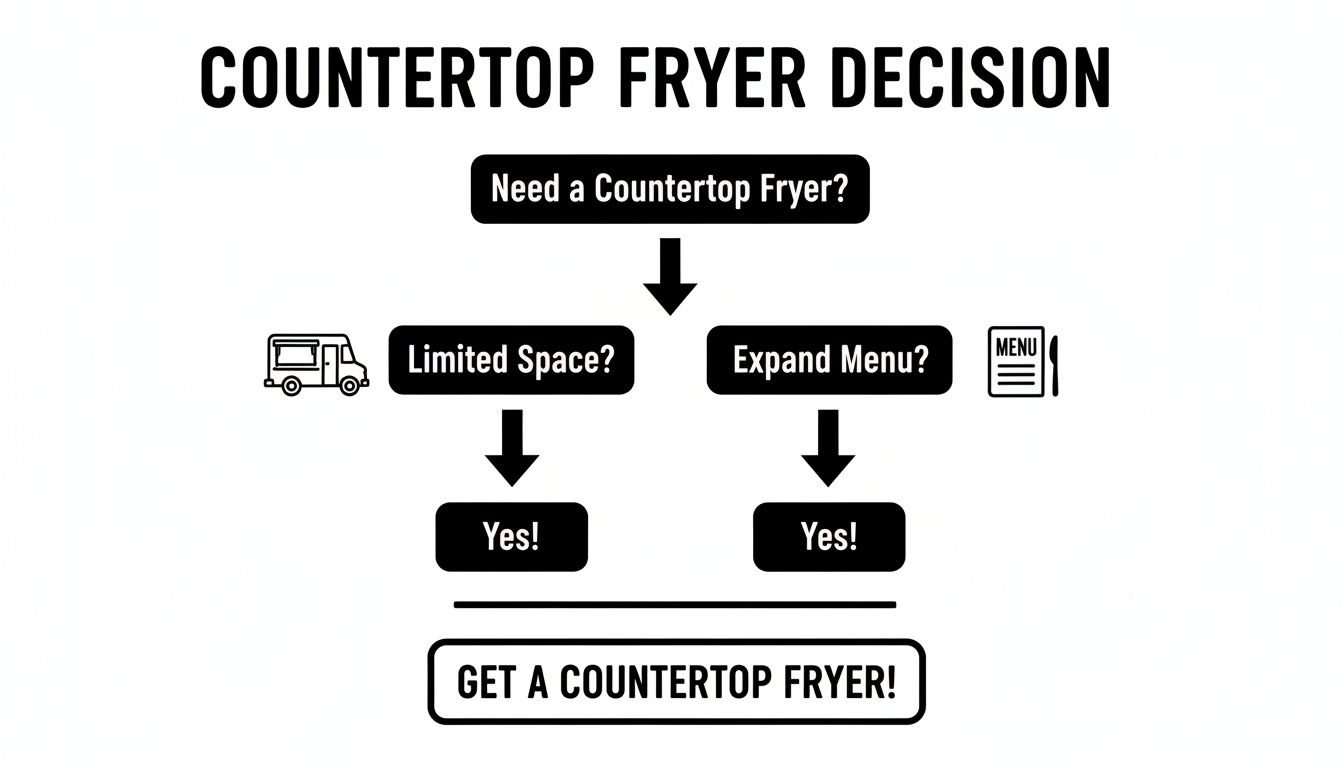
This simple flowchart shows that whether you're tight on space or looking to spice up your menu, a countertop fryer is often the perfect solution. They're strategic tools for growth, not just smaller versions of floor models.
Oil Capacity and Production Power
The most fundamental spec you'll see is oil capacity, measured in pounds (lbs). This number directly tells you how much food you can pump out per hour. It’s like choosing the right size pot for pasta; if it's too small, the water temperature plummets when you add the noodles, and you end up with a gummy mess. The same exact principle applies here.
A good rule of thumb is that a fryer's production rate is typically 1.5 to 2 times its oil capacity in pounds of food per hour.
- A 15 lb countertop fryer can reliably produce about 22-30 lbs of french fries per hour. This is perfect for a small café, a concession stand, or as a dedicated unit just for appetizers.
- A 30 lb model can handle 45-60 lbs per hour, making it a solid choice for a busier spot or a food truck with a focused fried menu.
Overloading a small fryer is a classic mistake. It tanks the oil temperature, leading to slow recovery, greasy food, and unhappy customers. Always size your fryer for your busiest rush, not your average day.
The Great Debate: Gas vs. Electric
Your next big decision is the power source. This choice really impacts your installation, performance, and day-to-day operating costs, much like deciding between a gas or electric car. Each has its own clear advantages depending on your kitchen's infrastructure and workflow.
An electric commercial countertop deep fryer is often the go-to for its pure simplicity and precision. They're usually easier to install—often just needing a specific electrical outlet—and offer incredibly precise temperature control. If you're leaning this way, you can check out our complete guide to electric countertop deep fryers to see if they fit your needs.
Gas fryers, powered by natural gas or propane, are beasts known for their rapid heat-up and recovery times. They're often cheaper to run in areas where gas is more affordable than electricity. But, they do require a dedicated gas line and absolutely must be installed under a proper ventilation hood, making their setup a bit more complex and costly upfront.
To make this choice easier, here's a straightforward comparison:
Electric vs. Gas Countertop Fryer Comparison
| Feature | Electric Countertop Fryer | Gas Countertop Fryer |
|---|---|---|
| Installation | Simpler, often plug-and-play with the correct outlet. | More complex; requires a dedicated gas line and professional installation. |
| Heat-Up Time | Generally slower to reach initial temperature. | Faster heat-up time from a cold start. |
| Recovery Time | Excellent; electric elements respond quickly to temperature drops. | Very fast; raw power brings oil back to temp rapidly. |
| Temperature Control | Highly precise, often with digital controls for accuracy. | Reliable, though analog controls can be less precise than digital. |
| Portability | More portable, ideal for food trucks and catering. | Less portable due to fixed gas line connection. |
| Operating Cost | Can be higher in areas with expensive electricity. | Often lower operating costs where natural gas is cheap. |
| Ventilation | May not require a hood in some jurisdictions (check local codes!). | Must be installed under a Type 1 ventilation hood. |
Ultimately, electric fryers offer plug-and-play convenience and precision, making them perfect for mobile setups or kitchens without existing gas lines. Gas fryers, on the other hand, provide raw power and faster recovery, making them a favorite in high-volume kitchens where the infrastructure is already in place.
Understanding BTUs and Kilowatts
If oil capacity is the size of the engine, then the BTU or kilowatt (kW) rating is its horsepower. This number tells you how much energy the fryer can generate, which directly affects how fast it heats the oil and—more importantly—how quickly it recovers temperature between batches.
- BTU (British Thermal Unit) is the standard for gas appliances. A higher BTU rating means more heating power.
- Kilowatts (kW) is the equivalent for electric appliances. A higher kW rating means a more powerful heating element.
Fast recovery time is the secret to consistently crispy food. When you drop a basket of frozen fries into hot oil, the temperature can plummet by 50-75°F. A powerful fryer with a high BTU or kW rating will bring that oil roaring back to the optimal cooking temp in seconds, not minutes. This speed is what prevents food from getting soggy and absorbing excess oil, giving you that perfect golden, crispy finish every single time.
Construction and Safety Features
Finally, pay close attention to the build quality and safety features. A commercial kitchen is a demanding environment, and you need equipment that's both tough enough to survive and safe for your staff to operate.
Stainless steel construction is non-negotiable. Look for heavy-duty, food-grade stainless steel for the fry tank and exterior. It stands up to corrosion and high heat, and it's far easier to clean and sanitize—a critical factor for passing health inspections.
Here are the crucial safety features to look for:
- High-Limit Safety Switch: This is an essential device that automatically shuts off the fryer if the oil gets dangerously hot, preventing flare-ups and fires.
- Cool Zone: A well-designed fryer will have a "cool zone" at the very bottom of the tank. Crumbs and sediment fall into this cooler area, which keeps them from burning and tainting the oil. This simple feature extends oil life and makes your food taste better.
- Thermostatic Controls: Precise thermostats let you lock in a consistent oil temperature, which is vital for quality. Digital controls offer the most accuracy, but good-quality analog dials are also effective.
By understanding these core specs, you're no longer a confused buyer. You're an informed operator, ready to choose a fryer that will truly elevate your menu.
Navigating Installation and Ventilation Requirements
Bringing a new commercial countertop deep fryer into your kitchen involves more than just clearing a spot on the counter. Proper installation is a critical step that ensures safety, compliance with local health codes, and the long-term performance of your equipment. Getting this right from the start is how you avoid costly fines, frustrating operational delays, and serious safety hazards down the road.
Think of installation as building the foundation for your fryer. Just like a house needs the right plumbing and electrical work before you can move in, your fryer needs the correct utility connections and ventilation to operate safely and effectively. Trust me, skipping these steps is a recipe for disaster.
Powering Your Fryer Correctly
The first checkpoint is ensuring you have the right power supply. This is one of the most common—and dangerous—mistakes new operators make, so pay close attention here.
A commercial countertop deep fryer is a high-powered piece of equipment. Unlike a home appliance, it almost always requires a dedicated electrical circuit. Most electric models need a 208V or 240V connection, not the standard 120V wall outlet you use for a blender. Plugging a powerful fryer into an inadequate circuit is a significant fire risk and will lead to terrible performance, slow recovery times, and constantly tripping breakers.
For gas models, you’ll need a professionally installed gas line with the correct pressure and connection size. I can't stress this enough: always have a licensed electrician and a certified plumber handle these connections to ensure everything is up to code.
Understanding Ventilation Hoods
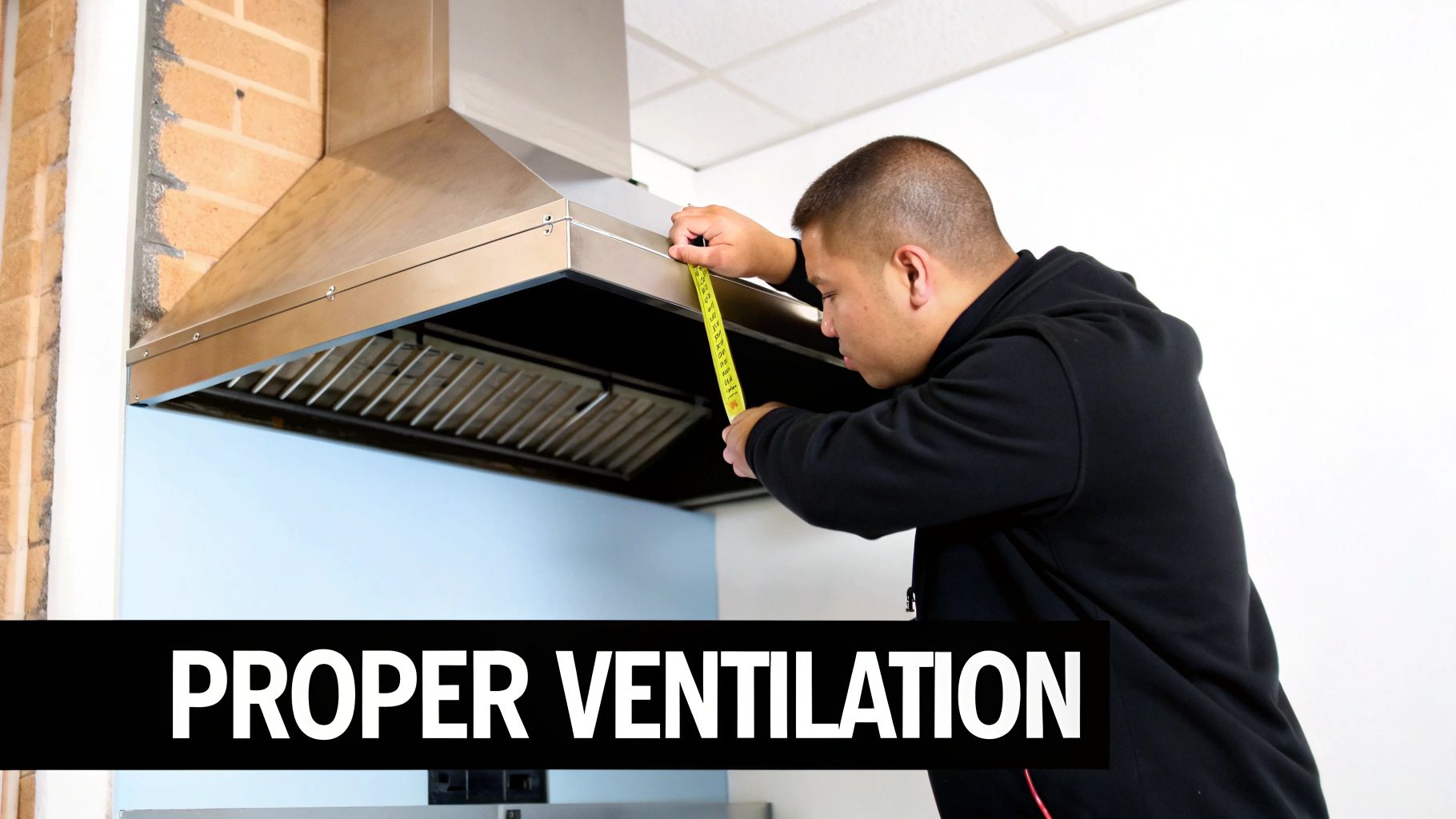
Ventilation is arguably the most crucial part of fryer installation. When you fry food, you release grease-laden vapors, smoke, and a ton of heat into the air. Without proper ventilation, this gunk accumulates in your kitchen, creating an unsanitary, unpleasant, and dangerous place to work.
Even though it’s a "countertop" unit, any commercial fryer producing grease-laden vapor legally requires a Type 1 hood, also known as a grease hood. This type of hood is specifically designed with baffle filters and a dedicated exhaust system to capture and remove grease from the air before it coats your walls and ceilings.
Local fire and health codes are extremely strict about ventilation for frying equipment. Failing to install the proper hood system is a serious violation that can result in immediate shutdown orders and significant fines.
It’s a common misconception that smaller fryers don't need serious ventilation. For a deeper dive into this topic, you can learn more about the specific commercial kitchen ventilation requirements that apply to all cooking equipment.
Fire Suppression and Clearances
Your ventilation hood is just one part of a larger safety system. A commercial kitchen hood must be equipped with an integrated fire suppression system. This system typically has nozzles aimed directly at your fryer and is designed to automatically release fire-retardant chemicals if a flare-up occurs.
Finally, pay close attention to clearances. Your fryer's manual will specify the minimum distance it must be from walls and other equipment. These clearances are non-negotiable; they ensure that heat can dissipate properly, preventing damage to surrounding surfaces and reducing fire risk. As a general rule, maintain at least 6 inches of clearance from any combustible surfaces, but always follow the manufacturer's specific guidelines. Taking these installation steps seriously protects your staff, your customers, and your business.
Mastering Daily Operations and Maintenance
A well-maintained commercial countertop deep fryer is more than just a clean machine; it’s the heart of your profit-generating operation, consistently cranking out delicious food. Neglecting its upkeep is like never changing the oil in your car—eventually, performance tanks, parts fail, and you’re left with costly repairs and unhappy customers. Let’s walk through the essential daily routines that will protect your investment and keep your food tasting fantastic.
Proper maintenance is the secret ingredient that extends the life of your fryer and ensures the quality of every dish. The oil in your fryer is its lifeblood. Regular filtering and timely changes are non-negotiable if you want to achieve that perfect golden-brown crispiness that keeps people coming back for more.
The Daily Oil Management Ritual
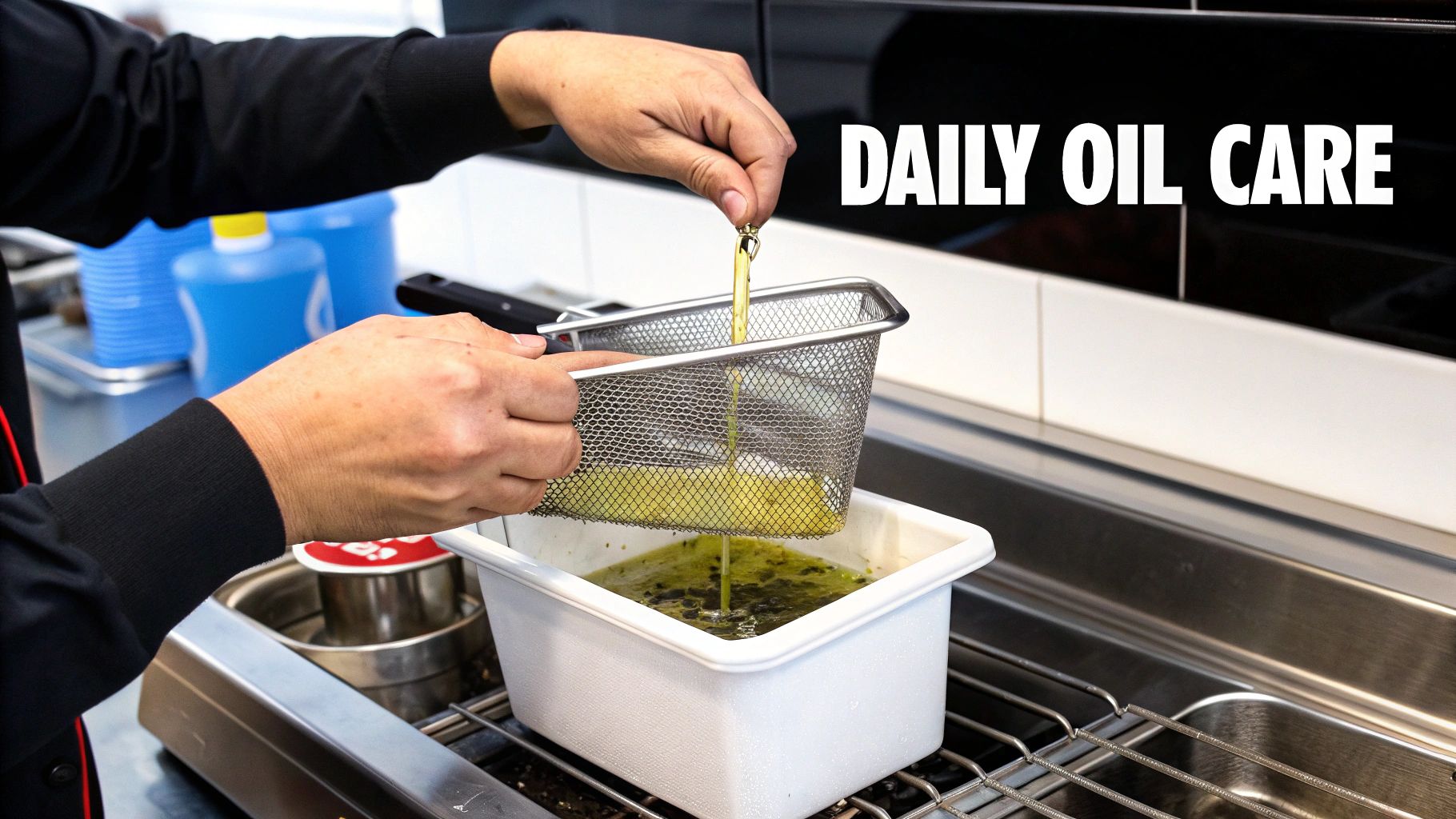
Great oil management isn't a once-a-day task; it's an ongoing process. It’s all about the small actions you take throughout the day that prevent bigger problems down the line. The goal is simple: keep the oil clean to make it last longer and ensure every single order tastes fresh.
Throughout each shift, get in the habit of using a skimmer to fish out any floating food particles or rogue bits of batter. These little floaters are troublemakers. If you let them hang around, they burn, release carbon, and speed up the breakdown of your oil, creating those dreaded off-flavors. It’s a simple, two-second task that makes a world of difference.
Your fryer's crumb screen or cool zone is there for a reason—it catches the heavier debris. Make it a routine to empty and clean these areas regularly. Preventing sediment from building up is one of the easiest ways to stop your oil from getting smoky, dark, and bitter before its time.
"The single most important factor in extending oil life is filtration. A kitchen that filters its oil at least once daily can often double the lifespan of its cooking oil compared to one that doesn't, directly cutting a major operational expense in half."
For a step-by-step approach to keeping your equipment spotless, you'll find more practical tips in our essential daily cleaning guide for commercial fryers. This routine isn't just about being clean; it's about protecting the quality of your final product.
Recognizing When Oil Needs Changing
Even with the best daily care, cooking oil has a limited lifespan. Frying is a chemical process that breaks oil down over time, and using spent oil is a costly mistake. It cooks inefficiently, soaks into food making it greasy, and just plain tastes bad. Here are the clear signs it’s time for a change:
- Look: Fresh oil is light and clear. If yours has become dark, murky, or thick like syrup, its time is up.
- Smell: Good oil has a neutral, clean scent. If you catch a sharp, bitter, or "off" smell, it's gone rancid and will pass those nasty flavors right into your food.
- Smoke Point: If the oil starts smoking at normal cooking temperatures (usually below 375°F), it has broken down. It's no longer safe or effective for frying.
- Taste: This is the ultimate test. If your fried food tastes oily, bitter, or carries lingering flavors from whatever was cooked before it, the oil is the culprit.
The Deep Clean Boil Out Process
At least once a week, your countertop fryer needs a deep clean, what we in the industry call a "boil out." This process gets rid of the stubborn, baked-on carbon and gunk that daily wiping just can't handle.
First, make sure the fryer is off and the oil has cooled down completely. Drain all the old oil and get rid of it properly. Next, fill the fry pot with water and an approved, non-corrosive fryer cleaning solution.
Bring the solution to a slow, gentle boil for about 15-20 minutes. This gentle simmering lifts all that stubborn grime off the heating elements and tank walls. Once you're done, carefully drain the cleaning solution, rinse the tank thoroughly with clean water, and dry it completely before you even think about adding fresh oil. This process basically resets your fryer, ensuring it heats efficiently and your food tastes pure.
Proper upkeep doesn't just save you money on oil; it saves you money on parts. The market for replacement components is huge, with projections showing the commercial deep fryer parts and accessories market growing from USD 295.0 million in 2025 to USD 916.3 million by 2035. That 12.0% CAGR highlights just how much operators spend on replacing baskets, heating elements, and thermostats—costs that are often slashed with diligent maintenance. You can explore more about these aftermarket trends in this detailed market analysis. By adopting these simple routines, you’ll serve better food, make your fryer last longer, and seriously improve your bottom line.
Figuring Out the Return on Your Fryer Investment
Let's be real: buying a new commercial countertop deep fryer is a business decision, not just a kitchen upgrade. While it's easy to get hung up on the initial price, a smart operator knows to look at the bigger picture. You need to understand how this piece of equipment is actually going to make you money. It’s time to move beyond the sticker price and figure out its true return on investment (ROI).
The first step is getting a handle on the Total Cost of Ownership (TCO). Think of it like buying a car—the price you pay the dealer is just the start. Your TCO includes the fryer's purchase price plus all the other expenses that come with keeping it running safely and efficiently.
Beyond the Sticker Price: Total Cost of Ownership
To get a clear financial picture, you have to account for every single related expense. These costs are just as real as the initial purchase and will hit your bottom line month after month.
Here’s what you need to factor into your TCO:
- Initial Purchase Price: This is the upfront cost of the fryer itself.
- Installation Costs: This might involve hiring an electrician to install the right outlet or a plumber to handle a new gas line.
- Energy Consumption: Whether it's your monthly electricity or natural gas bill, this is a major ongoing operational cost.
- Ongoing Supplies: This is a big one. It covers everything from cooking oil and cleaning chemicals to filtration supplies.
- Maintenance and Repairs: It's smart to budget for potential service calls or future replacement parts like baskets and thermostats.
Once you have a realistic idea of your TCO over a year, you can start looking at the fun part—the new revenue your fryer is about to generate.
Calculating Your Fryer's ROI
This is where the lightbulb goes on and the purchase makes perfect sense. The formula is simple: you just have to pit your costs against the potential new revenue from those high-margin fried menu items.
Let’s walk through a real-world example. Say you decide to add French fries to your menu.
- Calculate Cost Per Serving: Add up the cost of the potatoes, oil, and any packaging. Let's say that comes out to $0.75 per serving.
- Set Your Menu Price: You decide to sell a basket of fries for $4.00.
- Determine Your Profit: Your gross profit on each serving is $3.25 ($4.00 - $0.75).
- Forecast Sales: If you project selling just 20 orders of fries a day, that’s $65 in daily profit. That adds up to nearly $2,000 a month.
In this scenario, a $1,500 commercial countertop fryer could easily pay for itself in less than one month, even after you factor in those other TCO costs. This simple math turns the fryer from an expense into a powerful profit-making machine. It's no surprise that the whole commercial fryer market is growing, with one report projecting it to expand from USD 561.6 million in 2024 to USD 879.9 million by 2032. You can read the full research about commercial fryer market projections on 360iresearch.com.
Smart Financing and Leasing Options
For a lot of businesses, especially startups or those watching their cash flow, paying the full price upfront just isn't realistic. This is where financing and leasing options become incredibly useful tools.
Leasing allows you to acquire top-tier, efficient equipment with minimal initial capital. The monthly payment is a predictable operating expense, making it easier to budget while preserving cash for marketing, payroll, or other growth initiatives.
Think of it this way: financing lets the fryer start paying for itself from day one. The revenue you bring in from new menu items can often cover the monthly lease payment entirely, making the equipment essentially cost-neutral while you build your business. It's a strategic way to get your kitchen the gear it needs for success without draining your bank account.
Got Questions About Countertop Fryers? We've Got Answers
Even when you've done your homework, a few practical questions always pop up right before you pull the trigger on new equipment. This section tackles the most common things we hear from operators about their countertop deep fryers, with clear, straightforward answers. Our goal is to give you the confidence to not only pick the right unit but to run it like a seasoned pro from day one.
Think of this as your quick-reference guide for those day-to-day challenges and smart operational calls. We'll cut right through the confusion and get to the practical solutions you need.
How Often Should I Change My Fryer Oil?
This is the number one question we get, and the honest answer is: it really depends on what you’re frying and how much of it. There's no single magic number, but paying attention to your oil and sticking to a routine will be your best guides.
For a busy kitchen cranking out heavily breaded items like chicken wings or onion rings, you’ll probably be filtering the oil daily and doing a complete change every 2-3 days. On the other hand, a small café that mainly uses its fryer for French fries might be able to go 5-7 days between changes, as long as they're filtering every day.
Your best indicators are right there in the fry pot. If the oil gets dark and murky, starts smoking at normal cooking temps, foams up a lot when you drop food in, or gives everything a slightly bitter taste, it’s time for a change. Don't wait—it's a direct hit to your food quality.
Regular filtration is the single best thing you can do to extend the life of your cooking oil. That simple habit translates directly into real savings on one of your biggest consumable costs.
Can I Just Plug This Fryer into a Regular Wall Outlet?
This is a critical safety question, and the answer is almost always a hard no. A commercial countertop deep fryer is a powerful machine built for professional output, not your home kitchen. The vast majority of electric models require a dedicated 208V or 240V circuit.
Trying to plug a high-wattage commercial fryer into a standard 120V outlet isn't just a performance problem—it's a serious fire hazard. You'll end up with constantly tripped breakers, dangerously slow heat-up and recovery times, and you could permanently fry the fryer's internal components.
Before that new fryer even shows up at your door, you absolutely must have a licensed electrician come in, check your setup, and install the correct, dedicated outlet specified by the manufacturer. Do not skip this step. It's fundamental to operating your equipment safely and effectively.
What Are the Most Common Problems I Can Troubleshoot Myself?
Most fryer hiccups are surprisingly simple to fix on your own, without having to make an emergency service call. Knowing what to look for can save you a ton of time, money, and frustration during a busy shift.
- Fryer Won't Heat Up: Before you panic, check the simple stuff. Is it plugged in all the way? Did a circuit breaker trip? A lot of the time, the culprit is the high-limit safety switch. It's a small, resettable button designed to prevent overheating. Check your manual to find it and press the reset.
- Slow Recovery Time: If the oil temperature plummets and struggles to climb back up between batches, you're almost certainly overloading the fryer. Frying smaller, more manageable batches will not only solve the problem but will also give you a much crispier, better-quality product.
- Pilot Light Won't Stay Lit (for Gas Models): On a gas commercial countertop deep fryer, a pilot that keeps going out often points to a dirty or faulty thermocouple. This is a safety device that senses the flame, and if it's caked in grime, it can't do its job. Sometimes a careful cleaning is all it needs, but this issue might require a call to a professional service tech.
For more general inquiries about countertop fryers, you might find answers in a comprehensive FAQ section that covers a wide range of equipment. Being prepared for these small issues means you can keep your kitchen running smoothly, no matter what.
Ready to equip your kitchen with a high-performance, space-saving fryer? The Restaurant Warehouse offers a wide selection of top-tier commercial countertop deep fryers at unbeatable prices, with flexible financing options and fast delivery to get you cooking sooner. Explore our collection and find the perfect model for your menu today at https://therestaurantwarehouse.com.
About The Author

Sean Kearney
Sean Kearney used to work at Amazon.com and started The Restaurant Warehouse. He has more than 10 years of experience in restaurant equipment and supplies. He graduated from the University of Washington in 1993. He earned a BA in business and marketing. He also played linebacker for the Huskies football team. He helps restaurants find equipment at a fair price and offers financing options. You can connect with Sean on LinkedIn or Facebook.
Leave a comment