

Boosting Your Coffee Shop Profit Margin A Practical Guide
A healthy coffee shop profit margin typically lands somewhere between 10% and 25% for an established independent cafe. While the markup on a single latte can look huge on paper, that final net profit figure is the money you actually get to keep after paying for absolutely everything—from the beans and milk to your baristas' paychecks and the rent on your space.
Decoding Your Coffee Shop's Financial Health
It's easy for new shop owners to get drawn in by the high markup on drinks, but the real measure of a successful cafe is its net profit margin. This number is the ultimate report card for your shop's financial performance, showing you how much of every single dollar in sales you're able to convert into actual, take-home profit. Think of it as the final score in a game where managing your expenses is just as crucial as making sales.
Success isn't just about selling a ton of coffee; it's about mastering your costs. The journey from a high gross margin to a healthy net profit is loaded with financial hurdles. A few major expenses will consistently eat away at your revenue, making tight operational control essential for survival and growth.
The Big Three Expenses
Three main cost categories are going to make or break your profitability. Get these under control, and you're well on your way.
- Cost of Goods Sold (COGS): This is everything that goes into your final product—coffee beans, milk, syrups, cups, lids, pastries, you name it.
- Labor Costs: Almost always your biggest operational expense. This covers wages, payroll taxes, benefits, and training for your entire team.
- Rent and Utilities: These are the fixed costs for your physical location, including your lease payment, electricity, water, and internet.
These three areas are precisely where profits are either made or lost. In the next few sections, we'll dissect each of these "margin killers" and give you some actionable strategies to manage them effectively.
Coffee shops often boast some seriously impressive gross profit margins, frequently hitting 75%-80% on beverage sales alone. That's a figure that leaves many other food businesses in the dust. However, turning that into sustainable net profits demands meticulous control over every part of the operation. Data from the Independent Coffee Shop Industry Report shows that the average independent shop lands a net profit margin of 13.8%, with most successful cafes operating right within that 10-25% sweet spot. You can dive deeper into coffee shop industry benchmarks on beansandbrews.com.
To give you a clearer picture of where all that revenue goes, let's look at a typical breakdown. This table shows how a standard profit and loss (P&L) statement might look for an independent coffee shop, illustrating how each expense category chips away at revenue to arrive at your final profit.
Sample Coffee Shop P&L Breakdown by Percentage of Revenue
| Expense Category | Industry Benchmark (% of Total Revenue) |
|---|---|
| Cost of Goods Sold | 25% - 35% |
| Labor Costs | 25% - 35% |
| Rent & Utilities | 10% - 15% |
| Other Operating Costs | 5% - 10% |
| Net Profit Margin | 10% - 25% |
As you can see, after covering the cost of your products, paying your team, and keeping the lights on, the slice of the pie left for profit is much smaller than the initial markup suggests. This is why a laser focus on managing these key expenses is the secret to a thriving coffee business.
Understanding the Anatomy of Your Profit Margin
Financial jargon can feel like another language, but getting a handle on your coffee shop's profit margin is way simpler than you might think. We're going to break down the key numbers that show you the real financial health of your business—moving beyond confusing spreadsheets to concepts you can actually use every day.
Think of it like this: every single latte you sell tells a story about your shop's profitability. The trick is just learning how to read that story. We'll start by looking at the two main characters in this financial tale: Gross Profit Margin and Net Profit Margin.
The First Look: Gross Profit Margin
Your Gross Profit Margin is the profit you pocket from selling your products before paying for anything else, like rent or salaries. It’s the most direct way to see how profitable your menu items really are, focusing purely on the relationship between what you sell a product for and what it costs you to make it (your Cost of Goods Sold, or COGS).
Let's use a single $5.00 latte as a quick example:
- Coffee, Milk, and Syrup: $0.75
- Cup, Lid, and Sleeve: $0.25
- Total COGS: $1.00
To find the gross profit on just this one drink, you simply subtract the COGS from the sale price: $5.00 - $1.00 = $4.00 Gross Profit.
To get the margin as a percentage, you just divide that gross profit by the price and multiply by 100: ($4.00 / $5.00) x 100 = 80% Gross Profit Margin. This super high number is exactly why coffee looks so profitable on the surface.
This diagram helps visualize the flow from the money coming in to the profit you actually get to keep.
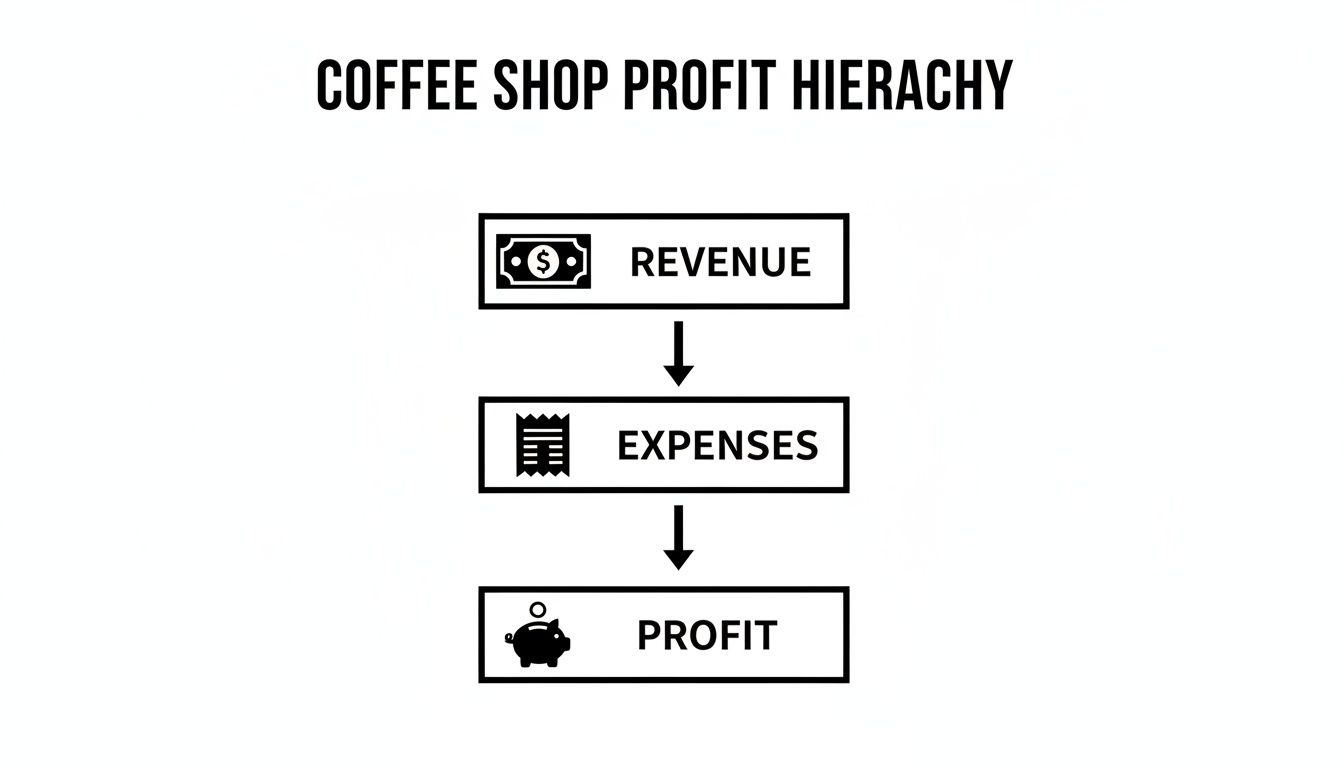
As you can see, revenue is just the starting line. A lot of expenses get subtracted before you get to the finish line, which is your final profit.
The Real Story: Net Profit Margin
While an 80% gross margin feels amazing, it doesn't paint the whole picture because it ignores all the other costs of actually running your business. That's where Net Profit Margin comes in. This is the money left in your pocket after all the bills—rent, barista salaries, utilities, marketing, insurance—are paid.
Net profit is the truest measure of your shop's overall financial success.
Let's expand on our latte example and look at a full month. Imagine your shop brings in $20,000 in revenue.
- Total Revenue: $20,000
- Cost of Goods Sold (COGS): $5,000 (This leaves you with $15,000 in gross profit)
- Labor (Wages & Taxes): $6,000
- Rent & Utilities: $3,000
- Other Operating Expenses (Marketing, Insurance, etc.): $2,000
- Total Expenses: $16,000
To find your net profit, you subtract all those expenses from your total revenue: $20,000 - $16,000 = $4,000 Net Profit. Your net profit margin is ($4,000 / $20,000) x 100 = 20%. That 20% is a much more realistic snapshot of your coffee shop's performance.
By keeping an eye on both gross and net margins, you get the complete picture. A high gross margin tells you your menu is priced right, while a healthy net margin proves your entire business model is sustainable.
Demystifying Your Expenses
Knowing exactly where your money is going is the first step to controlling it. Your expenses generally get sorted into a few key categories that you'll see on your Profit & Loss (P&L) statement.
- Cost of Goods Sold (COGS): This is the direct cost of the products you sell—the coffee beans, milk, syrups, pastries, cups, and lids. Learning how to calculate your https://therestaurantwarehouse.com/blogs/restaurant-equipment/restaurant-food-cost-percentage is a foundational skill for any owner.
- Operating Expenses (OpEx): These are the day-to-day costs of keeping the doors open. Think labor, rent, and utilities.
- General & Administrative (G&A): These are the background costs not directly tied to making a cup of coffee, like your accounting fees, office supplies, and bank charges.
To really get a grip on your profit structure, you have to account for all those indirect costs, including your General & Administrative Expenses. Once you master these categories, your P&L statement stops being a confusing document and becomes a powerful tool for making smarter business decisions.
Pinpointing Your Biggest Margin Killers
That healthy markup on a latte feels great, but it's just the starting point. Between the register and your bank account, a handful of major expenses are constantly chipping away at what you actually get to keep. The secret to a truly profitable coffee shop is mastering these costs.
Think of your revenue as a bucket of water. These big expenses—your margin killers—are like leaks. Your job is to find those leaks and plug them before all your hard-earned profit drains away. For nearly every coffee shop, the leaks fall into three big categories: what you spend on products, what you spend on people, and what you spend on your space. Let's break them down.
The First Margin Killer: Cost of Goods Sold (COGS)
This one’s straightforward: COGS is the direct cost of every single thing you sell. It’s not just the espresso beans. It's the milk, the oat milk, that pump of vanilla syrup, the branded paper cup, the lid, and the sleeve. It's the croissant you sell alongside the coffee. It all adds up.
For a healthy coffee shop, your COGS should land somewhere between 25% and 35% of your total sales. If you run the numbers and find you're creeping past 35%, that’s a red flag. It’s time to play detective.
- Are your suppliers charging too much? It might be time to shop around for better pricing on beans or paper goods.
- Are your baristas over-pouring? A little extra milk in every latte adds up to gallons—and hundreds of dollars—in waste over a month.
- How much is spoiling? Are you tossing out expired pastries or damaged bags of beans?
Getting a handle on these variables is your first line of defense. A good inventory system doesn't just tell you what's on the shelf; it gives you the data to stop waste and buy smarter. If you're looking to tighten things up, our guide on choosing the right restaurant inventory management system is a great place to start.
The Second Margin Killer: Labor Costs
For most shop owners, this is the big one. Labor is almost always your largest single expense, and it’s a tricky beast to tame. The cost isn't just the hourly wage you pay your team—not by a long shot. The true cost of labor is layered.
On top of wages, you have:
- Payroll Taxes: Your contributions for Social Security, Medicare, and unemployment.
- Benefits: Health insurance, paid time off, and retirement plans all add to the real cost per employee.
- Training: You're paying for the time it takes to get a new hire ready to work the bar alone.
- Turnover: The cost to recruit, hire, and train a replacement is a massive, often-ignored drain on profits.
A healthy labor cost for a coffee shop should hover between 25% and 35% of revenue. If you find yourself consistently spending more than this, it's time to analyze your staffing schedules, training efficiency, and employee retention strategies.
This is a huge pain point for owners. According to the Independent Coffee Shop Industry Report, the average net profit for shops like yours is 13.8%, with the most successful operators hitting between 10-25%. The same report found that a staggering 75% of owners say labor is their number one challenge, especially with wages rising 5-7% every year. You can dig into more of these insights about coffee shop industry trends on coffeeshopkeys.com.
The Third Margin Killer: Occupancy Costs
Finally, there's the cost of your four walls. We call this occupancy cost, and it's more than just the rent check you write every month. It’s the total price of having a physical space to welcome customers and brew coffee.
Your total occupancy costs should include:
- Base Rent: The main payment to your landlord.
- CAM Fees: Those "Common Area Maintenance" charges for things like the parking lot or landscaping.
- Property Taxes & Insurance: Your landlord often passes these costs on to you.
- Utilities: Electricity, water, gas, and internet are all part of keeping the shop open and the lights on.
Ideally, all of these costs combined shouldn't eat up more than 10% to 15% of your revenue. This is a largely fixed cost; it stays the same whether you sell ten lattes or a thousand. That means the best way to manage it is to drive more sales. A great location is worth paying for, but an out-of-control lease can sink a great coffee shop before it ever has a chance to succeed.
Actionable Strategies to Grow Your Margins
Knowing where your profits are leaking is only half the battle. Now it's time to get your hands dirty, plug those leaks, and actively boost your coffee shop profit margin. The good news is, you have a surprising amount of control over your bottom line through smart, everyday decisions.
Think of this as your playbook of proven tactics. We're moving beyond theory and diving into concrete steps you can take today to make every sale more profitable, every hour of labor more productive, and every square foot of your shop more valuable.
Engineer a More Profitable Menu
Your menu is more than just a list of what you sell; it’s your single most powerful sales tool. Menu engineering is the art and science of designing your menu to subtly guide customers toward your most profitable items. It’s all about making your star players shine.
Start by calculating the exact profit margin for every single item on your menu—from a basic black coffee to that fancy caramel latte with oat milk and an extra shot. This means knowing the precise cost of every bean, every splash of syrup, and every cup and lid. Once you have that data, you can sort your items into four simple categories.
- Stars: High popularity and high profitability. These are your winners—promote them like crazy!
- Plow Horses: High popularity but low profitability. Can you bump the price up just a bit or find a way to source ingredients for less?
- Puzzles: Low popularity but high profitability. How can you get more people to try these hidden gems? Think better menu descriptions, mouth-watering photos, or staff recommendations.
- Dogs: Low popularity and low profitability. It might be time to cut these from the team. They’re taking up valuable menu space and resources.
By strategically placing your "Stars" in prime menu real estate (like the top-right corner, where eyes go first) and training your baristas to upsell "Puzzles," you can naturally shift sales toward higher-margin items without anyone feeling pressured.
Think of it this way: selling one high-margin specialty latte might generate the same net profit as selling three low-margin black coffees. Menu engineering helps you make that profitable sale happen more often.
Optimize Your Pricing Strategy
Pricing your drinks can feel like walking a tightrope, but it should never be based on guesswork. You don’t want to scare away your regulars, but underpricing is one of the fastest ways to kill your profit margin.
A common and solid approach is cost-plus pricing. You figure out the total COGS for an item and then add a fixed profit percentage on top. For beverages, which have a naturally high gross margin, this markup can be pretty significant.
Another powerful tool is psychological pricing. Ending prices with ".99" or ".95" is a classic retail tactic for a reason—it just feels cheaper. You can also offer bundled deals, like a coffee and a pastry for a set price, which is a great way to increase the average check size while moving specific products.
Master Your Sourcing and Inventory
Your Cost of Goods Sold is a variable you can wrestle into submission with smarter purchasing and tight inventory control. Waste is a silent profit killer; every gallon of expired milk or stale scone is money straight down the drain.
- Conduct Regular Inventory Audits: Don't wait until the end of the month. Frequent spot checks help you catch waste patterns early, like baristas over-pouring milk or being a little too generous with the syrup pumps.
- Negotiate with Suppliers: Don't be afraid to ask for better pricing, especially if you’re a loyal customer. You can also look into joining a group purchasing organization (GPO) with other local cafes to leverage collective buying power for better deals on staples like cups and milk.
- Implement a "First-In, First-Out" (FIFO) System: This simple organizational rule—oldest stock gets used first—is a game-changer for reducing spoilage of perishable items like milk and baked goods.
To truly get a handle on profitability, it helps to analyze your business through the lens of cost centers and profit centers. This mindset gives you a clearer picture of which parts of your operation are making money versus which are costing money.
Enhance Operational Efficiency
Efficiency is all about getting more out of what you already have. In a coffee shop, that means maximizing sales while minimizing wasted time, energy, and resources. Two of the biggest areas to target are your labor schedule and your equipment.
Smart Staffing Schedules
Labor is likely your single biggest expense, so even small tweaks here can have a massive impact on your bottom line. Use the data from your point-of-sale (POS) system to map out your peak and slow hours. The goal is to match your staffing levels directly to customer traffic.
You want to avoid having two baristas on the clock during a predictably dead Tuesday morning, but you absolutely need to be fully staffed for the Saturday morning rush to prevent long waits and lost sales. Cross-training your team to handle multiple roles—from the bar to the register—also creates a more flexible and efficient crew.
Energy-Efficient Equipment
Your espresso machine, grinders, and refrigerators are humming along all day, and they’re hungry for electricity. While it's a long-term play, upgrading to modern, energy-efficient equipment can lead to substantial savings on your monthly utility bills.
Look for ENERGY STAR® certified appliances when it’s time to buy new gear. Even simple maintenance, like regularly cleaning refrigerator coils and making sure door seals are tight, can improve efficiency and lower your energy bill. Check out this detailed coffee shop equipment checklist to see where you might find opportunities for an upgrade.
By implementing these strategies, you can transform your shop from a place that simply sells coffee into a finely tuned operation designed for maximum profitability.
How Different Coffee Shop Models Find Profit
Profit in the coffee world isn't a one-size-fits-all game. A cozy neighborhood spot and a nimble food truck are playing on entirely different fields, each with its own rulebook for chasing a healthy coffee shop profit margin. Understanding their playbooks gives you a set of strategies you can steal for your own operation.
The global appetite for coffee just keeps growing, which is great news for everyone. The market has swelled to $228.12 billion and is expected to hit $290.23 billion by 2032. This isn't just about more people drinking coffee; it's about their willingness to pay for a great experience, with the average specialty cup in the U.S. now costing $4.90. Plus, with food sales making up around 23% of revenue for big chains, it's clear there's a huge opportunity for independents to grow beyond the cup. You can dig into more of this data on global coffee shop market trends at maximizemarketresearch.com.
Let’s break down three distinct models to see how they build profitable businesses from the ground up.
The Neighborhood Café Model
The classic neighborhood café is often in a constant battle with high fixed costs, especially rent. Its path to profit isn’t about having the lowest overhead; it’s about becoming an indispensable part of the community—that "third place" between home and work. This model thrives by maximizing customer loyalty and how much each person spends per visit.
Profitability here really hinges on building a solid base of regulars who stop by multiple times a week. These are the same customers who are much more open to trying a new pastry or grabbing a bag of beans for home.
- Strategy: Drive that repeat business with a simple loyalty program and genuinely personal service that makes people feel like they belong.
- Key Metric: Keep a close eye on Customer Lifetime Value (CLV). A regular who spends $15 a week is worth nearly $800 a year in revenue.
- P&L Snapshot: Rent might eat up a hefty 15% of revenue, but strong, consistent sales and higher-margin food items are what protect that final net profit.
The Coffee Food Truck Model
The coffee food truck flips the traditional model on its head. It trades a permanent address for extreme mobility and drastically lower overhead, offering a more direct route to a higher profit margin if you manage it well.
With no rent, property taxes, or massive utility bills, the biggest expenses become fuel, vehicle maintenance, and event fees. The core strategy is beautifully simple: go where the people are.
A food truck's success is tied to its schedule. By targeting high-traffic areas like business parks on weekday mornings, farmers' markets on weekends, and private catering events, a truck can generate revenue streams that a brick-and-mortar location could never access.
This model's financial strength is rooted in its incredibly low break-even point.
- Strategy: Build a dynamic schedule that follows demand, squeezing the most sales out of every hour you're open.
- Key Metric: Track sales per event or location. This tells you which spots are goldmines and which ones are duds you should cut.
- P&L Snapshot: Occupancy costs are almost zero. Labor and COGS are your main expenses, allowing a well-run truck to potentially hit a net profit margin of over 25%.
The Multi-Unit Operator Model
Scaling from one shop to many brings a whole new level of complexity, but it also unlocks some powerful advantages through economies of scale. The multi-unit operator finds profit through smart systems, standardization, and bulk purchasing power.
When you're buying coffee beans, milk, and cups for five locations instead of one, your cost for each unit drops significantly. That immediately boosts the gross margin on every single item sold across the entire company.
On top of that, centralizing tasks like payroll, marketing, and accounting reduces the administrative burden on each location. Every new shop gets to launch with an existing, proven operational playbook, which minimizes the risks and guesswork that come with opening your very first spot.
- Strategy: Standardize everything—from recipes and workflows to branding and customer service—to ensure consistency and peak efficiency.
- Key Metric: Analyze profit and loss statements on a per-store basis. This helps you spot your top performers and diagnose issues at any struggling locations.
- P&L Snapshot: While an individual store’s margin might look like the industry average, the collective profit gets amplified by those reduced COGS and streamlined admin costs.
Common Questions About Coffee Shop Profitability
Running a coffee shop means you’re constantly juggling questions about the financial side of the business. You're probably wondering what a realistic profit margin looks like for a brand-new shop, or maybe you're wrestling with whether adding a food menu is a smart move. These are the kinds of challenges that every owner faces.
Let's cut through the noise and tackle some of the most frequent questions we hear. My goal is to give you straightforward answers you can actually use to make smarter, more profitable decisions for your café. Understanding these common hurdles is key to building a business that doesn't just survive, but thrives.
What Is a Good Profit Margin for a New Coffee Shop?
Honestly, for a brand-new coffee shop, just breaking even in that first year is a massive win. A realistic net profit margin to aim for in years one and two is somewhere in the 2-6% range. This is naturally going to be lower than the industry average because you're dealing with startup costs, heavy marketing expenses, and the time it takes to build a loyal following.
Your initial focus should be on keeping a death grip on your variable costs—things like inventory and labor—while you hustle to grow your sales. As your shop matures and really finds its footing in the community, that industry average of 10-25% becomes a much more achievable goal.
It’s a marathon, not a sprint. The early years are all about survival and establishing your brand. Profitability follows a solid operational foundation; it doesn't come first.
How Can I Increase My Profit Margin Without Raising Prices?
Raising prices is the most obvious lever to pull, but it's far from your only one. You can seriously boost your coffee shop's profit margin by getting smarter about your costs and how you sell.
- Do a Waste Audit: This sounds tedious, but it's gold. Track every drop of spilled milk, every pastry that gets tossed, and every over-poured shot of syrup. You can't fix what you can't see, and this is the first step to cutting down your COGS.
- Optimize Your Staffing: Dive into your POS data to see your actual customer flow. Staffing your shop based on real traffic, not just guesswork, is one of the fastest ways to trim your biggest expense without hurting service.
- Talk to Your Suppliers: Don't be shy about asking your vendors for better terms, especially as your order volume grows. You can also look into joining a group purchasing organization to get better deals on essentials like cups and dairy.
- Engineer Your Menu: Gently guide customers toward your highest-margin items. Use better descriptions, place them strategically on the menu, and train your staff to recommend them. It's a subtle art that pays off.
Does Adding Food Always Increase My Overall Profit?
Not always. This is a classic trap. While adding food can absolutely boost your total revenue, it can wreck your overall profit margin if you’re not careful. Food typically has a much lower gross margin (around 50-65%) compared to the sky-high margins on coffee (often 75-80% or even more).
The key is to be strategic. Choose food items that complement your coffee program without demanding a ton of extra labor or expensive new equipment. Think high-quality pastries from a local bakery, pre-made sandwiches, or simple-to-assemble items like yogurt parfaits. You want to avoid complex dishes that need a dedicated cook unless you have the sales volume to justify those added costs.
Remember, food should be a profitable add-on, not a financial anchor that drags down your successful beverage program.
At The Restaurant Warehouse, we understand that outfitting your coffee shop for maximum profitability means finding the right balance of quality, efficiency, and cost. From energy-efficient espresso machines that lower your utility bills to durable worktables that optimize your workflow, we provide the essential tools you need to succeed. Explore our extensive selection of commercial kitchen equipment and flexible financing options to build a more profitable cafe today at https://therestaurantwarehouse.com.
About The Author

Sean Kearney
Sean Kearney is the Founder of The Restaurant Warehouse, with 15 years of experience in the restaurant equipment industry and more than 30 years in ecommerce, beginning with Amazon.com. As an equipment distributor and supplier, Sean helps restaurant owners make confident purchasing decisions through clear pricing, practical guidance, and a more transparent online buying experience.
Connect with Sean on LinkedIn, Instagram, YouTube, or Facebook.