

How to Choose a Commercial Hand Wash Basin
We spend a lot of time thinking about ovens, fryers, and prep tables, but one of the most important pieces of equipment in your kitchen is often overlooked. The commercial hand wash basin is the unsung hero of food safety. Unlike a residential sink, it’s engineered to handle constant use, harsh chemicals, and the strict standards of health inspectors. A well-chosen basin protects your staff and customers, streamlines your cleaning process, and signals your commitment to hygiene. This article breaks down the essential features, materials, and mounting styles to help you find the perfect fit for your space.
Why Choosing the Right Commercial Hand Wash Basin is a Big Deal
Image caption: A commercial hand wash basin with a deep bowl, integrated backsplash, and touchless faucet to reduce splashing and cross-contamination in high-traffic environments.
In any professional environment, the humble commercial hand wash basin serves as a vital gatekeeper against the spread of germs. It is more than just a sink; it is a cornerstone of public health, a requirement for regulatory compliance, and a visible reflection of your organization's commitment to safety. Unlike a residential sink chosen primarily for aesthetics or light use, a commercial basin is engineered as a specialized fixture for high-demand settings. It must withstand hundreds of uses daily, resist aggressive cleaning chemicals, and meet strict health and accessibility codes without compromising efficiency or user comfort.
The differences are significant. A commercial basin is typically constructed from heavy-duty materials—most often 16- or 18-gauge stainless steel—that resist denting, warping, and corrosion. It is designed with hygienic features like deep bowls to minimize splashing, integrated backsplashes to protect walls and limit water intrusion, and touchless faucet compatibility to reduce cross-contamination. It should also align with ADA accessibility requirements when properly installed, ensuring inclusive access for all users. In short, a well-chosen basin does the quiet, unglamorous work that helps your operation maintain a safe, clean, and compliant environment day after day.
The stakes are high. Effective hand hygiene has been repeatedly shown to reduce illness transmission in high-density settings. According to the Centers for Disease Control and Prevention, proper handwashing is one of the most effective ways to prevent the spread of germs and infections. Making handwashing convenient, intuitive, and reliable is one of the most cost-effective ways to protect both your team and your guests.
From foodservice to healthcare to public venues, the right basin provides measurable advantages:
- It helps prevent slip hazards and wall damage by containing water within the bowl and backsplash area.
- It streamlines daily cleaning by reducing splatter, drips, and hard-to-reach seams where grime accumulates.
- It supports training and compliance by providing a designated, well-equipped station that encourages frequent, proper handwashing.
- It protects your reputation, signaling to staff, guests, patients, and inspectors that hygiene is a top priority.
If you are upgrading or outfitting a new space, the key is to pair the basin's material and construction with the right mounting style, faucet technology, and accessories for your environment. This guide simplifies those choices so you can invest with confidence—balancing durability, hygiene, compliance, and cost-of-ownership from day one.
Ready to get specific? Explore commercial hand wash basins and accessories now: https://therestaurantwarehouse.com/collections/hand-sinks.
Need personalized guidance for your facility layout or compliance plan? Contact us: https://therestaurantwarehouse.com/pages/contact-us.
What's Your Basin Made Of? A Guide to Materials
Choosing the right material for your commercial hand wash basin is the foundation of its performance, longevity, and regulatory compliance. In busy environments, a basin endures constant use, harsh sanitizers, hard water, and the occasional impact. Your selection directly influences hygiene, maintenance requirements, total cost of ownership, and the likelihood of sailing through health inspections.
Image caption: Material comparison—stainless steel, vitreous china, and solid surface—each with distinct strengths for commercial hand wash stations.
Stainless steel dominates commercial use due to its unmatched balance of durability, hygiene, and value. Its non-porous surface is easy to sanitize, leaving bacteria and grime with few places to hide. Properly formulated stainless steel resists corrosion and rust, preserving a professional appearance even after years of exposure to water and chemicals. Just as importantly, it can be formed into seamless, crevice-free contours that speed cleaning and reduce the risk of biofilm buildup.
Vitreous china (ceramic) provides a hard, high-gloss glazed surface with excellent stain resistance. It is often chosen for front-of-house restrooms, hospitality venues, and patient-facing areas where a crisp, non-industrial aesthetic is preferred. Many vitreous china basins handle routine cleanings well, though they are more susceptible to chipping if struck by hard objects compared to heavy-gauge steel.
Solid surface composites represent a premium choice, especially in upscale or design-centric spaces. These materials enable sleek, seamless forms—including integrated counters and backsplashes—eliminating joints where water and contaminants can collect. A key benefit is repairability: minor scratches and small chips can often be sanded and refinished on-site, potentially extending service life without replacement.
Which material is right for you? Consider the following:
- Food service: Prioritize sanitary, non-porous surfaces that tolerate frequent disinfection. High-grade stainless steel is a practical workhorse and typically the most inspection-friendly option.
- Healthcare: Infection control rules the decision. Seamless designs, non-porous materials, and hands-free operation are common requirements.
- Public restrooms and transit hubs: Durability and vandal resistance are crucial; thick-gauge stainless steel and tamper-resistant fixtures offer long-term reliability.
- Upscale venues: Where design is paramount, vitreous china or solid surface may be preferred, provided cleaning protocols are maintained.
Understanding stainless steel grades and gauges
Not all stainless is created equal. Two specifications determine how a basin performs under real-world stress: grade and gauge.
- Grade refers to the alloy composition. In most commercial applications, 304 stainless steel is the benchmark. Its chromium and nickel content provide excellent corrosion resistance, a must for frequent cleaning and exposure to moisture. Lower-cost 430 stainless steel is available but offers reduced corrosion resistance, which can translate into staining or rust in harsh environments. For long-term value, 304 typically wins.
- Gauge refers to thickness. The lower the number, the thicker and more robust the steel. Sixteen-gauge is the most rugged choice for heavy traffic and occasional impacts; 18-gauge offers a balance of durability and cost that suits many standard applications. Thicker gauges resist denting and sound less “tinny” when in use.
Bowl geometry and structure matter
A deeper bowl—typically 5 inches or more—helps keep water within the basin, reducing splashback on users and floors. Integrated backsplashes and side splashes protect nearby walls, grout lines, and surfaces from persistent moisture. Pay attention to the transition between the bowl and backsplash; smooth, radiused corners are faster to clean and less likely to trap residue.
Cleanability details that save labor
- Crevice-free seams and tight welds minimize food or soap buildup.
- Brushed finishes on stainless can disguise minor scuffs while maintaining a professional look.
- Drain assemblies should be easy to remove and clean; basket strainers help prevent clogs during peak use.
- Consider pre-punched faucet holes that match your faucet specification to avoid field modifications.
Ownership costs over time
While budget dictates many decisions, selecting a cheaper, thin-gauge 430 stainless basin may increase total costs through repairs, staining, or early replacement. The sweet spot for many operators is a 304 stainless basin in 16- or 18-gauge with a simple, cleanable geometry. These models typically deliver years of reliable service with minimal downtime.
CTA: Explore durable, code-friendly hand wash basins now: https://therestaurantwarehouse.com/collections/hand-sinks.
Prefer help matching materials to your environment or local code requirements? Contact us for tailored recommendations: https://therestaurantwarehouse.com/pages/contact-us.
The Benefits of Stainless Steel
Stainless steel is the undisputed champion in commercial settings, and for good reason. It strikes an ideal balance between durability, hygiene, and long-term value that’s tough to beat. Its non-porous surface is a health inspector's dream, as it gives bacteria, food particles, and grime nowhere to hide and is incredibly easy to sanitize. A well-made stainless steel basin resists rust and corrosion, maintaining a clean, professional look even after years of exposure to water and harsh cleaning chemicals. Plus, it can be molded into seamless designs with rounded corners, which not only speeds up daily cleaning but also drastically reduces the risk of nasty biofilm buildup in hard-to-reach crevices. It’s the practical, reliable workhorse for any serious foodservice operation.
Exploring Composite Materials
For spaces where aesthetics are just as important as function, solid surface composites are a premium choice. Often found in upscale restaurants or design-focused public restrooms, these materials allow for sleek, seamless forms. You can even find basins with integrated countertops and backsplashes, completely eliminating the joints and seams where water and germs love to collect. One of their biggest advantages is repairability. Unlike ceramic that can chip permanently, minor scratches or dings in a solid surface basin can often be sanded and refinished on-site. This feature can significantly extend the basin's service life, protecting your investment while keeping your facility looking sharp. It’s an excellent option when you need to impress guests without compromising on cleanliness.
Which Basin Style is Right for Your Space?
The mounting style of a commercial hand wash basin can streamline your workflow, simplify cleaning, and ensure code compliance. The best choice depends on space constraints, the audience you serve, and how your staff moves through the environment.
Wall-mounted basins: The space-saving standard
Wall-mounted basins are common in back-of-house areas and compact restrooms because they free floor space and make mopping easy. When installed at ADA-compliant heights, they inherently provide clear knee and toe clearance. Ensure your wall has adequate blocking or studs to support the fixture and withstand repeated, vigorous use. In high-traffic areas, pair wall-mounted basins with splash guards or integrated backsplashes to keep adjacent surfaces dry.
Inset and countertop basins: Integrated and guest-facing
Inset (drop-in) and countertop basins provide a clean, integrated look that suits customer-facing restrooms or hospitality venues. This approach enables you to combine a durable basin with attractive counter materials—granite, quartz, or solid surface—without sacrificing cleanability. Precise cutouts and careful sealing around the rim are essential to prevent leaks, swelling, or mold under the counter. If you expect heavy use, specify counters that resist chemical cleaners and moisture.
Other mounting options
- Corner-mount basins: Ideal for tight footprints or to satisfy a dedicated handwashing requirement in a narrow prep alcove. They maximize every inch of usable space.
- Freestanding or pedestal basins: Selected for design impact in boutique settings, spas, or stylish lounges. If you choose this route, verify ADA clearance and consider tamper-resistant fixtures in public areas.
Choosing based on workflow and cleaning
- If housekeeping access is critical, prioritize wall-mounted units that allow unobstructed floor cleaning.
- Where guest experience matters most, opt for inset/countertop styles with matching accessories and easy-reach touchless faucets.
- In small service corridors or mobile stations, corner units can satisfy code without bottlenecking foot traffic.
Pairing accessories with mounting style
No matter the mounting style, a complete station includes soap and paper towel dispensers within easy reach, clear signage for staff, and proper lighting to encourage frequent use. Where vandal resistance is a concern, specify tamper-resistant fasteners and concealed plumbing.
CTA: See popular wall-mounted and corner hand sinks for tight spaces: https://therestaurantwarehouse.com/collections/hand-sinks.
Have a tricky layout or multiple stations to plan? Talk to a specialist: https://therestaurantwarehouse.com/pages/contact-us.
Multi-Person Washing Stations
When you need to accommodate a high volume of users at once, a single basin just won’t cut it. Multi-person washing stations, often called washfountains, are designed for exactly these scenarios. You’ll find them in large event venues, schools, and high-capacity production kitchens where efficiency is key. These units, typically circular or semi-circular, allow several people to wash their hands simultaneously, which keeps traffic flowing and reduces wait times during peak periods. Many models feature hands-free operation through foot pedals or infrared sensors, a critical feature for minimizing cross-contamination in busy environments. Built from durable materials like stainless steel, they are engineered to handle constant use while simplifying cleaning and maintenance for your staff.
Portable Hand Sinks for Flexibility
What happens when you need a handwashing station where there’s no plumbing? That’s where portable hand sinks come in. These self-contained units are a must-have for food trucks, outdoor caterers, and vendors at farmers’ markets or festivals. A typical portable sink includes separate tanks for fresh and waste water, along with a foot pump to dispense water, ensuring you can meet health code requirements anywhere you do business. Having a dedicated, code-compliant station for handwashing on-site is non-negotiable for any mobile food operation. It demonstrates your commitment to safety and allows you to operate professionally and hygienically, no matter the location.
Specialized Sinks for Healthcare Settings
While foodservice has strict hygiene standards, healthcare environments take them to another level. Specialized scrub sinks used in hospitals, dental offices, and clinics are designed with one primary goal: infection control. These sinks feature extra-deep basins to contain splashing during the vigorous, timed scrubbing that surgeons and medical staff perform. Operation is almost always hands-free, often using knee-operated panels or foot pedals to control water flow, eliminating any need to touch a faucet after sanitizing. As the Facility Guidelines Institute standards show, every detail in these settings is engineered to prevent the transfer of pathogens, reinforcing just how critical purpose-built design is for maintaining a safe environment.
Don't Overlook These Key Basin Features
The details of a commercial hand wash basin separate ordinary fixtures from reliable, inspection-ready stations. From bowl depth to faucet type, each feature influences hygiene, user experience, and maintenance time.
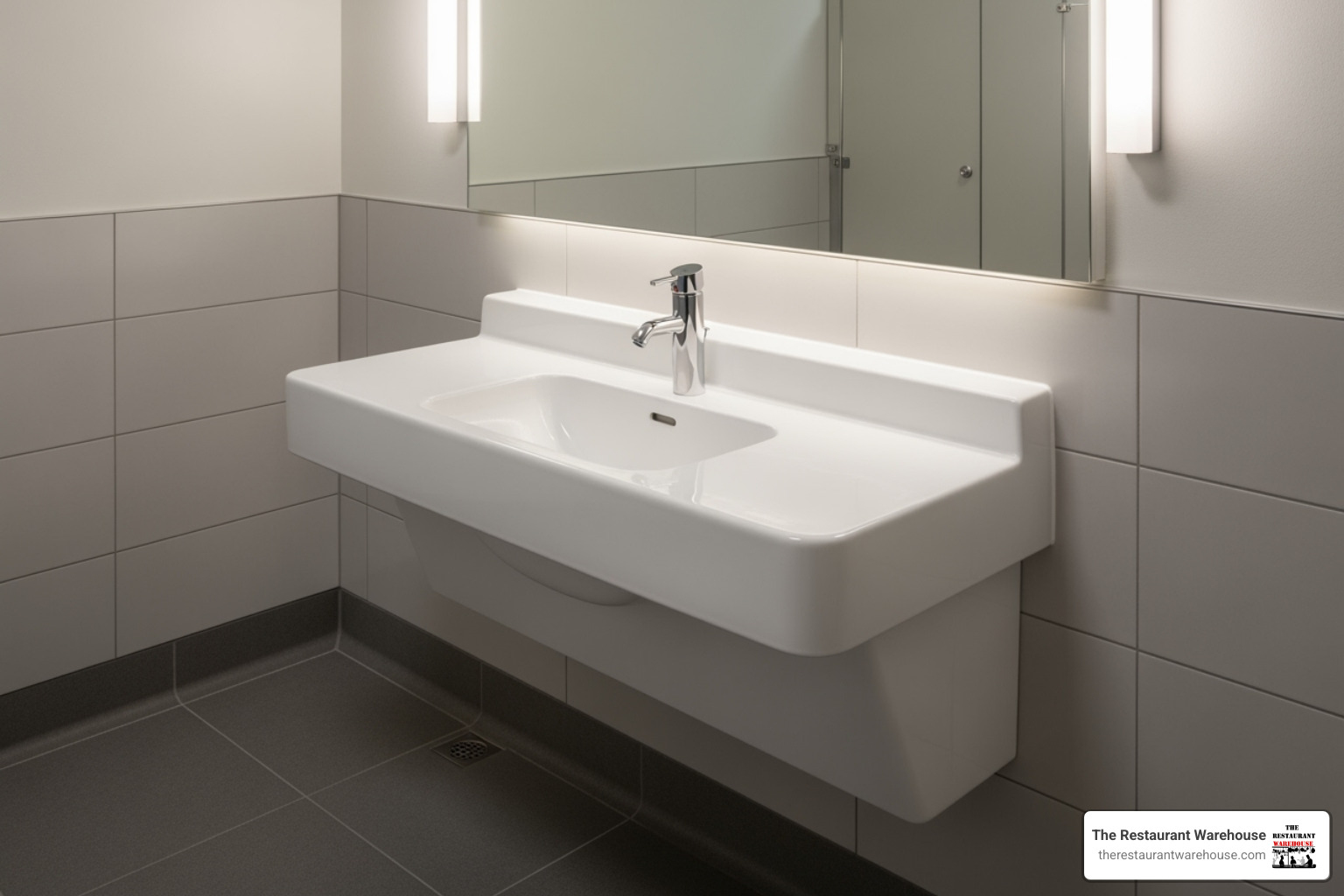
Image caption: ADA-ready handwashing station with touchless faucet, correct rim height, and clear knee/toe clearance to improve accessibility and throughput.
Key features to specify
- Bowl size and depth: A 5-inch or deeper bowl reduces splash and keeps water within the sink area, cutting down on wet floors and slip hazards.
- Backsplashes and side splashes: Integrated vertical panels protect walls from moisture and make daily wipe-downs faster. Seamless transitions and radiused corners reduce grime traps.
- Faucet configuration: Choose pre-punched holes to match your preferred faucet type—single-hole (single-handle or sensor), 4-inch centerset, or 8-inch widespread. Align your choice with local code and ADA requirements for easy operation.
- Drain and waste fittings: Look for removable strainers or baskets to capture debris and prevent clogs. Quick-to-clean drains reduce downtime during rush periods.
- Soap and towel access: Mount soap dispensers and towel dispensers within easy reach and on the same approach path as the faucet. Signage near the basin encourages correct handwashing technique.
Touchless technology and water management
Sensor-activated faucets and automatic soap dispensers are now standard in many commercial settings. Benefits include reduced cross-contamination (hands never touch faucet handles after washing), improved water conservation through auto-off controls, and better ADA alignment. Low-flow aerators further reduce consumption without compromising user experience.
In facilities with heightened sanitation demands, knee- or foot-operated valves offer a robust, non-electrical alternative. Where power is limited, battery-powered sensors can be paired with manual backups to maintain uptime.
Durability and maintenance choices
- Select faucet finishes and valve types proven to handle frequent cleaning agents.
- Where vandalism is a concern, specify tamper-resistant aerators and shrouded supply lines.
- If lime scale is common, consider cartridges and aerators that can be cleared or replaced without specialized tools.
Ergonomics and throughput
- ADA-compliant lever, push-button, or sensor controls enable operation with minimal force and one hand.
- Provide visual contrast between faucet, soap, and towel dispenser to help users navigate quickly.
- Position dispensers and trash receptacles to create a logical flow: approach, dispense soap, wash, rinse, dry, discard, exit—without cross-traffic.
CTA: Equip your station with compatible faucets and accessories in one place: https://therestaurantwarehouse.com/collections/hand-sinks.
Have ADA or layout questions? Our team can help you specify the right features: https://therestaurantwarehouse.com/pages/contact-us.
Integrated All-in-One Systems
To simplify installation and create a cohesive look, many facilities opt for integrated, all-in-one handwashing systems. These units combine the basin, faucet, soap dispenser, and sometimes even a hand dryer into a single, streamlined fixture. This approach not only reduces wall clutter but also guides users through the handwashing process in a logical sequence. By consolidating plumbing and electrical connections, installation can be faster and more predictable than sourcing and mounting individual components. For high-traffic restrooms, these systems offer a clean, modern aesthetic while ensuring all necessary functions are within easy reach, which can help improve user throughput and overall hygiene compliance.
Touchless Faucet Technology
Hands-free technology is no longer a luxury; it’s a standard for modern commercial restrooms. Touchless faucets, activated by sensors or foot and knee pedals, are one of the most effective ways to reduce cross-contamination. Since users never have to touch the fixture after washing, the transfer of germs from the faucet handle is completely eliminated. This feature is especially critical in foodservice and healthcare environments where hygiene is paramount. Beyond sanitation, these systems signal a commitment to modern standards, providing a better, safer experience for both staff and guests. When selecting a touchless system, consider the power source—hardwired or battery-operated—and the durability of the sensor to ensure reliable, long-term performance.
Water-Saving Flow Rates
A major benefit of modern touchless faucets is their built-in water efficiency. Most are designed with low-flow aerators that restrict the flow rate to 0.5 or even 0.35 gallons per minute (GPM), a significant reduction from older, less efficient models. This controlled flow saves a tremendous amount of water and reduces utility costs over the life of the fixture, all without compromising the user's ability to rinse effectively. Because the water only runs when hands are detected, you also eliminate waste from faucets being left on accidentally, making it a smart financial and environmental choice.
Automatic Line Flushing
In buildings where sinks may not be used consistently every day, stagnant water in the supply lines can become a breeding ground for bacteria. To combat this, some advanced touchless faucets include an automatic line flushing feature. This function automatically runs water for a short period, typically every 24 hours, to purge the lines and ensure fresh water is always available at the tap. This proactive hygiene measure is an important safeguard for maintaining water quality and safety, particularly in schools, clinics, or office buildings with fluctuating occupancy.
Smart Soap Dispenser Features
Just like faucets, soap dispensers have become more intelligent and user-friendly. Modern dispensers, especially those designed to pair with touchless faucets, often include features that simplify maintenance and improve reliability. Look for models with indicator lights that signal low soap or low battery levels, allowing your staff to refill them proactively before they run empty. Many are also designed to be refilled easily from the top to prevent messy spills under the counter. For public-facing restrooms, vandal-resistant designs and durable materials ensure the dispenser remains functional and secure, providing a consistent and hygienic experience for every user.
Common Faucet Styles
Functionality doesn't have to come at the expense of design. Commercial faucet manufacturers offer a variety of styles to match the aesthetic of your space, from sleek and minimalist to more traditional forms. You can often find coordinated collections—like the Crestt, Metro, or Zen series—that allow you to match the faucet style with soap dispensers and other hardware for a unified look. Choosing a style that complements your overall design reinforces a sense of quality and attention to detail, whether it's in an upscale restaurant restroom or a corporate office. The key is to find a balance between a durable, easy-to-clean design and an appearance that fits your brand.
Gooseneck Faucets
One of the most practical and popular styles in commercial settings is the gooseneck faucet. Its high, arching spout provides ample clearance between the faucet head and the bottom of the basin. This extra space makes it much easier for users to wash their hands and forearms without touching the sink surfaces, a critical requirement for food handlers and medical staff who must follow strict handwashing protocols. The generous clearance also simplifies the process of filling tall containers, adding a layer of utility to the handwashing station.
Integrated Safety Features
In certain work environments, a hand sink must do more than just provide soap and water. For kitchens, laboratories, or industrial settings where staff handle harsh chemicals or foreign materials, safety is a top priority. Some specialized commercial sinks are designed as multi-functional stations that incorporate essential safety equipment directly into the unit. This integration ensures that emergency response tools are immediately accessible at the point of need, which can be critical in preventing serious injury. It also helps facilities meet OSHA requirements for emergency fixtures without cluttering the workspace with separate, standalone units.
Built-in Eyewash Stations
A prime example of an integrated safety feature is the built-in eyewash station. These units combine a standard handwashing faucet with a secondary, ANSI-compliant eyewash fountain. If an employee gets cleaning chemicals, hot grease, or debris in their eyes, they can immediately flush them at the nearest sink. This dual-functionality saves valuable space and ensures that emergency eye care is never more than a few steps away. For any commercial kitchen or facility using potentially hazardous substances, an integrated eyewash station is a practical and vital safety investment.
Matching Aesthetics with Faucet and Dispenser Styles
Creating a cohesive and professional look in your restroom or handwashing area goes a long way in shaping user perception. When you select faucets, soap dispensers, and even paper towel dispensers from the same design family, you create a visually organized and intentional space. This is more than just aesthetics; a well-designed station with matching finishes and sleek forms is often easier to clean because it eliminates mismatched joints and crevices where grime can collect. By sourcing a complete package of restaurant equipment and fixtures, you can ensure every component works together functionally and visually, reinforcing your commitment to cleanliness and quality.
What to Know About Compliance, Cost, and Installation
Choosing a commercial hand wash basin goes beyond the model number. It requires understanding regulations, planning for installation logistics, and weighing long-term costs. Getting these elements right helps you pass inspections, protect users, and avoid expensive rework.
Regulatory standards that matter
- ADA (Americans with Disabilities Act): To be accessible, the basin rim must be 34 inches maximum above the finished floor, with adequate knee and toe clearance beneath. Controls must be operable with one hand and minimal force—lever, push-button, or sensor-activated faucet designs typically qualify. Confirm approach clearances and mounting heights during layout.
- NSF (National Sanitation Foundation): In food-related environments, look for NSF/ANSI 2 compliance. This indicates the fixture is constructed from safe, cleanable materials with smooth, non-porous surfaces and sanitary transitions that minimize bacterial harborage.
- Local health departments: Jurisdictions may specify the number of handwash stations, their proximity to specific work areas, minimum water temperatures, and signage requirements. Confirm these rules before ordering.
For broader federal guidance referenced by many inspectors, review the FDA Food Code, which provides comprehensive standards for food safety and sanitation in commercial establishments.
Installation planning and environment-specific needs
- Structural support: Wall-mounted basins require blocking or stud reinforcement to handle repeated use. Confirm load ratings and fastener specifications.
- Plumbing access and protection: Ensure supply and drain lines are correctly sized and protected. In public settings, conceal or guard supplies to deter tampering.
- Splash management: Select basins with integrated backsplashes or add side splashes near corners and partitions. Proper splash control preserves adjacent finishes and reduces mold risk.
- Electrical considerations: For sensor faucets and automatic dispensers, verify outlet locations or plan for battery-powered components with maintenance schedules for battery replacement.
Environment-specific priorities
- Food service: Many codes require a dedicated handwashing sink within a set distance—often 15–25 feet—of prep or dish areas. Provide soap, sanitary drying (paper towels or air dryers, per local rules), and visible signage. Keep the approach path unobstructed.
- Healthcare: Infection control drives decisions. Favor seamless, non-porous surfaces, hands-free operation, and components that tolerate medical-grade disinfectants.
- Public venues: Vandal resistance is key. Specify heavy-gauge stainless steel, tamper-resistant fasteners, and concealed plumbing where feasible.
Budgeting beyond the sticker price
The least expensive basin is not always the most economical choice. Consider:
- Material grade and gauge: 304 stainless steel in 16- or 18-gauge typically outlasts thinner or lower-grade alternatives, reducing replacement frequency.
- Cleanability: Seamless designs, radiused corners, and accessible drains lower daily labor and supplies costs.
- Compatibility: Pre-punched faucet holes, matched drains, and included splash guards can reduce installation time and field modifications.
CTA: Plan your compliant handwashing stations with our specialists—Book a strategy call or request a layout review: https://therestaurantwarehouse.com/pages/contact-us.
Ready to specify durable, inspection-ready basins? Shop our hand sink collection: https://therestaurantwarehouse.com/collections/hand-sinks.
Understanding the Investment
When you're budgeting for a commercial hand wash basin, it's easy to focus on the sticker price. But the true cost goes far beyond the initial purchase. Think about the complete picture: installation, long-term maintenance, and the potential for expensive rework if you fail a health inspection. A cheaper sink might save you money today, but if it’s made from lower-grade steel that rusts or has hard-to-clean crevices, you’ll pay for it later in labor costs and replacement fees. Investing in a durable, compliant sink from the start protects your staff, satisfies inspectors, and keeps your operation running smoothly. It’s a foundational piece of equipment, and managing the upfront cost with options like equipment financing can make it easier to get the right fixture without compromising your budget.
Sample Costs for Specialized Sinks
To give you a clearer idea of what to expect, costs can vary widely based on size, features, and the number of stations. For example, a single hand wash-up sink might run just over $1,100. If you need a multi-user station, the price increases accordingly. A three-station wash sink could be in the $4,300 range, while a larger four-station model with sensor faucets might cost over $7,000. These figures are just examples, but they show how features like hands-free operation and multi-person capacity influence the price. The key is to balance your specific needs with your budget, ensuring you get a sink that meets code without overspending on features you don't require. You can find a wide range of affordable equipment that delivers on quality and compliance.
Leading Commercial Sink Brands
As you shop, you’ll come across several well-known brands that have built a reputation for quality and reliability in the commercial space. Names like Elkay, Bradley, Zurn, and Sloan are fixtures in the industry because they consistently produce durable products that meet stringent health and safety standards. These brands are often specified by architects and designers because they are trusted to perform in high-demand environments like restaurants, hospitals, and public venues. While these leading names offer excellent products, it’s also good to know that many other manufacturers provide high-quality, code-compliant sinks at a more accessible price point. The most important factor is ensuring the sink you choose is made from sanitary materials and is built to withstand the rigors of your specific workplace.
Frequently Asked Questions about Commercial Hand Wash Basins
What is the main difference between a commercial and a residential sink?
Commercial basins are purpose-built tools for high-demand environments. They use thicker, more durable materials (often 16- or 18-gauge 304 stainless steel), prioritize cleanability with deep bowls and sanitary seams, and are designed to meet ADA and (where applicable) NSF requirements. Residential sinks, by contrast, emphasize aesthetics and light-duty use and are not typically held to those commercial standards.
How far should a hand wash sink be from a food prep area?
Local health codes vary, but a common guideline places a dedicated handwashing station within about 15–25 feet of any food prep, service, or dish area. The principle is accessibility—an inconveniently located station is less likely to be used. The path should be unobstructed, with soap and sanitary drying immediately available.
Why is stainless steel so common in commercial settings?
Stainless steel offers a hygienic, non-porous surface that withstands frequent cleaning and harsh sanitizers. Grade 304 stainless balances corrosion resistance and durability, making it suitable for most commercial environments. It also delivers long-term value, often outlasting lower-grade or thinner alternatives.
Which faucet style should I choose—sensor, lever, knee, or foot?
- Sensor faucets reduce cross-contamination, conserve water, and typically align with ADA operation requirements. They are excellent for most front- and back-of-house applications.
- Lever handles are simple and durable, provided they require minimal force and can be operated with one hand to meet ADA.
- Knee and foot valves offer dependable hands-free operation without electricity, ideal in high-sanitization or utility-heavy areas.
What bowl depth is best?
A bowl depth of 5 inches or more helps contain splash and keeps water inside the basin. This protects floors from slip hazards and reduces the cleaning burden around the station.
Do I need an integrated backsplash?
In many installations, yes. Integrated backsplashes shield the wall from constant moisture, protect finishes, and simplify cleaning. In corner or close-to-wall placements, consider side splashes as well.
What accessories complete a compliant handwashing station?
- Soap dispenser (manual or automatic) mounted within easy reach
- Paper towel dispenser or approved drying method per local code
- Clear, visible signage with handwashing instructions
- Waste bin positioned to support a smooth wash-dry-dispose flow
How do ADA requirements affect installation?
To meet ADA, keep the basin rim at or below 34 inches, ensure adequate knee and toe clearance, and use controls operable with one hand and minimal force. Confirm approach and turning clearances as part of your overall restroom or prep-area design.
What if I have hard water or frequent scaling?
Choose faucets with accessible aerators and serviceable cartridges. Consider scheduled descaling and select finishes that tolerate approved cleaning products. Basket strainers help keep debris out of drains, reducing maintenance.
How can I improve durability in public venues?
Select 16-gauge stainless steel where feasible, specify tamper-resistant fasteners and concealed plumbing, and use heavy-duty sensor faucets or shielded lever designs. Reinforce walls for wall-mounted basins and protect corners with guards.
Can I integrate a handwashing station into a design-forward restroom?
Yes. Consider vitreous china or solid surface basins for an elevated look, provided you maintain easy-to-clean geometries and adhere to ADA and local code. Touchless faucets with sleek profiles blend form and function.
Still have questions or need help matching a basin to your code requirements? Contact us for tailored support: https://therestaurantwarehouse.com/pages/contact-us.
Explore popular models and accessories in one place: https://therestaurantwarehouse.com/collections/hand-sinks.
Ready to Choose Your Commercial Hand Wash Basin?
Choosing the right commercial hand wash basin underpins safety, compliance, and operational efficiency across your entire facility. Materials and construction determine durability and cleanability; mounting style and bowl geometry influence ergonomics and daily housekeeping; faucets and accessories shape hygiene outcomes and water use; and careful attention to ADA/NSF and local codes ensures smoother inspections and a consistent user experience.
By prioritizing thick-gauge, cleanable materials; touchless or low-force controls; splash management; and code-aligned installation details, you make a high-impact, long-term investment in public health and your organization’s reputation. Whether you operate a busy restaurant, a healthcare clinic, or a public venue, a well-specified handwashing station is a non-negotiable asset that pays dividends through fewer incidents, faster cleaning, and a better experience for every user.
Ready to take the next step?
- Shop inspection-ready commercial hand wash basins: https://therestaurantwarehouse.com/collections/hand-sinks
- Book a strategy call or request a spec review: https://therestaurantwarehouse.com/pages/contact-us
Key Takeaways
- Invest in the Right Material for Long-Term Value: Your hand wash basin is a workhorse, not a design piece. Opting for durable, non-porous materials like 16- or 18-gauge 304 stainless steel is a smart investment that prevents rust, withstands heavy use, and ensures you pass health inspections for years to come.
- Select Features That Enhance Both Hygiene and Workflow: Look beyond the basic sink and focus on functional details. A deep bowl and integrated backsplash will contain splashes to keep floors dry and safe, while a touchless faucet is one of the most effective ways to reduce cross-contamination in a busy kitchen.
- Plan for Full Compliance, Not Just the Fixture: A compliant handwashing station is more than just the sink itself. You must ensure it's installed at the correct ADA-compliant height, located conveniently according to local health codes, and equipped with easily accessible soap and towel dispensers to be truly effective and inspection-ready.
Related Articles
About The Author

Sean Kearney
Sean Kearney is the Founder of The Restaurant Warehouse, with 15 years of experience in the restaurant equipment industry and more than 30 years in ecommerce, beginning with Amazon.com. As an equipment distributor and supplier, Sean helps restaurant owners make confident purchasing decisions through clear pricing, practical guidance, and a more transparent online buying experience.
Connect with Sean on LinkedIn, Instagram, YouTube, or Facebook.