

What is a Convection Oven Used For? A Quick Guide to Faster, Even Baking
So, what exactly is a convection oven used for? In short, it’s a professional kitchen’s secret weapon for cooking food faster and more evenly by circulating hot air with a built-in fan.
This process, known as forced convection, gets rid of annoying hot spots, cuts cooking times by up to 25%, and delivers incredible browning and crisping on everything from roasted chicken to trays of cookies.
Understanding Convection Oven Uses In The Kitchen
In a bustling commercial kitchen, convection ovens are absolute workhorses. Their main jobs are baking, roasting, and reheating, but they do it all with impressive speed and uniformity. This makes them a must-have for busy restaurant owners and food truck operators who need consistent results without having to babysit every single dish. To learn more about the industry, you can discover more insights about the commercial oven market and its growth.
So how does it work? Unlike a conventional oven that just radiates heat from stationary elements, a convection oven creates a constant "wind" of hot air. Think of the difference between standing outside on a still, hot day versus a windy one—that moving air transfers heat way more efficiently. This simple but powerful difference is what leads to such a dramatic boost in cooking performance.
For a quick look at the core differences, this table breaks it down.
Convection vs Conventional Oven Key Differences
| Feature | Convection Oven | Conventional Oven |
|---|---|---|
| Heating Method | Fan circulates hot air (forced convection) | Heat radiates from stationary elements |
| Cooking Speed | Up to 25% faster | Slower, standard cooking times |
| Evenness | Very even; eliminates hot spots | Prone to hot and cool spots |
| Browning/Crisping | Excellent, produces golden-brown results | Can be uneven without rotating pans |
| Best For | Roasting, baking, toasting, dehydrating | Delicate items like custards and soufflés |
This comparison highlights why convection technology is so valued for its speed and consistency in a professional setting.
Key Applications In Food Service
That core function—moving hot air—translates into several key uses that directly boost a kitchen’s output and the quality of its food.
- Roasting: It’s perfect for proteins like chicken, turkey, and beef. Convection cooking gives you that crispy skin everyone loves while keeping the inside juicy and tender. The circulating air ensures the entire surface gets that beautiful, even browning.
- Baking: You can bake multiple trays of cookies, pastries, or bread all at the same time without having to constantly rotate them. Every single item comes out perfectly golden.
- Toasting and Browning: It’s ideal for finishing dishes, melting cheese, or toasting bread with consistent color and texture across the whole batch.
This handy visual sums up the main jobs a commercial convection oven handles.
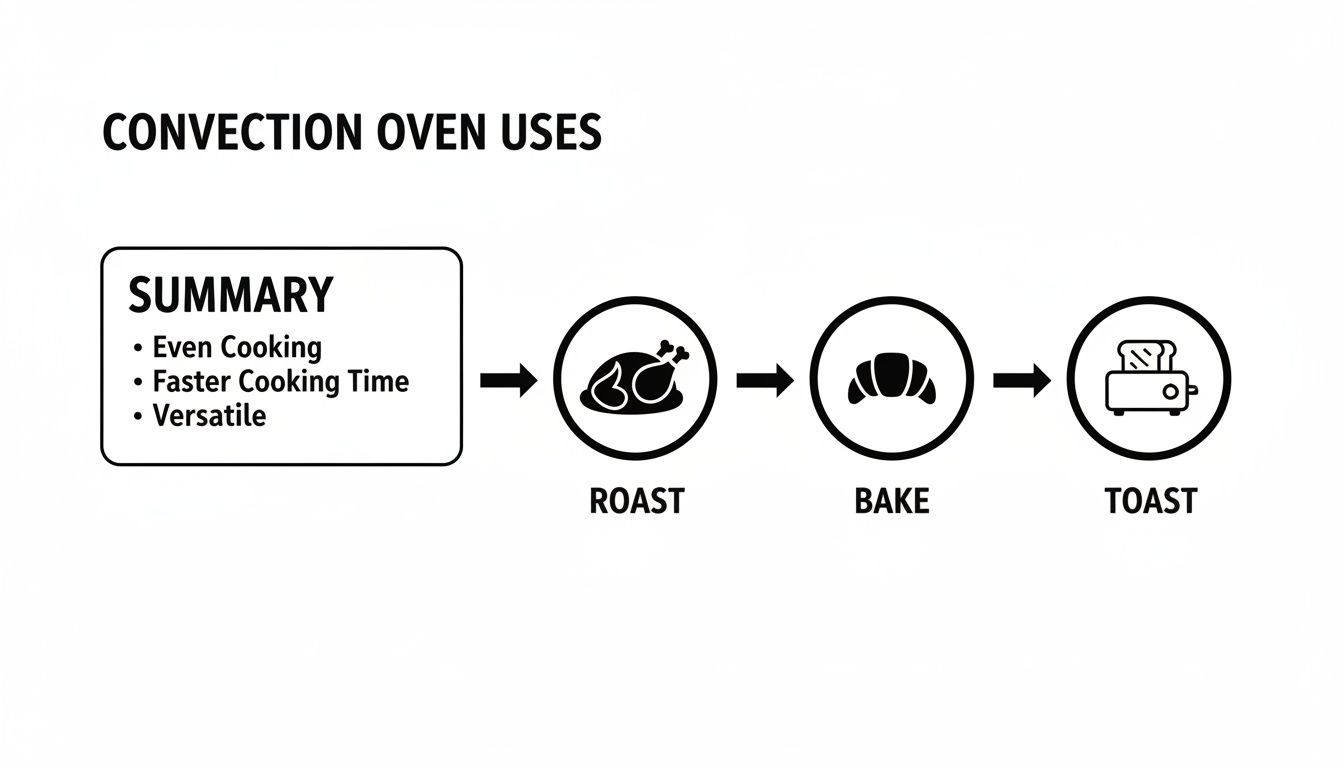
As you can see, these core uses are fundamental to any high-volume kitchen where getting food out quickly and consistently is the name of the game.
How a Convection Oven Transforms Your Cooking Process
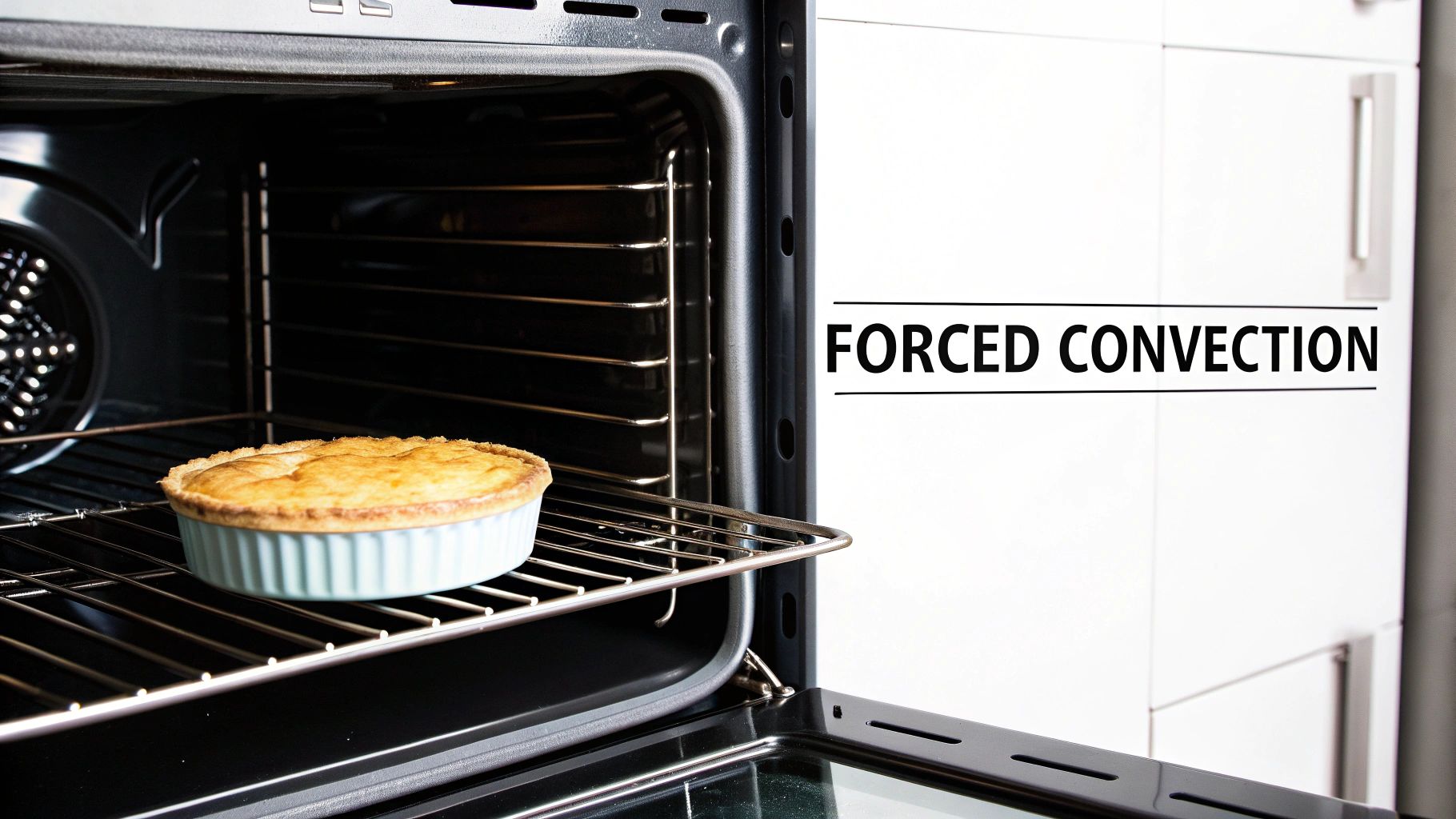
To really get what a convection oven brings to the table, you have to understand what’s happening inside that stainless steel box. The secret sauce is a simple but incredibly effective principle called forced convection.
Ever notice how a cold, windy day feels so much colder than a still one? That wind strips heat away from your skin. A convection oven flips that idea on its head, creating a constant "wind" of hot air that bombards food with heat, cooking it more efficiently and evenly. This is the magic behind its impressive speed and consistency.
Unlike a regular oven that can have all sorts of unpredictable hot spots, the circulating air in a convection oven envelops your food. Every surface gets the same consistent blast of heat. This active heat distribution is what elevates it from just another hot box to a precision tool for any professional kitchen.
The Core Components Working in Harmony
Three key parts work together to create this super-efficient cooking environment. Once you see how they interact, the whole process is demystified, and it’s easy to see why this technology is so reliable for high-volume cooking.
- Heating Element: This is the heat source, just like in any oven. It can be gas or electric, and its job is to get the oven cavity up to your set temperature.
- Fan: Here's the star of the show. Tucked in the back of the oven, this fan is responsible for continuously circulating the hot air, blowing away that little bubble of cooler air that naturally surrounds food.
- Exhaust System: This little vent is more important than it looks. It lets moisture escape from the oven, creating drier air that’s essential for getting that perfect browning and crispiness on everything from roasted potatoes to pastry.
This trio creates a dynamic system that actively cooks your food instead of just passively radiating heat at it.
Key Takeaway: A convection oven's fan-driven air circulation actively transfers heat, eliminating hot spots and creating a drier environment. This leads to faster cooking, even browning, and crispier results compared to the static heat of a conventional oven.
The Science of Better Browning and Faster Cooking
That constantly moving hot air does more than just cook things evenly. By wicking moisture away from the surface of foods like chicken skin or bread dough, it kicks the Maillard reaction into high gear. That’s the chemical process responsible for those irresistible deep brown colors and savory, roasted flavors.
This supercharged heat transfer also means the oven can cook food faster, often at a lower temperature. For a busy kitchen, this translates directly to higher throughput and better energy efficiency. It’s not just a better way to cook; it’s a smarter operational choice.
Adapting Your Recipes for Convection Cooking
Making the jump to a convection oven doesn't mean you have to toss out your whole recipe binder. Think of it more like a simple tune-up. Because that circulating hot air cooks food so much more efficiently, you just need to make a few tweaks to your time and temperature to nail the results.
The go-to starting point is what many of us in the industry call the "25/25 rule": either knock the oven temperature down by 25°F or slice the cooking time by about 25%. This isn't some rigid law, but it's a fantastic place to start. For example, a recipe that calls for 375°F in a conventional oven will probably be happiest around 350°F in a convection setup.
Just be sure to pick one or the other. If you drop both the temperature and the time, you're almost guaranteed to end up with undercooked food. The smartest approach is to start by lowering the temperature and then just check for doneness a bit earlier than you normally would.
Temperature and Time Adjustments in Practice
The best way to convert a recipe really depends on what you're making. A dense pork roast is going to behave very differently than a tray of delicate pastries that need to rise just right. The key is getting a feel for how that moving air affects different foods.
Let’s run through some real-world examples you’d see in any busy commercial kitchen.
- Roasted Meats and Vegetables: For anything you want a deep, golden-brown crust on while keeping the inside juicy, dropping the temperature by 25°F is the way to go. This lets the outside get beautifully crisp without overcooking the center.
- Baked Goods (Cookies, Scones, Pastries): When you're baking multiple trays at once, reducing the temperature helps everything bake evenly. Start checking for doneness when you're about three-quarters of the way through the original bake time.
- Casseroles and Braises: For dishes like these, which are usually covered, you might find that just cutting the cooking time by 20-25% works better than fiddling with the temperature. Even with a lid on, the circulating air still speeds things up.
Pro Tip: Whatever you do, don't overcrowd the oven. The whole point of what a convection oven is used for—that circulating air—is completely lost if you pack the racks too tightly. Always leave at least an inch of space around your pans so the fan can do its job.
Mastering Your Conversion Timing
As you get more comfortable, you'll start to develop a sixth sense for these adjustments. Since convection ovens almost always cook faster, knowing how to manage your timing is everything. Here’s a quick-glance table to help you get started.
Convection Oven Conversion Guide for Commercial Kitchens
| Food Category | Standard Temp/Time | Convection Adjustment | Pro Tip |
|---|---|---|---|
| Roasted Meats | 400°F for 1 hour | 375°F for 1 hour | The lower temp ensures a crisp exterior without drying out the inside. Check internal temp 15 minutes early. |
| Roasted Veggies | 425°F for 30 mins | 400°F for 25 mins | Reduce temp and time slightly for perfect caramelization without burning. |
| Cookies & Scones | 375°F for 12 mins | 350°F for 9-10 mins | Lowering the temp helps multiple trays bake evenly. Rotate pans halfway through. |
| Cakes & Breads | 350°F for 30 mins | 325°F for 25-28 mins | For delicate items, a small temp reduction prevents the outside from setting before the rise is complete. |
| Casseroles | 375°F for 45 mins | 375°F for 35 mins | Keep the temperature the same but reduce the time by about 25%, especially if covered. |
A dedicated cooking time conversion calculator can also be a lifesaver, especially when you’re adapting a new recipe under the pressure of a busy service.
Ultimately, the best way to adapt is to trust your senses. Keep a close eye on your food, using visual cues—like color and texture—and an instant-read thermometer to check for doneness. After a few successful runs, you’ll be tweaking recipes like a pro, avoiding costly mistakes and turning out consistently delicious food.
What Belongs in a Convection Oven (And What Doesn't)
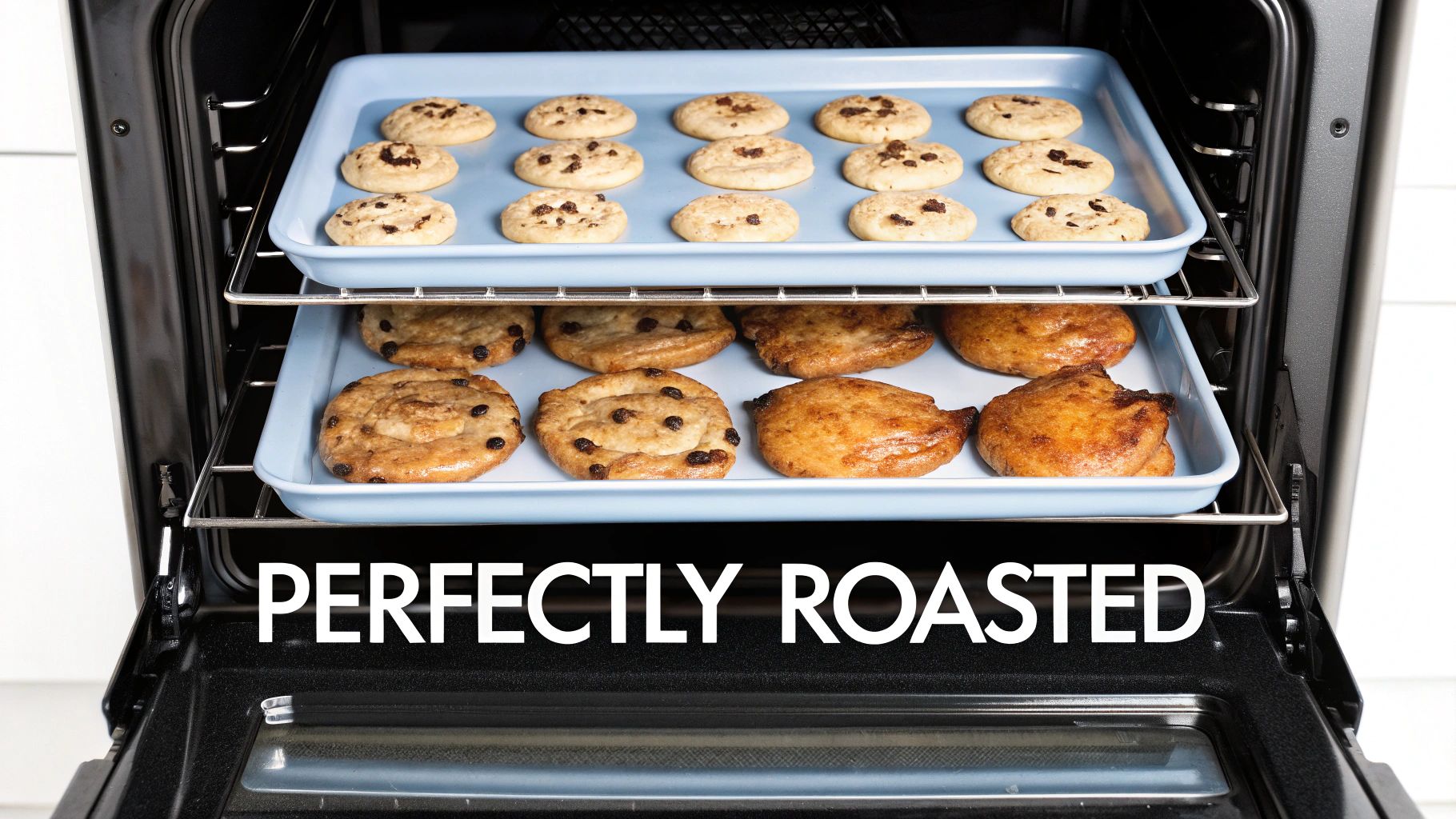
Okay, let’s get to the good stuff—figuring out exactly what a convection oven can do for your menu. This is where the magic really happens. This technology is an absolute superstar for any dish that loves a dry, hot environment. It’s your ticket to achieving perfectly crisp skins, deep browning, and incredibly even textures across huge batches of food.
Think of it as the ultimate machine for anything you want roasted or baked to golden-brown perfection. It turns routine tasks into high-quality, efficient production. That dry, circulating air is your secret weapon for creating those irresistible textures that are so tough to get right in a conventional oven’s static, steamy atmosphere.
Foods That Thrive with Convection Heat
Some menu items are just made for convection cooking. The consistent heat and moisture-wicking effect bring out their absolute best, ensuring your customers get the same fantastic result every single time.
These are the heroes of the convection oven world:
- Roasted Meats and Poultry: A whole chicken or turkey comes out with that perfectly crisp, crackling skin while the meat inside stays unbelievably moist and juicy. The same goes for big cuts of beef or pork, which cook evenly from edge to center without any fuss.
- Roasted Vegetables: Say goodbye to soggy Brussels sprouts and limp asparagus. Convection cooking caramelizes vegetables like potatoes, broccoli, and carrots beautifully, giving them a sweet, roasted flavor and a texture that’s to die for.
- Baked Goods: This is where convection ovens are a total game-changer. You can bake multiple sheet pans of cookies, scones, or croissants at the same time without having to rotate them. Every single one will come out uniformly golden and perfectly done.
- Puff Pastry and Breads: The hot, moving air helps puff pastry rise higher and create more distinct, flaky layers. For breads, it creates a superior crust that's both wonderfully crisp and beautifully browned.
In the heart of bustling restaurants and bakeries, convection ovens shine for their versatility in handling everything from crispy breads to juicy roasts, making them a go-to for operators juggling diverse menus in casual dining spots and coffee shops. Their ability to deliver uniform browning and cut cooking times dramatically optimizes efficiency in high-turnover environments. You can read the full analysis on commercial oven market trends here.
When to Skip the Convection Setting
While that fan is powerful, it isn't the right tool for every single dish. Delicate items that need to set slowly in a moist, gentle environment can really suffer from the circulating air. For these, it’s best to turn the fan off if your model allows it or just use a conventional oven instead.
Here are a few foods that are less suitable for convection:
- Delicate Custards and Flans: The moving air can cause them to curdle or form a rubbery skin before they have a chance to set properly.
- Soufflés and Cheesecakes: The force of the fan can make these delicate batters rise unevenly or, even worse, collapse entirely.
- Quick Breads and Moist Cakes: The dry air can sometimes pull too much moisture from the surface, creating a crust before the batter has finished rising inside.
Knowing when to use the fan—and when not to—is the key to getting the most out of your equipment. If you're outfitting a smaller space, be sure to check out our guide on understanding small commercial convection ovens to find the perfect fit. To illustrate the principle, even some of the best air fryer recipes for frozen meatballs rely on that same circulating air concept. Mastering your oven's features is what takes your cooking from good to great.
Picking the Perfect Convection Oven for Your Kitchen
Ready to make a move? Choosing the right convection oven is a huge decision that’ll shape your kitchen’s workflow, what you can put on your menu, and your bottom line. This practical guide will walk you through the most important factors, making sure you end up with a unit that works as hard as you do.
The first, and most important, thing to figure out is size and capacity. What you’re cooking and how much of it will tell you whether you need a full-size floor model or a more compact countertop unit.
- Full-Size Ovens: These are the absolute workhorses for high-volume restaurants, bakeries, and big catering gigs. They can handle multiple full-size sheet pans, letting you roast huge batches of protein or bake hundreds of pastries all at once.
- Half-Size Ovens: This is a great middle-ground option if your kitchen has a moderate output but a little less floor space. You still get serious capacity without the massive footprint of a full-size unit.
- Countertop Ovens: Perfect for food trucks, cafés, concession stands, or even as a backup oven in a larger kitchen. They’re fantastic for smaller batches, reheating, or putting the finishing touches on a dish.
Gas or Electric: Making the Call
Your next big decision is the power source: gas or electric. Each comes with its own set of pros and installation needs, so the choice really depends on your kitchen’s current setup and your priorities.
There's a clear trend happening in commercial kitchens right now. The global market for these ovens is expected to jump from USD 229.2 million in 2025 to USD 317.1 million by 2035. Electric models are on track to grab 48.60% of that revenue, mostly because they’re energy-efficient and easier to install. At the same time, demand for countertop units is soaring, with the market projected to hit USD 1.9 billion by 2033, which just goes to show how valuable they are for businesses tight on space. You can read the full research about these market dynamics here.
This data points to a real demand for flexible and efficient cooking solutions. To help you figure out what’s best for you, here’s a quick breakdown of how gas and electric models stack up.
| Feature | Gas Convection Ovens | Electric Convection Ovens |
|---|---|---|
| Heat Recovery | Heats up quickly and gets back to temperature faster after you open the door. | Slower to preheat but delivers more consistent, even, and dry heat. |
| Installation | Requires a professional gas line hookup and proper ventilation. | Much simpler installation; just needs the right electrical outlet. |
| Operating Cost | Natural gas is often cheaper, which can lead to lower utility costs over time. | Utility costs are generally higher, but the units are often more energy-efficient. |
| Best For | High-volume roasting and in kitchens where speed is everything. | Precision baking, pastries, and any situation that demands very stable heat. |
Must-Have Features for Today’s Kitchens
Beyond just size and power, a few key features can seriously boost your consistency and let you expand your menu. Keep an eye out for modern controls and functions that make life easier. Programmable controls, for instance, let you save recipes for temperature and time, ensuring every batch of cookies or roasted chicken turns out exactly the same, no matter who’s running the oven.
For bakeries that specialize in artisan breads, a steam injection feature is non-negotiable. It creates that perfect steamy environment needed for a crisp, golden crust. A multi-speed fan is also a huge asset, giving you a lower speed for delicate items like meringues and soufflés that could get blown around by a high-powered airflow.
For a deeper dive into different models, our complete guide on the commercial convection oven can offer even more clarity. By matching these features to your menu, you can make a smart investment that pays off in both quality and efficiency.
Essential Maintenance to Keep Your Oven Running Strong
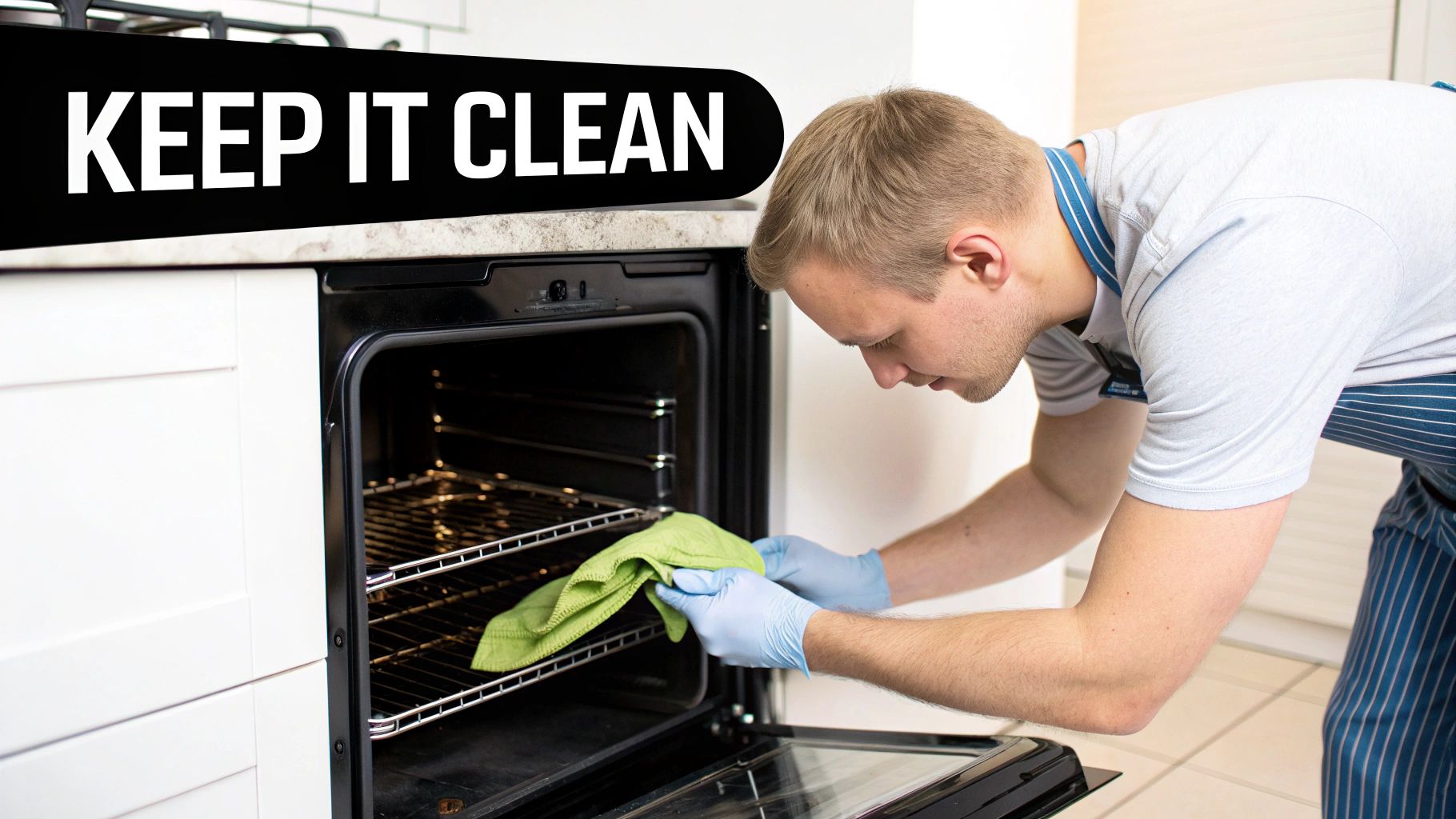
A commercial convection oven is a serious investment, and just like any high-performance machine in your kitchen, it needs consistent care to keep doing its job right. Regular maintenance isn't just about extending the oven's lifespan; it's about ensuring food safety, avoiding those dreaded emergency repair bills, and keeping your kitchen's workflow smooth and efficient.
Think of it as routine upkeep for your kitchen’s workhorse. Small, daily actions are what prevent the buildup of grease and food debris that can mess with performance, create serious fire hazards, and even start to affect the flavor of your food. A simple, consistent cleaning schedule is the absolute key to protecting your asset.
Your Convection Oven Cleaning Schedule
Breaking down maintenance into daily, weekly, and monthly tasks makes the whole process feel manageable instead of overwhelming. Integrating these simple habits into your kitchen's closing routine is crucial for long-term reliability and performance.
Daily Tasks (End of Day)
- Wipe Down Exterior: Use a soft cloth and a mild cleaner to wipe down all the stainless steel surfaces, paying attention to the doors and handles.
- Clean the Door Glass: A clear glass door lets your team monitor food without constantly opening the oven and losing precious heat.
- Address Spills Immediately: Clean up any drips or spills inside the oven cavity as soon as it's safe to do so. This prevents them from baking on and becoming a major headache later.
Weekly Deep Clean
- Clean the Interior: Once the oven has completely cooled down, pull out the racks. Use a designated oven cleaner to scrub the interior walls, focusing on any spots with built-up grease.
- Soak and Scrub Racks: Let the oven racks soak in a solution of hot water and a good degreaser before scrubbing them clean. They'll come out looking brand new.
A well-maintained oven is a safe and efficient oven. Neglecting regular cleaning can lead to uneven cooking as grease buildup obstructs airflow, and in serious cases, it can become a significant fire risk in a commercial kitchen.
Monthly Inspection Checklist
Once a month, take just a few minutes for a quick inspection. This proactive check can help you catch small issues before they blow up into expensive, service-disrupting problems.
- Inspect the Door Gasket: Check the seal around the oven door for any cracks, splits, or tears. A damaged gasket leaks heat, which wastes energy and leads to inconsistent cooking.
- Check the Fan: Make sure the convection fan spins freely without any obstruction. Listen for any unusual grinding or rattling noises that might signal a problem with the motor.
Following these straightforward steps helps you master more than just what a convection oven is used for; it ensures your equipment remains a dependable part of your kitchen's success. For more comprehensive tips, check out our guide on cleaning restaurant equipment.
Got Questions About Convection Ovens? We Have Answers
Even after you get the hang of how a convection oven can make your kitchen more efficient, a few practical questions always pop up. It’s totally normal. Let's clear up some of the common uncertainties you might have about using one of these workhorses day-to-day.
Can I Use My Regular Baking Pans?
Yes, absolutely. You can definitely use your standard baking pans, but there’s a small catch if you want the best results.
To really let that circulating air do its magic, you’ll want to reach for pans with low sides, like cookie sheets or roasting pans. High-sided pans can act like little walls, blocking the airflow and giving you results that are a lot closer to a regular oven. For that signature even browning and crisping, give the hot air a clear path to your food.
Do I Still Need to Preheat a Convection Oven?
Preheating is still a must. It’s a step you just can’t skip. While a convection oven gets up to temperature faster than a conventional one—thanks to that fan—starting with a fully heated oven cavity is the key to consistent results.
Proper preheating is what helps baked goods rise correctly and gives roasted items that initial, flavorful sear. Always let your oven reach its target temperature before you slide any food inside.
The core principle is simple: hot air needs to circulate freely. Pans with low sides allow the fan-driven heat to envelop the food from all angles, ensuring the fast, even cooking convection ovens are prized for.
Is a Convection Oven the Same as an Air Fryer?
While they both work on a similar principle—circulating hot air with a fan—they’re really designed for different jobs in the kitchen. A commercial convection oven is a larger, more versatile workhorse built for high-volume baking and roasting.
An air fryer, on the other hand, is a smaller countertop appliance with a much more powerful, high-speed fan. This intense airflow is what excels at creating that super crispy, "fried" texture on smaller batches of food. Think of the convection oven as your kitchen’s all-around utility player and the air fryer as a highly effective specialist.
At The Restaurant Warehouse, we provide the high-performance cooking equipment you need to boost your kitchen's output and consistency. Explore our full range of commercial convection ovens today!
About The Author

Sean Kearney
Sean Kearney used to work at Amazon.com and started The Restaurant Warehouse. He has more than 10 years of experience in restaurant equipment and supplies. He graduated from the University of Washington in 1993. He earned a BA in business and marketing. He also played linebacker for the Huskies football team. He helps restaurants find equipment at a fair price and offers financing options. You can connect with Sean on LinkedIn or Facebook.
Leave a comment