

The Atosa Advantage: Why Bottom-Mount Compressors are the King of Commercial Refrigerators

Does it really matter where you put the motor?
When you’re shopping for a new commercial refrigerator, you probably look at the dimensions, the number of doors, and the price tag. But there is one technical spec that most people gloss over that will actually have the biggest impact on your daily workflow and your monthly electric bill: the compressor location.
In the world of professional refrigeration, there are two camps: top-mount and bottom-mount. While top-mount units have their place in dusty, dry storage areas, the bottom-mount compressor is the undisputed king of the busy commercial kitchen.
At The Restaurant Warehouse, we see thousands of kitchen layouts. We’ve seen what works and what results in a service call three months later. If you are running a high-volume line, a bottom-mount unit like the Atosa MBF8505GR isn't just a choice—it’s an operational strategy.
1. Physics is on Your Side: Cooler Air, Higher Efficiency
Here is a basic rule of the kitchen: heat rises. If you stand on a milk crate in the middle of your cook line, it’s going to be significantly hotter than it is at floor level.
A top-mounted compressor has to suck in that hot, greasy air rising from your ranges, fryers, and ovens. It then has to work twice as hard to cool that air down to keep your inventory at a safe 33°F to 40°F.
A bottom-mount compressor, like the ones found on the Atosa MBF8507GR, pulls air from the floor. Floor-level air can be up to 15 degrees cooler than air at the ceiling. Because the air is cooler, the compressor doesn't have to run as long or as hard. This isn't just about saving a few bucks on your utility bill; it’s about the lifespan of the motor. A motor that doesn't have to work as hard lasts longer. Period.
2. No Ladders Required: The Maintenance Reality
Ask any kitchen manager: when was the last time the condenser coils were cleaned on the reach-in? If it’s a top-mount unit, the answer is usually "I don't know," because cleaning it requires a ladder, a screwdriver to remove a heavy panel, and a prayer that you don't drop something into the fan.
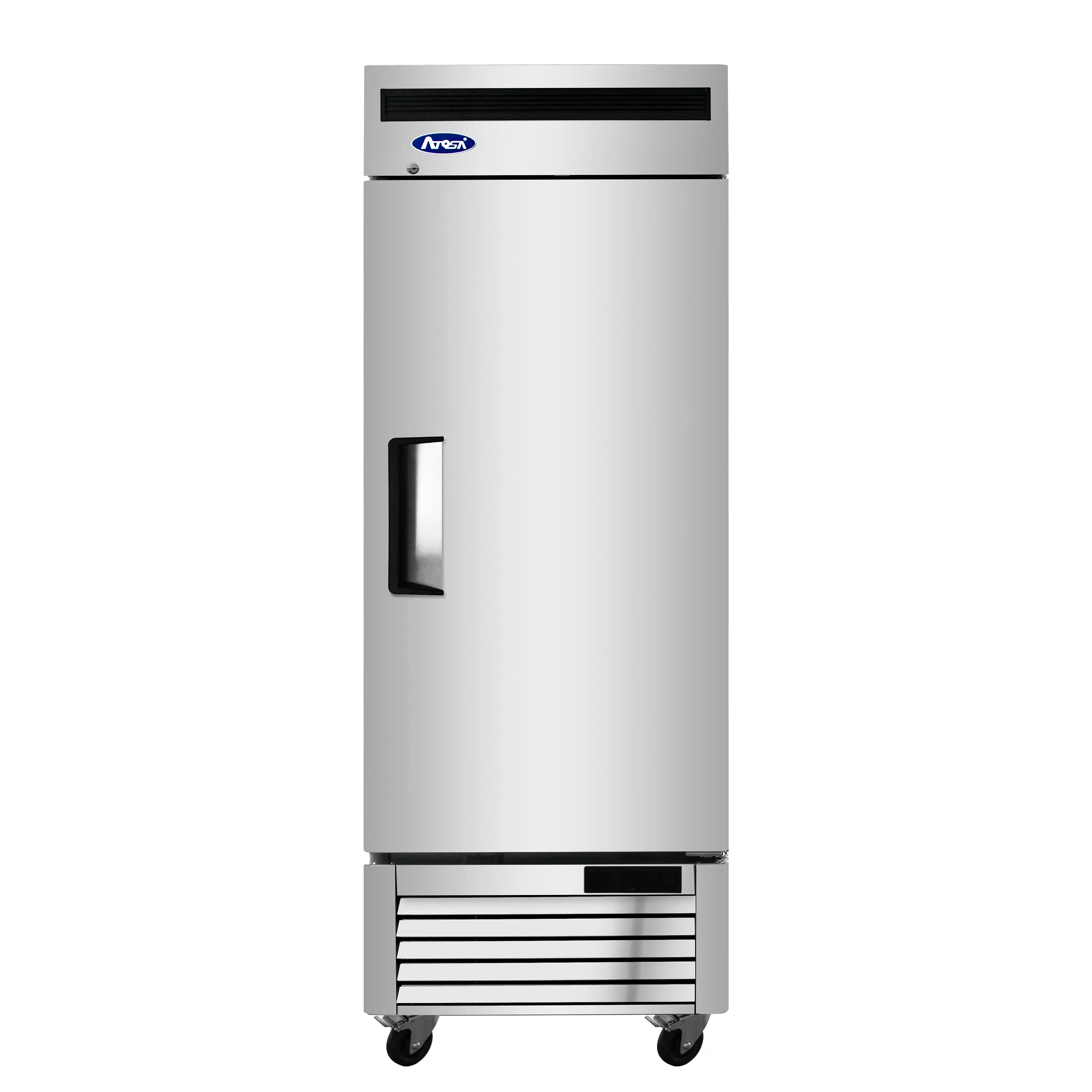
With an Atosa bottom-mount refrigerator, the "guts" of the machine are right at eye level—or rather, knee level. You don’t need a maintenance crew or a specialized technician for a routine cleaning. Most bottom-mount units feature a slide-out rail system. You can get in there with a vacuum or a brush, clear out the dust, and be back to work in five minutes.
Key Takeaway: If maintenance is easy, it actually gets done. If maintenance gets done, your refrigerator doesn't die in the middle of a Friday night rush.
3. Ergonomics: Stop Bending Over for the Bottom Shelf
This is the benefit that your staff will thank you for. In a top-mount refrigerator, the bottom shelf is practically on the floor. To get that heavy container of prepped sauce or the box of produce, your chefs have to stoop down, which is a recipe for back strain over an eight-hour shift.
In a bottom-mount unit, the refrigeration system takes up that bottom space. This naturally "lifts" the interior floor of the cabinet. Your lowest shelf is now at a comfortable height, making it easier to load and unload. Plus, the top of the refrigerator can be used for extra storage of dry goods (like flour or takeout containers) because there isn't a hot motor taking up that space.
4. The "Grease Factor" in Professional Kitchens
If your refrigerator is located near your fryers or ranges, grease is your biggest enemy. Grease-laden steam rises. In a top-mount configuration, that grease gets sucked directly into the condenser coils. It creates a sticky film that traps dust, effectively insulating the coils and causing the machine to overheat.
Bottom-mount compressors are shielded from that rising grease. While they might catch a bit more floor dust, dust is easy to vacuum. Grease requires chemical degreasers and heavy scrubbing that can damage delicate fins. For any kitchen with a deep fryer, the bottom-mount is the only logical choice.
Key Benefits of Atosa Bottom-Mount Units
- R290 Refrigerant: Environmentally friendly and highly efficient hydrocarbon refrigerant that meets all modern EPA standards.
- Stainless Steel Build: Atosa uses high-quality stainless steel for both the interior and exterior, making them easy to sanitize and resistant to the dings of a busy kitchen.
- Digital Controls: Precise temperature management that's easy to read from across the room.
- Self-Closing Doors: Doors stay open at 90 degrees for easy loading but pull themselves shut otherwise to save energy.
Comparison: When Should You Go Top-Mount?
We aren't saying top-mount units are "bad." For example, the Atosa MBF8001GR is a fantastic single-door unit. Top-mounts are great if:
- Your kitchen floor is incredibly dusty (like a bakery with lots of flour on the floor).
- You are tight on floor space and need every single cubic inch of interior height.
- The unit is located in a cold basement or a storage area where rising heat isn't an issue.
But for 90% of restaurant applications, the bottom-mount is the superior ROI.
Financing Your Upgrade
We know that a broken refrigerator usually happens at the worst possible time—when cash is tight. That’s why we focus on restaurant equipment financing. You shouldn't have to settle for a cheap, residential-grade unit that will break in six months just because you don't want to drop $3,000 today.
We offer lease-to-own programs and a 12-month rental program to get high-end Atosa equipment into your kitchen with low monthly payments. Learn more about our rent restaurant equipment program. Our goal is to help you keep your food safe and your kitchen running without draining your operating capital.
Maintenance Checklist for Bottom-Mount Refrigerators
To keep your commercial refrigerator running for the long haul, follow this simple routine:
- Weekly: Check the door gaskets for any tears or food debris. A leaky seal makes the compressor work overtime.
- Monthly: Vacuum the condenser coils. This is the #1 way to prevent a service call.
- Quarterly: Check the drain lines to ensure there is no standing water or mold buildup.
- Annually: Have a technician check the refrigerant levels and fan motors.
Key Takeaways
- Efficiency: Bottom-mount compressors breathe cooler air, reducing wear and tear.
- Maintenance: Easier access means you’ll actually clean it, extending the unit's life.
- Safety: Keeping the motor away from grease prevents overheating.
- Ergonomics: Your staff's backs will thank you for the raised bottom shelf.
FAQ: Bottom-Mount Commercial Refrigerators
Q: Do bottom-mount refrigerators have less storage space? A: Technically, yes. Because the refrigerant lines and the motor housing are at the bottom, you lose a few cubic feet compared to a top-mount of the same exterior height. However, most operators find the ergonomic benefits and the extra top-of-unit storage more than make up for it.
Q: Are they louder than top-mount units? A: Not necessarily. Modern Atosa units are designed to be quiet. However, because the motor is closer to the ground, the sound can sometimes bounce off hard kitchen floors. In a busy kitchen, you won't notice the difference.
Q: Can I use a bottom-mount unit in a food truck? A: Absolutely. In fact, we often recommend them for food truck equipment setups because they are more stable (lower center of gravity) and easier to service in tight spaces.
Q: Does it cost more to repair a bottom-mount compressor? A: Usually, it costs less. Because the technician doesn't need to bring a ladder or have a second person help them remove a heavy top shroud, labor costs for service calls are often lower.
Q: Is the Atosa MBF8507GR Energy Star certified? A: Yes, many Atosa bottom-mount models are Energy Star certified, which can help you qualify for local utility rebates.
About The Author

Sean Kearney
Sean Kearney is the Founder of The Restaurant Warehouse, with 15 years of experience in the restaurant equipment industry and more than 30 years in ecommerce, beginning with Amazon.com. As an equipment distributor and supplier, Sean helps restaurant owners make confident purchasing decisions through clear pricing, practical guidance, and a more transparent online buying experience.
Connect with Sean on LinkedIn, Instagram, YouTube, or Facebook.