

Sweet Dreams Are Made of These: Top Heavy-Duty Ice Cream Machines
Why Heavy-Duty Ice Cream Machines Are Essential for Commercial Success
A heavy duty ice cream machine is an essential asset for any foodservice establishment looking to lift its dessert menu. Unlike home models that produce a quart or two, these commercial-grade appliances are engineered for high-volume production, continuous operation, and the demanding conditions of a professional kitchen. They can churn out 16 to over 100 quarts of product per hour, featuring powerful compressors, durable stainless steel construction, and advanced cooling systems that allow for non-stop batch production throughout the day.
Offering house-made frozen desserts can transform an ordinary menu into an extraordinary one, creating a signature experience that attracts and retains customers. Choosing the right machine—from a compact countertop model to a high-capacity floor unit—is a critical business decision that balances upfront investment with long-term profitability.
Beyond the headline capacity, the value of a heavy-duty unit shows up in day-to-day service. Faster recovery times between pulls or batches prevent bottlenecks at the counter, while consistent texture keeps quality high even when your team is slammed. For a café, food hall stall, or full-service restaurant, the ability to produce on demand (soft-serve) or to build a par of prepped flavors (batch freezer) protects service speed and reduces the risk of stockouts during peak periods.
For operators, dessert margin is often among the strongest on the menu. A heavy-duty machine helps you capture that margin with fresh, house-made product, limited labor overhead, and the flexibility to rotate seasonal flavors. Whether you are adding a single soft-serve line extension or building a full scoop program with pints, cakes, and novelties, the right machine supports the menu strategy you choose.
If you are projecting demand for a new concept, plan capacity around your peak hour, not your average day. Estimate cones or scoops per minute during rushes, add a safety factor (often 20–30%), and select a machine whose real-world output comfortably exceeds that number. This gives you room to grow, maintain guest experience under stress, and avoid overextending staff.
As you narrow options, consider the total operating picture: electrical capacity available, ventilation and ambient heat, water access if needed, and your team’s readiness to execute cleaning protocols. Investing a little more in the right machine the first time prevents costly downtime and premature replacement.
Top Heavy-Duty Ice Cream Machine Types:
- Soft-Serve Machines - Produce whipped, airy ice cream; ideal for quick-service restaurants and cafeterias; available in single, dual, or twist flavor configurations
- Batch Freezers - Create dense, artisanal hard ice cream, gelato, and sorbet; perfect for scoop shops and fine dining
- Countertop Models - Compact units (2-6 quart capacity) for lower-volume operations
- Floor Models - High-capacity machines (20-40+ quart batches) for commercial production
Key Specifications to Consider:
| Feature | Home Unit | Heavy-Duty Commercial |
|---|---|---|
| Production | 1.5 qts/hour | 16-112+ qts/hour |
| Power | 50-500 watts | 1,000-4,000+ watts |
| Voltage | 110V | 110V, 208-230V, 3-phase |
| Construction | Plastic bowl | Stainless steel |
| Operation | Pre-freeze bowl | Built-in compressor |
The difference between serving store-bought ice cream and offering house-made frozen desserts can transform your menu from ordinary to extraordinary. But choosing between a $1,000 countertop model and a $30,000 batch freezer requires understanding your specific needs, from daily production volume to available electrical infrastructure.
As you read on, you’ll learn how to evaluate build quality, compare machine types, size capacity to your demand curve, and plan for ownership—maintenance, cleaning, and compliance. If you already have a concept in mind and want custom recommendations and wholesale pricing, contact us today to walk through your options and get a quote.
What Makes an Ice Cream Machine "Heavy-Duty"?
What truly separates a heavy duty ice cream machine from a residential appliance? It comes down to four core elements built for commercial success.
First, durable construction is non-negotiable. These machines feature food-grade stainless steel bodies, bowls, and dashers that withstand constant use and resist corrosion while ensuring hygiene. This is essential for the demanding environment of a restaurant or busy ice cream parlor. Look for sanitary welds, minimal crevices, and easily removable parts so your team can break the machine down quickly for cleaning and reassembly. Heavier frames and reinforced bearings reduce vibration, wear, and noise during peak service.
Second is high-volume, continuous operation. Equipped with powerful built-in compressors, they eliminate the need for pre-freezing bowls and can churn out batch after batch without downtime. While a home unit might make 1.5 quarts per hour, a commercial workhorse can produce anywhere from 16 to over 100 quarts in the same timeframe, allowing your business to meet peak demand. Recovery time after a large pull or a full batch should be minimal; premium machines are designed so your product quality stays consistent even as the line grows.
Third, powerful motors and compressors provide the endurance needed to churn thickening mixtures without stalling. This is crucial for achieving a consistently smooth and creamy texture that customers crave, preventing the hiccups that can plague less powerful home units. Oversized drive systems, torque that handles mix-ins without strain, and tight temperature control help you hit target overrun (air incorporation) for each product style—from light and airy soft-serve to dense, low-overrun gelato.
Finally, advanced cooling systems, whether air-cooled or water-cooled, are designed to maintain optimal freezing temperatures efficiently, even in a hot kitchen environment. These features ensure a heavy-duty machine is not just an appliance, but a reliable investment in quality, capacity, and overall efficiency. Consider condenser design, refrigerant type, and airflow requirements; an air-cooled unit must have adequate clearance and ventilation, while a water-cooled system needs reliable water supply and drainage.
Beyond the big four, heavy-duty machines often add operational advantages you’ll feel every day: intuitive controls, programmable recipes, low-mix alerts, hopper refrigeration to hold mix at safe temperatures, and safety interlocks that prevent accidental operation when panels are open. All of these details reduce training time, minimize errors, and protect your investment.
In short, a heavy-duty machine is purpose-built for repeatable output, food safety, and long service life—core requirements that basic home-oriented devices simply aren’t engineered to meet.
Types of Heavy-Duty Ice Cream Machines for Your Business
Selecting the right heavy duty ice cream machine depends entirely on your business model and the type of dessert you want to serve. The two primary categories cater to different needs, from high-speed service to artisanal craft.
Soft-Serve Machines
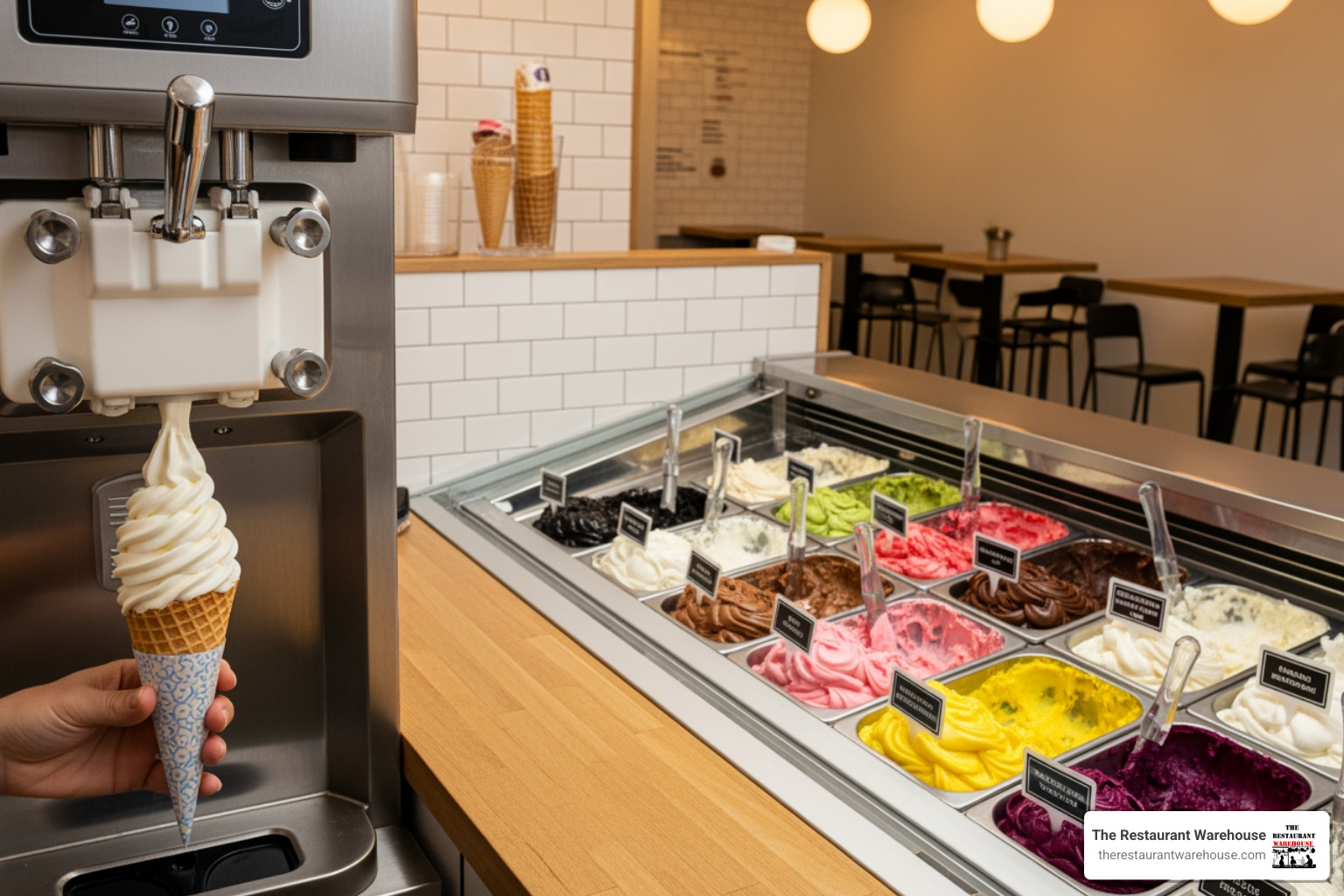
Ideal for speed and high volume, soft-serve machines produce the classic whipped, airy dessert perfect for cones and sundaes. They are staples in fast-casual restaurants, cafeterias, and buffets. These machines operate continuously by feeding a liquid mix into a freezing cylinder, delivering product on demand. You can choose from single-flavor, dual-flavor, or twist-flavor models. A key distinction is between gravity-fed systems, which create a denser product, and pressure-fed (or air pump) systems, which incorporate more air for a lighter texture and higher yield. Daily cleaning is a mandatory requirement for these machines to ensure hygiene.
Within soft-serve, think through your service style. Will you run self-serve for guests or staff-only behind the counter? Self-serve demands strict attention to sanitation and easy-to-understand controls; staff-only setups can manage more advanced features like adjustable overrun. Many operators prefer pressure-fed systems in high-volume environments because they increase yield and speed, while gravity-fed systems can offer a richer texture and simpler maintenance.
Capacity planning matters here too. Single-cylinder models are compact but can bottleneck under rush; dual-cylinder machines let you run two flavors (or twist) and recover faster after heavy pulls. Hopper refrigeration keeps mixes at safe temperatures between rushes, and standby modes are helpful if your business runs long hours.
Batch Freezers (Hard Ice Cream & Gelato)
For businesses focused on artisanal quality, batch freezers are the tool of choice. They produce dense, premium hard ice cream, gelato, and sorbet. Perfect for scoop shops and high-end restaurants, these machines freeze one batch at a time, offering precise control over texture and allowing for the addition of mix-ins like chocolate chunks or fruit swirls. The slower churn speed of a batch freezer is essential for creating authentic gelato, which has less air (overrun) and a richer, more intense flavor profile than traditional ice cream.
Choosing between horizontal and vertical batch freezers often comes down to workflow and space. Horizontal models tend to make extraction easier and can handle larger mix-ins; vertical machines often have a smaller footprint and excellent control for fine gelato textures. Look for programmable cycles for different styles (ice cream vs. gelato vs. sorbet), as well as options like mix heaters or pasteurization if you plan to process from scratch rather than using a pre-pasteurized base.
Batch freezers also support an expanded product strategy: pints to-go, ice cream cakes, novelties, and seasonal LTOs. This diversification can smooth revenue across dayparts and seasons. With proper planning, you can run a lean production schedule—batch in the morning, scoop through service, and prep specials for the weekend.
Making Your Choice
The decision between a soft-serve machine and a batch freezer comes down to your goals. Consider your desired product consistency, projected customer demand, available kitchen space, and budget. Thinking about your long-term business goals will help you make an investment that ensures profitability and customer satisfaction. If you need help deciding which heavy duty ice cream machine is right for your business, contact us today and our team will help you find the perfect fit.
To sharpen your decision, outline your must-haves (e.g., two flavors and twist, water-cooled condenser, 208–230V single-phase) and your nice-to-haves (e.g., touchscreen controls, auto-clean cycles). Then weigh total cost of ownership: not just purchase price, but installation, utilities, cleaning supplies, and preventive maintenance. A slightly higher upfront cost can be the least expensive choice over a five- to ten-year horizon if it delivers better uptime and throughput.
Key Features to Look for in a Heavy-Duty Ice Cream Machine
Understanding the key technical specifications is critical when investing in a heavy duty ice cream machine. These features directly impact performance, installation, and daily operations.
Capacity and Output: Quarts per Hour
Capacity refers to the batch size (in quarts), while output is the hourly production rate. A small countertop unit might produce 16 quarts per hour, suitable for a café, whereas high-capacity floor models can churn out over 100 quarts per hour, essential for a busy ice cream parlor. Matching your machine's output to your peak business hours is crucial. Underestimate your needs, and you risk long lines and lost sales; overestimate, and you waste capital and energy. Always factor in potential growth when selecting a size.
A practical approach is to model your peak hour by menu mix: cones, cups, sundaes, and shakes. Estimate scoops or pulls per minute and the average ounces per serving. Compare that to a machine’s sustained output, not just its theoretical maximum. Build in a buffer (20–30%) so you can maintain product quality while staff changes a bag-in-box mix, refills the hopper, or rotates to a new batch.
Cooling Systems: Air-Cooled vs. Water-Cooled
Your machine's cooling system removes heat from the compressor.
- Air-cooled systems are simpler and cheaper to install as they don't require plumbing. However, they release heat into your kitchen, requiring significant clearance and robust ventilation. In a hot or cramped space, their performance can suffer.
- Water-cooled systems are more efficient, especially in hot environments, and operate more quietly without adding heat to the room. The downside is the need for a continuous water supply and drainage, leading to higher installation and utility costs.
Also consider local utility rates and environmental conditions. In dense urban spaces with limited HVAC capacity, water-cooled can be more stable during summer months. In cooler, well-ventilated kitchens, air-cooled can be the simpler choice. Verify clearance around vents and ensure nothing obstructs airflow; inadequate ventilation is a common cause of poor performance.
Power, Voltage, and Installation
Commercial machines have significant power requirements. While some smaller countertop models run on a standard 110V/120V outlet, most high-capacity floor models require 208-230V power. The most powerful units often need a 3-phase electrical supply, which is common in commercial buildings but may require costly installation if not already present. Always consult a qualified electrician to verify your facility can support the machine's voltage, phase, and amperage requirements before you buy.
Plan the installation path: measure doorways, turns, and clearances; confirm the final location has the right electrical receptacle and, if applicable, water and drain access. Account for service access—technicians need space to remove panels. If you’re placing a machine in a customer-facing area, noise level and heat exhaust direction matter too.
Advanced Controls and Usability
Modern machines offer features that improve consistency and ease of use. Look for digital control panels that allow for precise adjustments to product hardness and texture. Programmable timers, low-mix indicator lights, and automatic cleaning cycles streamline operations, reduce staff training time, and prevent costly errors. Ergonomic designs with easy-to-remove parts for cleaning also contribute to a more efficient and pleasant workflow for your staff.
Additional features to consider:
- Hopper refrigeration and standby modes to keep mix food-safe during lulls.
- Adjustable overrun for tailoring texture and yield across different recipes.
- Mix level sensors that reduce the risk of air ingress and texture issues.
- Lockable settings to prevent accidental changes during a rush.
Ready to find the perfect heavy duty ice cream machine for your operation? Our team at The Restaurant Warehouse can walk you through your options. Contact us today for expert advice and wholesale pricing.
Owning and Operating Your Commercial Ice Cream Machine
Purchasing a heavy duty ice cream machine is the first step; proper ownership and operation are what guarantee a return on your investment.
Maintenance and Cleaning: The Key to Longevity
Rigorous cleaning is essential for longevity and food safety.
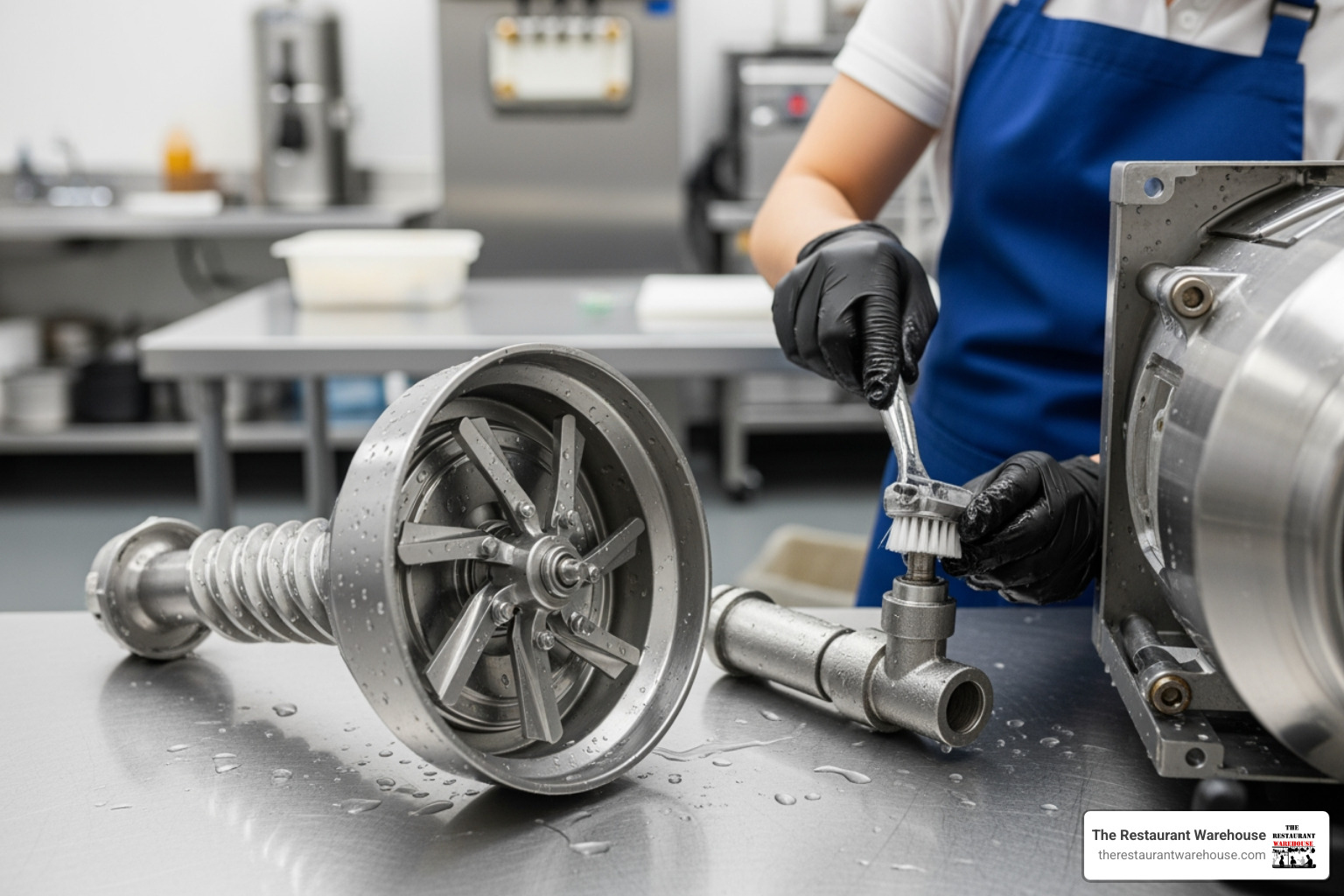
- Soft-Serve Machines: Require mandatory daily cleaning. This involves draining the product and completely disassembling, washing, and sanitizing all parts that contact the mix.
- Batch Freezers: The freezing barrel must be cleaned and sanitized between different flavors and at the end of each day. All contact parts, like the dasher and spigots, require thorough cleaning.
Always follow the manufacturer's specific instructions for cleaning, sanitizing, and lubricating seals to prevent breakdowns and ensure your product is safe.
Strengthen your SOPs by standardizing chemicals, dwell times, and water temperatures. Train every operator on full teardown and reassembly, including proper gasket placement and lubrication. Keep a written log of daily, weekly, and monthly tasks—daily sanitation; weekly checks of scraper blades and O-rings; monthly inspection of belts, drive components, and condenser coils. Replace wear parts proactively to avoid surprise downtime.
Plan for preventive maintenance. Schedule professional service at least annually (more often in high-volume shops) to check refrigerant pressures, calibrate controls, and verify safety interlocks. Keep backup parts on hand—seals, gaskets, scraper blades—so you’re not stuck during a weekend rush. A disciplined maintenance routine is a key determinant of machine lifespan and product consistency.
Understanding the Cost and Lifespan of a heavy duty ice cream machine
The initial investment for a heavy duty ice cream machine can range from a few thousand dollars for a small countertop unit to over $30,000 for a high-capacity, feature-rich batch freezer. The cost reflects capacity, features, and brand reputation. While the upfront price can be significant, these machines are built to last, often for 10-15 years or more with proper care. The return on investment (ROI) is realized through higher profit margins on house-made desserts and increased customer traffic.
When modeling ROI, include:
- Ingredient costs for base mixes and flavorings.
- Labor for production, cleaning, and prep.
- Utilities (electricity; and if water-cooled, water and sewer).
- Wear parts amortized over expected life.
- Potential incremental revenue from pints, novelties, and special events.
Because desserts often have strong contribution margins, many operators find payback periods in the range of 6–18 months, depending on volume and pricing. A well-chosen machine that fits your menu and footprint maximizes uptime and protects that payback.
Safety and Compliance
To operate legally and safely, ensure your machine meets key standards. Look for NSF (National Sanitation Foundation) certification for hygiene and UL (Underwriters Laboratories) certification for electrical safety. Always comply with your local health department's regulations regarding commercial frozen dessert production. Adhering to these standards protects your customers, your staff, and your business's reputation.
To align with broadly recognized food safety guidance, review the U.S. FDA Food Code for best practices around time/temperature control for safety (TCS) foods and machine sanitation requirements: https://www.fda.gov/food/fda-food-code. If you operate in California, also review California Proposition 65 notices to understand required warnings related to chemical exposure: Learn more about chemical exposure warnings at www.P65Warnings.ca.gov.
If you need help matching a machine to code requirements and health department expectations in your jurisdiction—or want a line-item quote that aligns with your utilities and space—contact us today.
Frequently Asked Questions about Heavy-Duty Ice Cream Machines
Here are answers to some common questions about operating a heavy duty ice cream machine.
How often should I clean my commercial ice cream machine?
Cleaning frequency is critical for food safety. Soft-serve machines must be completely disassembled, cleaned, and sanitized daily due to the perishable nature of dairy mixes. Batch freezers must be cleaned and sanitized between each different flavor batch and receive a full cleaning at the end of every day. Always follow the manufacturer's specific cleaning protocol.
Beyond daily cleaning, build a weekly and monthly preventive maintenance routine: check scraper blades for sharpness, inspect gaskets for wear, brush condenser coils, and verify temperature settings. Keep a log to satisfy health department reviews and to keep your team accountable.
What's the difference between making ice cream and gelato in a machine?
The main differences are air content (overrun), fat content, and serving temperature. Ice cream is churned faster, making it lighter with more air. Gelato is churned slower, resulting in a denser, richer product with less air and more intense flavor. Many versatile batch freezers can be adjusted to produce both styles perfectly.
Practically speaking, your machine’s speed and dasher design influence texture. For gelato, look for programs or controls that slow churn and reduce overrun. For ice cream, slightly higher overrun can improve scoopability and yield. Serve gelato at a warmer cabinet temperature than ice cream to preserve its silkier texture.
Can I use a home recipe in a commercial machine?
It is strongly discouraged. Commercial machines are engineered for professionally formulated mixes with a specific balance of fat, sugar, and stabilizers. Using a home recipe can result in poor texture, inconsistent freezing, and could potentially strain or damage the machine's motor. For best results and to protect your investment, use commercial-grade mixes or develop recipes specifically tested for your machine.
Do I need air-cooled or water-cooled?
It depends on your environment. Air-cooled units are simpler to install and avoid water costs, but they add heat to your space and need clear airflow. Water-cooled systems perform consistently in hot, crowded kitchens and run quieter, but they require water supply, drainage, and a higher utility budget. Choose based on your HVAC capacity, local water rates, and floor plan.
How do I size the machine to my volume?
Work backward from peak demand. Estimate servings per minute during rushes and the average ounces per serving. Compare to sustained output for the machines you’re considering. Build in a 20–30% buffer to allow for refills, flavor changes, and short cleaning tasks without quality drops. If in doubt, step up one capacity tier to reduce risk of bottlenecks.
Still unsure which model fits your concept, space, and utility setup? Our team can help you compare options and pricing—contact us today for expert guidance.
Conclusion
Choosing the right heavy duty ice cream machine is an investment that can transform your menu, delight customers, and boost profitability. By offering premium, house-made frozen desserts, you create a memorable experience that sets your business apart.
To ensure success, remember the key takeaways. First, match the machine's capacity to your peak volume to keep service flowing smoothly. Second, select a cooling system (air or water-cooled) that fits your kitchen's layout and ventilation. Finally, commit to a strict daily cleaning and maintenance schedule. This is the single most important factor in ensuring your machine's longevity and the safety of your product.
At The Restaurant Warehouse, we are passionate about helping your business thrive. We supply top-quality commercial ice cream machines at wholesale prices by cutting out the retail overhead and passing the savings directly to you. Our goal is to provide the right machine for your business's growth without the financial burden. Whether you’re opening your first scoop counter or scaling a multi-unit soft-serve program, we’ll help you choose confidently and budget wisely.
Ready to start churning out sweet success? Explore our selection of commercial ice cream machines or contact us today for expert advice and unbeatable pricing. If you’d like a side-by-side comparison and a custom quote matched to your power and space, book a quick consult—our team will get you up and running fast.
About The Author

Sean Kearney
Sean Kearney is the Founder of The Restaurant Warehouse, with 15 years of experience in the restaurant equipment industry and more than 30 years in ecommerce, beginning with Amazon.com. As an equipment distributor and supplier, Sean helps restaurant owners make confident purchasing decisions through clear pricing, practical guidance, and a more transparent online buying experience.
Connect with Sean on LinkedIn, Instagram, YouTube, or Facebook.