


Small Details, Big Impact: Must-Have Accessories for Sandwich Prep Tables
Why Your Sandwich Prep Table Cutting Board Matters More Than You Think
Image metadata: title=HDPE sandwich prep table cutting board on the line; subject=primary cutting and assembly surface with refrigerated wells; source=The Restaurant Warehouse; license=Used with permission
A sandwich prep table cutting board is the foundation of your food preparation workflow, directly impacting food safety, speed, accuracy, and your compliance posture. It is the central stage where every component of your menu comes together. Every tomato you slice, every roll you split, and every sandwich you assemble relies on this surface to stay flat, sanitary, and accessible. When the board is right, your line flows with an almost musical rhythm. When it isn’t, small inefficiencies and food safety risks compound into bigger problems—slower tickets, inconsistent quality, damaged brand reputation, and costly health code citations. It's the silent partner in your kitchen's success or failure, a tool whose condition dictates the pace and quality of your entire service.
Quick guide to sandwich prep table cutting boards:
- Primary function: To provide a sanitary, knife-friendly cutting and assembly surface that is seamlessly integrated with a refrigerated prep station. This integration is key to creating an ergonomic and efficient workspace where ingredients are always within reach.
- Best material: High-Density Polyethylene (HDPE) is the industry standard for its non-porous food contact surface, which prevents the absorption of juices and bacteria. It is exceptionally easy to sanitize, highly durable against knife cuts, and resistant to chemical damage from cleaners.
- Common dimensions: Depths typically range from 10 to 12 inches for standard sandwich prep, providing ample space for assembly without forcing staff to overreach. Lengths are designed to match the table's width (e.g., 27, 36, 48, 60, 72 inches). Common thicknesses are 1/2\", 3/4\", or 1\", with thicker boards offering greater stability and a longer lifespan.
- Must-have attributes: Always look for NSF/ANSI certification for food-contact compliance. The board must have a smooth, non-porous finish, be easily removable for deep cleaning, and be dishwasher safe. Crucially, it must be warp-resistant to sit flat and be fully compatible with your specific table’s support brackets or ledges.
- Signs it’s time to replace: Deep knife scoring that can harbor bacteria is a primary indicator. Other signs include persistent stains that don't come out with cleaning, chips or cracks along the edges, noticeable warping that makes the board unstable, or a surface that remains tacky or rough even after thorough sanitation.
Why it matters more than you think:
- It’s your first line of defense against cross-contamination. A compliant, non-porous board is a physical barrier that helps prevent pathogens from migrating from raw proteins (if used on a separate, color-coded board) to ready-to-eat foods. When combined with proper sanitation protocols and a logical workflow, this significantly reduces the risk of foodborne illness.
- It’s a throughput multiplier. A properly sized board allows for a continuous, fluid motion: pull ingredients from cold wells, prep them on the board, and assemble the final product without reaching, pivoting, or moving to another surface. Over a busy lunch rush, those saved seconds on each order add up to dozens of additional tickets served, directly boosting revenue.
- It protects brand perception and staff morale. Guests may not see your board up close, but health inspectors and your staff certainly do. A clean, professional, well-maintained surface signals a strong commitment to detail and reinforces your food safety culture. For staff, working with high-quality, well-maintained tools improves morale, reduces frustration, and shows that management is invested in their safety and efficiency.
The hidden cost of a bad or worn board:
- Critical sanitation gaps: Deep grooves, chips, and cracks become breeding grounds for moisture and food residue. Even with proper application of sanitizer, it’s nearly impossible to reach every micro-void once the surface is compromised, creating a persistent risk.
- Knife drag and inconsistency: A scarred, warped, or unstable board will catch your knife, leading to jagged cuts, slower prep times, and increased hand and wrist fatigue for your staff. This can also lead to inconsistent portioning and presentation.
- Avoidable rework and hazards: Liquids from tomatoes, pickles, or sauces can easily spill onto the floor or into the refrigerated rail if the surface is undersized, warped, or poorly designed. This creates a messy work environment, dangerous slip hazards, and wasted product, all of which hurt your bottom line.
Best practices you can put in place today:
- Standardize your cleaning and sanitizing steps for every shift, and document them in a clear, visible chart. Ensure your team knows exactly when and how to execute these critical tasks.
- Inspect boards daily for deep scoring, chips, and warping. A simple but effective method is the fingernail test: if your nail catches in the grooves, the board is a candidate for immediate replacement.
- Train all new hires on proper knife technique to reduce gouging. Emphasize slicing with smooth, even strokes, avoiding prying or twisting motions, and always using the right knife for the specific task.
Internal resources to help you choose and maintain your setup:
- See how the board integrates with the entire cold station in our Sandwich Prep Table Guide: https://therestaurantwarehouse.com/blogs/restaurant-equipment/sandwich-prep-table-guide
- Explore surface compatibility and frame considerations in our Prep Table Stainless Steel Guide: https://therestaurantwarehouse.com/blogs/restaurant-equipment/prep-table-stainless-steel-guide
Authoritative references for safe food contact and sanitation:
- FDA Food Code overview: https://www.fda.gov/food/retail-food-protection/fda-food-code
- CDC food safety basics: https://www.cdc.gov/foodsafety
CTA: Book a Strategy Call to review sizing and compliance for your location: https://therestaurantwarehouse.com/blogs/restaurant-equipment/sandwich-prep-table
CTA: Contact Us to request a sizing check or replacement recommendation: https://therestaurantwarehouse.com/blogs/restaurant-equipment/sandwich-prep-table
The Foundation of Your Prep Line: The Cutting Board's Role
Your sandwich prep table cutting board is arguably the hardest-working surface in your entire kitchen. It is the anchor for three critical, interconnected workflows: precision knife work, smooth and rapid assembly, and uncompromising sanitation. Many operators treat this component like a disposable commodity, leading to constant friction, slowdowns, and safety risks throughout their operation. By contrast, treating it as a core professional tool open ups new levels of speed, consistency, and safety.
How the board lifts knife work:
- Stability and Control: A properly supported, thicker board (3/4\" to 1\") resists flexing under pressure, giving your staff a controlled and predictable cutting feel. This stability is crucial for maintaining consistent blade angles for uniform slices and significantly reduces the wrist fatigue associated with high-volume prep. A flexing board can cause a knife to slip, creating a serious injury risk.
- Edge Preservation: High-Density Polyethylene (HDPE) is engineered to be firm enough to resist deep gouging from sharp knives, yet forgiving enough to avoid prematurely dulling the blade's edge. This delicate balance means your team will spend less time sharpening knives and more time prepping, while also extending the life of your expensive cutlery.
- Unwavering Accuracy: A perfectly flat, even surface is non-negotiable for quality. It prevents ingredients from rocking or chattering under the knife, which is the key to achieving uniform tomato slices, perfectly portioned deli meats, and clean, straight bread cuts. This consistency is what customers notice and appreciate.
Why integrated assembly matters for speed and flow:
- One-Motion Workflow: With the correct board depth (typically 10 to 12 inches for standard tops), an employee can pull ingredients from the refrigerated rail, place them on the board, and assemble the entire sandwich without ever reaching across the well or taking a step away from the station. This simple, ergonomic geometry eliminates wasted motion, reduces the chance of dropped items, and dramatically speeds up ticket times during peak hours.
- Clean and Organized Handoffs: The board acts as the neutral, organized zone where all ingredients meet. By organizing your mise en place logically from left to right (e.g., bread station, proteins, cheeses, fresh produce, condiments), your assembler’s hands move in a predictable, repeatable pattern. This shaves critical seconds off every single build, which can amount to hours of saved labor over a week.
- Enforcing Portion Control: A consistent, flat surface allows you to standardize the use of portion cups, spread patterns for sauces, and the layout of sliced ingredients. This visual guide helps prevent overuse of expensive items like proteins and cheeses, keeping your food costs precisely in line with your menu pricing.
Food safety and the “protective barrier” concept:
- A Non-Porous Defense System: The molecular structure of HDPE impedes the absorption of liquids, oils, and food residues. This physical property is what allows your sanitation chemicals to work as intended, ensuring they can make full contact with the surface to neutralize pathogens when used with proper cleaners and required dwell times.
- Advanced Cross-Contact Prevention: The integrated board should be a dedicated “clean zone” for ready-to-eat foods. By pairing this main board with a set of smaller, color-coded auxiliary boards for raw proteins and specific allergens (like gluten or nuts), you create a robust system that dramatically reduces the risk of dangerous cross-contact.
- Setting the Tone for Inspections: Health inspectors are trained to evaluate food-contact surfaces first and foremost. A pristine, well-maintained cutting board immediately sets a positive and professional tone for the entire visit, demonstrating a strong commitment to food safety from the moment they enter the prep area.
Lean workflow and ergonomics for a healthier team:
- Fewer Steps, Faster Service: A well-designed station keeps the entire build process within a 15 to 18-inch reach for the assembler. This principle of motion economy minimizes wasted steps and energy. If your team is constantly taking extra steps to grab pans, turn around, or move to another table, your board's depth or the station's positioning is likely suboptimal.
- Safer Reaches and Reduced Strain: Adequate board depth helps prevent staff from overreaching into the cold wells, a common cause of back and shoulder strain. It also reduces the chance of accidental contact with cold metal rails or other equipment, preventing minor injuries and improving overall comfort.
- Improved Visual Control: A bright, clean, and non-glare surface makes it significantly easier for staff to spot potential contaminants, such as stray seeds, small pieces of plastic, or allergens, before they end up in a guest’s sandwich. This visual clarity is a simple but powerful safety feature.
Internal resources to optimize the full station:
- Learn how the board, lids, and pans work as a system in our Sandwich Prep Table Guide: https://therestaurantwarehouse.com/blogs/restaurant-equipment/sandwich-prep-table-guide
- Compare top layouts and rail capacities when planning throughput in Choose Sandwich Prep Station: https://therestaurantwarehouse.com/blogs/restaurant-equipment/choose-sandwich-prep-station
Authoritative reference for safe surface practices:
- FDA Food Code food-contact surfaces: https://www.fda.gov/food/retail-food-protection/fda-food-code
CTA: Book a Strategy Call to map your ideal line layout and board depth: https://therestaurantwarehouse.com/blogs/restaurant-equipment/choose-sandwich-prep-station
Choosing the Right Material for Your Sandwich Prep Table Cutting Board
Material selection is a critical decision that directly affects sanitation effectiveness, long-term durability, and knife performance. While various options exist, for high-volume commercial food preparation, High-Density Polyethylene (HDPE) consistently delivers the best possible balance of safety, longevity, and total cost of ownership. Understanding the properties of different materials is key to making an informed investment.
HDPE (High-Density Polyethylene): Why It Leads the Industry
- Food-Contact Safe and Genuinely Non-Porous: Properly manufactured and finished HDPE does not readily absorb moisture, food juices, or oils. This is the single most important feature for sanitation, as it prevents bacteria from seeping into the material itself. This ensures that your sanitizer can make contact with and eliminate pathogens on the surface, rather than being blocked by absorbed residues.
- Exceptional Durability and Warp Resistance: HDPE is engineered to withstand the rigors of a commercial kitchen. It can handle heavy daily cutting, the thermal shock of going through a commercial dishwasher, and the constant temperature swings from being in contact with cold rails and then exposed to hot rinse cycles. Its resistance to warping ensures it remains flat and stable.
- Knife Friendly for Better Performance: The material strikes a perfect balance between hardness and softness. It's firm enough to resist deep cuts but forgiving enough to prevent the premature dulling of expensive knife edges. This means less time spent sharpening and honing blades and a longer life for your cutlery.
- Effortless to Clean: The smooth, non-porous finish of HDPE allows detergent and sanitizer to work at maximum effectiveness. Food particles and liquids wipe away easily, making the cleaning process faster and more reliable when performed according to your standard operating procedures.
Wood: Why It's Not Recommended for Most Professional Applications
- Inherently Porous Nature: Wood is composed of microscopic channels and fibers that naturally trap moisture, food particles, and bacteria. This makes complete and reliable sanitation extremely difficult, if not impossible, in a commercial setting. Bacteria like Salmonella and E. coli can thrive within these pores.
- Susceptibility to Damage: The constant wet/dry cycles, exposure to heat from dishwashers, and heavy use in a prep line environment cause wood to warp, crack, and splinter quickly. These cracks create even more havens for bacteria to hide from cleaning chemicals.
- Significant Regulatory Concerns: Due to its porous nature, many local health codes and inspectors strictly disallow or heavily discourage the use of wood for primary preparation surfaces, especially on lines where ready-to-eat foods are handled alongside other ingredients. Using wood can put you at immediate risk of a health code violation.
Composite Boards: A Viable Alternative with Caveats
- Strong and Relatively Gentle on Knives: Many modern composite boards, often made from phenolic or resin-impregnated paper or wood fibers (like Richlite), are extremely durable and can be less dulling to knives than some harder plastics. They offer a very dense and non-porous surface.
- High Heat Resistance: These materials often tolerate much higher temperatures than standard HDPE. This can be useful if the prep area experiences significant temperature variations, though you should still avoid exposing any integrated board to extreme, direct heat.
- Cost, Weight, and Brittleness: Composite boards are generally more expensive and significantly heavier than their HDPE counterparts. This extra weight can make removal for daily cleaning more cumbersome and increase the risk of being dropped. When dropped, some composites can chip or crack more easily than the more pliable HDPE.
Other Materials to Strictly Avoid
- Glass: While easy to clean, glass is a dangerous choice. It will dull a knife almost instantly, poses a severe safety hazard if it shatters, and can send microscopic glass shards into food.
- Marble or Granite: Like glass, these stone surfaces are extremely hard and will destroy a knife's edge. They are also porous unless perfectly sealed, and that seal can be compromised by knife cuts and acidic foods, creating sanitation risks.
Total Cost of Ownership Considerations
- Replacement Frequency vs. Upfront Cost: A thicker, high-quality 3/4\" or 1\" HDPE board may cost more upfront, but it can easily outlast a thin 1/2\" board by many months or even years in a high-volume operation. Consider a hypothetical: a $100 board that lasts 6 months costs $200 per year. A $180 board that lasts 18 months costs only $120 per year, saving you money and reducing downtime.
- Resurfacing vs. Replacing: Minor planing or sanding can sometimes extend a board's life, but this process removes the non-porous factory finish and can expose a more porous subsurface. If cracks, deep stains, or significant grooves persist, replacement is always the safest and most compliant choice.
Internal resources to help evaluate materials and finishes:
- Prep Table Stainless Steel Guide (frame and compatibility considerations): https://therestaurantwarehouse.com/blogs/restaurant-equipment/prep-table-stainless-steel-guide
Authoritative sources for standards and safe materials:
- NSF food equipment certification overview: https://www.nsf.org/knowledge-library/food-equipment-certification
- USDA food safety basics: https://www.fsis.usda.gov/food-safety
CTA: Contact Us for help selecting the right thickness and material grade for your volume: https://therestaurantwarehouse.com/blogs/restaurant-equipment/sandwich-prep-table
Sizing Up Your Needs: Dimensions and Key Features
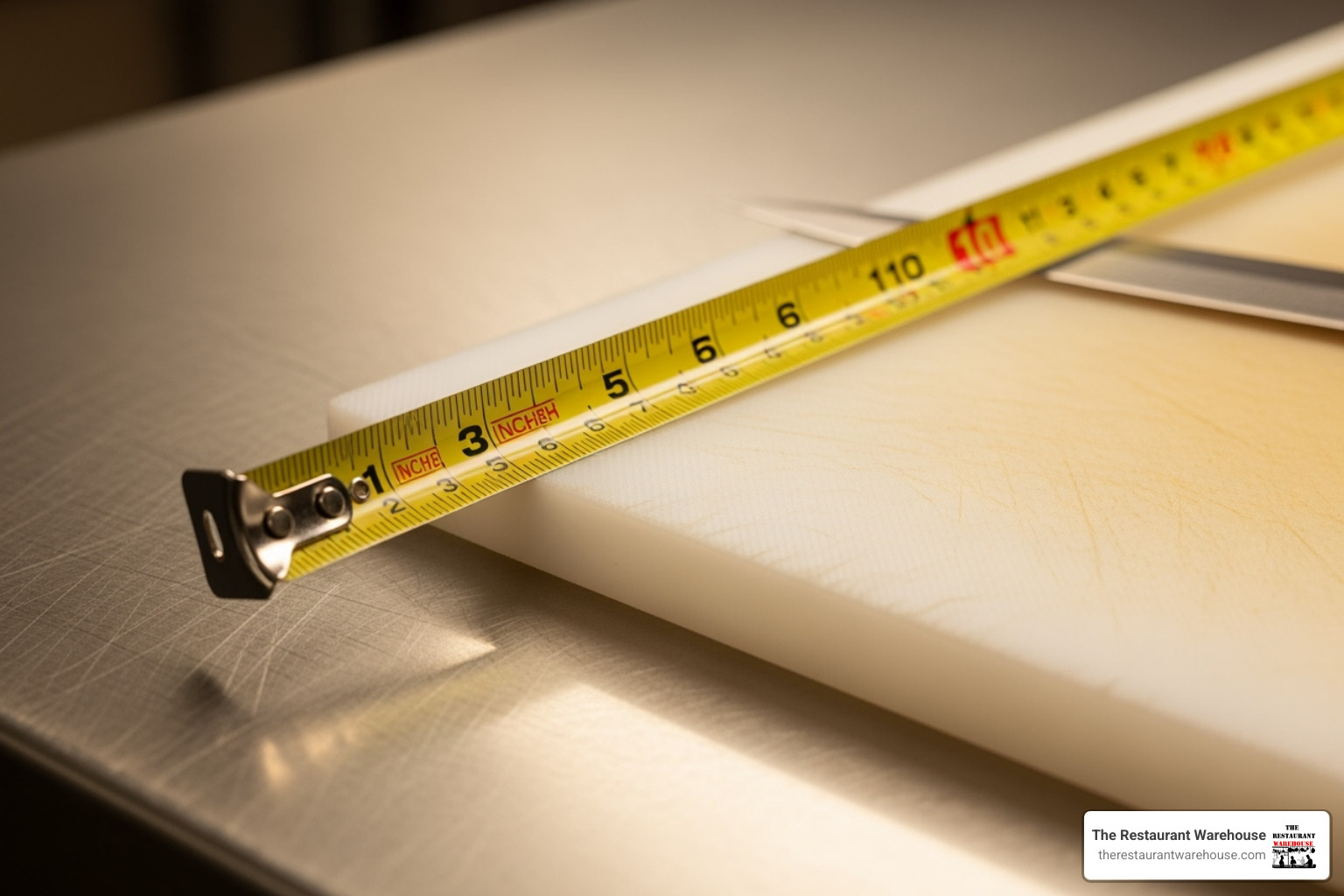
Image metadata: title=Measuring integrated board depth; subject=verifying depth for reach and rail access; source=The Restaurant Warehouse; license=Used with permission
Proper sizing is the critical factor that transforms a prep station from a cramped bottleneck into a smooth, high-speed assembly line. Getting the dimensions wrong can undermine your entire workflow. You must focus on three key dimensions—depth, length, and thickness—and then confirm exactly how the board mounts to your specific table model.
Depth (front-to-back)
- Standard Range: The industry standard is 10 to 12 inches for most sandwich prep applications. A 10-inch board is often sufficient for simple deli menus. However, a 12-inch board provides a more generous workspace, allowing for easier assembly of larger items like wraps or loaded subs without forcing staff to reach awkwardly over the rail.
- The Mega-Top Trade-Off: Mega-top prep tables, which feature an extra row of food pans, are excellent for menus with many toppings. However, this design necessitates a narrower cutting board (often 8-10 inches) to maintain proper ergonomic reach to all the pans. If your menu relies more on a wide variety of toppings than on a large assembly area, the narrower board is the correct choice for that specific setup.
- Ergonomic Reach Zone: The goal is to keep all critical ingredients and the assembly area within a 15 to 18-inch radius of the assembler’s neutral standing position. This minimizes reaching, twisting, and straining, which not only speeds up assembly but also reduces the risk of repetitive stress injuries over time.
Length (side-to-side)
- Match the Table Width: The board's length should correspond to the nominal width of your prep table. Common lengths include 27, 36, 48, 60, and 72 inches. The objective is to cover the entire working span of the refrigerated rail without interfering with the operation of the lids or any side-mounted accessories.
- Multi-Position Lines: For longer tables (60 inches and up) where two or more team members might work simultaneously, ensure there is enough uninterrupted board space for both. Alternatively, you can use this space to create defined zones for different stages of assembly (e.g., one person toasts bread and adds protein, the next adds produce and wraps). Some operators even use two separate boards on a long table to define these stations.
Thickness and Support System
- Typical Thicknesses: Boards are commonly available in 1/2\", 3/4\", and 1\" thicknesses. While a 1/2\" board is the most economical, it is also the most prone to flexing and warping. A 3/4\" or 1\" board offers superior stability, feels more solid under the knife, and will last significantly longer under heavy commercial use, making it a better long-term investment.
- Support Rails and Ledges: Before ordering, you must verify your table’s support design. Some models have a simple recessed ledge that the board rests on. Others use specific metal brackets or plastic pins that fit into holes drilled in the board. A board of the wrong thickness may not sit flush or securely in these supports.
- Weight vs. Cleanability: A thicker, heavier board is sturdier but also harder for staff to remove for daily cleaning. Ensure your team is trained on safe lifting techniques. If you plan to remove a heavy 1\" board every day, ensure you have a designated, sanitary storage rack for it.
Key Features to Consider
- Juice Management: A shallow perimeter groove, often called a juice groove, is an invaluable feature. It helps contain liquids from sliced tomatoes, pickles, and other wet ingredients, reducing wipe-down time, preventing drips onto the floor, and keeping the main assembly area cleaner.
- Rounded Edges: Edges and corners that are rounded and smooth are safer for staff to handle and reduce the risk of bumps and scrapes during a crowded, service.
- Reversibility: Some boards are designed to be reversible, allowing you to flip them over to use a fresh, new cutting surface. This can effectively double the lifespan of the board, providing excellent value.
How to Measure Accurately (5-Minute Checklist)
- Remove the existing board and use a reliable tape measure to get the actual depth and length. Do not rely on the model name or original spec sheet, as modifications may have occurred.
- Measure the thickness at both the edge and, if possible, the center to check for warping or uneven wear.
- Carefully note the location of any mounting points like holes, notches, or pins. Measure their exact distance from the edges and from each other.
- Place the old board back and confirm clearance for lids and sneeze guards when they are fully closed. An ill-fitting board can obstruct them.
- Take clear photos of the board installed, the board removed, and the support system on the table. Share these with your supplier for a visual fit verification.
Avoid These Common Sizing Mistakes
- Guessing based on the brand name alone. Models within the same brand can have different specs.
- Forgetting to account for lid clearance. An over-deep board can prevent the lid from closing properly, compromising food temperature.
- Assuming any 12-inch board will fit a mega-top unit. The unique pan layout of a mega-top changes the effective working depth and reach.
Internal resources and fit help:
- Find common lengths and specs for a 48 Inch Sandwich Prep Table: https://therestaurantwarehouse.com/blogs/restaurant-equipment/48-inch-sandwich-prep-table
- Need a size you don’t see? Contact us to discuss custom-fit options: https://therestaurantwarehouse.com/blogs/restaurant-equipment/sandwich-prep-table
Authoritative reference for workspace sanitation after sizing changes:
- CDC cleaning and sanitizing guidance: https://www.cdc.gov/foodsafety
CTA: Book a Strategy Call for a free measurement check before you buy: https://therestaurantwarehouse.com/blogs/restaurant-equipment/choose-sandwich-prep-station
The Guardian of Your Kitchen: Food Safety, Sanitation, and Regulations
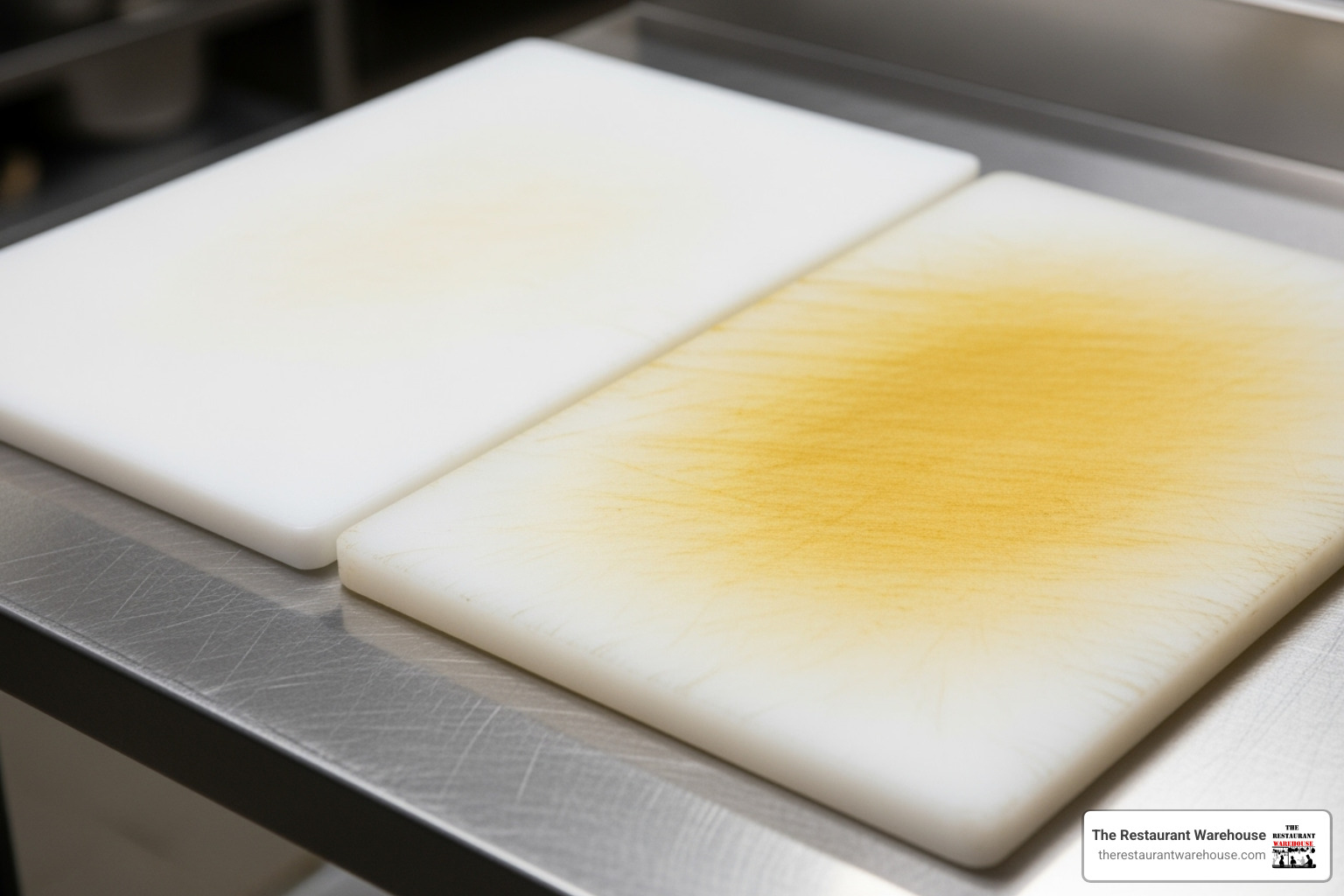
Image metadata: title=Safe versus unsafe cutting boards; subject=visual difference between sanitary and worn surfaces; source=The Restaurant Warehouse; license=Used with permission
Your sandwich prep table cutting board is a designated food-contact surface, which makes it one of the most critical control points in your entire food safety plan. Its condition and cleanliness can be the difference between a five-star health rating and a foodborne illness outbreak. Pairing the right material with a disciplined, non-negotiable cleaning and sanitizing routine is essential to reduce risk and remain perpetually inspection-ready.
How a Quality Board Supports Effective Sanitation
- A True Non-Porous Barrier: HDPE’s smooth, dense surface is the key. It prevents absorption, allowing your detergent and sanitizer to access and eliminate contaminants effectively. This only works, however, if you use the correct chemical concentrations and adhere to the required contact times specified by the manufacturer and your local health code.
- Easy Visual Inspection: Light-colored boards, typically white or light beige, make it incredibly easy to spot food residues, spills, and potential stains. This allows staff to identify and address problem areas immediately during service, maintaining a higher standard of cleanliness throughout the shift.
- Reliable and Safe Drying: A smooth board that readily sheds water is crucial for proper air-drying. Stacking wet boards is a major health code violation because it traps moisture between them, creating an ideal environment for dangerous microbial growth. A board that dries quickly helps prevent this unsafe practice.
Your Cleaning and Sanitizing SOP (Adapt to your local code and chemicals):
- Step 1: Scrape and Remove. Using a plastic or metal bench scraper, remove all gross food debris from the surface. This physical removal is the first and most important step.
- Step 2: Wash with Detergent. In a three-compartment sink, use hot water (typically at least 110°F) and a suitable detergent to scrub the entire surface, including the edges and any grooves. The combination of friction and soap helps to lift and suspend grease and food particles.
- Step 3: Rinse Thoroughly. Rinse the board with clean, hot water to remove all detergent residue. Any remaining soap can neutralize the sanitizer in the next step, making it ineffective.
- Step 4: Sanitize Correctly. Fully submerge or spray the board with a food-contact sanitizer mixed to the proper concentration. Common options include chlorine (50–100 ppm), quaternary ammonium or \"quat\" (often 200–400 ppm per label), or iodine. Crucially, you must allow the sanitizer to remain on the surface for the required contact time (e.g., 30-60 seconds) to be effective.
- Step 5: Air-Dry Completely. Place the board in a designated, clean storage rack that allows for air circulation on all sides. Never towel-dry a board, as the towel can reintroduce contaminants you just removed.
When to Resurface or Replace: A Critical Decision
- Deep grooves that catch your fingernail or a scraper are clear signs that the board is no longer safely cleanable.
- Persistent stains from sauces or produce that remain even after proper washing and sanitizing indicate that the surface is compromised and absorbing material.
- Any chips, cracks, or warping prevent the board from sitting flat and create physical hazards and uncleanable areas.
- If the surface feels tacky, rough, or uneven to the touch, it's a sign of chemical or physical degradation, and the board must be replaced.
- The Dangers of Resurfacing: While planing a board can make it look better temporarily, it removes the sealed, non-porous factory finish. This can expose a more porous subsurface that is harder to clean and may not be NSF-certified. For this reason, replacement is almost always the safer and more compliant long-term solution.
Color Coding and Cross-Contact Minimization
- Dedicate Your Main Board: Your large, integrated board should be used exclusively for assembling ready-to-eat (RTE) foods.
- Use a Color-Coded System: Implement a system of smaller, portable cutting boards for specific tasks, and never let them touch the main board. The standard system is: Red for raw meat, Yellow for raw poultry, Green for produce, Blue for seafood, White for dairy/bakery, and Brown for cooked meats. This is a powerful visual cue for preventing cross-contact.
- Clean Between Tasks: Always clean and sanitize surfaces and tools when switching between different food types, especially when moving from raw proteins to fresh produce.
Training Tips That Make SOPs Stick
- Post a laminated, one-page visual cleaning checklist directly at the cleaning station.
- Calibrate your sanitizer test strips with your staff regularly and require them to log the results at the beginning of each shift.
- Build five-minute "micro-clean" cycles into lulls between rushes to maintain a high standard throughout the day.
Internal maintenance resource:
- Step-by-step care in Sandwich Prep Table Maintenance: https://therestaurantwarehouse.com/blogs/restaurant-equipment/sandwich-prep-table-maintenance
Authoritative regulations and guidance:
- FDA Food Code (food-contact surfaces and sanitizing): https://www.fda.gov/food/retail-food-protection/fda-food-code
- USDA guidance on safe food handling: https://www.fsis.usda.gov/food-safety
- CDC food safety basics and cleaning: https://www.cdc.gov/foodsafety
CTA: Contact Us to set up a replacement schedule and sanitation checklist templates: https://therestaurantwarehouse.com/blogs/restaurant-equipment/sandwich-prep-table
OEM vs. Universal: Finding the Perfect Fit
When it’s time to replace your worn sandwich prep table cutting board, you will generally choose among three main options: an OEM board, a universal board, or a custom-cut solution. Each path offers a different balance of fit certainty, upfront cost, and lead time. Understanding these trade-offs is key to making the best decision for your operation's budget and timeline.
OEM (Original Equipment Manufacturer) Boards
An OEM board is manufactured to the exact specifications of your original prep table. It is, for all intents and purposes, an identical copy of the board that came with your unit when it was new.
- Pros: The primary advantage is a guaranteed, perfect fit. There is no guesswork, no need for modifications, and no risk of improper alignment. This ensures that lids, sneeze guards, and support brackets all function exactly as designed. Installation is a simple drop-in process, minimizing downtime.
- Cons: OEM boards are typically the most expensive option. For older or discontinued prep table models, they may also be difficult to find or have long lead times.
Universal Boards
Universal boards are produced in standard industry sizes (e.g., 10\"x48\", 12\"x60\") and are not specific to any one brand. They are designed to be a more economical, one-size-fits-most solution.
- Pros: The main benefit is cost-effectiveness, as they are often priced significantly below their OEM counterparts while offering comparable HDPE material quality. They are also widely available from various suppliers, ensuring quick delivery.
- Cons: The biggest drawback is that a perfect fit is not guaranteed. You will likely need to perform some modifications, such as drilling mounting holes or trimming an edge for a secure fit. This requires time, the right tools, and a degree of skill. An improper fit can leave gaps that trap food or cause the board to be unstable.
Custom-Cut Options
A custom-cut board is fabricated to the precise dimensions you provide. This is the go-to solution for unique situations where standard sizes won't work.
- Pros: This option provides an exact fit for unique, modified, or legacy tables where OEM parts are no longer available. You can also specify unique features, such as a custom thickness, a specific edge treatment, or cutouts to fit around fixtures.
- Cons: Custom work is generally the most expensive option and has the longest lead time, as it requires fabrication from scratch. The responsibility for providing perfectly accurate measurements falls entirely on you; any error in measurement will result in a board that doesn't fit.
Decision Factors and Total Cost of Ownership
- Downtime vs. Labor: An OEM board minimizes installation time and labor, making it ideal for high-volume operations where every minute of downtime costs money. A universal board can be a cost-effective win if you are on a tight budget and are comfortable with making minor modifications yourself.
- Service Volume and Lifespan: Heavier service volumes justify investing in thicker, longer-lasting boards. While a custom 1\" thick board might have the highest initial cost, its extended lifespan could offer the best long-term value compared to replacing a thinner universal board multiple times.
- Compliance and Safety: Regardless of which path you choose, you must ensure the material is made from FDA-compliant materials and is suitable for food contact (ideally with NSF/ANSI certification). A poor fit from a universal board can create sanitation risks that negate any initial cost savings.
Fit Verification Checklist Before You Buy
- Confirm depth, length, and thickness with a tape measure—do not rely on model numbers or online specs.
- Photograph the mounting system (brackets, pins, ledges) and measure the exact distances between any holes or pins.
- Double-check lid clearance and rail alignment with the old board in place.
- Share all measurements and photos with your supplier to get a second opinion and verify the fit before you place an order.
Internal links for selection help:
- Choose Sandwich Prep Station (line layout and capacity planning): https://therestaurantwarehouse.com/blogs/restaurant-equipment/choose-sandwich-prep-station
- Explore options and request sizing support: https://therestaurantwarehouse.com/blogs/restaurant-equipment/sandwich-prep-table
Authoritative standards reference:
- NSF food equipment certification overview: https://www.nsf.org/knowledge-library/food-equipment-certification
CTA: Book a Strategy Call for a free fit assessment and lead-time review: https://therestaurantwarehouse.com/blogs/restaurant-equipment/sandwich-prep-table
Conclusion
Your sandwich prep table cutting board is not a disposable accessory—it is a high-impact control point for the safety, speed, and consistency of your entire operation. It is a tool that directly influences your profitability every single day. By choosing the right material, carefully verifying the fit, and maintaining a disciplined, non-negotiable sanitation routine, you will actively protect your guests, your brand's reputation, and your bottom line.
Key takeaways you can act on today:
- Prioritize NSF-certified, high-density polyethylene (HDPE) for its proven non-porous surface, which is the cornerstone of effective sanitation and cross-contamination prevention on busy lines.
- Verify every dimension—depth (10–12 inches for standard tops), length, thickness, and mounting system—before ordering a replacement. Never guess or rely on model numbers alone.
- Implement and enforce a five-step cleaning and sanitizing SOP. Document your chemical concentrations and required contact times, and train your staff until the process is second nature.
- Immediately replace any board that shows deep scoring, persistent staining, chips, cracks, or warping. Understand that resurfacing is only a temporary fix for minor issues and replacement is the safest long-term solution.
- Train your staff on proper knife techniques to preserve the board's surface, conduct micro-clean cycles during lulls, and correctly use sanitizer test strips to maintain standards throughout every shift.
Next steps and support:
- Explore our Sandwich Prep Table Guide to gain a holistic understanding of how the cutting board integrates with the full station for maximum efficiency: https://therestaurantwarehouse.com/blogs/restaurant-equipment/sandwich-prep-table-guide
- Review our detailed care tips and establish a proactive maintenance and replacement cadence for your food-contact surfaces: https://therestaurantwarehouse.com/blogs/restaurant-equipment/sandwich-prep-table-maintenance
- If you need expert assistance with sizing, material selection, or compliance questions, we are here to help you make the right choice.
CTA: Book a Strategy Call to size your board and streamline your line: https://therestaurantwarehouse.com/blogs/restaurant-equipment/choose-sandwich-prep-station
CTA: Contact Us for a replacement recommendation and quote: https://therestaurantwarehouse.com/blogs/restaurant-equipment/sandwich-prep-table
Authoritative references to keep handy:
- FDA Food Code: https://www.fda.gov/food/retail-food-protection/fda-food-code
- CDC Food Safety: https://www.cdc.gov/foodsafety
- USDA Food Safety and Inspection Service: https://www.fsis.usda.gov/food-safety
By elevating your focus on this seemingly small component, you improve the quality and safety of every single sandwich you send across the pass. The right board, correctly sized and carefully maintained, is not an expense; it is a daily competitive advantage—one you can feel in faster ticket times, see in cleaner health inspections, and measure in more consistent, protected margins.
About The Author

Sean Kearney
Sean Kearney used to work at Amazon.com and started The Restaurant Warehouse. He has more than 10 years of experience in restaurant equipment and supplies. He graduated from the University of Washington in 1993. He earned a BA in business and marketing. He also played linebacker for the Huskies football team. He helps restaurants find equipment at a fair price and offers financing options. You can connect with Sean on LinkedIn or Facebook.
Leave a comment