

Equip Your Empire: The Best Restaurant Supplies in Seattle
Why Seattle restaurant equipment Matters for Your Culinary Success
Seattle restaurant equipment is the backbone of the city's thriving culinary scene. If you're looking to source supplies for your Seattle food business, understanding your options in detail will help you find the best long-term value, control operating costs, and protect your margins.
Seattle’s food landscape is unusually diverse for a city of its size. In a single neighborhood you can find craft coffee bars, ramen counters, seafood houses, breweries with ambitious kitchens, food trucks, and bakeries turning out world‑class bread and pastries. Each of these concepts has very different requirements when it comes to storage, prep, cooking, holding, and service gear.
That’s why taking a strategic approach to Seattle restaurant equipment matters. You’re not just filling a room with stainless steel—you’re building the physical system that will determine how many tickets you can push during a rush, how consistent your food will be, and how much you’ll spend each month on utilities and repairs.
Types of Restaurant Supply Partners
When you’re deciding where to buy, you’ll typically choose among three broad types of partners:
Local Showrooms
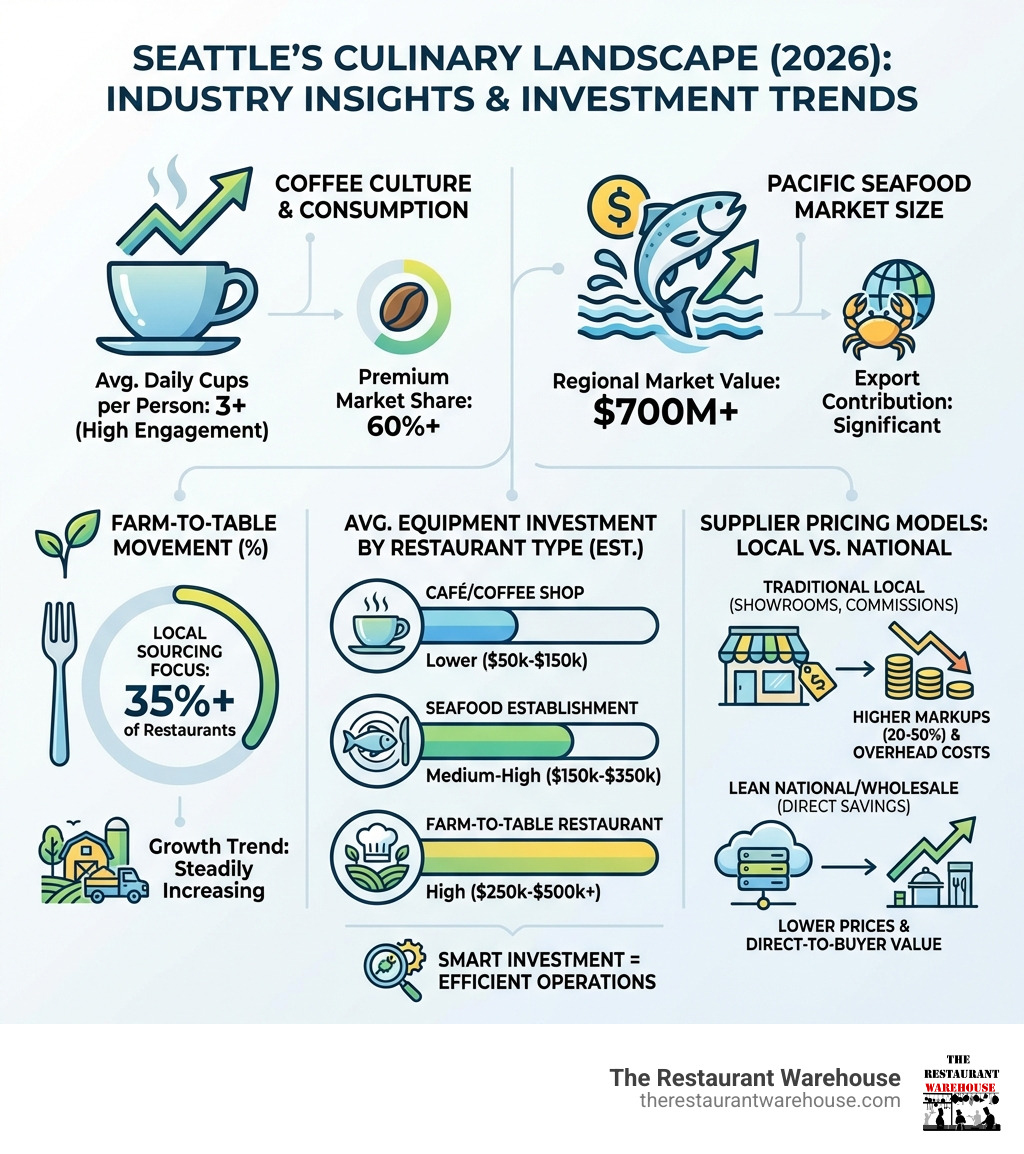
Brick‑and‑mortar supply houses let you walk the floor, open doors, and feel the build quality. The trade‑off is that large showrooms and commissioned sales teams create high overhead, which usually translates into higher prices. For a startup or expanding concept, that extra 20–50% markup adds up fast.National Online Retailers
Online suppliers offer deep catalogs and the ability to compare models and prices from your laptop. Because they operate with leaner business models—no large showrooms, fewer layers of sales management—they can often pass meaningful savings on to you. Shipping directly to your Seattle location also simplifies logistics when you’re coordinating build‑outs or remodels.Specialty Suppliers
Some partners zero in on a single category—like refrigeration, coffee, or bar supplies. These can be useful if you have highly specific needs (for example, a coffee program built around precise brew parameters), but they rarely function as true one‑stop shops. You’ll usually still need a broader supplier to round out your list.
If you want help choosing the right mix of partners for your concept and budget, you can schedule a strategy call with our team and walk through your equipment list line by line.
Key Supply Categories for Seattle Restaurants
Even though every concept is different, most Seattle operators rely on a similar core set of supply categories:
- Commercial refrigeration and freezers (reach‑ins, merchandisers, prep units, chest freezers)
- Food preparation tools (slicers, mixers, processors, blenders, immersion tools)
- Essential kitchen appliances and holding solutions (griddles, charbroilers, warmers, steam tables, induction units)
- Coffee and beverage supplies (espresso gear, grinders, drip systems, underbar refrigeration)
- Storage and transport solutions (shelving, racks, insulated carriers, bussing and utility carts)
- Dishwashing and sanitation tools (dish machines, sinks, sprayers, racks, chemical stations)
Seattle's diverse food scene—from its legendary coffee culture to fresh Pacific seafood and innovative farm‑to‑table restaurants—demands specialized, reliable supplies. The success of your establishment depends on choosing the right tools that can handle everything from Pike Place Market's seafood bounty to the city's demanding coffee standards while surviving long, wet winters and non‑stop service.
The Pricing Challenge in Seattle
Many Seattle restaurateurs face inflated prices from traditional suppliers who add hefty commissions and maintain prime‑location showrooms. That structure often builds 20–50% onto the cost of core items you need just to open your doors—reach‑in refrigeration, prep surfaces, dishwashing, and cold storage.
The upside is that you’re not locked into that model. By working with suppliers built around lean operations and wholesale pricing, you can often buy brand‑new, warranted supplies for what others pay for used gear.
This guide breaks down what supplies you actually need in Seattle, where to find them, and how to invest in a way that supports your cash flow instead of straining it. We’ll compare local versus national suppliers, explore the pros and cons of new versus used purchases, and highlight Seattle‑specific considerations like energy efficiency rules, humidity, and outdoor dining.
I’m Sean Kearney from The Restaurant Warehouse, and I’ve spent years helping restaurant owners find the right Seattle restaurant equipment at prices that make sense for their business. My background in sales taught me that the most successful projects start with an honest conversation about your concept, volume, and budget—whether you're launching a food truck in Ballard, a café in Capitol Hill, or upgrading a full‑service dining room downtown.
If you’re actively building or remodeling now, you can request a custom quote for your Seattle restaurant equipment list and get line‑item pricing to compare against local bids.
The Foundation: Essential Supplies for Seattle's Culinary Scene
When it comes to outfitting a restaurant in Seattle, understanding the specific needs of our vibrant culinary landscape is paramount. From the busy Pike Place Market to the cozy neighborhood cafes, every establishment requires a carefully planned set of supplies to thrive over the long haul—not just on opening weekend.
We're often asked: What types of restaurant supplies are essential for businesses in Seattle, Washington, and what role do specialized tools play in supporting Seattle's diverse culinary scene?
The answer starts with Seattle's unique gastronomic identity, which blends world‑renowned coffee culture, abundant seafood, and a strong farm‑to‑table ethos. To support that, every operation needs rock‑solid cold storage, ergonomic prep tools, and durable sanitation and storage solutions. On top of that, certain specialized items make it easier to execute the menu styles that define the city.

Core Categories Every Seattle Kitchen Needs
Regardless of concept, most Seattle operations benefit from carefully chosen items in these categories:
- Cold storage: Reach‑in refrigerators and freezers, undercounter units, refrigerated prep tables, and walk‑ins where space allows.
- Prep equipment: Food processors, slicers, mixers, blenders, immersion blenders, and portion scales.
- Hot‑side appliances and holding gear: Countertop griddles, charbroilers, fryers, induction units, rice cookers, steam tables, and warmers.
- Coffee and beverage: Espresso machines, grinders, drip coffee brewers, hot water towers, underbar refrigerators, and ice machines.
- Storage and shelving: Wire shelving, dunnage racks, ingredient bins, pan racks, and drying racks.
- Warewashing and sanitation: Dish machines, three‑compartment sinks, hand sinks, sprayers, racks, and chemical dispensing systems.
A thoughtful mix in each category will determine how many covers you can serve in an hour, how many staff you need on the line, and how consistently you can execute your menu.
If you want to browse common packages by category, you can explore our full range of restaurant supplies and filter by the type of operation you’re running.
Supporting the Coffee Capital: Beverage & Bar Essentials
Seattle isn't just known for its rain; it's globally recognized as a coffee mecca. The city's coffee culture is deeply ingrained, from Starbucks' first store in Pike Place Market to independent micro‑roasters in nearly every neighborhood. This legacy means that quality beverage preparation is non‑negotiable for many establishments, from dedicated coffee shops to full‑service restaurants with serious brunch programs.
To meet Seattle's high standards, your business needs a dialed‑in beverage station built around reliable, serviceable tools:
- Precision coffee grinders capable of reproducing the same grind profile all day, even as humidity and temperature shift.
- Commercial espresso machines and drip brewers sized to your peak traffic, with enough group heads and brew capacity to keep lines moving.
- High‑performance blenders for smoothies, frozen drinks, and specialty coffee beverages.
- Reliable ice machines that can handle summer patio rushes, game‑day crowds, and weekend brunch.
- Underbar refrigeration for milk, alternative milks, juices, mixers, and garnishes.
- Glassware and drinkware matched to your concept and volume, from demitasse cups to beer pints and cocktail glassware.
- Water filtration systems that protect equipment from scale and help your coffee taste consistent across seasons.
Given Seattle's municipal water quality standards, many operators choose to pair espresso and ice systems with robust filtration and softening solutions to prevent scale buildup and off flavors. You can review official information about local water parameters through the City of Seattle’s drinking water quality resources and then match filtration to those specs.
From Ocean to Plate: Seafood Preparation & Storage
With the Pacific Ocean at our doorstep, Seattle is a seafood lover's paradise. Restaurants here pride themselves on showcasing the freshest catches—from Puget Sound salmon and oysters to Alaskan halibut and Dungeness crab.
That abundance demands thoughtful seafood‑focused supplies:
- Refrigerated prep tables to keep fish and shellfish at safe temperatures while you portion, marinate, and assemble.
- Commercial‑grade freezers and walk‑ins to hold bulk product securely between deliveries.
- Fish‑friendly prep gear like flexible fillet knives, fish bone tweezers, and scaling tools.
- Insulated fish totes and ice transport bins that keep product cold during receiving, storage, and line transfer.
- Color‑coded cutting boards and knives to avoid cross‑contamination with raw meats and produce.
These items aren’t just about convenience—they’re central to food safety. The Washington State Department of Health publishes detailed guidance on safe seafood handling and cold holding temperatures, which is worth reviewing as you design your receiving and prep systems. You’ll find that information in the food safety rules and guidance for operators provided by the state.
Farm-to-Table Freshness: Refrigeration and Prep Tools
The farm‑to‑table movement has a strong presence in Seattle, with many chefs prioritizing locally sourced, seasonal ingredients. That commitment to freshness affects your shopping list more than you might expect.
To support a menu that changes with the market, consider:
- Reach‑in refrigerators with adjustable shelving to accommodate everything from tall hotel pans to farm crates.
- Dedicated produce washing sinks with sprayers and drainboards for leafy greens and root vegetables.
- Powerful food processors and commercial mixers for sauces, dressings, doughs, and batters.
- Vegetable slicers and mandolines for high‑volume prep of onions, potatoes, and garnishes.
- Stainless steel work tables with backsplashes and undershelves for clean, efficient workflows.
- Vacuum sealers and appropriate bags to extend the shelf life of prepared components, cuts of meat, and seasonal items.
These tools allow your kitchen to keep up with peak‑season deliveries without overwhelming your staff. They also help reduce waste—a core concern for many Seattle operators focused on sustainability and tight food costs.
Sourcing Your Success: Finding Reliable Seattle Restaurant Supply Partners
Finding the right suppliers for your food service business in Seattle is a pivotal step toward operational success. We frequently hear restaurant owners ask: Where can restaurant owners in Seattle find reliable suppliers for kitchen essentials, and what are the benefits of choosing a local Seattle restaurant supply store versus a national online retailer?
The decision often comes down to balancing immediate needs, budget constraints, build‑out timelines, and how much you value in‑person service versus a wider catalog and sharper prices.
Whether you opt for local suppliers or national online retailers, the goal remains the same: secure high‑quality, durable supplies that match your concept and projected volume. Reliability, responsive customer service, a broad inventory, and transparent pricing are key factors.
If you’d like to compare options against a real‑world quote, you can contact us for a detailed estimate on your Seattle restaurant equipment package and use it as a benchmark during your search.
The Local Advantage: The Traditional Showroom Model
Choosing a traditional, local restaurant supply partner offers a few distinct advantages:
- Hands‑on evaluation: You can open doors, test hinges and drawers, and get a sense of build quality.
- Immediate access: When a cooler fails before a weekend, being able to pick up a replacement locally can save a service.
- Local insight: Staff who work daily with Seattle operators often understand city‑specific challenges like tight footprints, basement kitchens, and steep delivery access.
However, showroom‑based models can come with trade‑offs:
- High commercial rents and large display spaces increase operating costs.
- Commission‑driven sales structures can add 20–50% to item costs.
- Floor space limits how many models you can see in person, compared with online catalogs.
The National Online Retailer: A World of Options
National online suppliers operate differently and provide their own advantages:
- Extensive catalogs: Hundreds or thousands of SKUs across refrigeration, prep, bar, storage, and sanitation.
- Competitive pricing: Lean operations and wholesale purchasing can translate into meaningfully lower prices.
- 24/7 shopping: You can research and order between services without waiting for business‑hour appointments.
- Direct‑to‑door delivery: Gear shows up at your Seattle location, often with options for lift‑gate or inside delivery.
For businesses like ours at The Restaurant Warehouse, this lean operational model—minimal retail footprint, no high‑commission sales teams—allows us to supply new, warrantied restaurant supplies at price points that are often comparable to or better than local used markets. You can browse our categories and packages at https://therestaurantwarehouse.com/collections/all.
New vs. Used: A Critical Decision for Your Seattle Restaurant Supplies
A common dilemma for Seattle restaurant owners is deciding between new and used supplies. How does the availability of new versus used restaurant supplies impact purchasing decisions for Seattle businesses?
Used gear can be attractive for a few reasons:
- Lower upfront cost
- Immediate local availability
- Perception of being “good enough” for back‑of‑house
But those savings can be misleading when you consider:
- Lack of warranties: Most used items are sold as‑is, with no guarantee.
- Unknown history: Prior heavy use, poor maintenance, or improper repairs can shorten lifespan.
- Downtime risk: Failures during service cause lost revenue, food loss, and staff stress.
By contrast, new supplies typically offer:
- Manufacturer warranties that protect you from early failures.
- Current technology that can be more energy‑efficient and easier to service.
- Predictable performance, which is critical for consistency and food safety.
While the sticker price on new equipment is higher, the total cost of ownership—factoring in lifespan, energy usage, and downtime—often ends up lower than a revolving door of used purchases.
If you’re currently weighing a used purchase, you can compare it against a new option by requesting a side‑by‑side quote at https://therestaurantwarehouse.com/pages/contact-us. That way, you can make the call based on real numbers instead of guesswork.
The ROI of Quality: Why Smart Investment Matters in Seattle
In Seattle's competitive restaurant scene, every purchasing decision affects your reputation, labor model, and long‑term profitability. Investing in high‑quality supplies is less about prestige and more about building a kitchen that works as hard as your team does.
Enhancing Operational Efficiency and Consistency
Well‑chosen equipment directly shapes your workflow:
- Faster prep times: High‑capacity food processors, mixers, and slicers reduce manual labor and prep hours.
- Streamlined line layout: Compact refrigeration, undercounter units, and warmers placed correctly shorten steps and speed up ticket times.
- Reduced bottlenecks: Adequate refrigeration, dish capacity, and hot holding help your team stay ahead of the rush.
All of this translates into:
- Lower labor cost per plate
- Shorter ticket times and better table turns
- Fewer remakes and comped meals due to inconsistent output
Reliable tools also improve staff morale. When cooks can trust that doors will seal, thermostats will hold, and blenders will power through a full shift, they can focus on cooking and plating instead of fighting failing gear.
Elevating Food Quality and Safety
High‑quality supplies are instrumental in protecting both your guests and your brand:
- Stable refrigeration maintains safe temperatures for seafood, dairy, and prepared foods.
- Well‑designed prep tools (such as slicers, mixers, and processors) allow for more precise cuts and textures, which matter for everything from ramen toppings to tasting menus.
- Adequate hot holding keeps food in the safe zone without drying it out, which is critical during long rushes.
Maintaining optimal storage and prep conditions is also central to health code compliance. Building your equipment list with these standards in mind saves you from expensive last‑minute changes during inspection.
Long-Term Financial Benefits
While quality supplies might require a higher initial investment, they offer significant long‑term financial benefits:
- Lower repair costs: Better build quality and warranty coverage reduce emergency service calls.
- Fewer replacements: Durable items stay in service longer, delaying capital expenditures.
- Energy savings: Modern, efficient refrigeration, dish machines, and hot holding units can lower monthly utility bills.
Over a five‑ to ten‑year window, these savings can easily surpass the initial cost difference between entry‑level or used gear and solid mid‑tier options.
If you’d like to see how your projected equipment choices impact operating costs, you can book a strategy call with our team and walk through sample ROI comparisons based on your menu and hours of operation.
Navigating Seattle-Specific Considerations for Your Supplies
Operating a restaurant in Seattle means navigating a specific set of local considerations. What are the key factors when selecting restaurant supplies for a Seattle‑based business—such as climate, local cuisine, and energy efficiency? Are there local regulations or trends that influence your choices, and what financing or support services are available for restaurants purchasing new items?
Understanding these elements before you buy can save money and prevent frustrating surprises during permitting and inspections.
Climate and Environment: The Emerald City Factor
Seattle’s maritime climate is mild but damp, and that affects your equipment list in several ways:
- Humidity and moisture: Prolonged moisture exposure can accelerate corrosion. Choosing appropriate stainless steel grades and rust‑resistant finishes helps extend the life of shelving, prep tables, and outdoor fixtures.
- Outdoor dining: Patios, rooftops, and parklets are increasingly common. For these spaces, prioritize all‑weather furniture, stackable seating, and outdoor‑rated heating elements that can handle rain and cold.
- Tight urban footprints: Older buildings and small lots mean you may need narrower refrigeration, compact dish solutions, and creative storage like wall‑mounted shelving and dunnage racks.
Seattle’s water can also have specific mineral content that contributes to scale buildup in dishwashers, espresso machines, and ice makers. Proper filtration and softening protect your investment and reduce maintenance needs.
Energy Efficiency and Local Regulations
Seattle’s commitment to sustainability shows up in building codes, customer expectations, and marketing value.
When sourcing your supplies, consider:
- ENERGY STAR–rated refrigeration and dish machines to reduce electricity and water use.
- Efficient hot holding and warming solutions that maintain food quality without wasting energy.
- LED lighting in display cases, back‑of‑house, and bar areas.
Local building and health codes influence everything from hood requirements and make‑up air to sink placement and floor drains. Planning your purchases with these in mind helps you avoid buying items that don’t pass inspection or require costly rework.
Many Seattle operators also choose equipment that exceeds minimum standards to signal a deeper commitment to sustainability. Efficient refrigeration and water‑saving dish solutions are often highlighted in marketing to eco‑conscious guests.
Financing and Support for Seattle Businesses
Outfitting a new restaurant or upgrading an existing one can require significant capital. Fortunately, you don’t always have to pay for everything upfront.
Common options include:
- Equipment financing and leasing: Spread payments over time while generating revenue from the gear.
- Small business loans and lines of credit: Through banks or community lenders focused on the hospitality sector.
- Local and federal programs: Certain economic development initiatives and grants occasionally support small food businesses, especially in targeted neighborhoods or for specific upgrades like energy‑efficient refrigeration.
Many suppliers, including The Restaurant Warehouse, can help connect you with financing partners or structure purchases to match your budget and build‑out schedule.
If you’re planning a new build or renovation, you can explore our restaurant equipment catalog and then contact us to discuss financing or phased purchasing that aligns with your timeline.
Conclusion
Outfitting your Seattle restaurant for success means far more than simply filling a space with stainless steel. It requires strategic choices that reflect our city’s unique culinary identity, climate, and regulatory environment—while also supporting efficient operations and long‑term financial health.
We’ve looked at the essential supplies that power Seattle’s diverse dining scene, from coffee programs that can stand up to the city’s exacting standards, to seafood‑ready prep and storage, to farm‑to‑table workflows that protect ingredient quality. We’ve compared local showrooms and national online partners, and we’ve examined how the choice between new and used gear affects reliability, food safety, and total cost of ownership.
We’ve also explored how Seattle‑specific factors—like humidity, tight urban footprints, and strong sustainability expectations—shape equipment decisions. Choosing durable, energy‑efficient items that fit your space and menu not only helps you pass inspections, it keeps your utility bills under control and your staff working efficiently.
At The Restaurant Warehouse, we focus on providing new, warrantied Seattle restaurant equipment through a wholesale‑oriented model that avoids high commissions and heavy showroom overhead. That approach allows us to help operators equip their kitchens with dependable gear while preserving precious startup and expansion capital.
If you’re ready to move from planning to purchasing, you can learn more about our Seattle restaurant supply options or book a strategy call with our team today to review your menu, space, and budget line by line.
Thoughtful investment in the right Seattle restaurant equipment today lays the groundwork for smoother services, happier guests, and a stronger bottom line for years to come.
About The Author

Sean Kearney
Sean Kearney used to work at Amazon.com and started The Restaurant Warehouse. He has more than 10 years of experience in restaurant equipment and supplies. He graduated from the University of Washington in 1993. He earned a BA in business and marketing. He also played linebacker for the Huskies football team. He helps restaurants find equipment at a fair price and offers financing options. You can connect with Sean on LinkedIn or Facebook.
Leave a comment