


Restaurant Supplies Near Me: Find Top Local Vendors
Finding the right local supplier is so much more than a quick "restaurant supplies near me" search. It's a strategic partnership. This is the partner who will supply everything from your walk-in cooler to the ramekins you use every single day. Getting this right directly impacts your kitchen's flow, your food quality, and ultimately, your bottom line.
Your Blueprint For Finding Local Suppliers
The very first thing you need to do is build a master list of potential local vendors. This isn't just about finding one supplier and calling it a day. The goal is to create a solid pool of businesses that can meet your restaurant's specific needs, giving you options and leverage. Think of it as creating a well-researched roster of contenders before you even start making calls.
This whole process is a mix of digital detective work and good old-fashioned networking. By hitting it from both angles—online research and real-world connections—you'll uncover some hidden gems that might not pop up on the first page of a Google search. A little legwork now saves a ton of time and prevents some seriously costly mistakes later on.
Mastering Your Digital Search
Of course, your search for local suppliers is going to start online. But you need to be smarter than a simple search query. Use Google Maps for more than just finding a location. Dig into the "nearby" feature to spot distributors clustered in industrial parks, which can be a goldmine. Read the user reviews carefully and check out their photos—you can often get a decent feel for their showroom or warehouse before you ever set foot inside.
Go beyond the search engines and dive into industry-specific forums and social media groups. I'm talking about local chef and restaurant owner groups on Facebook or LinkedIn. These are invaluable. You can ask for genuine recommendations and, just as importantly, get warnings about who to avoid. It’s firsthand experience from people in your shoes, turning a generic search into a targeted investigation.
Tapping Into Your Local Network
As powerful as digital tools are, nothing beats a recommendation from someone you trust in the business. Start talking to other chefs and restaurateurs in your area. Ask them who they count on for everything—their daily produce, their essential cooking equipment, and who they call for emergency restocks. These conversations give you unfiltered, honest feedback on a supplier's reliability, customer service, and product quality.
Key Takeaway: Your local culinary community is your best asset. A supplier who consistently earns praise from other successful operators in your city is a strong candidate for your short list.
And don't forget, your network of local vendors should include critical service providers, not just equipment suppliers. For instance, finding a company that offers commercial laundry services specifically for restaurants is crucial for handling your linens and uniforms, keeping your whole operation looking sharp and professional.
This whole discovery process—from searching and evaluating to finally connecting—is a journey with several key stages.
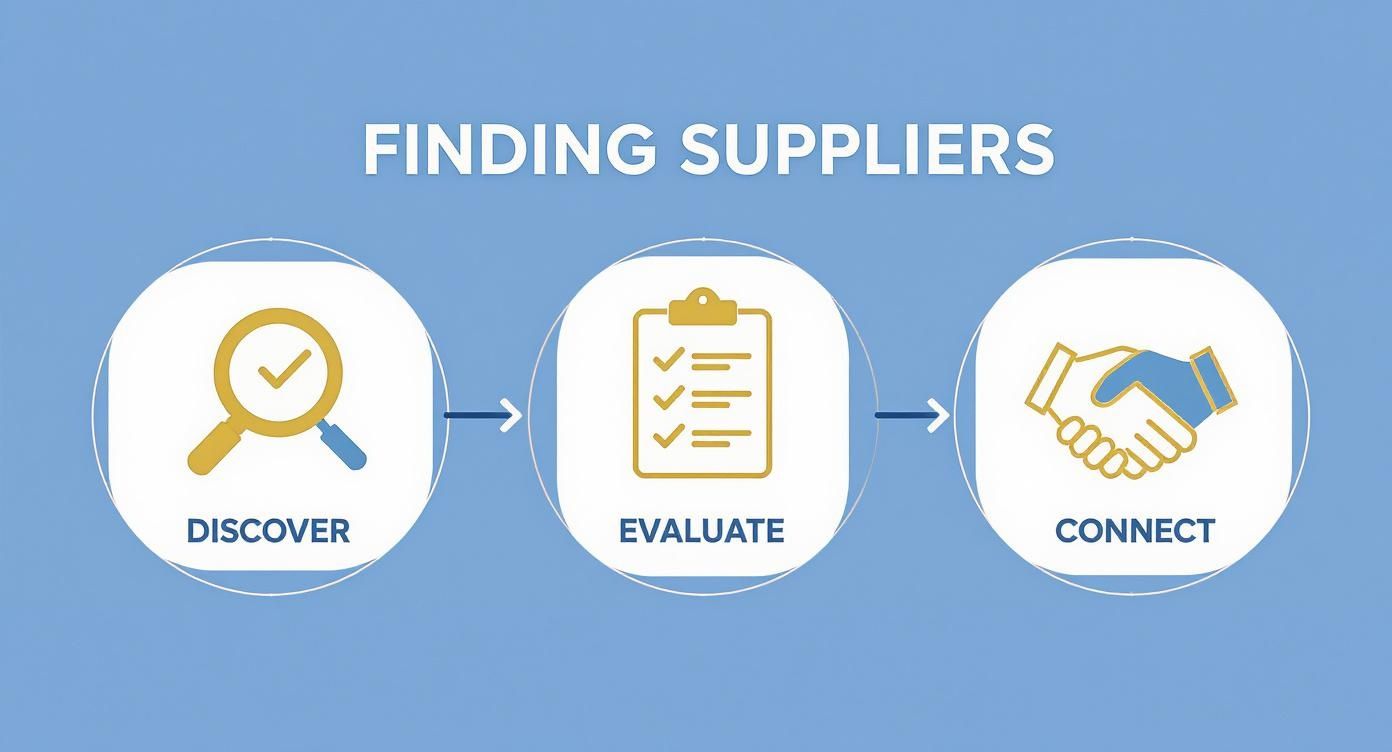
As you can see, it's not about making a single decision. It's about a series of careful evaluations before you commit to a partnership.
Building Your Master Supplier List
As you gather names, get them all into a master spreadsheet. This isn't just a list of names and phone numbers; it's your command center for comparing and contrasting. The market you're tapping into is massive. The food service equipment market was valued at USD 39.07 billion and is projected to hit USD 58.22 billion by 2030. That's a lot of money on the line, so making smart purchasing decisions is absolutely critical for your financial health.
To give you a better idea of your options, here’s a quick rundown of the different places you can look.
Supplier Sourcing Channel Comparison
| Sourcing Channel | Primary Benefit | Potential Drawback |
|---|---|---|
| Google/Maps Search | Quick access to a wide range of local options and reviews. | Top results are often paid ads; may miss smaller suppliers. |
| Industry Forums/Groups | Honest, peer-to-peer recommendations and warnings. | Advice can be subjective or based on outdated experiences. |
| Peer Recommendations | Highly trusted, firsthand accounts of reliability and service. | May be limited to the personal network of a few individuals. |
| Trade Shows | See products in person and meet suppliers face-to-face. | Can be time-consuming and may not feature local-only vendors. |
Each channel has its place, and using a mix of them will give you the most comprehensive list of potential partners.
Once you start populating your spreadsheet, make sure you track the right details for each potential supplier.
- Company Name & Contact Info: The basics, for easy reference.
- Specialty: Do they focus on heavy equipment, smallwares, or fresh produce?
- Key Brands Carried: Note the manufacturers they represent.
- Source of Recommendation: Keep track of who told you about them.
This organized approach gives you a solid foundation for the next stage: evaluation and outreach. For a deeper dive into exactly what to look for, check out our complete restaurant supply guide for 2024 to make sure you're fully prepared.
How To Evaluate A Supplier's Inventory And Quality
Once you've got a solid list of potential suppliers, the focus shifts from who they are to what they sell. A supplier is only as good as their stock, and this is where you need to put on your detective hat. It’s time to really dig into their catalogs, websites, and—if possible—their showrooms to see what they’re actually offering.
This step is critical. If you run a high-volume steakhouse, choosing a supplier that mostly stocks light-duty, budget-friendly gear is a recipe for equipment failure. On the flip side, you don't want to overspend on premium brands for basic items that see little wear and tear. Finding that sweet spot is key to managing your startup costs without sacrificing quality where it counts.
One-Stop-Shop Or Niche Specialist?
As you start digging, you’ll notice that most suppliers fall into one of two camps. Some try to be a one-stop-shop, boasting a massive catalog that covers every possible need at various price points. Others are more like specialists, curating a smaller selection from a handful of trusted, high-performance brands.
Neither approach is automatically better; it all comes down to your restaurant's specific needs and budget.
- The Generalist: These suppliers are fantastic for everyday consumables, basic smallwares, and standard equipment where brand isn't a huge factor. Their sheer selection can be a massive time-saver.
- The Specialist: This is your go-to when you need a specific, high-performance piece of equipment. Think of that top-of-the-line espresso machine for your café or a very particular convection oven for your bakery.
Your goal is to find a supplier whose inventory philosophy matches your operational reality. For most restaurants, a hybrid approach works best—using a generalist for the daily grind and a specialist for those big, signature equipment purchases.
How To Judge Equipment Quality And Durability
Looking past the brand names, you've got to learn how to judge the actual build quality of the equipment. This is non-negotiable for anything that's going to take a beating day in and day out, like worktables, sinks, and cooking lines.
In commercial kitchens, one of the clearest indicators of quality is the grade of stainless steel. You'll constantly see two numbers thrown around: 304 and 430.
- 304 Stainless Steel: This is the good stuff. It has a higher nickel content, which makes it far more resistant to rust and corrosion from salt, acidic foods, and harsh cleaners. It's the gold standard for prep surfaces, sinks, and anything that directly touches food.
- 430 Stainless Steel: This is a more budget-friendly, magnetic grade. It’s perfectly fine for things like equipment stands, shelving, or external panels that won’t be in constant contact with corrosive substances.
Here’s a pro tip: Ask a potential supplier what grade of steel their house-brand worktables are made from. A good sales rep will know the answer immediately and be able to explain why it matters. It’s a great little test of their knowledge and transparency.
The global restaurant equipment market is booming, valued at around USD 4.8 billion and on track to hit USD 10.2 billion by 2035. This growth, highlighted in a report by Future Market Insights, is centered on core items like cooking equipment and work tables, making it more important than ever to understand quality to make a smart investment.
A Real-World Comparison
Let's say you're shopping for a new prep table and you're looking at two local suppliers.
Supplier A has a table for $250. It looks okay, but the product description just says "stainless steel construction." When you ask the sales rep, they can't confirm the steel grade or its gauge (thickness). Red flag.
Supplier B lists a similar table for $375. Its description is crystal clear: 16-gauge, 304-grade stainless steel top with galvanized steel legs. The rep explains that this build is perfect for heavy-duty prep, from butchering to acidic marinades, and it even comes with a 2-year warranty against rust.
While Supplier A is cheaper today, Supplier B is offering a far more durable product that will likely outlast the cheaper option by years, saving you the cost and headache of a future replacement. This is the kind of critical thinking that pays off big time.
Properly evaluating inventory is the first step in building a solid operational foundation. In fact, you can learn more about how this ties into the bigger picture in our detailed guide on creating a powerful restaurant inventory management system. Always push for the details that matter: material quality, warranty specifics, and the equipment's intended use.
Comparing Price, Service, and Reputation
Once you've got a handle on a supplier's inventory, it’s time to dig deeper. It's so easy to get fixated on the price tag, but I’ve seen countless new operators make that classic rookie mistake. Scoring a rock-bottom price on a new range feels great until you realize it comes from a supplier with a terrible reputation and non-existent service. That "deal" quickly turns into a nightmare, costing you way more in lost business and headaches than you ever saved.
Real value isn't just about the lowest price. It’s a three-legged stool: fair pricing, responsive service, and a track record you can trust. When you're looking for local suppliers, you aren't just buying stuff—you're looking for a partner. The right one will be an asset, the kind of company that actually answers the phone and helps you solve problems.
Look Beyond The Price Tag
The sticker price is only the beginning of the story. To get a true sense of what you'll actually spend, you have to look at the total cost of ownership. One supplier might offer an amazing deal on a walk-in cooler, but their quote is often just the starting point. Another supplier’s slightly higher price might already include all the extras.
To make a real apples-to-apples comparison, you absolutely have to ask about these hidden costs:
- Delivery Fees: How do they work? Is it a flat rate? Is it based on mileage? This can easily add hundreds of dollars to a big order.
- Installation Charges: This is a big one for complex gear like hood systems or walk-ins. Find out if the supplier's team handles it or if you’re on your own to find a certified installer.
- Warranty and Maintenance: Get specific. What does the warranty really cover? A "parts only" warranty can leave you with a massive labor bill if something goes wrong.
Delivery fees, in particular, can sneak up on you. It's worth learning how to calculate shipping costs to get a realistic picture of your final bill. Doing this homework ensures you're comparing the real, all-in cost, not just a tempting but misleading price.
Vetting A Supplier's Reputation
A supplier’s reputation is everything, and it’s up to you to investigate it. A solid reputation is built over years of doing the right thing—getting the right equipment to the right place on time, offering solid advice, and making things right when they go wrong.
The best place to start? Ask for references. Any supplier worth their salt will be happy to connect you with a few of their long-time customers. Call those restaurant owners and ask direct questions. What are their on-time delivery rates like? How does the supplier handle backorders? How do they respond in an emergency?
After that, hit the internet. Check out reviews on Google, browse industry forums, and see what people are saying in restaurant owner Facebook groups. Don't just look at the star rating; look for patterns. One bad review could be a fluke, but a dozen people all complaining about late deliveries is a huge red flag.
Pro Tip: Your first interaction with a supplier is a test. How long does it take them to get back to you with a quote? Is it detailed and professional? Their initial responsiveness is often a preview of the service you'll get after they have your money.
The Value Of Service And Support
Picture this: it’s 8 PM on a Friday, your dining room is packed, and your main freezer dies. This is the moment you discover the true value of your supplier. Are you stuck navigating an automated phone menu, or can you get a real person on the line who can dispatch a technician? That level of support is priceless.
When you're sizing up a supplier's service, think about these things:
- Team Expertise: Do their sales reps actually know the equipment inside and out, or are they just reading you a spec sheet?
- Problem Resolution: Ask them to walk you through their process for a damaged shipment or a warranty claim. A clear, straightforward policy is a great sign.
- Brand Partnerships: Do they have strong relationships with the equipment brands you prefer? Good partnerships mean better support and faster access to parts.
Choosing your supplier is a huge decision. For a broader look at some of the top names out there, our guide to the best commercial kitchen equipment suppliers can give you more context. Always remember, you’re looking for a partner who offers long-term value, not just a one-time discount.
Making Sure Your Supplies Actually Show Up On Time
Nothing throws a wrench in your opening plans faster than a missed delivery. A delayed fryer or a backordered case of your signature sauce can mean lost revenue and a major headache. That’s why you absolutely have to dig into a potential supplier's logistics before signing on the dotted line.
Nailing Down Delivery Times and Schedules
Getting a straight answer on lead times is non-negotiable. You need to know exactly when to expect your orders so you can plan your kitchen prep and service accordingly.
Ask for their typical delivery windows for everything—from your daily consumables and smallwares to the big-ticket equipment. Don't forget to ask how things change during peak season or holidays, because they always do.
A few things to clarify upfront:
- What’s the turnaround for standard, in-stock items versus something you have to special order?
- Do they deliver on weekends or holidays, and what’s the extra cost?
- Are there penalties if you need to change the schedule?
Here’s a rough idea of what you can expect, but always get it in writing from your supplier:
| Item Type | Typical Lead Time | Possible Peak Season Delay |
|---|---|---|
| Disposable Supplies | 1–3 days | +2 days |
| Smallwares | 3–5 days | +1 week |
| Heavy Equipment | 1–2 weeks | +3 weeks |
I once saw a fast-casual spot save themselves a ton of grief by confirming a next-day delivery slot for a huge cookware order. They locked in the time, got a direct contact number, and avoided having their gear sit in a warehouse all weekend. It’s those small details that prevent massive operational headaches.
Handling Backorders and Breakables
We’ve all been there: you open a box of wine glasses and half of them are shattered. Before you commit, find out exactly how they handle fragile items like glassware and plates. Do they use custom crates or just toss them in a box with some packing peanuts?
Equally important is their backorder process. You don't want to find out you're out of your best-selling appetizer containers an hour before the dinner rush.
A good partner will have a solid system for packing fragile items and will tell you about a backorder before it becomes your problem.
Look for suppliers who offer:
- Automatic email or text alerts for backordered items.
- Photo proof of how fragile items are packed before they ship.
- A clear, straightforward process for making a damage claim.
A quick look on Google Maps can also show you where their distribution hubs are located. The closer they are, the faster you'll likely get your stuff.
Having a supplier with a warehouse just across town can be a lifesaver for those last-minute, "we just ran out of everything" emergencies.
Who’s Installing Your Heavy-Duty Equipment?
When it comes to installing a commercial oven or a walk-in cooler, you can't just have any guy with a toolkit show up. This isn't a DIY project.
You need to verify that their technicians are certified and insured. I heard a horror story about a QSR opening that was delayed because the installer they sent didn't have the right license to use the scaffolding. A simple check of credentials could have saved them weeks.
Before they start, make sure you know:
- Who the technician is and what their qualifications are.
- What the installation process looks like, step-by-step.
- What happens after the install—do they test it, train your staff, and haul away the old unit?
Choosing the Right Shipping Partner
The choice between a standard courier and a freight carrier usually comes down to the size of your order.
| Partner Type | Best For | How They Charge |
|---|---|---|
| Parcel Courier | Small orders of consumables, utensils | Per package, based on weight |
| Freight Carrier | Heavy equipment, bulk orders | By volume or distance |
For your regular, smaller restocks, a parcel service is fine. But for that big, heavy mixer, you'll need a freight carrier that knows how to handle it.
A Cautionary Tale: The Grand Opening That Almost Wasn't
Let me tell you about a small bistro I knew. They planned their entire grand opening menu around a new set of prep tables. The supplier promised a one-week lead time. You can guess what happened next—a last-minute backorder notice. They had to scramble and completely rework the menu for opening night. It was a mess.
Proactive communication is the hallmark of a supplier you can trust. They'll give you a heads-up on potential delays so you can plan for them.
The restaurant industry is moving faster than ever. Online ordering and delivery have exploded, growing from USD 220 billion to USD 380 billion and are projected to hit USD 650 billion. Quick-service restaurants, which now make up 55% of the delivery market, need suppliers who can keep up. You can read more about these trends over at Dojobusiness.
Before you make your final choice, run through this last checklist of questions:
- Are the delivery dates you give me a guarantee or just an estimate?
- How long do I have to report a damaged item?
- If something is backordered, where do I go in the queue when it’s back in stock?
- Does your installation fee include cleanup and debris removal?
When you know your supplier's logistics are rock-solid, you can stop worrying about deliveries and get back to what you do best: running a fantastic restaurant.
The Crucial On-Site Supplier Visit
You’ve done the research, crunched the numbers, and narrowed down your list. Now it’s time for the most important step: seeing things for yourself. Visiting your top two or three potential suppliers in person is absolutely non-negotiable.
A slick website can promise you the world, but the reality of their showroom and warehouse tells the true story. This is where you trade the spec sheets for a hands-on look and get a real gut feeling about who you’re about to partner with. Don't skip this. It's the single best way to avoid a partnership that looks great on paper but falls apart in practice.

What to Look For In The Showroom and Warehouse
Your evaluation starts the second you walk through the door. A supplier’s space is a direct reflection of their standards. Think about it: if they can’t keep their own house in order, how can you expect them to handle your critical equipment and supply orders?
A clean, well-organized warehouse with clear aisles is a fantastic sign. It points to an efficient operation that respects its inventory—and its customers. On the flip side, a cluttered or dirty space is a massive red flag for potential problems like lost inventory, picking errors, and damaged goods.
As you tour the facility, keep an eye out for a few key things:
- Organization and Cleanliness: Are products easy to find? Are the aisles clear and safe to navigate? A tidy warehouse signals a smooth-running machine.
- Condition of Display Equipment: Check out the floor models. Are they clean and well-maintained? This shows they take pride in what they sell.
- Staff Engagement: Observe the team. Do they seem knowledgeable and happy to be there, or are they disorganized and dismissive? The culture you see is the one you’ll be dealing with on every call and order.
This is also your chance to get hands-on. Go ahead and kick the tires. Feel the gauge of that stainless steel prep table you’ve been eyeing. Swing open the doors on that reach-in cooler. You'll learn more in five minutes of touching and feeling the equipment than you will in an hour of online research.
Key Insight: A supplier's warehouse is a window into their operational soul. A messy warehouse almost always translates into messy orders, which will quickly become your headache.
Questions That Reveal The Truth
An on-site visit is your best opportunity to ask the tough questions. You're not there to be confrontational, but to dig deeper than a product catalog ever could. You want to understand their processes, test their product knowledge, and see how they handle pressure.
A great supplier will welcome this scrutiny. Come prepared with a list of specific questions tied directly to your restaurant's needs.
Before you go, it's a good idea to create a simple checklist to guide your visit. This ensures you cover all the critical bases and can compare different suppliers using the same criteria.
Supplier On-Site Visit Checklist
Here’s a quick-and-dirty checklist to bring with you. It helps you focus on what really matters and ask questions that reveal how a supplier truly operates behind the scenes.
| Observation Area | What to Look For | Key Question to Ask |
|---|---|---|
| Product Knowledge | How well reps explain features without just reading from a catalog. | "Can you explain the real-world difference between this brand and its main competitor for a high-volume kitchen?" |
| Warehouse Operations | The system for picking, packing, and checking orders for accuracy. | "What's your process for ensuring an order is 100% complete and accurate before it ships?" |
| Customer Service | The established process for returns, damages, or warranty issues. | "Walk me through exactly what happens if a piece of equipment arrives damaged." |
| Technical Support | The availability and actual expertise of their service technicians. | "Who would I call if my new oven isn't heating correctly, and what’s a realistic response time?" |
After you've walked the floor, here's one of my favorite questions to ask: “What’s the most common issue customers have with this specific piece of equipment, and how do you help them solve it?”
An honest, detailed answer shows transparency and a true commitment to support. If a sales rep tells you a product has zero issues, they’re either brand new or not being straight with you. This visit is your ultimate due diligence—make it count.
Final Questions to Ask Before You Commit
Alright, you've done the legwork. You've vetted suppliers, compared quotes, and are this close to making a final decision. But this is where the last-minute doubts can creep in. Getting these final questions answered is the key to moving forward with real confidence.
Think of this as your final gut check before you sign on the dotted line. We’re talking about the practical, financial, and strategic details that can make or break a supplier relationship down the road. Let’s clear the air so you can lock in a partner you can truly count on.
One Big Supplier or Several Specialists?
This is a classic dilemma: do you put all your eggs in one basket with a single, full-service supplier, or do you build a team of specialized vendors? Honestly, there’s no single right answer. It really boils down to your restaurant's specific concept and how you operate day-to-day.
Going with one big supplier is undeniably convenient. One order, one invoice, one phone call to make. Plus, you can often get better pricing based on your total volume. The flip side is that you might have to compromise. That massive supplier might not have the unique, handcrafted plates from a local potter or that specific Italian espresso machine that’s core to your coffee program.
Many of the sharpest operators I know use a hybrid model, and it works beautifully:
- Primary Supplier: They handle the workhorses—everyday cleaning supplies, standard pans, and basic consumables where brand isn't the top priority.
- Specialist Vendors: They turn to specialists for the items that define their brand. Think high-quality proteins from a local butcher, signature equipment, or unique produce that makes a dish stand out.
This balanced approach gives you efficiency for the day-to-day grind while making sure you never sacrifice quality on the things that matter most to your guests.
What Are My Options for Financing and Leasing?
For big-ticket items like a new walk-in or a full cookline, paying cash upfront isn't always the smartest move. Good financing or leasing options are powerful tools for managing your cash flow, especially when you're just starting out or in the middle of an expansion. You should always be asking potential suppliers about their financing programs.
A reputable supplier usually has relationships with lenders who get the restaurant business. You're looking for flexible payment terms, fair interest rates, and crystal-clear buyout options at the end of a lease. Leasing gets you that top-of-the-line equipment without draining your bank account, freeing up capital for marketing, payroll, or the inevitable surprise repair. Just make sure you get it in writing who’s on the hook for maintenance and repairs during the lease term.
How Can I Negotiate a Better Deal?
Let's be clear: negotiation is a normal, expected part of this process. Never, ever take the first price you're given. The best way to kick things off is to get at least three competing quotes for the exact same piece of equipment.
Use those other offers as your starting point. But don't just focus on the sticker price—that’s where amateurs make a mistake. Push for a better deal on delivery fees, installation costs, or an extended warranty. You can also often get a discount by offering to pay in cash or by committing to a long-term contract for your recurring orders. Building a respectful, professional relationship from the very first conversation will almost always lead to better pricing and more flexibility when you need it.
What Are the Biggest Red Flags I Should Watch For?
Knowing what to avoid is just as critical as knowing what to look for. Some things should make you hit the brakes immediately and reconsider working with a supplier.
A supplier who uses high-pressure sales tactics is more interested in their commission than in solving your operational problems. A true partner acts as a consultant, helping you find the right solution, not just the most expensive one.
Here are a few major warning signs that should send you running:
- Vague Pricing: If a quote has fuzzy line items or feels like there's room for hidden fees, that’s a bad sign.
- Unclear Policies: Their warranty, return, or damage claim policies should be simple and in writing. If they’re not, walk away.
- Bad Local Buzz: Consistently negative reviews from other restaurant owners in your area are the most reliable predictor of a bad experience.
- A Disorganized Shop: A messy showroom or a chaotic warehouse is a window into their soul. It often signals a disorganized operation that will lead to messed-up or late orders.
Bottom line: if a deal feels too good to be true, it is. Trust your gut. Partner with suppliers who are transparent, professional, and have a solid reputation in your community.
Ready to equip your kitchen with reliable, high-quality supplies from a trusted partner? The Restaurant Warehouse offers an extensive selection of commercial equipment with flexible financing and fast, dependable delivery to get your operation running smoothly. Explore our catalog and find the perfect solutions for your restaurant today at https://therestaurantwarehouse.com.
About The Author

Sean Kearney
Sean Kearney is the Founder of The Restaurant Warehouse, with 15 years of experience in the restaurant equipment industry and more than 30 years in ecommerce, beginning with Amazon.com. As an equipment distributor and supplier, Sean helps restaurant owners make confident purchasing decisions through clear pricing, practical guidance, and a more transparent online buying experience.
Connect with Sean on LinkedIn, Instagram, YouTube, or Facebook.