

Understanding the Real Rational Oven Cost for Your Restaurant
So, you’re thinking about bringing a Rational combi oven into your kitchen. Good choice. But the first question on everyone's mind is always the same: "What's this going to cost me?"
The short answer is a new Rational combi oven cost can run anywhere from $10,000 for a small countertop model to over $50,000 for a large, full-size unit. If you're looking at the used market, you can expect to pay between $5,000 and $25,000, depending heavily on the oven's age, condition, and how hard its previous life was.
But that initial price is just the starting line.
Beyond the Sticker Price: What Is the True Investment?
Thinking about the cost of a Rational oven is a lot like buying a new car. The sticker price gets your attention, but the real cost to own it includes insurance, gas, and oil changes. In the same way, the total investment in a combi oven goes far beyond what you pay the dealer. To make a smart decision for your kitchen, you need to look at the Total Cost of Ownership (TCO).
This guide will give you a clear, no-nonsense framework for understanding every expense, from the moment it's delivered to its daily impact on your operations. We’ll break down not just the upfront price, but all the ongoing costs—and more importantly, the savings—that can turn this piece of equipment into one of your most profitable assets.
H3: At-a-Glance Rational Oven Price Ranges
The initial cost varies a ton based on size and features, which we'll get into in a minute. For now, it helps to have some ballpark figures in mind. The table below gives you a quick snapshot of what you can expect to invest, giving you a solid baseline for your budget.
| Oven Type | Size/Capacity | Estimated Price Range (New) | Estimated Price Range (Used) |
|---|---|---|---|
| iCombi Classic | 6-Pan (Half-Size) | $10,000 - $16,000 | $5,000 - $9,000 |
| iCombi Pro | 6-Pan (Half-Size) | $15,000 - $22,000 | $8,000 - $13,000 |
| iCombi Classic | 20-Pan (Full-Size) | $25,000 - $35,000 | $12,000 - $18,000 |
| iCombi Pro | 20-Pan (Full-Size) | $38,000 - $55,000+ | $18,000 - $25,000+ |
A quick note: These prices are just estimates. Your final cost can change based on the dealer, your location, and any accessories you bundle in.
These numbers give you a starting point, but they also bring up a pretty obvious question.
H3: Why the Big Difference in Price?
You might be looking at that table and wondering why two ovens of the same size can have such wildly different price tags. The answer usually comes down to the model series—specifically, whether you're looking at an iCombi Pro or an iCombi Classic.
Think of it like choosing between a standard work truck and a luxury, fully-loaded model with all the tech.
- The iCombi Classic is the dependable workhorse. It’s built for kitchens that need rock-solid reliability and the core functions of a combi oven without all the advanced automation. It gets the job done, and it does it well.
- The iCombi Pro is an intelligent cooking system. It’s packed with automated programs, a self-cleaning function, and advanced sensors that deliver perfect, repeatable results with minimal human oversight. It basically thinks for you.
For many high-volume kitchens, the extra upfront cost for an iCombi Pro is easily justified by the long-term savings in labor, a serious reduction in food waste, and the kind of consistency that's nearly impossible to achieve otherwise.
Ultimately, the choice between them comes down to your kitchen's needs, your staff's skill level, and your business goals. This guide will help you figure out which model gives you the best return on your investment.
Breaking Down the Upfront Purchase Price
When you start looking at Rational ovens, it's pretty clear they aren't all priced the same. Just like a car's price depends on its engine, features, and size, the initial rational oven cost is shaped by a few key factors. Getting a handle on these is the first step to picking an oven that works for your kitchen and your budget.
The biggest thing that moves the price tag is the model series you choose. Rational has two main lines: the iCombi Classic and the iCombi Pro. Each one is built for a different kind of kitchen and a different way of working.
ICombi Classic: The Dependable Workhorse
The iCombi Classic is the more budget-friendly of the two, built for chefs who like to be hands-on. It’s a seriously tough, powerful combi that delivers incredible food, but it relies on you to program it manually.
Think of it like a professional-grade manual transmission car. It gives you exact control over every single function, from temperature to steam, but you need an experienced driver behind the wheel to really make it sing. It’s perfect for kitchens with skilled staff who can nail their recipes time and again without needing a computer's help.
ICombi Pro: The Intelligent Cooking System
The iCombi Pro, on the other hand, is a bigger upfront investment because it's so much more than an oven—it’s an intelligent partner in the kitchen. This model is loaded with advanced tech designed to automate complex cooking processes, guaranteeing perfect, repeatable results every single time.
What drives up its cost? It’s all about the smart features:
- iCookingSuite: This is the brains of the operation. It senses the size, amount, and condition of your food and tweaks the cooking parameters on the fly.
- iDensityControl: A climate control system that manages air circulation and humidity to give you the perfect browning, crusts, and moisture levels. No guesswork.
- iCareSystem: A fully automatic cleaning and descaling system. It uses solid chemical tablets, cutting down on labor and keeping the oven in pristine shape.
The Pro model is like a high-tech car with adaptive cruise control and self-parking. It handles the complicated stuff for you, which frees up your team to focus on other things.
For a high-volume catering business or a multi-unit restaurant chain, the iCombi Pro's consistency and labor-saving features often provide a rapid return on investment, justifying the higher initial price tag.
Size and Capacity: How Much Oven Do You Need?
After you decide on a model, the next big factor influencing the rational oven cost is its size. Rational ovens are usually sized by how many food pans they can hold, from small 6-pan countertop units all the way up to massive 40-pan floor models.
A small café could run its entire hot line with a 6-pan iCombi Classic (the XS model), which fits perfectly on a counter. At the other end of the spectrum, a large hotel or banquet hall will need a full-size, roll-in 20-pan or 40-pan iCombi Pro just to manage the sheer volume of food for events.
Bigger ovens simply need more materials, more powerful heating elements, and more complex engineering, all of which add to the cost. A critical part of your decision is getting a realistic forecast of your peak production needs. You can learn more by exploring our detailed guide on how much a commercial oven costs to see how different sizes impact budgets.
Gas Versus Electric: The Power Decision
Finally, your choice between a gas or an electric model will nudge the price one way or the other. Generally, gas models have a slightly higher upfront purchase price than their electric twins because of the extra burners and gas line components. But that’s only one part of the equation.
The commercial oven market is a massive global space, and electric ovens command a staggering 75% of it. This is largely because they can offer 20-25% lower running costs compared to gas in many areas, a huge consideration for coffee shops and QSRs. This trend is part of a larger market projected to hit $3,087 million by 2032, with the U.S. alone holding over 35% market share.
Your final decision should really come down to your local utility rates. If electricity is significantly cheaper in your area, an electric model could save you more money over the oven's lifespan, easily making up for any difference in the initial sticker price.
Planning for Installation and Setup Costs
So, the delivery truck has pulled away, and your gleaming new Rational oven is sitting in your kitchen. But getting it from the delivery pallet to daily service is a lot more involved than just plugging it in. The sticker price is just the first part of the rational oven cost; the next crucial phase is installation, and it comes with its own set of expenses.
Think of it like buying a powerful new engine for a race car. The engine itself is fantastic, but it's totally useless without the right fuel lines, exhaust system, and a frame that can handle all that power. In the same way, your Rational oven needs the correct infrastructure to perform at its best, safely and efficiently. Factoring these setup costs into your budget from the very beginning is the secret to avoiding any expensive surprises down the road.
Professional Installation and Kitchen Upgrades
While it might be tempting to handle the setup yourself to save a few bucks, professional installation by a certified technician is almost always a requirement to keep your warranty valid. These pros make sure everything is connected correctly, calibrated for peak performance, and compliant with all local safety codes.
Installation fees can range from $500 to over $2,500, depending on how complex the job is. A simple countertop unit swap might land on the lower end, but a full-size floor model that needs new utility lines run to it will definitely cost more.
This is where your existing kitchen setup really comes into play. The technician will need to assess your:
- Electrical System: Does your kitchen have the correct voltage and a dedicated circuit? An iCombi Pro is a serious machine that might require an upgrade to your electrical panel, a cost that can add several hundred to a few thousand dollars.
- Plumbing Connections: The oven needs a water inlet for generating steam and a drain for wastewater. If these connections aren't already in place, you'll need to call in a plumber to run new lines.
- Gas Lines (for gas models): Gas ovens need a properly sized and installed gas line, which has to be leak-tested and certified by a professional.
Neglecting these utility requirements is a common and costly mistake. An undersized electrical circuit or an improper water connection won't just hinder the oven's performance—it can actually damage its sensitive internal components, leading to repairs that cost far more than the initial savings of a DIY setup.
Ventilation and Water Treatment Systems
Proper ventilation is completely non-negotiable. A commercial combi oven produces a massive amount of heat, steam, and grease-filled vapor. You'll need a properly sized commercial hood to keep your kitchen safe, comfortable, and compliant with health codes. If your current hood isn't up to the task, a new one can be a major expense, often running from $3,000 to $10,000 or more. You can learn more about these requirements in our guide to commercial kitchen ventilation.
Just as important is the quality of your water. Mineral buildup, or scale, is the number one enemy of a combi oven's steam generator. To protect your investment, a water filtration and treatment system is essential. This isn't just a suggestion; it's a necessity to prevent damage and ensure the oven functions as it should. Depending on the hardness of your local water, a suitable system can cost between $400 and $2,000.
Essential Accessories and Supplies
Finally, you'll need a few more items to get your oven fully up and running. Don't forget to budget for these initial necessities:
- Equipment Stand: Unless you have dedicated countertop space ready, you'll need a sturdy stainless steel stand, which typically costs $300 to $800.
- Initial Cleaning Supplies: Rational ovens use specific cleaning tablets for their automated iCareSystem. A starter pack of cleaner and care tablets will run you around $200 to $400.
- Food Pans and Racks: While you may already have some, you might need specific sizes or just more of them to really take full advantage of the oven's massive capacity.
By planning for these installation and setup costs upfront, you turn a bunch of unknown variables into a predictable expense. This ensures a smooth rollout and lets your new oven start generating a return on your investment from day one.
The Long-Term Value of Operational Savings
The sticker price and setup fees are a big part of the rational oven cost, but they're honestly just the beginning of the story. To really get what this investment means for your kitchen, we need to look past that initial expense and focus on how this machine performs day in and day out. This is where a Rational oven starts to pay you back, shifting from a budget line-item to a profit-generating engine for your kitchen.
Thinking about the ongoing costs is where savvy operators win. Every oven uses energy, water, and labor every single day it's fired up. A high-performance combi oven, however, is built to slash those costs while pushing out more product, creating a powerful ripple effect across your entire P&L statement.
Slashing Labor Costs Through Automation
One of the first and most powerful savings you'll see is in labor efficiency. In a traditional kitchen, a chef is often juggling a convection oven, a steamer, a fryer, and a griddle—all demanding constant babysitting. A Rational oven brings all those functions together into one smart, self-managing unit.
With incredible features like the iCookingSuite, the oven can run complex cooking processes all on its own. A single chef can load it up, tap a program, and walk away to handle other crucial tasks. This lets you:
- Reduce Staffing Needs: One person can now manage the work that used to take two or three cooks. In a tight labor market, that’s a massive advantage.
- Improve Consistency: Automation gets rid of human error. Every dish comes out perfectly, no matter who’s on the clock.
- Increase Throughput: By making the cooking process so much smoother, your team can produce more food in less time without ever cutting corners on quality.
A single iCombi Pro can often take the place of multiple traditional appliances, freeing up not only valuable floor space but, more importantly, your most valuable asset—your skilled kitchen staff. This isn't just about saving money; it's about empowering your team to be more creative and productive.
Minimizing Food and Energy Waste
Waste is the silent killer of restaurant profits. Every overcooked steak, dried-out piece of chicken, and inconsistent batch of pastries goes straight into the trash, taking your food cost dollars with it. A Rational oven’s precision is the perfect weapon against this problem.
The iDensityControl system flawlessly manages the cooking environment, ensuring perfect browning and ideal moisture levels. What does that mean for you? Higher yields from your expensive proteins and produce. For instance, roasts cooked in an iCombi Pro hold onto way more moisture, giving you more sellable portions from the exact same cut of meat.
This infographic breaks down the primary setup expenses, which are the first step before realizing these long-term operational savings.
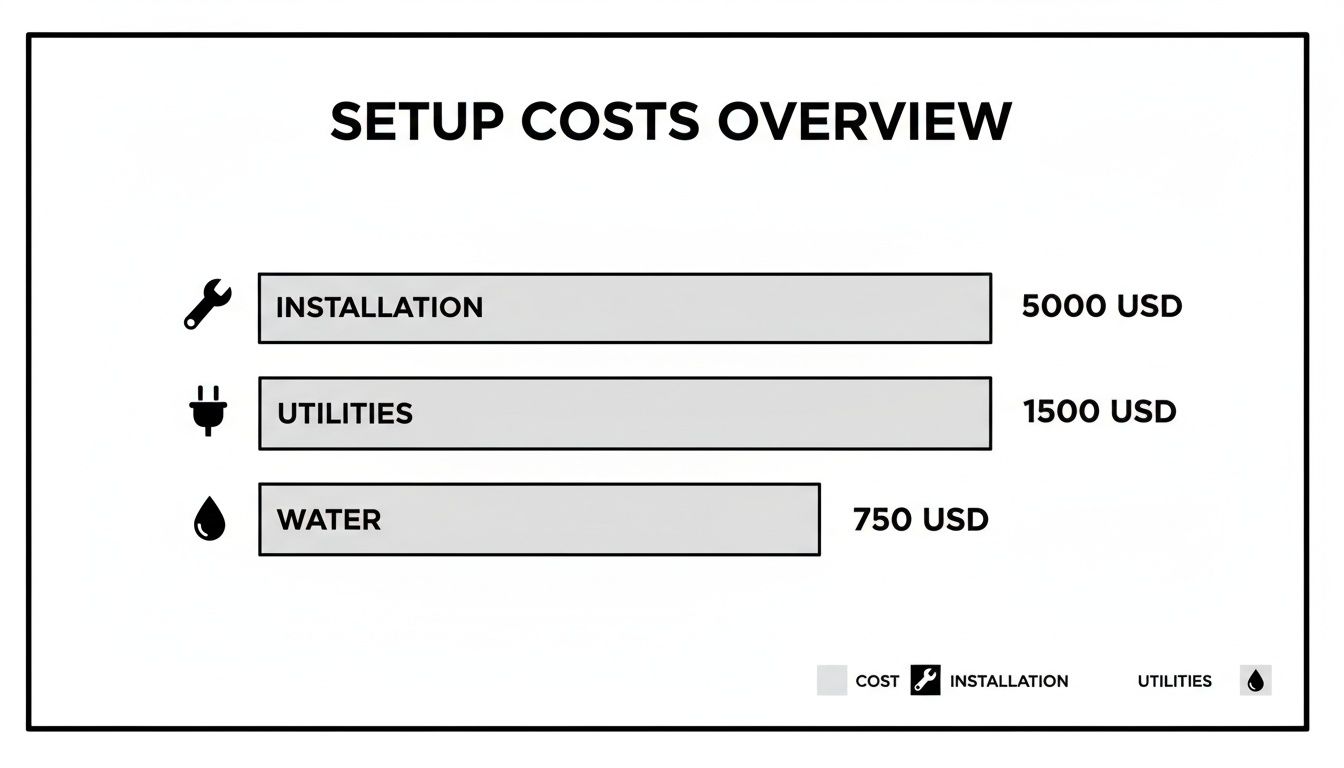
These upfront costs for installation, utilities, and water treatment are necessary investments to unlock the oven's full efficiency potential.
Energy use is another major operational expense where a Rational oven really shines. These units are engineered for maximum efficiency, using up to 30% less energy than a collection of traditional cooking equipment. This efficiency is a huge draw in the commercial oven market, which is projected to rocket from a USD 13.6 billion industry in 2025 to USD 28.0 billion by 2035. With operators facing 10-15% annual energy cost hikes, this kind of saving directly protects your bottom line, especially for independent owners. You can explore more about these market trends and their impact on foodservice.
Sample 5-Year Total Cost of Ownership (TCO) Projection
To really bring this to life, let’s look at a sample scenario. The table below compares the estimated five-year cost of owning a single Rational iCombi Pro against a traditional kitchen setup with separate pieces of equipment.
| Cost Factor | Rational iCombi Pro | Traditional Equipment Setup | Net Savings with Rational |
|---|---|---|---|
| Initial Purchase Cost | $25,000 | $15,000 | -$10,000 |
| Annual Energy Costs | $3,500 | $5,000 | $1,500 |
| Annual Labor Savings | $20,000 | $0 | $20,000 |
| Annual Food Waste Reduction | $4,000 | $0 | $4,000 |
| Annual Maintenance | $500 | $1,000 | $500 |
| 5-Year Total Savings | $120,000 |
As you can see, while the initial investment is higher, the operational savings from reduced labor, energy, food waste, and maintenance quickly add up. Over five years, the Rational oven doesn't just pay for itself; it can generate substantial net savings, turning a capital expense into a powerful financial tool for your business.
The True Total Cost of Ownership
When you add up the savings from less labor, minimal food waste, and lower utility bills, the picture becomes crystal clear. The higher upfront rational oven cost is dwarfed by the massive ongoing operational savings. Over its lifespan, the oven doesn't just pay for itself; it generates a significant return on investment.
This long-term perspective is what separates a smart operator from the rest. By seeing the purchase as a strategic investment in efficiency, consistency, and quality, you can build a more resilient and profitable business. The real value isn't just in the oven, but in the smarter, leaner, and more consistent kitchen it helps you create.
Financing Your Oven to Boost Cash Flow
That initial Rational oven cost can feel like a steep hill to climb, especially when you're juggling payroll, inventory, and marketing budgets. But letting that upfront investment stall your kitchen's growth is a huge missed opportunity. Smart financing and leasing options are designed specifically to turn this major capital expense into a predictable, manageable monthly payment, keeping your precious cash flow right where you need it.
Think about it this way: you wouldn't pay a full year's rent on your building all at once, right? You pay it monthly so you can use your working capital for day-to-day operations. Financing your combi oven works the exact same way. It allows this powerhouse asset to start generating revenue and paying for itself from the very first service.
Understanding Financing and Leasing Options
When it comes to getting a Rational oven in your kitchen, you generally have two main paths: financing to own or leasing. They both get the job done, but they work a bit differently and offer distinct advantages for your restaurant's financial health.
-
Equipment Financing: This is pretty straightforward—it's a loan to buy the oven. You make regular payments over a set term (usually 24-60 months), and once it's paid off, you own the equipment outright. This is a great way to build equity in your business's assets and can offer some nice tax advantages through depreciation.
-
Lease-to-Own: This works more like a long-term rental with the option to buy it at the end. Monthly payments are often lower than with a traditional loan, which gives you more flexibility. When the lease term is up, you can typically choose to buy the oven for a predetermined price, upgrade to a newer model, or simply return it.
The key takeaway is that both options let you get the equipment you need now without draining your cash reserves. This means you can keep funds free for other critical parts of your business, like launching a new marketing campaign or hiring another talented chef.
To keep your cash flow healthy, exploring various financing options for major appliance purchases is almost always a smart move.
How Leasing Preserves Your Capital
For new restaurants, growing food trucks, or any business focused on rapid expansion, leasing can be a particularly powerful strategy. It keeps the rational oven cost off your balance sheet as a large liability, which frees up your borrowing power for other needs down the road. Since lease payments are typically lower, it makes your monthly budget more predictable and easier to manage.
This approach is becoming more and more popular as operators recognize just how valuable these ovens are. The global market for commercial combi ovens was valued at USD 771 million in 2024 and is expected to hit USD 994 million by 2034. That growth is being fueled by the U.S. foodservice industry’s constant drive for more efficiency, with financing making this kind of high-end equipment accessible to startups and independent owners.
The Application Process and Typical Terms
Getting approved for equipment financing is often much simpler and faster than going through a traditional bank. Many suppliers, including us here at The Restaurant Warehouse, have straightforward application processes that can get you a decision in as little as 24 hours.
Generally, here’s what you’ll need to provide:
- A completed application form.
- An invoice or quote for the Rational oven you want.
- Some basic financial information about your business.
Terms are flexible, but most agreements range from 24 to 60 months, allowing you to pick a payment that fits comfortably into your monthly operating budget. By breaking down a significant investment into smaller pieces, financing turns the acquisition of top-tier equipment into a strategic move instead of a financial burden. For a deeper look into the specifics, check out our guide on restaurant equipment financing.
Calculating Your Return on Investment
At the end of the day, all the talk about the rational oven cost boils down to a single question: is it worth it? To get to the real answer, you have to look past the initial price tag and figure out your Return on Investment (ROI). This isn't just a numbers game; it’s about shifting your mindset to see this oven as a powerful asset that actively generates revenue and fuels your long-term growth.
Think of it like a balancing scale. On one side, you have the total cost of ownership—everything from the purchase to installation and upkeep. On the other, you have all the financial gains and operational improvements the oven brings to your kitchen.
Quantifying the Tangible Gains
First, let's look at the hard-dollar savings you can track directly on your profit and loss statement. These are the most straightforward pieces of the ROI puzzle.
- Labor Savings: How much time does your team get back thanks to automated cooking programs? If one chef can now confidently manage the work that used to take two, that’s a direct cut in your payroll expenses.
- Energy and Water Reduction: Pull out your utility bills before and after the installation. A new iCombi Pro is engineered to use significantly less energy and water than the hodgepodge of older, separate equipment it replaces.
- Food Cost Savings: Start tracking your yields, especially on expensive proteins and baked goods. When precise cooking dramatically reduces shrinkage, you get more sellable portions from the exact same amount of raw product. That’s money straight back into your pocket.
When you add up these concrete numbers over the course of a year, you’ll often find the oven starts paying for itself much faster than you might have guessed.
Accounting for Intangible Benefits
Next, you have to consider the benefits that are a bit harder to stick a price tag on but have a massive impact on your restaurant's success and reputation. You might not see them as a line item, but they are crucial for driving revenue and building a loyal following.
An investment in kitchen technology is an investment in consistency and quality. The ability to produce the exact same high-quality result every time, regardless of who is in the kitchen, is what builds a loyal customer base and a strong brand.
These intangible—but incredibly valuable—benefits include:
- Superior Food Quality: Perfect results lead to happier guests, glowing online reviews, and more repeat business.
- Unbeatable Menu Consistency: Every single customer gets the same fantastic experience, which builds incredible trust in your brand.
- Expanded Production Capacity: Suddenly, you have the bandwidth to take on that big catering job you used to turn down or finally launch that pastry line you've been dreaming of. This opens up entirely new revenue streams that were simply out of reach before.
For a deeper dive into the financial benefits of major kitchen improvements, consider the overall Return On Investment (ROI) of a kitchen remodel.
When you combine the tangible savings with the powerful impact of these intangible benefits, you build a crystal-clear case for the investment. You'll quickly see that the true rational oven cost is easily outweighed by the significant return it delivers.
Still Have Questions About Rational Ovens?
Deciding on a major piece of kitchen equipment like this always brings up a few last-minute questions. It's a big investment, and you want to be sure. Here are some clear, straightforward answers to the questions we hear most often from operators just like you.
What's The Real Difference Between The iCombi Pro And Classic Models?
Think of it like choosing between a high-end smartphone and a super durable, reliable flip phone. Both get the job done, but one is packed with intelligent features.
The iCombi Classic is a powerhouse combi oven that gives a skilled chef precise, manual control. You tell it exactly what to do, and it executes flawlessly. It's perfect for teams that have their recipes and processes down pat.
The iCombi Pro, on the other hand, is an intelligent cooking system. Its iCookingSuite technology is the real game-changer; it can actually sense the size and condition of the food and automatically adjust the cooking process on the fly. That higher price tag on the Pro model reflects this advanced automation, which translates directly into serious labor savings and less food waste.
Can A Rational Oven Actually Fit In A Small Kitchen?
Absolutely. Rational knows that great food comes out of kitchens of all sizes, so they design their ovens to fit a huge range of footprints. The XS model, a 6-pan unit, packs the full punch of an iCombi Pro or Classic but is compact enough to sit right on a countertop.
For businesses like cozy cafes, ghost kitchens, or food trucks where every inch of space is premium real estate, the XS model is a lifesaver. It can replace several bulky, single-purpose appliances, freeing up valuable workspace and dramatically expanding what you can offer on your menu without a massive kitchen overhaul.
How Often Does A Rational Oven Need Maintenance?
Protecting your investment really comes down to routine upkeep, and Rational makes it pretty simple. Daily cleaning, especially with the automated iCareSystem on the Pro models, is quick and usually takes just a few minutes.
Beyond the daily wipe-down, a more structured schedule is the way to go:
- Weekly: Give the air filters a quick check and clean, and run a descaling cycle. This prevents mineral buildup in the steam generator, which is key for long-term performance.
- Annually: This is the big one. Schedule a professional service check with a certified technician. They’ll inspect the crucial components like door seals, heating elements, and sensors to catch any small issues before they turn into costly, service-stopping problems.
Following this simple schedule is the best way to ensure your oven runs like a top for years.
Ready to see how a Rational oven can boost your kitchen's efficiency and profitability? The team at The Restaurant Warehouse can help you find the perfect model and a financing plan that fits your budget.
Explore our selection of Rational combi ovens at https://therestaurantwarehouse.com.
About The Author

Sean Kearney
Sean Kearney is the Founder of The Restaurant Warehouse, with 15 years of experience in the restaurant equipment industry and more than 30 years in ecommerce, beginning with Amazon.com. As an equipment distributor and supplier, Sean helps restaurant owners make confident purchasing decisions through clear pricing, practical guidance, and a more transparent online buying experience.
Connect with Sean on LinkedIn, Instagram, YouTube, or Facebook.