

Prep Counter Powerhouses: Top Commercial Refrigeration for Pizzerias
Why Pizza Prep Fridges Are Essential for Every Pizzeria
A pizza prep fridge is a specialized refrigerated table that masterfully combines cold ingredient storage with a dedicated cutting board workspace, creating the ultimate hub for pizza assembly. These indispensable units are engineered to keep a wide array of toppings perfectly chilled at food-safe temperatures, typically between 33°F and 41°F, while ensuring they are immediately accessible during the process of food preparation. In any commercial kitchen, but especially in a pizzeria, they are the cornerstone of food safety, operational efficiency, and product consistency.
Key Features of Pizza Prep Fridges:
- Refrigerated Pan Rail: A recessed, chilled well designed to hold multiple food pans (typically 1/3 size) filled with pizza toppings, from pepperoni and mushrooms to various cheeses and sauces.
- Deep Cutting Board: An extra-deep, full-length work surface, usually made of durable polyethylene, that provides ample space for stretching dough, applying sauce, and assembling large pizzas without feeling cramped.
- Refrigerated Base Storage: A spacious undercounter cabinet or set of drawers that offers bulk cold storage for dough trays, blocks of cheese, bags of vegetables, and other backup ingredients.
- Forced-Air Cooling System: A dynamic refrigeration method that uses fans to actively circulate cold air, ensuring consistent and uniform temperatures throughout the base cabinet and, crucially, around every pan in the topping rail.
- Durable Stainless Steel Construction: The use of high-grade stainless steel for both the interior and exterior provides exceptional durability, resistance to corrosion, and a non-porous surface that is incredibly easy to clean and sanitize.
Without the integrated refrigeration provided by a prep table, ingredients would need to be retrieved from a separate walk-in or reach-in cooler for every order. This constant movement not only slows down service but also repeatedly exposes ingredients to the ambient heat of the kitchen, allowing them to quickly enter the temperature danger zone (41°F to 135°F). A pizza prep fridge completely eliminates this risk by keeping everything from mozzarella to pepperoni at optimal, safe temperatures right at the point of use.
The true game-changer is the dramatic improvement in speed and organization. By creating a self-contained workstation where everything is within arm's reach, you eliminate wasted motion and create a logical, streamlined workflow. This ergonomic design can drastically increase your pizza output, allowing you to handle the busiest dinner rushes with ease. For any serious restaurant owner, a quality pizza prep fridge is not just an expense but a powerful investment, as the combined benefits of food safety compliance, improved labor efficiency, and significantly reduced food waste deliver a rapid return.
The Anatomy of a Perfect Pizza Prep Fridge
A pizza prep fridge is the command center of a pizzeria, a carefully engineered workspace that combines refrigeration, storage, and prep space into a single, highly efficient unit. Every component, from the refrigerated pan rail and its insulated lids to the deep cutting board and durable stainless steel construction, is carefully designed to support an ergonomic and productive workflow. This seamless integration is what keeps your ingredients impeccably fresh and your pizza-making process exceptionally smooth.
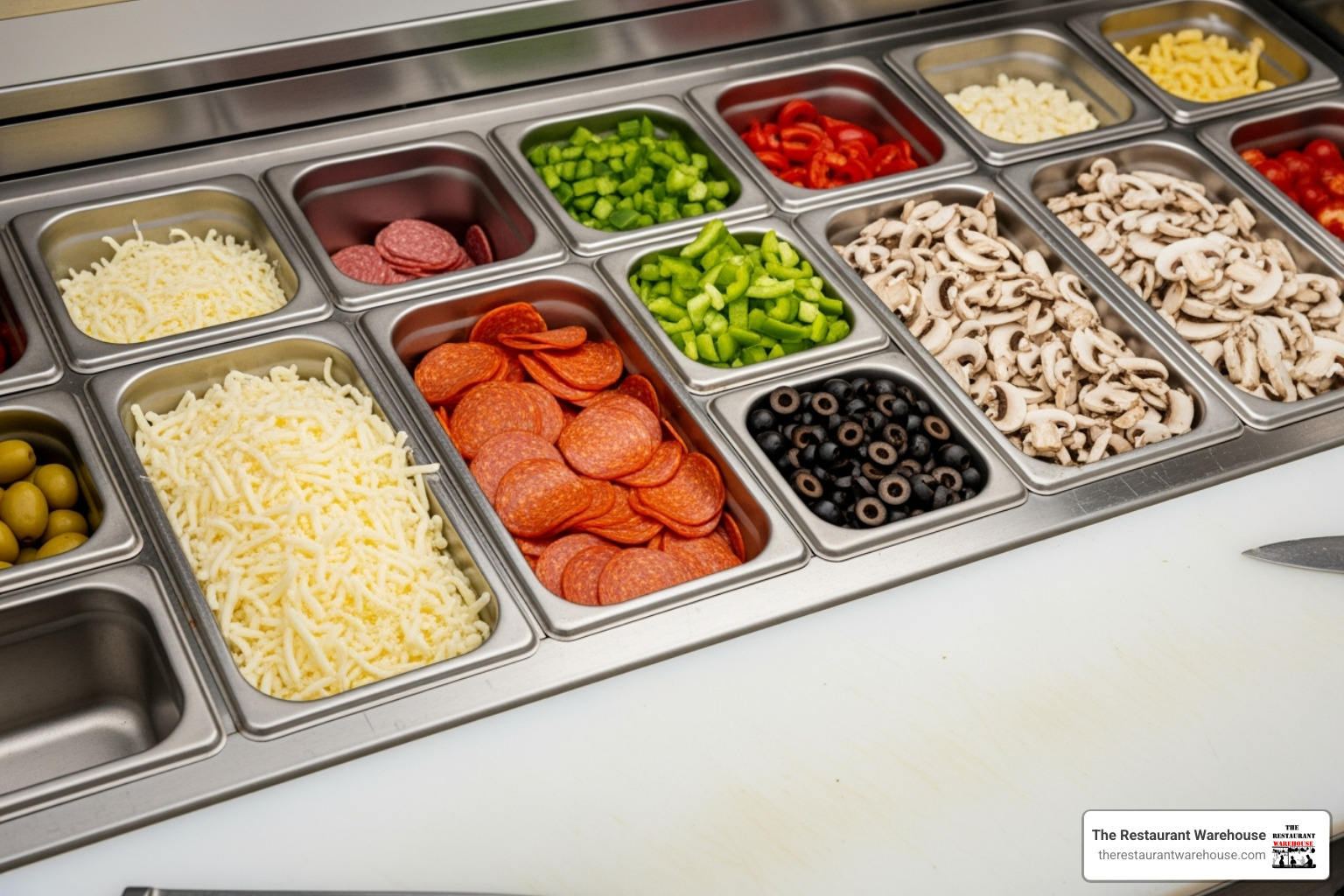
Ready to dive deeper into your options? Check out More info about Pizza Prep Tables for our complete selection.
The Workspace: Cutting Boards and Prep Surfaces
The cutting board is where the magic happens, changing a simple dough ball into a culinary creation. Most pizza prep fridges feature thick, non-porous polyethylene cutting boards. This material is the industry standard for good reason: it's exceptionally durable, can withstand constant chopping and slicing, and is gentle on knife edges, helping your tools stay sharper for longer. For establishments specializing in artisanal pizzas, some high-end units offer naturally cool granite or marble surfaces. These stone tops are ideal for working with sticky dough, as they help keep it cool and prevent it from adhering to the surface. A defining feature of a pizza prep table is its cutting board depth; they boast deeper boards than their sandwich prep counterparts to provide ample real estate for stretching and topping large 16-inch or 18-inch pizzas. For hygiene and maintenance, these boards are always removable, allowing for easy and thorough cleaning in a sink. When selecting a unit, look for NSF certification. This mark is your assurance that the materials, design, and performance of the unit have been rigorously tested to meet strict public health and safety standards, a non-negotiable for any commercial kitchen.
The Topping Rail: Keeping Ingredients Cool and Accessible
The topping rail is your secret weapon for achieving maximum speed and uncompromising food safety. This refrigerated section holds multiple ingredient pans (typically industry-standard 1/3 size pans) directly above the cutting board for lightning-fast, ergonomic access. The magic behind its performance is a forced-air refrigeration system. Unlike older cold-wall systems, this technology uses fans to continuously circulate cold air around all sides of each pan, bathing them in a consistent blanket of cold. This prevents dangerous hot spots and ensures every ingredient, from the front to the back of the rail, remains at a safe temperature between 33°F and 41°F. Insulated lids are another critical component. When closed, they seal in the cold air, preserving ingredient freshness overnight and during slower periods. They also significantly reduce energy consumption and prevent condensation from dripping onto the food, protecting both its quality and safety.
The Base: Refrigerated Storage Configurations
Beneath the busy workspace lies the high-capacity refrigerated base, the powerhouse for your bulk storage needs. This section is available in several configurations to suit different operational styles. Cabinet storage with self-closing doors and adjustable, heavy-duty shelving is the classic and most common choice. It's ideal for storing bulky or awkwardly shaped items like large dough trays, cases of sauce, and blocks of cheese. The shelves are typically epoxy-coated or stainless steel, designed to withstand heavy loads (often up to 90 pounds each) and the rigors of a commercial environment. Drawer storage, on the other hand, offers superior organization and energy efficiency. By assigning specific ingredients to different drawers (e.g., one for cheeses, one for meats), you can create dedicated zones that streamline access. This also minimizes cold air loss, as you only open the small, specific compartment you need, rather than the entire cabinet. For many operators, a combination of doors and drawers provides the ultimate flexibility, allowing them to store bulk items in the cabinet section and frequently used, pre-portioned ingredients in the drawers for the best of both worlds.
For more insights on maximizing your cold storage efficiency, explore More info about Undercounter Refrigerators.
How a Refrigerated Prep Table Boosts Pizzeria Profitability
Investing in a pizza prep fridge is not merely an operational upgrade; it's a strategic business decision that directly impacts every facet of your operation and improves your bottom line. Every minute of labor saved, every ounce of cheese that stays fresh, and every customer served more quickly translates into tangible financial gains. A dedicated prep table transforms a potentially chaotic kitchen workflow into a model of efficiency, systematically reducing food waste and empowering your team to serve more customers without the need to increase labor costs.

These powerful benefits create a positive ripple effect throughout your business. Faster, more consistent service leads to higher customer satisfaction and repeat business. Reduced food spoilage directly protects your profit margins. A demonstrable commitment to food safety secures your reputation and protects you from liability. Furthermore, a streamlined, less stressful workflow reduces staff fatigue and turnover, which in turn improves morale, retention, and the consistency of the final product.
Streamlining the Pizza-Making Process
A well-designed pizza prep fridge establishes the perfect mise en place—a culinary term meaning "everything in its place." With dough, sauce, cheese, and every topping perfectly chilled and organized within arm's reach, your team eliminates wasted motion, such as walking back and forth to a reach-in cooler. This organized mise en place can dramatically cut the time it takes to assemble a single pizza. The seamless dough-to-topping flow allows staff to move intuitively from one step to the next. Wider units are designed to let multiple employees work side-by-side without getting in each other's way, effectively doubling or tripling your production capacity during peak hours. The result is a significant increase in output and higher revenue. Consider the math: if the improved efficiency allows you to make just 10 extra pizzas per hour during a four-hour dinner rush, at an average of $20 per pizza, that's an additional $800 in revenue for a single shift. This turns high-volume service from a challenge into a powerful competitive advantage.
For more insights on creating an efficient cold storage system throughout your kitchen, explore More info about Commercial Refrigeration Solutions That Won't Leave You Cold.
Upholding Food Safety Standards
In the foodservice industry, food safety is non-negotiable, and a pizza prep fridge is your most reliable partner in maintaining the highest standards. Its primary and most critical function is to keep perishable ingredients out of the temperature danger zone (41°F to 135°F), the range in which harmful bacteria can multiply at an alarming rate. The unit is engineered to maintain the cold chain from the moment ingredients are placed inside until the pizza is fully assembled, keeping everything between 33°F and 41°F. This consistent temperature control is essential for HACCP compliance. HACCP, or Hazard Analysis and Critical Control Points, is a systematic approach to food safety, and the prep station is a key control point where temperature must be managed. A reliable prep fridge helps you pass health inspections with confidence.
The design also inherently helps prevent cross-contamination. By using separate, dedicated pans for each ingredient (e.g., raw meats, vegetables, cheeses), you create physical barriers that minimize the risk of pathogens spreading. The easy-to-clean stainless steel surfaces and removable cutting boards further simplify the daily sanitization protocols required to keep your operation safe. This unwavering focus on safety also extends ingredient longevity, drastically reducing spoilage and waste. This not only improves your profit margins but also ensures that every pizza you serve is made with the freshest, highest-quality ingredients.
Choosing Your Ideal Pizza Prep Refrigerator
Finding the right pizza prep fridge is a critical decision that involves carefully matching the unit's specifications to your kitchen's available space, your average and peak production volume, and the complexity of your menu. There is no single "best" model; the ideal choice is the one that seamlessly integrates into your workflow and reliably supports your specific operational needs for years to come.
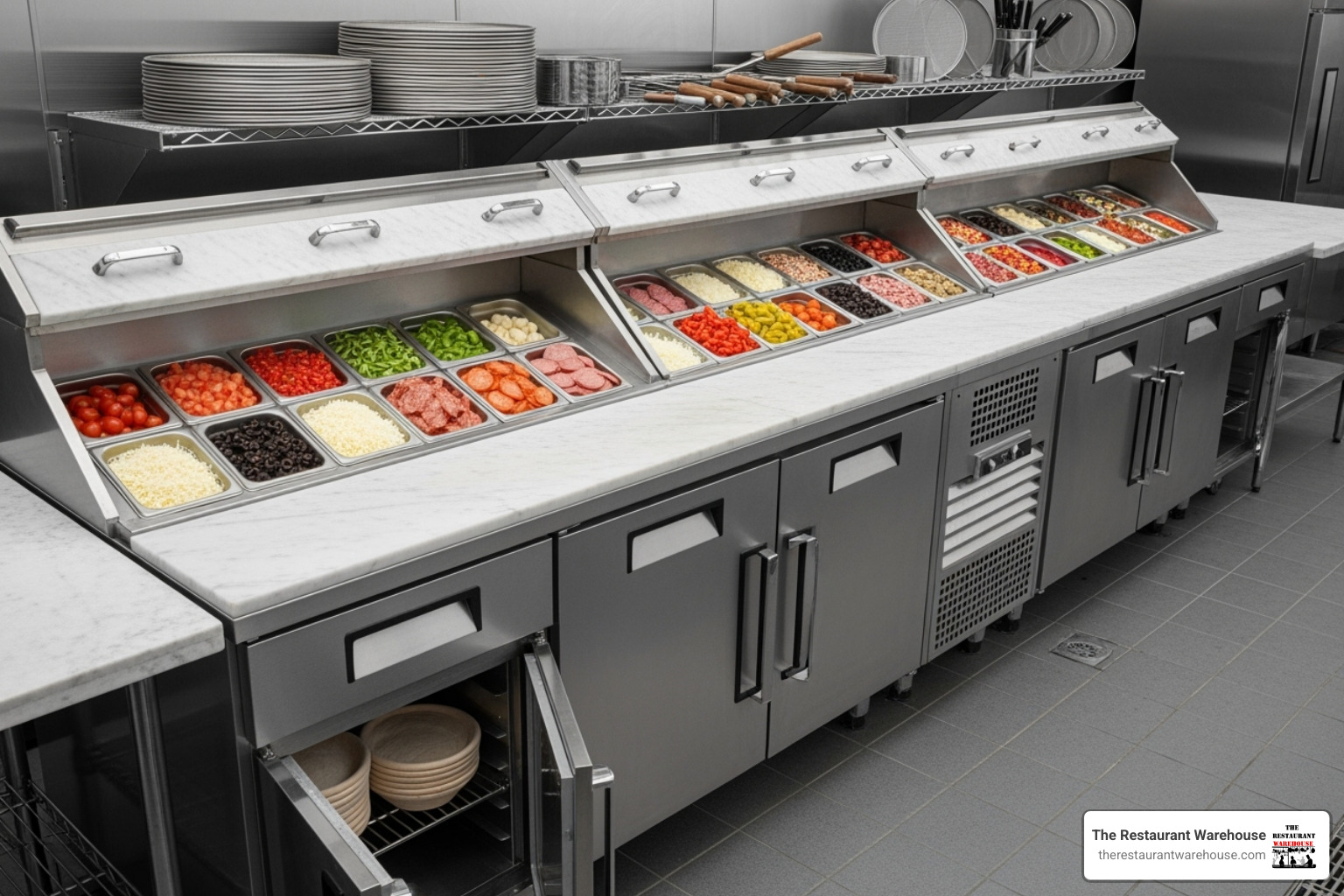
Before you start browsing, consider your daily reality. Are you a high-volume pizzeria in a busy downtown area, or a smaller shop with a steady, predictable flow? How many different toppings do you offer? Answering these fundamental questions will provide the foundation for choosing a unit that is an asset, not a hindrance. For a deeper understanding of commercial refrigeration options, our More info about our Commercial Refrigerators Guide covers everything you need to know.
Sizing Your Pizza Prep Fridge for Peak Performance
Selecting the correct size is arguably the most crucial decision. A unit that's too small will create bottlenecks, forcing constant and disruptive restocking during busy periods. Conversely, a unit that's too large wastes valuable kitchen footprint, consumes unnecessary energy, and can even disrupt workflow. Pizza prep fridges are available in a wide spectrum of sizes, from compact 44-inch models to massive 119-inch units.
- Small (44" to 50"): These single-section units, typically with one door and around 7.8 to 14 cubic feet of storage, are perfect for smaller pizzerias, cafes adding pizza to their menu, food trucks, or as a dedicated secondary prep station for gluten-free or specialty items.
- Medium (60" to 72"): These two-section models (16 to 21 cu. ft.) are the industry workhorses. They offer a great balance of topping rail capacity, workspace, and refrigerated storage, making them ideal for most medium-volume pizzerias and growing businesses.
- Large (92" to 119"): These three-section giants, with up to 30+ cubic feet of storage, are built to support high-volume operations with extensive menus. Their expansive workspace allows multiple staff members to work simultaneously without interference, maximizing throughput during the most intense rushes.
Before purchasing, always measure your space carefully. Account for the unit's dimensions, but also leave adequate clearance at the back and sides for proper ventilation (typically 2-4 inches), and ensure there is enough room for doors to swing open fully. Don't forget to measure doorways, hallways, and corners along the delivery path to ensure you can get the unit into your kitchen.
Doors, Drawers, or a Combination?
The storage configuration below the workspace significantly impacts workflow and ergonomics. Door storage represents the classic cabinet style. It excels at providing flexible bulk storage for large or irregularly shaped items like stacks of dough trays, large bags of flour, or gallon jugs of sauce. With adjustable shelving, you can customize the space, making it a versatile and cost-effective option. Drawer storage is the champion of organization and efficiency. Each drawer can become a dedicated zone for specific items (e.g., cheeses, meats, prepped vegetables), making it faster to find what you need. Because you only open a small drawer instead of a large door, they are also more energy-efficient, minimizing cold air loss. Many experienced operators opt for a combination setup, which provides the best of both worlds: using cabinets for long-term bulk stock and drawers for frequently accessed, portioned ingredients.
| Feature | Door Storage Benefits | Drawer Storage Benefits |
|---|---|---|
| Storage Type | Excellent for bulk ingredients and larger containers | Superior organization with dedicated compartments |
| Temperature Control | Larger opening means more cold air loss when accessed | Individual compartments minimize temperature fluctuations |
| Accessibility | Requires bending and reaching into a large cavity | Ergonomic access brings contents directly to you |
| Best For | Dough boxes, backup supplies, large containers | Portion-controlled items, frequently used ingredients |
| Workflow Impact | Flexible but can be slower to find specific items | Faster access to organized ingredients, improved speed |
Pizza Prep vs. Sandwich Prep Tables: What's the Difference?
While they appear similar at first glance, these two types of prep tables are purpose-built for different tasks, and using the wrong one can lead to significant frustration and inefficiency. The key differences are:
- Cutting Board Depth: This is the most significant distinction. Pizza prep fridges have extra-deep cutting boards, often 16 to 20 inches deep, to provide enough surface area for stretching large pizza doughs. Sandwich prep tables have much shallower boards, typically 8 to 10 inches, which is sufficient for bread and subs but inadequate for pizza.
- Pan Configuration: Pizza prep fridges are designed to use larger 1/3 size food pans. This accommodates the generous quantities of high-volume toppings like mozzarella cheese and pepperoni needed for making pizzas. Sandwich tables, in contrast, primarily use smaller 1/6 or 1/9 size pans for ingredients that are used in smaller portions, like sliced tomatoes or pickles.
- Rail Design: The refrigerated rail on a pizza prep table is often raised and angled toward the user. This ergonomic design makes it easier to see and reach into the pans when working on a large, flat pizza.
Choosing the right tool for the job is essential for a smooth, productive, and profitable operation. If you're curious about the sandwich side of things, you can explore More info about Sandwich Prep Tables to see how they compare.
Under the Hood: Performance, Power, and Longevity
When you invest in a pizza prep fridge, you're not just buying a stainless steel box; you're acquiring the mechanical heart of your entire prep line. The technical specifications—from the location and power of the compressor to the type of refrigerant used—have a direct and lasting impact on your daily utility bills, the unit's reliability, and its overall lifespan. A well-engineered unit can perform reliably for 10 to 15 years or more, making it crucial to look beyond the sticker price and understand its core components. The true cost of ownership encompasses not just the initial purchase but also long-term energy consumption and maintenance requirements. For a comprehensive guide, our More info about Choosing the Right Commercial Refrigeration System for Your Restaurant offers valuable insights.
Key Technical Features That Affect Performance
The consistent and efficient performance of your pizza prep fridge relies on several key components working in perfect harmony.
- Compressor: As the heart of the refrigeration system, the compressor's design and placement are critical. Most modern units use reliable and efficient hermetic compressors. Their location matters: side-mounted compressors are often preferred in hot kitchens as they don't draw in greasy air from cooking lines and are easier to access for service. Rear-mounted units save width but require more clearance behind them. Bottom-mounted units can be more ergonomic for accessing the storage base but may be more prone to clogging from floor debris.
- Forced-Air Refrigeration: This is a non-negotiable feature for a pizza prep table. The system uses fans to actively circulate cold air throughout the cabinet and, most importantly, around the pan rail. This dynamic cooling eliminates hot spots and ensures every ingredient is held at a consistent, food-safe temperature, even during a busy service with the lids frequently open.
- Digital Temperature Controls: These provide precise, user-friendly control over the internal temperature, typically within the 33°F to 41°F range. They offer far superior accuracy and efficiency compared to older manual thermostats and often include a clear digital display for at-a-glance monitoring.
- Automatic Defrost: This essential feature prevents performance-killing ice from building up on the evaporator coils. The system automatically runs a defrost cycle at predetermined intervals, which maintains optimal cooling efficiency and prevents the compressor from overworking and failing prematurely.
- Insulation: High-quality insulation is the unsung hero of efficiency. Look for units injected with high-density, CFC-free polyurethane foam. This insulation not only keeps cold air in and hot air out, reducing compressor runtime, but also provides significant structural rigidity to the cabinet.
- Energy Efficiency and Refrigerants: Look for ENERGY STAR certified models, which are independently verified to be up to 20% more energy-efficient than standard models, saving you hundreds of dollars per year on electricity. Also, pay close attention to the refrigerant type. Modern, eco-friendly refrigerants like R290 (Propane) are now the standard. They have a near-zero impact on the ozone layer and a very low Global Warming Potential (GWP), and they often improve the unit's overall energy efficiency.
Essential Maintenance for Your Pizza Prep Refrigerator
Proper, consistent maintenance is the key to ensuring your pizza prep fridge will serve you faithfully for its entire 10-15 year lifespan. Neglecting these simple tasks is a surefire way to face premature breakdowns, costly emergency repairs, and unnecessarily high energy bills.
- Clean Condenser Coils: This is the single most critical maintenance task. The condenser coils dissipate heat, but when they become clogged with dust, grease, and flour, they can't work effectively. This forces the compressor to run longer and hotter, wasting energy and leading to failure. Clean them at least monthly with a stiff brush or a vacuum.
- Inspect and Clean Door Gaskets: Worn, cracked, or dirty gaskets create a poor seal, allowing cold air to leak out constantly. This makes the unit work harder to maintain temperature. Clean gaskets weekly with a mild detergent and check for a tight seal using the "dollar bill test" (a dollar bill closed in the door should have some resistance when pulled). Replace any damaged gaskets immediately.
- Check Door Alignment and Closers: Ensure that self-closing doors operate smoothly and that they latch securely every time. A door left slightly ajar can be a major energy drain and a food safety risk.
- Monitor and Calibrate Temperature: Don't rely solely on the unit's display. Periodically place a calibrated food thermometer inside the cabinet and in a pan of water in the rail to verify accuracy. If you notice significant discrepancies, the thermostat may need to be recalibrated.
- Follow Regular Cleaning Procedures: A clean unit is an efficient unit. Regularly clean all stainless steel surfaces, wipe up spills in the pan rail immediately, and remove and sanitize the cutting board daily. Ensure the condensate drain line is clear and that the evaporation pan is clean.
Frequently Asked Questions about Pizza Prep Fridges
Investing in a pizza prep fridge is a major decision for any foodservice business, and it's perfectly natural to have questions. This piece of equipment will be the central workhorse of your kitchen, so getting the choice right is essential for long-term success. Here are the straight answers to some of the most common questions we receive from pizzeria owners and chefs.
What is the ideal temperature range for a pizza prep fridge?
The ideal and legally required temperature range is critical for both food safety and ingredient quality. Your pizza prep fridge must be able to consistently maintain a product temperature between 33°F and 41°F (0.5°C to 5°C). This range is carefully chosen because it is safely below the "temperature danger zone" (41°F and above) where bacteria thrive, but just above freezing, which protects the delicate texture of fresh items like vegetables, herbs, and certain cheeses. A quality unit's forced-air refrigeration system is specifically designed to hold this temperature steady, especially in the topping rail, which is constantly exposed to ambient kitchen air. For ultimate peace of mind, look for NSF-7 certified units. This certification means the refrigerator has been tested and proven to maintain safe temperatures even under demanding, real-world kitchen conditions.
How many ingredient pans can a pizza prep table hold?
The pan capacity of a prep table is directly related to its overall width. While these tables are primarily designed to hold industry-standard 1/3 size food pans, the total number they can accommodate varies significantly:
- Small (44-inch) units typically hold six to eight 1/3 size pans.
- Medium (60 to 72-inch) units generally accommodate nine to twelve 1/3 size pans.
- Large (92-inch and larger) units can hold anywhere from twelve to eighteen or even more 1/3 size pans.
One of the great features of these units is their flexibility. You can often use adapter bars to mix and match pan sizes, allowing you to use smaller 1/6 or 1/9 size pans for less-frequently used ingredients or expensive specialty items. More width equals more pans and more variety at your fingertips, so you should choose a size based on the complexity and demands of your menu.
What is the difference between a standard-top and a mega-top pizza prep fridge?
This is a great question that gets into the specifics of topping capacity. A standard-top model has a single row of food pans in its refrigerated rail. A mega-top model, as the name implies, is designed with a deeper rail that can accommodate an additional row of pans (usually 1/6 size pans in front of the main row of 1/3 size pans). This increases the total number of available topping pans by about 30-50%. Mega-tops are an excellent choice for businesses with very extensive and complex menus, such as gourmet pizzerias or shops that also build intricate sandwiches and salads, as they put an even greater variety of ingredients within immediate reach.
Can I use a pizza prep table for other foods?
Absolutely. While specifically engineered for the demands of pizza making, the fundamental design of a pizza prep fridge—a large, durable workspace combined with an organized, chilled topping rail—is incredibly versatile. This makes it a valuable asset for many other foodservice applications:
- Sandwich and Sub Preparation: The deep cutting board provides ample space for assembling long subs, and the organized rail is perfect for meats, cheeses, and condiments.
- Salad Bars and Build-Your-Own Bowl Concepts: Keep greens, proteins, chopped vegetables, and dressings crisp, fresh, and ready for building custom salads, grain bowls, or poke bowls.
- Taco, Burrito, and Gyro Stations: The setup is ideal for holding various cooked proteins, shredded cheeses, salsas, sour cream, and other toppings.
- Omelet and Crepe Stations: For breakfast or brunch service, the rail can hold all the necessary fillings, making for a fast and efficient assembly line.
This inherent cross-utilization makes the pizza prep fridge a true multi-tasking champion, adding tremendous value and flexibility to kitchens with diverse or evolving menus.
Conclusion
As we've explored in detail, a pizza prep fridge is far more than just another piece of commercial refrigeration; it's a strategic investment that can fundamentally transform the core of your pizzeria's operations. Its intelligently engineered design—from the extra-deep cutting boards that accommodate large doughs to the forced-air refrigerated topping rails that guarantee food safety—creates a centralized, ergonomic workstation that empowers your team to be faster, safer, and vastly more efficient. This streamlined process directly translates into tangible benefits: significantly reduced prep times, a higher capacity for order output, and the consistent, high-quality product that builds a loyal customer base.
The bottom-line impact of this efficiency is undeniable and multifaceted. A quality pizza prep fridge pays for itself many times over through improved labor productivity, a dramatic reduction in costly food waste, and unwavering compliance with critical food safety standards. Every minute of labor saved during a rush, and every ingredient preserved from spoilage, contributes directly and measurably to your profitability and long-term success.
At The Restaurant Warehouse, we have a understanding of how the right equipment can open up a kitchen's true potential. We are passionately committed to offering top-tier commercial restaurant equipment and food service supplies at genuine wholesale pricing. By eliminating the high commissions and expensive overhead associated with traditional retail, we make it possible for every foodservice operation, from a brand-new startup to an established local favorite, to access the professional-grade equipment they need to thrive without breaking the bank.
Investing in the right pizza prep fridge is an investment in your business's future—a commitment to operational excellence, uncompromising safety, and sustainable growth. Ready to see the difference the right equipment can make? Explore our complete collection of Pizza Prep Tables and find how our wholesale pricing model can help you build the professional kitchen you deserve.
About The Author

Sean Kearney
Sean Kearney used to work at Amazon.com and started The Restaurant Warehouse. He has more than 10 years of experience in restaurant equipment and supplies. He graduated from the University of Washington in 1993. He earned a BA in business and marketing. He also played linebacker for the Huskies football team. He helps restaurants find equipment at a fair price and offers financing options. You can connect with Sean on LinkedIn or Facebook.
Leave a comment