

A Complete Guide to Mop Sink Faucet Height
It might seem like a tiny detail in the grand scheme of a commercial kitchen, but getting your mop sink faucet height right is a total game-changer. It affects your daily workflow, your staff's safety, and even your ability to stay compliant with codes. While you'll often hear 36 inches from the finished floor to the spout as a standard starting point, the perfect measurement really comes down to your specific sink and how you operate.
Why Faucet Height Is a Big Deal for Your Kitchen
Nailing the faucet height isn’t just about making things look neat; it's a decision that hits right at the core of your kitchen's efficiency and safety. When it’s wrong, a simple task like filling a mop bucket becomes a frustrating chore that slows everything down. This one small detail can create a surprisingly big ripple effect across your entire cleaning process.
Imagine your team constantly wrestling to squeeze a tall bucket under a low-hanging spout. They have to tilt it awkwardly, water sloshes everywhere, and suddenly you’ve got a slip hazard on the floor. On the flip side, a faucet that’s mounted way too high creates a messy splash zone, turning a clean area into a grimy, unsanitary puddle.
The Impact on Daily Operations
When you take the time to optimize your mop sink faucet height, you get real, tangible benefits that go way beyond just convenience. A well-thought-out janitorial station makes the whole cleaning process smoother and faster, which is absolutely essential in the controlled chaos of a busy kitchen. When your crew can work without fighting their equipment, they get their jobs done better and faster.
Here's what a good setup does for you:
- Better Ergonomics: A faucet at the right height means less bending, stooping, or awkward lifting of heavy, water-filled buckets. This goes a long way in preventing back strain and other injuries for your staff.
- More Efficiency: Quick, easy bucket filling means less time wasted at the sink and faster cleanup times overall. That frees up your team to handle other critical tasks.
- A Safer Workspace: By stopping spills and splashes before they happen, you create a much safer environment with fewer slip-and-fall risks for everyone on your team.
A 2021 study by the Hospitality Institute found that commercial kitchens with optimized mop stations cut their cleaning time by an average of 18%. This boost in efficiency saved operators up to $2,400 a year in labor costs alone.
In the end, paying attention to faucet height is all about practical, real-world function. It's a key part of smart kitchen and bathroom upgrades that genuinely improves how a space works.
Understanding Measurements from the Floor vs. the Rim
When plumbers and inspectors start talking about mop sink faucet height, they're usually coming at it from two different angles. You'll hear them mention measurements from the floor and measurements from the sink's rim. Both are critical, but they solve different problems. Getting them mixed up is one of the fastest ways to end up with a setup that drives your janitorial staff crazy.
Think of it like this: measuring from the finished floor is all about ergonomics. It’s about making sure the faucet controls are at a comfortable height for your team, so they aren't constantly bending over and straining their backs. Measuring from the sink’s rim, on the other hand, is all about pure functionality. This is the gap that decides whether you can actually fit a big bucket underneath without a wrestling match.
This chart breaks down how all these factors come together to find that sweet spot for your faucet height.
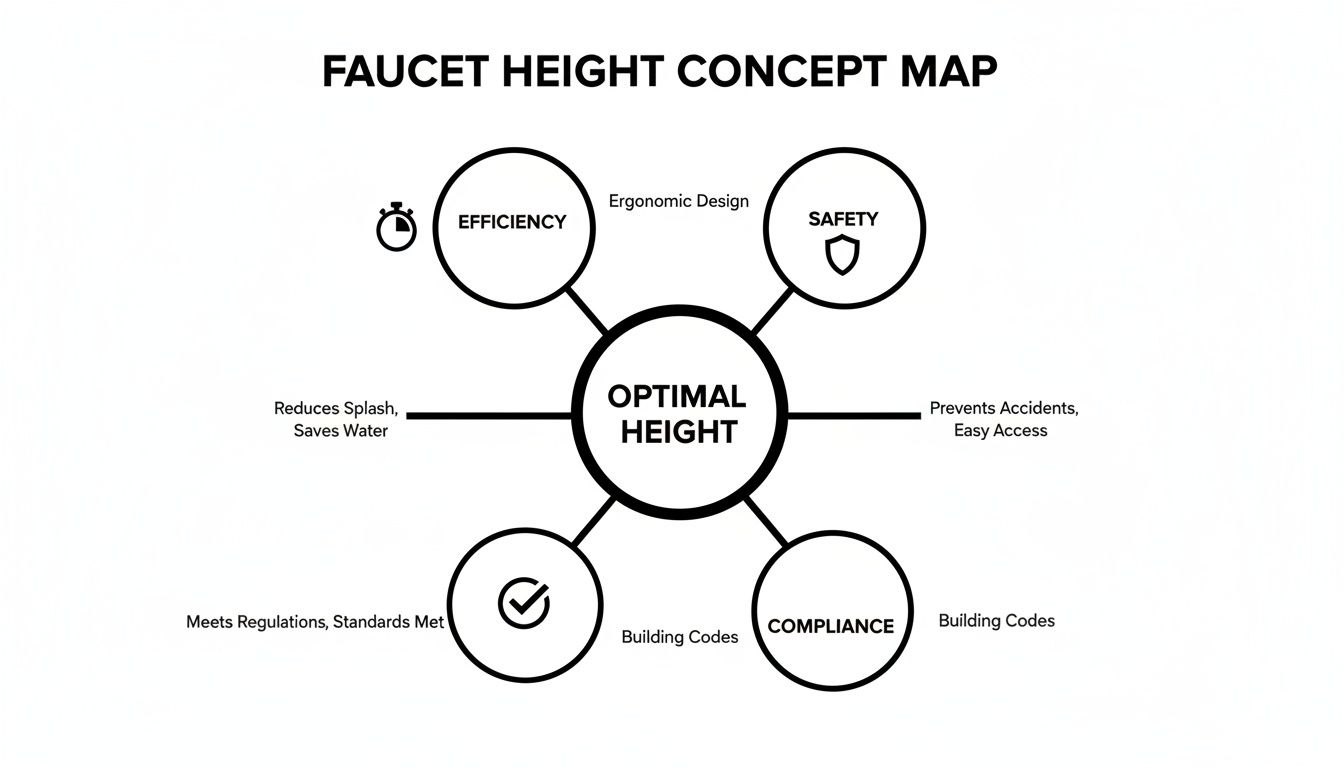
As you can see, the perfect height is a balancing act between efficiency, safety, and staying compliant with codes, and both measurement points have a big role to play.
Why Rim Clearance Is So Important
That space between the faucet spout and the top edge of the sink? That's where the real action is. If it's too tight, your staff will be struggling to cram a standard 5-gallon bucket under the tap. But if there’s too much space, you create a firehose effect that splashes water all over the floor, creating a constant slip hazard.
Getting the mop sink faucet height right has a direct impact on both worker safety and how fast your team can get their work done. It’s a small detail that prevents common accidents and keeps cleaning routines moving without a hitch.
Over time, we’ve landed on a real sweet spot for this dimension. The consensus for most utility models is a faucet height of 10-14 inches above the sink rim. This range gives you plenty of clearance for just about any bucket—from 5-quart pails to 32-quart monsters—while minimizing that messy splash-back. In fact, a 2021 facilities study linked improper heights to 28% of overflow incidents, so it's a detail worth getting right.
How Floor Height Complements Rim Height
While the rim height is all about bucket-filling, the floor height determines the overall accessibility of the controls. A good target to aim for is around 36 inches from the floor to the spout outlet, but this isn't set in stone. It really depends on the sink you’re using.
A deep, floor-mounted basin, for instance, will need a different faucet placement than a shallower, wall-hung sink to achieve that ideal 10-14 inch rim clearance. The two measurements have to work together. If you get one wrong, the other will be off, too.
For more on the different kinds of sinks you'll find in a commercial setting, check out our guide on choosing an industrial sink.
Meeting ADA Compliance For Accessible Kitchens
When you're setting up a janitorial closet or a commercial kitchen, thinking about the Americans with Disabilities Act (ADA) isn't just about checking a box—it's about creating a workspace that's inclusive, safe, and truly functional for everyone on your team. This directly impacts details you might not think about at first, like the height of your mop sink faucet. Getting it right from the start is about building a better, more legally sound environment for all.
The core ADA rule for sinks is pretty straightforward. For a sink to be considered accessible, its rim can’t be higher than 34 inches off the finished floor. This single requirement has a domino effect on everything else, especially faucet placement. Because the sink basin sits lower to accommodate wheelchair users, the faucet and its controls must also be positioned within an easy forward reach, which the ADA defines as no more than 48 inches from the floor.
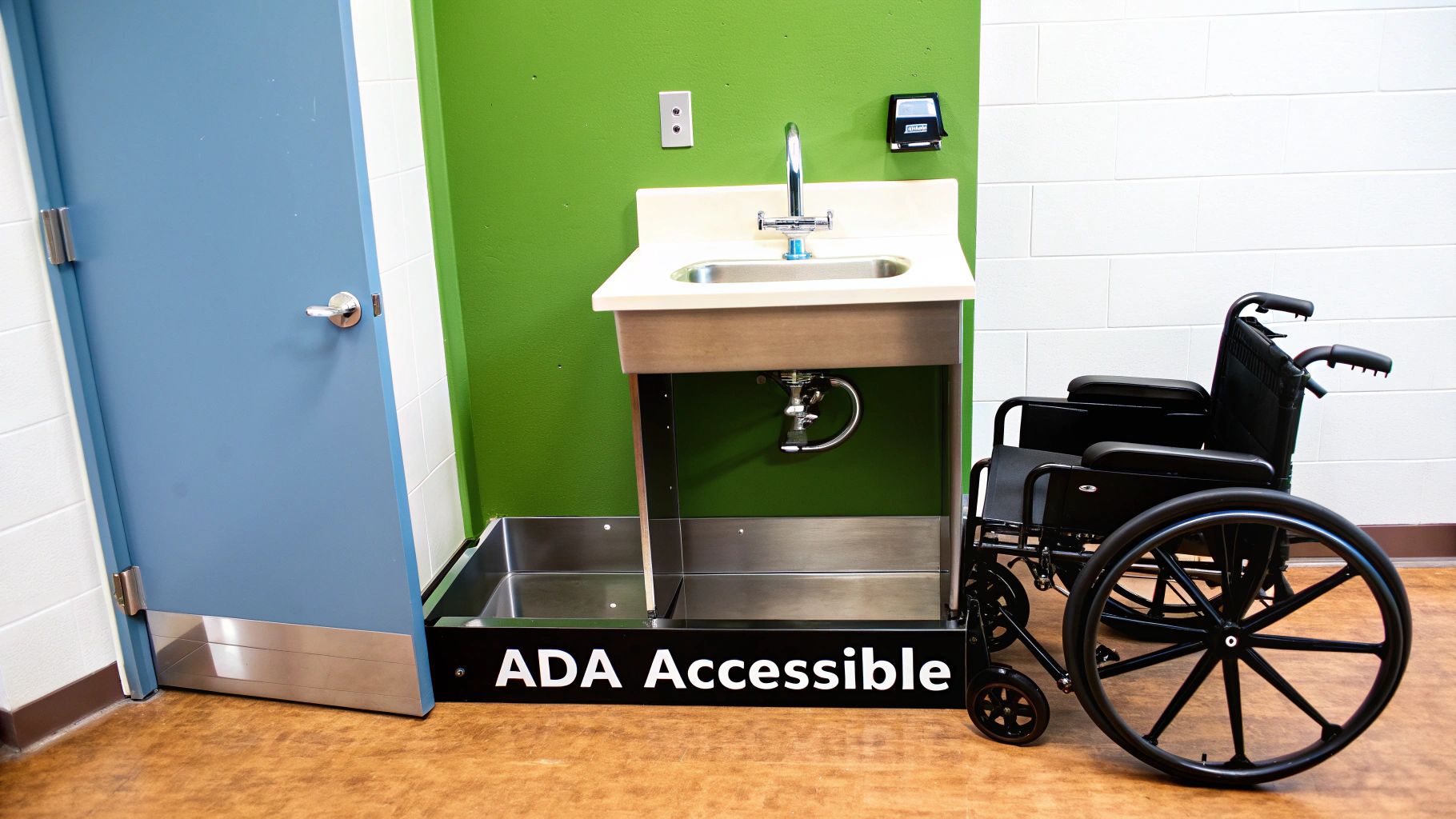
This standard has fundamentally changed how commercial spaces are designed. Before ADA regulations were widely implemented, it's estimated that only about 12% of facilities met these kinds of accessibility benchmarks. Fast forward to 2022, and compliance in major markets had jumped to an impressive 78%. It's a clear sign of progress in creating more inclusive workplaces.
Key ADA Faucet and Sink Features
But full ADA compliance is about more than just hitting a certain height. A few other critical features work together to make the entire sink station genuinely accessible.
- Knee and Toe Clearance: There has to be enough open space underneath the sink for a wheelchair user to pull up comfortably. This clear area for knees and toes is what allows someone to approach the sink head-on.
- Clear Floor Space: The area in front of the sink needs a clear patch of floor, typically 30 by 48 inches, so a person can approach without any obstructions.
- Easy-to-Use Controls: This one is huge. Faucet handles have to be operable with one hand and can't require any tight grasping, pinching, or twisting. Think lever-style handles, push-buttons, or sensor-activated controls—those are the gold standard.
These requirements are all interconnected, and it's important to see the whole picture. For instance, the principles behind faucet accessibility are similar to those for other fixtures, so understanding ADA hand dryer height compliance is another piece of the puzzle when designing accessible restrooms or janitorial areas.
Meeting ADA standards isn't just about avoiding potential fines—it’s a proactive step toward creating a workplace where every employee can perform their duties safely, comfortably, and efficiently.
Ultimately, designing with accessibility in mind from the get-go saves a ton of time, prevents expensive retrofits down the road, and helps foster a more inclusive company culture. If you're outfitting a space with various types of sinks, our guide on https://therestaurantwarehouse.com/blogs/restaurant-equipment/clean-hands-happy-guests-catering-hand-wash-sink-buying-guide can offer more insight into the specific needs of different stations.
Choosing Between Wall Mounted and Deck Mounted Faucets
When you're picking out a faucet for your mop sink, you'll run into two main players: wall-mounted and deck-mounted. This isn't just a cosmetic choice; it's a decision that shapes everything from how complex the installation will be to how easy your daily cleanup is. Each style has its own distinct advantages, and the right one for you really boils down to your kitchen's specific layout and workflow.
Wall-mounted faucets are what you'll see in most commercial janitorial stations, and there’s a good reason for that. They bolt directly to the wall right above the sink, which gives you incredible clearance for filling up those big, heavy mop buckets. It also makes wiping down the sink basin a breeze, since there's no faucet base on the sink itself for grime to get trapped around.
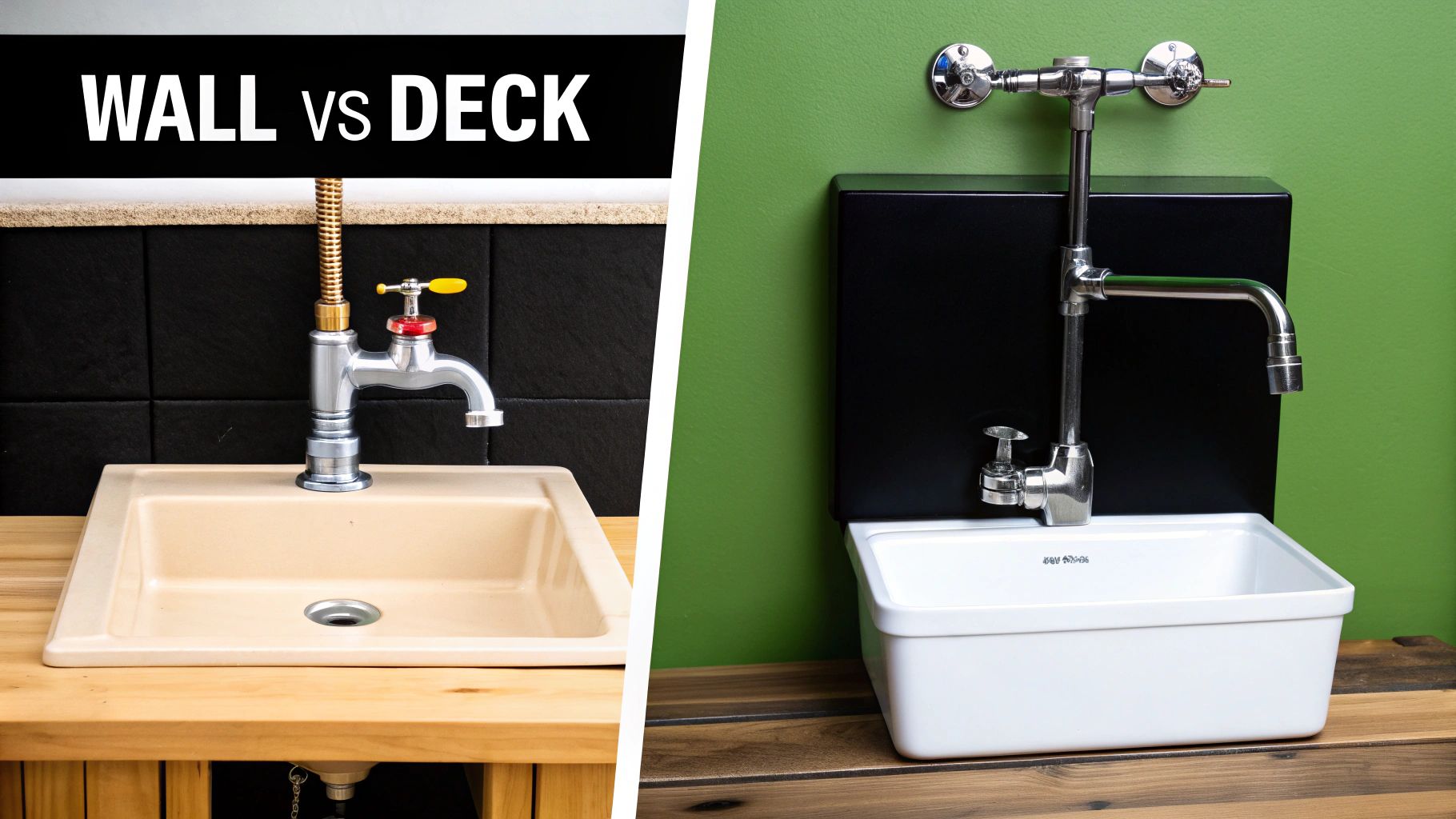
This setup gives you total freedom with height placement when the initial plumbing is roughed in. You can set the spout at the perfect height for your largest buckets, optimizing your whole cleaning process from day one.
Understanding Deck Mounted Alternatives
On the other hand, you have deck-mounted faucets. These are installed directly onto the sink itself, usually on a flat ledge or "deck" right behind the basin. This creates a really sturdy, all-in-one unit that can actually be simpler to install if your plumbing is already set up to come from below the sink instead of out of the wall.
You’ll often find these on drop-in sinks or models that come with pre-drilled holes. While they feel incredibly robust, they do create a small cleaning hurdle. That spot where the base of the faucet meets the sink deck can become a magnet for buildup if you’re not careful.
The choice between wall-mounted and deck-mounted fundamentally changes your game plan for installation. Wall-mounted units demand precise in-wall plumbing, while deck-mounted faucets hinge on the sink’s specific design and your existing connections.
Wall Mounted vs Deck Mounted Faucet Comparison
To make the best call, it helps to see the pros and cons side-by-side. Think about your specific environment—are you working in the tight quarters of a food truck, or do you need to meet the high-volume demands of a busy restaurant kitchen? This table breaks it down.
| Feature | Wall-Mounted Faucet | Deck-Mounted Faucet |
|---|---|---|
| Bucket Clearance | Excellent. Offers maximum, unobstructed space for easy filling. | Good. Clearance is limited by the sink's backsplash height. |
| Cleaning | Easier. No obstacles on the sink deck for seamless wipe-downs. | More difficult. Grime can build up around the faucet base. |
| Height Flexibility | High. Can be set at any height on the wall during installation. | Limited. Height is predetermined by the sink's design. |
| Best For | High-volume kitchens, custom setups, and maximizing sink space. | Pre-fabricated sink units, drop-in sinks, and simpler installs. |
At the end of the day, the ideal mop sink faucet height is achieved when the faucet style works in harmony with the sink and your workflow. A wall-mounted faucet usually gives you far more control over this critical measurement, ensuring your cleaning station is as efficient and ergonomic as it can possibly be.
Common Installation Mistakes and How to Avoid Them
Even with the best intentions, a simple mistake during a mop sink installation can lead to some serious long-term headaches. We’re not just talking about minor annoyances, either. These slip-ups can cause persistent leaks, frustrating code violations, or daily operational nightmares for your staff. Knowing the common pitfalls is the first step to getting a flawless, functional setup.
One of the most frequent errors I see is simply "eyeballing" the mop sink faucet height. This approach almost never ends well. If the faucet is too high, it creates a messy splash zone that needs constant cleanup and introduces a slip hazard. Too low, and your team will be fighting to fit buckets underneath, slowing down the entire cleaning process.
Forgetting Key Measurements and Clearances
Another critical oversight is failing to account for the sink’s rim height. It’s a classic mistake: installers measure from the floor but forget to subtract the height of the basin itself. The result? Barely enough clearance for a bucket, if any at all. A good installation always prioritizes that functional gap between the spout and the sink's edge.
Beyond the height, improper sealing is a hidden danger that can cause big problems down the road. A poor seal around the faucet base or where it meets the wall can lead to slow, hidden leaks. Over time, that creeping water damage can compromise the wall, invite mold growth, and lead to expensive repairs that could have been easily avoided with a little extra care.
To sidestep these common issues, just follow this simple checklist:
- Measure Twice, Install Once: Seriously. Always use a tape measure and a level. Confirm your floor-to-spout height and your rim-to-spout clearance before you even think about drilling.
- Account for the Bucket: Don't just guess how much space you'll need. Grab your largest mop bucket and use it as a physical guide to make sure you have more than enough room to work with.
- Seal Everything Properly: Use a high-quality plumber's putty or silicone caulk that’s right for your fixture and wall materials. You want a watertight seal at every single connection point.
A secure, compliant, and functional mop sink station isn't an accident. It's the result of careful planning and avoiding the temptation to take shortcuts during the installation process.
Ignoring Local Codes and Professional Advice
Finally, a lot of installation mistakes happen because people aren't aware of local plumbing and health codes. Commercial plumbing isn’t the same as what’s in your house; it has strict requirements for things like backflow prevention and proper drainage, all designed to protect public health. Assuming residential standards apply is a recipe for a failed inspection.
Honestly, the single best way to avoid all these pitfalls is to consult a licensed plumber. While a DIY approach might seem like it's saving you money upfront, a pro ensures the job is done right the first time. They know the specific codes in your area and have the experience to handle any unexpected challenges, guaranteeing your installation is secure, compliant, and built to last.
Putting It All Together: Setting Up Your Janitorial Station
Alright, let's tie this all together. You've got the essentials down—the key height standards, the ADA rules, and the difference between a wall-mounted and deck-mounted faucet. The next move is to turn that knowledge into a solid plan for a janitorial station that actually works for your crew and your space. This means double-checking your measurements and getting all your ducks in a row before you hit "buy."
Before you order that mop sink and faucet, you need a simple, clear game plan. Start by confirming the exact dimensions of your sink, paying close attention to its depth and how high the rim sits. Then, figure out if any specific ADA requirements apply to your building and decide which faucet installation makes the most sense for your plumbing and daily workflow.
Your Pre-Purchase Checklist
- Confirm Sink Dimensions: Get the exact height, width, and depth of the sink you're planning to install.
- Verify ADA Needs: Check your local regulations to see if ADA compliance is a must for your facility.
- Choose Installation Type: Decide between a wall-mounted or deck-mounted faucet based on your plumbing and how your team works.
The most important step? Knowing when to bring in a pro. While it’s great to understand the principles of mop sink faucet height, a licensed plumber is your best bet for getting the installation done right.
Bringing in a professional ensures your setup will meet every local health and building code—no exceptions. They can handle tricky plumbing requirements, like backflow prevention, and make sure every connection is rock-solid. This expert guidance is the smartest way to guarantee a smooth, compliant project from start to finish, helping you avoid costly mistakes and future headaches.
For a deeper dive into selecting the right sink for your needs, you might be interested in our complete restaurant mop sink guide.
Got Questions? We’ve Got Answers.
Even the most straightforward projects can bring up a few questions. When it comes to something as fundamental as your janitorial setup, it pays to get it right. Here are some of the most common queries we hear from business owners about mop sink faucets, answered simply and directly.
What Happens If My Mop Sink Faucet Is Too Low?
If the faucet sits too low, your staff will immediately run into problems trying to fit standard cleaning buckets underneath it. This isn't a small inconvenience; it's a daily frustration that leads to slow fills, messy spills, and even the risk of back strain from lifting and angling heavy, water-filled buckets.
Ultimately, a low faucet turns a simple, routine task into a frustrating bottleneck. In a fast-paced environment where every minute counts, it’s an operational headache that directly hurts cleaning efficiency and introduces an unnecessary workplace hazard.
Does a Small Cafe Need an ADA Compliant Mop Sink?
This is a great question, and the answer usually comes down to your local codes and exactly where the sink is located. For any new construction or a major renovation project, the answer is almost always yes, ADA compliance will be required. It’s always the smartest move to check with your local building authority to be absolutely certain.
That said, many operators decide to meet ADA standards regardless of the strict requirement. It’s a good way to future-proof the business and foster a more inclusive and accessible workplace right from the start.
No matter the specific sink design, the goal is always to maintain a functional clearance of 10-14 inches between the faucet spout and the sink's rim. Think of this gap as the sweet spot for easily fitting buckets while minimizing splashes.
Can I Install a Mop Sink Faucet Myself?
While it might look like a simple plumbing job on the surface, commercial plumbing is a different ballgame. It has to meet specific health and building codes, which often include requirements for things like backflow prevention. For this reason, we strongly recommend hiring a licensed plumber.
An improper installation can quickly lead to leaks, fines from a surprise health inspection, or water damage that costs far more to fix than what you’d save on installation. A professional ensures the job is done right the first time, protecting your investment and giving you peace of mind.
Does the Type of Mop Sink Affect Faucet Height?
Yes, absolutely. The design of the sink is a huge factor. A deep, floor-mounted basin is going to have very different faucet height requirements compared to a shallower, wall-hung sink. You can't use a one-size-fits-all approach, which is why you should always measure your specific sink before drilling any holes or setting the final faucet height.
For all your commercial kitchen needs, from durable sinks and faucets to heavy-duty cooking equipment, you can trust The Restaurant Warehouse to deliver quality products with fast, reliable shipping. Explore our full catalog and financing options.
About The Author

Sean Kearney
Sean Kearney is the Founder of The Restaurant Warehouse, with 15 years of experience in the restaurant equipment industry and more than 30 years in ecommerce, beginning with Amazon.com. As an equipment distributor and supplier, Sean helps restaurant owners make confident purchasing decisions through clear pricing, practical guidance, and a more transparent online buying experience.
Connect with Sean on LinkedIn, Instagram, YouTube, or Facebook.
Leave a comment