


How to Open a Coffee Shop Your Complete Founder's Guide
Before you even think about grinders or rent checks, every great coffee shop starts with a rock-solid foundation. This isn't the fun part with latte art and cool playlists; it's the critical first stage where you turn your passion for coffee into a business that can actually work. Getting this right means digging into your concept, validating your idea, and putting together a plan that proves you're serious.
Crafting Your Coffee Shop's Foundation
Let's be honest, dreaming up a coffee shop is easy. The hard part is turning that daydream into a viable business. Forget generic templates and vague ideas; your foundation has to be built on a unique vision that connects with a specific crowd. This is where the real work begins.
Nail Down Your Unique Concept
Before you do anything else, you have to decide what kind of coffee shop you want to be. Are you aiming to be the go-to spot for commuters grabbing a quick, high-quality espresso? Or are you creating a cozy neighborhood hub where people linger over laptops with comfy chairs and local art?
This concept is your shop's identity. It dictates every decision you'll make, from the location you choose to the pastries you sell. A key part of this is defining what specialty coffee means for your business. This single choice will shape your brand, your target customer, and your entire pricing strategy.
To get clear on your concept, you need to answer a few core questions:
- Who is your ideal customer? "Everyone" is not an answer. Get specific. Are you targeting college students, remote workers, young families, or professionals in a specific industry?
- What makes you different (your USP)? What’s your hook? It could be your ethically sourced, single-origin beans, your incredible in-house baked Finnish pastries, or your focus on hosting community events.
- What’s the vibe? Modern and minimalist? Rustic and warm? Quirky and artistic? The atmosphere needs to be a magnet for your ideal customer.
Test Your Idea and Scope Out the Competition
Passion is essential, but it doesn't pay the bills. You have to make sure your brilliant idea has a real market waiting for it. That means getting out there and actually talking to potential customers.
Ask them what they look for in a coffee shop, what they’re willing to pay for a great latte, and what’s missing from the options they already have. Don't be afraid of honest feedback—it's gold.
The good news? You're tapping into a massive global market. The coffee shop industry was valued at $220.21 billion and is projected to climb to nearly $290 billion by 2032. This isn't just a trend; it's a sustained demand, with independent shops carving out powerful local niches.
You also need to become a student of your local market. Go visit every single coffee shop in the area you’re considering. Take notes on their pricing, their menu, their customer service, and the general atmosphere. Find their strengths, but more importantly, find their weaknesses. That's where you'll find your opportunity to shine.
Build Your Investor-Ready Business Plan
A formal business plan is your roadmap. It forces you to think through every single detail of your operation, from staffing to marketing to financials. If you plan on getting a loan from a bank or bringing on investors, this document is non-negotiable.
Don't let it intimidate you. A business plan is just a series of logical sections that tell the story of your future business. We've got a comprehensive guide on https://therestaurantwarehouse.com/ that breaks it down step-by-step. A well-crafted plan shows potential partners that you've done your homework and have a firm grasp on both the creative vision and the financial reality of your new venture.
Before asking for a dime, you need to know what you’re asking for. Here's a look at the typical one-time startup costs you'll need to budget for.
Initial Startup Cost Breakdown (Estimates)
| Expense Category | Low-End Estimate | High-End Estimate |
|---|---|---|
| Business Registration & Permits | $500 | $2,000 |
| Commercial Espresso Machine | $5,000 | $25,000 |
| Coffee Grinders (2–3 units) | $2,000 | $6,000 |
| Drip Brewers & Water System | $1,500 | $7,500 |
| Refrigeration Units | $3,000 | $10,000 |
| POS System & Technology | $1,200 | $5,000 |
| Lease Security Deposit & Build-Out | $15,000 | $150,000+ |
| Initial Inventory & Supplies | $5,000 | $10,000 |
| Marketing & Grand Opening | $2,500 | $8,000 |
| Total Estimated Startup Costs | $35,700 | $223,500+ |
These numbers can seem daunting, but remember they represent a huge range depending on your location, concept, and the condition of the space you lease. A smaller, kiosk-style shop will be on the lower end, while a large, full-service cafe with a major kitchen build-out will skew much higher. Your business plan is where you'll refine these estimates into a concrete budget.
Choosing a Location and Designing Your Space
Your location is the heartbeat of your business—the physical anchor for your brand and the very first thing your customers will experience. The old real estate mantra, "location, location, location," has never been more true than in the competitive world of coffee shops. This isn't just about finding an empty storefront; it's about finding the right one for your specific concept.
This single decision directly impacts your potential sales and brand visibility. A spot buzzing with heavy morning foot traffic near a transit stop is perfect for a quick-service, commuter-focused shop. On the other hand, a cozy corner in a residential neighborhood with ample parking might be the ideal home for a community hub designed for lingering.
Analyzing Potential Spots
Before you even think about signing a lease, you need to become a detective. Spend real time at potential locations during different hours and on different days of the week. Don't just drive by; get out and walk around.
Observe the natural flow of people and cars. Is the area a morning rush destination, a lazy afternoon spot, or an evening gathering place? Your goal is to find a location whose natural rhythm matches your business model.
Keep these key factors in your sights:
- Visibility and Accessibility: Can people easily see your shop from the street? Is there convenient parking, or is it a walker's paradise?
- Neighborhood Demographics: Does the local population match your ideal customer? A family-friendly cafe won't do well in a business district that's a ghost town on weekends.
- Proximity to Anchor Businesses: Being near complementary spots like offices, boutiques, or universities can provide a built-in stream of customers.
- Local Competition: Don't just count the other coffee shops. Analyze what they do well and where they fall short. Their biggest weakness could become your greatest opportunity.
A solid rule of thumb is that your rent should never exceed 15% of your projected monthly sales. For example, if you project $30,000 in monthly sales, your target rent should be no more than $4,500. This formula helps keep one of your largest fixed costs from getting out of control.
From Finding a Space to Making It Yours
Once you’ve found the perfect spot, the real fun begins: transforming an empty shell into a welcoming, functional cafe. This is where your brand's personality truly comes to life. Your layout needs to accomplish two things at once: maximum barista efficiency behind the counter and maximum customer comfort out front.
A well-designed workflow is non-negotiable. Think through the journey of making a single latte, from grinding the beans to handing it over. Every step should feel logical and ergonomic to prevent bottlenecks during those crazy morning rushes. This means smart placement of your espresso machine, grinders, refrigerators, and POS system.
For the customer-facing area, the design needs to feel intentional. You can get a ton of great ideas by studying successful coffee shop interior design principles that balance aesthetics with pure function.
Think about offering a mix of seating to cater to different visitors:
- Bar seating for solo customers on laptops.
- Small two-top tables for pairs catching up.
- Comfortable lounge chairs or a sofa to encourage people to settle in.
- A large communal table to help foster a sense of community.
Every single element, from the lighting fixtures to the type of wood on the tables, contributes to the atmosphere. It tells your story and makes customers feel like they've found their new favorite spot, ensuring they come back again and again.
Untangling the Red Tape: Your Guide to Permits and Licenses
Once you've zeroed in on a location, it’s time to tackle the less glamorous—but absolutely critical—part of the journey. The mountain of paperwork needed to open a coffee shop can feel intimidating, but think of it this way: each permit and license you secure is an official green light, moving you one step closer to opening day.
Before you can even think about serving your first latte, you have to make your business a real, legal entity. This starts with picking a business structure, a decision that will shape your taxes, personal liability, and how you can bring in money.
Choosing Your Business Structure
For most first-time coffee shop owners, the choice usually boils down to two main options. A Sole Proprietorship is the simplest path; you and your business are legally one and the same. It's a breeze to set up, but it comes with a major catch: there’s no shield for your personal assets. If the business gets sued, your personal savings could be on the line.
This is why the Limited Liability Company (LLC) is often the go-to choice. It creates a separate legal entity for your business, protecting your personal assets from any business debts or lawsuits. Yes, it involves a bit more paperwork and a small filing fee, but that layer of protection is worth its weight in gold. After registering your business name and structure with the state, you'll need an Employer Identification Number (EIN) from the IRS—it’s basically a Social Security number for your company.
Your Essential Permit and License Checklist
The exact permits you'll need can vary from one city to the next, but there’s a core set of licenses that nearly every coffee shop has to get. My advice? Start this process as early as possible. Some of these approvals can take weeks, or even months, to come through.
Here’s what you’ll almost certainly need to have in hand:
- Business License: This is the most basic requirement, giving you permission from your city or county to operate a business there.
- Food Service License: Issued by your local health department, this permit proves you meet all the standards for safely preparing and serving food and drinks.
- Health Department Permit: This one goes hand-in-hand with your food service license. You can expect a detailed inspection of your shop to make sure everything from refrigerator temperatures to hand-washing stations is up to code.
- Certificate of Occupancy: This document comes from your local building or zoning department and confirms your space is safe for the public and meets all building codes for a coffee shop.
Don't ever assume your location is good to go, even if it was a café before. You'll almost always need fresh inspections and new permits under your business's name. I know a shop owner in Portland who took over a former restaurant space; while it did streamline the plan review process, it definitely didn't eliminate it.
Staying Compliant from Day One
Beyond these big four, you might also need a seller's permit to collect sales tax, a sign permit for any outdoor signage, and even music licensing if you plan on playing copyrighted tunes in your shop. Creating a master checklist with application deadlines and agency contact info is a total lifesaver.
Trying to cut corners on licensing can lead to massive fines or, even worse, getting shut down before you’ve even had a chance to open. Treat this legal groundwork with the same seriousness you give your business plan. It’s the essential framework that ensures your coffee shop dream is built on a solid, lasting foundation.
Equipping Your Cafe and Sourcing Your Supplies
Your coffee shop's equipment is its engine, and your suppliers are your partners in quality. This is where your operational blueprint comes to life, turning an empty space into a humming cafe capable of producing consistently excellent drinks.
Let's be clear: selecting the right gear isn’t about buying the most expensive or flashiest models. It's a strategic decision based on your projected sales volume, the complexity of your menu, and of course, your budget.
Think of your main bar equipment—the espresso machine, grinders, and brewers—as the very heart of your entire operation. A two-group espresso machine might be perfect for a shop expecting steady traffic. But if you’re planning a high-volume location with a drive-thru, you could easily justify a three-group machine to prevent bottlenecks during that critical morning rush. If they’re not working, you’re not making money.
Building Your Core Equipment Arsenal
Beyond the main coffee gear, your success hinges on a whole suite of supporting equipment. This covers everything from refrigeration for your milk and alternative milks to the point-of-sale (POS) system that processes every single transaction. Your goal here is to create an efficient, reliable ecosystem where every piece of hardware has a clear purpose.
Here's a quick look at the essential categories you'll need to budget for:
- Coffee & Espresso Gear: This is the main event. You'll need your commercial espresso machine, at least two espresso grinders (one for regular, one for decaf), and a bulk grinder for your drip coffee.
- Brewing & Water Systems: Don't forget commercial drip brewers, airpots to hold fresh coffee, and a non-negotiable water filtration system. Seriously, good water protects your expensive equipment and ensures taste consistency.
- Refrigeration & Storage: This includes under-counter refrigerators for easy access to milk, a reach-in cooler for food and drinks, an ice machine, and maybe even a glass-front merchandiser to show off bottled drinks and grab-and-go items.
- Food Prep & Service: Even if you have a simple menu, you'll likely need a convection oven for pastries, blenders for those popular cold drinks, and some sturdy stainless-steel prep tables.
- POS System & Technology: A modern, intuitive POS system is critical. It helps you manage orders, track sales data, and handle payments smoothly without any hiccups.
For a much more granular breakdown, our complete coffee shop equipment checklist offers an exhaustive list to guide your purchasing decisions.
Sourcing Quality and Building Supplier Relationships
Once your shop is equipped, your focus shifts to the consumables that fill it. Your suppliers are more than just vendors; they are crucial partners who directly impact your product quality and your bottom line. The single most important relationship you'll build is with your coffee roaster.
When you're vetting roasters, look for more than just great beans. Do they offer training for your staff? What’s their delivery schedule like? A roaster who acts as a true partner can provide invaluable support as you get started. For example, a local Portland shop, Mayger Coffee, built a strong relationship with Proud Mary Roasters from day one, which helped them refine their entire coffee program before they even opened their doors.
The opportunity in this space is massive. The global coffee shop sector's out-of-home revenue is projected to hit $376.70 billion, completely dwarfing at-home consumption. Capturing even a tiny fraction of the 2.3 billion cups consumed daily worldwide can lead to a thriving business, highlighting why smart sourcing is so vital to success. Discover more insights about coffee shop trends.
Beyond coffee, you'll need to establish accounts with suppliers for a variety of other goods. Here’s a look at the core equipment you’ll be looking at.
Essential Coffee Shop Equipment Checklist
Getting your equipment list right is foundational. Below is a checklist of the core items, categorized by function, to help you start building out your budget and operational plan.
| Category | Essential Items | Key Considerations |
|---|---|---|
| Coffee & Espresso | Espresso Machine, Espresso Grinders, Bulk Grinder, Drip Brewers | Capacity: Match machine groups to projected sales volume. Quality: Grinders are just as important as the espresso machine. |
| Water Systems | Water Filtration System, Hot Water Dispenser | Consistency: Protects equipment from scale and ensures consistent taste. Safety: A dedicated hot water tap is safer and faster. |
| Refrigeration | Under-Counter Fridge, Reach-In Fridge, Ice Machine | Workflow: Under-counter units keep milk at arm's reach. Space: A reach-in is crucial for food and backup supplies. |
| Food Service | Convection Oven, Blender, Prep Tables, Sinks | Menu: Your food program dictates the equipment needed. Health Code: A three-compartment sink is a must. |
| Operations | POS System, Cash Drawer, Receipt Printer | Data: A good POS provides invaluable sales insights. Reliability: Don't skimp here; it's how you get paid. |
This table covers the big-ticket items, but remember the smaller details like pitchers, tampers, and scales are just as important for day-to-day quality.
Your supply chain is the absolute lifeline of your daily operations. Establishing reliable, consistent relationships with high-quality suppliers ensures you never have to tell a customer, "Sorry, we're out of that." It's the foundation of operational excellence and, ultimately, customer trust.
Crafting a Profitable Menu
Your menu is so much more than a list of drinks. It’s the heart and soul of your coffee shop, the first thing customers look at, and your number one tool for making money. It communicates who you are, what you care about, and the kind of experience people can expect the moment they walk through your door. A truly great menu strikes that perfect balance between the familiar comforts everyone loves and those unique, signature offerings that make your shop the place to go.
The foundation of any solid cafe menu is a killer lineup of espresso drinks, high-quality brewed coffee, and a thoughtfully chosen selection of teas. This core offering needs to be tight and flawlessly executed. Seriously, instead of overwhelming people with fifty mediocre options, focus on perfecting a dozen or so stellar ones that your baristas can nail every single time, even during the chaos of a morning rush.
Building Your Core Drink Menu
Start with the classics. These are the drinks people know, love, and order day after day. They're the workhorses that will likely make up the bulk of your sales. Your core menu should feel familiar but be made exceptionally well, showing your commitment to quality in every single cup.
A strong starting lineup should include:
- Espresso-Based Drinks: Latte, cappuccino, americano, cortado, and mocha are absolute must-haves.
- Brewed Coffee: Offer a reliable and delicious house drip coffee. You might also consider adding a pour-over option for coffee lovers looking for a more dialed-in experience.
- Teas and Alternatives: A curated selection of black, green, and herbal teas, plus a high-quality chai and matcha latte, will make sure you have something for everyone.
The secret here is quality over quantity. Use exceptional beans, properly filtered water, and perfectly steamed milk (or alternative milks). This is where you build trust with your customers and earn a reputation for being the best.
The Rise of Specialty Coffee
Look, just serving basic coffee isn't enough anymore. The market has shifted in a big way toward higher-quality, unique coffee experiences. This is where leaning into specialty coffee becomes your secret weapon. It’s not just some fleeting trend; it’s the engine driving the industry's growth right now.
The specialty coffee scene has exploded into a $45 billion market and is on track to hit $62 billion by 2030. This niche is where the real profits are, especially in an industry where 73% of American adults drink coffee daily. It’s a massive opportunity for new shops to really stand out. To get a deeper understanding of this trend, you can explore the full Specialty Coffee Association report.
This is your chance to shine. Offering unique single-origin beans, featuring different brewing methods like AeroPress or siphon, or partnering with a respected local roaster can become your shop's defining feature. It elevates your brand and attracts discerning customers who are more than willing to pay a premium for a truly superior cup.
Pricing for Profitability
Okay, crafting a beautiful menu is one thing, but you have to price it to actually make money. This is where so many new owners stumble. It requires a crystal-clear understanding of your Cost of Goods Sold (COGS) for every single item on your menu. Simply put, COGS is the direct cost of all the ingredients that go into a drink or food item.
Let's break down the COGS for a standard 12-ounce latte:
- The espresso shot (e.g., $0.35 for 18g of coffee)
- The milk (e.g., $0.40 for 10 ounces)
- The cup, lid, and sleeve (e.g., $0.25)
- Sugar, syrup, and a napkin (e.g., $0.15)
In this example, your total COGS comes out to $1.15. A common and healthy pricing strategy is to aim for a beverage cost of 20-25%. That means if your COGS is $1.15, you should price that latte somewhere between $4.60 and $5.75. This simple math is the most critical step in ensuring your menu isn't just delicious, but financially sustainable.
Finally, think about how you’ll present these amazing drinks you’ve worked so hard on. A well-designed menu board is key to showcasing your products and tempting customers. You can find tons of inspiring menu board design ideas out there, from slick digital displays to rustic chalkboards, to help create a visual centerpiece for your cafe.
Building Your Team and Launching Your Brand
You can have the best espresso machine on the market and the perfect corner location, but none of it matters without the right people. Your baristas are so much more than employees. They’re the face of your brand, the heart of the customer experience, and the biggest reason people will walk past three other cafes to get to yours.
At the same time you’re building that team, you need to be building excitement. The goal is to have a line of eager customers already waiting for you on opening day. This final push is all about people and promotion—assembling a passionate crew and then telling the world they’re ready to serve.
Assembling Your Opening Team
When you’re hiring your very first baristas, I can't stress this enough: look for personality and reliability over a long coffee resume. You can teach anyone how to pull a perfect espresso shot and steam velvety milk. What you can't teach is genuine warmth, a killer work ethic, or a real passion for making someone's day.
These are the traits that turn a one-time visitor into a regular.
Look for people who are:
- Genuinely friendly and engaging: Can they make a real connection in the 30 seconds it takes to place an order?
- Eager to learn: A deep curiosity about coffee and a desire to master the craft is way more valuable than existing skills.
- Cool under pressure: The morning rush is no joke. You need people who can stay organized, positive, and focused when things get hectic.
During interviews, skip the generic questions and go for scenario-based ones. "What would you do if a customer said their latte was too cold?" or "Describe a time you worked with a team to solve a problem." Their answers will tell you far more about how they’ll fit into your shop than just asking if they know how to dial in a grinder.
Comprehensive Training and Creating Culture
Once you’ve found your people, a thorough training program is non-negotiable. And I’m not just talking about drink recipes. Your training needs to cover the story of your brand, your specific standards for service, and the entire operational flow of the cafe.
A solid training plan breaks down like this:
- Brand Immersion: Start with your "why." Why did you open this coffee shop? What makes it special? Get them excited and bought into the story they're about to become a part of.
- Coffee Knowledge: Cover the basics of your beans, from their origin and processing to their unique flavor profile. This empowers your team to talk to customers with real confidence.
- Hands-On Skill Building: Carve out serious time for hands-on practice with the espresso machine, grinders, and brewers before you open your doors to the public.
- Customer Service Excellence: Role-play different customer interactions, both good and bad. Set crystal-clear expectations for how every single guest should be treated from the moment they walk in.
Remember, a strong team culture doesn't just happen—it's built intentionally. Invest in your staff with fair wages, real opportunities for growth, and an environment where they feel seen and valued. A happy, engaged team is your single greatest asset; it directly translates to a better customer experience and much lower turnover.
Your Pre-Launch Marketing Playbook
While you're building your team, you need to be building buzz. Your marketing efforts should kick off a good 60–90 days before your planned opening. The entire goal here is to create a sense of anticipation so you aren't just opening to an empty room.
First things first, grab your social media handles on platforms like Instagram and Facebook. Start posting behind-the-scenes content of the build-out, introduce your new hires as you bring them on board, and share sneak peeks of your developing menu. This creates a narrative that people in the community can follow and get invested in.
Get out there and connect with your neighbors—the non-competing businesses on your block. Offer to leave flyers at their counters if they'll do the same for you, or even plan a collaborative giveaway. Engaging with your local community from day one shows you're committed to being part of the neighborhood, not just another business in it.
As you finalize your offerings, this timeline can help you visualize the path from your core products to a fully profitable, well-priced menu.
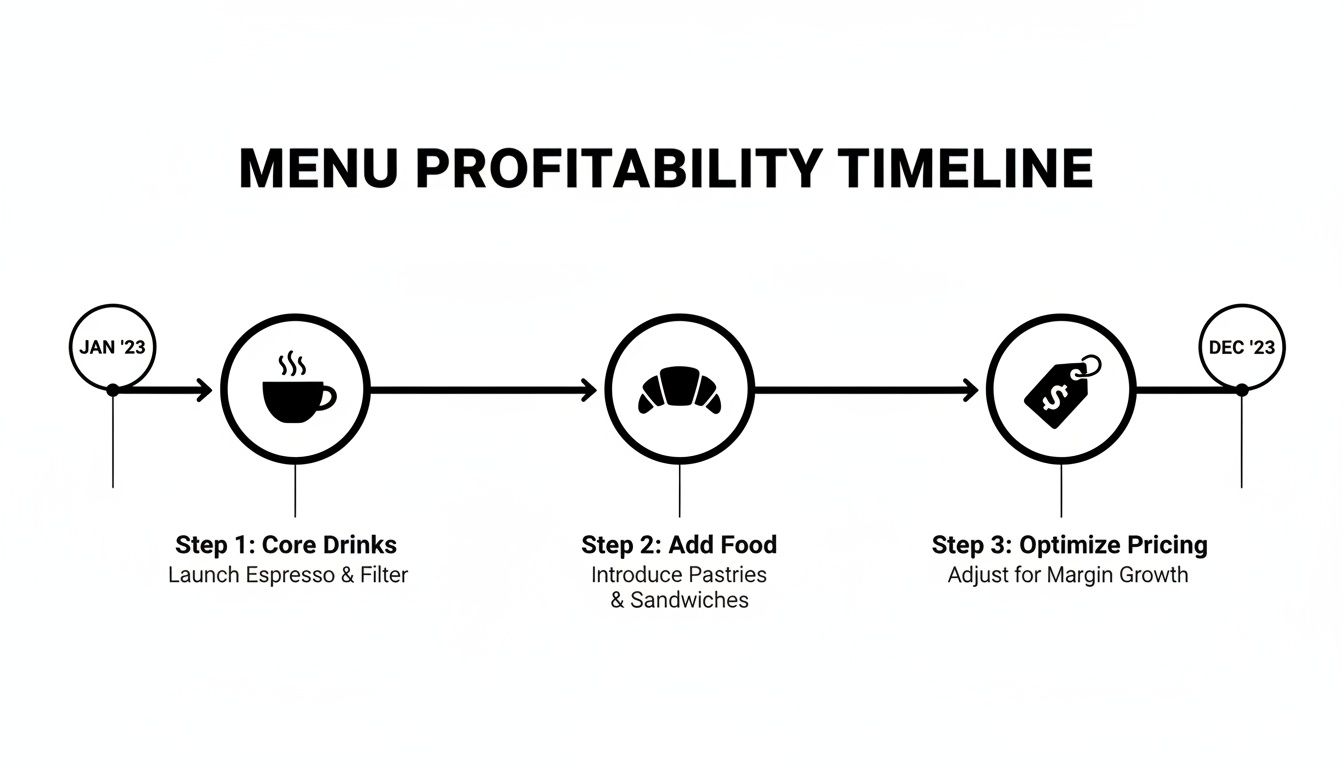
This visual shows the natural progression: start by perfecting your core drinks, then expand with food that makes sense, and finally, optimize your pricing for maximum profitability. A successful launch is the grand finale of all this work, culminating in an opening event that solidifies your shop's place in the local scene.
The Big Questions: Profit, Costs, and Timelines
When you’re dreaming up your perfect coffee shop, a few big, practical questions always come to the surface. It’s completely normal. Let's tackle the most common ones I hear from aspiring shop owners so you can move forward with a clearer picture.
How Much Profit Can a Coffee Shop Actually Make?
This is the million-dollar question, isn't it? The honest answer is that profit margins for a coffee shop usually land somewhere between 10% and 17%.
Of course, this isn't set in stone. I've seen well-run shops in killer locations with a strong local following push those numbers higher. Your final profit really boils down to how well you can manage the big three expenses: your rent, your labor costs, and the cost of everything you sell (your beans, milk, cups, etc.).
What's the Single Biggest Expense When Starting Out?
Get ready for it: your biggest upfront cost will almost certainly be the build-out and equipment. Taking an empty commercial space and turning it into a beautiful, functional cafe that meets all the health codes can run anywhere from $15,000 to over $150,000.
Your commercial espresso machine is a huge piece of that puzzle, often costing between $5,000 and $25,000 all by itself.
A word of advice: Don't try to cut corners by buying a used espresso machine. Any money you save upfront will likely get eaten up by repair bills and—even worse—downtime when you can't pull shots for your customers.
How Long Until My Coffee Shop Is Profitable?
Patience is key here. Most independent coffee shops take anywhere from six months to two years to start turning a profit. The first year is all about building your crew, perfecting your workflow, and winning over your regulars.
How quickly you get into the black depends on your location, how much debt you started with, and how effective your marketing is. This is why having a solid financial plan is non-negotiable—you need enough cash in the bank to float the business until it can stand on its own two feet.
Ready to equip your dream cafe with reliable, top-tier gear without breaking the bank? Explore the extensive selection at The Restaurant Warehouse and discover flexible financing options to get you started. Visit https://therestaurantwarehouse.com to build your perfect coffee shop kitchen today.
Coffee Shop Menu Ideas That Actually Drive Profit
Your menu is your margin. Two shops on the same corner selling the same espresso can have a 20-point difference in profit margin, and it comes down to menu design. Here are the categories that consistently outperform for independent coffee shops.
High-Margin Espresso Drinks
A double shot of espresso costs the shop roughly 30 to 50 cents to produce and sells for $3.50 to $5. Espresso-based drinks (cappuccinos, lattes, cortados, flat whites) sit at 80 to 85 percent gross margin. Push these on the menu and in barista suggestive selling.
Seasonal Signature Drinks
Rotating four to six signature drinks per season creates urgency and repeat visits. Pumpkin spice launched a category worth hundreds of millions of dollars for one chain, but the model works for any shop. Ideas: brown sugar oat lattes, lavender vanilla cortados, maple pecan cold brew, honey cardamom cappuccinos. Charge a $0.75 to $1.25 premium over the base drink.
Cold Brew and Nitro
Cold brew has 3x the shelf life of hot coffee, roughly 40 percent lower brew loss, and sells at a premium. Nitro cold brew on tap adds a wow factor and can command $5 to $7 per glass. Ideal for shops with even modest afternoon traffic.
Food Pairings That Move
Baked goods sell better when they visibly pair with drinks. Almond croissant + latte. Bagel + drip coffee. Avocado toast + cold brew. Package these as combos with a $1 to $2 discount and watch attach rates jump from 20 percent to 45 percent.
Categories to Avoid
- Deep frozen blended drinks: Require expensive blenders, generate constant noise, and drive labor cost up per drink.
- Overly complex sandwich programs: Unless you have a dedicated sandwich station, hot sandwiches slow the line and eat into peak-hour throughput.
- Too many milk alternatives without upcharge: Oat, almond, coconut, soy, macadamia all cost 3 to 5x dairy milk. Charge a $0.75 to $1 premium or your margin collapses.
Coffee Shop Profit Margins: The Real Numbers
The industry average net profit margin for an independent coffee shop is 3 to 8 percent. Top performers reach 15 to 20 percent. Here are the levers that move the number.
Cost Breakdown for a Typical Shop
- Cost of goods sold (COGS): 25 to 35 percent of revenue.
- Labor: 30 to 40 percent of revenue.
- Rent: 8 to 15 percent of revenue (much higher in urban locations).
- Utilities: 3 to 5 percent.
- Other operating costs (POS, insurance, cleaning, marketing): 8 to 12 percent.
- Net profit: 3 to 20 percent depending on execution.
The Four Biggest Profit Levers
- Ticket size: A guest who adds a pastry to a $5 drink turns a $1 margin sale into a $3 margin sale. Attach rates matter more than any other lever.
- Speed of service: A morning rush window is often 90 minutes. Every second saved per transaction adds throughput. A shop that handles 120 customers in that window instead of 90 nets 33 percent more revenue with the same fixed costs.
- Wholesale beans: Owning your bean program (roasting in house or a house-branded blend) pushes COGS from 30 percent to 18 percent on drip coffee.
- Off-peak revenue: Afternoon sandwich programs, evening pastry-and-wine hours, catering, and wholesale coffee bean sales can add 15 to 30 percent to top-line revenue with minimal labor increase.
The Fixed-Cost Trap
Rent, insurance, and equipment loans are fixed. If a shop needs $2,000 per day in revenue just to cover fixed costs and averages $1,800, it loses money even with 65 percent gross margins. Model your rent as no more than 10 percent of your realistic annual revenue projection, and get that projection from actual observed foot traffic, not optimistic forecasts.
Tea, Hot Cocoa, and Beyond: Building a Full Hot Beverage Program
A coffee shop that only sells coffee leaves 20 to 30 percent of potential customers on the table. Non-coffee hot drinkers include kids, tea enthusiasts, pregnant guests, guests avoiding caffeine after mid-afternoon, and the growing wellness-focused crowd. Round out the menu with these.
Commercial Tea Programs
Loose-leaf tea sells for $4 to $6 per cup at a 90 percent gross margin. It requires a tea brewer or an urn setup and 8 to 12 SKUs of quality loose-leaf. Focus on categories: black (English breakfast, Earl Grey, chai), green (jasmine, sencha, matcha), herbal (chamomile, peppermint, rooibos), and one seasonal rotation.
Matcha as a Category
Ceremonial-grade matcha lattes command $5 to $7 per drink and have become a status beverage. Requires a matcha whisk (or an electric frother) and a $200 tin of ceremonial matcha that lasts several weeks. Very high margin, growing category, low equipment overhead.
Hot Cocoa and Steamers
Kids drinks are pure profit. A hot cocoa costs the shop about $0.40 to produce and sells for $3.75 to $4.50. Adding steamers (steamed milk with flavored syrups, no coffee) gives you an easy $3.50 to $4 kids drink option that requires zero new equipment. Vanilla steamer, chocolate steamer, and cinnamon steamer sell year-round.
Chai Latte Programs
Concentrate-based chai is easy to run: shot of concentrate plus steamed milk. Ships shelf-stable, no waste, and sells at $4.50 to $5.75. Adding dirty chai (chai plus espresso shot) gives you a $6 to $7 drink that many guests order daily.
Slushies and Frozen Programs (for Summer)
A single-bowl or three-bowl slush machine can add $500 to $2,000 per week in summer revenue at 75 to 80 percent margins. Best for shops with a summer patio or a strong kid/family demographic. Popular flavors: strawberry lemonade, blue raspberry, mango, coffee slush (blend cold brew with ice and simple syrup).
About The Author

Sean Kearney
Sean Kearney is the Founder of The Restaurant Warehouse, with 15 years of experience in the restaurant equipment industry and more than 30 years in ecommerce, beginning with Amazon.com. As an equipment distributor and supplier, Sean helps restaurant owners make confident purchasing decisions through clear pricing, practical guidance, and a more transparent online buying experience.
Connect with Sean on LinkedIn, Instagram, YouTube, or Facebook.